
EECE 460 Final, Fall 2003
American University of Beirut · Control Systems · 2 pages
More EECE 460 files
- Exam 1 Questions + Solution · Fall 2015Problems · with solutionView
- Exam 2 Questions + Solution · Fall 2015Problems · with solutionView
- Homework · Spring 2008HomeworkView
- Homework · Spring 2008HomeworkView
- Homework · Spring 2008HomeworkView
- Homework · Spring 2008HomeworkView
- Homework · Spring 2008HomeworkView
- Homework · Spring 2008HomeworkView
Show the text of this final exam
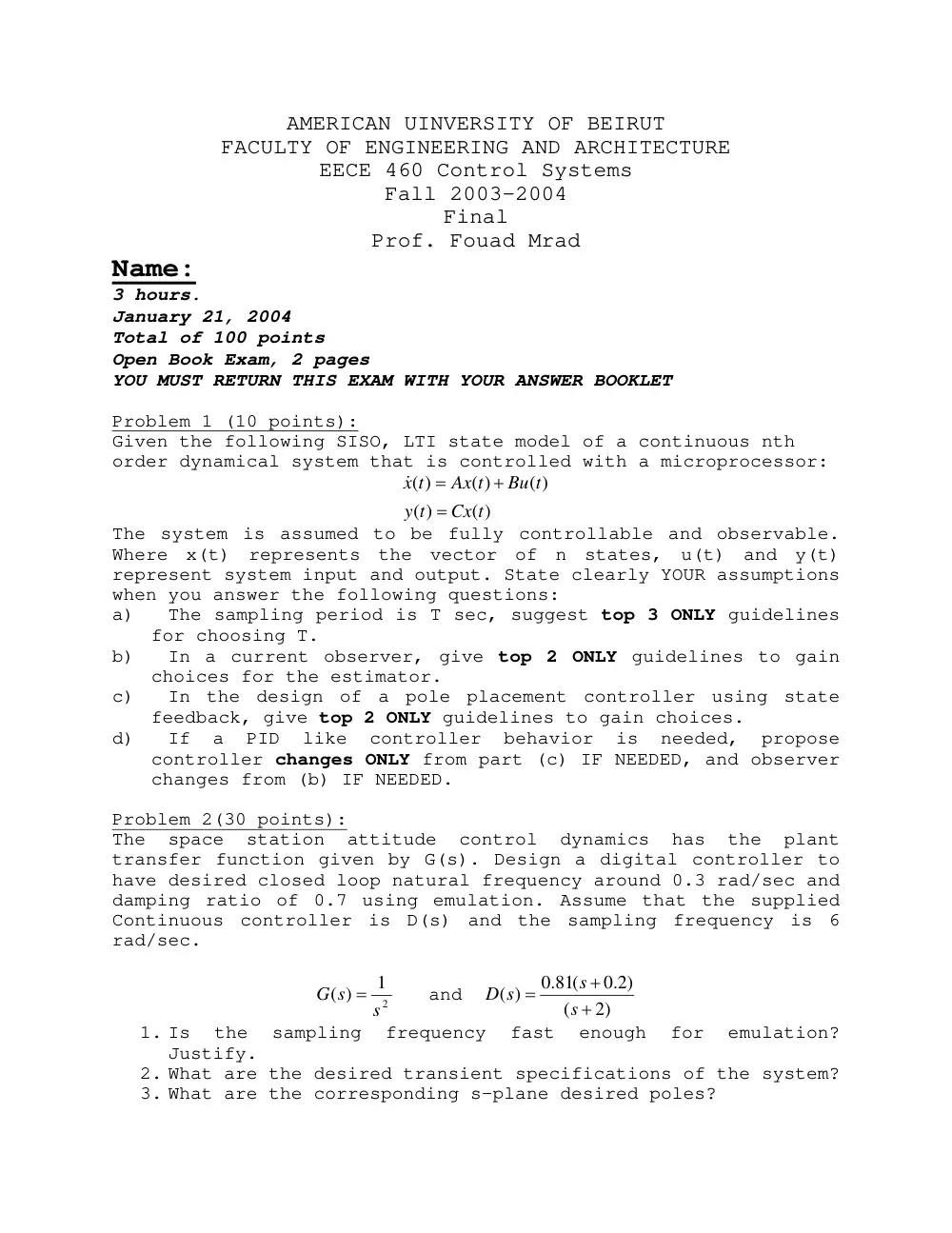
AMERICAN UINVERSITY OF BEIRUT
FACULTY OF ENGINEERING AND ARCHITECTURE
EECE 460 Control Systems
Fall 2003-2004
Final
Prof. Fouad Mrad
Name:
3 hours.
January 21, 2004
Total of 100 points
Open Book Exam, 2 pages
YOU MUST RETURN THIS EXAM WITH YOUR ANSWER BOOKLET
Problem 1 (10 points):
Given the following SISO, LTI state model of a continuous nth
order dynamical system that is controlled with a microprocessor:
( )
)
(
( )
( )
)
(
Cx t
t
y
Bu t
Ax t
t
x
=
+
=
&
The system is assumed to be fully controllable and observable.
Where x(t) represents the vector of n states, u(t) and y(t)
represent system input and output. State clearly YOUR assumptions
when you answer the following questions:
a)
The sampling period is T sec, suggest top 3 ONLY guidelines
for choosing T.
b)
In a current observer, give top 2 ONLY guidelines to gain
choices for the estimator.
c)
In the design of a pole placement controller using state
feedback, give top 2 ONLY guidelines to gain choices.
d)
If a PID like controller behavior is needed, propose
controller changes ONLY from part (c) IF NEEDED, and observer
changes from (b) IF NEEDED.
Problem 2(30 points):
The space station attitude control dynamics has the plant
transfer function given by G(s). Design a digital controller to
have desired closed loop natural frequency around 0.3 rad/sec and
damping ratio of 0.7 using emulation. Assume that the supplied
Continuous controller is D(s) and the sampling frequency is 6
rad/sec.
2
1
( )
s
G s
=
and
2)
(
2.0 )
.0 81(
( )
+
+
=
s
s
D s
1. Is the sampling frequency fast enough for emulation?
Justify.
2. What are the desired transient specifications of the system?
3. What are the corresponding s-plane desired poles?
2
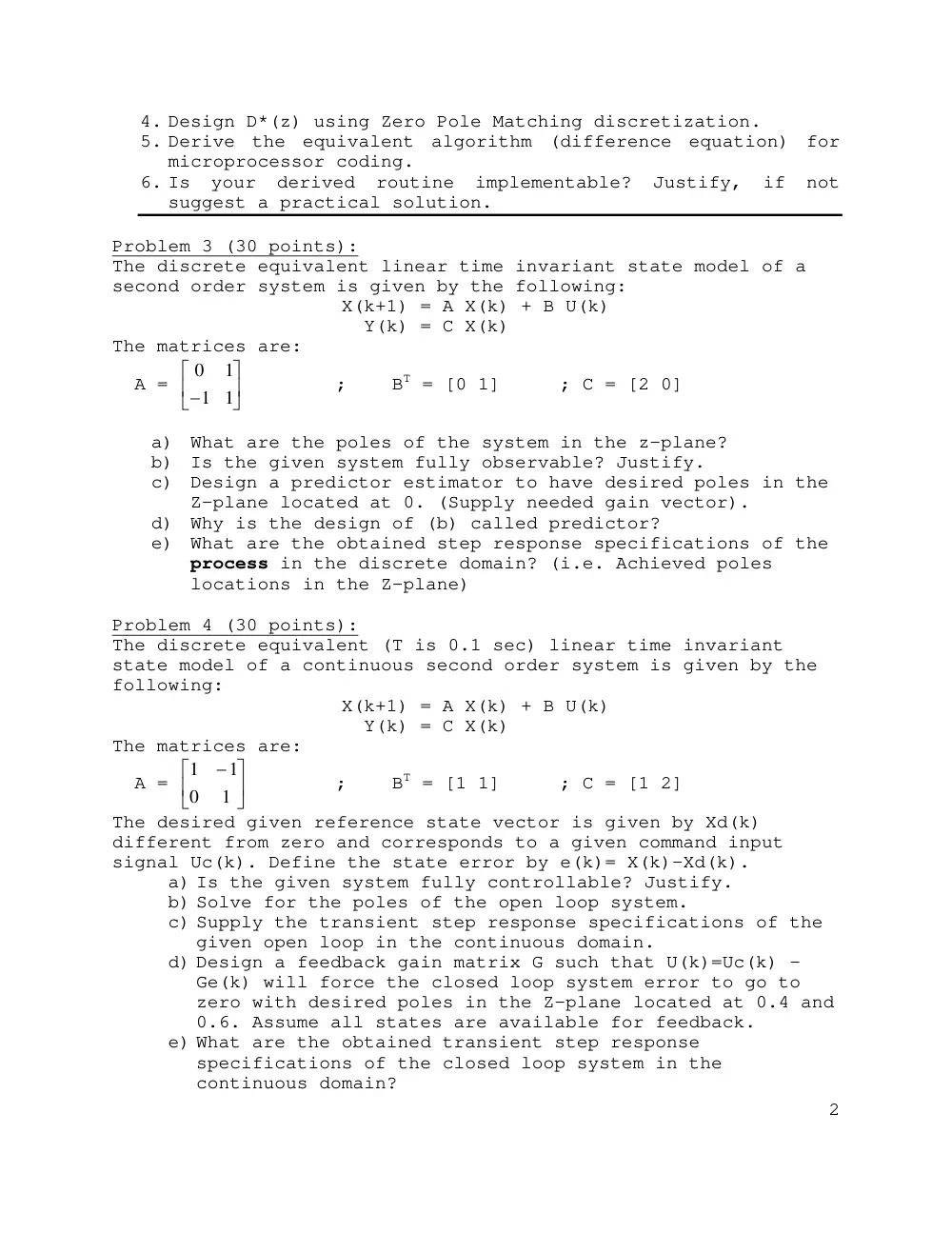
4. Design D*(z) using Zero Pole Matching discretization.
5. Derive the equivalent algorithm (difference equation) for
microprocessor coding.
6. Is your derived routine implementable? Justify, if not
suggest a practical solution.
Problem 3 (30 points):
The discrete equivalent linear time invariant state model of a
second order system is given by the following:
X(k+1) = A X(k) + B U(k)
Y(k) = C X(k)
The matrices are:
A =
⎥⎦
⎤
⎢⎣
⎡
−
1 1
1
0
;
BT = [0 1]
; C = [2 0]
a) What are the poles of the system in the z-plane?
b) Is the given system fully observable? Justify.
c) Design a predictor estimator to have desired poles in the
Z-plane located at 0. (Supply needed gain vector).
d) Why is the design of (b) called predictor?
e) What are the obtained step response specifications of the
process in the discrete domain? (i.e. Achieved poles
locations in the Z-plane)
Problem 4 (30 points):
The discrete equivalent (T is 0.1 sec) linear time invariant
state model of a continuous second order system is given by the
following:
X(k+1) = A X(k) + B U(k)
Y(k) = C X(k)
The matrices are:
A =
⎥⎦
⎤
⎢⎣
⎡
−
1
0
1
1
;
BT = [1 1]
; C = [1 2]
The desired given reference state vector is given by Xd(k)
different from zero and corresponds to a given command input
signal Uc(k). Define the state error by e(k)= X(k)-Xd(k).
a) Is the given system fully controllable? Justify.
b) Solve for the poles of the open loop system.
c) Supply the transient step response specifications of the
given open loop in the continuous domain.
d) Design a feedback gain matrix G such that U(k)=Uc(k) -
Ge(k) will force the closed loop system error to go to
zero with desired poles in the Z-plane located at 0.4 and
0.6. Assume all states are available for feedback.
e) What are the obtained transient step response
specifications of the closed loop system in the
continuous domain?