
ENG 102 Final, Fall 2000
American University of Beirut · Enrichment Course in English · 7 pages


More ENG 102 files
Show the text of this final exam
English 102
Final Examination
Fall 2000-2001
Reading Comprehension
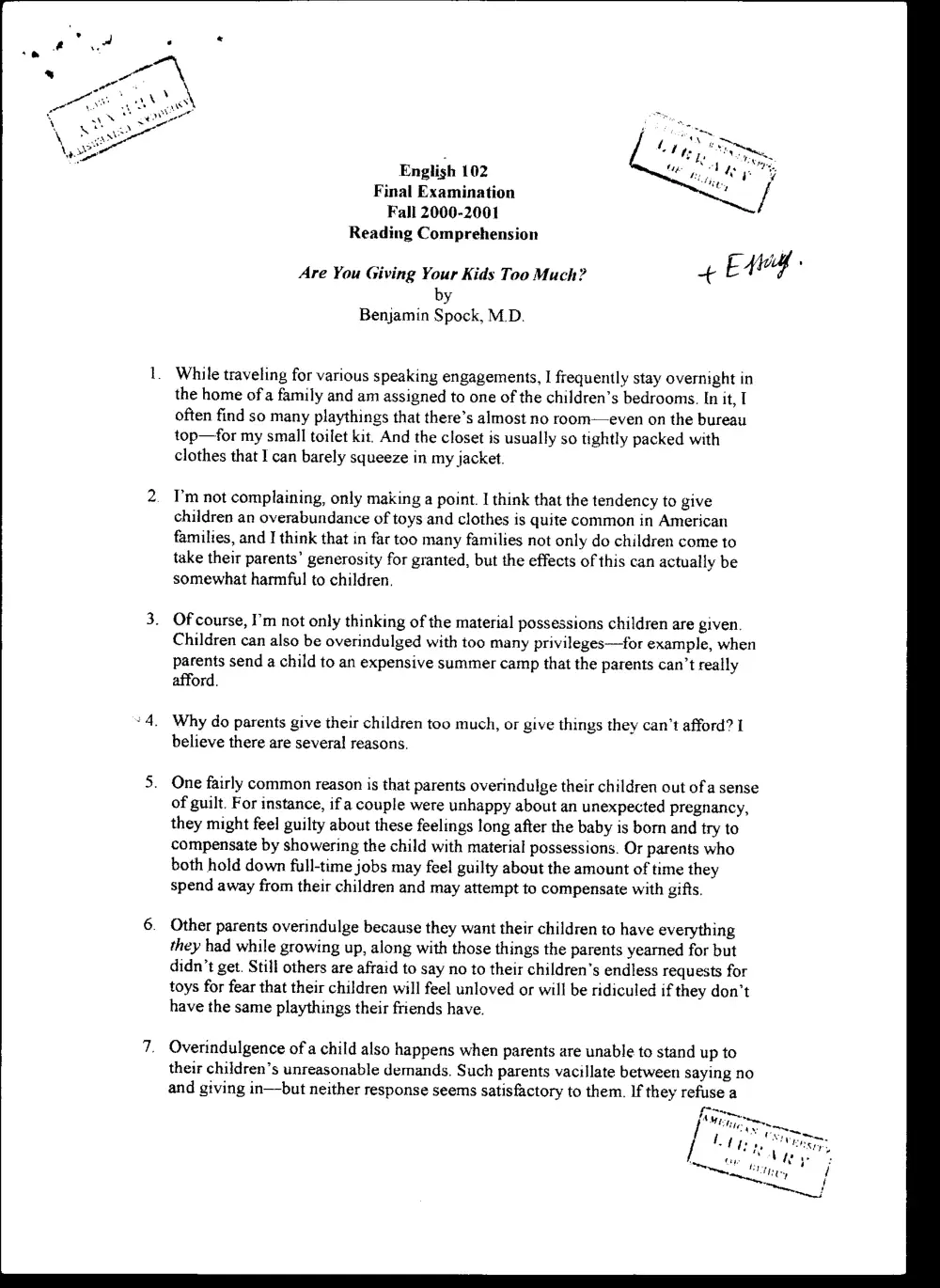
Are You Giving Your Kids Too Much?
by
Benjamin Spock, M.D.
While traveling for various speaking engagements, I frequently stay overnight in
the home of a family and am assigned to one of the children’s bedrooms. In it, T
often find so many playthings that there’s almost no room—even on the bureau
top—for my small toilet kit. And the closet is usually so tightly packed with
clothes that I can barely squeeze in my jacket.
Tm not complaining, only making a point. I think that the tendency to give
children an overabundance of toys and clothes is quite common in American
families, and J think that in far too many families not only do children come to
take their parents’ generosity for granted, but the effects of this can actually be
somewhat harmful to children.
Of course, I’m not only thinking of the material possessions children are given.
Children can also be overindulged with too many privileges—for example, when
parents send a child to an expensive summer camp that the parents can’t really
afford.
Why do parents give their children too much, or give things they can’t afford? 1
believe there are several reasons.
One fairly common reason is that parents overindulge their children out ofa sense
of guilt. For instance, if a couple were unhappy about an unexpected pregnancy,
they might feel guilty about these feelings long after the baby is born and try to
compensate by showering the child with material possessions. Or parents who
both hold down full-time jobs may feel guilty about the amount of time they
spend away from their children and may attempt to compensate with gifts.
Other parents overindulge because they want their children to have everything
they had while growing up, along with those things the parents yearned for but
didn’t get. Still others are afraid to say no to their children’s endless requests for
toys for fear that their children will feel unloved or will be ridiculed if they don’t
have the same playthings their friends have.
Overindulgence of a child also happens when parents are unable to stand up to
their children’s unreasonable demands. Such parents vacillate between saying no
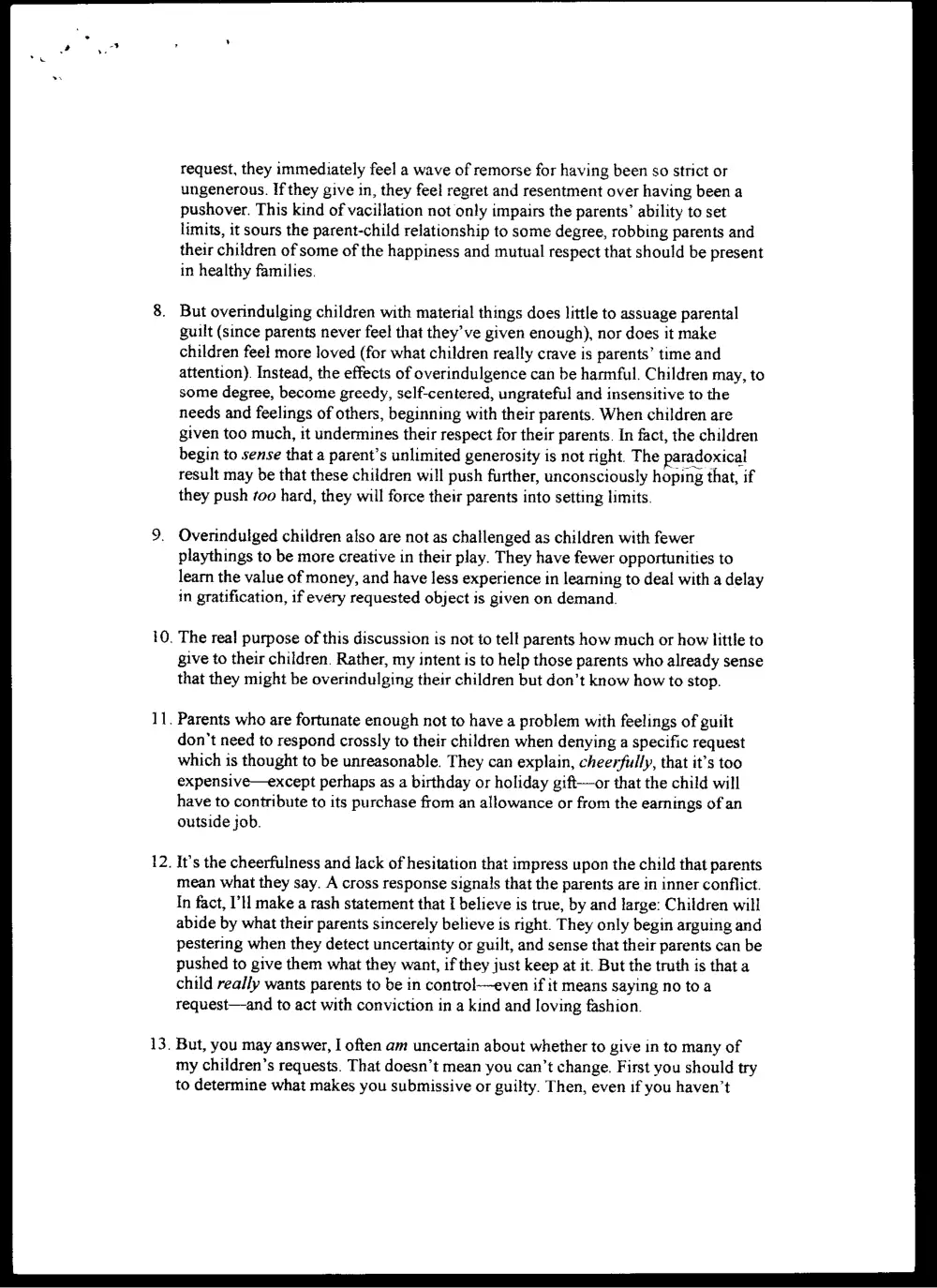
and giving in—but neither response seems satisfactory to them. If they refuse a
request, they immediately feel a wave of remorse for having been so strict or
ungenerous. If they give in, they feel regret and resentment over having been a
pushover. This kind of vacillation not only impairs the parents’ ability to set
limits, it sours the parent-child relationship to some degree, robbing parents and
their children of some of the happiness and mutual respect that should be present
in healthy families.
But overindulging children with material things does little to assuage parental
guilt (since parents never feel that they’ ve given enough), nor does it make
children feel more loved (for what children really crave is parents’ time and
attention). Instead, the effects of overindulgence can be harmful. Children may, to
some degree, become greedy, self-centered, ungrateful and insensitive to the
needs and feelings of others, beginning with their parents. When children are
given too much, it undermines their respect for their parents. In fact, the children
begin to sense that a parent’s unlimited generosity is not right. The paradoxical
result may be that these children will push further, unconsciously hoping that, if
they push zoo hard, they will force their parents into setting limits.
Overindulged children also are not as challenged as children with fewer
playthings to be more creative in their play. They have fewer opportunities to
learn the value of money, and have less experience in leaming to deal with a delay
in gratification, if every requested object is given on demand.
. The real purpose of this discussion is not to tell parents how much or how little to
give to their children. Rather, my intent is to help those parents who already sense
that they might be overindulging their children but don’t know how to stop.
. Parents who are fortunate enough not to have a problem with feelings of guilt
don’t need to respond crossly to their children when denying a specific request
which is thought to be unreasonable. They can explain, cheerfully, that it’s too
expensive—except perhaps as a birthday or holiday gift—or that the child will
have to contribute to its purchase from an allowance or from the earnings of an
outside job.
. It's the cheerfulness and lack of hesitation that impress upon the child that parents
mean what they say. A cross response signals that the parents are in inner conflict.
In fact, I'l make a rash statement that I believe is true, by and large: Children will
abide by what their parents sincerely believe is right. They only begin arguing and
pestering when they detect uncertainty or guilt, and sense that their parents can be
pushed to give them what they want, if they just keep at it. But the truth is that a
child really wants parents to be in control—even if it means saying no toa
request—and to act with conviction in a kind and loving fashion.
. But, you may answer, I often am uncertain about whether to give in to many of
my children’s requests. That doesn’t mean you can’t change. First you should try
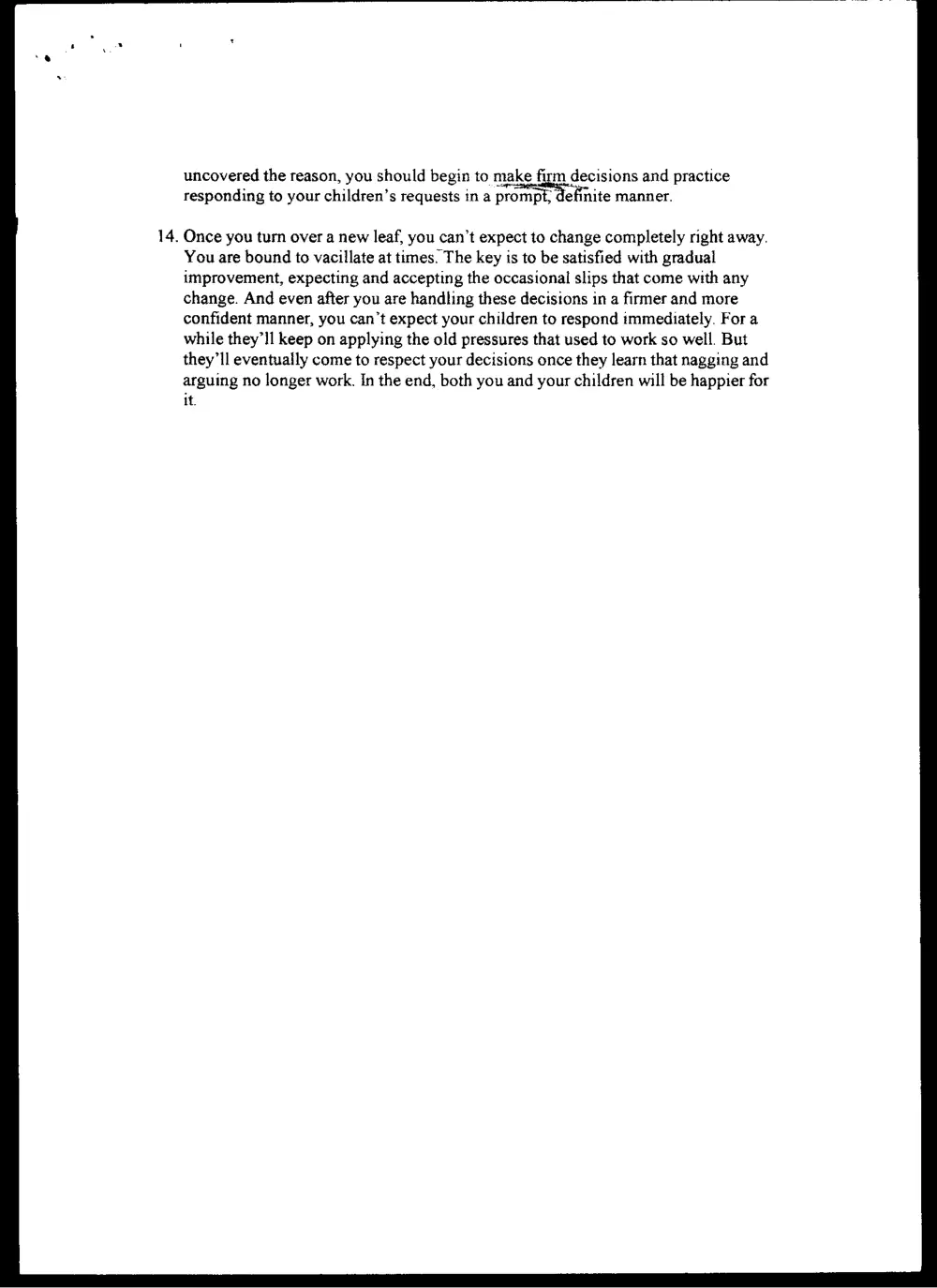
to determine what makes you submissive or guilty. Then, even if you haven’t
uncovered the reason, you should begin to make firm decisions and practice
responding to your children’s requests in a prompt, definite manner.
. Once you turn over a new leaf, you can’t expect to change completely right away.
You are bound to vacillate at times. The key is to be satisfied with gradual
improvement, expecting and accepting the occasional slips that come with any
change. And even after you are handling these decisions in a firmer and more
confident manner, you can’t expect your children to respond immediately. For a
while they’!l keep on applying the old pressures that used to work so well. But
they'll eventually come to respect your decisions once they learn that nagging and
arguing no longer work. In the end, both you and your children will be happier for
it.
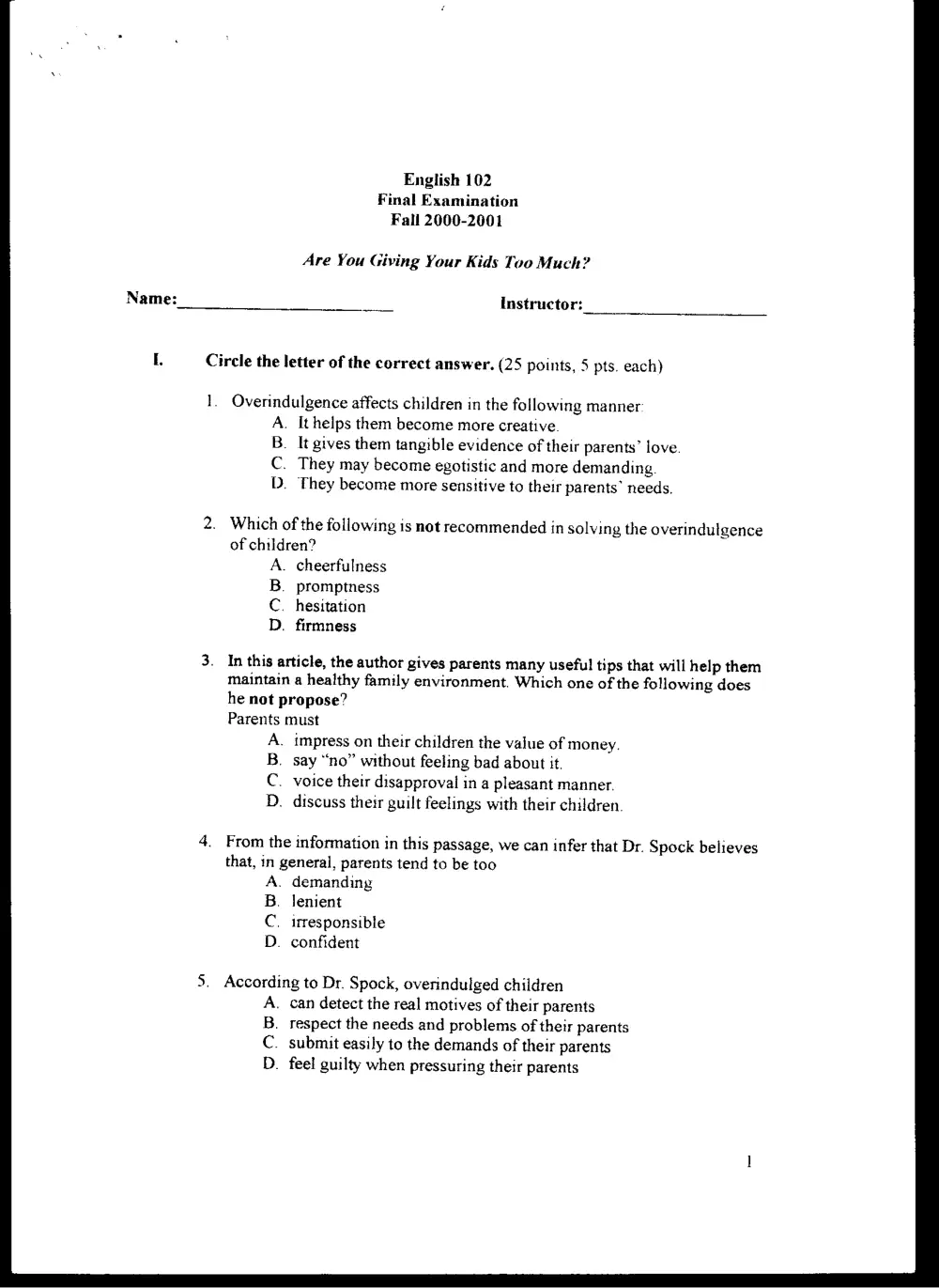
English 102
Final Examination
Fall 2000-2001
Are You Giving Your Kids Too Much?
Name: Instructor:
L Circle the letter of the correct answer, (25 points, 5 pts. each)
1. Overindulgence affects children in the following manner:
A. Ithelps them become more creative.
B. It gives them tangible evidence of their parents’ love.
C. They may become egotistic and more demanding.
D. They become more sensitive to their parents’ needs,
2. Which of the following is not recommended in solving the overindulgence
of children?
A. cheerfulness
B. promptness
C. hesitation
D. firmness
3. In this article, the author gives parents many useful tips that will help them
maintain a healthy family environment. Which one of the following does
he not propose?
Parents must
A. impress on their children the value of money.
B. say “no” without feeling bad about it.
C. voice their disapproval in a pleasant manner.
D. discuss their guilt feelings with their children
4. From the information in this passage, we can infer that Dr. Spock believes
that, in general, parents tend to be too
A. demanding
B. lenient
C. irresponsible
D. confident
5. According to Dr. Spock, overindulged children
A. can detect the real motives of their parents
B. respect the needs and problems of their parents
C. submit easily to the demands of their parents
D. feel guilty when pressuring their parents
Answer the following questions in the blank spaces provided. (58 points)
1. a) Name two causes for overindulgence (4 pts)
i,
b) Name two effects of overindulgence (4 pts)
i.
il.
Despite their endless demands on parents, what children really want from
their parents is
(6 pts)
. Dr. Spock presents a problem and suggests a solution. Which paragraph
links the two main sections?
_ . (5 pts.)
Who is the expected audience of this article?
(3 pts.)
Give concrete evidence from the text.
__.G pts.)
What does Dr. Spock propose as a solution for overindulgence? (6 pts.)
What advantages, according to Dr. Spock, do unspoiled children have over
the overindulged children? (6 pts.)
In your own words, explain the last sentence of paragraph 8. (6 pts.)
Write a suitable thesis statement for the passage that sums up the author’s
main ideas. (7 pts.)
Paraphrase the last sentence of paragraph 7. (8 pts.)
IT, Words and Expressions (17 points)
1. a) Find a word in paragraph 5 similar in meaning to “make up for”
_(3 pts)
b) Find a word in paragraph 7 similar in meaning to “regret”
- _ G pts)
2. Explain what the author means by the following
a) “delay in gratification” (parag.9)
(4 pts.)
b) “the old pressures” (parag. 14)
_ (4 pts.)
3. Circle the correct answer (3 pts.)
yeamed for (parag.6) means
a. worked for
b. pushed for
c. paid for
d. longed for
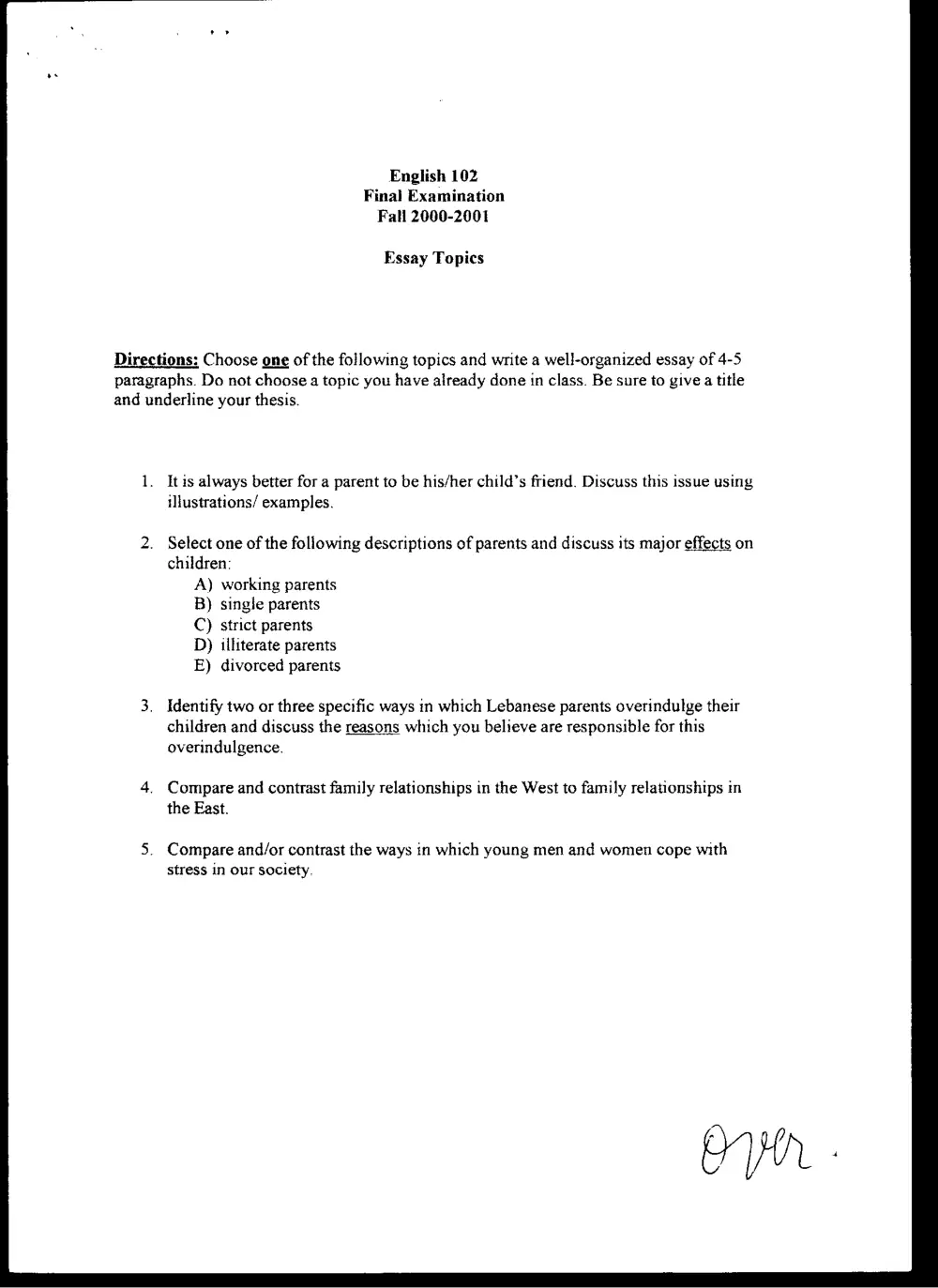
English 102
Final Examination
Fall 2000-2001
Essay Topics
Directions: Choose one of the following topics and write a well-organized essay of 4-5
paragraphs. Do not choose a topic you have already done in class. Be sure to give a title
and underline your thesis.
1. Itis always better for a parent to be his/her child’s friend. Discuss this issue using
illustrations/ examples.
2. Select one of the foliowing descriptions of parents and discuss its major effects on
children:
A) working parents
B) single parents
C) strict parents
D) illiterate parents
E) divorced parents
3. Identify two or three specific ways in which Lebanese parents overindulge their
children and discuss the reasons which you believe are responsible for this
overindulgence.
4. Compare and contrast family relationships in the West to family relationships in
the East.
5. Compare and/or contrast the ways in which young men and women cope with
stress in our society.