
ENG 102 Final, Fall 2002
American University of Beirut · Enrichment Course in English · 8 pages


More ENG 102 files
Show the text of this final exam
Pree
(AMEBIE (5, ONTVERS!
LIBRaRy
OF BRET
_—
AMERICAN UNIVERSITY OF BEIRUT
UNIVERSITY PREPARATORY PROGRAM
FINAL EXAMINATION
FALL 2002-2003 U
READING ~ W re Aervd:
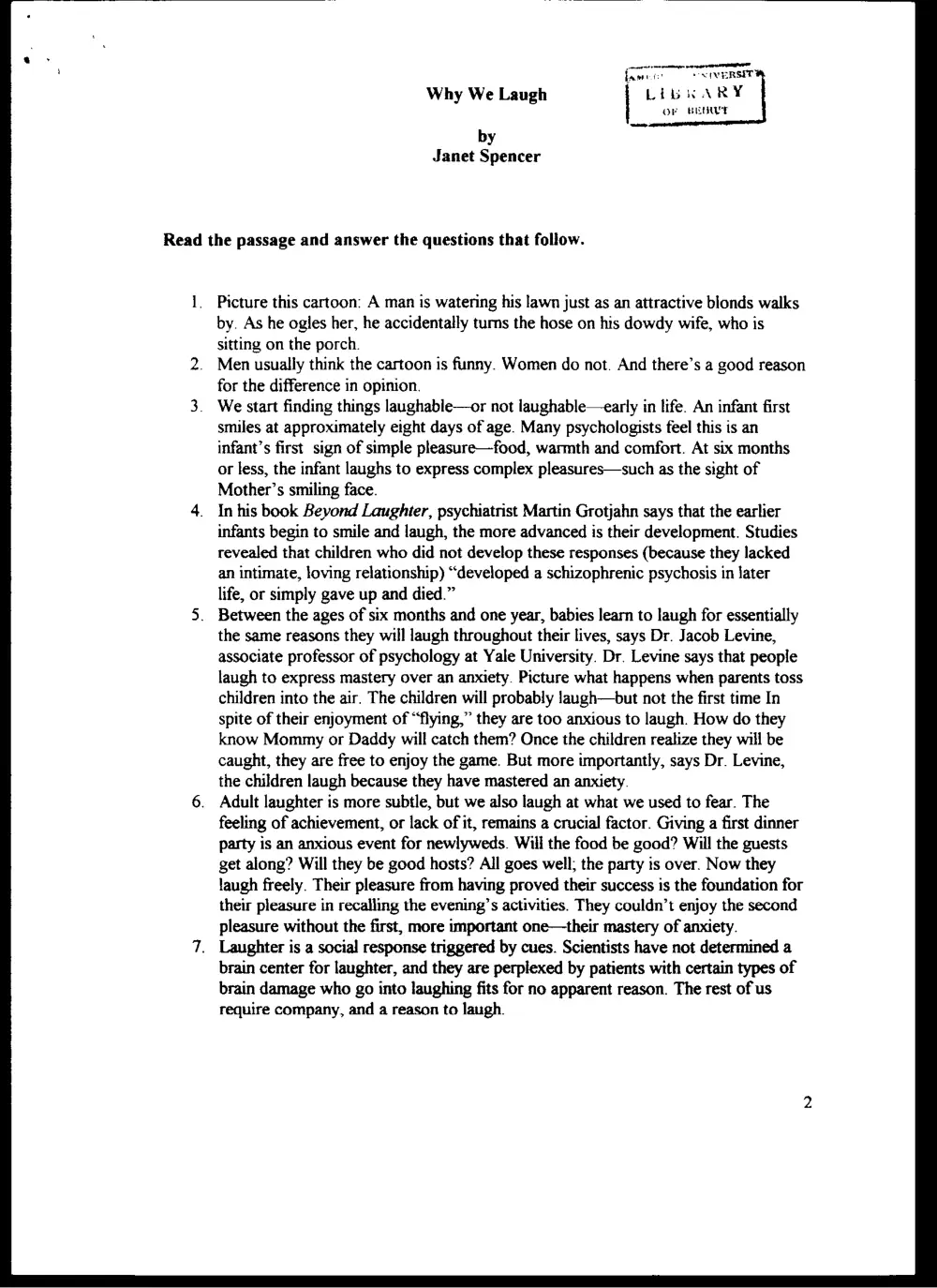
Why We Laugh
by
Janet Spencer
Read the passage and answer the questions that follow.
1. Picture this cartoon: A man is watering his lawn just as an attractive blonds walks
by. As he ogles her, he accidentally turns the hose on his dowdy wife, who is
sitting on the porch.
2. Men usually think the cartoon is funny. Women do not. And there’s a good reason
for the difference in opinion.
3. We start finding things laughable—or not laughable—early in life. An infant first
smiles at approximately eight days of age. Many psychologists feel this is an
infant’s first sign of simple pleasure—food, warmth and comfort. At six months
or less, the infant laughs to express complex pleasures—such as the sight of
Mother’s smiling face.
4. In his book Beyond Laughter, psychiatrist Martin Grotjahn says that the earlier
infants begin to smile and laugh, the more advanced is their development. Studies
revealed that children who did not develop these responses (because they lacked
an intimate, loving relationship) “developed a schizophrenic psychosis in later
life, or simply gave up and died.”
5. Between the ages of six months and one year, babies learn to laugh for essentially
the same reasons they will laugh throughout their lives, says Dr. Jacob Levine,
associate professor of psychology at Yale University. Dr. Levine says that people
laugh to express mastery over an anxiety. Picture what happens when parents toss
children into the air. The children will probably laugh—but not the first time In
spite of their enjoyment of “flying,” they are too anxious to laugh. How do they
know Mommy or Daddy wiil catch them? Once the children realize they will be
caught, they are free to enjoy the game. But more importantly, says Dr. Levine,
the children laugh because they have mastered an anxiety.
6. Adult laughter is more subtle, but we also laugh at what we used to fear. The
feeling of achievement, or lack of it, remains a crucial factor. Giving a first dinner
party is an anxious event for newlyweds. Will the food be good? Will the guests
get along? Will they be good hosts? All goes well; the party is over. Now they
laugh freely. Their pleasure from having proved their success is the foundation for
their pleasure in recalling the evening’s activities. They couldn’t enjoy the second
pleasure without the first, more important one—their mastery of anxiety.
7. Laughter is a social response triggered by cues. Scientists have not determined a
brain center for laughter, and they are perplexed by patients with certain types of
brain damage who go into laughing fits for no apparent reason. The rest of us
require company, and a reason to laugh.
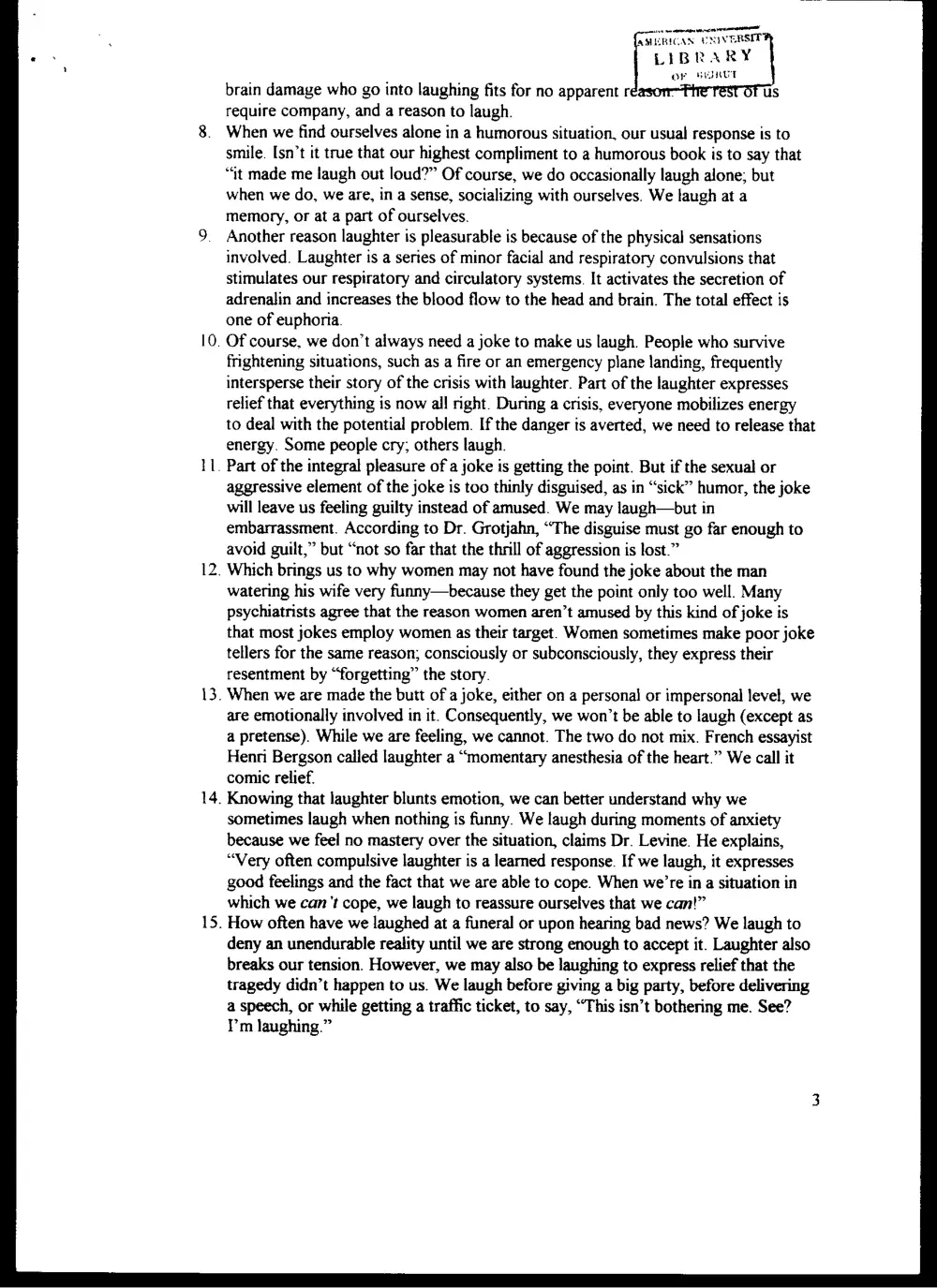
OF BRUT
brain damage who go into laughing fits for no apparent ri
require company, and a reason to laugh.
When we find ourselves alone in a humorous situation, our usual response is to
smile. [sn’t it true that our highest compliment to a humorous book is to say that
“it made me laugh out loud?” Of course, we do occasionally laugh alone; but
when we do, we are, in a sense, socializing with ourselves. We laugh at a
memory, or at a part of ourselves.
Another reason laughter is pleasurable is because of the physical sensations
involved. Laughter is a series of minor facial and respiratory convulsions that
stimulates our respiratory and circulatory systems. It activates the secretion of
adrenalin and increases the blood flow to the head and brain. The total effect is
one of euphoria.
. Of course, we don’t always need a joke to make us laugh. People who survive
frightening situations, such as a fire or an emergency plane landing, frequently
intersperse their story of the crisis with laughter. Part of the laughter expresses
relief that everything is now all right. During a crisis, everyone mobilizes energy
to deal with the potential problem. If the danger is averted, we need to release that
energy. Some people cry; others laugh.
. Part of the integral pleasure of a joke is getting the point. But if the sexual or
aggressive element of the joke is too thinly disguised, as in “sick” humor, the joke
will leave us feeling guilty instead of amused. We may laugh—but in
embarrassment. According to Dr. Grotjahn, “The disguise must go far enough to
avoid guilt,” but “not so far that the thrill of aggression is lost.”
. Which brings us to why women may not have found the joke about the man
watering his wife very funny—because they get the point only too well. Many
psychiatrists agree that the reason women aren’t amused by this kind of joke is
that most jokes employ women as their target. Women sometimes make poor joke
tellers for the same reason, consciously or subconsciously, they express their
resentment by “forgetting” the story.
. When we are made the butt of a joke, either on a personal or impersonal level, we
are emotionally involved in it. Consequently, we won’t be able to laugh (except as
a pretense). While we are feeling, we cannot. The two do not mix. French essayist
Henri Bergson called laughter a “momentary anesthesia of the heart.” We call it
comic relief.
. Knowing that laughter blunts emotion, we can better understand why we
sometimes laugh when nothing is funny. We laugh during moments of anxiety
because we feel no mastery over the situation, claims Dr. Levine. He explains,
“Very often compulsive laughter is a learned response. If we laugh, it expresses
good feelings and the fact that we are able to cope. When we’re in a situation in
which we can't cope, we laugh to reassure ourselves that we can!”
. How often have we laughed at a funeral or upon hearing bad news? We laugh to
deny an unendurable reality until we are strong enough to accept it. Laughter also
breaks our tension. However, we may also be laughing to express relief that the
tragedy didn’t happen to us. We laugh before giving a big party, before delivering
a speech, or while getting a traffic ticket, to say, “This isn’t bothering me. See?
I'm laughing.”
Conti ce .
AMERICAN ONTIVERSIT
LIBRARY
OF hmoRUT
16. But if we sometimes laugh in sorrow, more often we laugh with joy. Laughter
creates and strengthens our social bonds. And the ability to share a laugh has
guided many marriages through hard periods of adjustment.
17. According to Dr. Levine, we can measure our adjustment to the world by our
capacity to laugh. When we are secure about our abilities, we can poke fun at our
foibles. If we can laugh through our anxieties, we will not be overpowered by
them.
18. The ability to laugh starts early, but it takes a lifetime to perfect. Says Dr.
Grotjahn, “When social relationships are mastered, when individuals have
mastered... a peaceful relationship with themselves, then they have... the sense of
humor.” And then they can throw back their heads and laugh.
(Taken from Baudoin et als Reader’s Choice)
re :
put ‘\ UNIVERS
LIBRARY
OF huaRUT
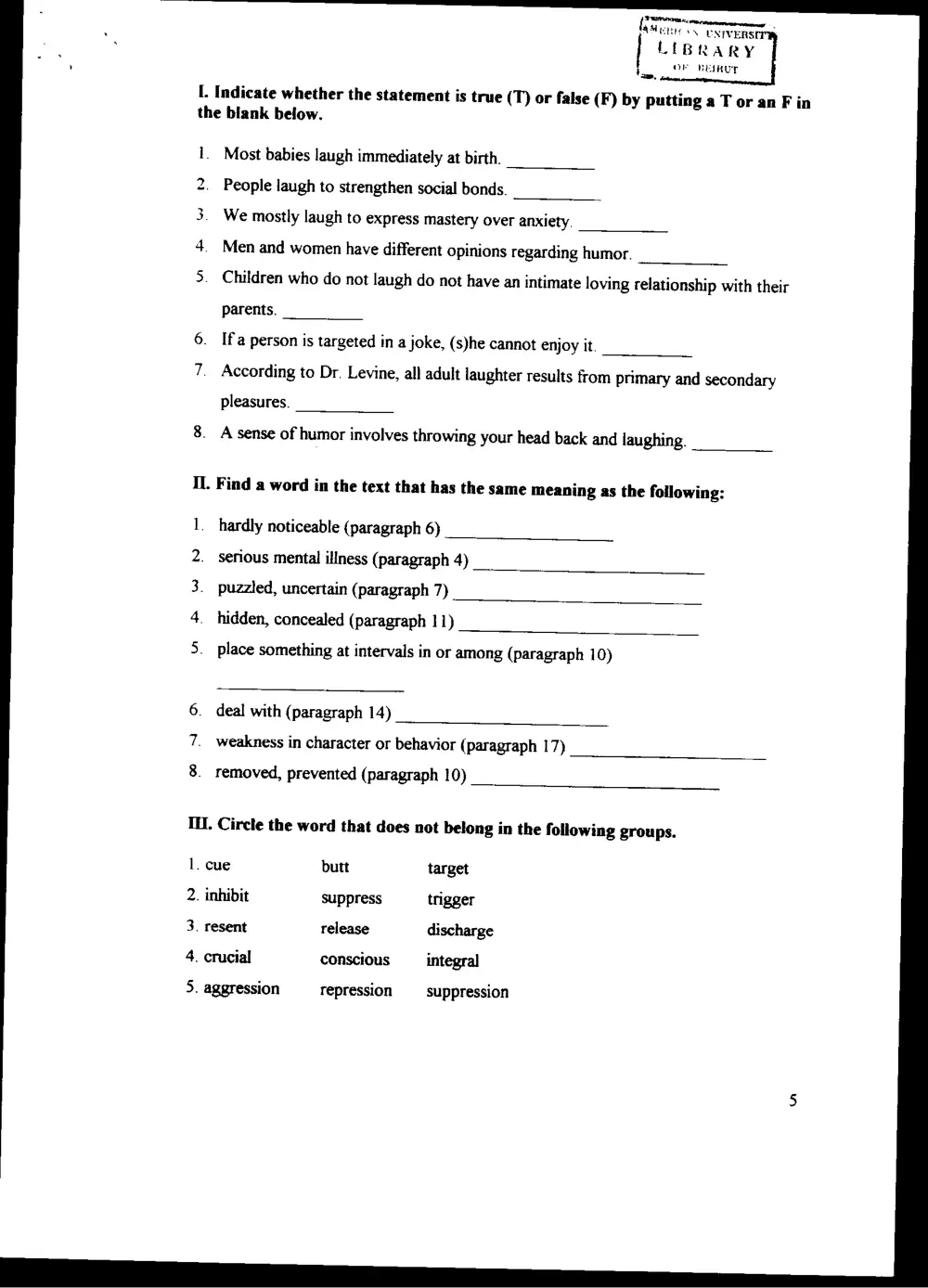
L. Indicate whether the statement is true (T) or false (F) by putting a T or an F in
the blank below.
1.
2.
we
ww +
a
Most babies laugh immediately at birth.
People laugh to strengthen social bonds.
We mostly laugh to express mastery over anxiety.
Men and women have different opinions regarding humor.
Children who do not laugh do not have an intimate loving relationship with their
parents.
Ifa person is targeted in a joke, (s)he cannot enjoy it.
According to Dr. Levine, all adult laughter results from primary and secondary
pleasures.
A sense of humor involves throwing your head back and laughing.
II. Find a word in the text that has the same meaning as the following:
1.
2. serious mental illness (paragraph 4)
3.
4. hidden, concealed (paragraph 11)
5
hardly noticeable (paragraph 6)
puzzled, uncertain (paragraph 7)
. place something at intervals in or among (paragraph 10)
deal with (paragraph 14)
weakness in character or behavior (paragraph 17)
removed, prevented (paragraph 10)
IH. Circle the word that does not belong in the following groups.
1. cue butt target
2. inhibit suppress trigger
3. resent release discharge
4. crucial conscious integral
5. aggression repression suppression
eects
: \ CNIVERS IT
f tieeary
. OF RETRUT
t
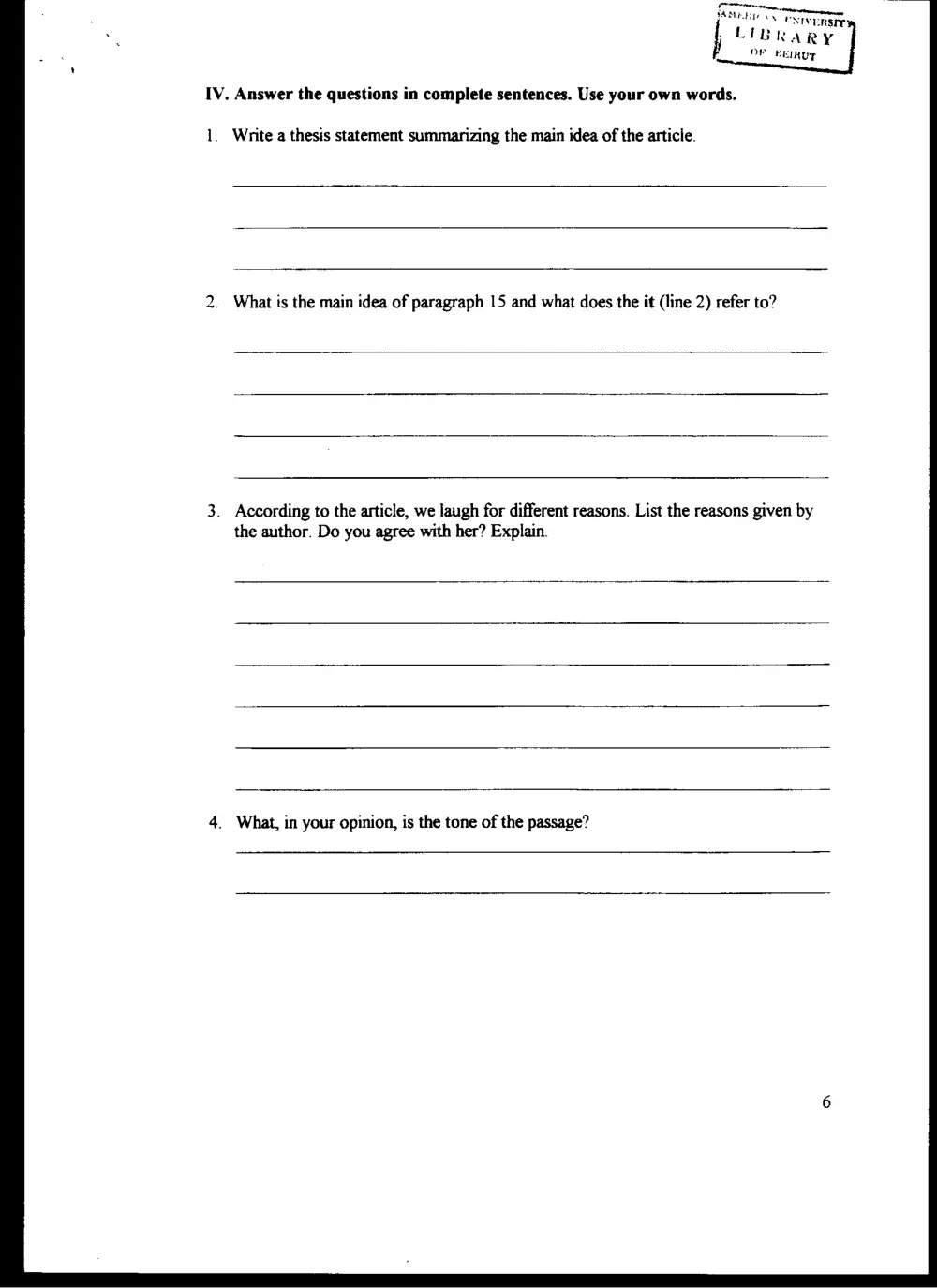
IV. Answer the questions in complete sentences. Use your own words.
1, Write a thesis statement summarizing the main idea of the article.
2. What is the main idea of paragraph 15 and what does the it (line 2) refer to?
3. According to the article, we laugh for different reasons. List the reasons given by
the author. Do you agree with her? Explain.
4. What, in your opinion, is the tone of the passage?
AMERICAN UNIVERSITY OF BEIRUT
UNIVERSITY PREPARATORY PROGRAM
FINAL EXAMINATION
FALL 2002-2003 (4 )
WRITING
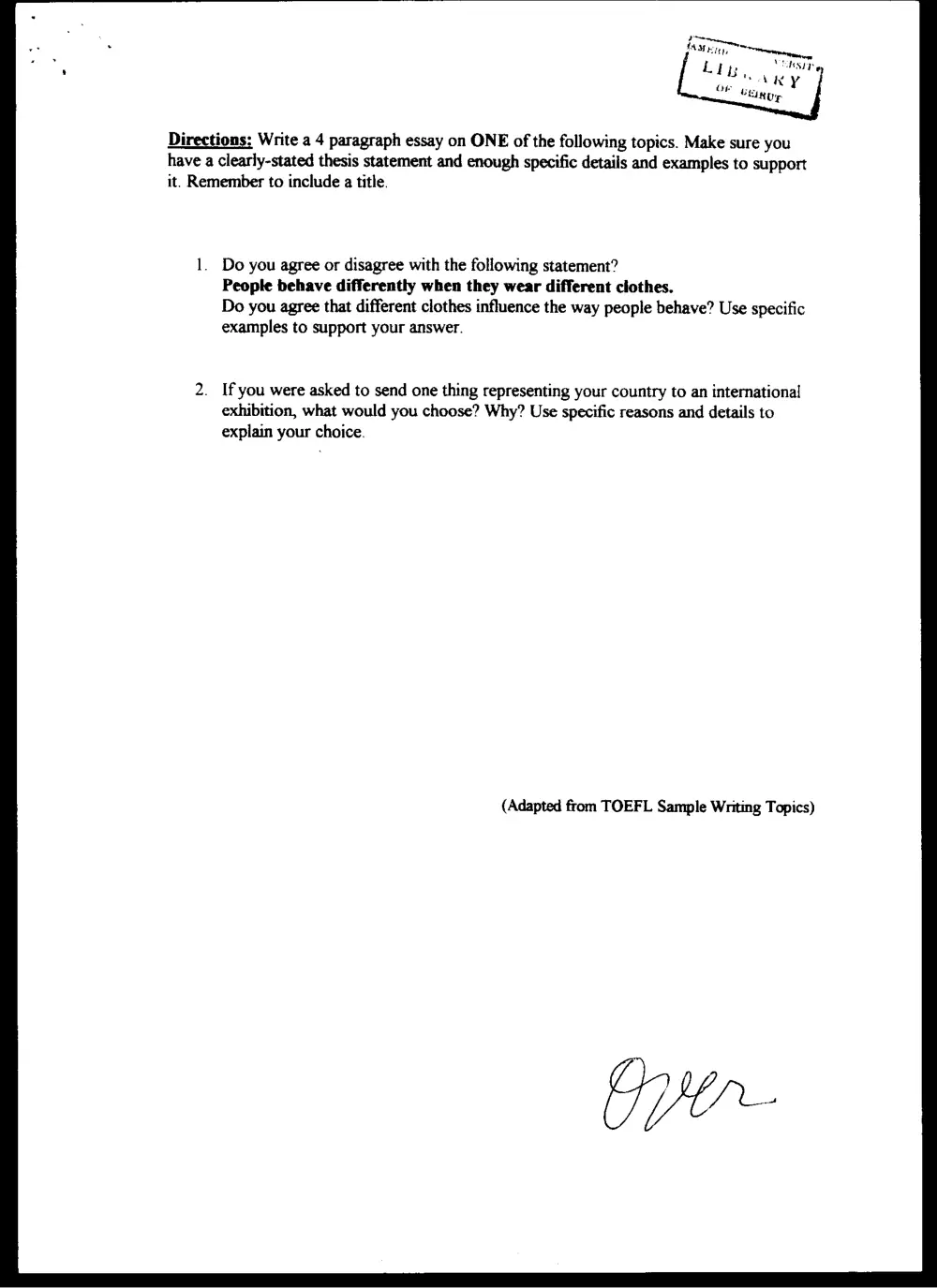
Directions: Write a 4 paragraph essay on ONE of the following topics. Make sure you
have a clearly-stated thesis statement and enough specific details and examples to support
it. Remember to include a title.
1. Do you agree or disagree with the following statement?
People behave differently when they wear different ciothes.
Do you agree that different clothes influence the way people behave? Use specific
examples to support your answer.
. Ifyou were asked to send one thing representing your country to an international
exhibition, what would you choose? Why? Use specific reasons and details to
explain your choice.
(Adapted from TOEFL Sample Wnting Topics)