
ENG 102 Final, Fall 2002
American University of Beirut · Enrichment Course in English · 10 pages

More ENG 102 files
Show the text of this final exam
ye
seem renrenee a
@ | LIBKARY.
OF GEIRUT
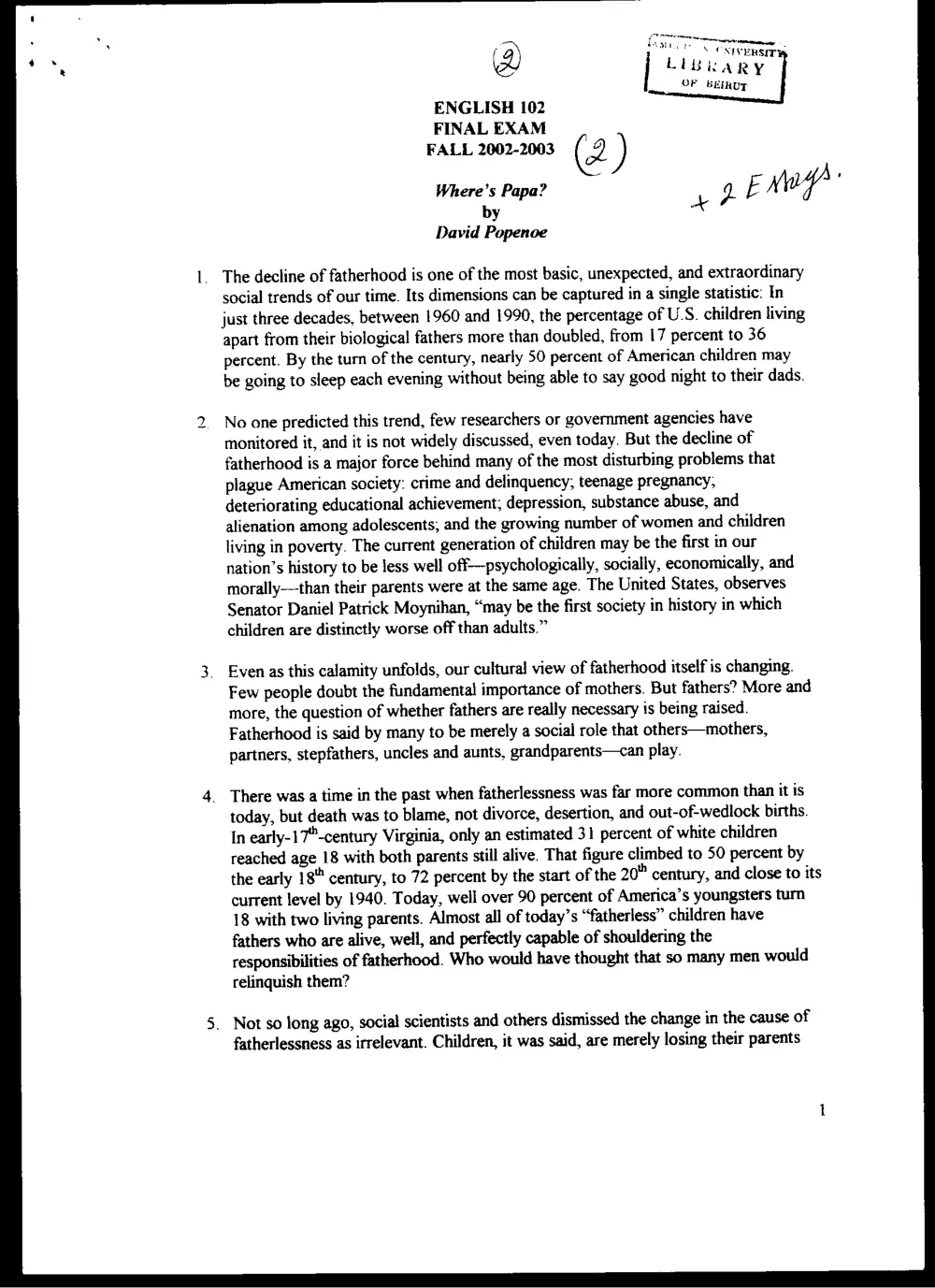
ENGLISH 102
FINAL EXAM
FALL 2002-2003 (2)
Where’s Papa? 2 E nag ,
by
David Popenoe
1. The decline of fatherhood is one of the most basic, unexpected, and extraordinary
social trends of our time. Its dimensions can be captured in a single statistic: In
just three decades, between 1960 and 1990, the percentage of U.S. children living
apart from their biological fathers more than doubled, from 17 percent to 36
percent. By the turn of the century, nearly 50 percent of American children may
be going to sleep each evening without being able to say good night to their dads.
No one predicted this trend, few researchers or government agencies have
monitored it, and it is not widely discussed, even today. But the decline of
fatherhood is a major force behind many of the most disturbing problems that
plague American society: crime and delinquency, teenage pregnancy,
deteriorating educational achievement, depression, substance abuse, and
alienation among adolescents; and the growing number of women and children
living in poverty. The current generation of children may be the first in our
nation’s history to be less well off-—-psychologically, socially, economically, and
morally-—-than their parents were at the same age. The United States, observes
Senator Daniel Patrick Moynihan, “may be the first society in history in which
children are distinctly worse off than adults.”
Even as this calamity unfolds, our cultural view of fatherhood itself is changing.
Few people doubt the fundamental importance of mothers. But fathers? More and
more, the question of whether fathers are really necessary is being raised.
Fatherhood is said by many to be merely a social role that others—mothers,
partners, stepfathers, uncles and aunts, grandparents—can play.
There was a time in the past when fatherlessness was far more common than it is
today, but death was to blame, not divorce, desertion, and out-of-wedlock births.
In early-17"-century Virginia, only an estimated 31 percent of white children
reached age 18 with both parents still alive. That figure climbed to 50 percent by
the early 18" century, to 72 percent by the start of the 20" century, and close to its
current level by 1940. Today, well over 90 percent of America’s youngsters tun
18 with two living parents. Almost all of today’s “fatherless” children have
fathers who are alive, well, and perfectly capable of shouldering the
responsibilities of fatherhood. Who would have thought that so many men would
relinquish them?
_ Not so long ago, social scientists and others dismissed the change in the cause of
fatherlessness as irrelevant. Children, it was said, are merely losing their parents
10.
Se eer
ADEE NY ONE RSIT
Libary
OF BEIRUT
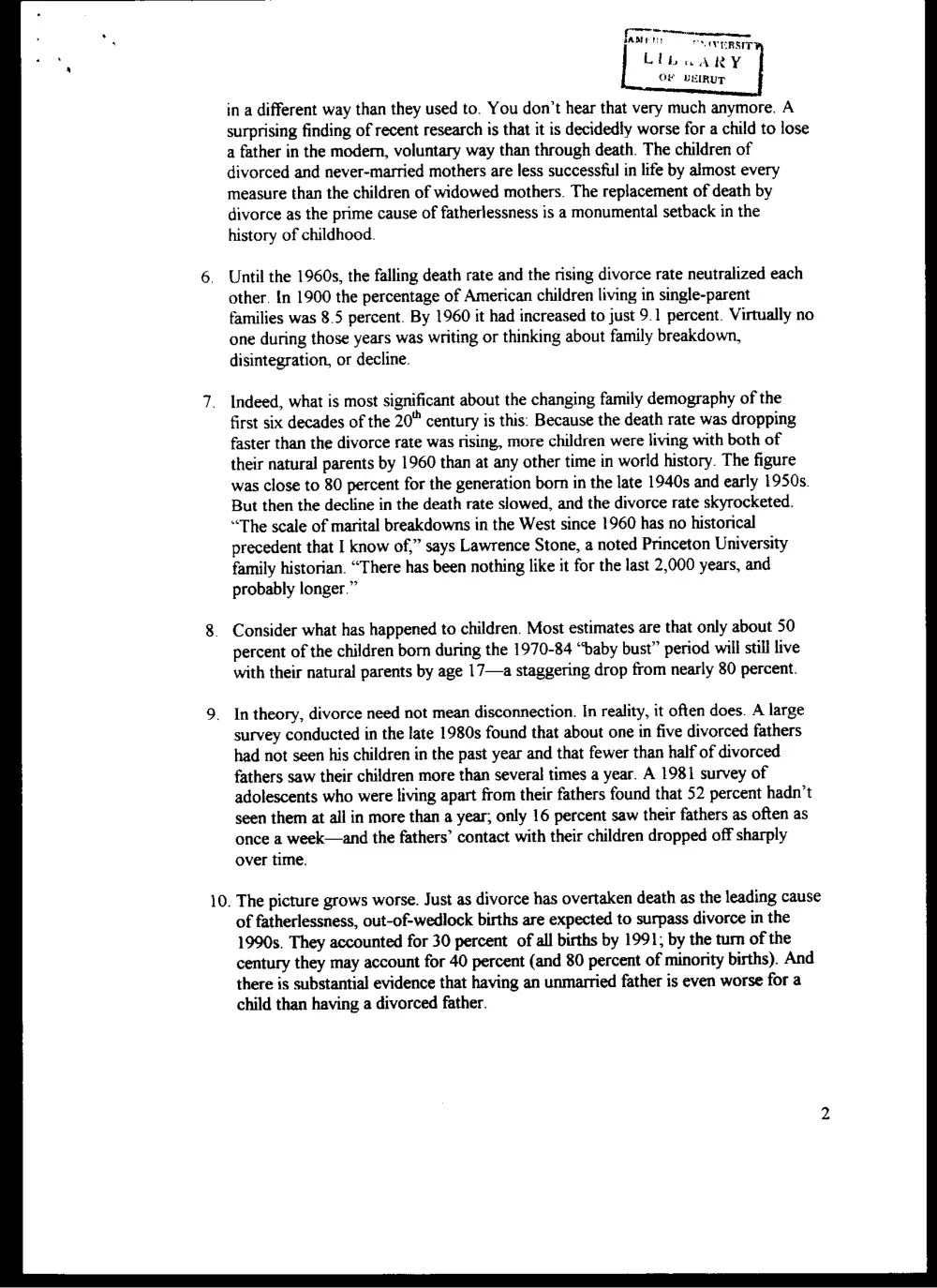
in a different way than they used to. You don’t hear that very much anymore. A
surprising finding of recent research is that it is decidedly worse for a child to lose
a father in the modern, voluntary way than through death. The children of
divorced and never-married mothers are less successful in life by almost every
measure than the children of widowed mothers. The replacement of death by
divorce as the prime cause of fatherlessness is a monumental setback in the
history of childhood.
Until the 1960s, the falling death rate and the rising divorce rate neutralized each
other. In 1900 the percentage of American children living in single-parent
families was 8.5 percent. By 1960 it had increased to just 9.1 percent. Virtually no
one during those years was writing or thinking about family breakdown,
disintegration, or decline.
Indeed, what is most significant about the changing family demography of the
first six decades of the 20” century is this: Because the death rate was dropping
faster than the divorce rate was rising, more children were living with both of
their natural parents by 1960 than at any other time in world history. The figure
was close to 80 percent for the generation born in the late 1940s and early 1950s.
But then the decline in the death rate slowed, and the divorce rate skyrocketed.
“The scale of marital breakdowns in the West since 1960 has no historical
precedent that I know of,” says Lawrence Stone, a noted Princeton University
family historian. “There has been nothing like it for the last 2,000 years, and
probably longer.”
Consider what has happened to children. Most estimates are that only about 50
percent of the children born during the 1970-84 “baby bust” period will still live
with their natural parents by age 17—a staggering drop from nearly 80 percent.
In theory, divorce need not mean disconnection. In reality, it often does. A large
survey conducted in the late 1980s found that about one in five divorced fathers
had not seen his children in the past year and that fewer than half of divorced
fathers saw their children more than several times a year. A 1981 survey of
adolescents who were living apart from their fathers found that 52 percent hadn’t
seen them at all in more than a year; only 16 percent saw their fathers as often as
once a week—and the fathers’ contact with their children dropped off sharply
over time.
The picture grows worse. Just as divorce has overtaken death as the leading cause
of fatherlessness, out-of-wedlock births are expected to surpass divorce in the
1990s. They accounted for 30 percent of all births by 1991, by the tum of the
century they may account for 40 percent (and 80 percent of minority births). And
there is substantial evidence that having an unmarried father is even worse for a
child than having a divorced father.
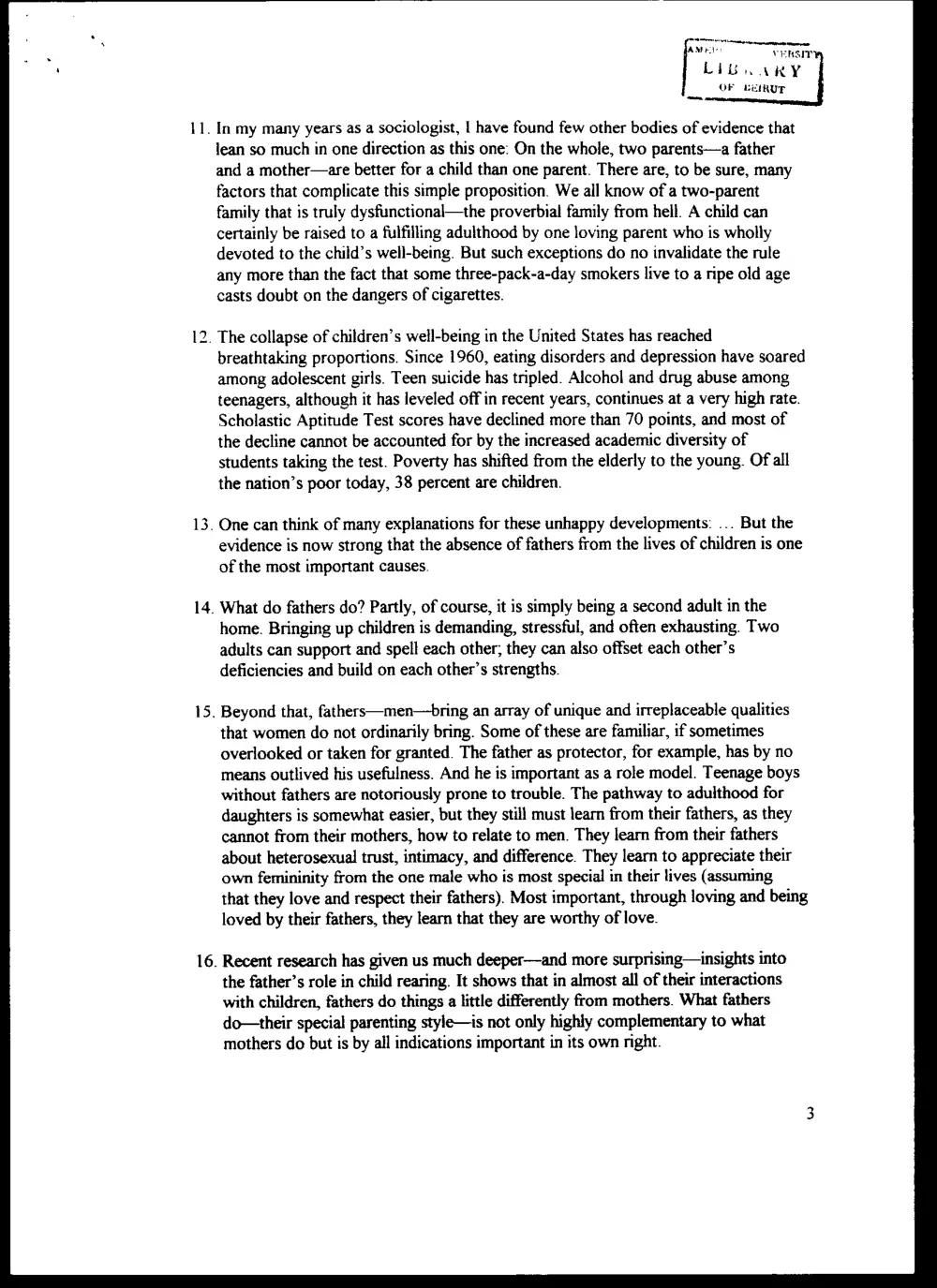
11. In my many years as a sociologist, | have found few other bodies of evidence that
lean so much in one direction as this one: On the whole, two parents—a father
and a mother—are better for a child than one parent. There are, to be sure, many
factors that complicate this simple proposition. We all know of a two-parent
family that is truly dysfunctional—the proverbial family from hell. A child can
certainly be raised to a fulfilling adulthood by one loving parent who is wholly
devoted to the child’s well-being. But such exceptions do no invalidate the rule
any more than the fact that some three-pack-a-day smokers live to a ripe old age
casts doubt on the dangers of cigarettes.
12. The collapse of children’s well-being in the United States has reached
breathtaking proportions. Since 1960, eating disorders and depression have soared
among adolescent girls. Teen suicide has tripled. Alcohol and drug abuse among
teenagers, although it has leveled off in recent years, continues at a very high rate.
Scholastic Aptitude Test scores have declined more than 70 points, and most of
the decline cannot be accounted for by the increased academic diversity of
students taking the test. Poverty has shifted from the elderly to the young. Of all
the nation’s poor today, 38 percent are children.
13. One can think of many explanations for these unhappy developments: ... But the
evidence is now strong that the absence of fathers from the lives of children is one
of the most important causes.
14. What do fathers do? Partly, of course, it is simply being a second adult in the
home. Bringing up children is demanding, stressful, and often exhausting. Two
adults can support and spell each other; they can also offset each other’s
deficiencies and build on each other’s strengths.
15. Beyond that, fathers—men—bring an array of unique and irreplaceable qualities
that women do not ordinarily bring. Some of these are familiar, if sometimes
overlooked or taken for granted. The father as protector, for example, has by no
means outlived his usefulness. And he is important as a role model. Teenage boys
without fathers are notoriously prone to trouble. The pathway to adulthood for
daughters is somewhat easier, but they still must learn from their fathers, as they
cannot from their mothers, how to relate to men. They learn from their fathers
about heterosexual trust, intimacy, and difference. They learn to appreciate their
own femininity from the one male who is most special in their lives (assuming
that they love and respect their fathers). Most important, through loving and being
loved by their fathers, they learn that they are worthy of love.
16. Recent research has given us much deeper—and more surprising—insights into
the father’s role in child rearing. It shows that in almost all of their interactions
with children, fathers do things a little differently from mothers. What fathers
do—their special parenting style—is not only highly complementary to what
mothers do but is by all indications important in its own right.
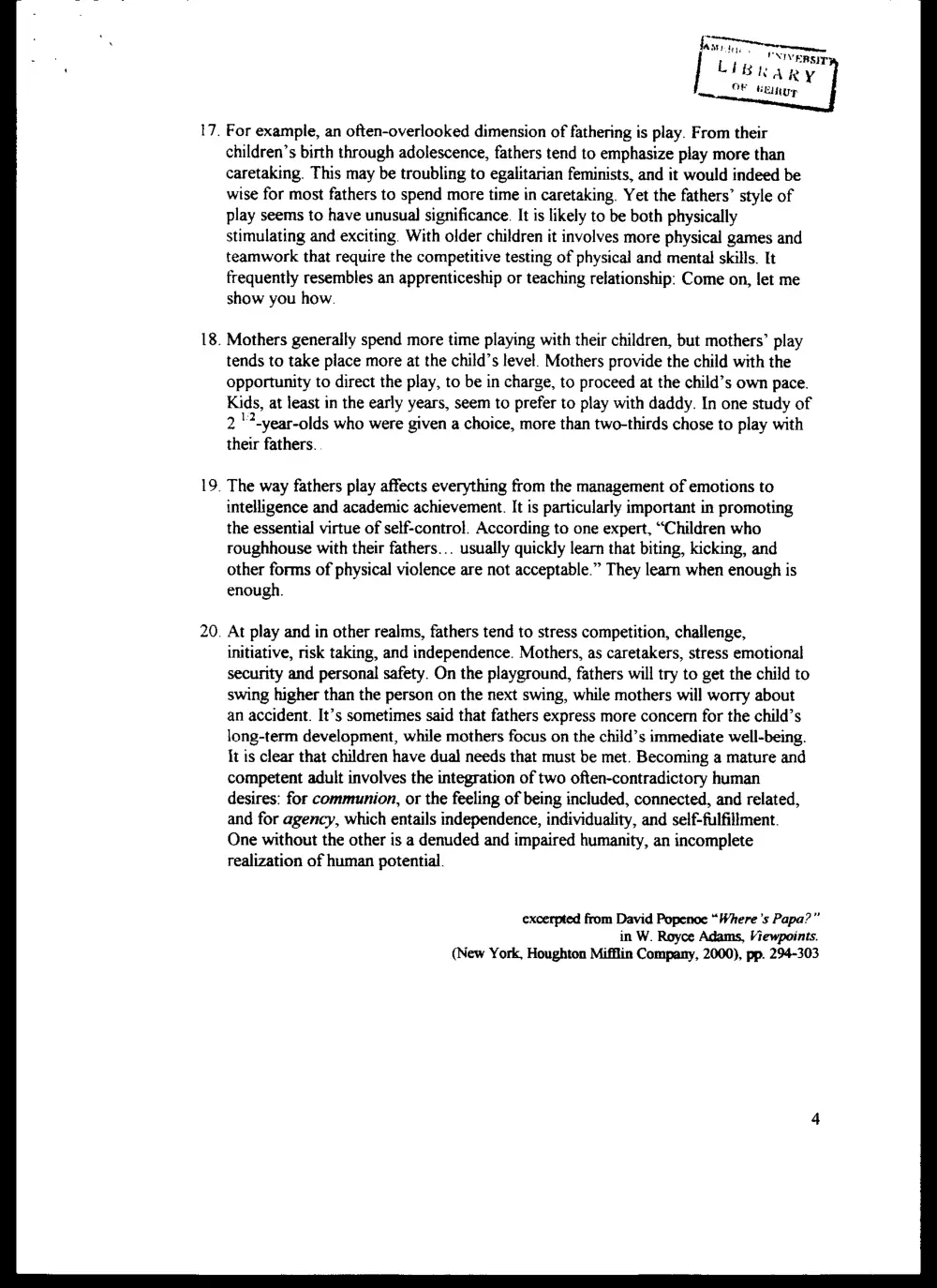
17.
18.
19.
20.
For example, an often-overlooked dimension of fathering is play. From their
children’s birth through adolescence, fathers tend to emphasize play more than
caretaking. This may be troubling to egalitarian feminists, and it would indeed be
wise for most fathers to spend more time in caretaking. Yet the fathers’ style of
play seems to have unusual significance. It is likely to be both physically
stimulating and exciting. With older children it involves more physical games and
teamwork that require the competitive testing of physical and mental skills. It
frequently resembles an apprenticeship or teaching relationship: Come on, let me
show you how.
Mothers generally spend more time playing with their children, but mothers’ play
tends to take place more at the child’s level. Mothers provide the child with the
opportunity to direct the play, to be in charge, to proceed at the child’s own pace.
Kids, at least in the early years, seem to prefer to play with daddy. In one study of
2 '?-year-olds who were given a choice, more than two-thirds chose to play with
their fathers.
The way fathers play affects everything from the management of emotions to
intelligence and academic achievement. It is particularly important in promoting
the essential virtue of self-control. According to one expert, “Children who
roughhouse with their fathers... usually quickly learn that biting, kicking, and
other forms of physical violence are not acceptable.” They learn when enough is
enough.
At play and in other realms, fathers tend to stress competition, challenge,
initiative, risk taking, and independence. Mothers, as caretakers, stress emotional
security and personal safety. On the playground, fathers will try to get the child to
swing higher than the person on the next swing, while mothers will worry about
an accident. It’s sometimes said that fathers express more concern for the child’s
long-term development, while mothers focus on the child’s immediate well-being.
It is clear that children have dual needs that must be met. Becoming a mature and
competent adult involves the integration of two often-contradictory human
desires: for communion, or the feeling of being included, connected, and related,
and for agency, which entails independence, individuality, and self-fulfillment.
One without the other is a denuded and impaired humanity, an incomplete
realization of human potential.
excerpted from David Popenoc “Where's Papa?”
in W. Royce Adams, Viewpoints.
(New York, Houghton Mifflin Company, 2000), pp. 294-303
. a Se ne
| Lig oAy |
Op ge
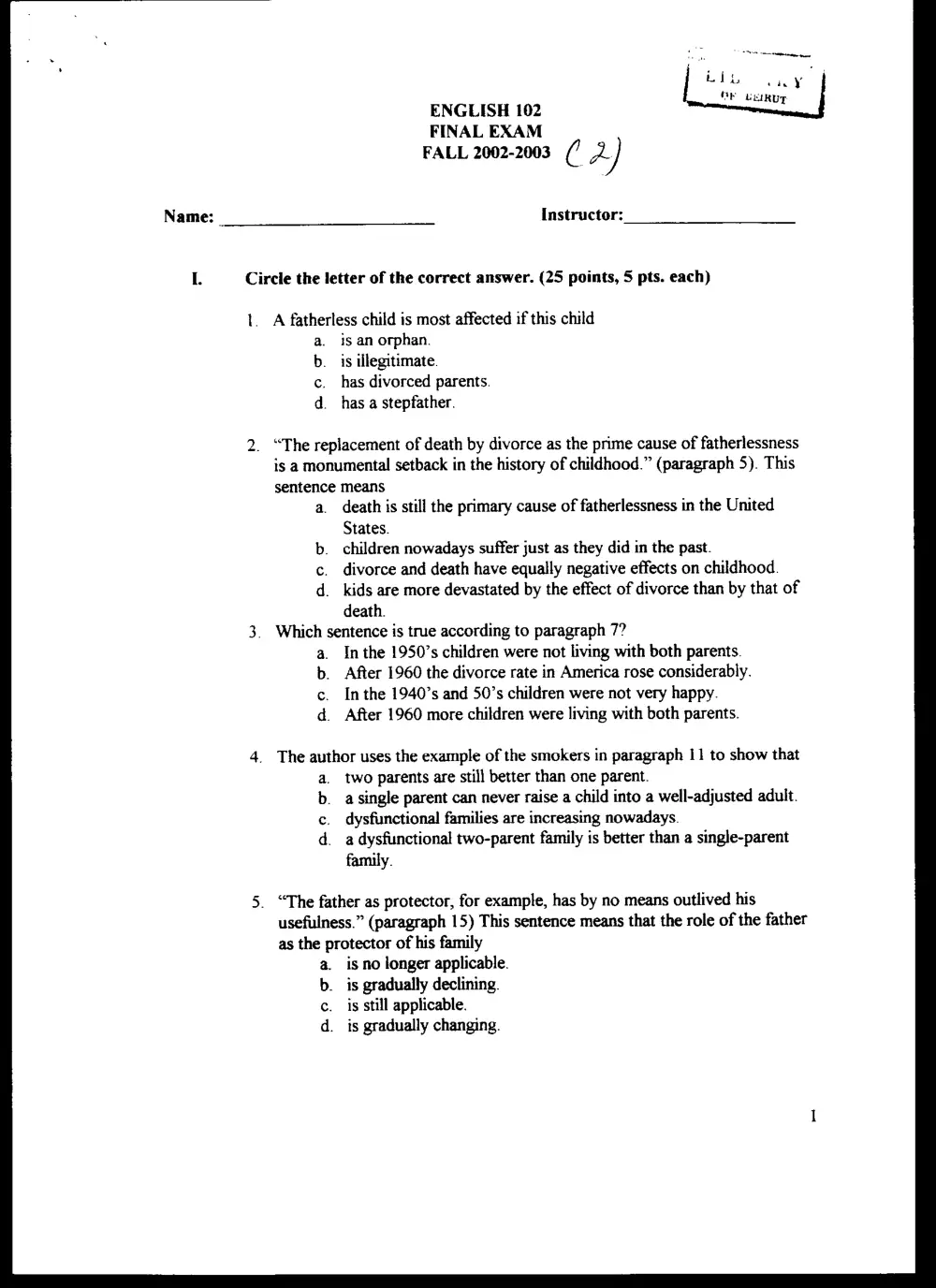
ENGLISH 102 ae unis |
FINAL EXAM
FALL 2002-2003 (’ A)
Name: Instructor:
I Circle the letter of the correct answer. (25 points, 5 pts. each)
\. A fatherless child is most affected if this child
a. is an orphan.
b._ is illegitimate.
c. has divorced parents.
d._ has a stepfather.
2. “The replacement of death by divorce as the prime cause of fatherlessness
is a monumental setback in the history of childhood.” (paragraph 5). This
sentence means
a. death is still the primary cause of fatherlessness in the United
States.
b. children nowadays suffer just as they did in the past.
c. divorce and death have equally negative effects on childhood.
d. kids are more devastated by the effect of divorce than by that of
death.
3. Which sentence is true according to paragraph 7?
In the 1950’s children were not living with both parents.
After 1960 the divorce rate in America rose considerably.
In the 1940’s and 50’s children were not very happy.
After 1960 more children were living with both parents.
ao of
4. The author uses the example of the smokers in paragraph 11 to show that
two parents are still better than one parent.
a single parent can never raise a child into a well-adjusted adult.
dysfunctional families are increasing nowadays.
a dysfunctional two-parent family is better than a single-parent
family.
ao rep
5. “The father as protector, for example, has by no means outlived his
usefulness.” (paragraph 15) This sentence means that the role of the father
as the protector of his family
is no longer applicable.
is gradually declining.
is still applicable.
is gradually changing.
nese
fannie PNIVERSIT
. , LIBRARY
‘ OF BCIRUT
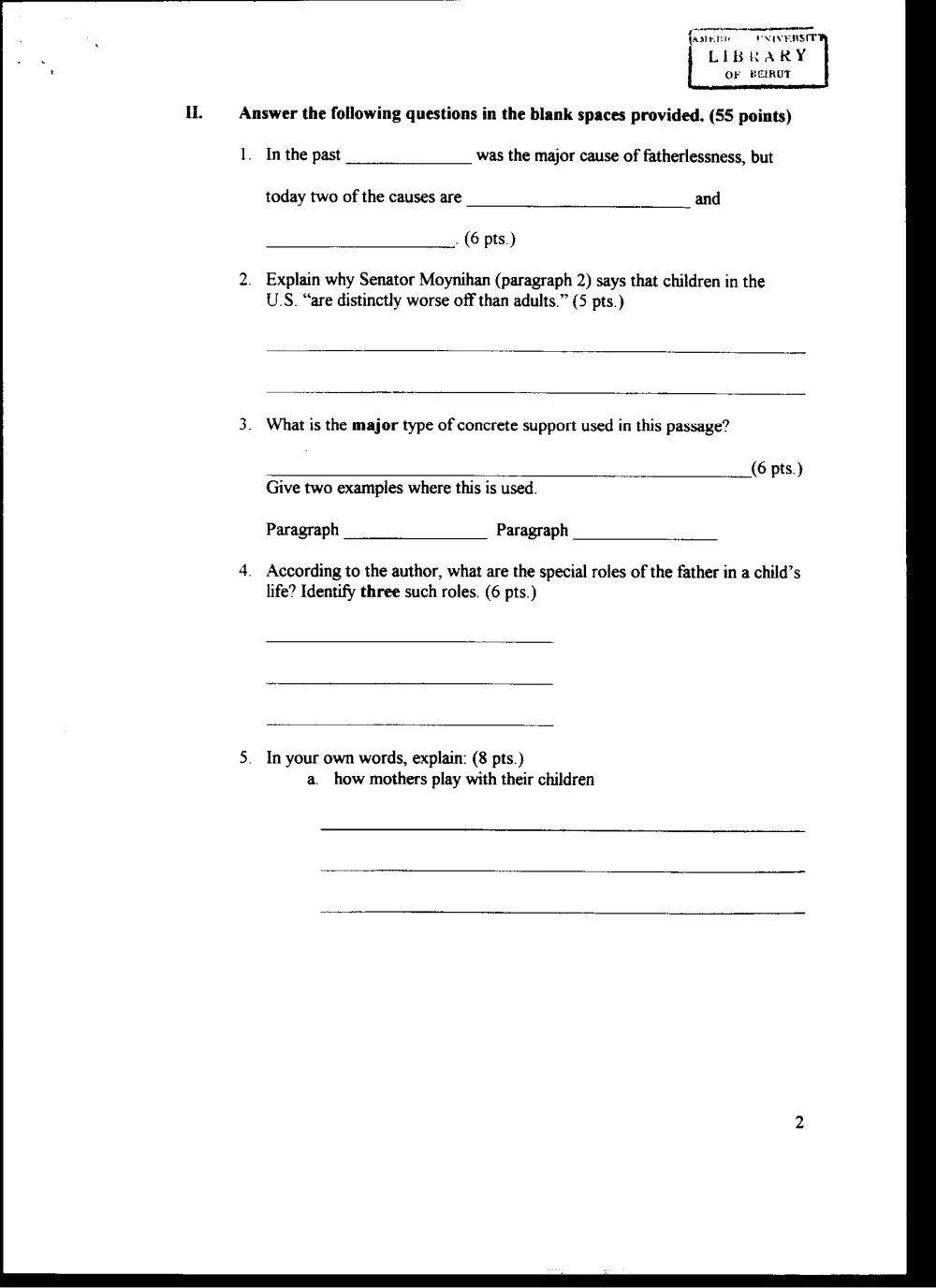
I. Answer the following questions in the blank spaces provided. (55 points)
1. In the past was the major cause of fatherlessness, but
today two of the causes are and
. (6 pts.)
2. Explain why Senator Moynihan (paragraph 2) says that children in the
U.S. “are distinctly worse off than adults.” (5 pts.)
3. What is the major type of concrete support used in this passage?
(6 pts.)
Give two examples where this is used.
Paragraph Paragraph
4. According to the author, what are the special roles of the father in a child’s
life? Identify three such roles. (6 pts.)
5. In your own words, explain: (8 pts.)
a. how mothers play with their children
‘
ISM tie
LIL .ANY
OF BRUT
b. how fathers play with their children
. What are the effects resulting from the lack of fathers that appeared in
American society? (6 pts.)
. In your own words (1-2 sentences) state the main idea of the passage. (6
pts.) .
In paragraph 20 the author refers to “communion” and “agency”. Which
parent, according to the author, provides each one for the child? (6 pts.)
communion
agency
Paraphrase the last sentence in paragraph 20. (6 pts.)
I.
4 Tannen carne
JASERY ON ONIVERSIT®
LIBKARY
OF BEIRUT
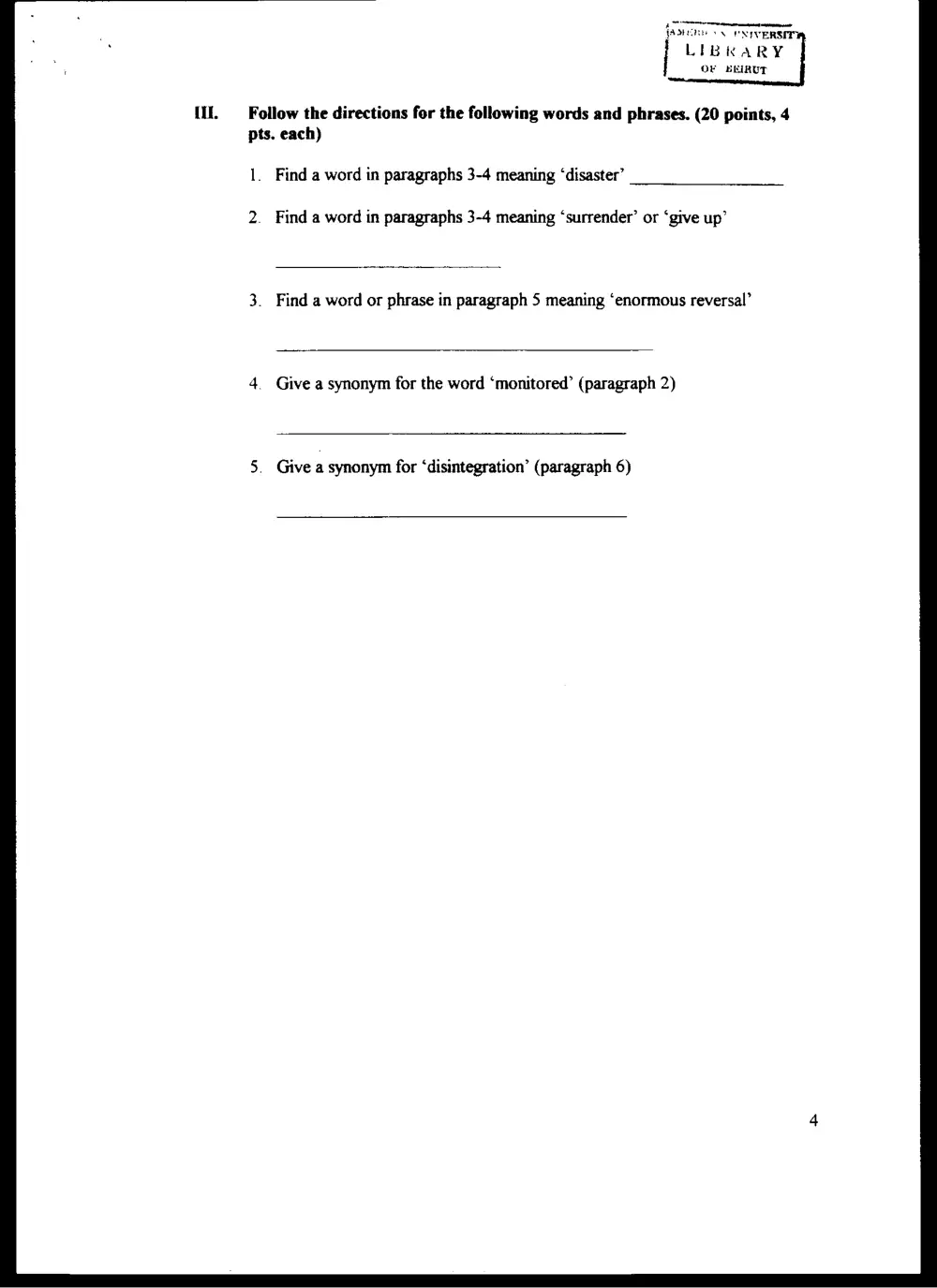
Follow the directions for the following words and phrases. (20 points, 4
pts. each)
1.
2.
Find a word in paragraphs 3-4 meaning ‘disaster’
Find a word in paragraphs 3-4 meaning ‘surrender’ or ‘give up’
Find a word or phrase in paragraph 5 meaning ‘enormous reversal’
Give a synonym for the word ‘monitored’ (paragraph 2)
Give a synonym for ‘disintegration’ (paragraph 6)
AMERICAN UNTVERSIT®)
LIBRARY |
OF GEIRUT
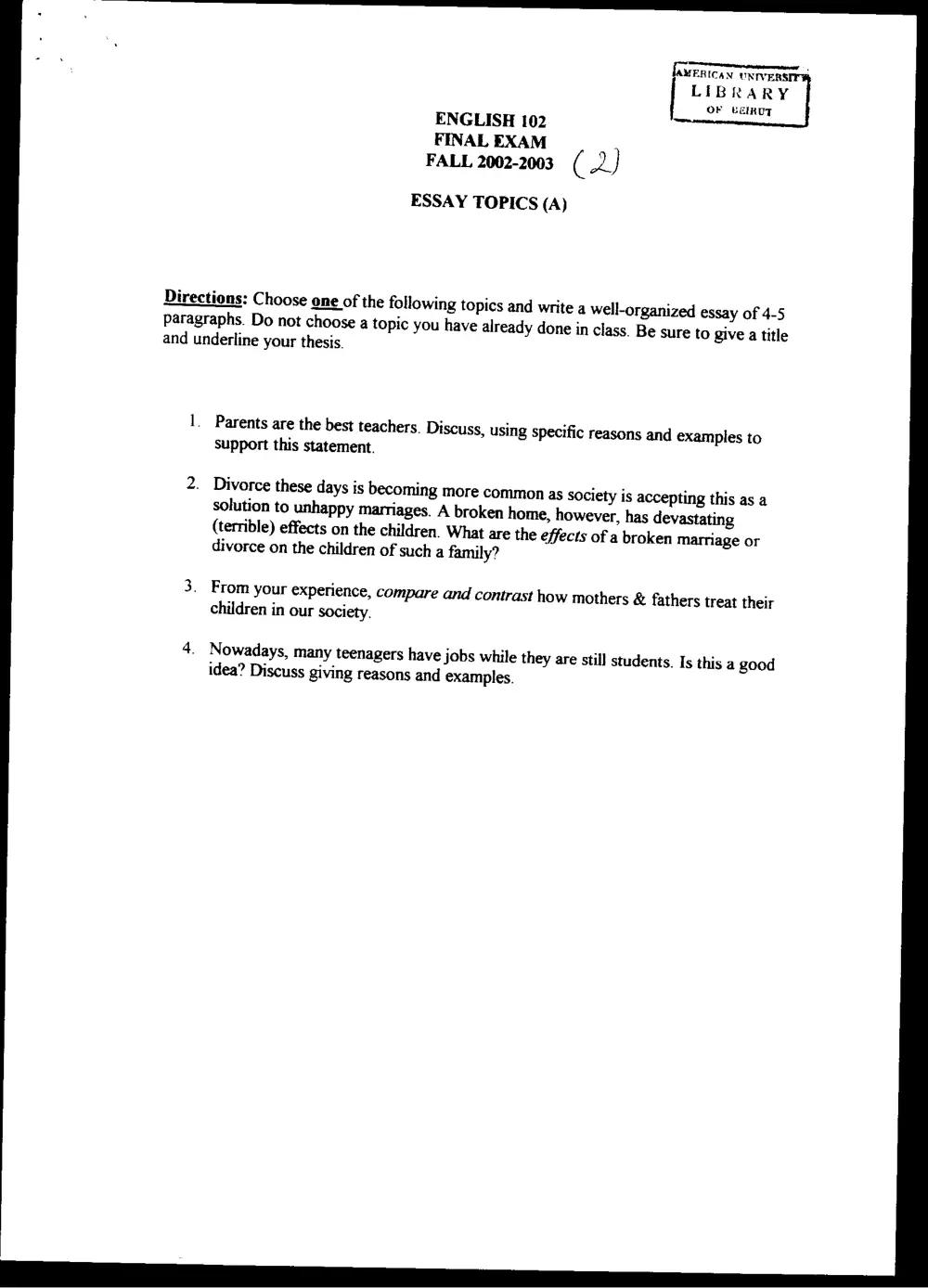
ENGLISH 102
FINAL EXAM
FALL 2002-2003 ( 2)
ESSAY TOPICS (A)
Directions: Choose one of the following topics and write a well-organized essay of 4-5
paragraphs. Do not choose a topic you have already done in class. Be sure to give a title
and underline your thesis.
support this statement.
2. Divorce these days is becoming more common as society is accepting this as a
solution to unhappy marriages. A broken home, however, has devastating
(terrible) effects on the children, What are the effects of a broken marriage or
divorce on the children of such a family?
3. From your experience, compare and contrast how mothers & fathers treat their
children in our society.
4. Nowadays, many teenagers have jobs while they are still students. Is this a good
idea? Discuss giving reasons and examples.
Fare ete net emanate
[ nie XIVERSIT
LIBRARY
OF VEIRUT
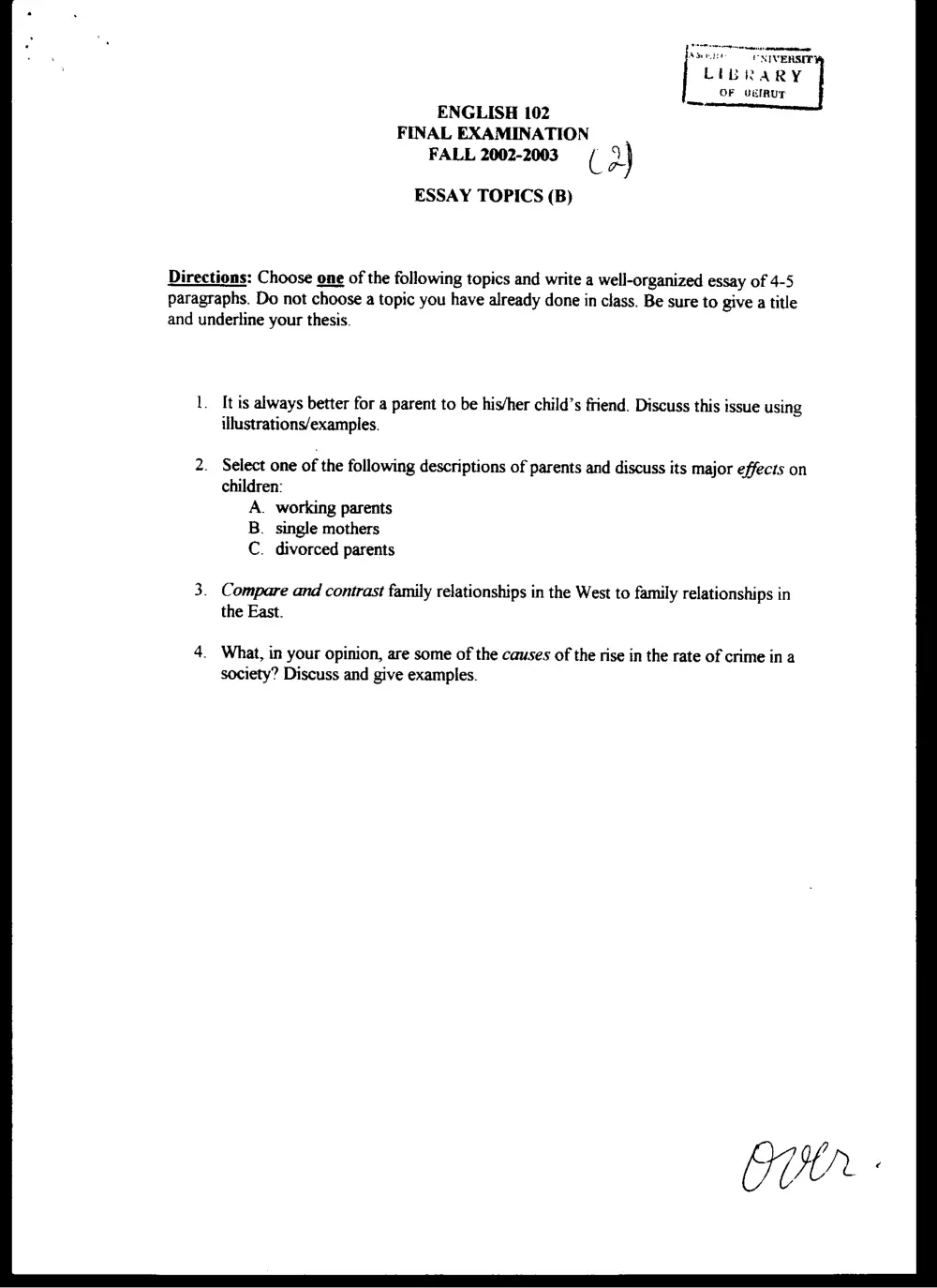
ENGLISH 102
FINAL EXAMINATION
FALL 2002-2003 ( 2)
ESSAY TOPICS (B)
Directions: Choose one of the following topics and write a well-organized essay of 4-5
paragraphs. Do not choose a topic you have already done in class. Be sure to give a title
and underline your thesis.
L._ It ts always better for a parent to be his/her child’s friend. Discuss this issue using
illustrations/examples.
2. Select one of the following descriptions of parents and discuss its major effects on
children:
A. working parents
B. single mothers
C. divorced parents
3. Compare and contrast family relationships in the West to family relationships in
the East.
4. What, in your opinion, are some of the causes of the rise in the rate of crime in a
society? Discuss and give examples.