
ENG 102 Final, Summer 2003
American University of Beirut · Enrichment Course in English · 8 pages


More ENG 102 files
Show the text of this final exam
~ LIBRARY
hia do OF BEIRUT
AUV NEAT |
je LISHAMN SVOIUAVY
ENGLISH 102 B
FINAL EXAMINATION
SUMMER SESSION 2002-2003
Humor Found To Aid Problem-Solving
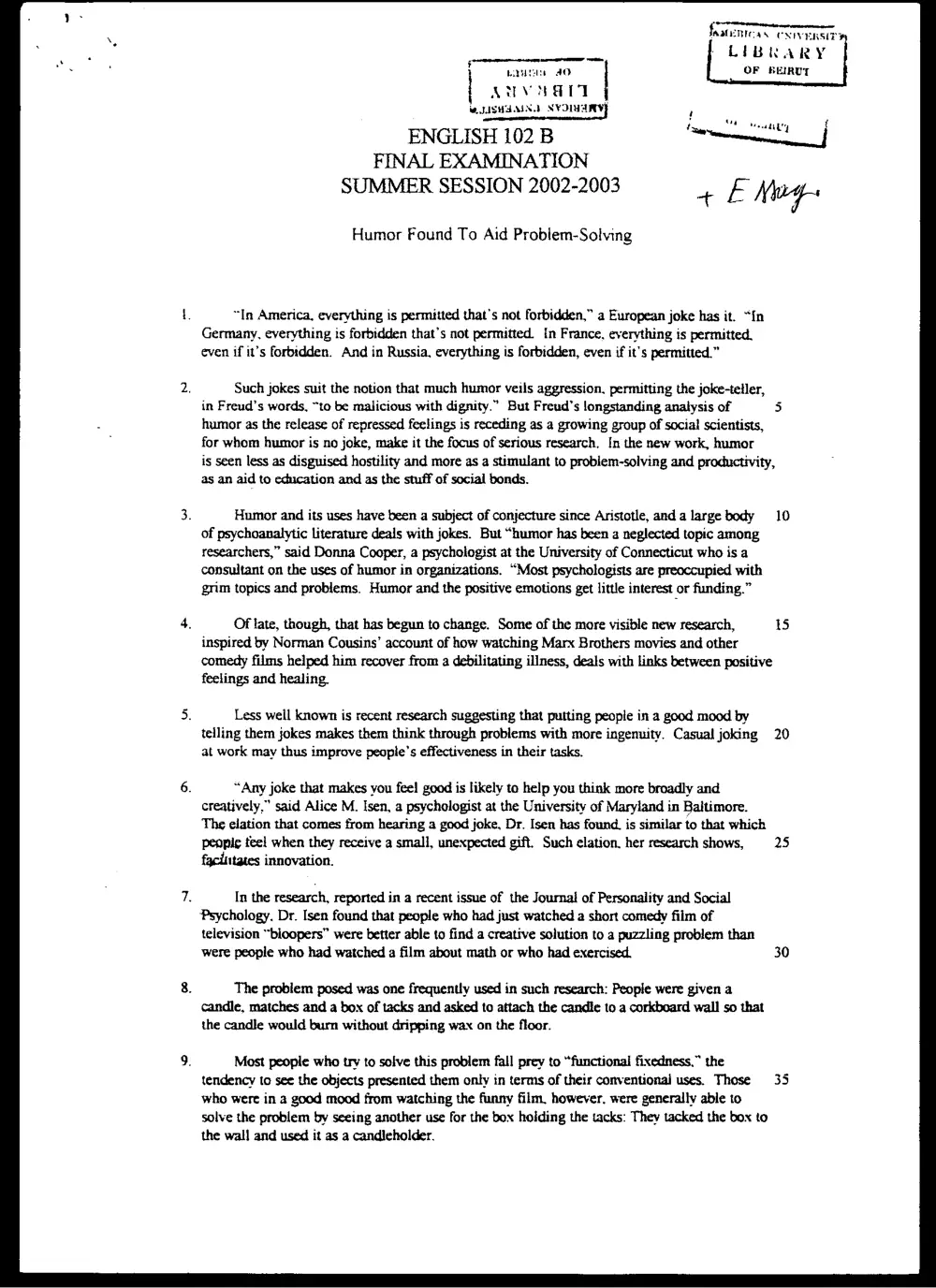
“In America, everything is permitted that’s not forbidden,” a European joke has it. “{n
Germany, everything is forbidden that’s not permitted. In France, everything is permitted.
even if it’s forbidden. And in Russia, everything is forbidden, even if it’s permitted.”
. Such jokes suit the notion that much humor veils aggression, permitting the joke-teller,
in Freud’s words, “to be malicious with dignity.” But Freud’s longstanding analysis of 5
humor as the release of repressed feelings is receding as a growing group of social scientists,
for whom humor is no joke, make it the focus of serious research, In the new work, humor
is seen less as disguised hostility and more as a stimulant to problem-solving and productivity,
as an aid to education and as the stuff of social bonds.
. Humor and its uses have been a subject of conjecture since Aristotle, anda large body 10
of psychoanalytic literature deals with jokes. But “humor has been a neglected topic among
researchers,” said Donna Cooper, a psychologist at the University of Connecticut who is a
consultant on the uses of humor in organizations. “Most psychologists are preoccupied with
grim topics and problems. Humor and the positive emotions get little interest or funding.”
Of tate, though, that has begun to change. Some of the more visible new research, 15
inspired by Norman Cousins’ account of how watching Marx Brothers movies and other
comedy films helped him recover from a debilitating illness, deals with links between positive
feelings and healing.
. Less well known is recent research suggesting that putting people in a good mood by
telling them jokes makes them think through problems with more ingenuity. Casual joking 20
at work may thus improve people’s effectiveness in their tasks.
“Any joke that makes you feel good is likely to help you think more broadly and
creatively,” said Alice M. Isen, a psychologist at the University of Maryland in Baltimore.
The elation that comes from hearing a good joke, Dr. Isen has found. is similar to that which
peopig feel when they receive a small, unexpected gift. Such elation. her research shows, 25
facilitates innovation.
7. In the research, reported in a recent issue of the Journal of Personality and Social
Psychology, Dr. [sen found that people who had just watched a short comedy film of
television “bloopers” were better able to find a creative solution to a puzzling problem than
were people who had watched a film about math or who had exercised. 30
. The problem posed was one frequently used in such research: People were given a
candle, matches and a box of tacks and asked to attach the candle to a corkboard wall so that
the candle would burn without dripping wax on the floor.
Most people whe try to solve this problem fall prey to “functional fixedness,” the
tendency to see the objects presented them only in terms of their conventional uses. Those 35
who were in a good mood from watching the funny film, however, were generally able to
solve the problem by seeing another use for the box holding the tacks: They tacked the box to
the wall and used it as a candleholder.
r .
AMERICAN CNIVERSIT
LIBRARY
OF SUIRUT
ead
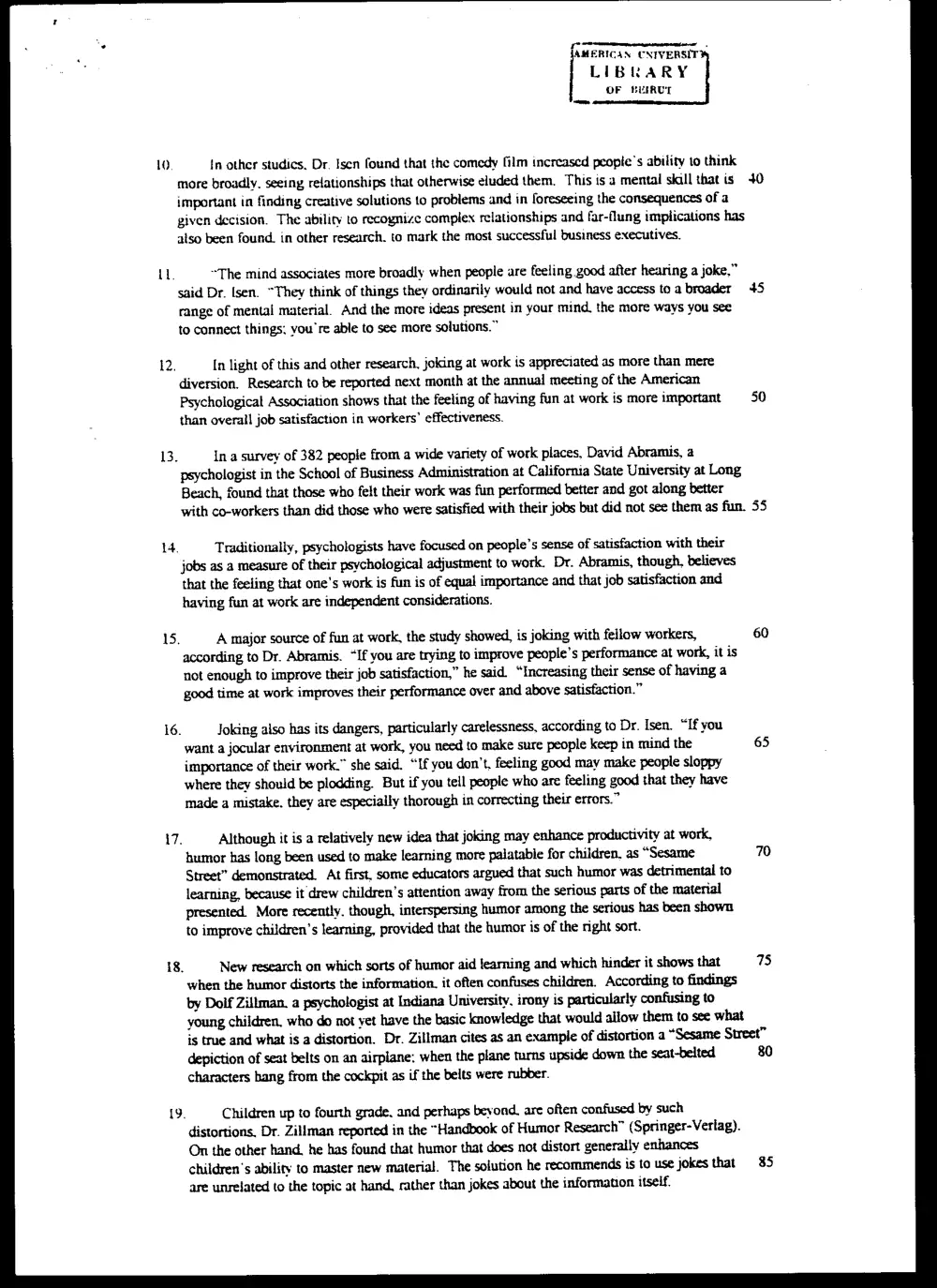
10 In other studies. Dr. Isen found that the comedy film increased people's ability to think
more broadly. seeing refationships that otherwise eluded them, This is a mental skall that is 40
important in finding creative solutions to problems and in foreseeing the consequences of a
given decision. The ability to recognize complex relationships and far-flung implications has
also been found. in other research. to mark the most successful business executives.
~The mind associates more broadly when people are feeling good after hearing a joke,”
said Dr. Isen. “They think of things they ordinarily would not and have access toa broader 45
range of mental material. And the more ideas present in your mind, the more ways you see
to connect things; you're able to see more solutions.”
12. In light of this and other research, joking at work is appreciated as more than mere
diversion. Research to be reported next month at the annual meeting of the American
Psychological Association shows that the feeling of having fun at work is more important 50
than overall job satisfaction in workers’ effectiveness.
13, In a survey of 382 people from a wide variety of work places. David Abramis, a
psychologist in the School of Business Administration at California State University at Long
Beach, found that those who felt their work was fun performed better and got along better
with co-workers than did those who were satisfied with their jobs but did not see them as fun. 55
4. Traditionally, psychologists have focused on people’s sense of satisfaction with their
jobs as a measure of their psychological adjustment to work. Dr. Abramis, though, believes
that the feeling that one's work is fun is of equal importance and that job satisfaction and
having fun at work are independent considerations.
15. A major source of fun at work, the study showed, is joking with fellow workers,
according to Dr. Abramis. “If you are trying to improve people's performance at work, it is
not enough to improve their job satisfaction,” he said “Increasing their sense of having a
good time at work improves their performance over and above satisfaction.”
16. Joking also has its dangers, particularly carelessness, according to Dr. Isen. “If you
want a jocular environment at work, you need to make sure people keep in mind the
importance of their work.” she said. “If you don’t, feeling good may make people sloppy
where they should be plodding. But if you tell people who are feeling good that they have
made a mistake. they are especially thorough in correcting their errors.”
17. Although it is a relatively new idea that joking may enhance productivity at work,
humor has long been used to make learning more palatable for children. as “Sesame
Street” demonstrated. At first, some educators argued that such humor was detrimental to
learning, because it drew children’s attention away from the serious parts of the material
presented. More recently. though, interspersing humor among the serious has been shown
to improve children’s learning, provided that the humor is of the right sort.
18. New research on which sorts of humor aid learning and which hinder it shows that
when the humor distorts the information. it often confuses children. According to findings
by Doif Zillman. a psychologist at Indiana University. irony is particularly confusing to
young children, who do not yet have the basic knowledge that would allow them to see what
is true and what is a distortion. Dr. Zillman cites as an example of distortion a “Sesame Street”
depiction of seat belts on an airplane: when the plane turns upside down the seat-belted 80
characters bang from the cockpit as if the belts were rubber.
19. Children up to fourth grade, and perhaps beyond, are often confused by such
distortions, Dr. Zillman reported in the “Handbook of Humor Research” (Springer-Verlag).
On the other hand, he has found that humor that does not distort generally enhances
children’s ability to master new material. The solution he recommends is to use jokes that 85
are unrelated to the topic at hand, rather than jokes about the informanon itself.
{awenivas UNIVERSIT .
LIBIARY
er BEIRUT
ad
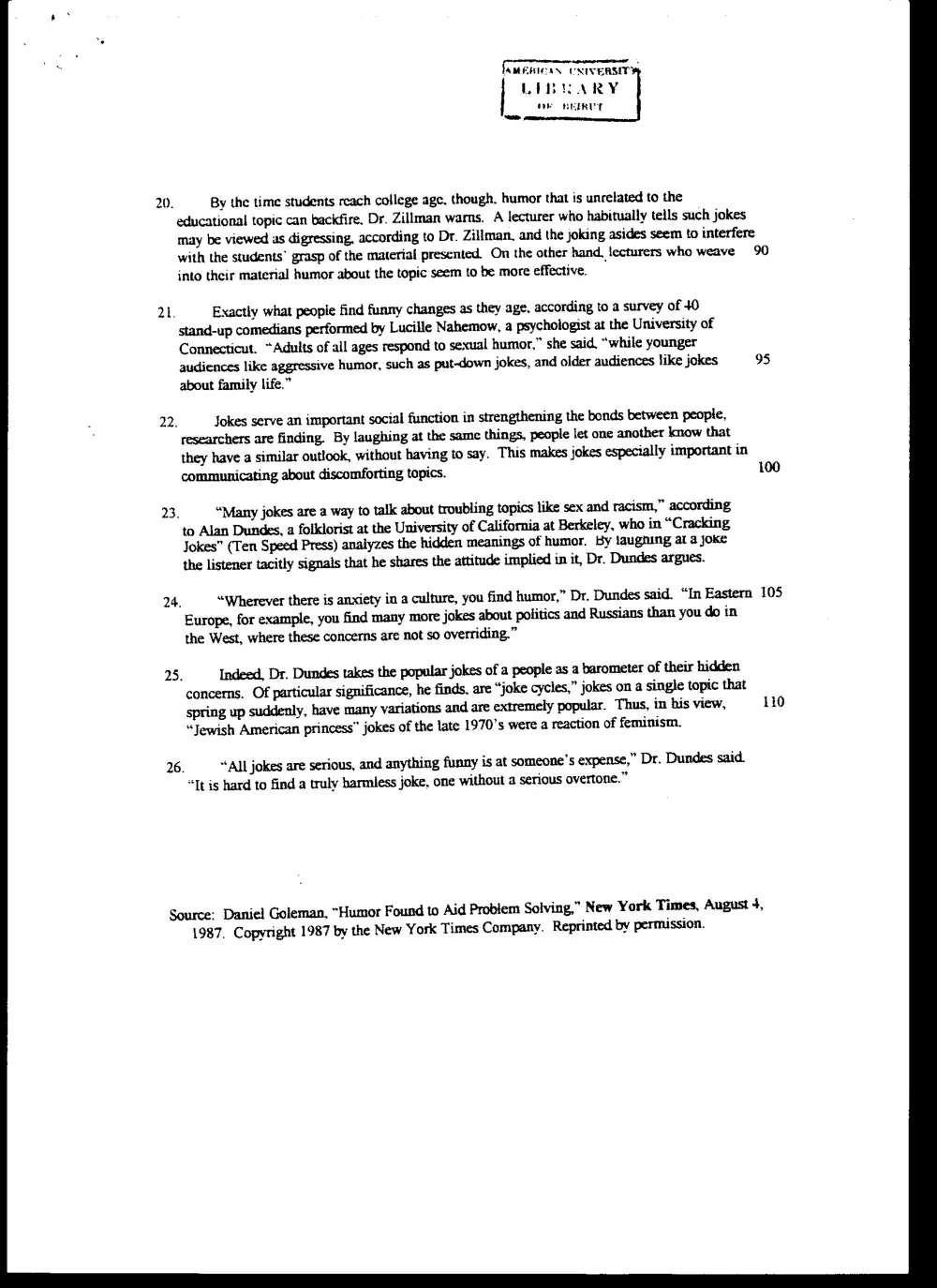
20. By the time students reach college age. though. humor that is unrelated to the
educational topic can backfire, Dr. Zillman warns. A lecturer who habitually tells such jokes
may be viewed as digressing, according to Dr. Zillman, and the joking asides seem to interfere
with the students’ grasp of the material presented. On the other hand, lecturers who weave 90
into their material humor about the topic seem to be more effective.
2k. Exactly what people find funny changes as they age, according to a survey of 40
stand-up comedians performed by Lucille Nahemow, a psychologist at the University of
Connecticut. “Adults of all ages respond to sexual humor,” she said, “while younger
audiences like aggressive humor, such as put-down jokes, and older audiences like jokes 95
about family life.”
22. Jokes serve an important social function in strengthening the bonds between people,
researchers are finding. By laughing at the same things, people let one another know that
they have a similar outlook, without having to say. This makes jokes especially important in
communicating about discomforting topics. 100
23. “Many jokes are a way to talk about troubling topics like sex and racism,” according
to Alan Dundes, a folklorist at the University of California at Berkeley, who in “Cracking
Jokes” (Ten Speed Press) analyzes the hidden meanings of humor. By laughing al a Joke
the listener tacitly signals that he shares the attitude implied in it, Dr. Dundes argues.
24. “Wherever there is anxiety in a culture, you find humor,” Dr. Dundes said. “In Eastern 105
Europe, for example, you find many more jokes about politics and Russians than you do in
the West, where these concerns are not so overriding.”
25. Indeed, Dr. Dundes takes the popular jokes of a people as a barometer of their hidden
concerns. Of particular significance, he finds, are “joke cycles,” jokes on a single topic that
spring up suddenly, have many variations and are extremely popular. Thus, in his view, 110
“Jewish American princess” jokes of the late 1970's were a reaction of feminism.
26. “All jokes are serious, and anything funny is at someone’s expense,” Dr. Dundes said.
“It is hard to find a truly harmless joke, one without a serious overtone.”
Source: Daniel Goleman, “Humor Found to Aid Problem Solving,” New York Times, August 4,
1987. Copyright 1987 by the New York Times Company. Reprinted by permission.
ae ne ere
famente es CNIVERSIT?
LIBRARY
OF BEARUT
ENGLISH 102 B
FINAL EXAMINATION
SUMMER SESSION 2002-2003
INSTRUCTOR:
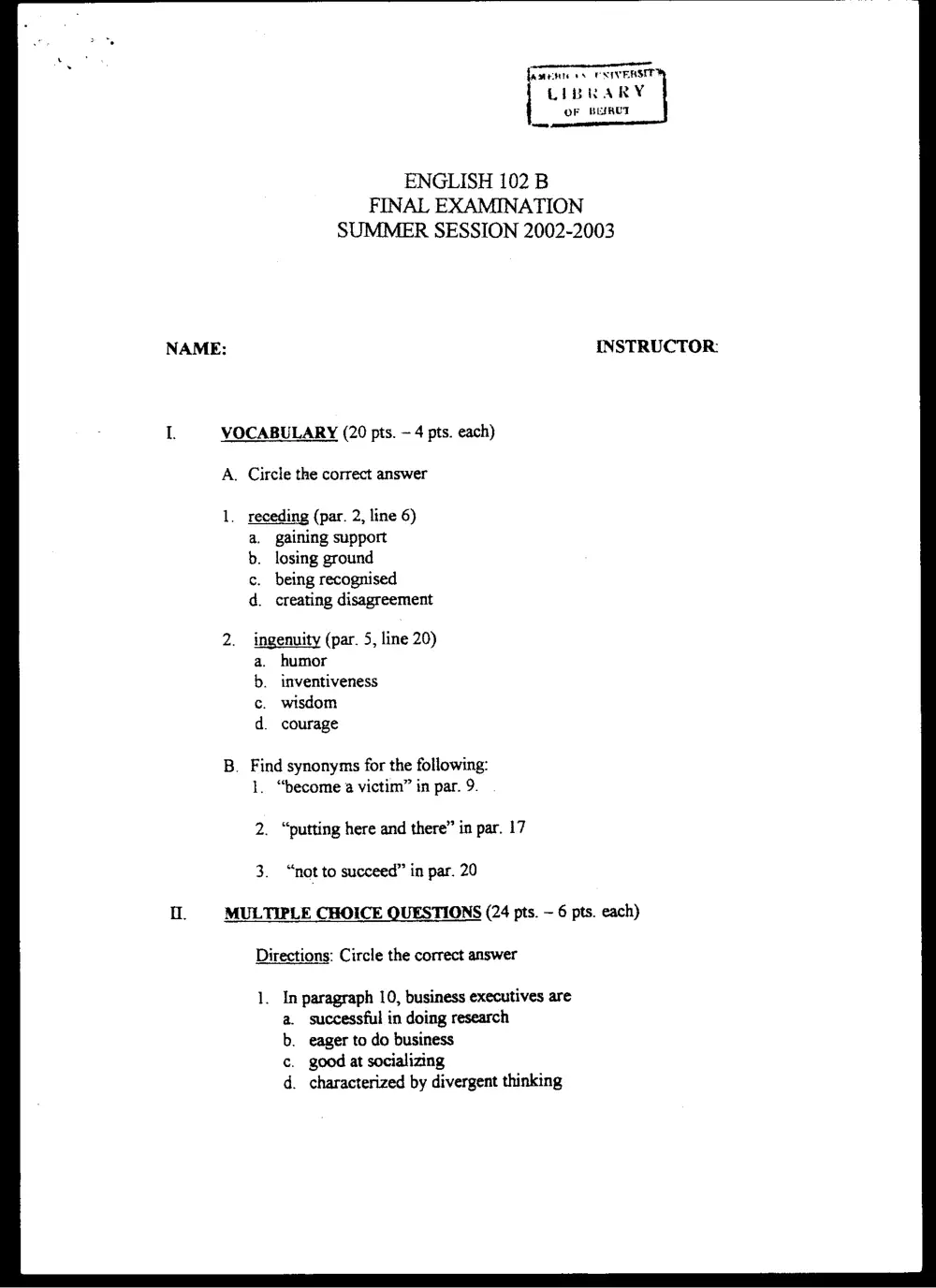
VOCABULARY (20 pts. ~ 4 pts. each)
A. Circle the correct answer
1. receding (par. 2, line 6)
a. gaining support
b. losing ground
c. being recognised
d. creating disagreement
ingenuity (par. 5, line 20)
. humor
. inventiveness
. wisdom
. courage
. Find synonyms for the following:
1. “become a victim” in par. 9.
2. “putting here and there” in par. 17
3. “not to succeed” in par. 20
I. MULTIPLE CHOICE QUESTIONS (24 pts. ~ 6 pts. each)
Directions: Circle the correct answer
1. In paragraph 10, business executives are
a. successful in doing research
b. eager to do business
c. good at socializing
d. characterized by divergent thinking
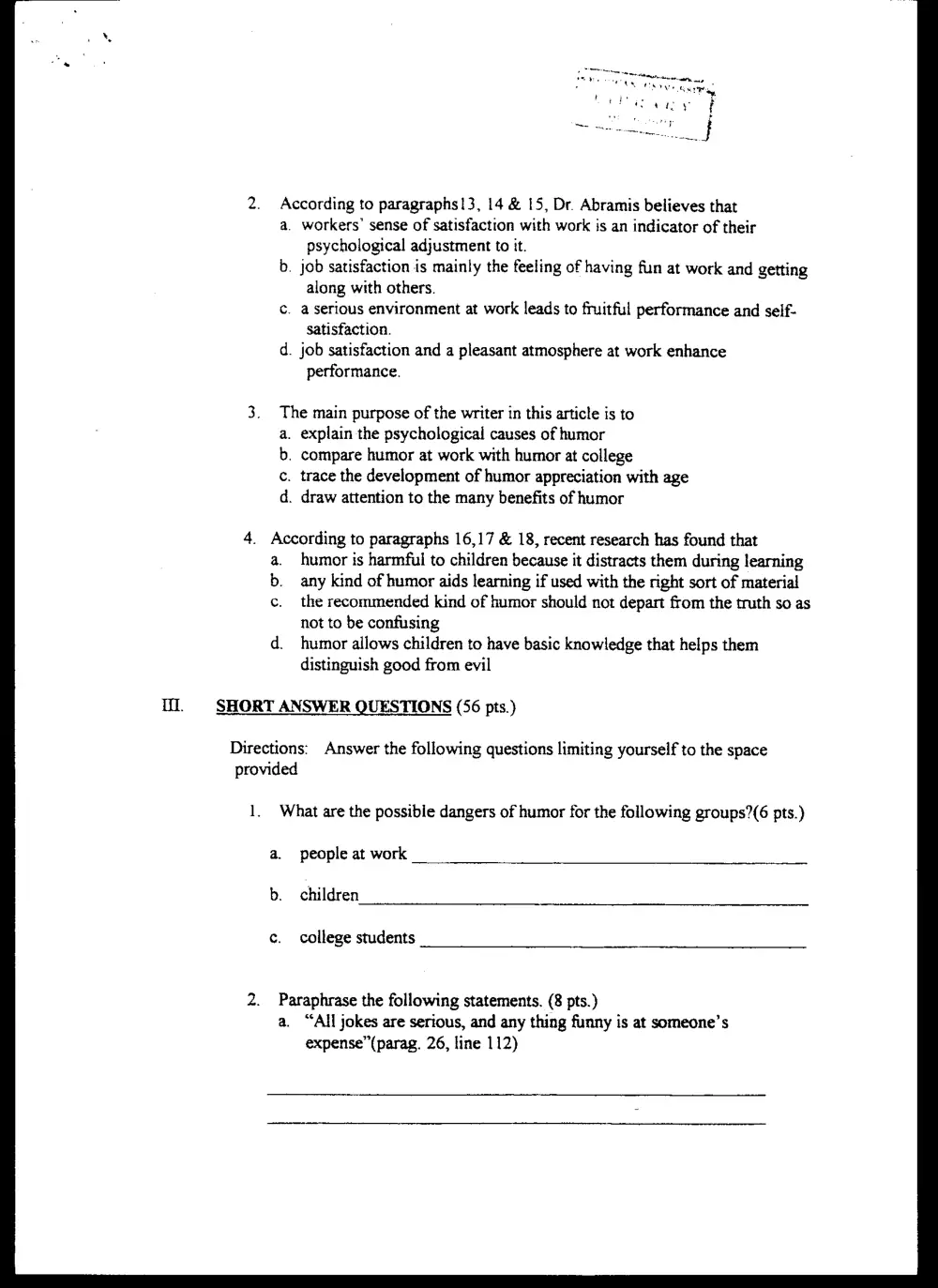
According to paragraphs!3, 14 & 15, Dr. Abramis believes that
a. workers’ sense of satisfaction with work is an indicator of their
psychological adjustment to it.
b. job satisfaction is mainly the feeling of having fun at work and getting
along with others.
c. a serious environment at work leads to fruitful performance and self-
satisfaction.
d. job satisfaction and a pleasant atmosphere at work enhance
performance.
The main purpose of the writer in this article is to
a. explain the psychological causes of humor
b. compare humor at work with humor at college
c. trace the development of humor appreciation with age
d. draw attention to the many benefits of humor
4. According to paragraphs 16,17 & 18, recent research has found that
a. humor is harmful to children because it distracts them during learning
b. any kind of humor aids learning if used with the right sort of material
c. the recommended kind of humor should not depart from the truth so as
not to be confusing
d. humor allows children to have basic knowledge that helps them
distinguish good from evil
TW. SHORT ANSWER QUESTIONS (56 pts.)
Directions: Answer the following questions limiting yourself to the space
provided
1. What are the possible dangers of humor for the following groups?(6 pts.)
a. people at work
b. children
c. college students
2. Paraphrase the following statements. (8 pts.)
a. “AI jokes are serious, and any thing funny is at someone’s
expense”(parag. 26, line 112)
eee nie
ry
F
AM
CHIC CNIVERSIT
LIBRARY
OF BEIRUT
—
b. “-----—-- takes the popular jokes of a people as 2 barometer of their
hidden concerns.” (parag. 25, line 108)
3. What does the expression “for whom humor is no joke” (in par. 2, line 7)
imply about the relation between social scientists and humor? (6 pts)
4. Complete the following structure in light of paragraphs 22,23. (6 pts)
When you laugh at a joke, you indirectly ----------------------------------- —
5. The following experts had certain opinions on humor. Summarize each
view in not more than one sentence. (20 pts.)
a. Isen
Nahemow and Dundes
[ne eeeememenennl
AMERICAN UNIVERSITY
LIBIARY
OF UEIRUT
6. Quote the thesis statement of the passage. (5 pts.)
ee ee
AML
' SIVERSIT’
LIBAARY
OF BEIRUT
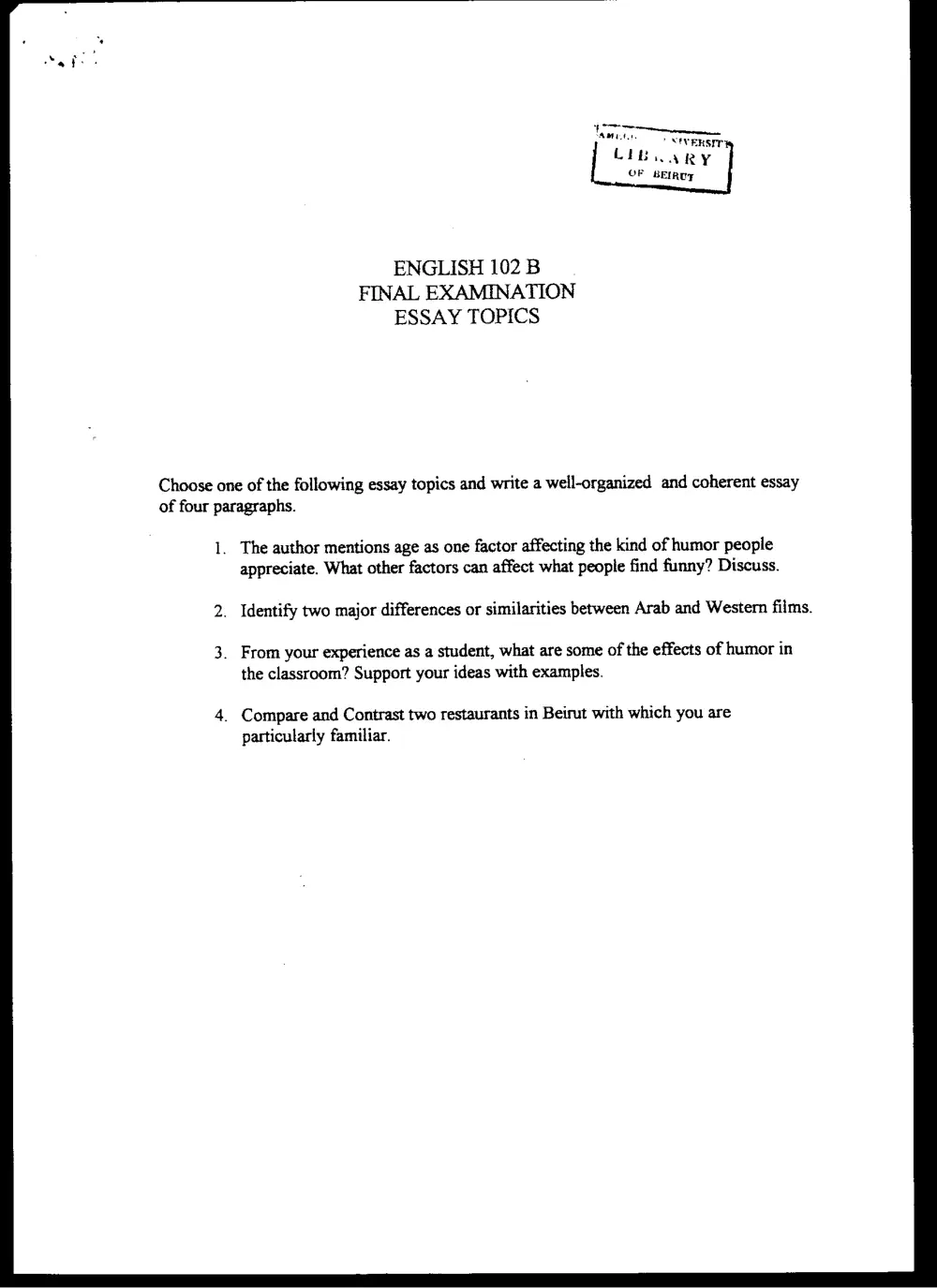
ENGLISH 102 B
FINAL EXAMINATION
ESSAY TOPICS
Choose one of the following essay topics and write a well-organized and coherent essay
of four paragraphs.
1.
The author mentions age as one factor affecting the kind of humor people
appreciate. What other factors can affect what people find funny? Discuss.
_ Identify two major differences or similarities between Arab and Western films.
. From your experience as a student, what are some of the effects of humor in
the classroom? Support your ideas with examples.
. Compare and Contrast two restaurants in Beirut with which you are
particularly familiar.