
ENG 102 Final, Spring 2002
American University of Beirut · Enrichment Course in English · 8 pages

More ENG 102 files
Show the text of this final exam
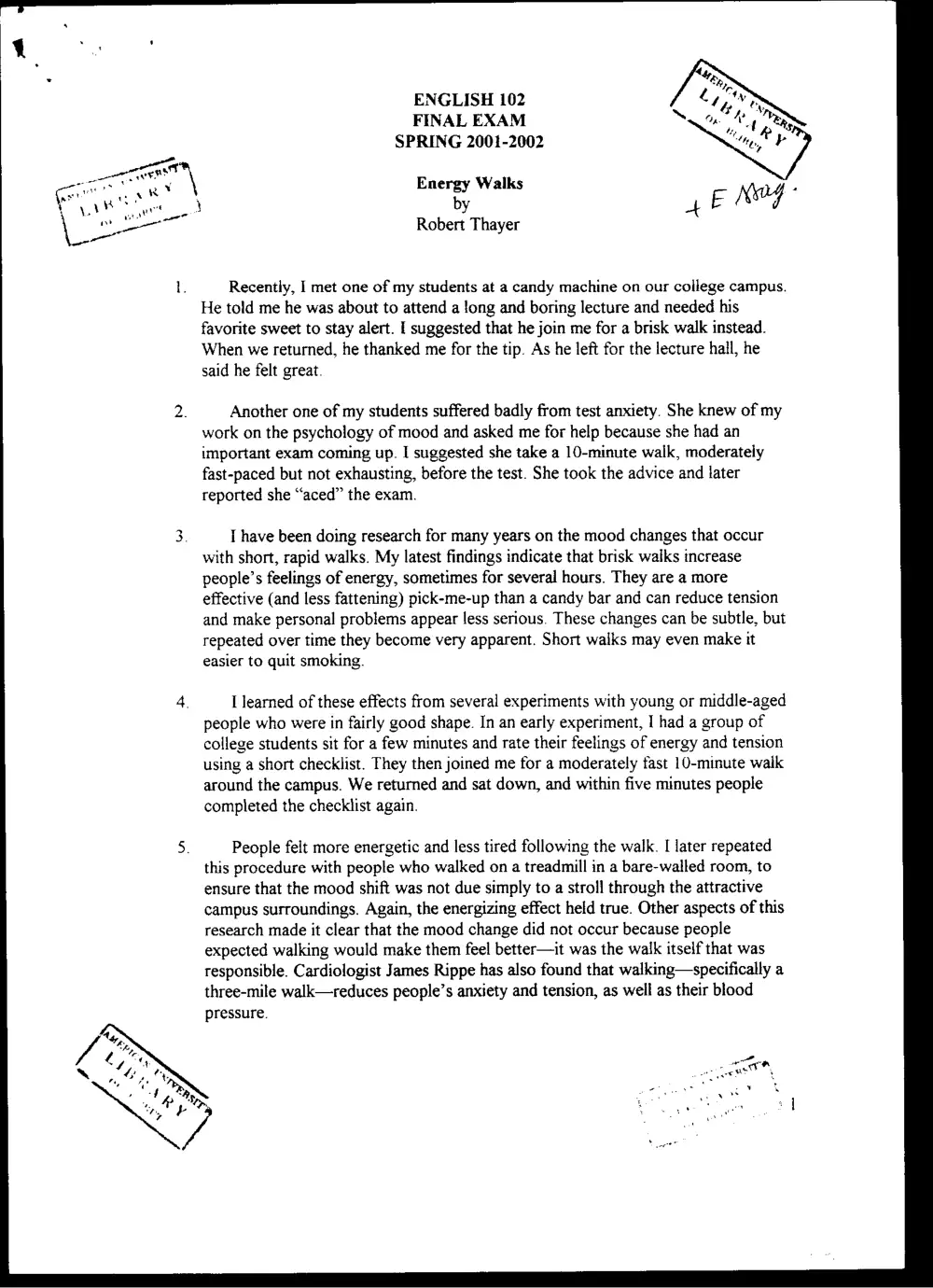
ENGLISH 102
FINAL EXAM
SPRING 2001-2002
ane Energy Walks
ey Be by
_ a Robert Thayer
1. Recently, I met one of my students at a candy machine on our college campus.
He told me he was about to attend a long and boring lecture and needed his
favorite sweet to stay alert. I suggested that he join me for a brisk walk instead.
When we returned, he thanked me for the tip. As he left for the lecture hall, he
said he felt great.
2. Another one of my students suffered badly from test anxiety. She knew of my
work on the psychology of mood and asked me for help because she had an
important exam coming up. I suggested she take a 10-minute walk, moderately
fast-paced but not exhausting, before the test. She took the advice and later
reported she “aced” the exam.
we
I have been doing research for many years on the mood changes that occur
with short, rapid walks. My latest findings indicate that brisk walks increase
people’s feelings of energy, sometimes for several hours. They are a more
effective (and less fattening) pick-me-up than a candy bar and can reduce tension
and make personal problems appear less serious. These changes can be subtle, but
repeated over time they become very apparent. Short walks may even make it
easier to quit smoking.
4. I learned of these effects from several experiments with young or middle-aged
people who were in fairly good shape. In an early experiment, I had a group of
college students sit for a few minutes and rate their feelings of energy and tension
using a short checklist. They then joined me for a moderately fast 10-minute walk
around the campus. We returmed and sat down, and within five minutes people
completed the checklist again.
5. People felt more energetic and less tired following the walk. I later repeated
this procedure with people who walked on a treadmill in a bare-walled room, to
ensure that the mood shift was not due simply to a stroll through the attractive
campus surroundings. Again, the energizing effect held true. Other aspects of this
research made it clear that the mood change did not occur because people
expected walking would make them feel better—it was the walk itself that was
responsible. Cardiologist James Rippe has also found that walking—specifically a
three-mile walk—reduces people’s anxiety and tension, as well as their blood
pressure.
10.
11.
12.
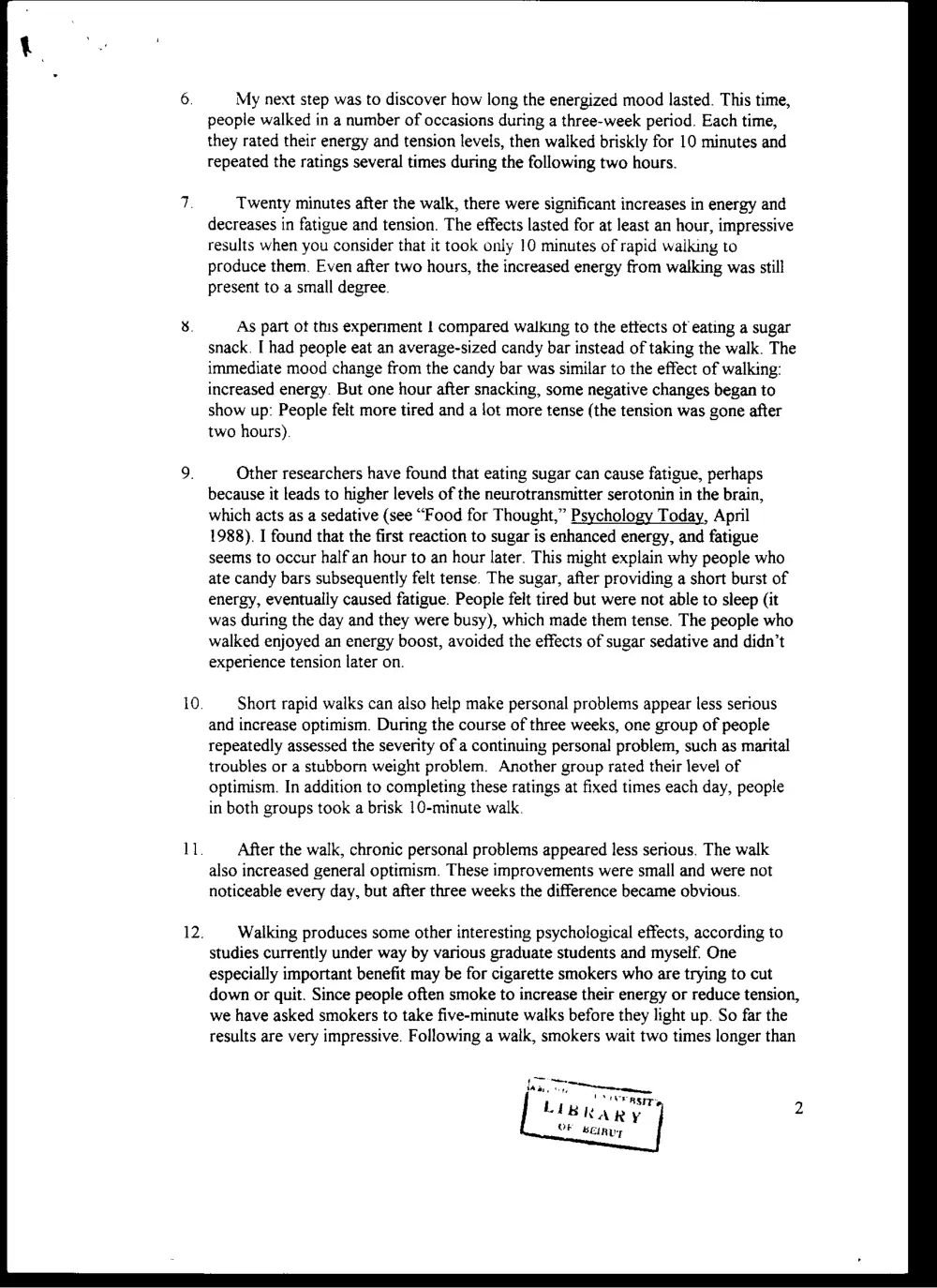
My next step was to discover how long the energized mood lasted. This time,
people walked in a number of occasions during a three-week period. Each time,
they rated their energy and tension levels, then walked briskly for 10 minutes and
repeated the ratings several times during the following two hours.
Twenty minutes after the walk, there were significant increases in energy and
decreases in fatigue and tension. The effects lasted for at least an hour, impressive
results when you consider that it took only 10 minutes of rapid waiking to
produce them. Even after two hours, the increased energy from walking was still
present to a small degree.
As part of this experiment | compared walking to the ettects of eating a sugar
snack. I had people eat an average-sized candy bar instead of taking the walk. The
immediate mood change from the candy bar was similar to the effect of walking:
increased energy. But one hour after snacking, some negative changes began to
show up: People felt more tired and a lot more tense (the tension was gone after
two hours).
Other researchers have found that eating sugar can cause fatigue, perhaps
because it leads to higher levels of the neurotransmitter serotonin in the brain,
which acts as a sedative (see “Food for Thought,” Psychology Today, April
1988). I found that the first reaction to sugar is enhanced energy, and fatigue
seems to occur half an hour to an hour later. This might explain why people who
ate candy bars subsequently felt tense. The sugar, after providing a short burst of
energy, eventually caused fatigue. People felt tired but were not able to sleep (it
was during the day and they were busy), which made them tense. The people who
walked enjoyed an energy boost, avoided the effects of sugar sedative and didn’t
experience tension later on.
Short rapid walks can also help make personal problems appear less serious
and increase optimism. During the course of three weeks, one group of people
repeatedly assessed the severity of a continuing personal problem, such as marital
troubles or a stubborn weight problem. Another group rated their level of
optimism. In addition to completing these ratings at fixed times each day, people
in both groups took a brisk 10-minute walk.
After the walk, chronic personal problems appeared less serious. The walk
also increased general optimism. These improvements were small and were not
noticeable every day, but after three weeks the difference became obvious.
Walking produces some other interesting psychological effects, according to
studies currently under way by various graduate students and myself. One
especially important benefit may be for cigarette smokers who are trying to cut
down or quit. Since people often smoke to increase their energy or reduce tension,
we have asked smokers to take five-minute walks before they light up. So far the
results are very impressive. Following a walk, smokers wait two times longer than
nonwalking smokers do between cigarettes during free-smoking periods. And
those who report the greatest energy increases from the walk wait the longest to
smoke the next cigarette.
. Walking is, of course, very good physical exercise. Beyond that, it feels good to
walk and at moderate walking speeds those good feelings occur right away. Try it
after you have been sitting for a while. Keep your posture erect but otherwise
relaxed, swing your arms freely and breathe normally. You don’t have to be a
dedicated athlete to walk, nor do you need to invest a lot of time and money. Ten
minutes should do it and the benefits — both mental and physical — should last a
lot longer.
ENGLISH 102
FINAL EXAM
SPRING 2001-2002
Teacher:
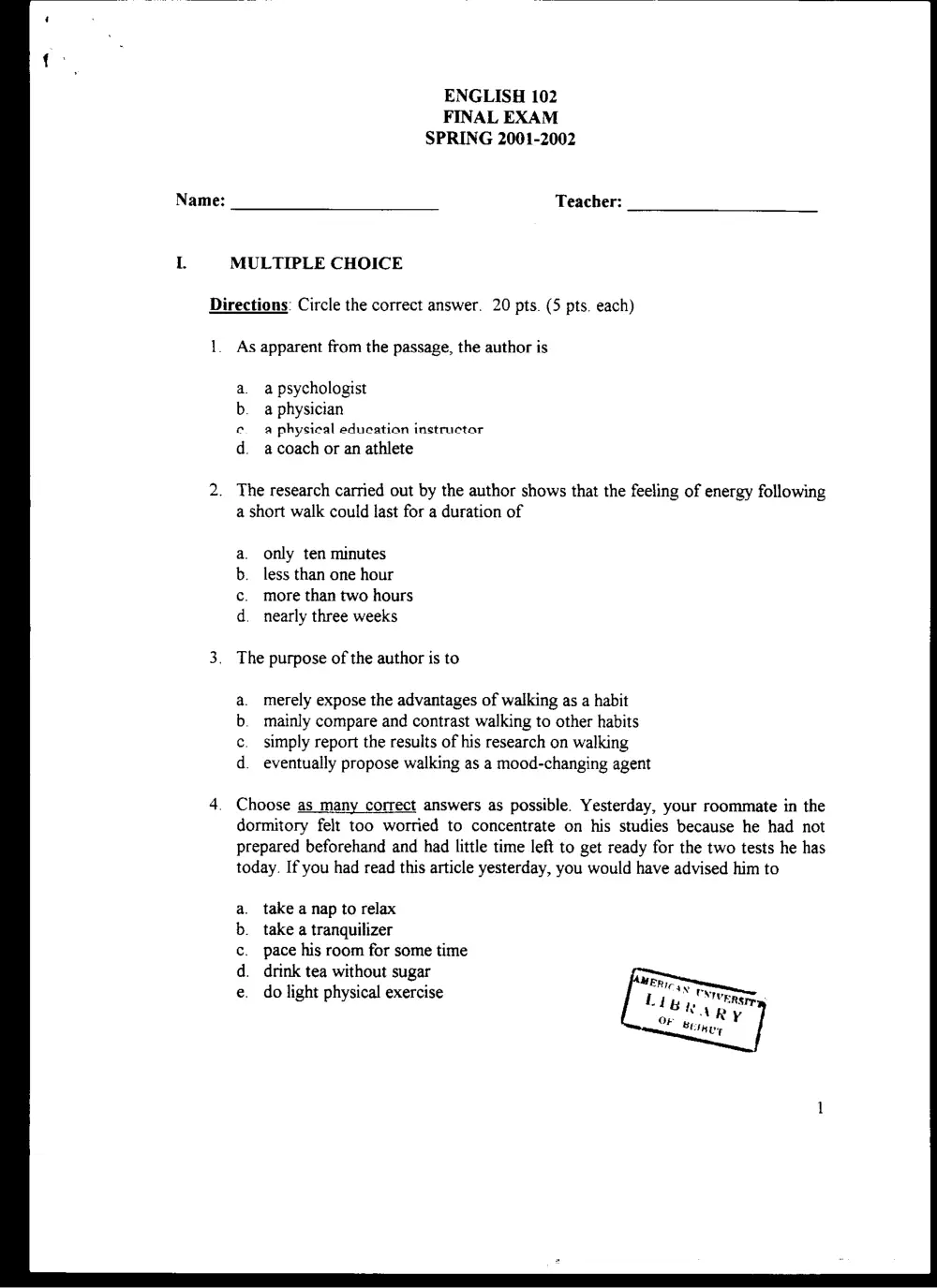
MULTIPLE CHOICE
Directions: Circle the correct answer. 20 pts. (5 pts. each)
1. As apparent from the passage, the author is
a psychologist
a physician
a physical education instructar
a coach or an athlete
. The research carried out by the author shows that the feeling of energy following
a short walk could last for a duration of
only ten minutes
less than one hour
. more than two hours
. nearly three weeks
The purpose of the author is to
merely expose the advantages of walking as a habit
mainly compare and contrast walking to other habits
. simply report the results of his research on walking
. eventually propose walking as a mood-changing agent
Choose as_many correct answers as possible. Yesterday, your roommate in the
dormitory felt too worried to concentrate on his studies because he had not
prepared beforehand and had little time left to get ready for the two tests he has
today. If you had read this article yesterday, you would have advised him to
. take a nap to relax
. take a tranquilizer
. pace his room for some time
. drink tea without sugar
do light physical exercise
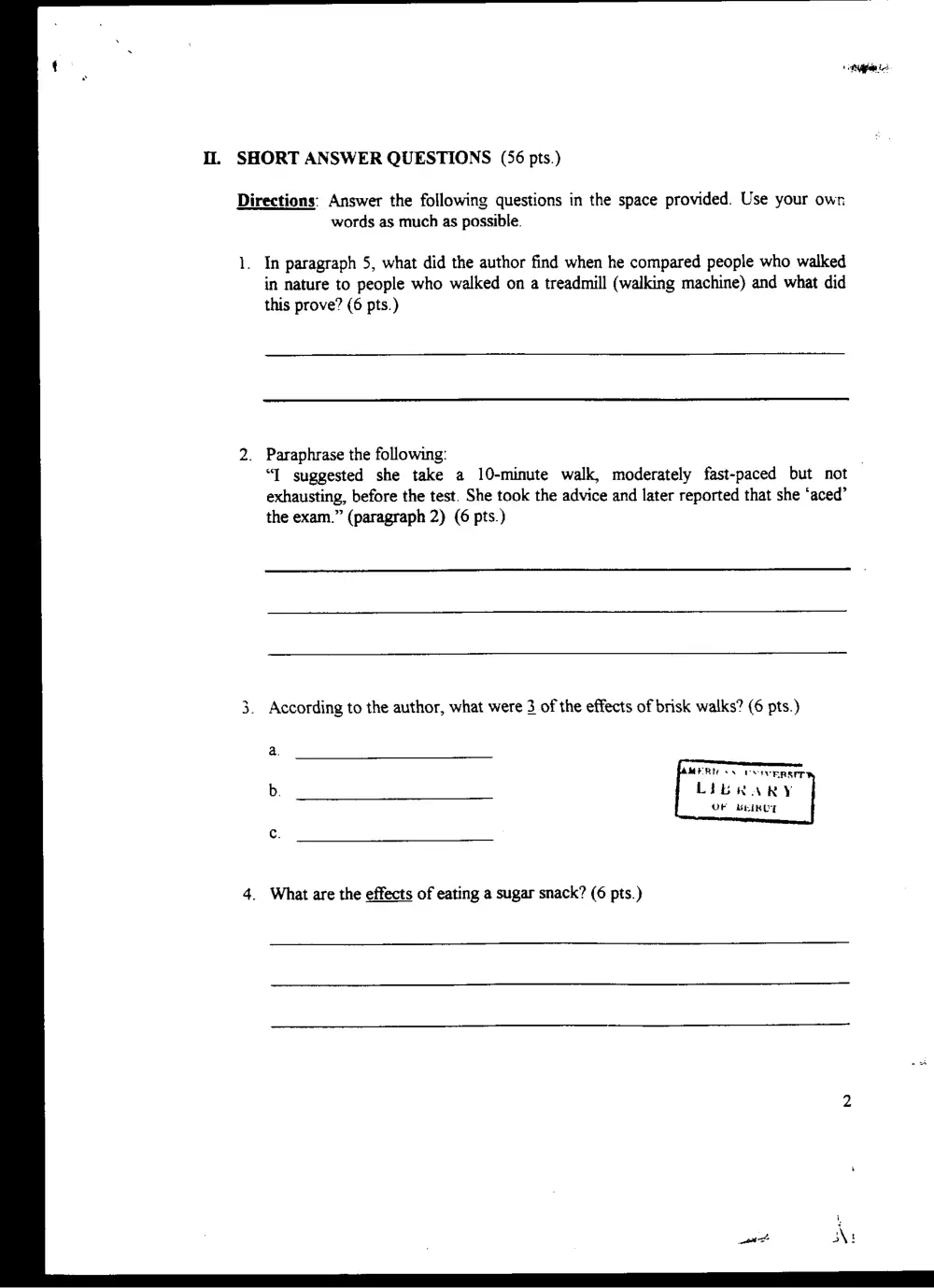
IL SHORT ANSWER QUESTIONS (56 pts.)
Directions: Answer the following questions in the space provided. Use your own
words as much as possible.
1. In paragraph 5, what did the author find when he compared people who walked
in nature to people who walked on a treadmill (walking machine) and what did
this prove? (6 pts.)
2. Paraphrase the following:
“I suggested she take a 10-minute walk, moderately fast-paced but not
exhausting, before the test. She took the advice and later reported that she ‘aced’
the exam.” (paragraph 2) (6 pts.)
we
According to the author, what were 3 of the effects of brisk walks? (6 pts.)
a.
MERTOOS Sm ER SET
b. LIBRARY
OF BEIRUT
C.
. What are the effects of eating a sugar snack? (6 pts.)
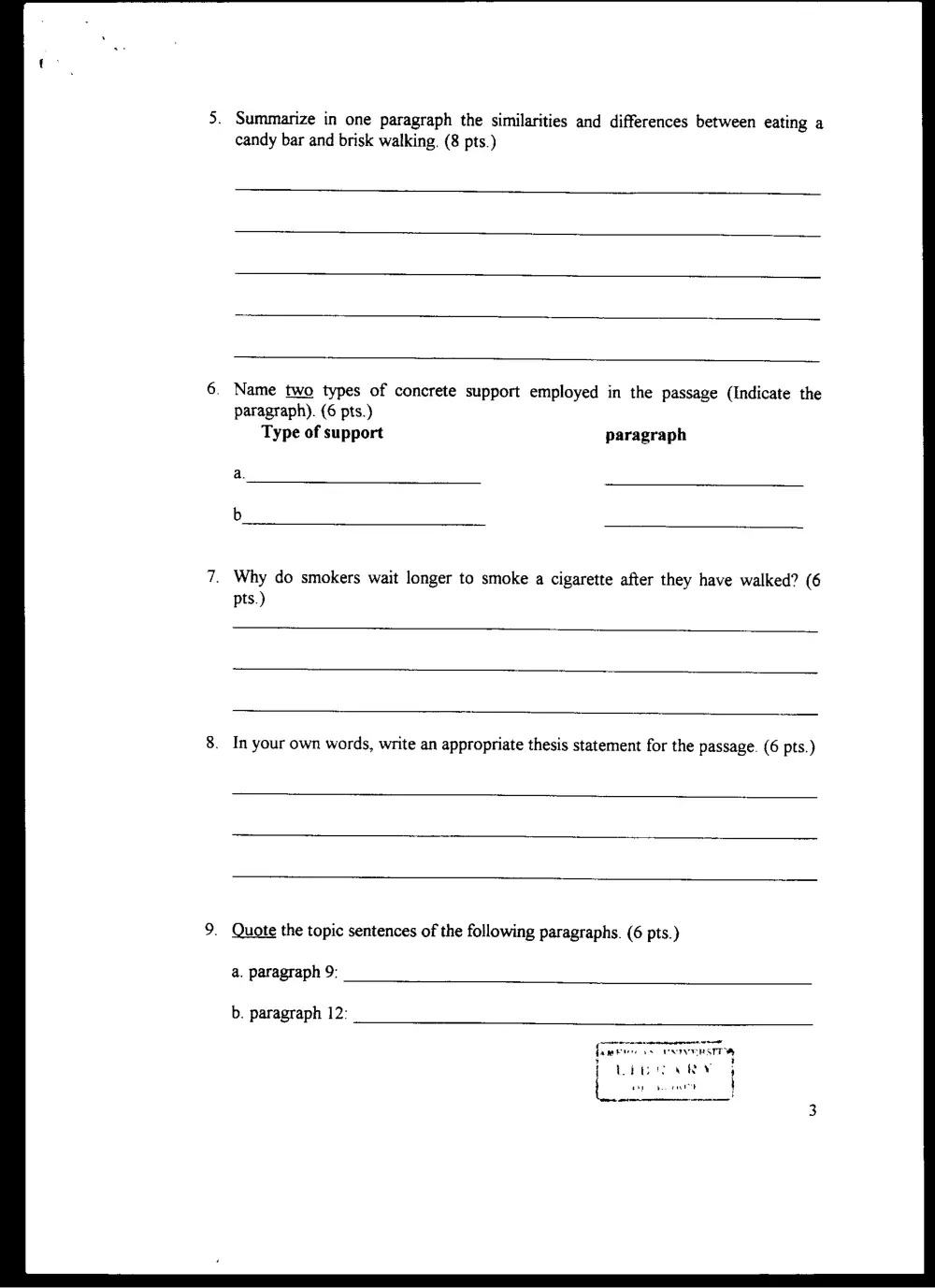
5. Summarize in one paragraph the similarities and differences between eating a
candy bar and brisk walking. (8 pts.)
. Name two types of concrete support employed in the passage (Indicate the
paragraph). (6 pts.)
Type of support paragraph
. Why do smokers wait longer to smoke a cigarette after they have walked? (6
pts.)
. In your own words, write an appropriate thesis statement for the passage. (6 pts.)
. Quote the topic sentences of the following paragraphs. (6 pts.)
a. paragraph 9:
b. paragraph 12:
as PRI ERSTT
i fiery ]
Lois” |
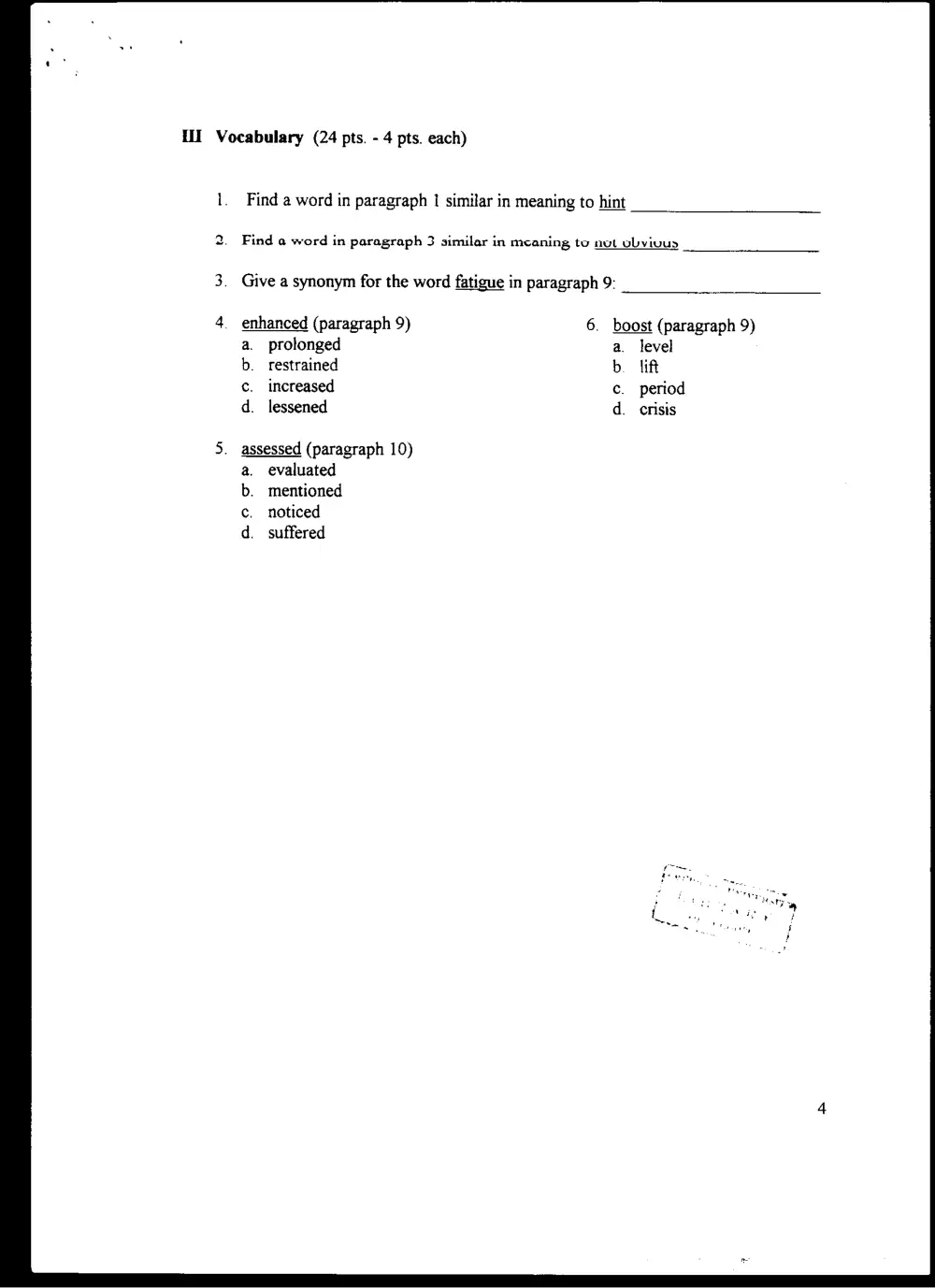
UI Vocabulary (24 pts. - 4 pts. each)
1. Find a word in paragraph 1 similar in meaning to hint
. Find a word in paragraph 3 similar in meaning to nut ubvivus
Give a synonym for the word fatigue in paragraph 9:
. enhanced (paragraph 9) 6. boost (paragraph 9)
a. prolonged . level
b. restrained lift
c. increased . period
d. lessened . crisis
. assessed (paragraph 10)
a. evaluated
b. mentioned
c. noticed
d. suffered
ENGLISH 102
FINAL EXAM
SPRING 2001-2002
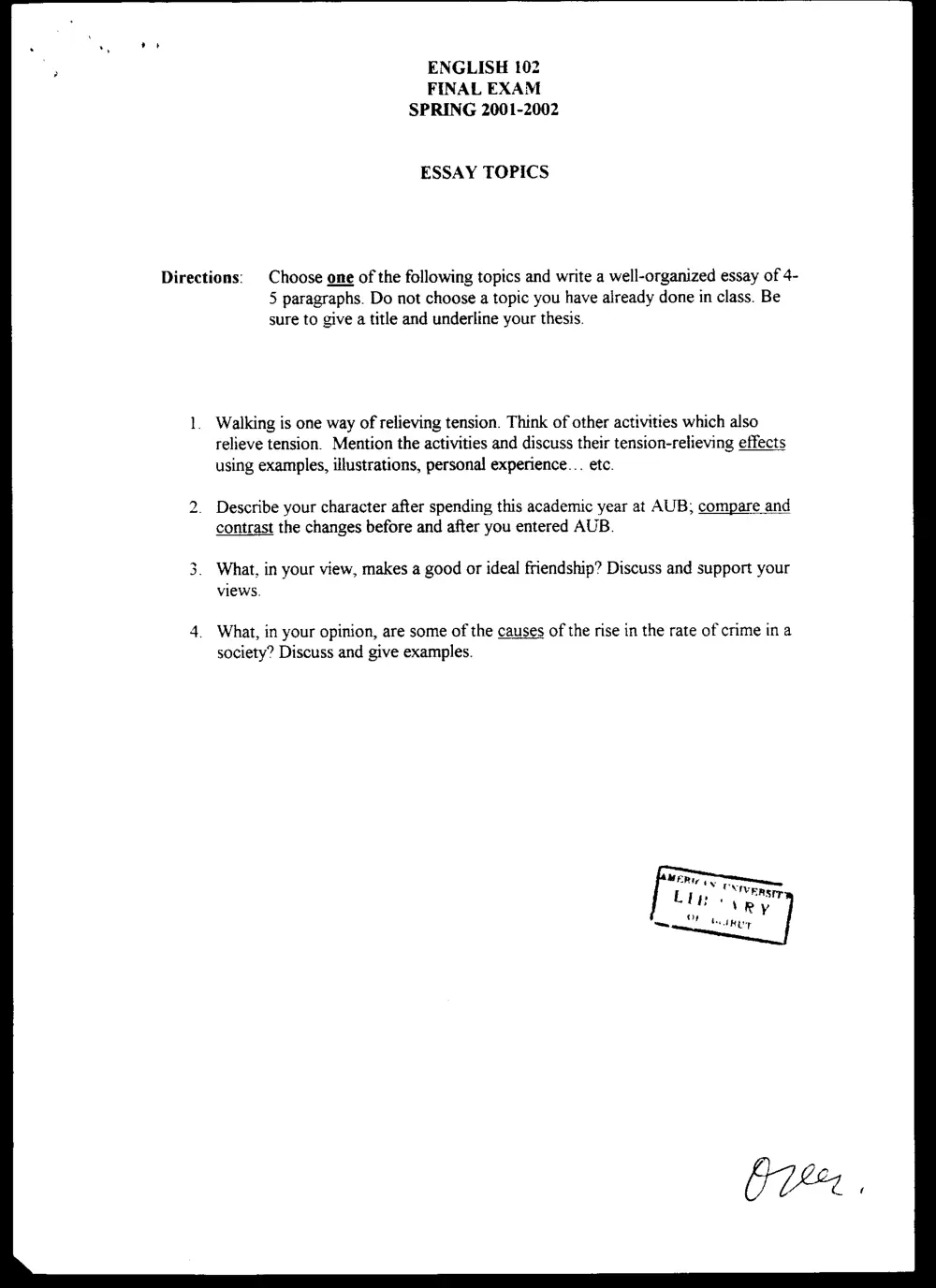
ESSAY TOPICS
Directions: | Choose one of the following topics and write a well-organized essay of 4-
5 paragraphs. Do not choose a topic you have already done in class. Be
sure to give a title and underline your thesis.
Walking is one way of relieving tension. Think of other activities which also
relieve tension. Mention the activities and discuss their tension-relieving effects
using examples, illustrations, personal experience... etc.
Describe your character after spending this academic year at AUB; compare and
contrast the changes before and after you entered AUB.
What, in your view, makes a good or ideal friendship? Discuss and support your
views.
What, in your opinion, are some of the causes of the rise in the rate of crime in a
society? Discuss and give examples.