
ENG 203 Final, Fall 2001
American University of Beirut · Academic English · 7 pages


More ENG 203 files
Show the text of this final exam
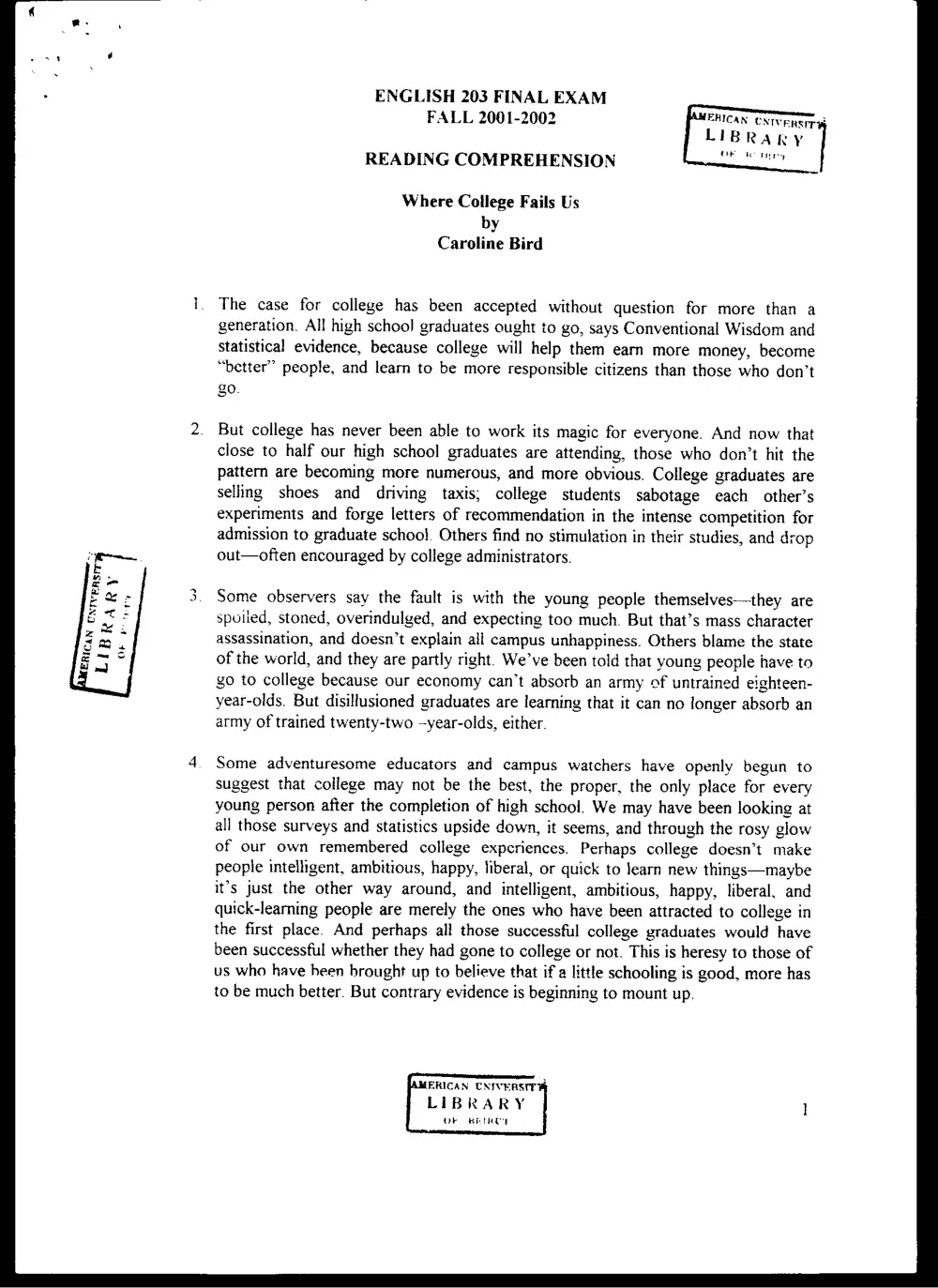
ENGLISH 203 FINAL EXAM
FALL 2001-2002 ERICAN CNIVERSIFR
LIBRARY ]
READING COMPREHENSION en
Where College Fails Us
by
Caroline Bird
The case for college has been accepted without question for more than a
generation. All high school graduates ought to go, says Conventional Wisdom and
Statistical evidence, because college will help them earn more money, become
“better” people, and learn to be more responsible citizens than those who don’t
go.
But college has never been able to work its magic for everyone. And now that
close to half our high school graduates are attending, those who don’t hit the
pattern are becoming more numerous, and more obvious. College graduates are
selling shoes and driving taxis; college students sabotage each other’s
experiments and forge letters of recommendation in the intense competition for
admission to graduate school. Others find no stimulation in their studies, and drop
out—often encouraged by college administrators.
Some observers say the fault is with the young people themselves—they are
spoiled, stoned, overindulged, and expecting too much. But that’s mass character
assassination, and doesn’t explain all campus unhappiness. Others blame the state
of the world, and they are partly right. We’ve been told that young people have to
go to college because our economy can’t absorb an army of untrained eighteen-
year-olds. But disillusioned graduates are learning that it can no longer absorb an
army of trained twenty-two —year-olds, either.
Some adventuresome educators and campus watchers have openly begun to
suggest that college may not be the best, the proper, the only place for every
young person after the completion of high school. We may have been looking at
all those surveys and statistics upside down, it seems, and through the rosy glow
of our own remembered college experiences. Perhaps college doesn’t make
people intelligent, ambitious, happy, fiberal, or quick to learn new things—maybe
it’s just the other way around, and intelligent, ambitious, happy, liberal, and
quick-learning people are merely the ones who have been attracted to college in
the first place. And perhaps all those successful college graduates would have
been successful whether they had gone to college or not. This is heresy to those of
us who have heen brought up to believe that if a little schooling is good, more has
to be much better. But contrary evidence is beginning to mount up.
ERICAN UNIVERSITA
LIBRARY
OF BEIRUT
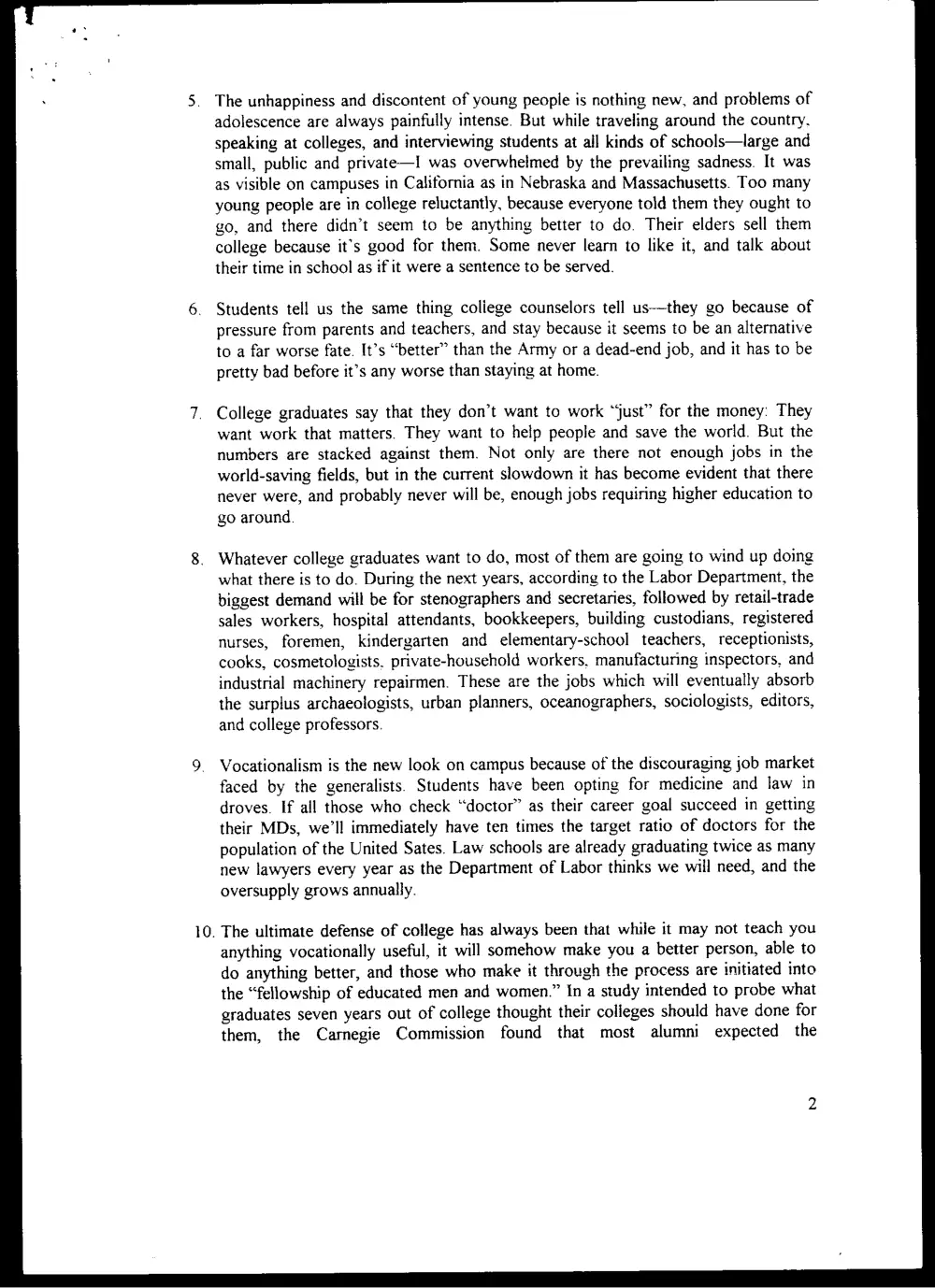
The unhappiness and discontent of young people is nothing new, and problems of
adolescence are always painfully intense. But while traveling around the country.
speaking at colleges, and interviewing students at all kinds of schools—large and
small, public and private—I was overwhelmed by the prevailing sadness. It was
as visible on campuses in California as in Nebraska and Massachusetts. Too many
young people are in college reluctantly, because everyone told them they ought to
go, and there didn’t seem to be anything better to do. Their elders sell them
college because it’s good for them. Some never learn to like it, and talk about
their time in school as if it were a sentence to be served.
Students tell us the same thing college counselors tell us—they go because of
pressure from parents and teachers, and stay because it seems to be an alternative
to a far worse fate. It’s “better” than the Army or a dead-end job, and it has to be
pretty bad before it’s any worse than staying at home.
College graduates say that they don’t want to work “just” for the money: They
want work that matters. They want to help people and save the world. But the
numbers are stacked against them. Not only are there not enough jobs in the
world-saving fields, but in the current slowdown it has become evident that there
never were, and probably never will be, enough jobs requiring higher education to
go around.
Whatever college graduates want to do, most of them are going to wind up doing
what there is to do. During the next years, according to the Labor Department, the
biggest demand will be for stenographers and secretaries, followed by retail-trade
sales workers, hospital attendants, bookkeepers, building custodians, registered
nurses, foremen, kindergarten and elementary-school teachers, receptionists,
cooks, cosmetologists, private-household workers, manufacturing inspectors, and
industrial machinery repairmen. These are the jobs which will eventually absorb
the surplus archaeologists, urban planners, oceanographers, sociologists, editors,
and college professors.
Vocationalism is the new look on campus because of the discouraging job market
faced by the generalists. Students have been opting for medicine and law in
droves. If all those who check “doctor” as their career goal succeed in getting
their MDs, we’ll immediately have ten times the target ratio of doctors for the
population of the United Sates. Law schools are already graduating twice as many
new lawyers every year as the Department of Labor thinks we will need, and the
oversupply grows annually.
_ The ultimate defense of college has always been that while it may not teach you
anything vocationally useful, it will somehow make you a better person, able to
do anything better, and those who make it through the process are initiated into
the “fellowship of educated men and women.” In a study intended to probe what
graduates seven years out of college thought their colleges should have done for
them, the Carnegie Commission found that most alumni expected the
“development of my abilities to think and express myself.” But if such respected
educational psychologists as Bruner and Piaget are right, specific learning skills
have to be acquired very early in life, perhaps even before formal schooling
begins.
So, when pressed, liberal-arts defenders speak instead about something more
encompassing, and more elusive. “College changed me inside,” one graduate told
us fervently. The authors of a Carnegie Commission report, who obviously
struggled for a definition, concluded that one of the common threads in the
perceptions of a liberal education is that it provides “an integrated view of the
world which can serve as an inner guide.” More simply, alumni say that college
should have “helped me to formulate the values and goals of my life.”
_In theory, a student is taught to develop these values and goals himself, but in
practice, it doesn’t work quite that way. All but the wayward and the saintly take
their sense of the good, the true, and the beautiful from the people around them.
When we speak of students acquiring “values” in college, we often mean that they
will acquire the values—and sometimes that means only the tastes—of their
professors. The values of professors may be “higher” than many students will
encounter elsewhere, but they may not be relevant to situations in which students
find themselves in college and later.
It had always been comfortable for students to believe that authorities, like
Mother, or outside specialists, like educators, could determine what was best for
them. However, specialists and authorities no longer enjoy the credibility former
generations accorded them. Patients talk back to doctors and are not struck
suddenly dead. Clients question the lawyer’s bills and sometimes get them
reduced. It is no longer self-evident that all adolescents must study a fixed
curriculum that was constructed at a time when all educated men could agree on
precisely what it was that made them educated.
_The same with college. If high school graduates don’t want to continue their
education, or don’t want to continue it right away, they may perceive more clearly
than their elders that college is not for them.
_ College is an ideal place for those young adults who love learning for its own
sake. Who would rather read than eat, and who like nothing better than writing
research papers. But they are a minority, even at the prestigious colleges, which
recruit and attract the intellectually oriented.
_The rest of our high school graduates need to look at college more closely and
critically, to examine it as a consumer product, and decide if the cost in dollars, in
time, in continued dependency, and in future returns, is worth the very large
investment each student—and his family—must make.
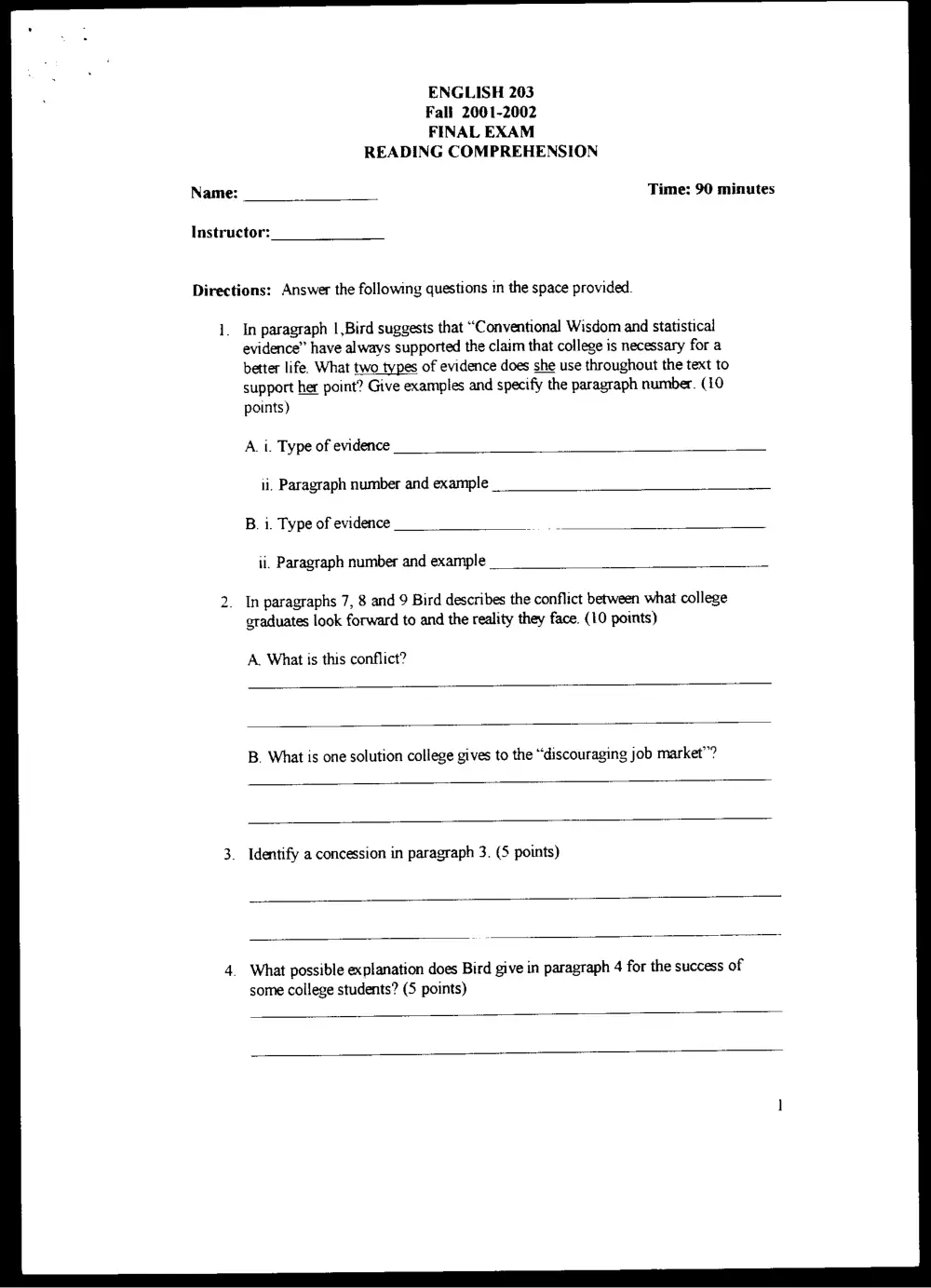
ENGLISH 203
Fall 2001-2002
FINAL EXAM
READING COMPREHENSION
Name: Time: 90 minutes
Instructor:
Directions: Answer the following questions in the space provided.
1. In paragraph | Bird suggests that “Conventional Wisdom and statistical
evidence” have always supported the claim that college is necessary for a
better life. What two types of evidence does she use throughout the text to
support her point? Give examples and specify the paragraph number. (10
points)
A. i. Type of evidence
ii, Paragraph number and example
B. i. Type of evidence
ii, Paragraph number and example
. In paragraphs 7, 8 and 9 Bird describes the conflict between what college
graduates look forward to and the reality they face. (10 points)
A. What is this conflict?
B. What is one solution college gives to the “discouraging job market”?
. Identify a concession in paragraph 3. (5 points)
_ What possible explanation does Bird give in paragraph 4 for the success of
some college students? (5 points)
5. Describe the relationship between students and figures of authority that the
author outlines in the text. (5 points)
Why is Bird in paragraph 12 doubtful about students acquiring “values” in
college? (5 points)
Throughout the text, Bird incorporates arguments from the opposing view and
then refutes them. Identify two counterarguments and their refutations.
Specify the paragraph numbers. (20 points)
Counterargument |:
Refutation 1: _
Counterargument 2:
Refutation 2:
In your own words explain what the writer means by the following
expressions: (20 points)
A. “that’s mass character assassination” (paragraph 3)
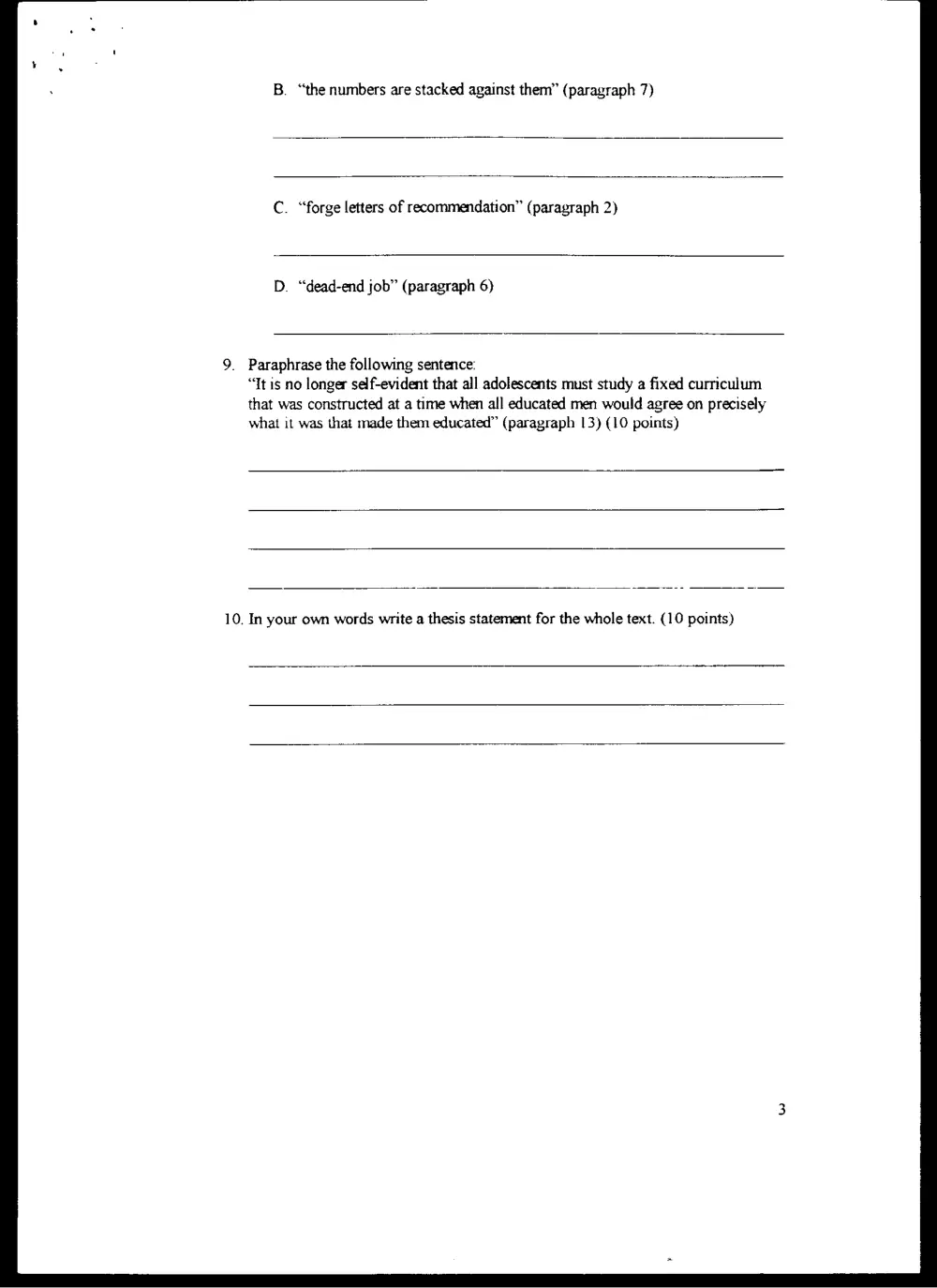
B. “the numbers are stacked against them” (paragraph 7)
C. “forge letters of recommendation” (paragraph 2)
D. “dead-end job” (paragraph 6)
9. Paraphrase the following sentence:
“It is no longer self-evident that all adolescents must study a fixed curriculum
that was constructed at a time when all educated men would agree on precisely
what it was that made them educated” (paragraph 13) (10 points)
10. In your own words write a thesis statement for the whole text. (10 points)
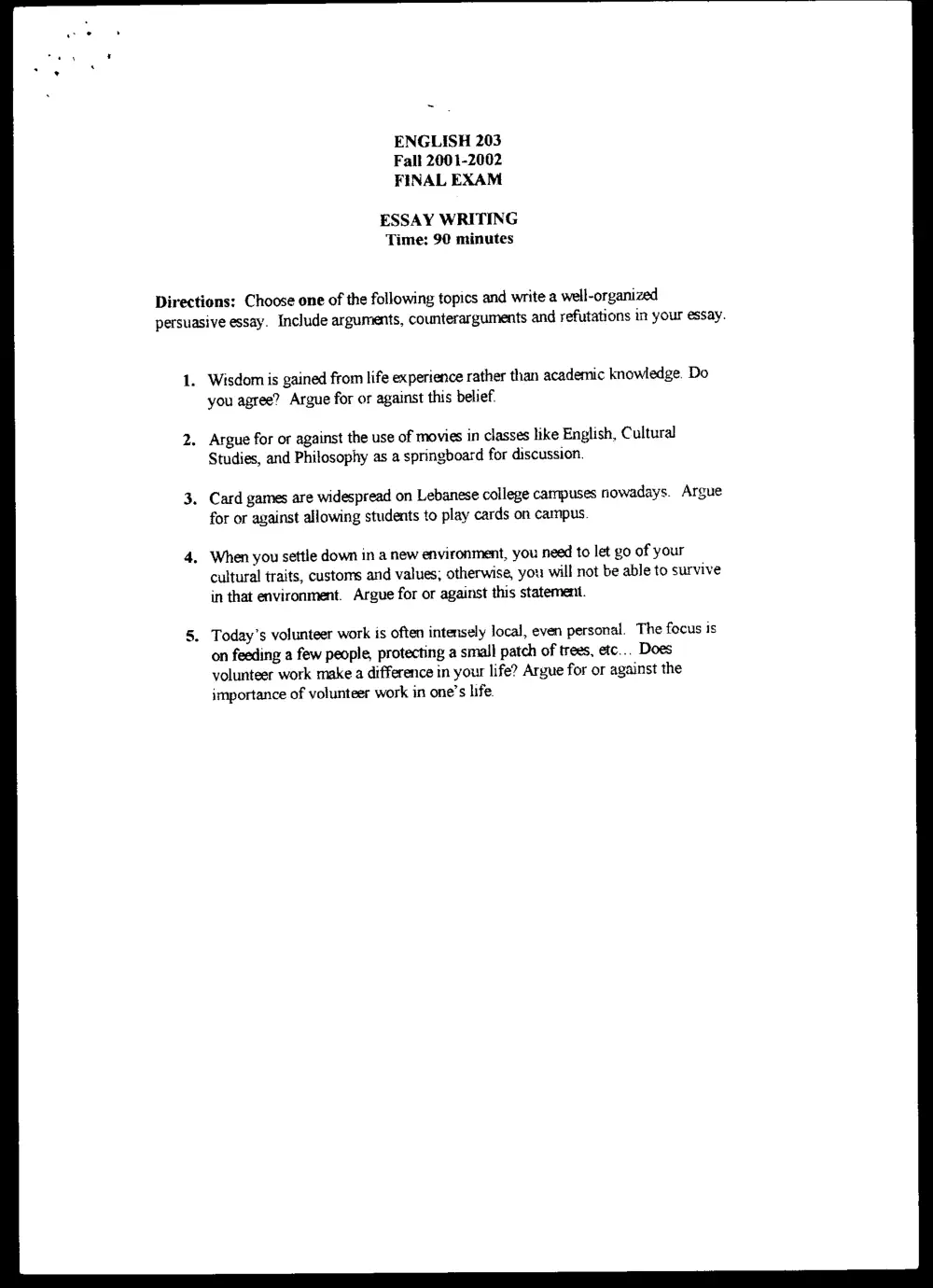
ENGLISH 203
Fall 2001-2002
FINAL EXAM
ESSAY WRITING
Time: 90 minutes
Directions: Choose one of the following topics and write a well-organized
persuasive essay. Include arguments, counterarguments and refutations in your essay.
. Wisdom is gained from life experience rather than academic knowledge. Do
you agree? Argue for or against this belief.
. Argue for or against the use of movies in classes like English, Cultural
Studies, and Philosophy as a springboard for discussion.
. Card games are widespread on Lebanese college campuses nowadays. Argue
for or against allowing students to play cards on campus.
. When you settle down in a new environment, you need to let go of your
cultural traits, customs and values; otherwise, you will not be able to survive
in that environment. Argue for or against this statement.
. Today’s volunteer work is often intensely local, even personal. The focus is
on feeding a few people, protecting a small patch of trees, etc... Does
volunteer work make a difference in your life? Argue for or against the
importance of volunteer work in one’s life.