
ENG 203 Final, Fall 2004
American University of Beirut · Academic English · 2 pages
More ENG 203 files
Show the text of this final exam
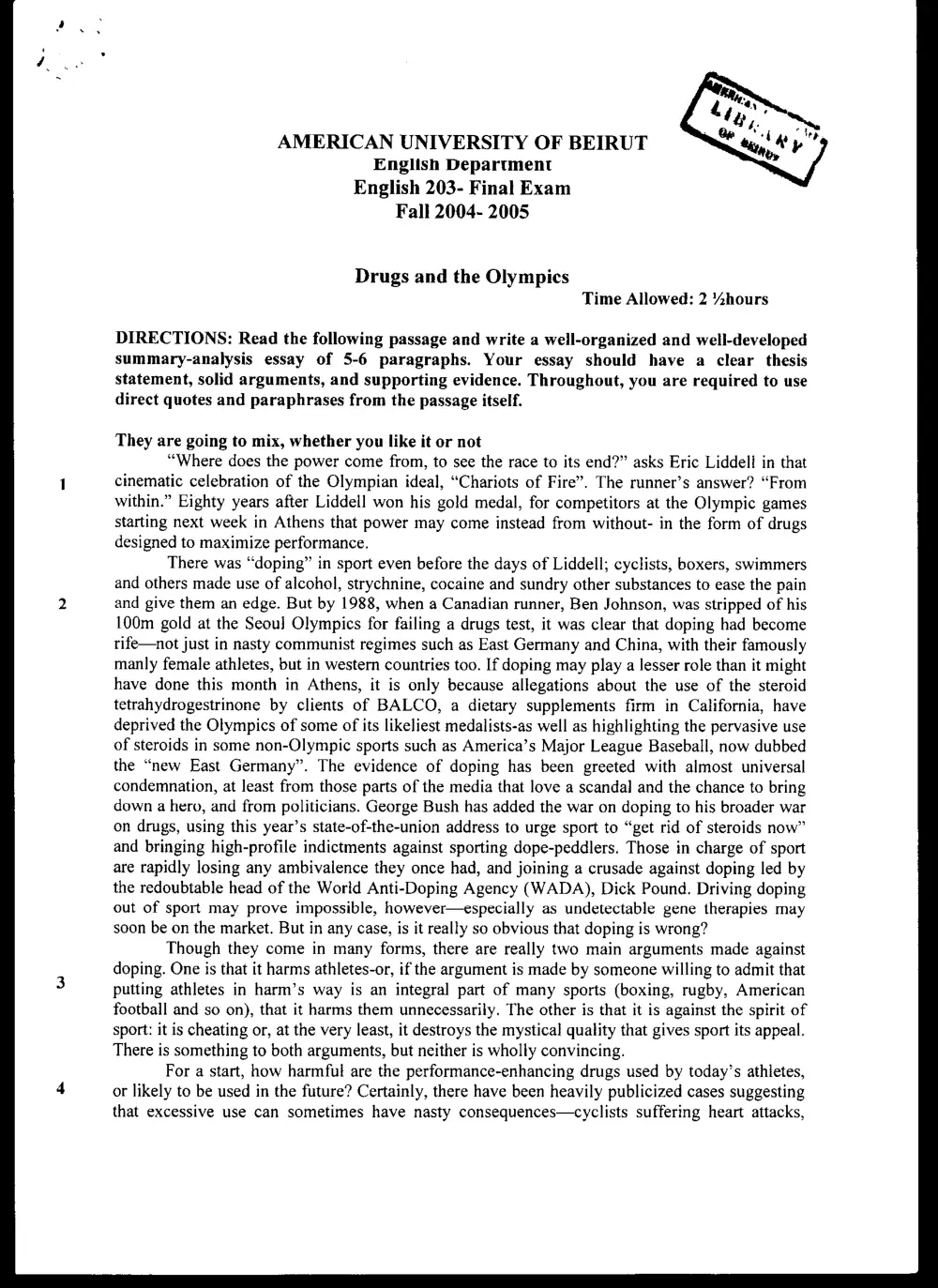
AMERICAN UNIVERSITY OF BEIRUT
English Department
English 203- Final Exam
Fall 2004- 2005
Drugs and the Olympics
Time Allowed: 2 “hours
DIRECTIONS: Read the following passage and write a well-organized and well-developed
summary-analysis essay of 5-6 paragraphs. Your essay should have a clear thesis
statement, solid arguments, and supporting evidence. Throughout, you are required to use
direct quotes and paraphrases from the passage itself.
They are going to mix, whether you like it or not
“Where does the power come from, to see the race to its end?” asks Eric Liddell in that
cinematic celebration of the Olympian ideal, “Chariots of Fire”. The runner’s answer? “From
within.” Eighty years after Liddell won his gold medal, for competitors at the Olympic games
starting next week in Athens that power may come instead from without- in the form of drugs
designed to maximize performance.
There was “doping” in sport even before the days of Liddell; cyclists, boxers, swimmers
and others made use of alcohol, strychnine, cocaine and sundry other substances to ease the pain
and give them an edge. But by 1988, when a Canadian runner, Ben Johnson, was stripped of his
100m gold at the Seouj Olympics for failing a drugs test, it was clear that doping had become
rife—not just in nasty communist regimes such as East Germany and China, with their famously
manly female athletes, but in western countries too. If doping may play a lesser role than it might
have done this month in Athens, it is only because allegations about the use of the steroid
tetrahydrogestrinone by clients of BALCO, a dietary supplements firm in California, have
deprived the Olympics of some of its likeliest medalists-as well as highlighting the pervasive use
of steroids in some non-Olympic sports such as America’s Major League Baseball, now dubbed
the “new East Germany”. The evidence of doping has been greeted with almost universal
condemnation, at least from those parts of the media that love a scandal and the chance to bring
down a hero, and from politicians. George Bush has added the war on doping to his broader war
on drugs, using this year’s state-of-the-union address to urge sport to “get rid of steroids now”
and bringing high-profile indictments against sporting dope-peddlers. Those in charge of sport
are rapidly losing any ambivalence they once had, and joining a crusade against doping led by
the redoubtable head of the World Anti-Doping Agency (WADA), Dick Pound. Driving doping
out of sport may prove impossible, however—especially as undetectable gene therapies may
soon be on the market. But in any case, is it really so obvious that doping is wrong?
Though they come in many forms, there are really two main arguments made against
doping. One is that it harms athletes-or, if the argument is made by someone willing to admit that
putting athletes in harm’s way is an integral part of many sports (boxing, rugby, American
football and so on), that it harms them unnecessarily. The other is that it is against the spirit of
sport: it is cheating or, at the very least, it destroys the mystical quality that gives sport its appeal.
There is something to both arguments, but neither is wholly convincing.
For a start, how harmful are the performance-enhancing drugs used by today’s athletes,
or likely to be used in the future? Certainly, there have been heavily publicized cases suggesting
that excessive use can sometimes have nasty consequences—cyclists suffering heart attacks,
perhaps because of the oxygen-storage boosting but blood-thickening steroid EPO, or drug-
expanded body-builders who are deeply depressed—though these examples are isolated, and
may not be entirely as they appear. Some of the drugs used in East Germany had severe
consequences, including gender-bending, but these were often given to the athletes with neither
their knowledge nor any concern for the consequences after the gold medal was won. There are
grounds to worry about the reportedly widespread use of steroids by children, who may, among
other things, lack the maturity (physical and mental) to handle them. But the balance of the
medical evidence-which would be harder to gather in an era of outright prohibition- suggests
that, used responsibility, today’s more popular performance-enhancers mostly have only
temporary side-effects, at worst. (“Gene-doping”, done properly, may well prove to have no
side-effects at all.) And any such harm pales beside that known to be done by, say, smoking
tobacco and drinking alcohol—activities not unknown among athletes, but not likely to be
banned anytime soon by the sporting authorities.
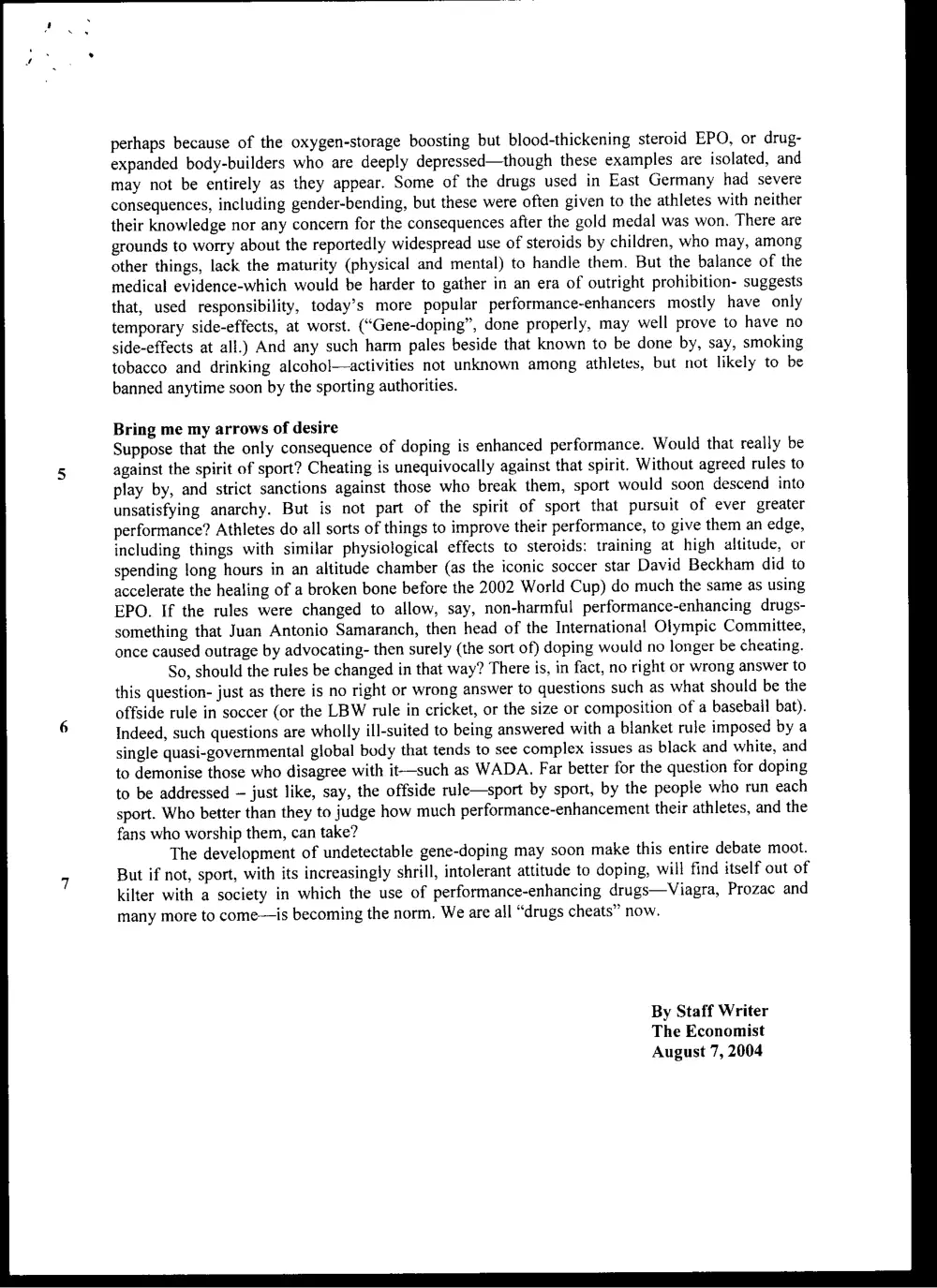
Bring me my arrows of desire
Suppose that the only consequence of doping is enhanced performance. Would that really be
against the spirit of sport? Cheating is unequivocally against that spirit. Without agreed rules to
play by, and strict sanctions against those who break them, sport would soon descend into
unsatisfying anarchy. But is not part of the spirit of sport that pursuit of ever greater
performance? Athletes do all sorts of things to improve their performance, to give them an edge,
including things with similar physiological effects to steroids: training at high altitude, or
spending long hours in an altitude chamber (as the iconic soccer star David Beckham did to
accelerate the healing of a broken bone before the 2002 World Cup) do much the same as using
EPO, If the rules were changed to allow, say, non-harmful performance-enhancing drugs-
something that Juan Antonio Samaranch, then head of the International Olympic Committee,
once caused outrage by advocating- then surely (the sort of) doping would no longer be cheating.
So, should the rules be changed in that way? There is, in fact, no right or wrong answer to
this question- just as there is no right or wrong answer to questions such as what should be the
offside rule in soccer (or the LBW rule in cricket, or the size or composition of a basebail bat).
Indeed, such questions are wholly ill-suited to being answered with a blanket rule imposed by a
single quasi-governmental global body that tends to see complex issues as black and white, and
to demonise those who disagree with it—such as WADA. Far better for the question for doping
to be addressed — just like, say, the offside rule—sport by sport, by the people who run each
sport. Who better than they to judge how much performance-enhancement their athletes, and the
fans who worship them, can take?
The development of undetectable gene-doping may soon make this entire debate moot.
But if not, sport, with its increasingly shrill, intolerant attitude to doping, will find itself out of
kilter with a society in which the use of performance-enhancing drugs—Viagra, Prozac and
many more to come—is becoming the norm. We are all “drugs cheats” now.
By Staff Writer
The Economist
August 7, 2004