
ENG 203 Final, Spring 2003
American University of Beirut · Academic English · 7 pages
More ENG 203 files
Show the text of this final exam
MELEE AN ENT
LIBiwid
mon
}
BIKE \
OF BHIKET {
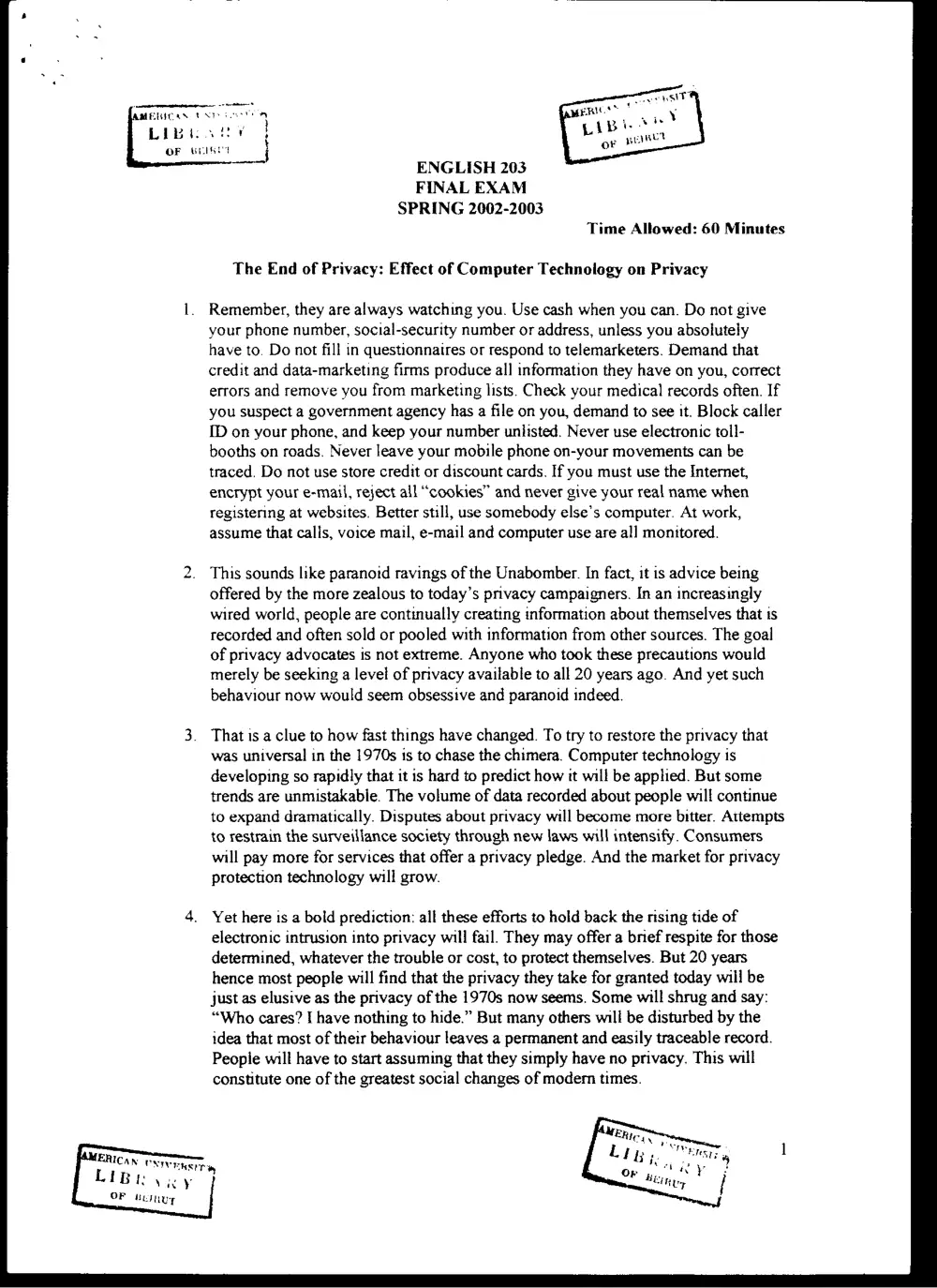
ENGLISH 203
FINAL EXAM
SPRING 2002-2003
Time Allowed: 60 Minutes
The End of Privacy: Effect of Computer Technology on Privacy
1. Remember, they are always watching you. Use cash when you can. Do not give
your phone number, social-security number or address, unless you absolutely
have to. Do not fill in questionnaires or respond to telemarketers. Demand that
credit and data-marketing firms produce all information they have on you, correct
errors and remove you from marketing lists. Check your medical records often. If
you suspect a government agency has a file on you, demand to see it. Block caller
ID on your phone, and keep your number unlisted. Never use electronic toll-
booths on roads. Never leave your mobile phone on-your movements can be
traced. Do not use store credit or discount cards. If you must use the Internet,
encrypt your e-mail, reject all “cookies” and never give your real name when
registering at websites. Better still, use somebody else’s computer. At work,
assume that calls, voice mail, e-mail and computer use are all monitored.
2. This sounds like paranoid ravings of the Unabomber. In fact, it is advice being
offered by the more zealous to today’s privacy campaigners. In an increasingly
wired world, people are continually creating information about themselves that is
recorded and often sold or pooled with information from other sources. The goal
of privacy advocates is not extreme. Anyone who took these precautions would
merely be seeking a level of privacy available to all 20 years ago. And yet such
behaviour now would seem obsessive and paranoid indeed.
3. That is a clue to how fast things have changed. To try to restore the privacy that
was universal in the 1970s is to chase the chimera. Computer technology is
developing so rapidly that it is hard to predict how it will be applied. But some
trends are unmistakable. The volume of data recorded about people will continue
to expand dramatically. Disputes about privacy will become more bitter. Attempts
to restrain the surveillance society through new laws will intensify. Consumers
will pay more for services that offer a privacy pledge. And the market for privacy
protection technology will grow.
4. Yet here is a bold prediction: all these efforts to hold back the rising tide of
electronic intrusion into privacy will fail. They may offer a brief respite for those
determined, whatever the trouble or cost, to protect themselves. But 20 years
hence most people will find that the privacy they take for granted today will be
just as elusive as the privacy of the 1970s now seems. Some will shrug and say:
“Who cares? I have nothing to hide.” But many others will be disturbed by the
idea that most of their behaviour leaves a permanent and easily traceable record.
People will have to start assuming that they simply have no privacy. This will
constitute one of the greatest social changes of modern times.
OF Belhuy
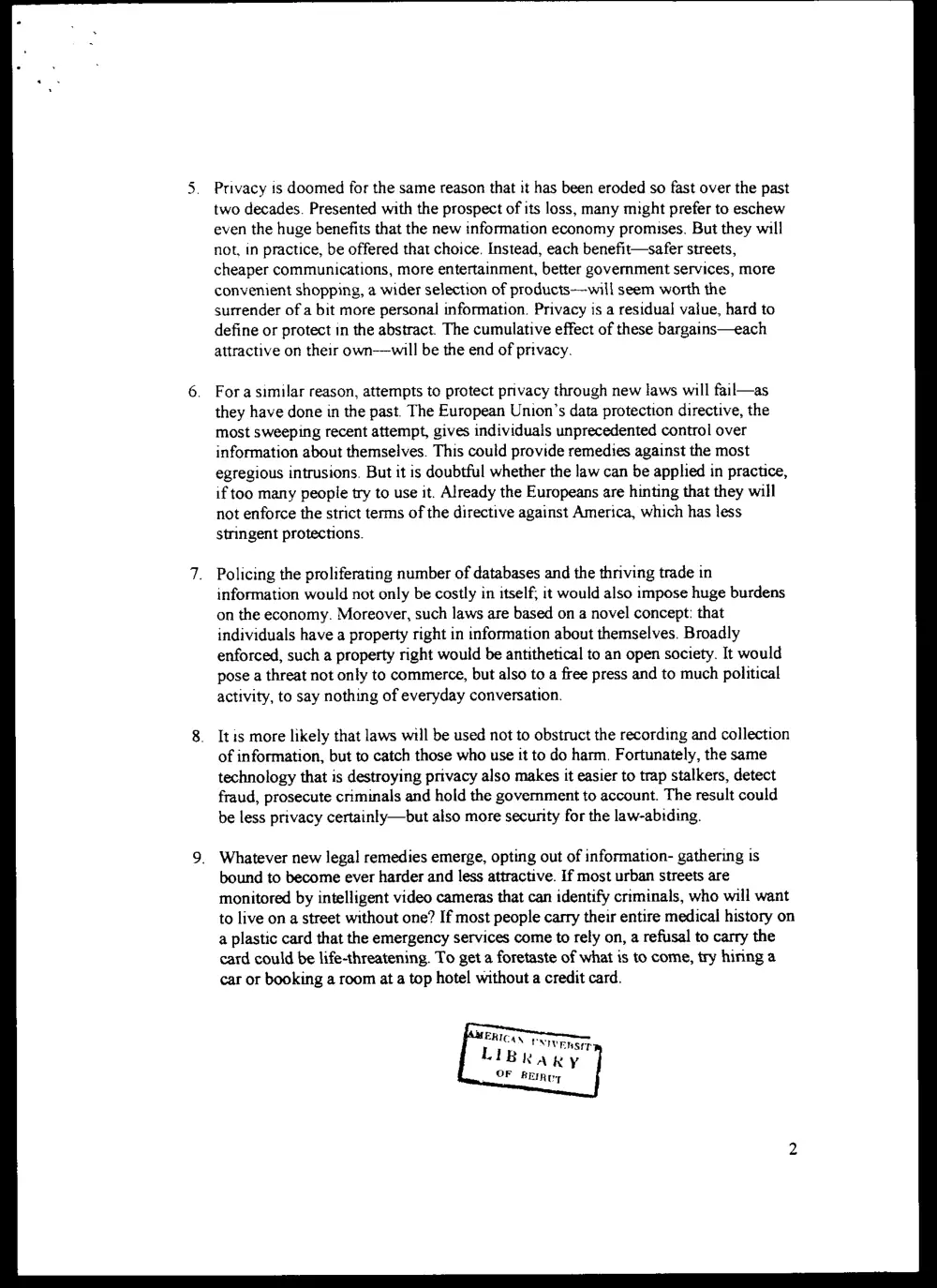
Privacy is doomed for the same reason that it has been eroded so fast over the past
two decades. Presented with the prospect of its loss, many might prefer to eschew
even the huge benefits that the new information economy promises. But they will
not, in practice, be offered that choice. Instead, each benefit—safer streets,
cheaper communications, more entertainment, better government services, more
convenient shopping, a wider selection of products—will seem worth the
surrender of a bit more personal information. Privacy is a residual value, hard to
define or protect in the abstract. The cumulative effect of these bargains—each
attractive on their own-—will be the end of privacy.
For a similar reason, attempts to protect privacy through new laws will fail—as
they have done in the past. The European Union’s data protection directive, the
most sweeping recent attempt, gives individuals unprecedented control over
information about themselves. This could provide remedies against the most
egregious intrusions. But it is doubtful whether the law can be applied in practice,
if too many people try to use it. Already the Europeans are hinting that they will
not enforce the strict terms of the directive against America, which has less
stringent protections.
Policing the proliferating number of databases and the thriving trade in
information would not only be costly in itself; it would also impose huge burdens
on the economy. Moreover, such laws are based on a novel concept: that
individuals have a property right in information about themselves. Broadly
enforced, such a property right would be antithetical to an open society. It would
pose a threat not only to commerce, but also to a free press and to much political
activity, to say nothing of everyday conversation.
It is more likely that laws will be used not to obstruct the recording and collection
of information, but to catch those who use it to do harm. Fortunately, the same
technology that is destroying privacy also makes it easier to trap stalkers, detect
fraud, prosecute criminals and hold the government to account. The result could
be less privacy certainly—but also more security for the law-abiding.
Whatever new legal remedies emerge, opting out of information- gathering is
bound to become ever harder and less attractive. If most urban streets are
monitored by intelligent video cameras that can identify criminals, who will want
to live on a street without one? If most people carry their entire medical history on
a plastic card that the emergency services come to rely on, a refusal to carry the
card could be life-threatening. To get a foretaste of what is to come, try hiring a
car or booking a room at a top hotel without a credit card.
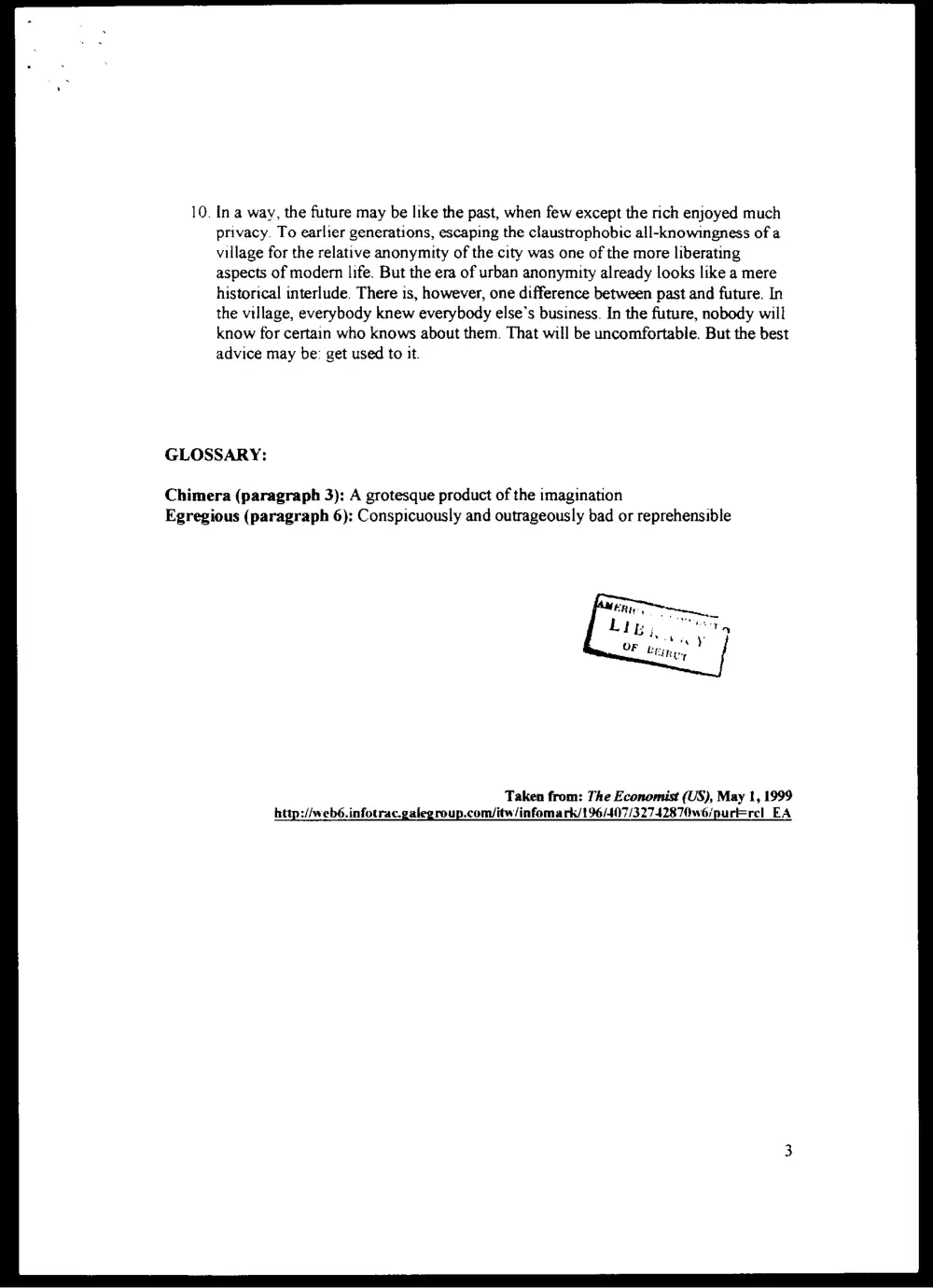
10. In a way, the future may be like the past, when few except the rich enjoyed much
privacy. To earlier generations, escaping the claustrophobic all-knowingness of a
village for the relative anonymity of the city was one of the more liberating
aspects of modern life. But the era of urban anonymity already looks like a mere
historical interlude. There is, however, one difference between past and future. In
the village, everybody knew everybody else’s business. In the future, nobody will
know for certain who knows about them. That will be uncomfortable. But the best
advice may be: get used to it.
GLOSSARY:
Chimera (paragraph 3): A grotesque product of the imagination
Egregious (paragraph 6): Conspicuously and outrageously bad or reprehensible
Taken from: The Economist (US), May 1, 1999
http://web6.infotrac.galeg roup.com/itw/infoma rk/196/407/32742870w6/purtercl_ EA
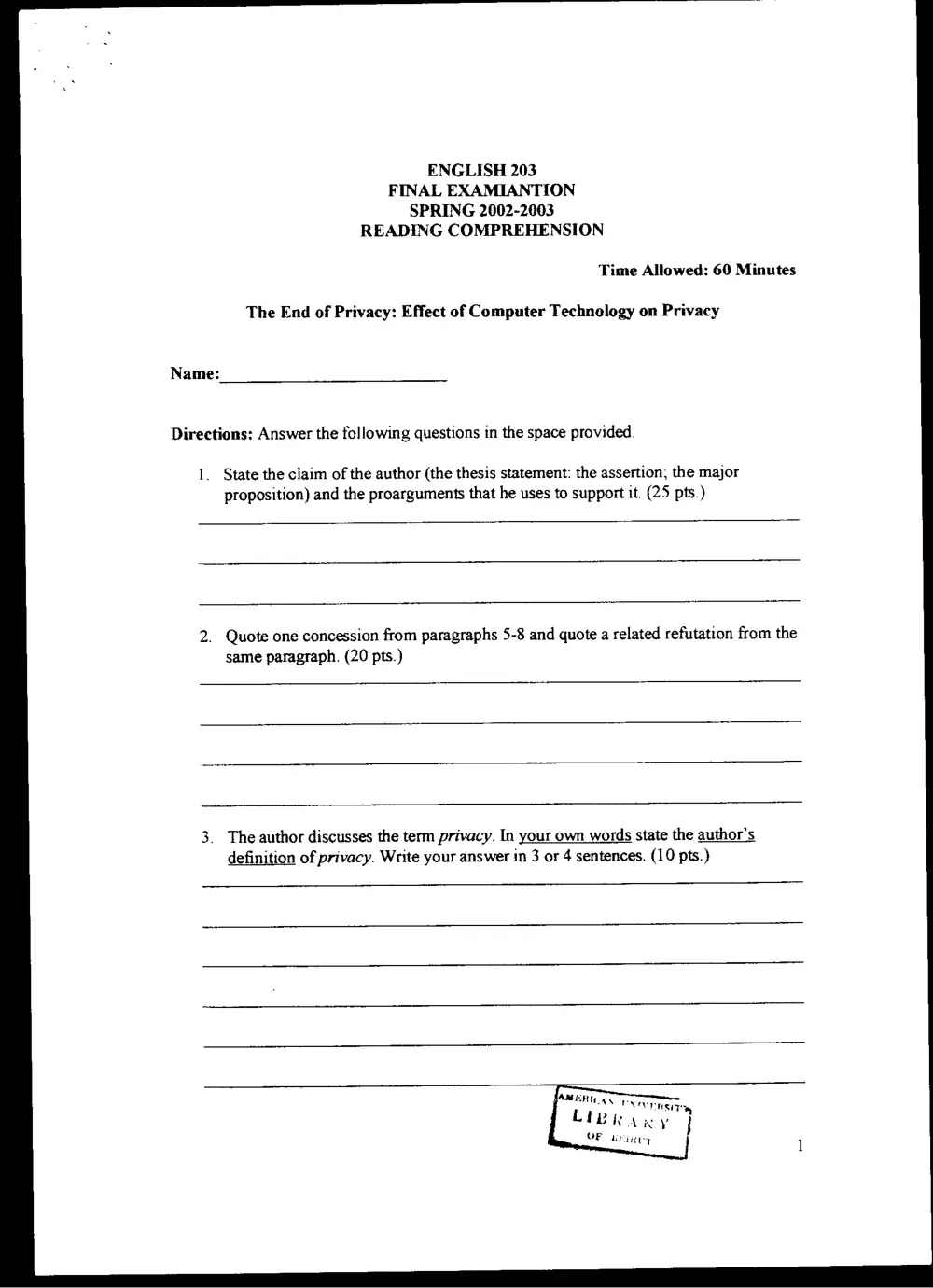
ENGLISH 203
FINAL EXAMIANTION
SPRING 2002-2003
READING COMPREHENSION
Time Allowed: 60 Minutes
The End of Privacy: Effect of Computer Technology on Privacy
Name:
Directions: Answer the following questions in the space provided.
1. State the claim of the author (the thesis statement: the assertion; the major
proposition) and the proarguments that he uses to support it. (25 pts.)
Quote one concession from paragraphs 5-8 and quote a related refutation from the
same paragraph. (20 pts.)
The author discusses the term privacy. In your own words state the author’s
definition of privacy. Write your answer in 3 or 4 sentences. (10 pts.)
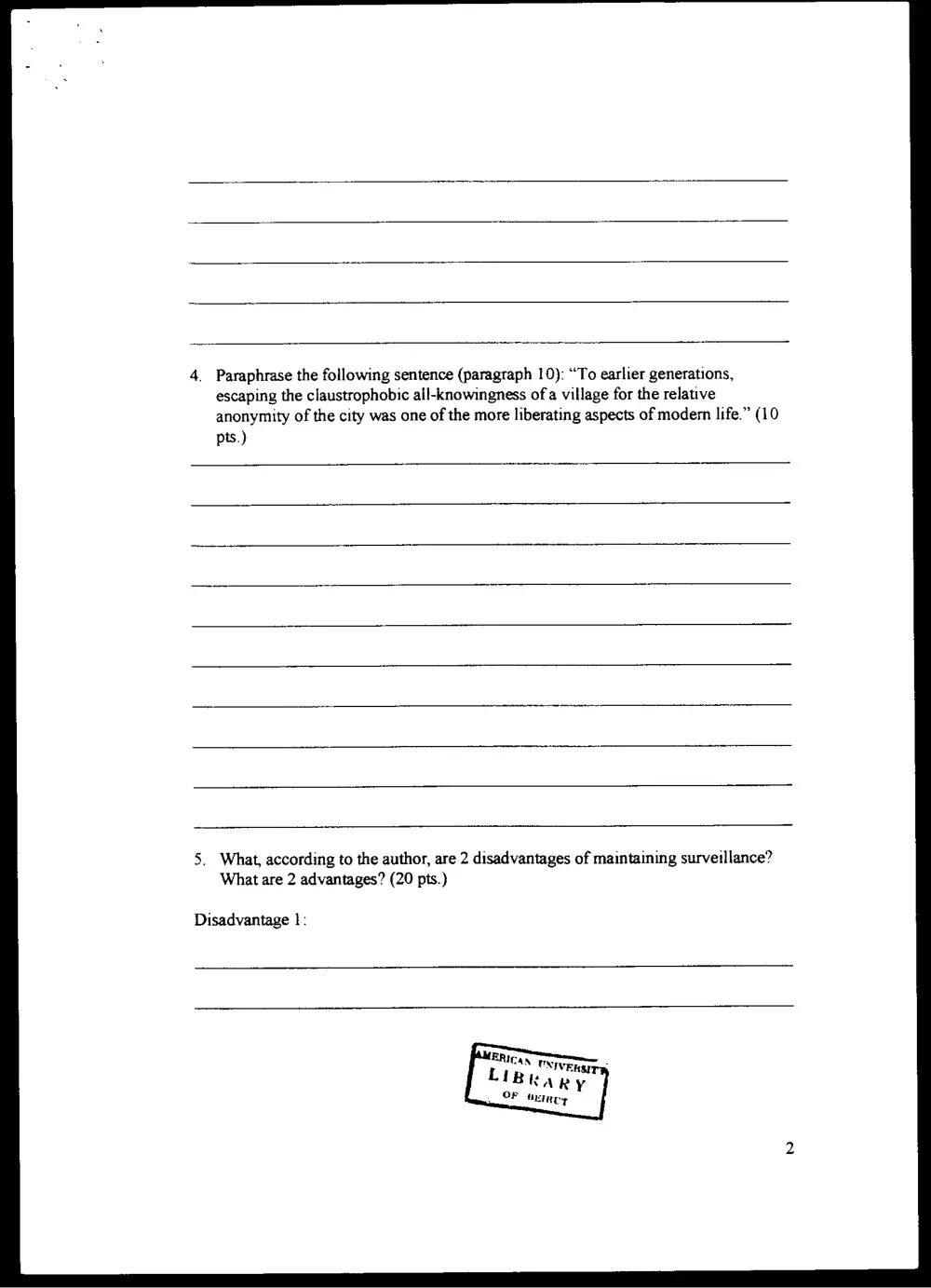
4. Paraphrase the following sentence (paragraph 10): “To earlier generations,
escaping the claustrophobic all-knowingness of a village for the relative
anonymity of the city was one of the more liberating aspects of modern life.” (10
pts.)
5. What, according to the author, are 2 disadvantages of maintaining surveillance?
What are 2 advantages? (20 pts.)
Disadvantage |:
Disadvantage 2:
Advantage 1:
Advantage 2:
6. Name two methods of development (strategies, rhetorical modes), other than
definition and argumentation, which the author uses. Give specific examples from
the text in each case. (15 pts.)
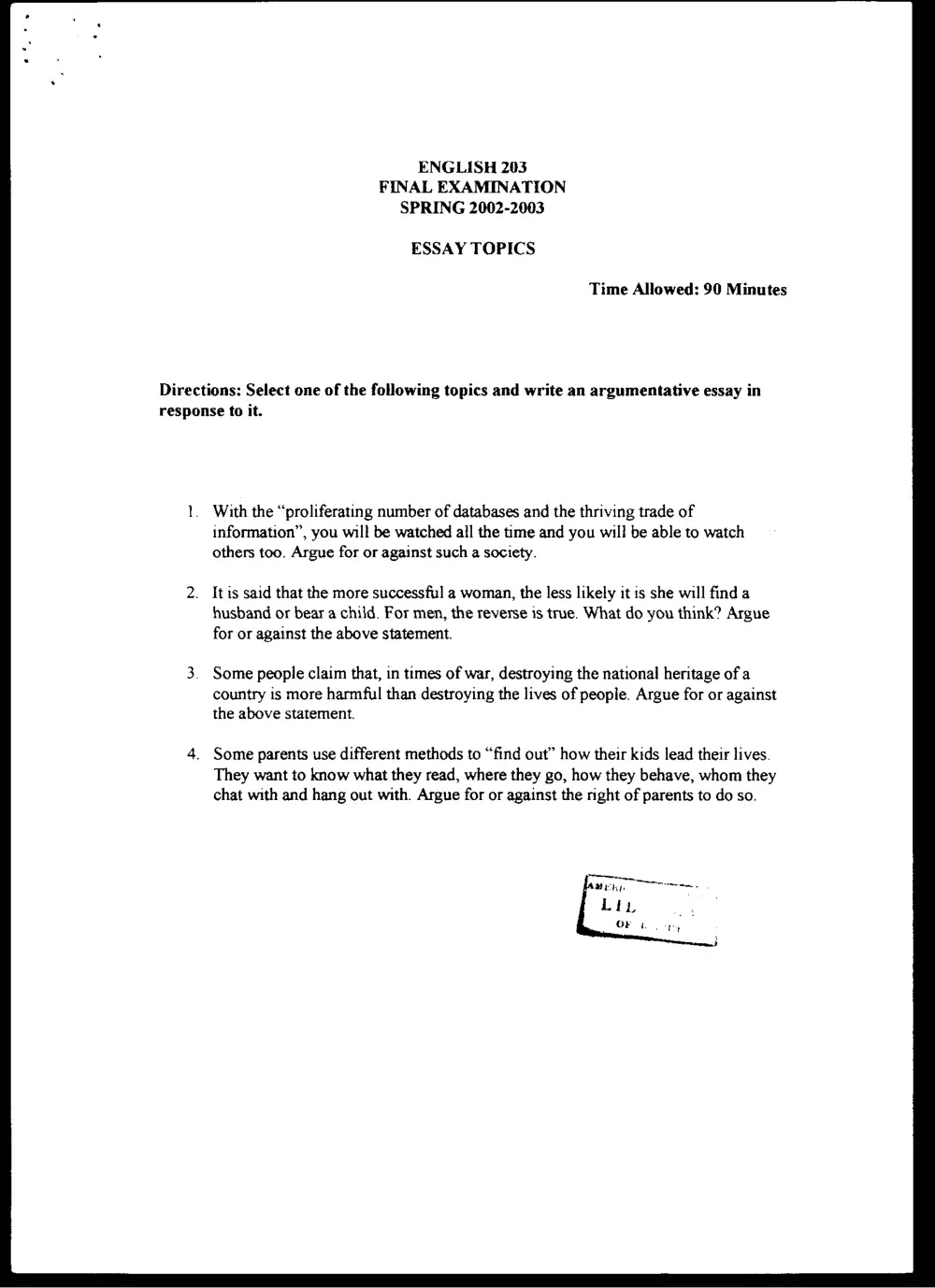
ENGLISH 203
FINAL EXAMINATION
SPRING 2002-2003
ESSAY TOPICS
Time Allowed: 90 Minutes
Directions: Select one of the following topics and write an argumentative essay in
response to it.
1.
2.
With the “proliferating number of databases and the thriving trade of
information”, you will be watched all the time and you will be able to watch
others too. Argue for or against such a society.
It is said that the more successful a woman, the less likely it is she will find a
husband or bear a child. For men, the reverse is true. What do you think? Argue
for or against the above statement.
Some people claim that, in times of war, destroying the national heritage of a
country is more harmful than destroying the lives of people. Argue for or against
the above statement.
Some parents use different methods to “find out” how their kids lead their lives.
They want to know what they read, where they go, how they behave, whom they
chat with and hang out with. Argue for or against the right of parents to do so.