
ENG 203 Final, Spring 2005
American University of Beirut · Academic English · 3 pages
More ENG 203 files
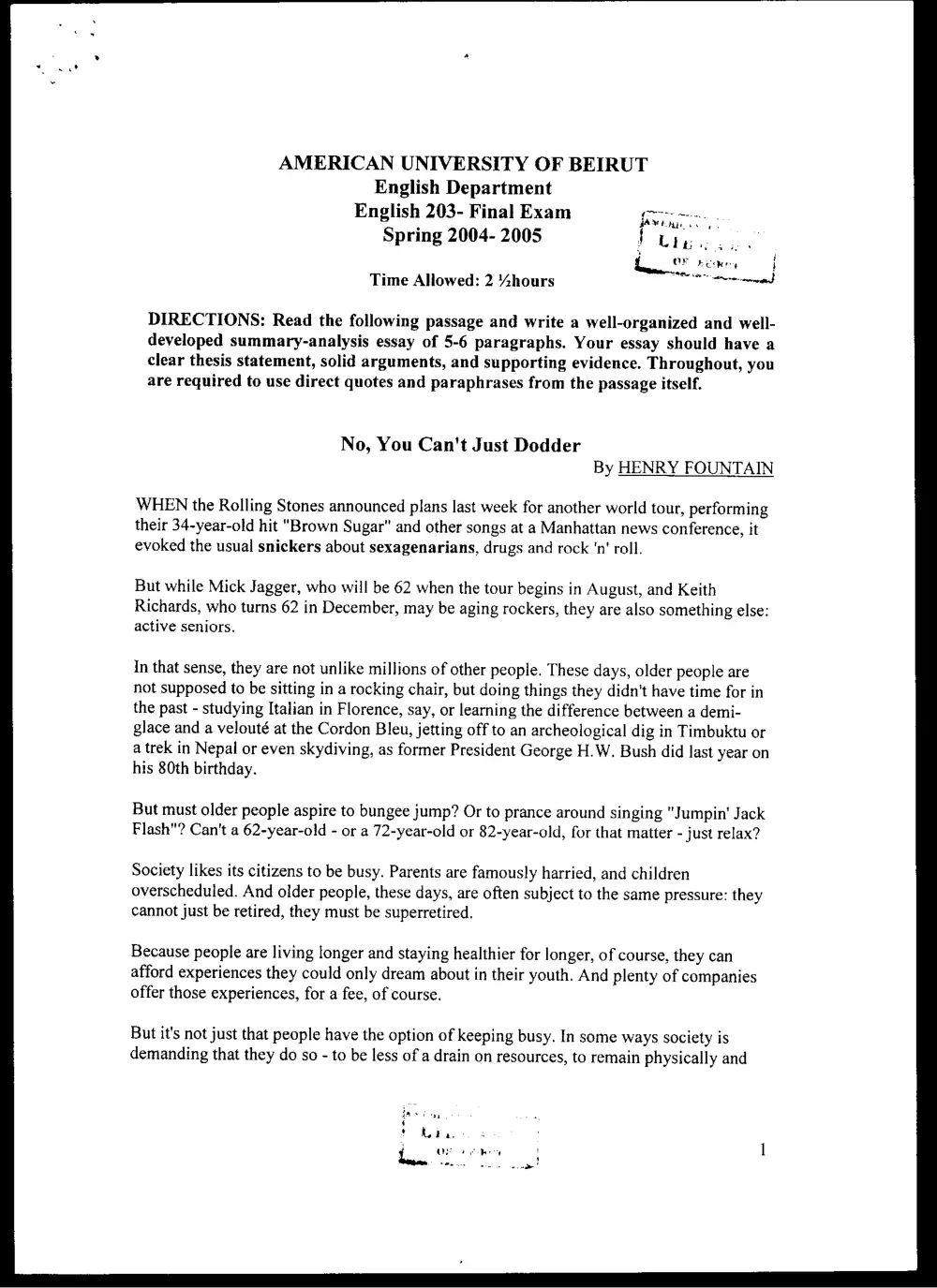
Show the text of this final exam
AMERICAN UNIVERSITY OF BEIRUT
English Department
English 203- Final Exam (or me
BM,
Spring 2004- 2005 are
,
Time Allowed: 2 “hours
DIRECTIONS: Read the following passage and write a well-organized and well-
developed summary-analysis essay of 5-6 paragraphs. Your essay should have a
clear thesis statement, solid arguments, and supporting evidence. Throughout, you
are required to use direct quotes and paraphrases from the passage itself.
No, You Can't Just Dodder
By HENRY FOUNTAIN
WHEN the Rolling Stones announced plans last week for another world tour, performing
their 34-year-old hit "Brown Sugar" and other songs at a Manhattan news conference, it
evoked the usual snickers about sexagenarians, drugs and rock 'n' roll.
But while Mick Jagger, who will be 62 when the tour begins in August, and Keith
Richards, who turns 62 in December, may be aging rockers, they are also something else:
active seniors.
In that sense, they are not unlike millions of other people. These days, older people are
not supposed to be sitting in a rocking chair, but doing things they didn't have time for in
the past - studying Italian in Florence, say, or learning the difference between a demi-
glace and a velouté at the Cordon Bleu, jetting off to an archeological dig in Timbuktu or
a trek in Nepal or even skydiving, as former President George H.W. Bush did last year on
his 80th birthday.
But must older people aspire to bungee jump? Or to prance around singing "Jumpin’ Jack
Flash"? Can't a 62-year-old - or a 72-year-old or 82-year-old, for that matter - just relax?
Society likes its citizens to be busy. Parents are famously harried, and children
overscheduled. And older people, these days, are often subject to the same pressure: they
cannot just be retired, they must be superretired.
Because people are living longer and staying healthier for longer, of course, they can
afford experiences they could only dream about in their youth. And plenty of companies
offer those experiences, for a fee, of course.
But it's not just that people have the option of keeping busy. In some ways society is
demanding that they do so - to be less of a drain on resources, to remain physically and
mentally fit, and as a source of support for the pharmaceutical and other aging-related
industries.
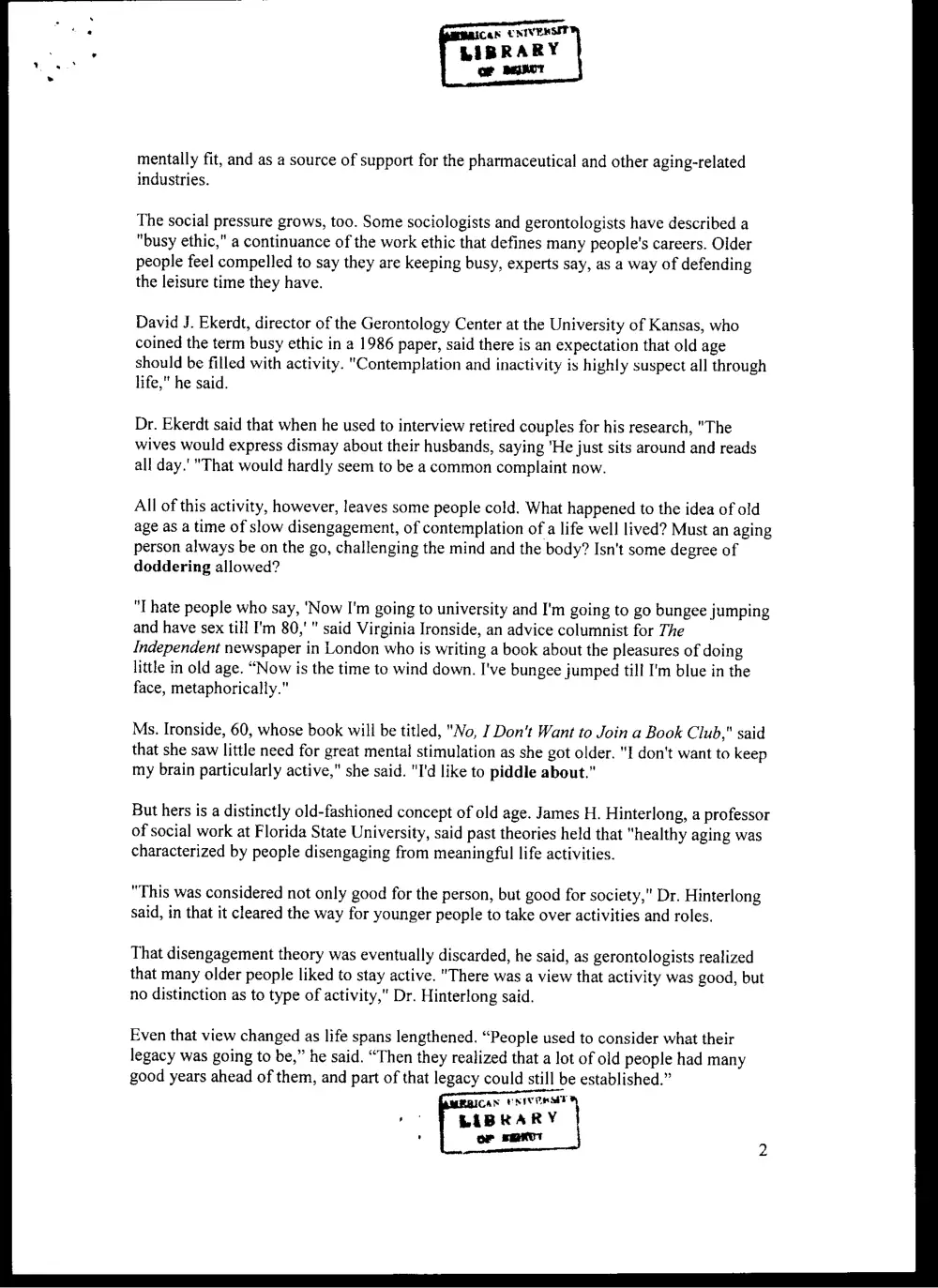
The social pressure grows, too. Some sociologists and gerontologists have described a
"busy ethic," a continuance of the work ethic that defines many people's careers. Older
people fee] compelled to say they are keeping busy, experts say, as a way of defending
the leisure time they have.
David J. Ekerdt, director of the Gerontology Center at the University of Kansas, who
coined the term busy ethic in a 1986 paper, said there is an expectation that old age
should be filled with activity. "Contemplation and inactivity is highly suspect all through
life," he said.
Dr. Ekerdt said that when he used to interview retired couples for his research, "The
wives would express dismay about their husbands, saying 'He just sits around and reads
all day.’ "That would hardly seem to be a common complaint now.
All of this activity, however, leaves some people cold. What happened to the idea of old
age as a time of slow disengagement, of contemplation of a life well lived? Must an aging
person always be on the go, challenging the mind and the body? Isn't some degree of
doddering allowed?
"I hate people who say, ‘Now I'm going to university and I'm going to go bungee jumping
and have sex till I'm 80,'" said Virginia Ironside, an advice columnist for The
Independent newspaper in London who is writing a book about the pleasures of doing
little in old age. “Now is the time to wind down. I've bungee jumped till I'm blue in the
face, metaphorically.”
Ms. Ironside, 60, whose book will be titled, "Vo, J Don't Want to Join a Book Club," said
that she saw little need for great mental stimulation as she got older. "I don't want to keep
my brain particularly active,” she said. "I'd like to piddle about.”
But hers is a distinctly old-fashioned concept of old age. James H. Hinterlong, a professor
of social work at Florida State University, said past theories held that "healthy aging was
characterized by people disengaging from meaningful life activities.
"This was considered not only good for the person, but good for society," Dr. Hinterlong
said, in that it cleared the way for younger people to take over activities and roles.
That disengagement theory was eventually discarded, he said, as gerontologists realized
that many older people liked to stay active. "There was a view that activity was good, but
no distinction as to type of activity," Dr. Hinterlong said.
Even that view changed as life spans lengthened. “People used to consider what their
legacy was going to be,” he said. “Then they realized that a lot of old people had many
good years ahead of them, and part of that legacy could still be established.”
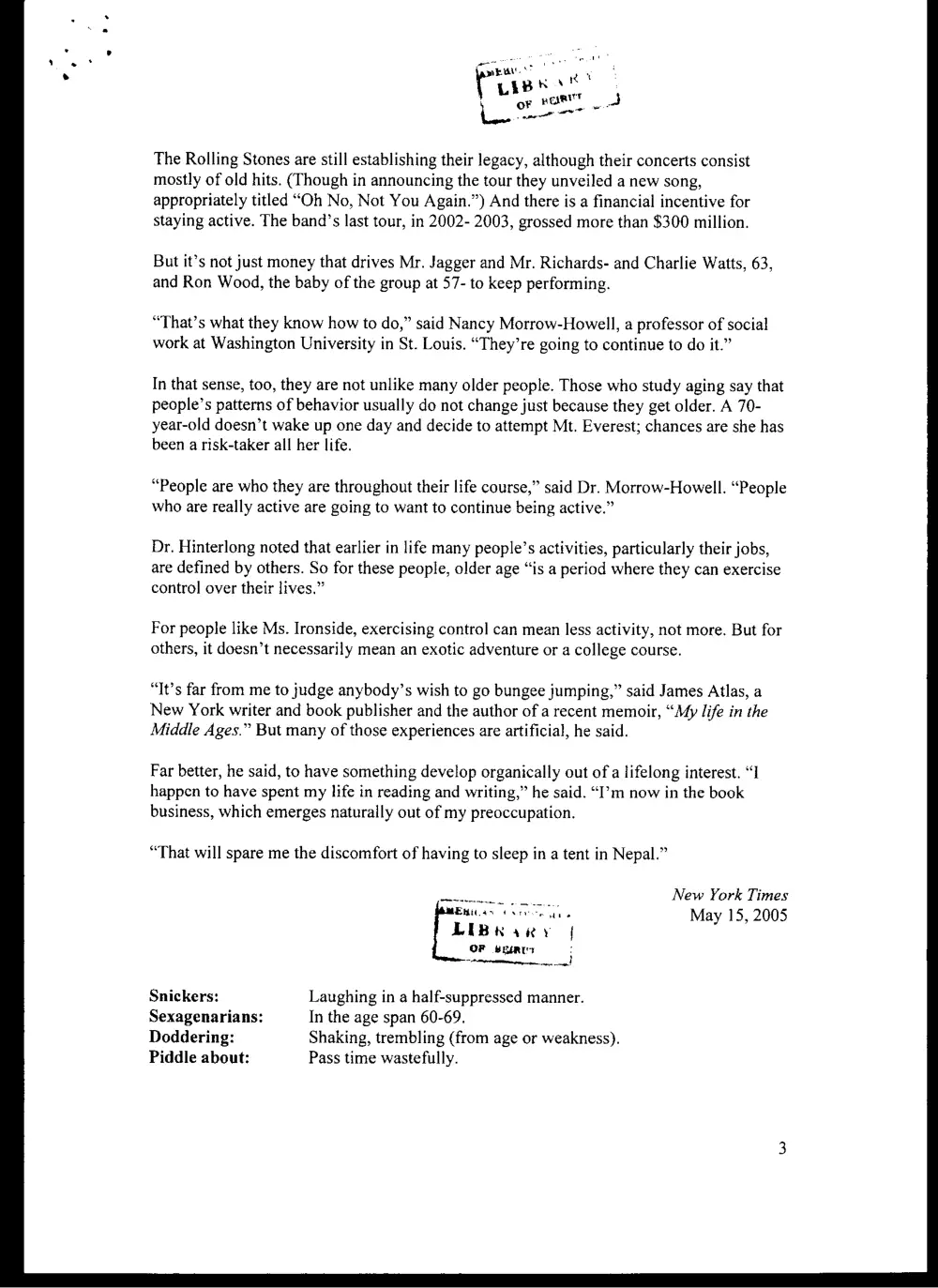
The Rolling Stones are still establishing their legacy, although their concerts consist
mostly of old hits. (Though in announcing the tour they unveiled a new song,
appropriately titled “Oh No, Not You Again.”) And there is a financial incentive for
staying active. The band’s last tour, in 2002- 2003, grossed more than $300 million.
But it’s not just money that drives Mr. Jagger and Mr. Richards- and Charlie Watts, 63,
and Ron Wood, the baby of the group at 57- to keep performing.
“That’s what they know how to do,” said Nancy Morrow-Howell, a professor of social
work at Washington University in St. Louis. “They’re going to continue to do it.”
In that sense, too, they are not unlike many older people. Those who study aging say that
people’s patterns of behavior usually do not change just because they get older. A 70-
year-old doesn’t wake up one day and decide to attempt Mt. Everest; chances are she has
been a risk-taker all her life.
“People are who they are throughout their life course,” said Dr. Morrow-Howell. “People
who are really active are going to want to continue being active.”
Dr. Hinterlong noted that earlier in life many people’s activities, particularly their jobs,
are defined by others. So for these people, older age “is a period where they can exercise
control over their lives.”
For people like Ms. Ironside, exercising control can mean less activity, not more. But for
others, it doesn’t necessarily mean an exotic adventure or a college course.
“It’s far from me to judge anybody’s wish to go bungee jumping,” said James Atlas, a
New York writer and book publisher and the author of a recent memoir, “My life in the
Middle Ages.” But many of those experiences are artificial, he said.
Far better, he said, to have something develop organically out of a lifelong interest. “1
happen to have spent my life in reading and writing,” he said. “I’m now in the book
business, which emerges naturally out of my preoccupation.
“That will spare me the discomfort of having to sleep in a tent in Nepal.”
New York Times
PMEWiCss te aie May 15, 2005
LIBKaRy |
OF bEiAIs :
|
Snickers: Laughing in a half-suppressed manner.
Sexagenarians: In the age span 60-69.
Doddering: Shaking, trembling (from age or weakness).
Piddle about: Pass time wastefully.