
ENG 203 Final, Summer 2003
American University of Beirut · Academic English · 3 pages
More ENG 203 files
Show the text of this final exam
anne
oS UNIVERnSEr
| LIBRARY
OF BeiRET
—
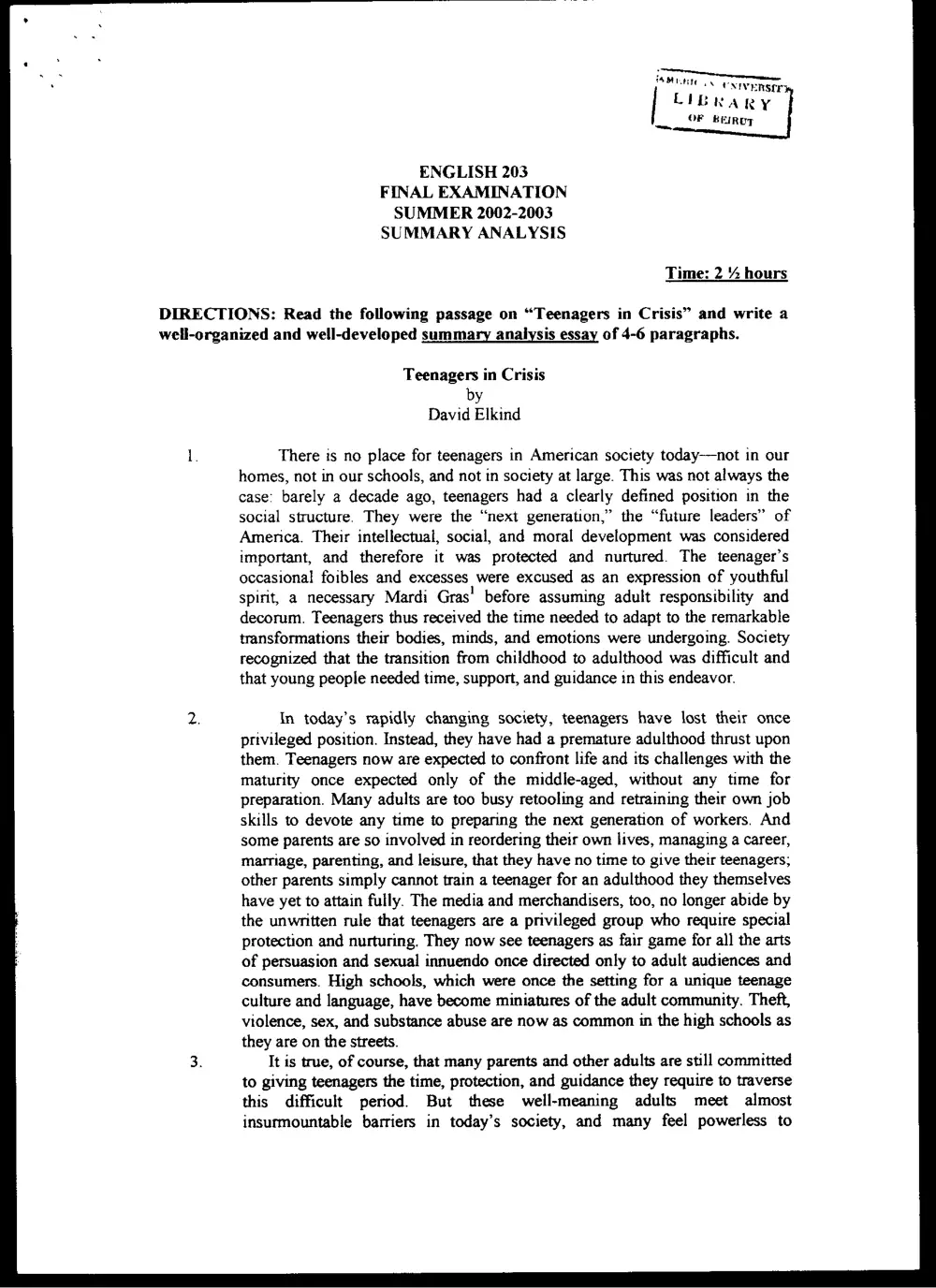
ENGLISH 203
FINAL EXAMINATION
SUMMER 2002-2003
SUMMARY ANALYSIS
Time: 2% hours
DIRECTIONS: Read the following passage on “Teenagers in Crisis” and write a
well-organized and well-developed summary analysis essay of 4-6 paragraphs.
Teenagers in Crisis
by
David Elkind
There is no place for teenagers in American society today——not in our
homes, not in our schools, and not in society at large. This was not always the
case: barely a decade ago, teenagers had a clearly defined position in the
social structure. They were the “next generation,” the “future leaders” of
Amenica. Their intellectual, social, and moral development was considered
important, and therefore it was protected and nurtured. The teenager’s
occasional foibles and excesses were excused as an expression of youthful
spirit, a necessary Mardi Gras’ before assuming adult responsibility and
decorum. Teenagers thus received the time needed to adapt to the remarkable
transformations their bodies, minds, and emotions were undergoing. Society
recognized that the transition from childhood to adulthood was difficult and
that young people needed time, support, and guidance in this endeavor.
In today’s sapidly changing society, teenagers have lost their once
privileged position. Instead, they have had a premature adulthood thrust upon
them. Teenagers now are expected to confront life and its challenges with the
maturity once expected only of the middle-aged, without any time for
preparation. Many adults are too busy retooling and retraining their own job
skills to devote any time to preparing the next generation of workers. And
some parents are so involved in reordering their own lives, managing a career,
marriage, parenting, and leisure, that they have no time to give their teenagers;
other parents simply cannot train a teenager for an adulthood they themselves
have yet to attain fully. The media and merchandisers, too, no longer abide by
the unwritten rule that teenagers are a privileged group who require special
protection and nurturing. They now see teenagers as fair game for all the arts
of persuasion and sexual innuendo once directed only to adult audiences and
consumers. High schools, which were once the setting for a unique teenage
culture and language, have become miniatures of the adult community. Theft,
violence, sex, and substance abuse are now as common in the high schools as
they are on the streets.
It is true, of course, that many parents and other adults are still committed
to giving teenagers the time, protection, and guidance they require to traverse
this difficult period. But these well-meaning adults meet almost
insurmountable barriers in today’s society, and many feel powerless to
camel
AMERICAN CSTVERSIT
LIBRARY
OF BURUT
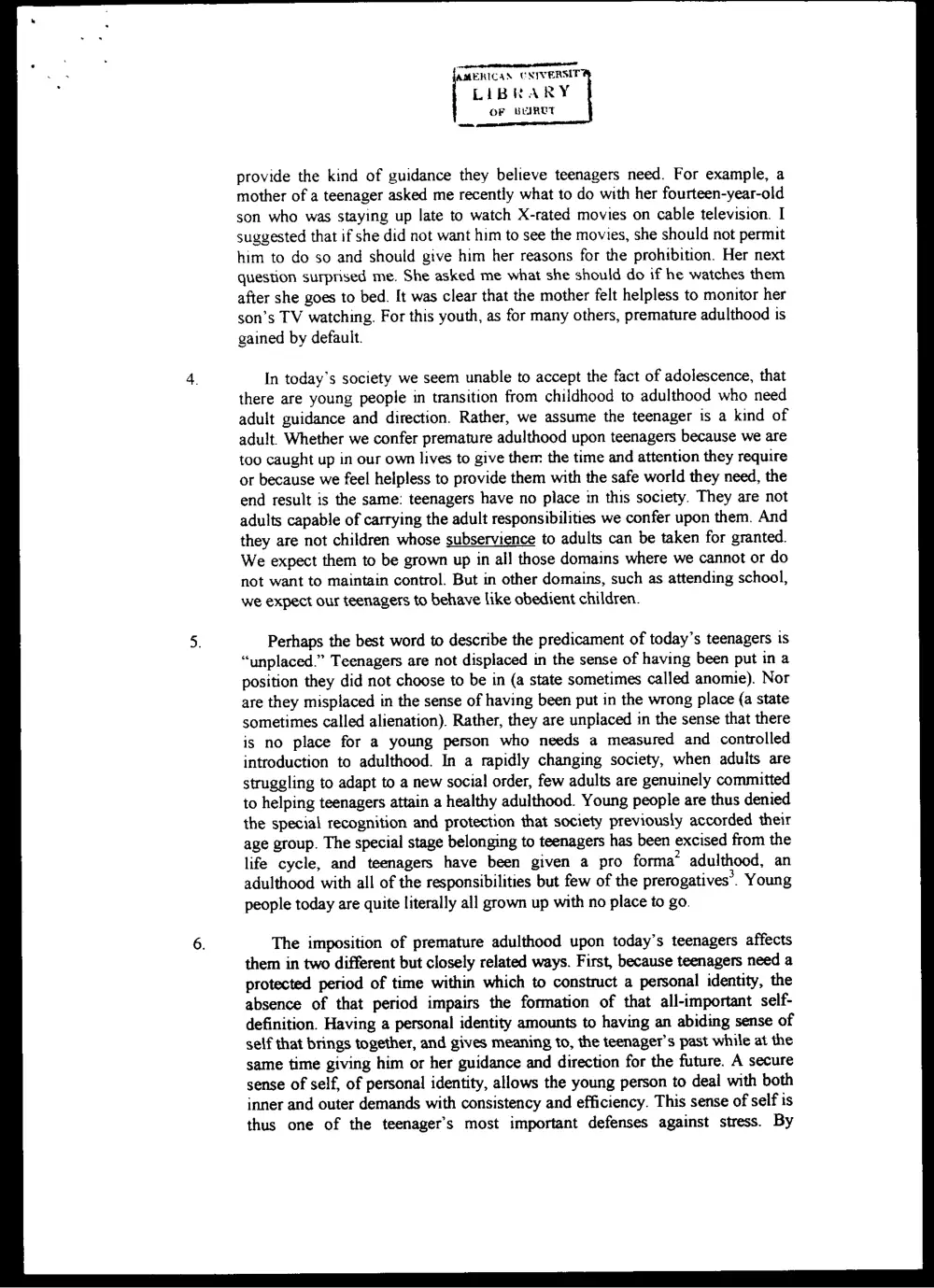
provide the kind of guidance they believe teenagers need. For example, a
mother of a teenager asked me recently what to do with her fourteen-year-old
son who was staying up late to watch X-rated movies on cable television. I
suggested that if she did not want him to see the movies, she should not permit
him to do so and should give him her reasons for the prohibition. Her next
question surprised me. She asked me what she should do if he watches them
after she goes to bed. It was clear that the mother felt helpless to monitor her
son’s TV watching. For this youth, as for many others, premature adulthood is
gained by default.
In today’s society we seem unable to accept the fact of adolescence, that
there are young people in transition from childhood to adulthood who need
adult guidance and direction. Rather, we assume the teenager is a kind of
adult. Whether we confer premature adulthood upon teenagers because we are
too caught up in our own lives to give them: the time and attention they require
or because we feel helpless to provide them with the safe world they need, the
end result is the same: teenagers have no place in this society. They are not
adults capable of carrying the adult responsibilities we confer upon them. And
they are not children whose subservience to adults can be taken for granted.
We expect them to be grown up in all those domains where we cannot or do
not want to maintain control. But in other domains, such as attending school,
we expect our teenagers to behave like obedient children.
Perhaps the best word to describe the predicament of today’s teenagers is
“unplaced.” Teenagers are not displaced in the sense of having been put in a
position they did not choose to be in (a state sometimes called anomie). Nor
are they misplaced in the sense of having been put in the wrong place (a state
sometimes called alienation). Rather, they are unpiaced in the sense that there
is no place for a young person who needs a measured and controlled
introduction to adulthood. In a rapidly changing society, when adults are
struggling to adapt to a new social order, few adults are genuinely committed
to helping teenagers attain a healthy adulthood. Young people are thus denied
the special recognition and protection that society previously accorded their
age group. The special stage belonging to teenagers has been excised from the
life cycle, and teenagers have been given a pro forma” adulthood, an
adulthood with all of the responsibilities but few of the prerogatives’. Young
people today are quite literally all grown up with no place to go.
The imposition of premature adulthood upon today’s teenagers affects
them in two different but closely related ways. First, because teenagers need a
protected period of time within which to construct a personal identity, the
absence of that period impairs the formation of that all-important self-
definition. Having a personal identity amounts to having an abiding sense of
self that brings together, and gives meaning to, the teenager’s past while at the
same time giving him or her guidance and direction for the future. A secure
sense of self, of personal identity, allows the young person to deal with both
inner and outer demands with consistency and efficiency. This sense of self is
thus one of the teenager's most important defenses against stress. By
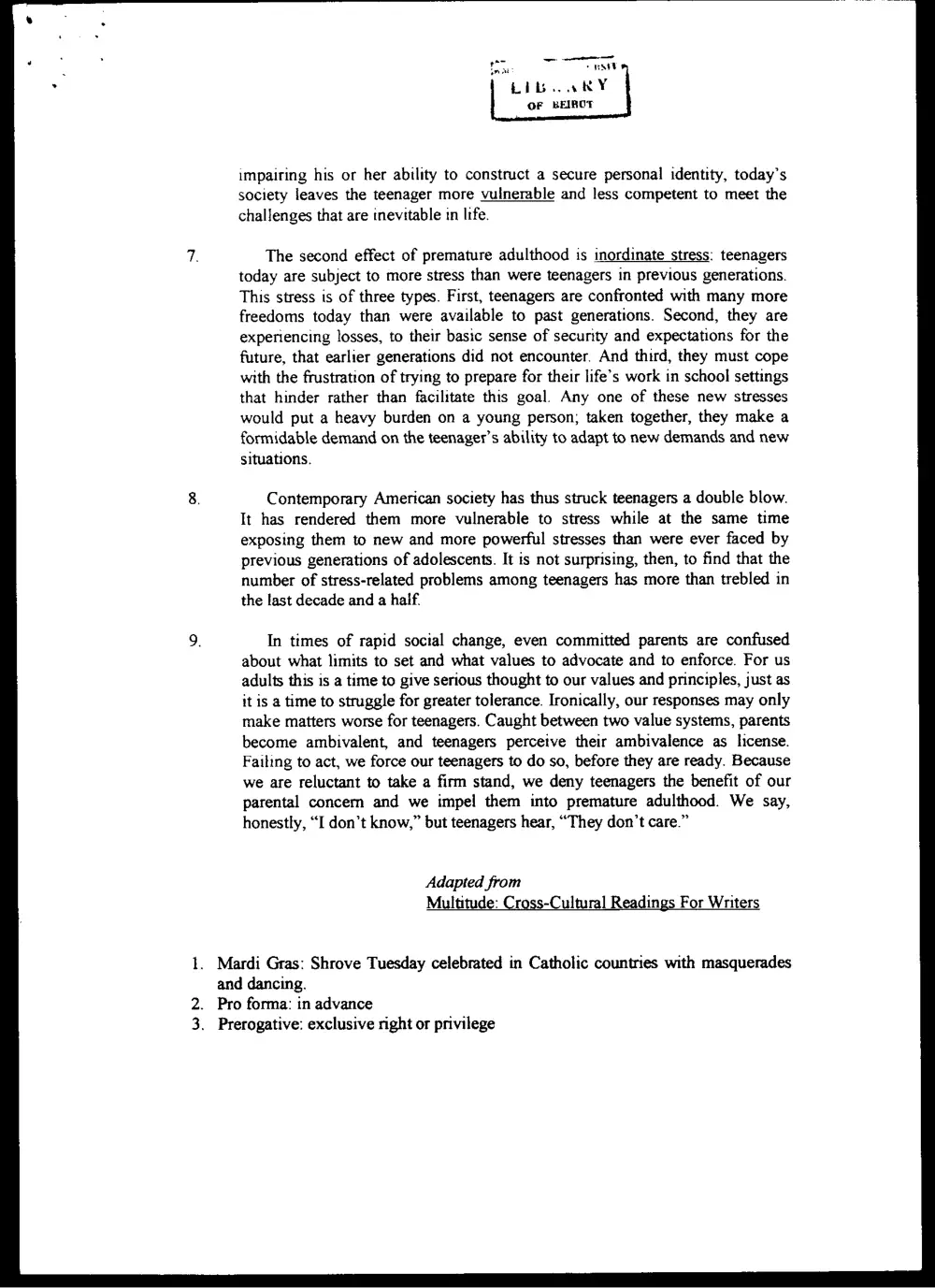
impairing his or her ability to construct a secure personal identity, today’s
society leaves the teenager more vulnerable and less competent to meet the
challenges that are inevitable in life.
The second effect of premature adulthood is inordinate stress: teenagers
today are subject to more stress than were teenagers in previous generations.
This stress is of three types. First, teenagers are confronted with many more
freedoms today than were available to past generations. Second, they are
experiencing losses, to their basic sense of security and expectations for the
future, that earlier generations did not encounter. And third, they must cope
with the frustration of trying to prepare for their life’s work in school settings
that hinder rather than facilitate this goal. Any one of these new stresses
would put a heavy burden on a young person; taken together, they make a
formidable demand on the teenager’s ability to adapt to new demands and new
situations.
Contemporary American society has thus struck teenagers a double blow.
It has rendered them more vulnerable to stress while at the same time
exposing them to new and more powerful stresses than were ever faced by
previous generations of adolescents. It is not surprising, then, to find that the
number of stress-related problems among teenagers has more than trebled in
the last decade and a half.
In times of rapid social change, even committed parents are confused
about what limits to set and what values to advocate and to enforce. For us
adults this is a time to give serious thought to our values and principles, just as
it is a time to struggle for greater tolerance. Ironically, our responses may only
make matters worse for teenagers. Caught between two value systems, parents
become ambivalent, and teenagers perceive their ambivalence as license.
Failing to act, we force our teenagers to do so, before they are ready. Because
we are reluctant to take a firm stand, we deny teenagers the benefit of our
parental concern and we impel them into premature adulthood. We say,
honestly, “I don’t know,” but teenagers hear, “They don’t care.”
Adapted from
Multitude: Cross-Cultural Readings For Writers
Mardi Gras: Shrove Tuesday celebrated in Catholic countries with masquerades
and dancing.
Pro forma: in advance
Prerogative: exclusive right or privilege