
ENG 203 Final, Fall 2002
American University of Beirut · Academic English · 8 pages


More ENG 203 files
Show the text of this final exam
AMERICAN UNIVERSITY OF BEIRUT
DEPARTMENT OF ENGLISH
ENGLISH 203
FINAL EXAM: READING
FALL 2002-2003
Cyberspace: If You Don’t Love It, Leave It
by
Esther Dyson
Esther Dyson (b. 1951) was born in Zurich, Switzerland, grew up in Princeton, New Jersey, and received a
BA in economics from Harvard University. She is the daughter of Freeman Dyson, a physicist prominent in
arms control. She is the editor and publisher of the widely respected computer newsletter Release 1.0.
which is circulated to many computer industry leaders. She is also chairperson of the Electronic Frontier
Foundation and on the board of the Santa Fe Institute, the Global Business Network, and the Institute for
East: West Studies. She served as a reporter for Forbes magazine for four years. The following essav
appeared in The New York Times Magazine in July 1995.
1.
Something in the American psyche loves new frontiers. We hanker after wide-
open spaces, we like to explore, we like to make rules instead of follow them. But
in this age of political correctness and other intrusions on our national cult of
independence, it’s hard to find a place where you can go and be yourself without
worrying about the neighbors.
There is such a place: cyberspace. Lost in the furor over porn on the Net is the
exhilarating sense of freedom that this new frontier once promised—and still does
in some quarters. Formerly a playground for computer nerds and techies,
cyberspace now embraces every conceivable constituency: schoolchildren,
flirtatious singles, Hungarian-Americans, accountants—along with pederasts and
porn fans. Can they all get along? Or will our fear of kids surfing for cyberporn
behind their bedroom doors provoke a crackdown?
The first order of business is to grasp what cyberspace is. It might help to leave
behind metaphors of highways and frontiers and to think instead of real estate.
Real estate, remember, is an intellectual, legal, artificial environment constructed
on top of land. Real estate recognizes the difference between parkland and
shopping mall, between red-light zone and school district, between church, state
and drugstore.
In the same way, you could think of cyberspace as a giant and unbounded world
of virtual real estate. Some property is privately owned and rented out; other
property is common land; some places are suitable for children, and others are
best avoided by all but the kinkiest citizens. Unfortunately, it’s those places that
are now capturing the popular imagination: places that offer bomb-making
instructions, pornography, advice on how to procure stolen credit cards. They
make cyberspace sound like a nasty place. Good citizens jump to a conclusion:
Better regulate it.
10.
VL.
12.
Fc opacirenieearerenceanventam
MERICAN UNIVERS?
[ LIBRARY
OF BEIRUT
~—
The most recent manifestation of this impulse is the Exon-Coats Amendment, a
well-meaning but misguided bill drafted by Senators Jim Exon, Democrat of
Nebraska, and Daniel R. Coats, Republican of Indiana, to make cyberspace
“safer” for children. Part of the telecommunications reform bill passed by the
Senate and awaiting consideration by the House, the amendment would outlaw
making “indecent communication” available to anyone under 18. "Then there’s
the Amateur Action bulletin board case, in which the owners of a porn service in
Milpitas, Calif., were convicted in a Tennessee court of violating “community
standards” after a local inspector requested that the material be transmitted to him.
Regardless of how many laws or lawsuits are launched, regulation won’t work.
Aside from being unconstitutional, using censorship to counter indecency and
other troubling “speech” fundamentally misinterprets the nature of cyberspace.
Cyberspace isn’t a frontier where wicked people can grab unsuspecting children,
nor is it a giant television system that can beam offensive messages at unwilling
viewers. In this kind of real estate, users have to choose where they visit, what
they see, what they do. It’s optional, and it’s much easier to bypass a place on the
Net than it is to avoid walking past an unsavory block of stores on the way to your
local 7-11.
Put plainly, cyberspace is a voluntary destination—in reality, many destinations.
You don’t just get “onto the net”; you have to go someplace in particular. That
means that people can choose where to go and what to see. Yes, community
standards should be enforced, but those standards should be set by cyberspace
communities themselves, not by the courts or by politicians in Washington. What
we need isn’t Government control over all these electronic communities: We need
self-rule.
What makes cyberspace so alluring is precisely the way in which it’s different
from shopping malls, television, highways and other terrestrial jurisdictions. But
let’s define the territory:
First, there are private E-mail conversations, akin to the conversations you have
over the telephone or voice mail. These are private and consensual and require no
regulation at all.
Second, there are information and entertainment services, where people can
download anything from legal texts and lists of “great new restaurants” to game
software or dirty pictures. These places are like bookstores, malls and movie
houses—places where you go to buy something. The customer needs to request an
item or sign up for a subscription; stuff (especially pornography) is not sent out to
people who don’t ask for it. Some of these services are free or included as part of
a broader service like Compuserve or America Online; others charge and may bill
their customers directly.
Third, there are “real” communities—groups of people who communicate among
themselves. In real-estate terms, they’re like bars or restaurants or bathhouses.
13.
14.
15.
16.
17.
pte secon on
inate UNIVER: ;
Lib CARY
oF MeIRUT
a
Each active participant contributes to a general conversation, generally through
posted messages. Other participants may simply listen or watch. Some are
supervised by a moderator; others are more like bulletin boards—anyone is free to
post anything. Many of these services started out unmoderated but are now
imposing rules to keep out unwanted advertising, extraneous discussions or
increasingly rude participants. Without a moderator, the decibel level often gets
too high.
Ultimately, it’s the rules that determine the success of such places. Some of the
tules are determined by the supplier of content; some of the rules concer prices
and membership fees. The rules may be simple: “Only high-quality content about
oil-industry liability and pollution legislation: $120 an hour.” Or: “This forum is
unmoderated, and restricted to information about copyright issues. People who
insist on posting advertising or unrelated material will be asked to desist (and may
eventually be barred).” Or: “Only children 8 to 12, on school-related topics and
only clean words. The moderator will decide what’s acceptable.”
Cyberspace communities evolve just the way terrestrial communities do: people
with like-minded interests band together. Every cyberspace community has its
own character. Overall, the communities on Compuserve tend to be more techy or
professional; those on America Online, affluent young singles; Prodigy, family
oriented. Then there are independents like Echo, a hip, downtown New York
service, or Women’s Wire, targeted to women who want to avoid the male culture
prevalent elsewhere on the Net. There’s SurfWatch, a new program allowing
access only to locations deemed suitable for children. On the Internet itself, there
are lots of passionate noncommercial discussion groups on topics ranging from
Hungarian politics (Hungary-Online) to copyright law.
And yes, there are also porn-oriented services, where people share dirty pictures
and communicate with one another about all kinds of practices, often
anonymously. Whether these services encourage the fantasies they depict is
subject to debate—the same debate that has raged about pornography in other
media. But the point is that no one is forcing this stuff on anybody.
What’s unique about cyberspace is that it liberates us from the tyranny of
government, where everyone lives by the rule of the majority. In a democracy,
minority groups and minority preferences tend to get squeezed out, whether they
are minorities of race and culture or minorities of individual taste. Cyberspace
allows communities of any size and kind to flourish; in cyberspace, communities
are chosen by the users, not forced on them by accidents of geography. This
freedom gives the rules that preside in cyberspace a moral authority that rules in
terrestrial environments don’t have. Most people are stuck in the country of their
birth, but if you don’t like the rules of a cyberspace community, you can just sign
off. Love it or leave it. Likewise, if parents don’t like the rules of a given
cyberspace community, they can restrict their children’s access to it.
What’s likely to happen in cyberspace is the formation of new communities, free
of the constraints that cause conflict on earth. Instead of a global village, which is
3
18.
19.
20.
21.
7 nena ncteencemmamanet
AB ERICAN UNIVERSIT?S
LIBRARY
OF BEIRUT
a nice dream but impossible to manage, we'll have invented another world of self-
contained communities that cater to their own members’ inclinations without
interfering with anyone else’s. The possibility of a real market-style evolution of
governance is at hand. In cyberspace, we'll be able to test and evolve rules
governing what needs to be governed— intellectual property, content and access
control, rules about privacy and free speech. Some communities will allow
anyone in, others will restrict access to members who qualify on one basis or
another. Those communities that prove self-sustaining will prosper (and perhaps
grow and split into subsets with ever-more-particular interests and identities).
Those that can’t survive—either because people lose interest or get scared off—
will simply wither away.
In the near future, explorers in cyberspace will need to get better at defining and
identifying their communities. They will need to put in place—and accept—their
own local governments, just as the owners of expensive real estate often prefer to
have their own security guards rather than call in the police. But they will rarely
need help from any terrestrial government.
Of course, terrestrial governments may not agree. What to do, for instance, about
pornography? The answer is labeling—not banning—questionable material. In
order to avoid censorship and lower the political temperature, it makes sense for
cyberspace participants themselves to agree on a scheme for questionable items,
so that people or automatic filters can avoid them. In other words, posting
pornography in “alt.sex, bestially” would be O.K.,; it’s easy enough for sofiware
manufacturers to build an automatic filter that would prevent you——or your
child—from ever seeing that item on a menu. (It’s as if all the items were
wrapped with labels on the wrapper.) Someone who posted the same material
under the title “Kid-Fun” could be sued for mislabeling.
Without a lot of fanfare, private enterprises and local groups are already
producing a variety of labeling and ranking services, along with kid-oriented sites
like Kidlink, EdWeb and Kids’ Space. People differ in their tastes and values and
can find services or reviewers on the Net that suit them in the same way they
select books and magazines. Or they can wander freely if they prefer, making up
their own itinerary.
In the end, our society needs to grow up. Growing up means understanding that
there are no perfect answers, no all-purpose solutions, no government-sanctioned
safe havens. We haven’t created a perfect society on earth and we won’t have one
in cyberspace either. But at least we can have individual choice—and individual
responsibility.
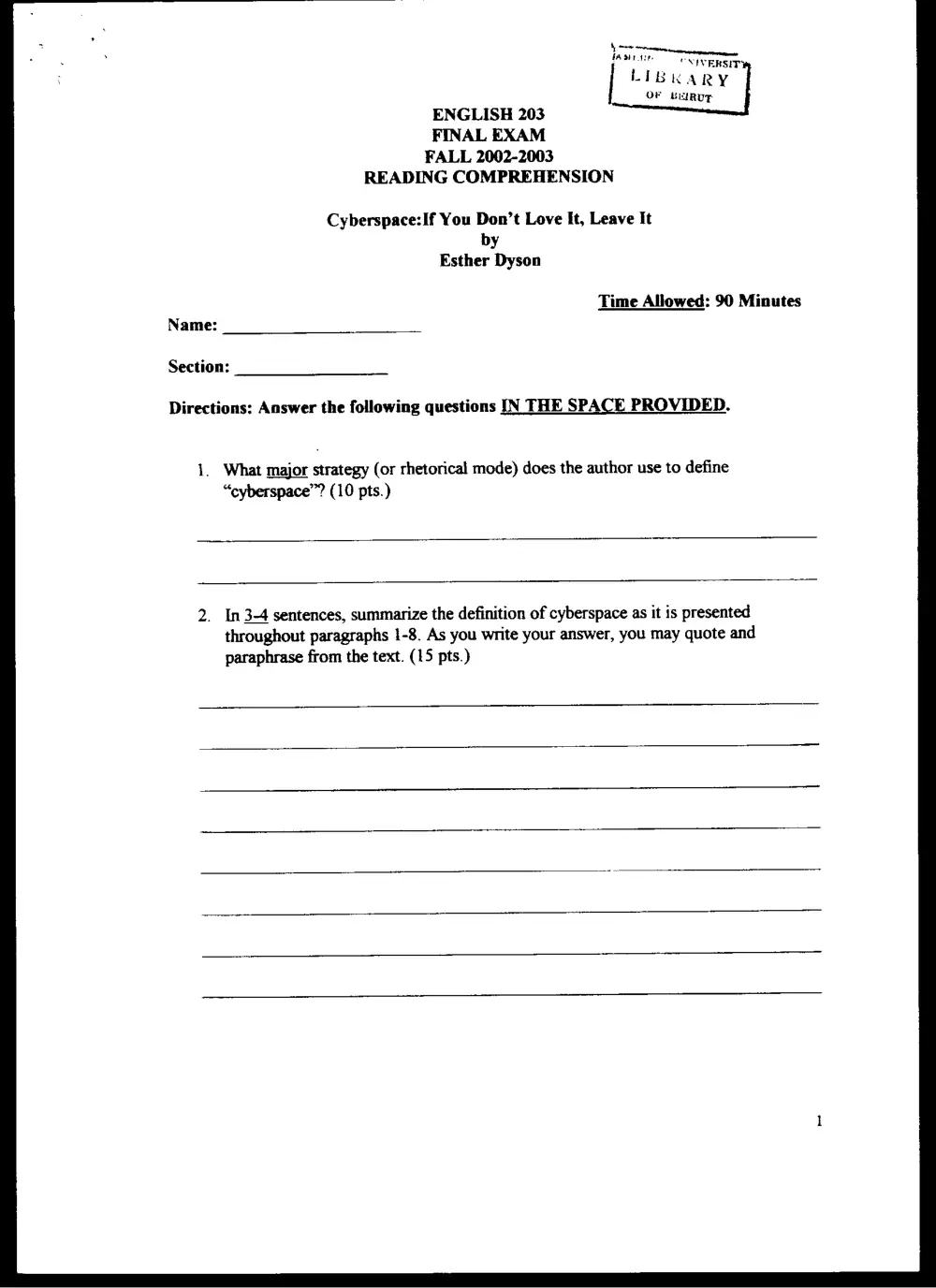
ENGLISH 203
FINAL EXAM
FALL 2002-2003
READING COMPREHENSION
Cyberspace:If You Don’t Love It, Leave It
by
Esther Dyson
Time Allowed: 90 Minutes
Name:
Section:
Directions: Answer the following questions IN THE SPACE PROVIDED.
. What major strategy (or rhetorical mode) does the author use to define
“cyberspace”? (10 pts.)
_ In3- sentences, summarize the definition of cyberspace as it is presented
throughout paragraphs 1-8. As you write your answer, you may quote and
paraphrase from the text. (15 pts.)
fete.
q . UNIVERSTT
. : LIBR, ry f[
a OF BEIRUT
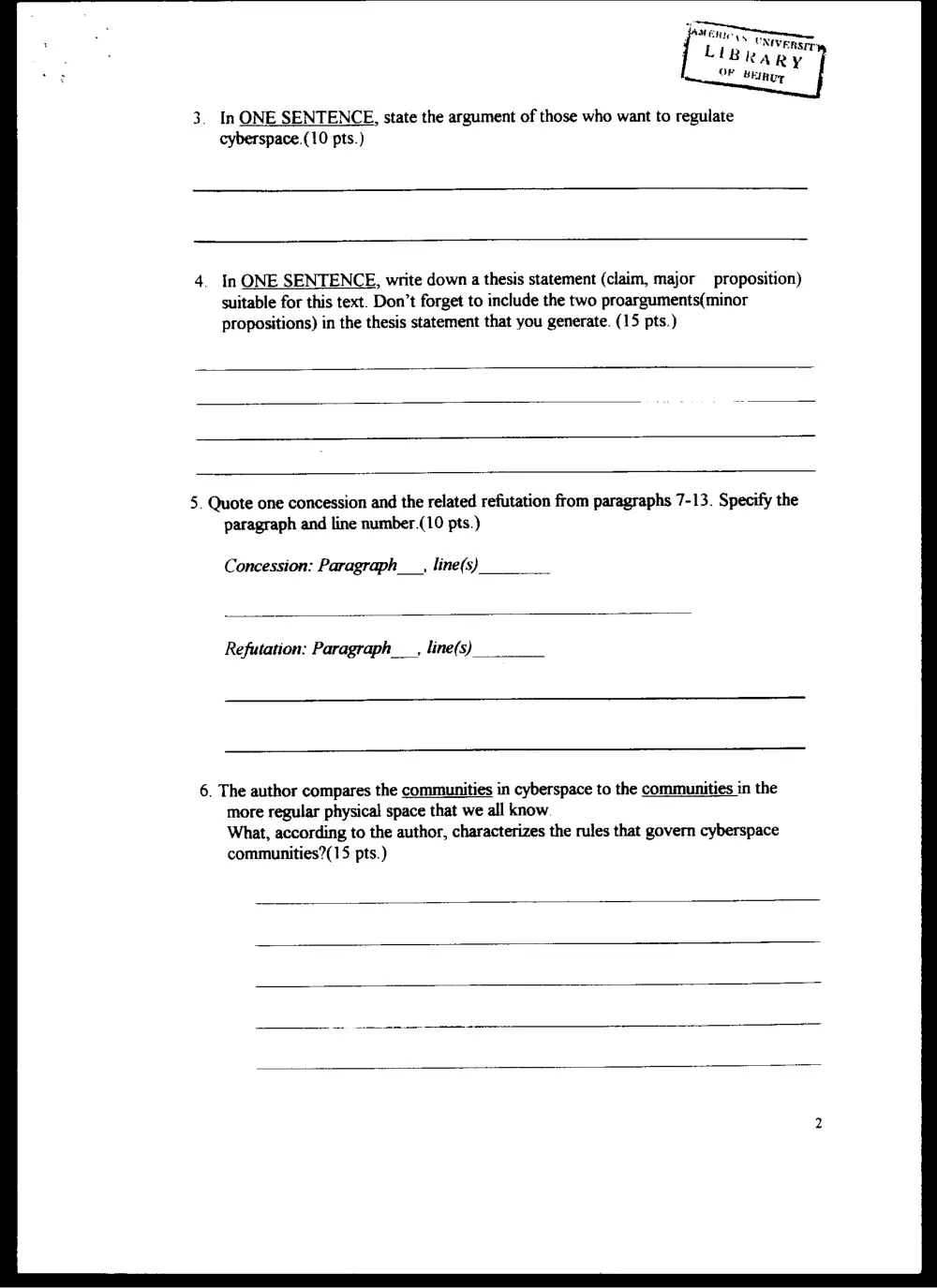
3. In ONE SENTENCE, state the argument of those who want to regulate
cyberspace.(10 pts.)
4. In ONE SENTENCE, write down a thesis statement (claim, major proposition)
suitable for this text. Don’t forget to include the two proarguments(minor
propositions) in the thesis statement that you generate. (15 pts.)
5. Quote one concession and the related refutation from paragraphs 7-13. Specify the
paragraph and line number.(10 pts.)
Concession: Paragraph __, line(s)
Refutation: Paragraph __, line(s)
6. The author compares the communities in cyberspace to the communities in the
more regular physical space that we all know.
What, according to the author, characterizes the rules that govern cyberspace
communities?(15 pts.)
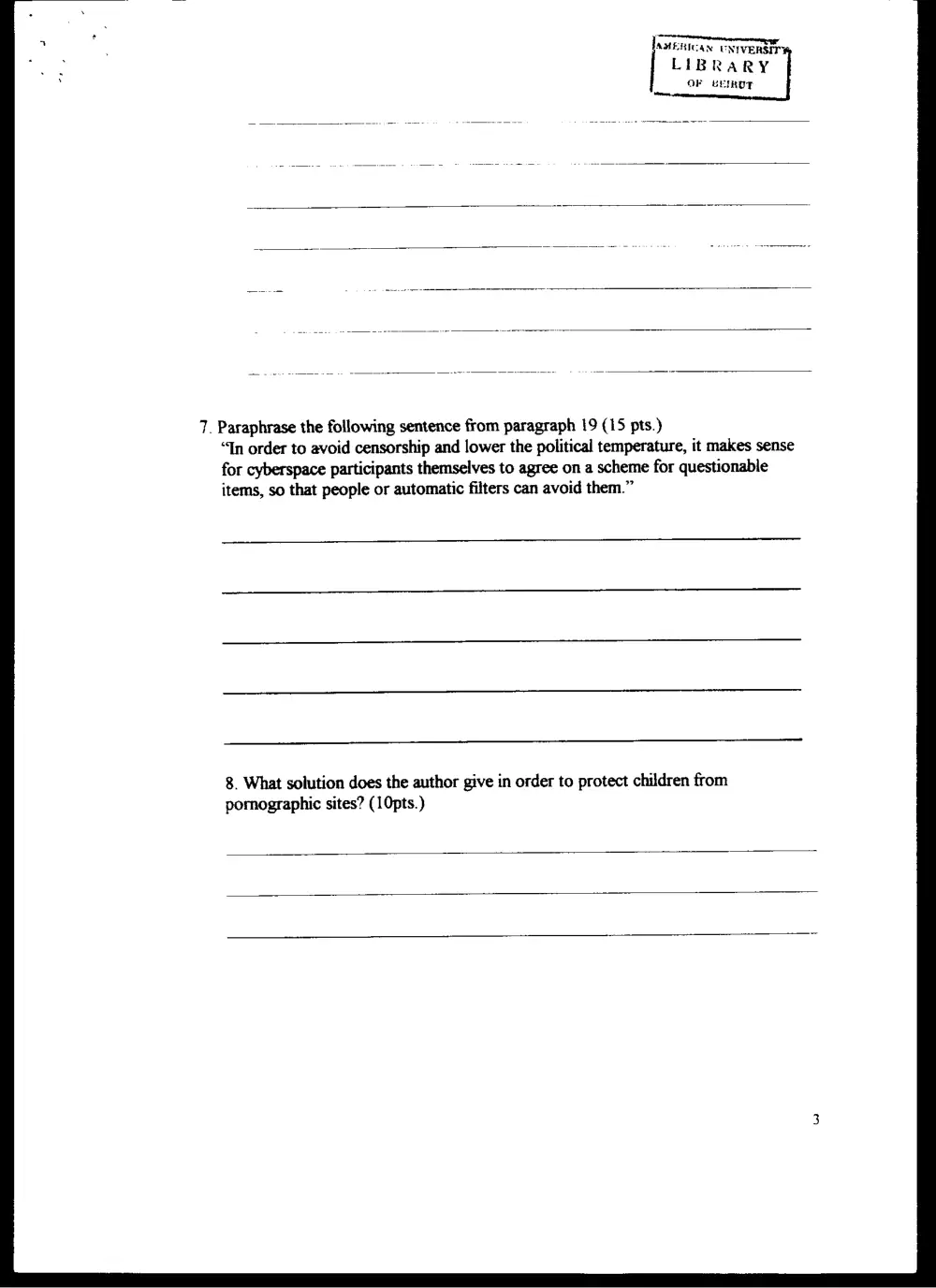
7. Paraphrase the following sentence from paragraph 19 (15 pts.)
“In order to avoid censorship and lower the political temperature, it makes sense
for cyberspace participants themselves to agree on a scheme for questionable
items, so that people or automatic filters can avoid them.”
8. What solution does the author give in order to protect children from
pornographic sites? (10pts.)
‘ (oor
PAA Cts ee
- : | LIB RARY
i OF KEIRUD
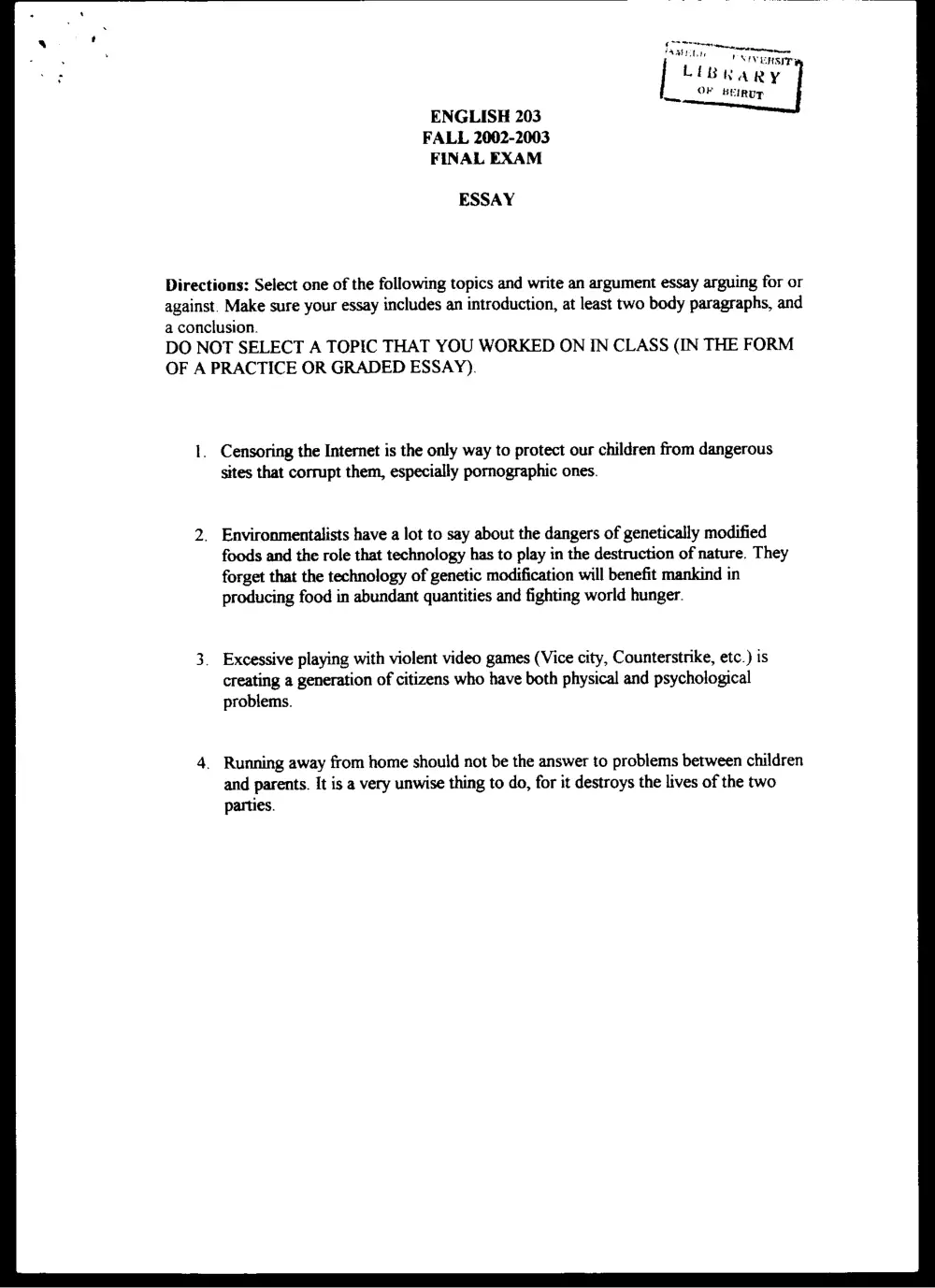
ENGLISH 203
FALL 2002-2003
FINAL EXAM
ESSAY
Directions: Select one of the following topics and write an argument essay arguing for or
against. Make sure your essay includes an introduction, at least two body paragraphs, and
a conclusion.
DO NOT SELECT A TOPIC THAT YOU WORKED ON IN CLASS (IN THE FORM
OF A PRACTICE OR GRADED ESSAY).
1. Censoring the Internet is the only way to protect our children from dangerous
sites that corrupt them, especially pornographic ones.
2. Environmentalists have a lot to say about the dangers of genetically modified
foods and the role that technology has to play in the destruction of nature. They
forget that the technology of genetic modification will benefit mankind in
producing food in abundant quantities and fighting world hunger.
3. Excessive playing with violent video games (Vice city, Counterstrike, etc.) is
creating a generation of citizens who have both physical and psychological
problems.
4. Running away from home should not be the answer to problems between children
and parents. It is a very unwise thing to do, for it destroys the lives of the two
parties.