
ENG 203 Final, Spring 2001
American University of Beirut · Academic English · 7 pages

More ENG 203 files
Show the text of this final exam
AMERICAN Estee!
LIBRARY ENGLISH 203
ae terete FINAL EXAMINATION
Spring 2000-2001
READING COMPREHENSION
Time Allowed: 90 Minutes
To Err Is Human
by
Lewis Thomas
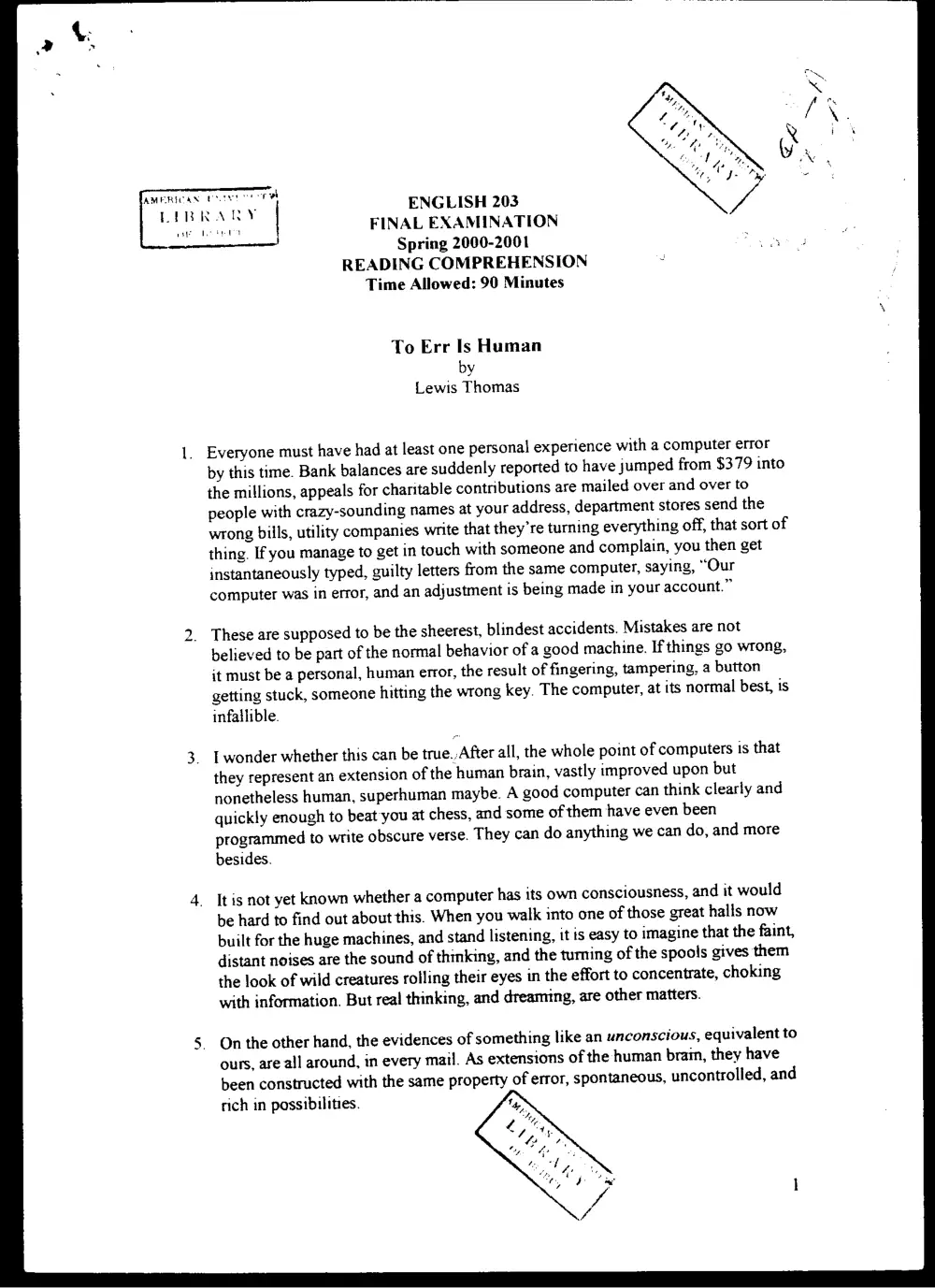
Everyone must have had at least one personal experience with a computer error
by this time. Bank balances are suddenly reported to have jumped from $379 into
the millions, appeals for charitable contributions are mailed over and over to
people with crazy-sounding names at your address, department stores send the
wrong bills, utility companies write that they’re turning everything off, that sort of
thing. If you manage to get in touch with someone and complain, you then get
instantaneously typed, guilty letters from the same computer, saying, “Our
computer was in error, and an adjustment is being made in your account.”
These are supposed to be the sheerest, blindest accidents. Mistakes are not
believed to be part of the normal behavior of a good machine. If things go wrong,
it must be a personal, human error, the result of fingering, tampering, a button
getting stuck, someone hitting the wrong key. The computer, at its normal best, is
infallible.
L wonder whether this can be true. After all, the whole point of computers is that
they represent an extension of the human brain, vastly improved upon but
nonetheless human, superhuman maybe. A good computer can think clearly and
quickly enough to beat you at chess, and some of them have even been
programmed to write obscure verse. They can do anything we can do, and more
besides.
It is not yet known whether a computer has its own consciousness, and it would
be hard to find out about this. When you walk into one of those great halls now
built for the huge machines, and stand listening, it is easy to imagine that the faint,
distant noises are the sound of thinking, and the tuming of the spools gives them
the look of wild creatures rolling their eyes in the effort to concentrate, choking
with information. But real thinking, and dreaming, are other matters.
On the other hand, the evidences of something like an unconscious, equivalent to
ours, are all around, in every mail. As extensions of the human brain, they have
been constructed with the same property of error, spontaneous, uncontrolled, and
rich in possibilities.
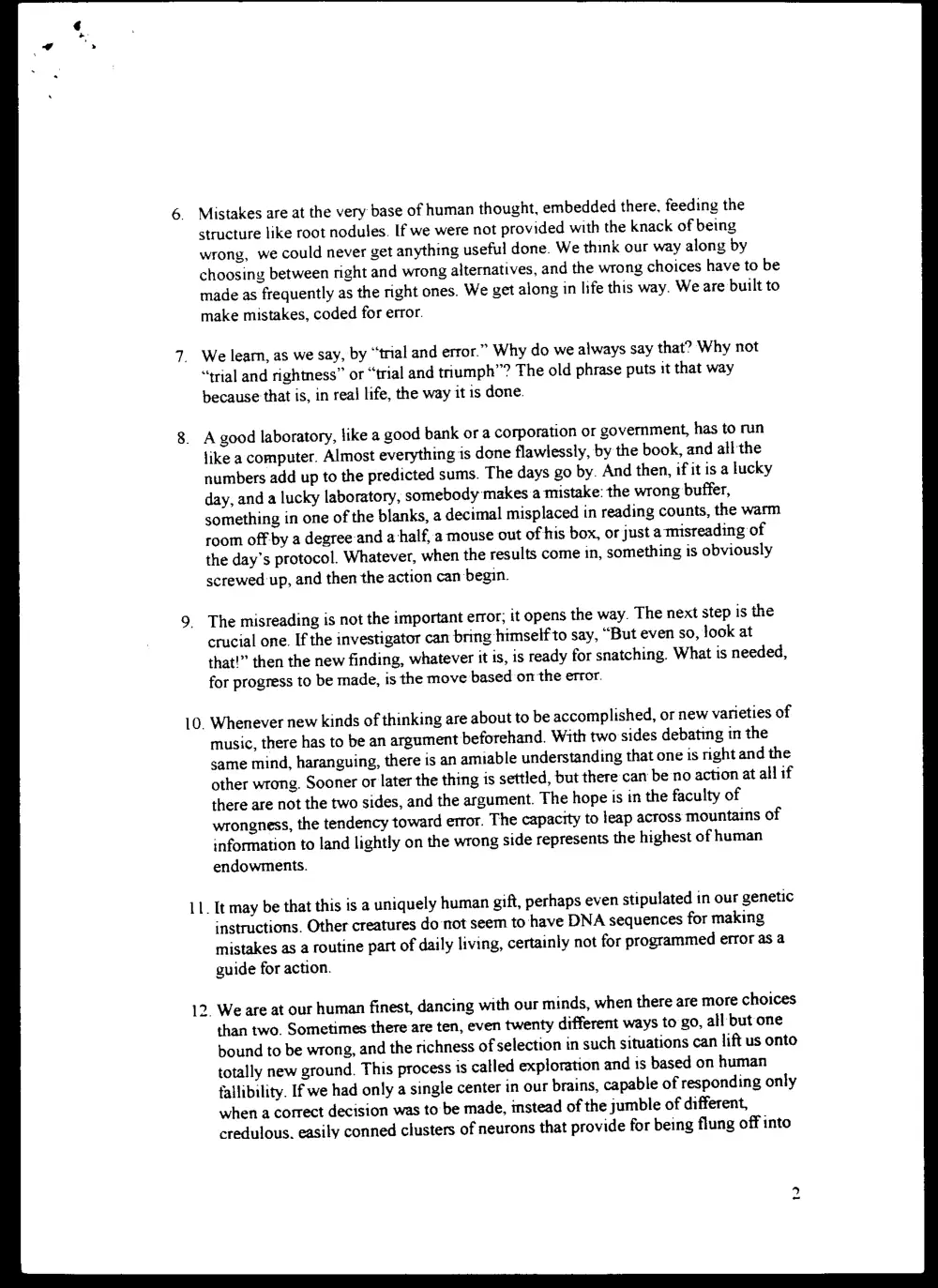
Mistakes are at the very base of human thought, embedded there, feeding the
structure like root nodules. If we were not provided with the knack of being
wrong, we could never get anything useful done. We think our way along by
choosing between right and wrong alternatives, and the wrong choices have to be
made as frequently as the right ones. We get along in life this way. We are built to
make mistakes, coded for error.
_ We learn, as we say, by “trial and error.” Why do we always say that? Why not
“trial and rightness” or “trial and triumph’? The old phrase puts it that way
because that is, in real life, the way it is done.
. A good laboratory, like a good bank or a corporation or government, has to run
like a computer. Almost everything is done flawlessly, by the book, and allthe
numbers add up to the predicted sums. The days go by. And then, if it is a lucky
day, and a lucky laboratory, somebody makes a mistake: the wrong buffer,
something in one of the blanks, a decimal misplaced in reading counts, the warm
room off-by a degree-and a half, a mouse out of his box, or just a misreading of
the day’s protocol. Whatever, when the results come in, something is obviously
screwed up, and then the action can begin.
The misreading is not the important error, it opens the way. The next step is the
crucial one. If the investigator can bring himself to say, “But even so, jook at
that!” then the new finding, whatever it is, is ready for snatching. What is needed,
for progress to be made, is the move based on the error.
_ Whenever new kinds of thinking are about to be accomplished, or new varieties of
music, there has to be an argument beforehand. With two sides debating in the
same mind, haranguing, there is an amiable understanding that one is right and the
other wrong. Sooner or later the thing ts settled, but there can be'no action at all if
there are not the two sides, and the argument. The hope is in the faculty of
wrongness, the tendency toward error. The capacity to leap across mountains of
information to land lightly on the wrong side represents the highest of human
endowments.
_ It may be that this is a uniquely human gift, perhaps even stipulated in our genetic
instructions. Other creatures do not seem to have DNA sequences for making
mistakes as a routine part of daily living, certainly not for programmed error as a
guide for action.
"We are at our human finest, dancing with our minds, when there are more choices
than two. Sometimes there are ten, even twenty different ways to go, all but one
bound to be wrong, and the richness of selection in such situations can lift us onto
totally new ground. This process is catled exploration and is based on human
fallibility. If we had only a single center in our brains, capable of responding only
when a correct decision was to be made, instead of the jumble of different,
credulous, easily conned clusters of neurons that provide for being flung off into
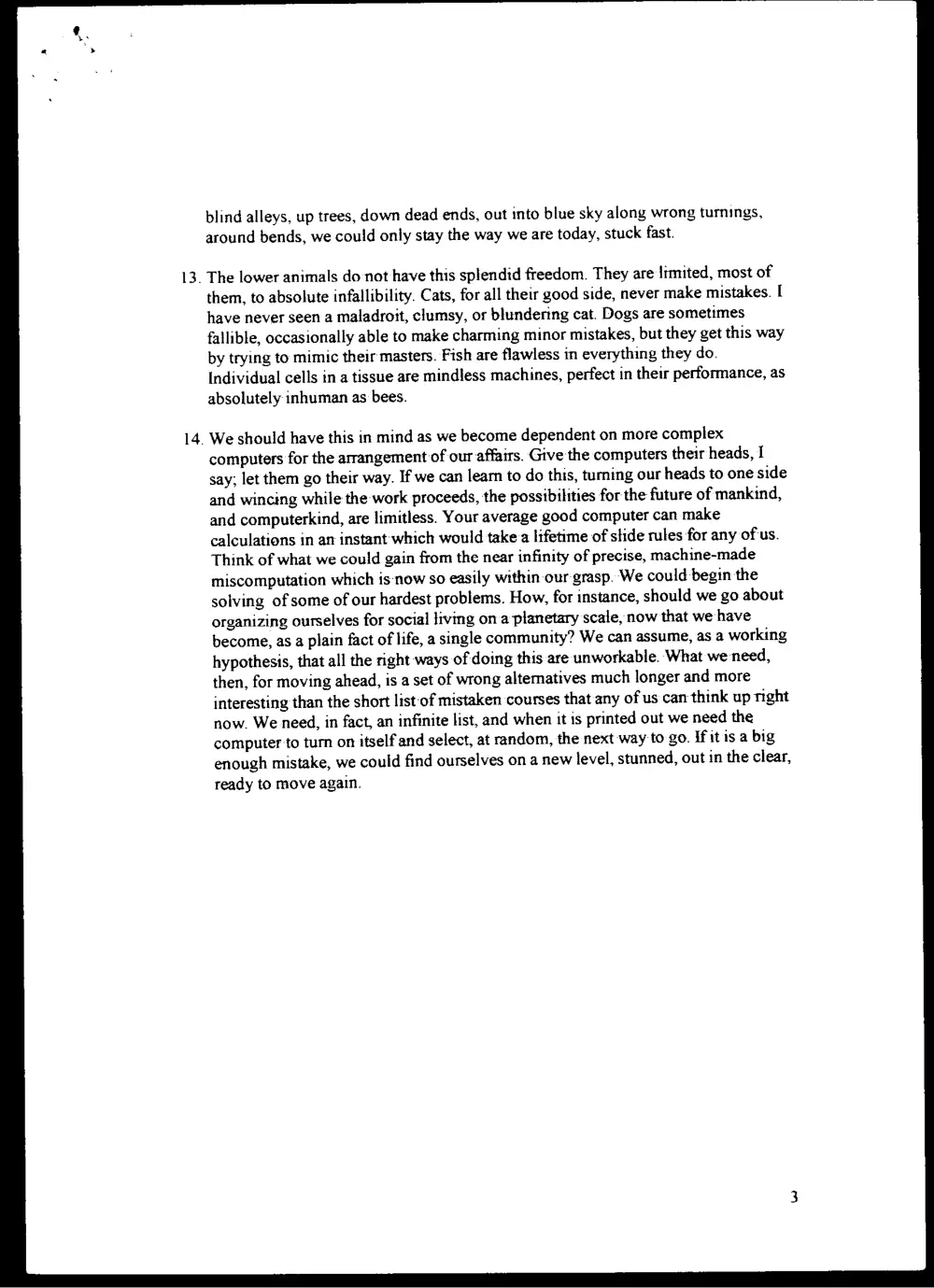
blind alleys, up trees, down dead ends, out into blue sky along wrong turnings,
around bends, we could only stay the way we are today, stuck fast.
_ The lower animals do not have this splendid freedom. They are limited, most of
them, to absolute infallibility. Cats, for all their good side, never make mistakes. [
have never seen a maladroit, clumsy, or blundering cat. Dogs are sometimes
fallible, occasionally able to make charming minor mistakes, but they get this way
by trying to mimic their masters. Fish are flawless in everything they do.
Individual cells in a tissue are mindless machines, perfect in their performance, as
absolutely inhuman as bees.
_We should have this in mind as we become dependent on more complex
computers for the arrangement of our affairs. Give the computers their heads, I
say; let them go their way. If we can learn to do this, turning our heads to one side
and wincing while the work proceeds, the possibilities for the future of mankind,
and computerkind, are limitless. Your average good computer can make
calculations in an instant which would take a lifetime of slide rules for any of'us.
Think of what we could gain from the near infinity of precise, machine-made
miscomputation which is-now so easily within our grasp. We could begin the
solving of some of our hardest problems. How, for instance, should we go about
organizing ourselves for social livmg on a planetary scale, now that we have
become, as a plain fact of life, a single community? We can assume, as a working
hypothesis, that all the right ways of doing this are unworkable. What we need,
then, for moving ahead, is a set of wrong alternatives much longer and more
interesting than the short list-of mistaken courses that any of us can think up right
now. We need, in fact, an infinite list, and when it is printed out we need the
computer to turn on itself and select, at random, the next way-to go. If itis a big
enough mistake, we could find ourselves on a new level, stunned, out in the clear,
ready to move again.
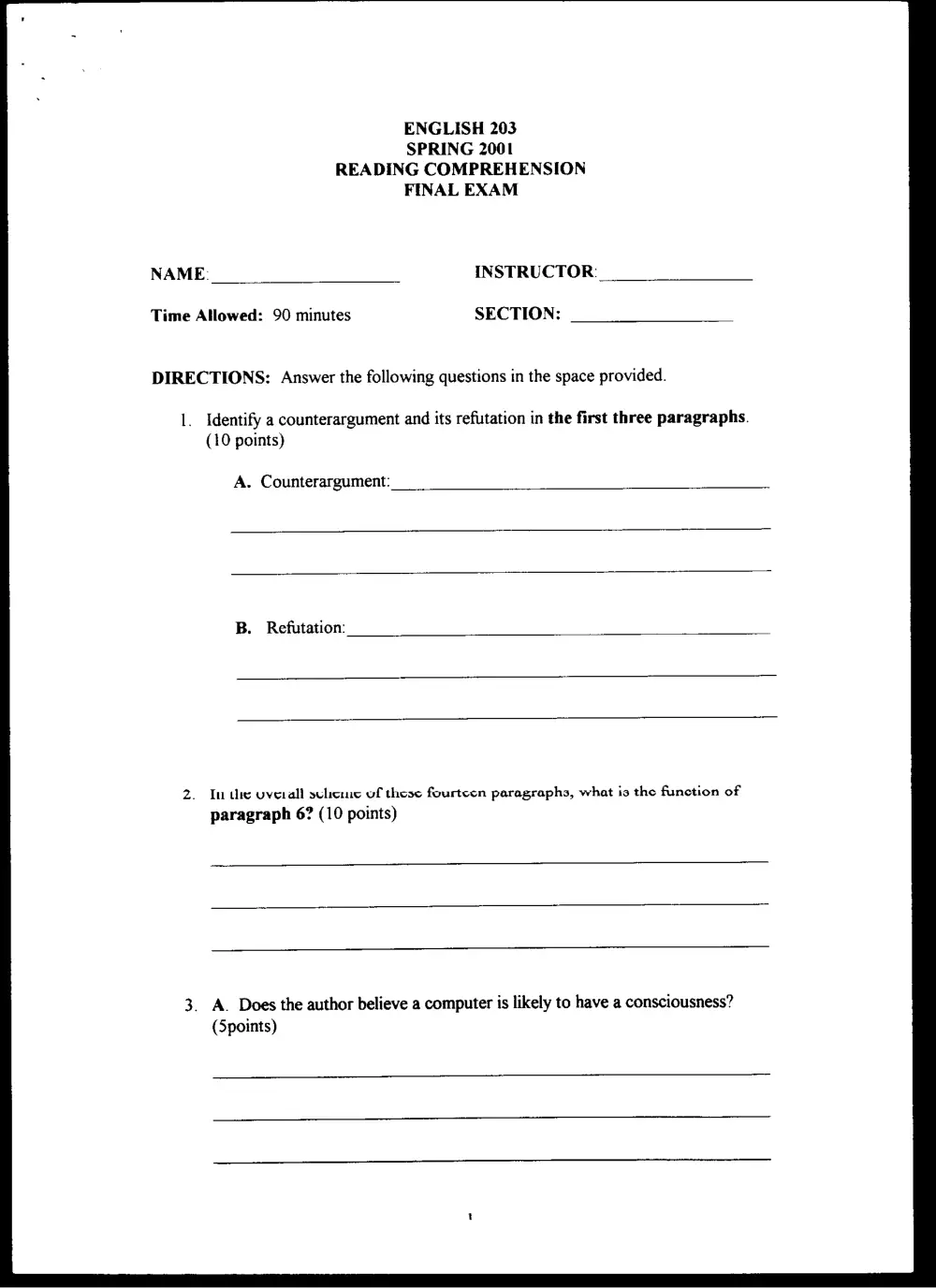
ENGLISH 203
SPRING 2001
READING COMPREHENSION
FINAL EXAM
NAME: INSTRUCTOR:
Time Allowed: 90 minutes SECTION:
DIRECTIONS: Answer the following questions in the space provided.
1. Identify a counterargument and its refutation in the first three paragraphs.
(10 points)
A. Counterargument:
B. Refutation:
2. In the uverall seliciic of those fourteen paragraphs, what is the function of
paragraph 6? (10 points)
3. A. Does the author believe a computer is likely to have a consciousness?
(5points)
B. Quote a sentence that clarifies the author’s position on this matter.(5 points)
4. Why does the author use the term “computerkind” in the concluding
paragraph? Explain how this serves the purpose of the author. (10 points)
5. The author traces human “fallibility” to some probable reason. What is this
reason? (10 points)
6. “The lower animals do not have this splendid freedom”(paragraph 13).
Exactly which kind of freedom is the author referring to? (10 points)
7. The last paragraph ends on an optimistic note. Find two words or phrases that
make this paragraph positive. (10 points)
A.
B.
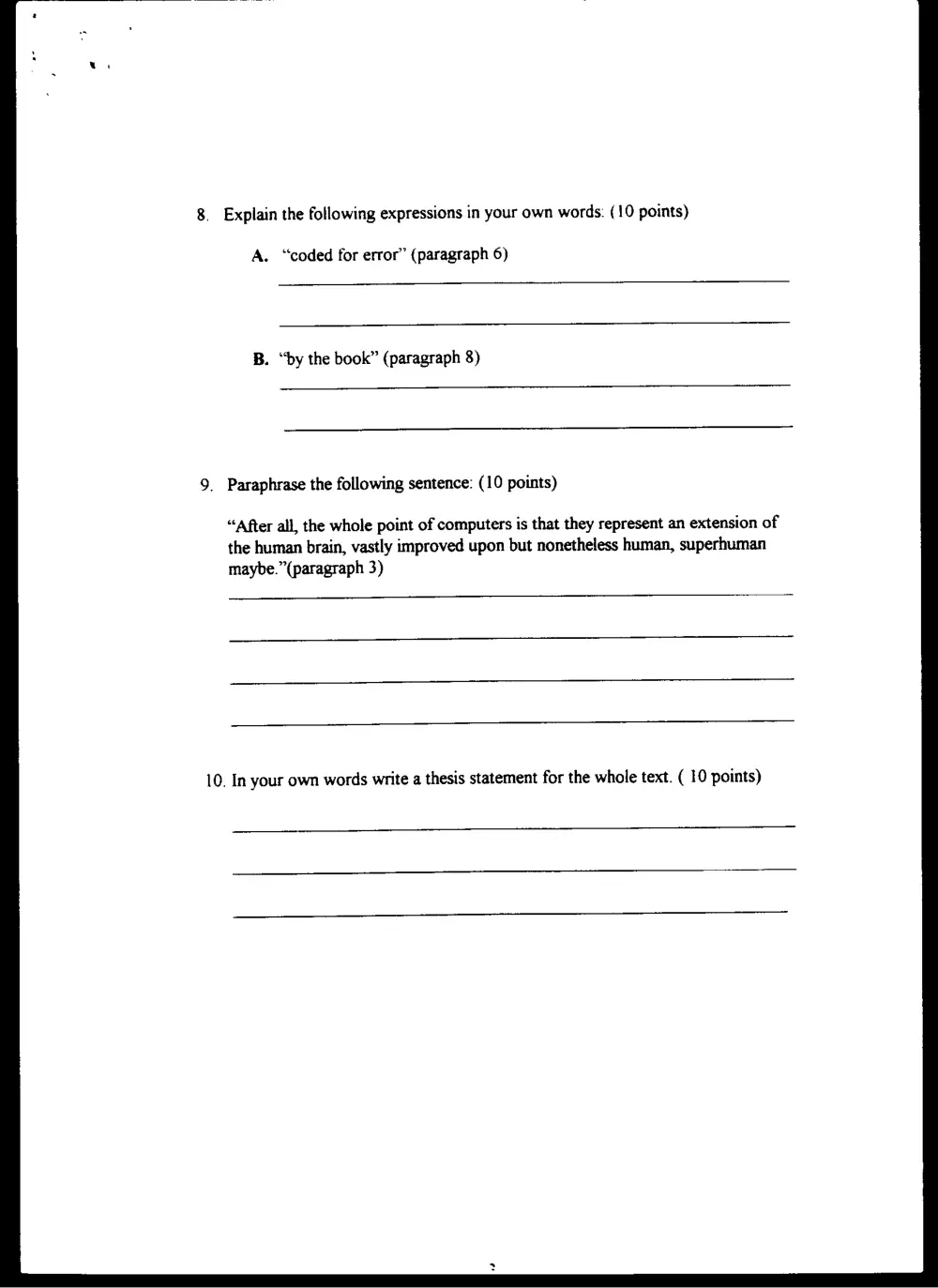
8. Explain the following expressions in your own words: (10 points)
A. “coded for error” (paragraph 6)
B. “by the book” (paragraph 8)
9. Paraphrase the following sentence: (10 points)
“After all, the whole point of computers is that they represent an extension of
the human brain, vastly improved upon but nonetheless human, superhuman
maybe.”(paragraph 3)
10. In your own words write a thesis statement for the whole text. (10 points)
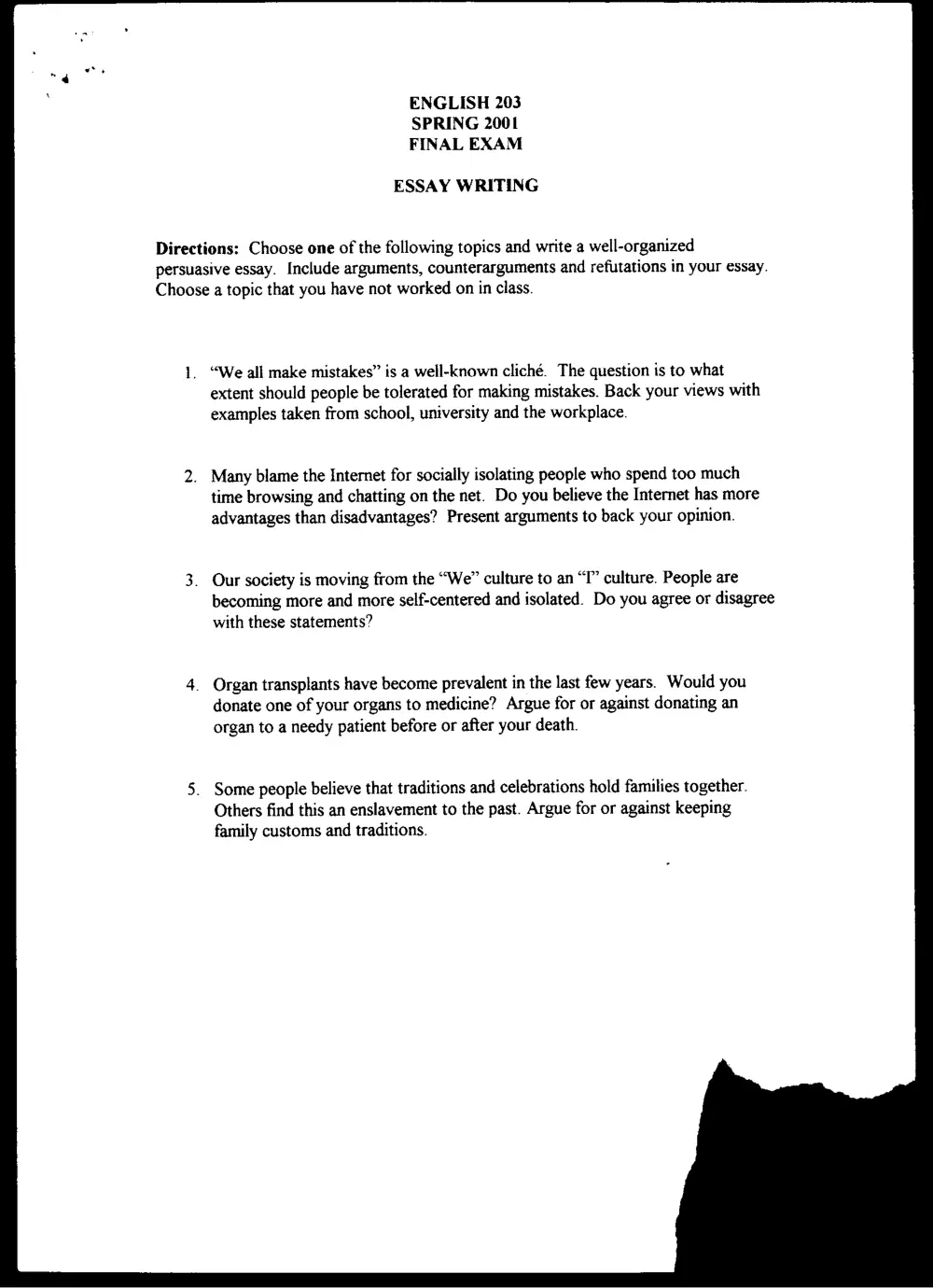
ENGLISH 203
SPRING 2001
FINAL EXAM
ESSAY WRITING
Directions: Choose one of the following topics and write a well-organized
persuasive essay. Include arguments, counterarguments and refutations in your essay.
Choose a topic that you have not worked on in class.
“We all make mistakes” is a well-known cliché. The question is to what
extent should people be tolerated for making mistakes. Back your views with
examples taken from school, university and the workplace.
. Many blame the Internet for socially isolating people who spend too much
time browsing and chatting on the net. Do you believe the Internet has more
advantages than disadvantages? Present arguments to back your opinion.
. Our society is moving from the “We” culture to an “T” culture. People are
becoming more and more self-centered and isolated. Do you agree or disagree
with these statements?
. Organ transplants have become prevalent in the last few years. Would you
donate one of your organs to medicine? Argue for or against donating an
organ to a needy patient before or after your death.
Some people believe that traditions and celebrations hold families together.
Others find this an enslavement to the past. Argue for or against keeping
family customs and traditions.