
ENG 203 Final, Summer 2001
American University of Beirut · Academic English · 7 pages


More ENG 203 files
Show the text of this final exam
ernie
— .
PMCRIEAN USICERSTE
LIBRARY
Or CCERUTE ae " s .
No 7
AMERICAN UNIVERSITY OF BEIRUT Ww
DEPARTMENT OF ENGLISH
Enghsh 203
Final Exam
Summer 2001
Time Allowed: 9O Minutes
Write an argumentative essay of four or five well-developed paragraphs on ONE of
the following propositions. Remember to use counterarguments and refutations as
well as examples.
It is social forces outside the school that have lowered educational standards,
not the schools themselves.
The standard of social and moral behavior in our community has deteriorated
in the last decade
Some people argue that the family as the basic unit of the social structure
underwent the most dramatic changes in the twentieth century.
The human being is the first victim of the computer-age technology.
GOOD LUCK
AMERICAN UNIVERSITY OF BEIRUT
DEPARTMENT OF ENGLISH
Enghsh 203
Fimal Exam
Summer 2001
Time Allowed: 9O Minutes
I. Short Answer Questions
Answer the following questions in YOUR OWN WORDS, limiting yourself to the
space provided.
1. According to Krutch, what is the paradox of his age? Explain. (10%)
2. Krutch employs emotionally charged language in this essay. Cite five charged
words and explain what purpose they serve. (10%)
AMERICAN UNIVERSIT?
LIBRARY
aoe meanest
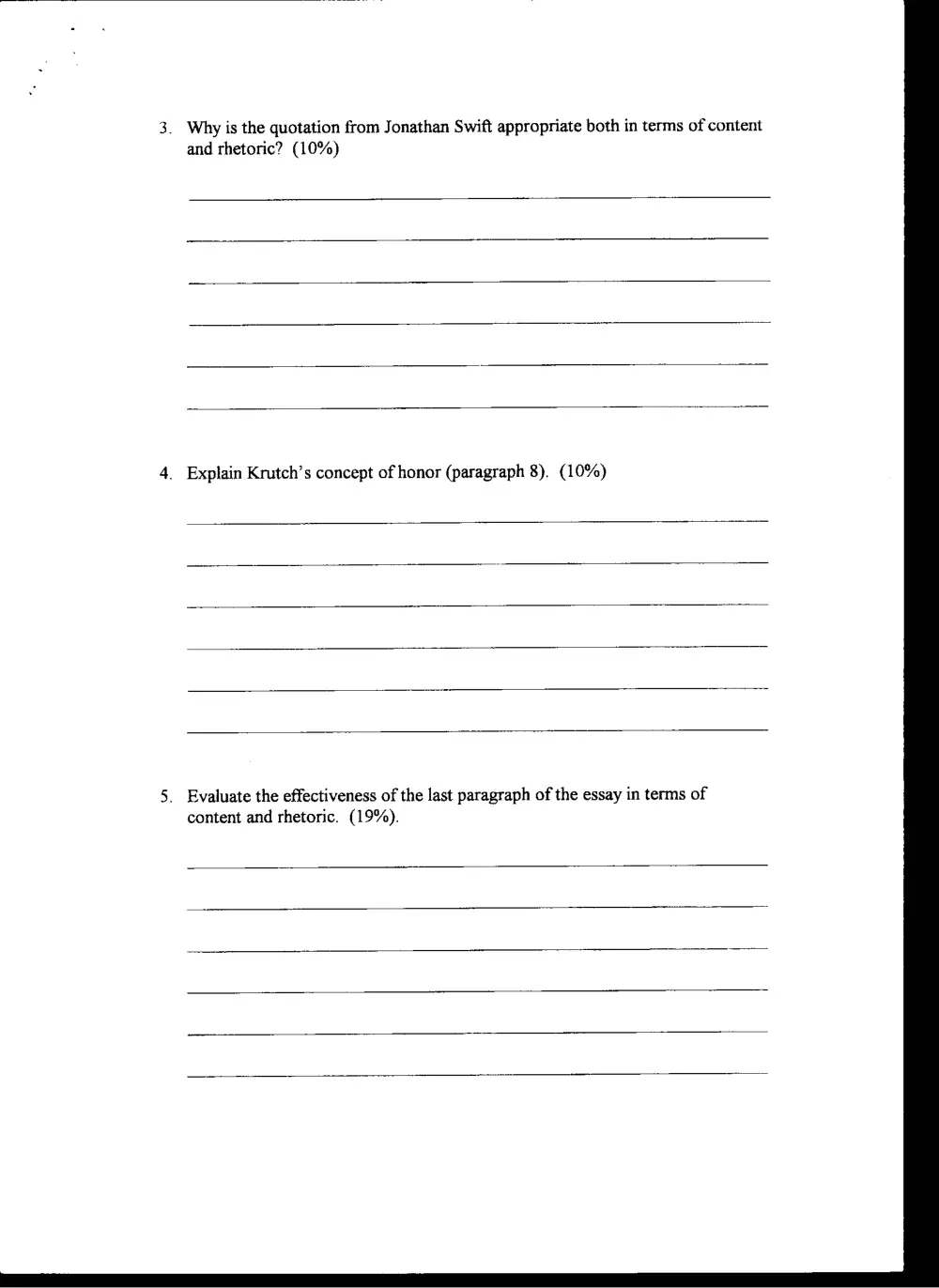
3. Why is the quotation from Jonathan Swift appropriate both in terms of content
and rhetoric? (10%)
4. Explain Krutch’s concept of honor (paragraph 8). (10%)
5. Evaluate the effectiveness of the last paragraph of the essay in terms of
content and rhetoric. (19%).
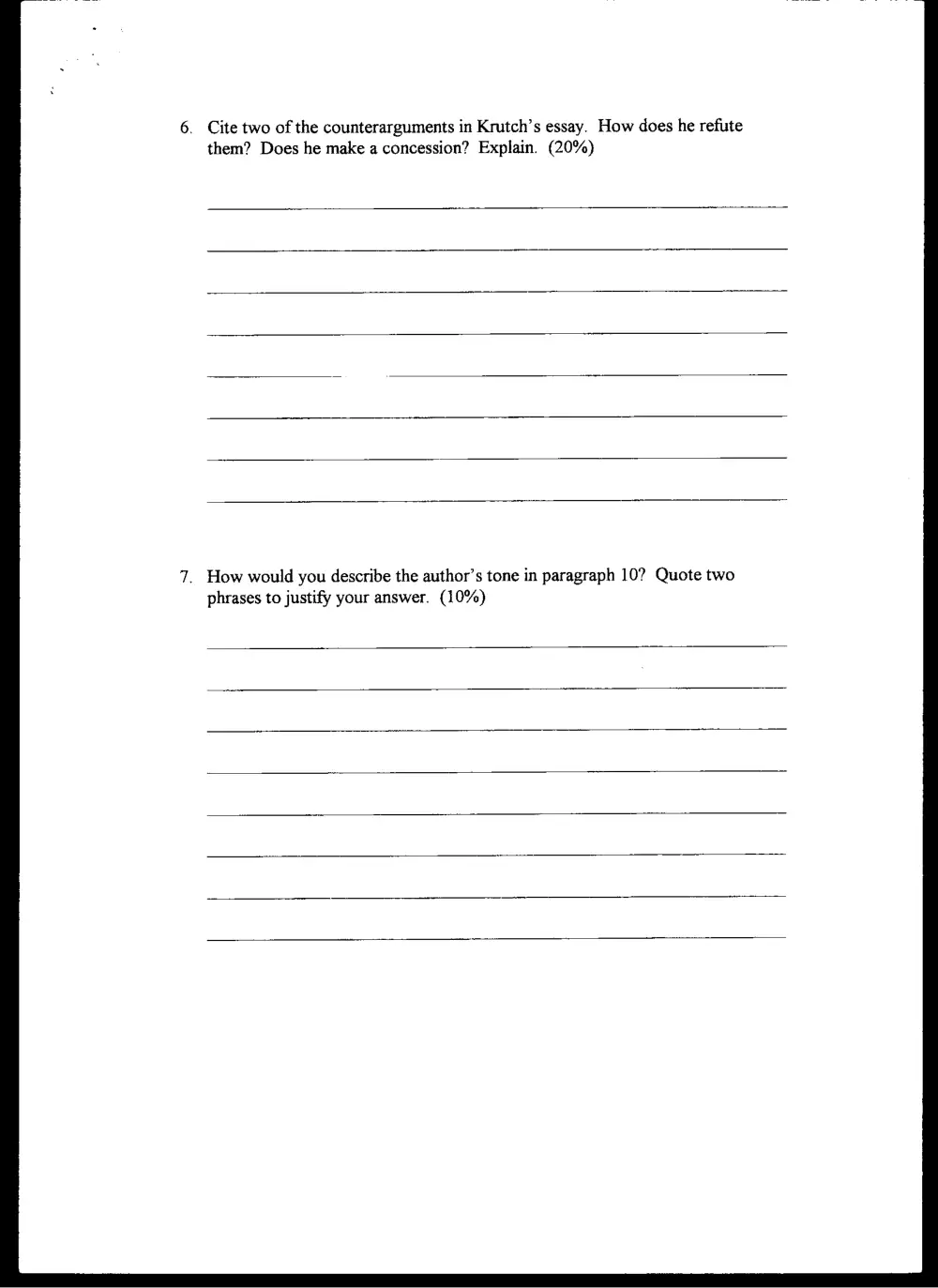
6. Cite two of the counterarguments in Krutch’s essay. How does he refute
them? Does he make a concession? Explain. (20%)
7. How would you describe the author’s tone in paragraph 10? Quote two
phrases to justify your answer. (10%)
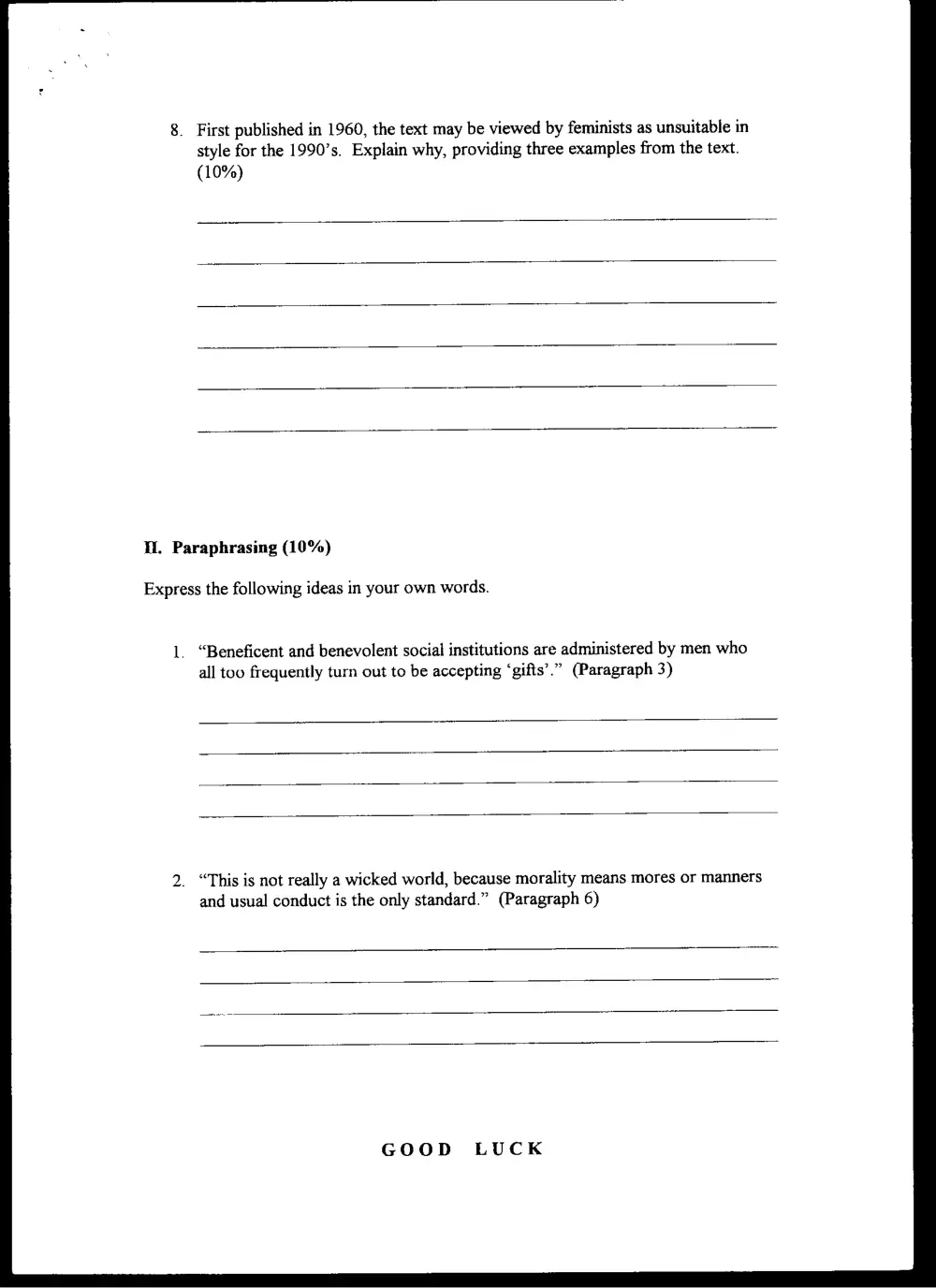
8. First published in 1960, the text may be viewed by feminists as unsuitable in
style for the 1990’s. Explain why, providing three examples from the text.
(10%)
i. Paraphrasing (10%)
Express the following ideas in your own words.
1. “Beneficent and benevolent social institutions are administered by men who
all too frequently turn out to be accepting ‘gifts’.” (Paragraph 3)
2. “This is not really a wicked world, because morality means mores or manners
and usual conduct is the only standard.” (Paragraph 6)
GOOD LUCK
AMERICAN UNIVERSITY OF BEIRU
DEPARTMENT OF ENGLISH
Enghsh 203
Final Exam
Summer 2001
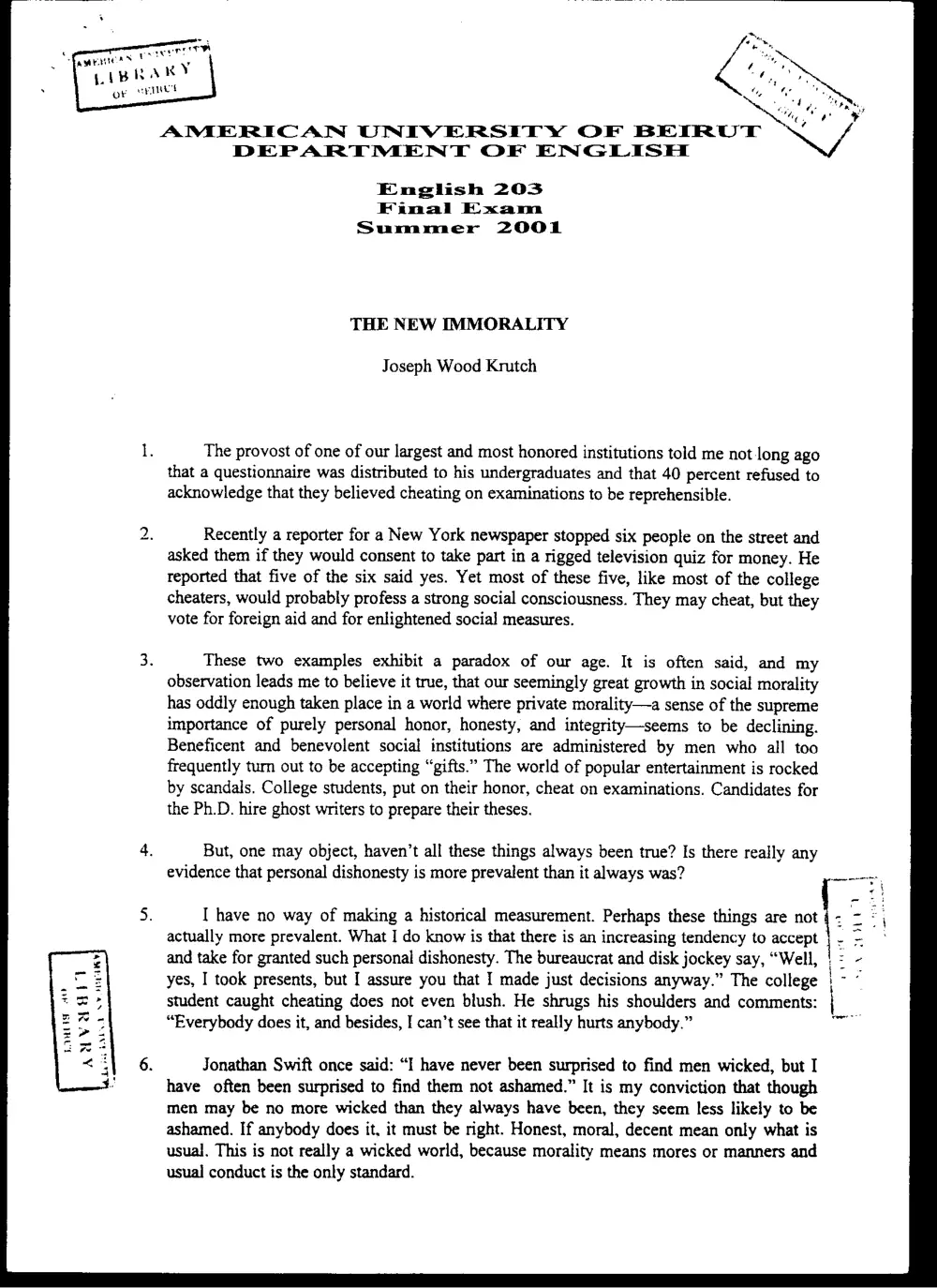
THE NEW IMMORALITY
Joseph Wood Knutch
1.
2.
The provost of one of our largest and most honored institutions told me not long ago
that a questionnaire was distributed to his undergraduates and that 40 percent refused to
acknowledge that they believed cheating on examinations to be reprehensible.
Recently a reporter for a New York newspaper stopped six people on the street and
asked them if they would consent to take part in a rigged television quiz for money. He
reported that five of the six said yes. Yet most of these five, like most of the college
cheaters, would probably profess a strong social consciousness. They may cheat, but they
vote for foreign aid and for enlightened social measures.
These two examples exhibit a paradox of our age. It is often said, and my
observation leads me to believe it true, that our seemingly great growth in social morality
has oddly enough taken place in a world where private morality—a sense of the supreme
importance of purely personal honor, honesty, and integrity—seems to be declining.
Beneficent and benevolent social institutions are administered by men who all too
frequently turn out to be accepting “gifts.” The world of popular entertainment is rocked
by scandals. College students, put on their honor, cheat on examinations. Candidates for
the Ph.D. hire ghost writers to prepare their theses.
4. But, one may object, haven’t all these things always been true? Is there really any
evidence that personal dishonesty is more prevalent than it always was?
I have no way of making a historical measurement. Perhaps these things are not
actually more prevalent. What I do know is that there is an increasing tendency to accept } -
and take for granted such personal dishonesty. The bureaucrat and disk jockey say, “Well, | =
yes, I took presents, but I assure you that I made just decisions anyway.” The college |:
student caught cheating does not even blush. He shrugs his shoulders and comments: |
“Everybody does it, and besides, I can’t see that it really hurts anybody.” —
>
=
»
?
ae
ZR
id
—
see
at
6. Jonathan Swift once said: “I have never been surprised to find men wicked, but I
have often been surprised to find them not ashamed.” It is my conviction that though
men may be no more wicked than they always have been, they seem less likely to be
ashamed. If anybody does it, it must be right. Honest, moral, decent mean only what is
usual. This is not really a wicked world, because morality means mores or manners and
usual conduct is the only standard.
Paver
The second part of the defense, “it really doesn’t hurt anybody,” is equally revealing.
“It doesn’t hurt anybody” means it doesn’t do that abstraction called society any harm.
The harm it did the bribe-taker and the cheater isn’t important; it is purely personal. And
personal as opposed to social decency doesn’t count for much. Sometimes [ am inclined
to blame sociology for part of this paradox. Sociology has tended to lay exclusive stress
upon social morality, and tended too often to define good and evil as merely the “socially
useful” or its reverse.
What social morality and social conscience leave out is the narrower but very
significant concept of honor—as opposed to what is sometimes called merely “socially
desirable conduct.” The man of honor is not content to ask merely whether this or that
will hurt society, or whether it is what most people would permit themselves to do. He
asks, and he asks first of all, would it hurt him and his self-respect? Would it dishonor
him personally?
It was a favorite and no doubt sound argument among early twentieth-century
reformers that “playing the game” as the gentleman was supposed to play it was not
enough to make a decent society. They were right: it is not enough. But the time has
come to add that it is indeed inevitable that the so-called social conscience unsupported
by the concept of personal honor will create a corrupt society. But suppose that it
doesn’t? Suppose that no one except the individual suffers from the fact that he sees
nothing wrong in doing what everybody else does? Even so, I still insist that for the
individual himself nothing is more important than this personal, interior sense of right
and wrong and his determination to follow that rather than to be guided by what
everybody does or merely the criterion of “social usefulness.” It is impossible for me to
imagine a good society composed of men without honor.
We hear it said frequently that what present-day men most desire is security. If that
is so, then they have a wrong notion of what the real, the ultimate, security is. No one
who is dependent on anything outside himself, upon money, power, fame, or whatnot, is
or ever can be secure. Only he who possesses himself and is content with himself is
actually secure. Too much is being said about the importance of adjustment and
“participation in the group.” Even cooperation, to give this thing its most favorable
designation, is no more important than the ability to stand alone when the choice must be
made between the sacrifice of one’s own integrity and adjustment to or participation in
group activity.
No matter how bad the world may become, no matter how much the mass man of
the future may lose such of the virtues as he still has, one fact remains. If one person
alone refuses to go along with him, if one person alone asserts his individual and inner
right to believe in and be loyal to what his fellow men seem to have given up, then at
least he will still remain what is perhaps the most important part of humanity.