
ENG 203 Final, Summer 2002
American University of Beirut · Academic English · 7 pages
More ENG 203 files
Show the text of this final exam
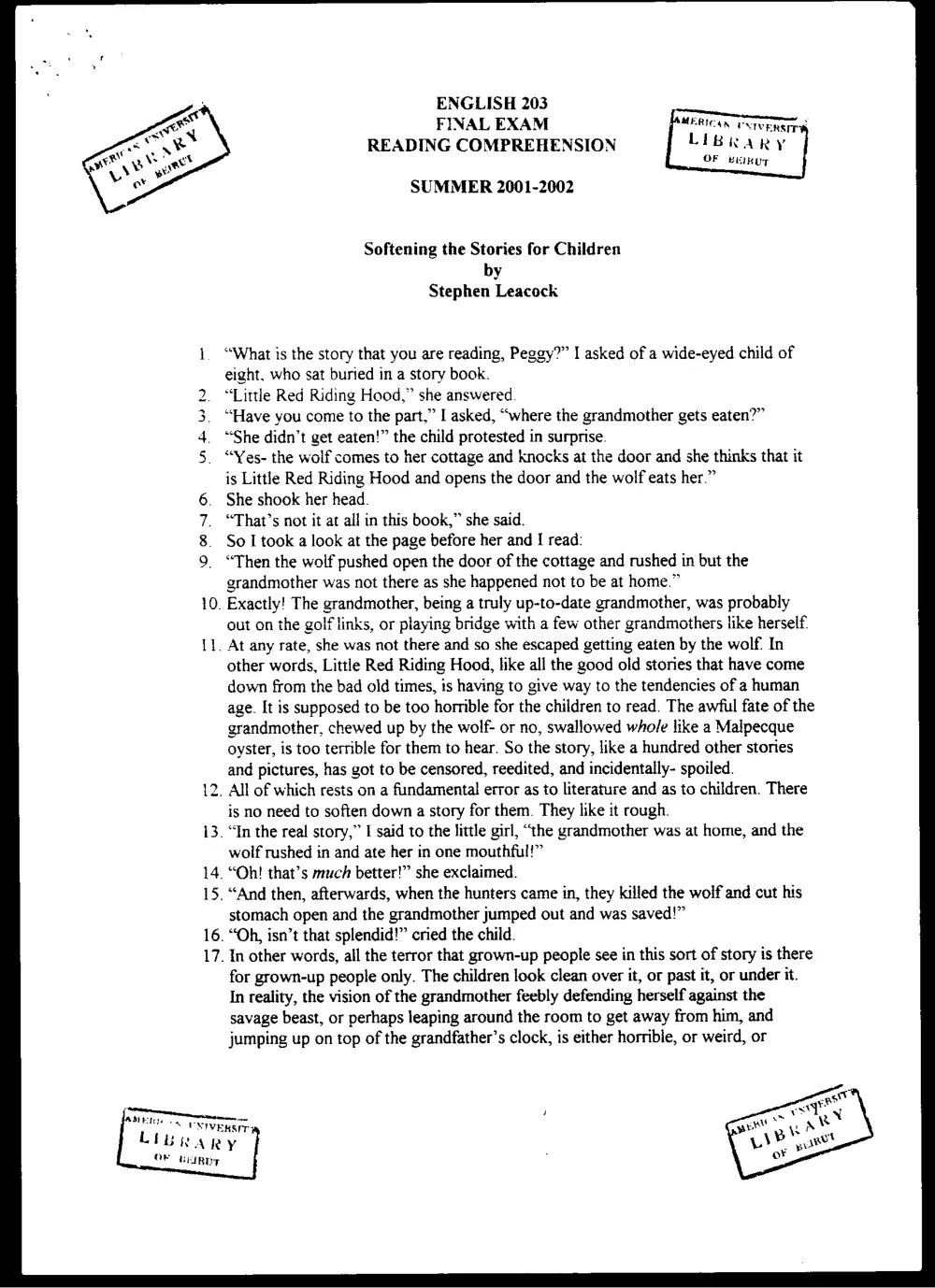
ENGLISH 203
FINAL EXAM MERICON UNTVERSIFR
READING COMPREHENSION LIBkaRy
OF keiod
SUMMER 2001-2002
Softening the Stories for Children
by
Stephen Leacock
“What is the story that you are reading, Peggy?” I asked of a wide-eyed child of
eight, who sat buried in a story book.
“Little Red Riding Hood,” she answered.
“Have you come to the part,” I asked, “where the grandmother gets eaten?”
_ “She didn’t get eaten!” the child protested in surprise.
. “Yes- the wolf comes to her cottage and knocks at the door and she thinks that it
is Little Red Riding Hood and opens the door and the wolf eats her.”
She shook her head.
“That’s not it at all in this book,” she said.
So I took a look at the page before her and [ read:
“Then the wolf pushed open the door of the cottage and rushed in but the
grandmother was not there as she happened not to be at home.”
. Exactly! The grandmother, being a truly up-to-date grandmother, was probably
out on the golf links, or playing bridge with a few other grandmothers like herself.
. At any rate, she was not there and so she escaped getting eaten by the wolf. In
other words, Little Red Riding Hood, like all the good old stories that have come
down from the bad old times, is having to give way to the tendencies of a human
age. It is supposed to be too horrible for the children to read. The awful fate of the
grandmother, chewed up by the wolf- or no, swallowed whole like a Malpecque
oyster, is too terrible for them to hear. So the story, like a hundred other stories
and pictures, has got to be censored, reedited, and incidentally- spoiled.
. All of which rests on a fundamental error as to literature and as to children. There
is no need to soften down a story for them. They like it rough.
. “In the real story,” I said to the little girl, “the grandmother was at home, and the
wolf rushed in and ate her in one mouthful!”
. “Oh! that’s much better!” she exclaimed.
. “And then, afterwards, when the hunters came in, they killed the wolf and cut his
stomach open and the grandmother jumped out and was saved!”
. “Oh, isn’t that splendid!” cried the child.
_ In other words, all the terror that grown-up people see in this sort of story is there
for grown-up people only. The children look clean over it, or past it, or under it.
In reality, the vision of the grandmother feebly defending herself against the
savage beast, or perhaps leaping around the room to get away from him, and
jumping up on top of the grandfather’s clock, is either horrible, or weird, or
Pyrenean
°S USIVERSrr
18.
19,
21.
isa
eo
25.
26.
27.
28.
29.
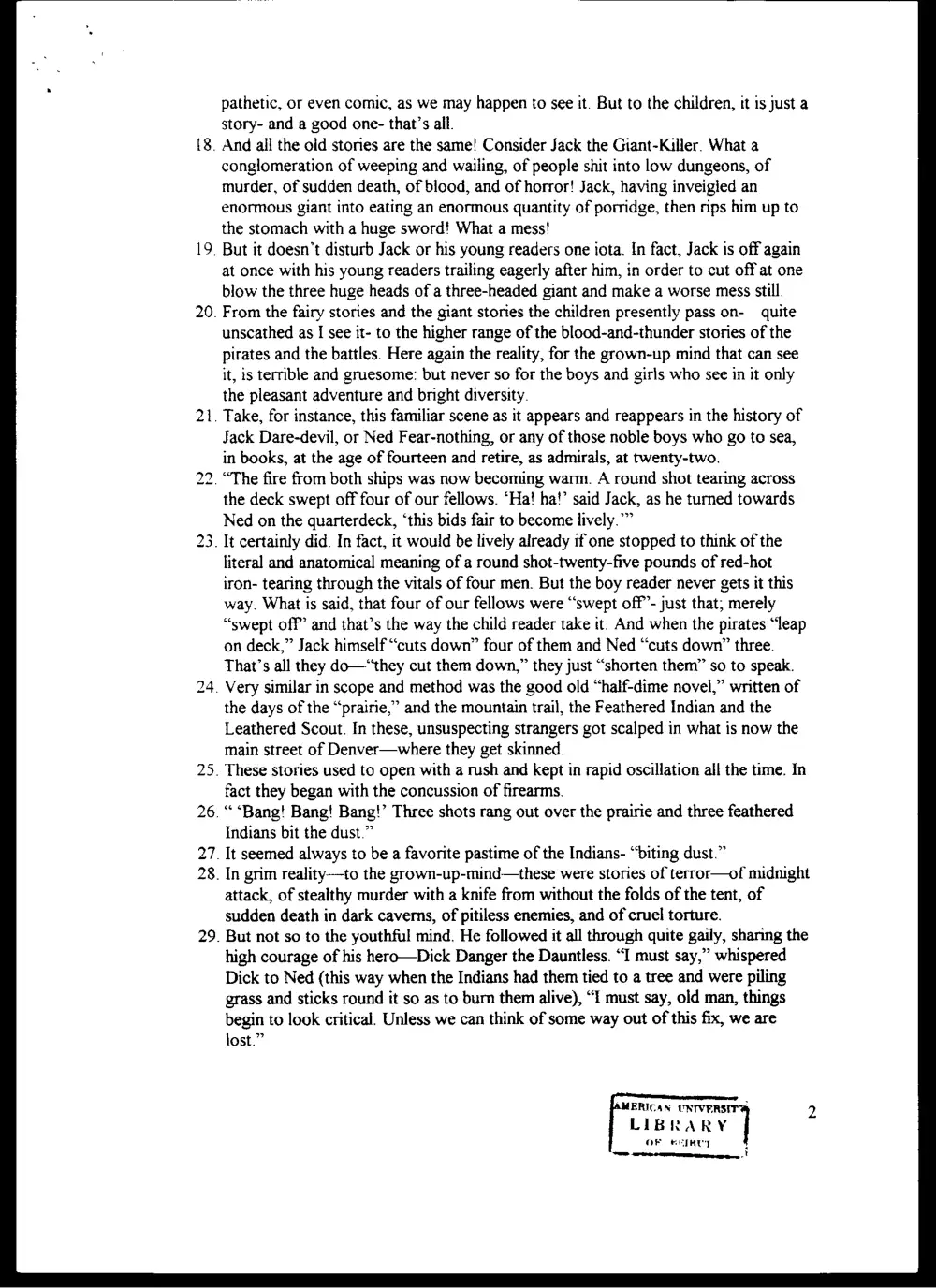
pathetic, or even comic, as we may happen to see it. But to the children, it is just a
story- and a good one- that’s all.
And ali the old stories are the same! Consider Jack the Giant-Killer. What a
conglomeration of weeping and wailing, of people shit into low dungeons, of
murder, of sudden death, of blood, and of horror! Jack, having inveigied an
enormous giant into eating an enormous quantity of porridge, then rips him up to
the stomach with a huge sword! What a mess!
But it doesn’t disturb Jack or his young readers one iota. In fact, Jack is off again
at once with his young readers trailing eagerly after him, in order to cut off at one
blow the three huge heads of a three-headed giant and make a worse mess still.
. From the fairy stories and the giant stories the children presently pass on- quite
unscathed as I see it- to the higher range of the blood-and-thunder stories of the
pirates and the battles. Here again the reality, for the grown-up mind that can see
it, is terrible and gruesome: but never so for the boys and girls who see in it only
the pleasant adventure and bright diversity.
Take, for instance, this familiar scene as it appears and reappears in the history of
Jack Dare-devil, or Ned Fear-nothing, or any of those noble boys who go to sea,
in books, at the age of fourteen and retire, as admirals, at twenty-two.
. “The fire from both ships was now becoming warm. A round shot tearing across
the deck swept off four of our fellows. ‘Ha! ha!” said Jack, as he tured towards
Ned on the quarterdeck, ‘this bids fair to become lively.””
. It certainly did. In fact, it would be lively already if one stopped to think of the
literal and anatomical meaning of a round shot-twenty-five pounds of red-hot
iron- tearing through the vitals of four men. But the boy reader never gets it this
way. What is said, that four of our fellows were “swept off’- just that; merely
“swept off’ and that’s the way the child reader take it. And when the pirates “leap
on deck,” Jack himself “cuts down” four of them and Ned “cuts down” three.
That’s all they do—‘they cut them down,” they just “shorten them” so to speak.
. Very similar in scope and method was the good old “half-dime novel,” written of
the days of the “prairie,” and the mountain trail, the Feathered Indian and the
Leathered Scout. In these, unsuspecting strangers got scalped in what is now the
main street of Denver—where they get skinned.
These stories used to open with a rush and kept in rapid oscillation all the time. In
fact they began with the concussion of firearms.
“ ‘Bang! Bang! Bang!’ Three shots rang out over the prairie and three feathered
Indians bit the dust.”
It seemed always to be a favorite pastime of the Indians- “biting dust.”
In grim reality-—-to the grown-up-mind—these were stories of terror—of midnight
attack, of stealthy murder with 2 knife from without the folds of the tent, of
sudden death in dark caverns, of pitiless enemies, and of cruel torture.
But not so to the youthful mind. He followed it all through quite gaily, sharing the
high courage of his hero—Dick Danger the Dauntless. “I must say,” whispered
Dick to Ned (this way when the Indians had them tied to a tree and were piling
grass and sticks round it so as to burn them alive), “I must say, old man, things
begin to look critical. Unless we can think of some way out of this fix, we are
lost.”
ERICAN UNIVERSIT® 2
LIBRARY ]
OF eeIRUT
Woe eee cmmmmennnees-!
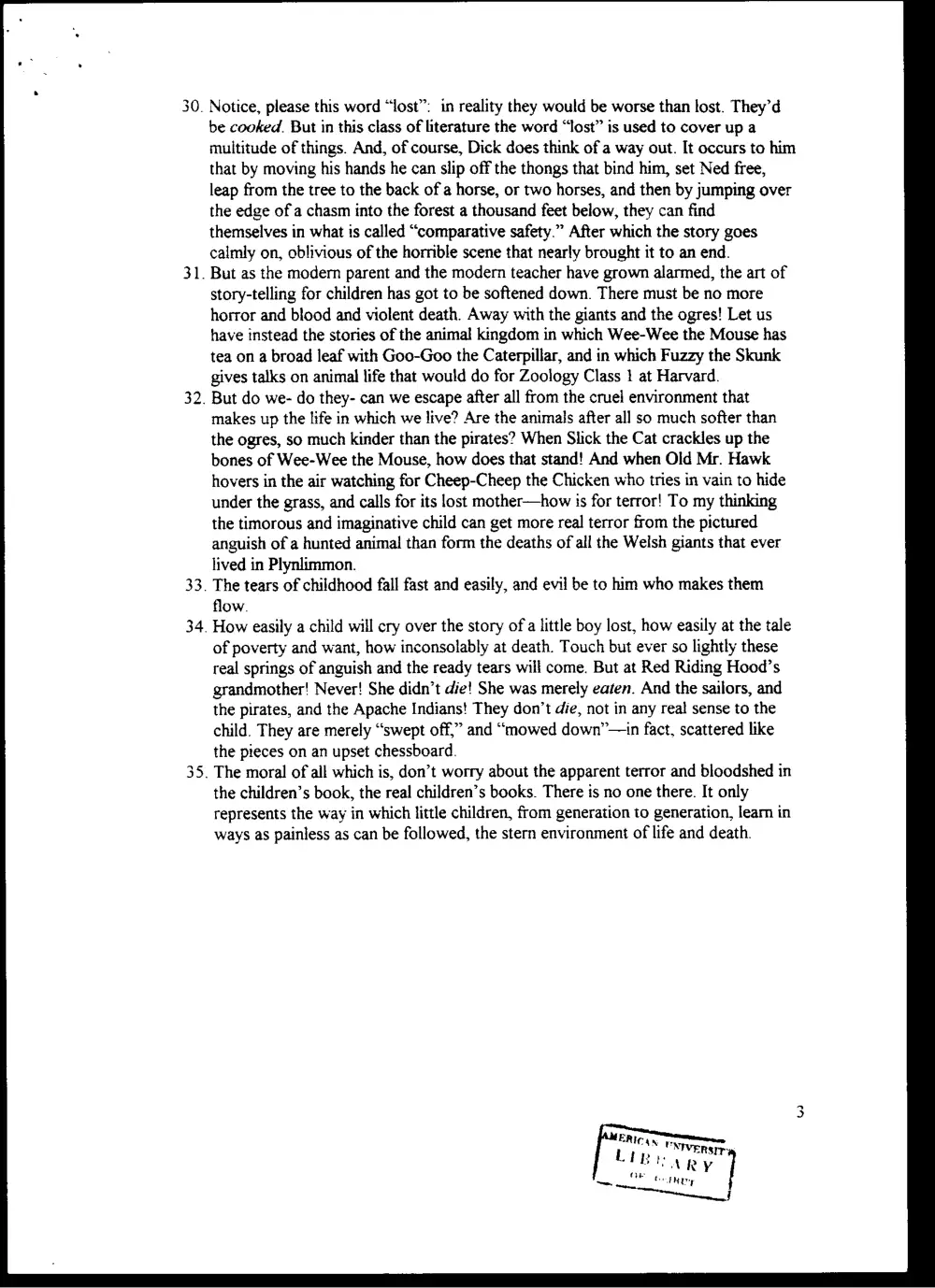
. Notice, please this word “lost”: in reality they would be worse than lost. They’d
be cooked. But in this class of literature the word “lost” is used to cover up a
multitude of things. And, of course, Dick does think of a way out. It occurs to him
that by moving his hands he can slip off the thongs that bind him, set Ned free,
leap from the tree to the back of a horse, or two horses, and then by jumping over
the edge of a chasm into the forest a thousand feet below, they can find
themselves in what is called “comparative safety.” After which the story goes
calmly on, oblivious of the horrible scene that nearly brought it to an end.
. But as the modern parent and the modern teacher have grown alarmed, the art of
story-telling for children has got to be softened down. There must be no more
horror and blood and violent death. Away with the giants and the ogres! Let us
have instead the stories of the animal kingdom in which Wee-Wee the Mouse has
tea on a broad leaf with Goo-Goo the Caterpillar, and in which Fuzzy the Skunk
gives talks on animal life that would do for Zoology Class 1 at Harvard.
. But do we- do they- can we escape after all from the cruel environment that
makes up the life in which we live? Are the animals after all so much softer than
the ogres, so much kinder than the pirates? When Slick the Cat crackles up the
bones of Wee-Wee the Mouse, how does that stand! And when Old Mr. Hawk
hovers in the air watching for Cheep-Cheep the Chicken who tries in vain to hide
under the grass, and calls for its lost mother—how is for terror! To my thinking
the timorous and imaginative child can get more real terror from the pictured
anguish of a hunted animal than form the deaths of all the Welsh giants that ever
lived in Plynlimmon.
. The tears of childhood fall fast and easily, and evil be to him who makes them
flow.
. How easily a child will cry over the story of a little boy lost, how easily at the tale
of poverty and want, how inconsolably at death. Touch but ever so lightly these
real springs of anguish and the ready tears will come. But at Red Riding Hood’s
grandmother! Never! She didn’t die! She was merely eaten. And the sailors, and
the pirates, and the Apache Indians! They don’t die, not in any real sense to the
child. They are merely “swept off,” and “mowed down”—in fact, scattered like
the pieces on an upset chessboard.
. The moral of all which is, don’t worry about the apparent terror and bloodshed in
the children’s book, the real children’s books. There is no one there. It only
represents the way in which little children, from generation to generation, learn in
ways as painless as can be followed, the stern environment of life and death.
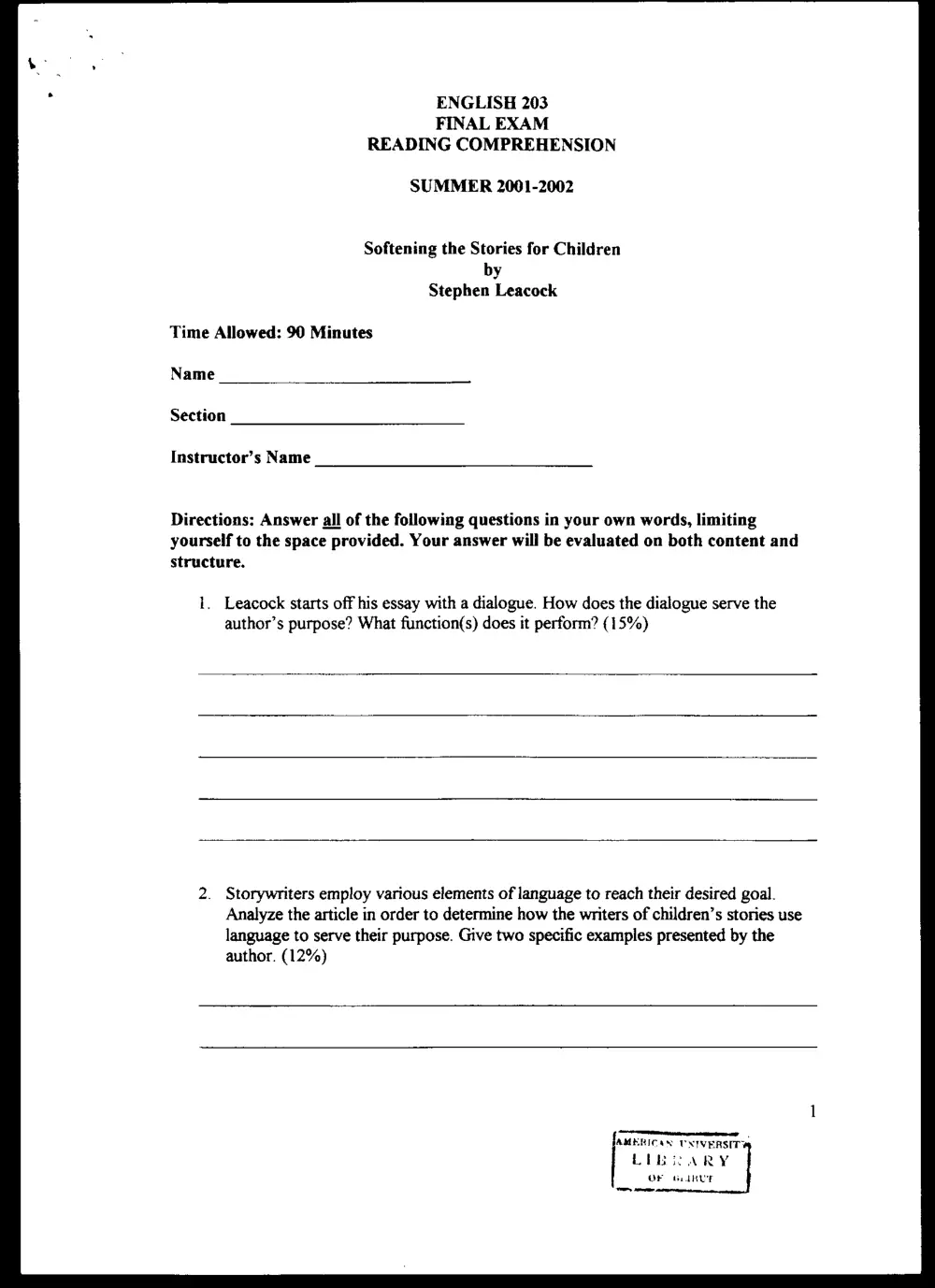
ENGLISH 203
FINAL EXAM
READING COMPREHENSION
SUMMER 2001-2002
Softening the Stories for Children
by
Stephen Leacock
Time Allowed: 90 Minutes
Name
Section
Instructor’s Name
Directions: Answer all of the following questions in your own words, limiting
yourself to the space provided. Your answer will be evaluated on both content and
structure.
1. Leacock starts off his essay with a dialogue. How does the dialogue serve the
author’s purpose? What function(s) does it perform? (15%)
2. Storywriters employ various elements of language to reach their desired goal.
Analyze the article in order to determine how the writers of children’s stories use
language to serve their purpose. Give two specific examples presented by the
author. (12%)
—— enemy |
AMERICAN UNIVERSITY
LIB ARY
OF biuRUT
—_ er.
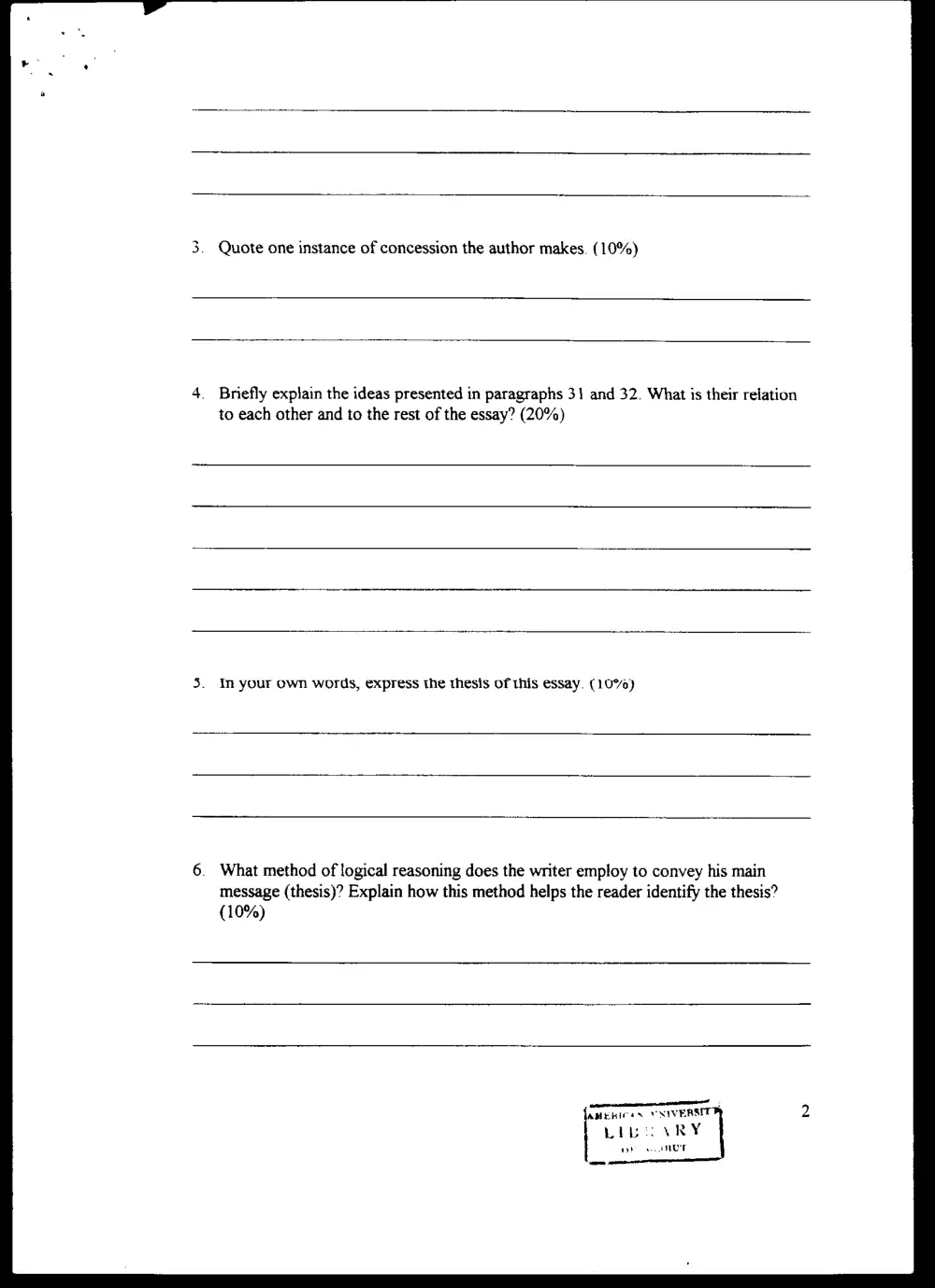
Quote one instance of concession the author makes. (10%)
Briefly explain the ideas presented in paragraphs 31 and 32. What is their relation
to each other and to the rest of the essay? (20%)
In your Own words, express the thesis of this essay. (10%)
What method of logical reasoning does the writer employ to convey his main
message (thesis)? Explain how this method helps the reader identify the thesis?
(10%)
pn peel
AMERICES UNIVERSIT
Lib wRY
oh ROT
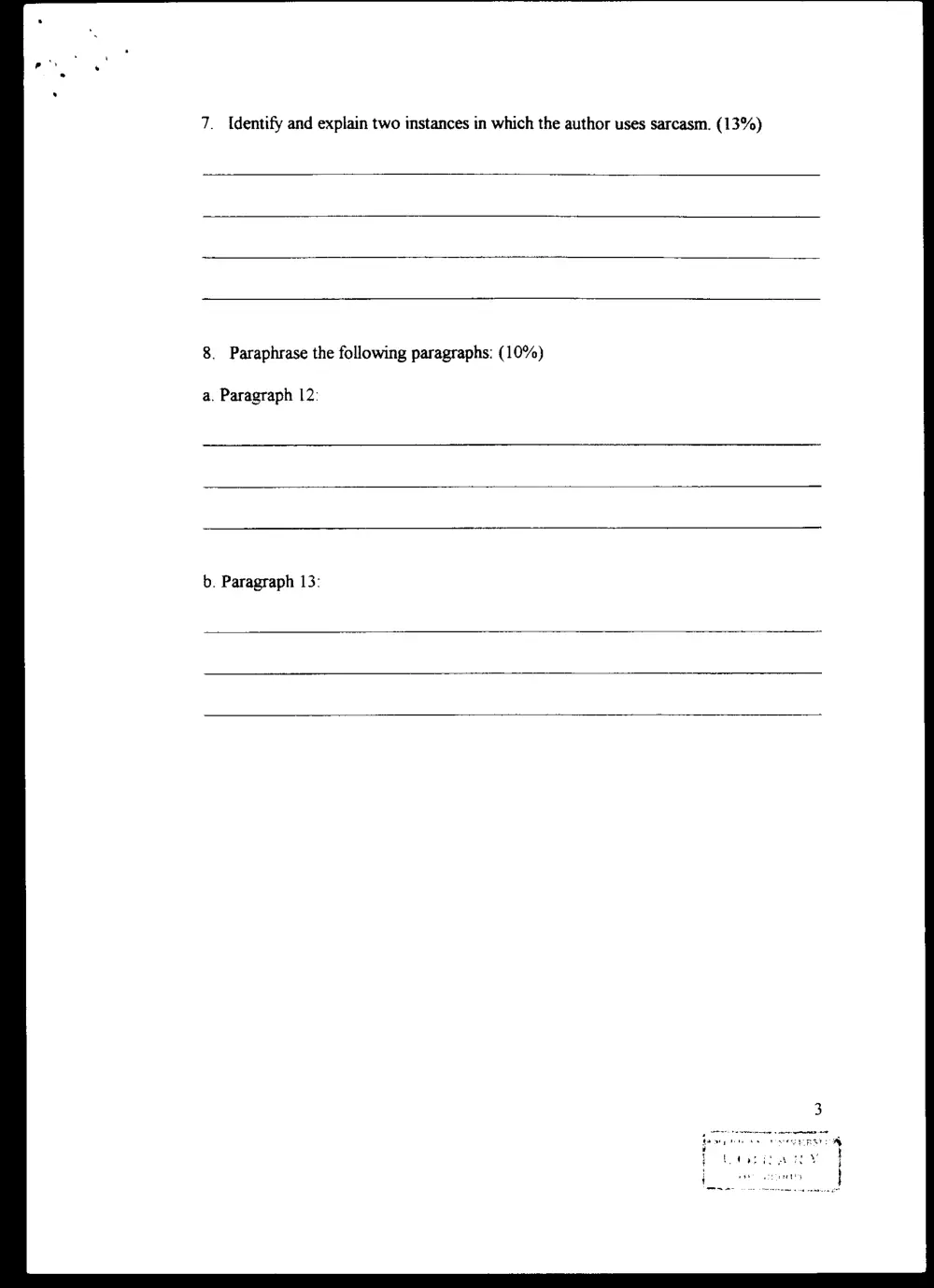
7. Identify and explain two instances in which the author uses sarcasm. (13%)
8. Paraphrase the following paragraphs: (10%)
a. Paragraph 12:
b. Paragraph 13:
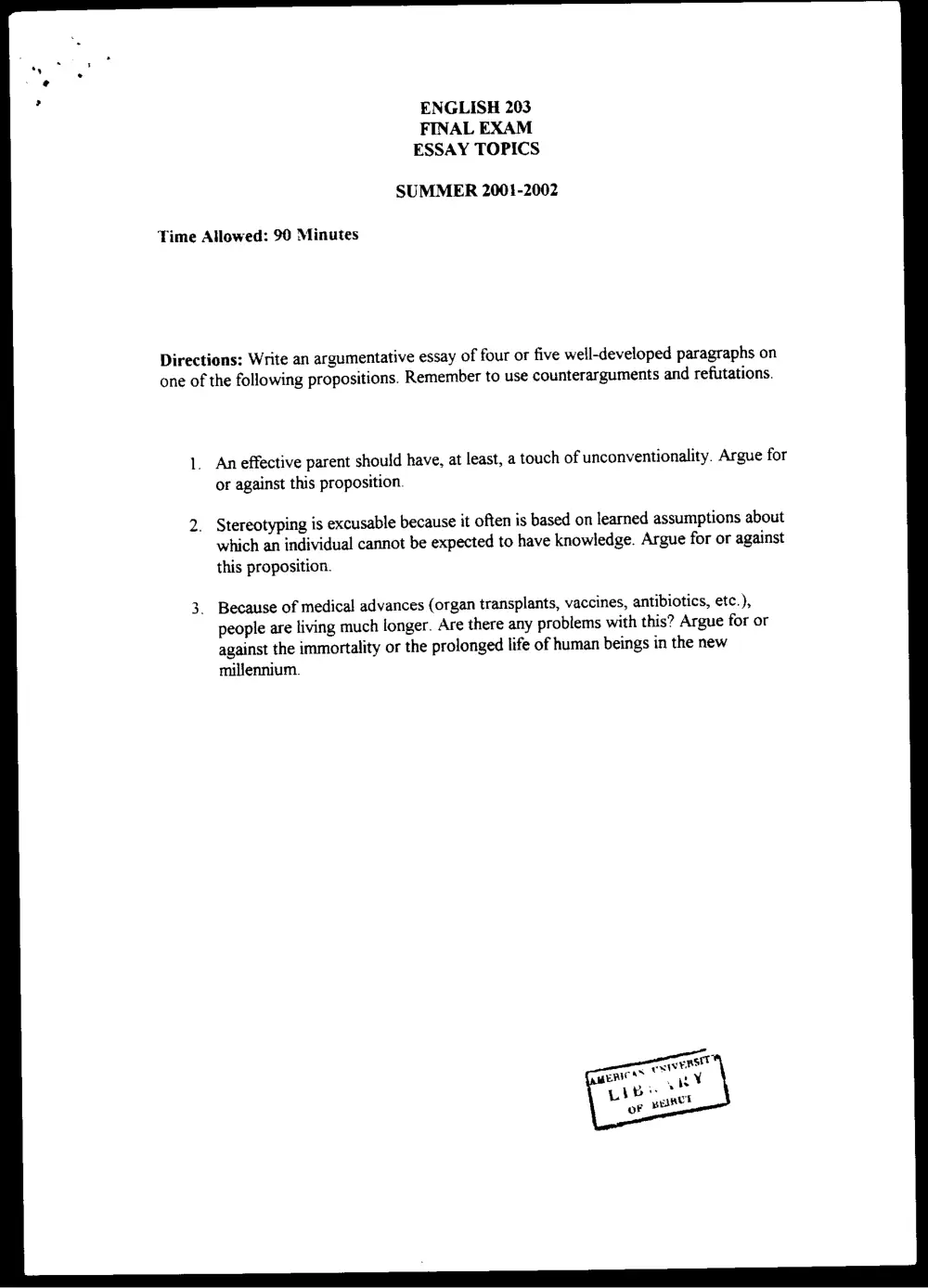
ENGLISH 203
FINAL EXAM
ESSAY TOPICS
SUMMER 2001-2002
Time Allowed: 90 Minutes
Directions: Write an argumentative essay of four or five well-developed paragraphs on
one of the following propositions. Remember to use counterarguments and refutations.
_ Aneffective parent should have, at least, a touch of unconventionality. Argue for
or against this proposition.
Stereotyping is excusable because it often is based on learned assumptions about
which an individual cannot be expected to have knowledge. Argue for or against
this proposition.
_ Because of medical advances (organ transplants, vaccines, antibiotics, etc.),
people are living much longer. Are there any problems with this? Argue for or
against the immortality or the prolonged life of human beings in the new
millennium.