
ENG 212 Final, Fall 2002
American University of Beirut · The Age of Shakespeare · 2 pages

More ENG 212 files
Show the text of this final exam
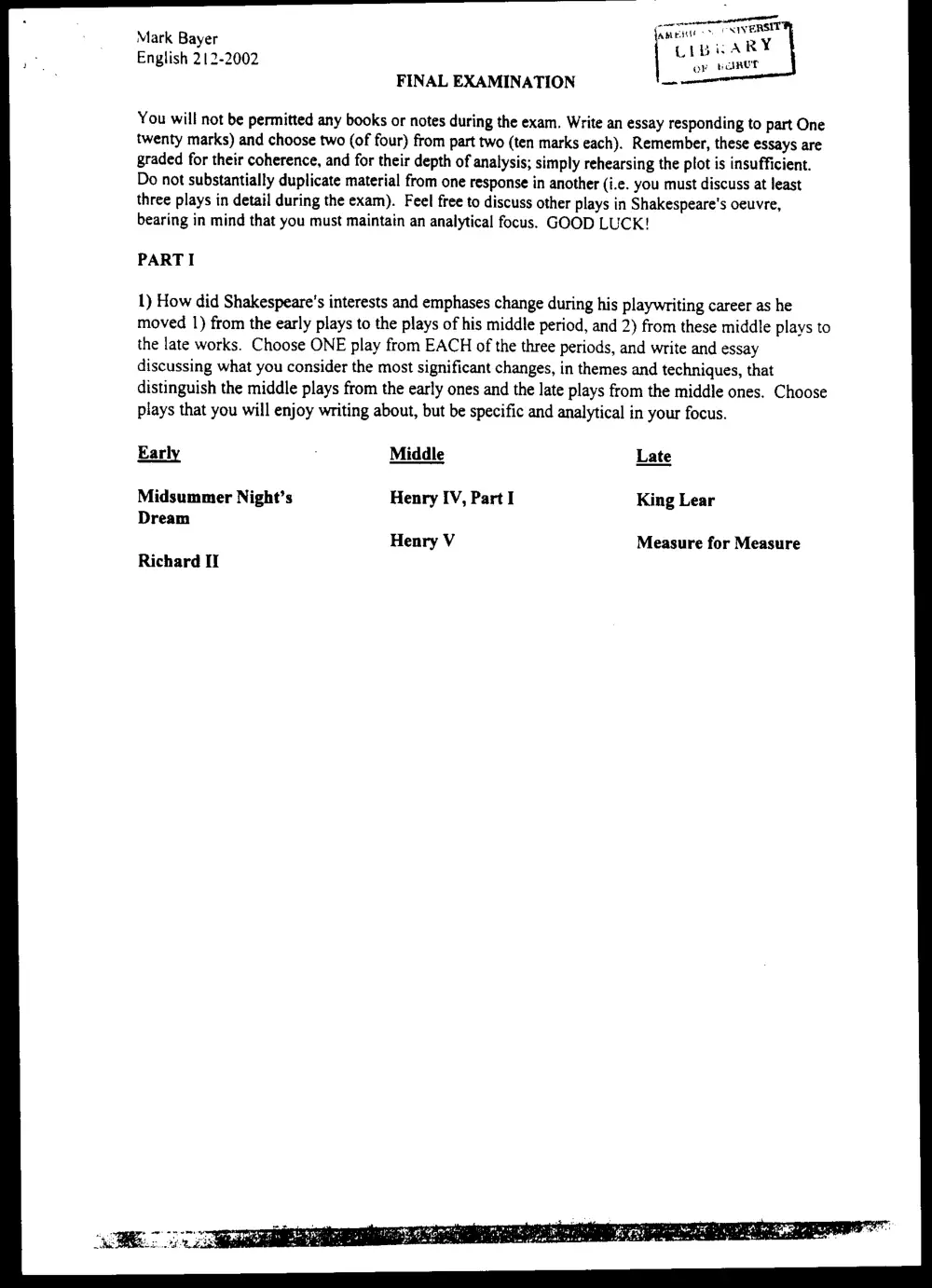
Mark Bayer
English 212-2002
FINAL EXAMINATION
You will not be permitted any books or notes during the exam. Write an essay responding to part One
twenty marks) and choose two (of four) from part two (ten marks each). Remember, these essays are
graded for their coherence, and for their depth of analysis; simply rehearsing the plot is insufficient.
Do not substantially duplicate material from one response in another (i.e. you must discuss at least
three plays in detail during the exam). Feel free to discuss other plays in Shakespeare's oeuvre,
bearing in mind that you must maintain an analytical focus. GOOD LUCK!
PART I
1) How did Shakespeare's interests and emphases change during his playwriting career as he
moved 1) from the early plays to the plays of his middle period, and 2) from these middle plays to
the late works. Choose ONE play from EACH of the three periods, and write and essay
discussing what you consider the most significant changes, in themes and techniques, that
distinguish the middle plays from the early ones and the late plays from the middle ones. Choose
plays that you will enjoy writing about, but be specific and analytical in your focus.
Early : Middle Late
Midsummer Night’s Henry IV, Part I King Lear
Dream
Henry V Measure for Measure
Richard IT
| eatumeemenene toed
JAMERIC VN CNIVERSIT!
LIBRARY
PART II OF GEIRUT
1) Throughout the course we have discussed a number of critical paradigms (Northrop Frye’s
greenworld, A.C. Barber's festive comedy, Aristotle and A.C. Bradley's conception of tragedy, Rene
Girard’s notions of mimetic desire, Bakhtin’s carnivalesque and lenten butchery). Write an essay in
which you explain the tenets of the theory in question and then apply it to one of the plays we've
looked at. NOTE: If you choose to discuss the greenworld DO NOT apply it to Midsummer Night's
Dream; if you choose carnivalesque DO NOT apply it to | Henry IV.
2) Many, if not all, of the plays we've examined revolve around issues of political power, sovereignty,
and royal authority. Write an essay in which you discuss the political dimensions in AT LEAST ONE
of the plays we've examined. If possible, relate the notions of political authority in the play to those
current in Elizabethan/ Jacobean England. NOTE: If you choose this question DO NOT discuss
Richard IL.
3) “Nine lives are taken off for his father’s one, Our Father who art in purgatory. Khaki Hamlets
don’t hesitate to shoot back. The bloodboltered shambles in act five is a forecast of the
concentration camp. . .”
James Joyce, Ulysses (1922)
As Stephen Dedalus’ bleak remarks indicate, Shakespeare's plays and their positioning in
contemporary culture, as well as over the longue duree of history since their original production, are
far from neutral. Discuss this quotation in relation to any specific play, or the plays in general. What
does Stephen’s quotation portend for those who teach, study, read, perform, or witness Shakespeare?
How can meaning BY Shakespeare have potentially disastrous consequences? This question is open
ended, but offers a lot to think about and requires a reasoned, analytically focused response that
requires not only your interpretation of the plays, but also their imbrication in cultural and political
conflict.
4) Many of the plays we've looked at feature dramatic action (a play within a play) within them (ex.
the mock trial in QI King Lear, the masque in The Tempest, role playing in the Henriad, et.). Discuss
the ways in which one or more of these meta-dramatic works reflects some facet of the culture of early
modern playgoing. For instance, how do these plays within a play reflect staging conditions, audience
dynamics, the city of London, and other features affecting the playhouse of Shakespeare’s time.