
ENG 212 Final, Fall 2002
American University of Beirut · The Age of Shakespeare · 1 page
Stuck on a question? A tutor can walk you through it.
More ENG 212 files
Show the text of this final exam
MhhiN
> Ase *ENIVERS EF
English 212 (Fall 2003) Liviary
Mark Bayer OF SEINCE
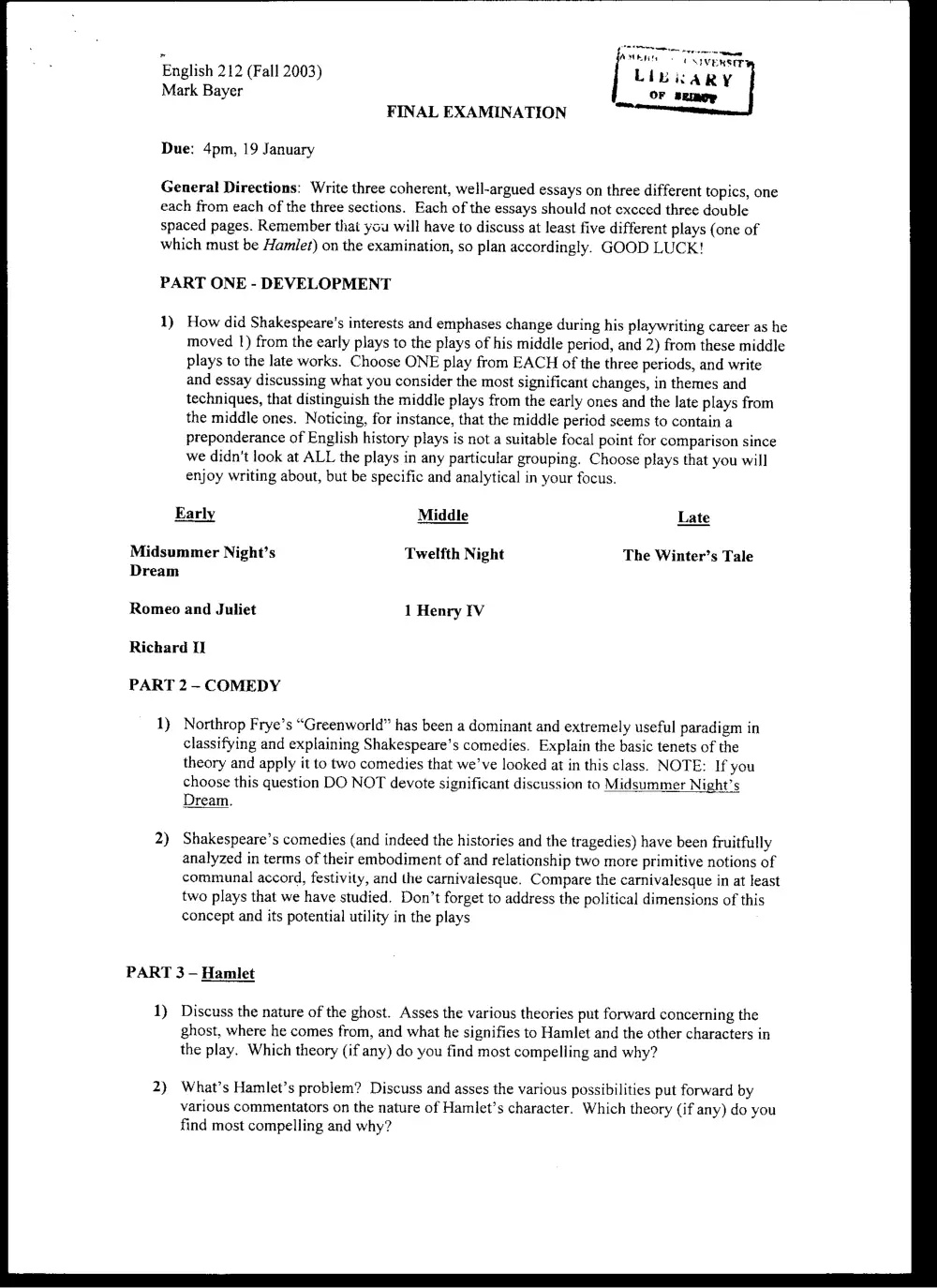
FINAL EXAMINATION
Due: 4pm, 19 January
General Directions: Write three coherent, well-argued essays on three different topics, one
each from each of the three sections. Each of the essays should not cxcced three double
spaced pages. Remember thai you will have to discuss at least five different plays (one of
which must be Hamlet) on the examination, so plan accordingly. GOOD LUCK!
PART ONE - DEVELOPMENT
1) How did Shakespeare's interests and emphases change during his playwriting career as he
moved 1) from the early plays to the plays of his middle period, and 2) from these middle
plays to the late works. Choose ONE play from EACH of the three periods, and write
and essay discussing what you consider the most significant changes, in themes and
techniques, that distinguish the middle plays from the early ones and the late plays from
the middle ones. Noticing, for instance, that the middle period seems to contain a
preponderance of English history plays is not a suitable focal point for comparison since
we didn't look at ALL the plays in any particular grouping. Choose plays that you will
enjoy writing about, but be specific and analytical in your focus.
Early Middle Late
Midsummer Night’s Twelfth Night The Winter’s Tale
Dream
Romeo and Juliet 1 Henry IV
Richard I
PART 2 - COMEDY
1) Northrop Frye’s “Greenworld” has been a dominant and extremely useful paradigm in
classifying and explaining Shakespeare’s comedies. Explain the basic tenets of the
theory and apply it to two comedies that we’ve looked at in this class. NOTE: If you
choose this question DO NOT devote significant discussion to Midsummer Night’s
Dream.
2) Shakespeare’s comedies (and indeed the histories and the tragedies) have been fruitfully
analyzed in terms of their embodiment of and relationship two more primitive notions of
communal accord, festivity, and the carnivalesque. Compare the carnivalesque in at least
two plays that we have studied. Don’t forget to address the political dimensions of this
concept and its potential utility in the plays
PART 3 - Hamlet
1) Discuss the nature of the ghost. Asses the various theories put forward concerning the
ghost, where he comes from, and what he signifies to Hamlet and the other characters in
the play. Which theory (if any) do you find most compelling and why?
2) What’s Hamlet’s problem? Discuss and asses the various possibilities put forward by
various commentators on the nature of Hamlet’s character. Which theory (if any) do you
find most compelling and why?