
ENG 228 Final, Fall 2000
American University of Beirut · Phonology · 5 pages


More ENG 228 files
Show the text of this final exam
a be
3 on,
English 228 1st Semester 2000-2001
Phonology Prof. Kassim A. Shaaban
FINAL EXAMINATION ( Two Hours )
January 30, 2001
[. Answer the following two questions.
A. 1. Mark the following statements as TRUE or FALSE.
a. Pharyngealization involves drawing the tongue back so that the
pharynx is narrowed.
b. The “motor theory of speech perception” refers to the notion that we
can produce only what we can perceive.
- There are no clear rules for how stress works in English.
d. The frequency of a sound refers to the rate of variation in air pressure
in that sound,
e. Vowel rhotacization is determined acoustically by the frequency of
the third formant.
f. People differ in their estimate of the number of syllables in words like
spasm, prizm, and schism because of some mispronunciations.
g. Allophones of a phoneme are sound variations that are similar in
structure and in complementary distribution.
h. Children and women normally speak at a lower pitch than men do,
i. Spectrograms provide more detailed information about sounds than
waveforms do.
j. English accents are usually marked by differences in the way
consonants are pronounced.
a
A. 2. Explain briefly your answers to (c), (), and (i). (Write your answer on
the back of this page)
1, phonetics is in part the study of how speech sounds are perceived.
2. Obstruents is a term used to refer to stops, . and affricates.
3. One of the challenges to specialists in speech synthesis relates to the areas of
stress and .
4. The rhyme part of a syllable consists of the vocalic nucleus and the .
5. Labialization is a secondary articulation that involves of the
lips.
6. A diphthong may be defined as the movement from one vowel to another
within a single .
7. The basic formant in spectrograms is indicative of a speaker's voice
8. Stops may vary in their voice onset time. In this respect, [ p’, t, ky are
stops and [ b,d,g] are stops.
9. Acclosed syllable is one that ends ina
10. The stops [b“,d* , g* ] which occur in Hindi are called stops.
Il. Clicks are sounds produced by a airstream mechanism.
12. A syllable that stands out in an utterance because it carries the greatest pitch
change is known as syllable.
II. Answer three of the following five questions.
A. Define five of the following terms and give examples of each.
1. Syllabic nasals:
2. Ejectives:
3. Sound amplitude:
4. States of the glottis:
5. Anticipatory coarticulation:
6. Phoneme:
7. Velarization:
B. Make a broad phonemic transcription of the following utterances
(conversational style)
1. Did you realize that the state of the economy is rather depressing.
2. Despite all that happened, the two chieftains still communicate by phone.
3. Sleazy Johnny’s favorite shampoo remains head and shoulders.
4. The illustrations provided show clearly that sentence rhythm is a function of
emphasis.
5. An opportunity like thus does not recur often enough for those who need
the enlightenment.
C. Explain how acoustic phonetics (waveforms and spectrograms) have helped
contribute to the understanding of the following:
1. Vowel height and backness:
2. Natural classes of sounds, in particular sonorants, siblilants, and back consonants.
3. Intonation patterns of utterances:
4. Gender differences in Pitch:
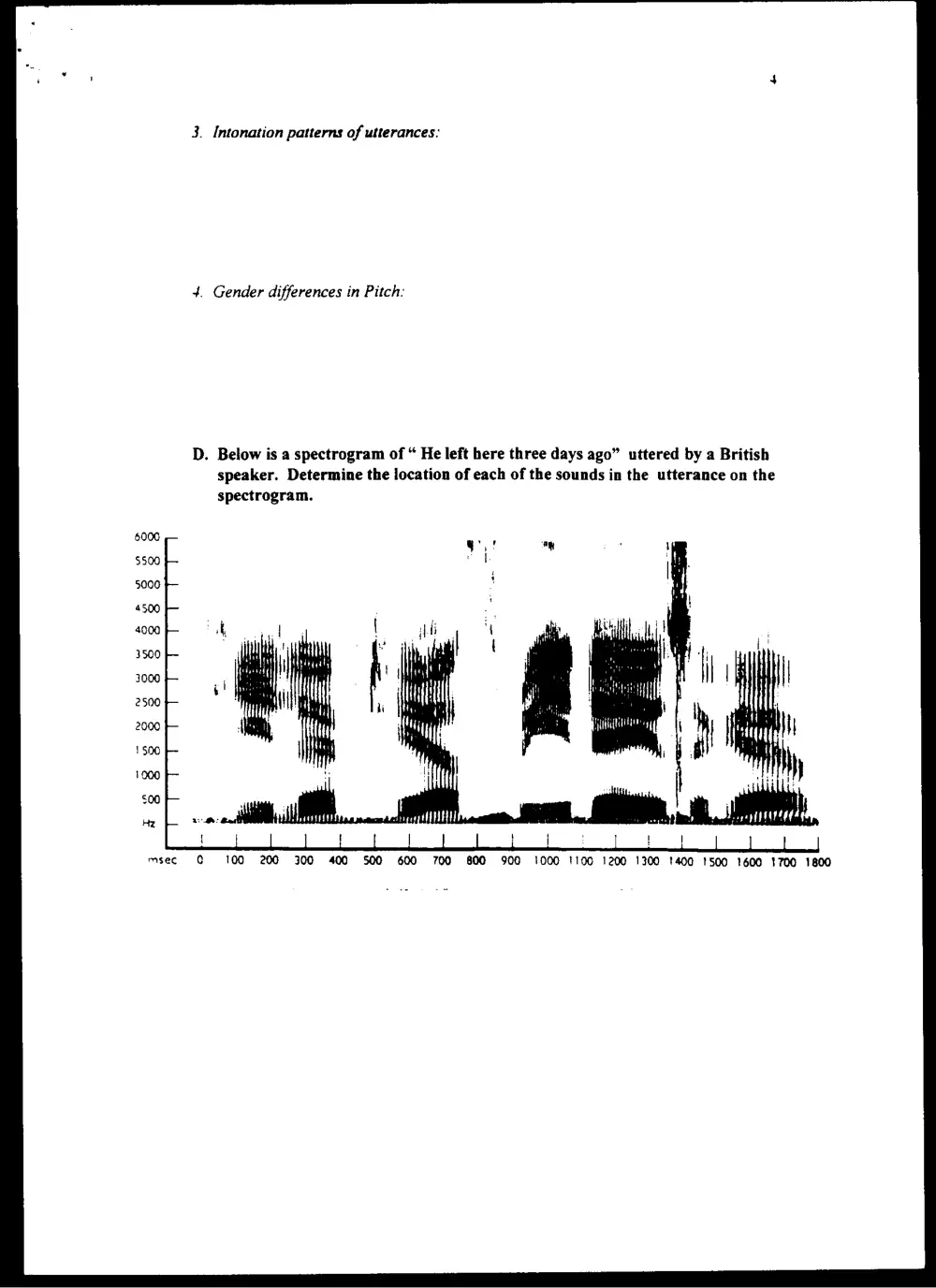
. Below is a spectrogram of “ He left here three days ago” uttered by a British
speaker. Determine the location of each of the sounds in the utterance on the
spectrogram.
100 200 «6300 ©4400 S00 600 700 800 900 1000 1100 1200 1300 t400 1500 1600 1700 1800
E. 1. Indicate the intonation patterns that might occur in the following
situations:
a. What have you been thinking about all this time? (polite question)
b. Your actions speak loud enough. (angry statement)
¢. Your mother is the head of the PTA! (surprise)
d. The policemen came to the apartment, looking for hidden evidence. (reporting)
e. Are you ready for this trip? (polite question)
E. 2. Using some of the examples in E.1, and adding to them, if necessary,
explain how intonation can be phonemic.