
ENG 228 Final, Fall 2004
American University of Beirut · Phonology · 6 pages


More ENG 228 files
Show the text of this final exam
English 228 First Semester 2004 - 2005
Phonetics Professor Kassim Shaaban
FINAL EXAMINATION (Two Hours)
January 31, 2005
I. Answer the following two questions.
A. Mark the following statements as TRUE or FALSE.
a. Rhotacization is one type of secondary articulation.
b. The term “marked” refers to the natural occurrence of sounds.
Thus [i] is marked, but [y] (front rounded vowel) is unmarked.
. English has a tendency to avoid having strong stresses too close together.
. The loudness of a sound depends on the size of the variations that occur
in air pressure.
. Vowel rounding is determined by the width of the pharynx.
. Approximants have formant structures similar to those in vowels.
. It is relatively easy to define syllables but hard to identify them.
. Women normally speak at a higher pitch than men do.
i. English has no geminates within words.
j. English accents are usually marked by differences in the way
consonants are pronounced.
. The “motor theory of speech perception” refers to the notion that we
can produce only what we can perceive.
. Spectrograms provide more detailed information about sounds than
waveforms do.
B. Fill in the blanks in the following sentences with the appropriate terms.
. Phonetics is the study of the that occur in human language.
. “Obstruents” is a term used to refer to , affricates, and stops.
. The greatest challenge to specialists in speech synthesis relates to the areas of
stress and :
. The part of a syilable consists of the vocalic nucleus and the
coda.
. Velarization is a secondary articulation that involves raising the of
the tongue.
. A dipthong may be defined as the movement from one vowel to another within a
single .
. The formant in most vowels is indicative of a speaker’s voice quality.
. Stops may vary in their voice onset time. In this respect, [ p*, th, kK] are
stops and [ b,d,g] are stops.
. In creaky voice, the arytenoid cartilages are tightly together so that the vocal chords
can vibrate only at the end. Creaky-voiced sounds are also called
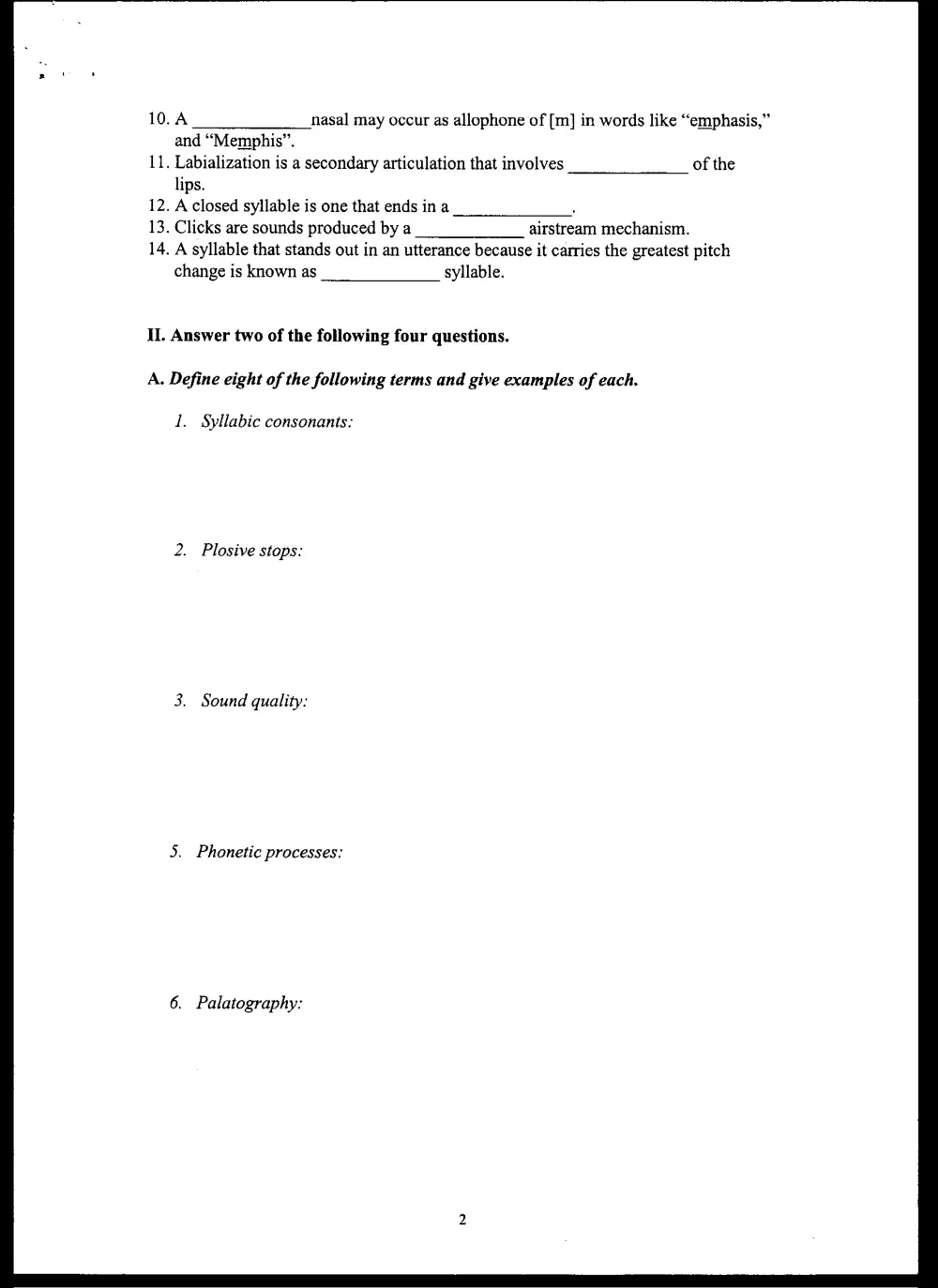
10.A nasal may occur as allophone of [m] in words like “emphasis,”
and “Memphis”.
11. Labialization is a secondary articulation that involves of the
lips.
12. A closed syllable is one that ends in a .
13. Clicks are sounds produced by a airstream mechanism.
14. A syllable that stands out in an utterance because it carries the greatest pitch
change is known as syllable.
II. Answer two of the following four questions.
A. Define eight of the following terms and give examples of each.
1. Syllabic consonants:
2. Plosive stops:
3. Sound quality:
5. Phonetic processes:
6. Palatography:
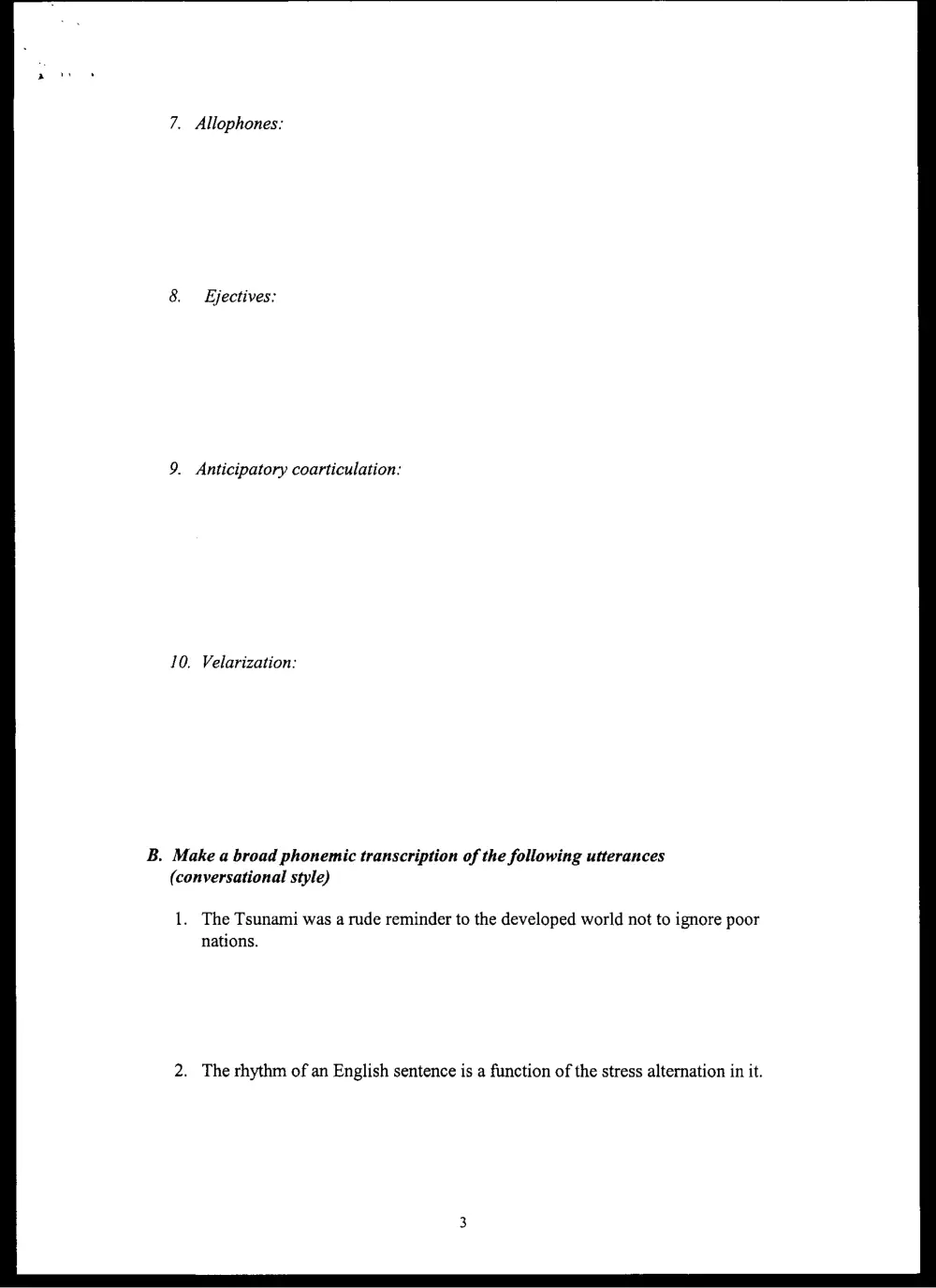
7. Allophones:
8 Ejectives:
9. Anticipatory coarticulation:
10. Velarization:
B. Make a broad phonemic transcription of the following utterances
(conversational style)
1. The Tsunami was a rude reminder to the developed world not to ignore poor
nations.
2. The rhythm of an English sentence is a function of the stress alternation in it.
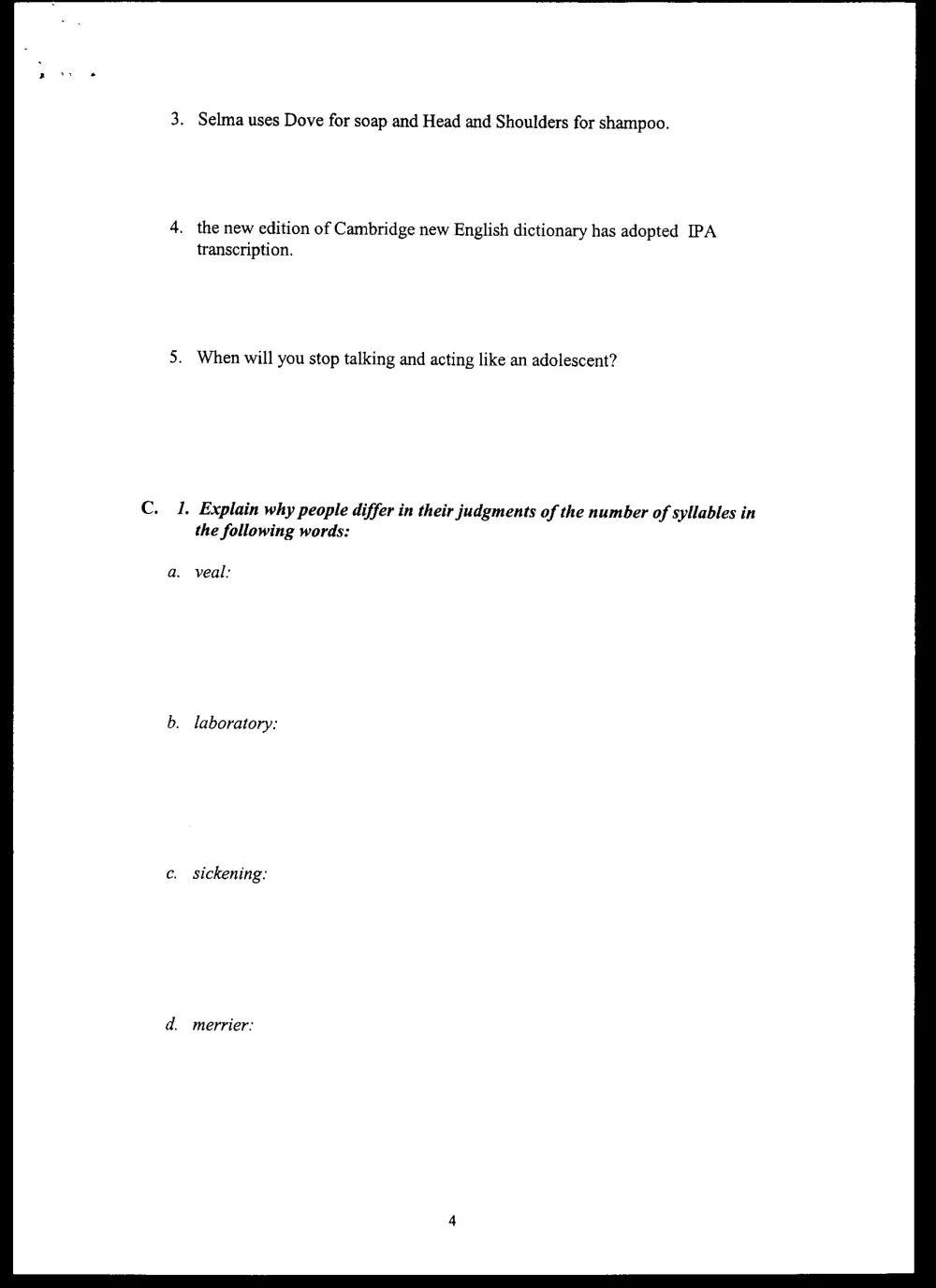
- Selma uses Dove for soap and Head and Shoulders for shampoo.
. the new edition of Cambridge new English dictionary has adopted IPA
transcription.
. When will you stop talking and acting like an adolescent?
. Explain why people differ in their judgments of the number of syllables in
the following words:
. veal:
. laboratory:
sickening:
, merrier:
e. fascism:
6. Explain the sonority theory of syllabicity and show its shortcomings.
D. 1. Indicate the intonation patterns that might occur in the following situations.
a. How much time do you need?(polite question)
. Even your mother won’t like you for what you have done. (angry
statement)
Bellhurst the Mad Boa is your lawyer. (surprise)
. The children are in their room, checking on their toys.
Shall I call you a cab?
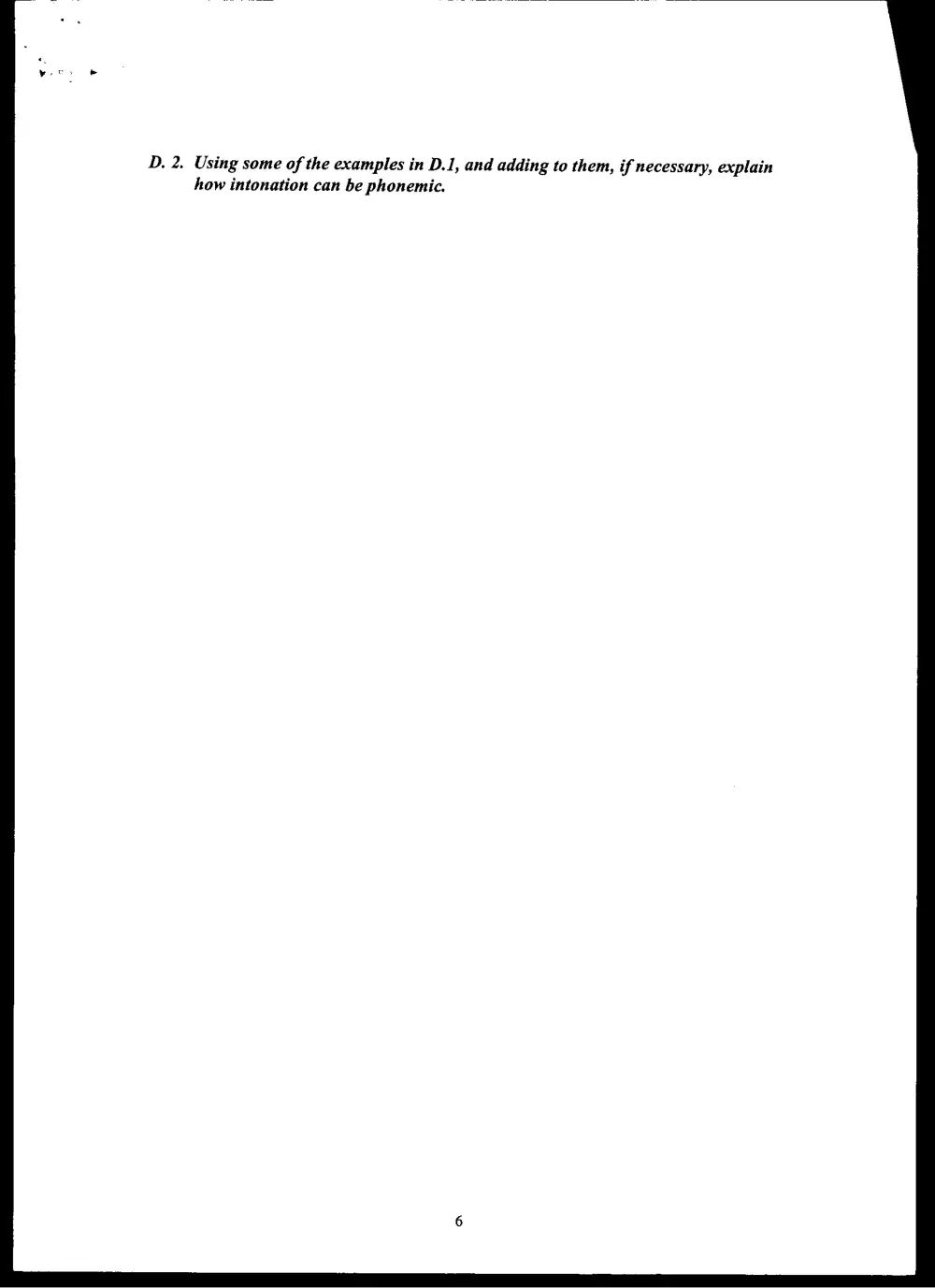
D. 2. Using some of the examples in D.1, and adding to them, if necessary, explain
how intonation can be phonemic.