
ENG 228 Final, Fall 2007
American University of Beirut · Phonology · 4 pages
More ENG 228 files
Show the text of this final exam
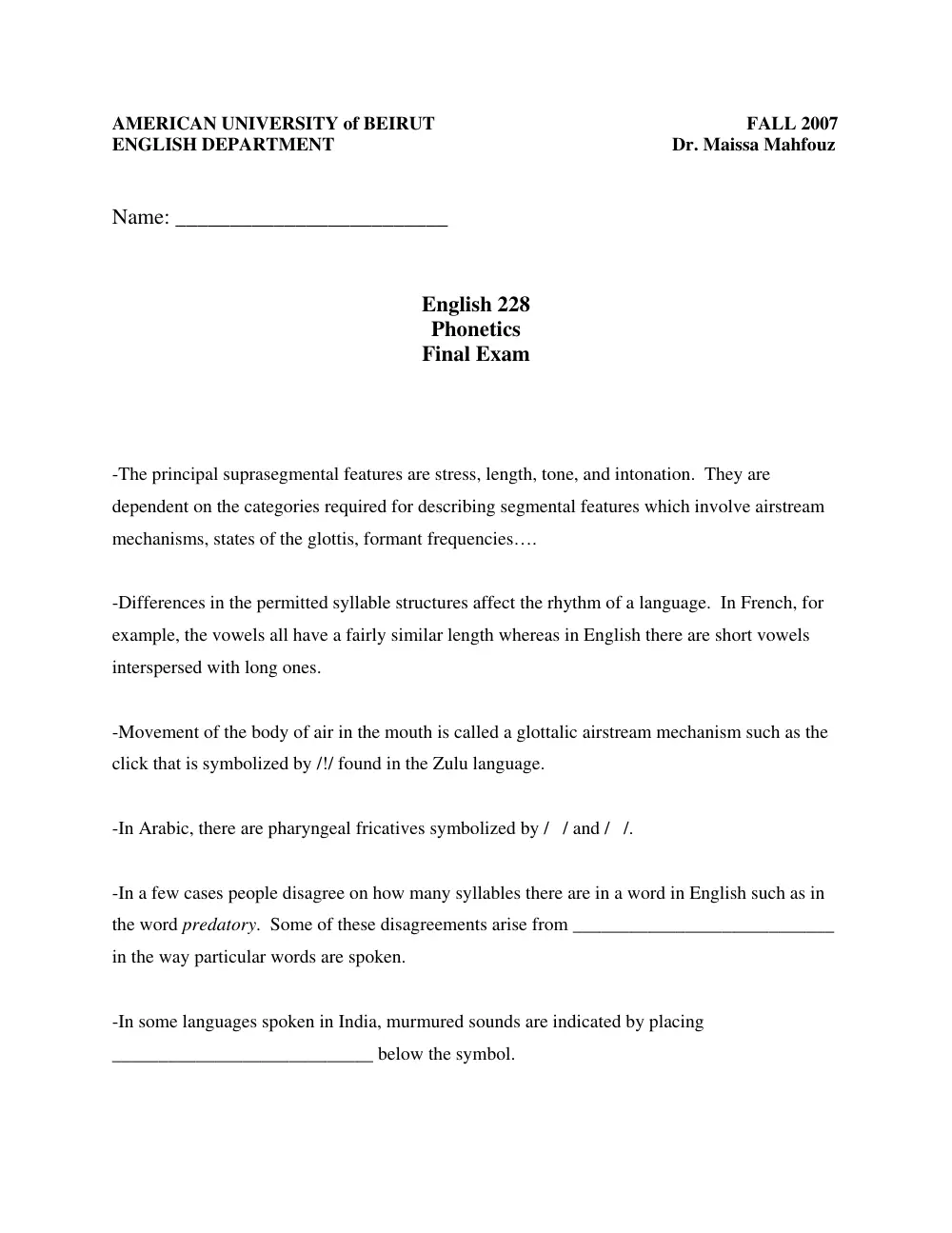
AMERICAN UNIVERSITY of BEIRUT
FALL 2007
ENGLISH DEPARTMENT
Dr. Maissa Mahfouz
Name: _________________________
English 228
Phonetics
Final Exam
-The principal suprasegmental features are stress, length, tone, and intonation. They are
dependent on the categories required for describing segmental features which involve airstream
mechanisms, states of the glottis, formant frequencies….
-Differences in the permitted syllable structures affect the rhythm of a language. In French, for
example, the vowels all have a fairly similar length whereas in English there are short vowels
interspersed with long ones.
-Movement of the body of air in the mouth is called a glottalic airstream mechanism such as the
click that is symbolized by /!/ found in the Zulu language.
-In Arabic, there are pharyngeal fricatives symbolized by / / and / /.
-In a few cases people disagree on how many syllables there are in a word in English such as in
the word predatory. Some of these disagreements arise from ____________________________
in the way particular words are spoken.
-In some languages spoken in India, murmured sounds are indicated by placing
____________________________ below the symbol.
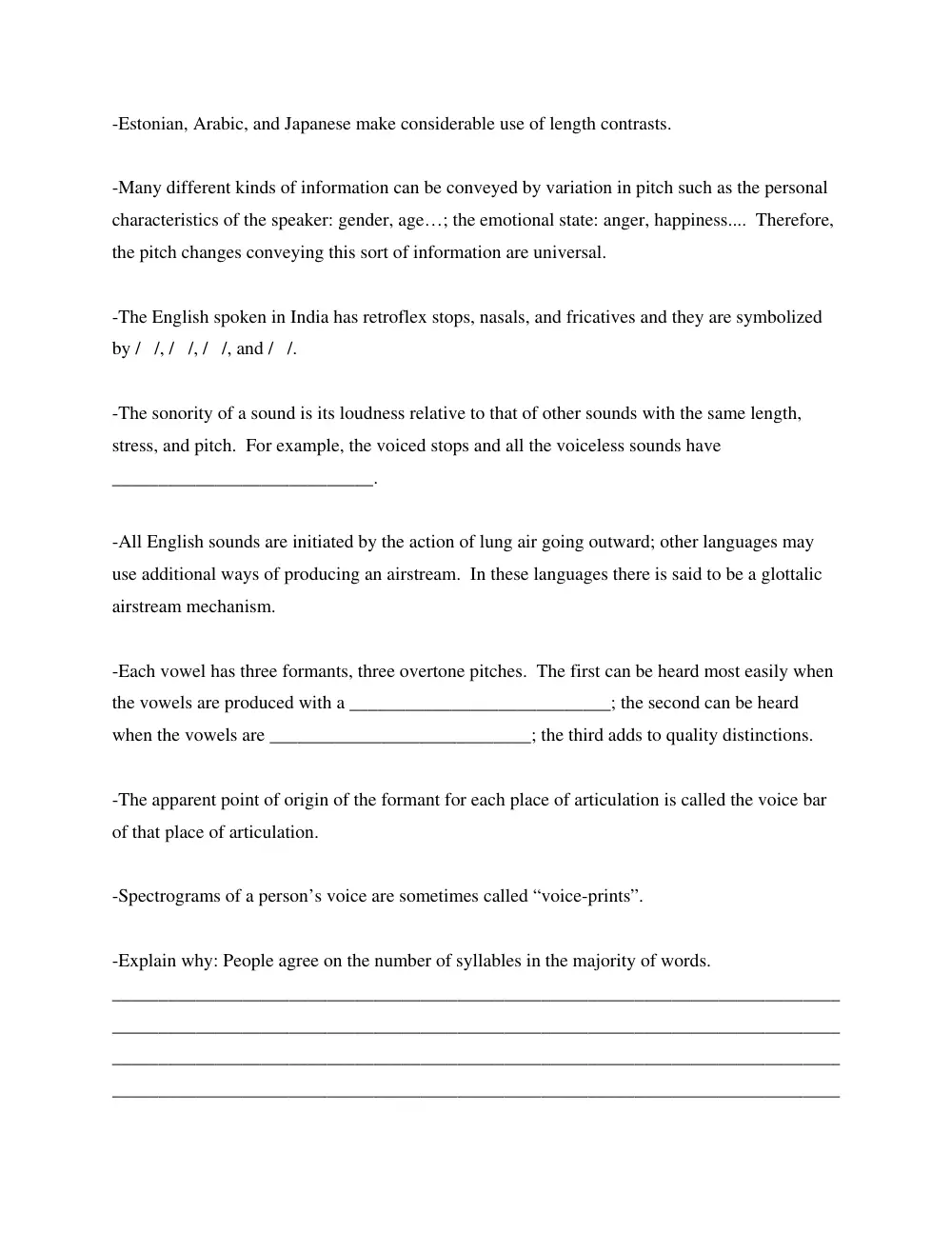
-Estonian, Arabic, and Japanese make considerable use of length contrasts.
-Many different kinds of information can be conveyed by variation in pitch such as the personal
characteristics of the speaker: gender, age…; the emotional state: anger, happiness.... Therefore,
the pitch changes conveying this sort of information are universal.
-The English spoken in India has retroflex stops, nasals, and fricatives and they are symbolized
by / /, / /, / /, and / /.
-The sonority of a sound is its loudness relative to that of other sounds with the same length,
stress, and pitch. For example, the voiced stops and all the voiceless sounds have
____________________________.
-All English sounds are initiated by the action of lung air going outward; other languages may
use additional ways of producing an airstream. In these languages there is said to be a glottalic
airstream mechanism.
-Each vowel has three formants, three overtone pitches. The first can be heard most easily when
the vowels are produced with a ____________________________; the second can be heard
when the vowels are ____________________________; the third adds to quality distinctions.
-The apparent point of origin of the formant for each place of articulation is called the voice bar
of that place of articulation.
-Spectrograms of a person’s voice are sometimes called “voice-prints”.
-Explain why: People agree on the number of syllables in the majority of words.
______________________________________________________________________________
______________________________________________________________________________
______________________________________________________________________________
______________________________________________________________________________
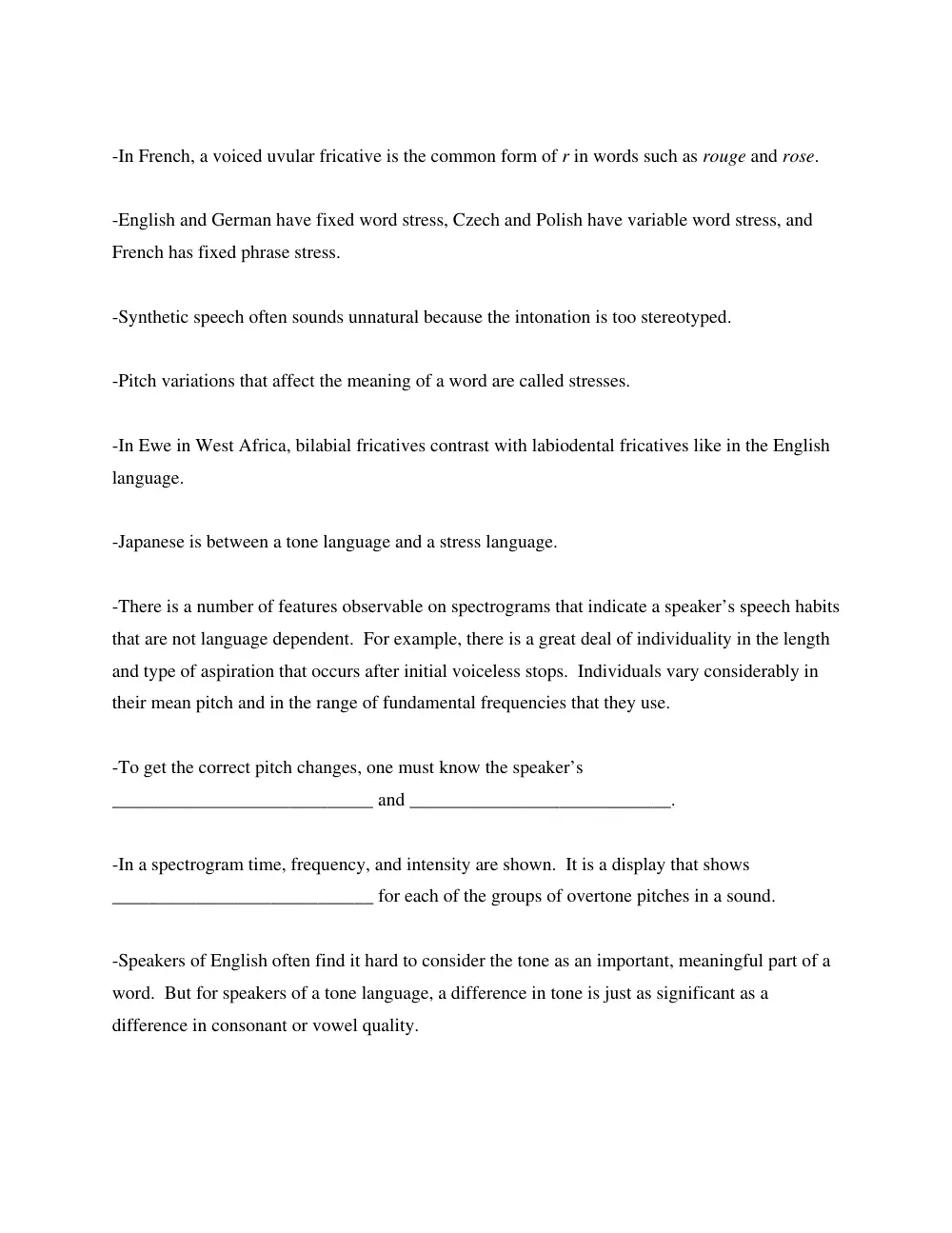
-In French, a voiced uvular fricative is the common form of r in words such as rouge and rose.
-English and German have fixed word stress, Czech and Polish have variable word stress, and
French has fixed phrase stress.
-Synthetic speech often sounds unnatural because the intonation is too stereotyped.
-Pitch variations that affect the meaning of a word are called stresses.
-In Ewe in West Africa, bilabial fricatives contrast with labiodental fricatives like in the English
language.
-Japanese is between a tone language and a stress language.
-There is a number of features observable on spectrograms that indicate a speaker’s speech habits
that are not language dependent. For example, there is a great deal of individuality in the length
and type of aspiration that occurs after initial voiceless stops. Individuals vary considerably in
their mean pitch and in the range of fundamental frequencies that they use.
-To get the correct pitch changes, one must know the speaker’s
____________________________ and ____________________________.
-In a spectrogram time, frequency, and intensity are shown. It is a display that shows
____________________________ for each of the groups of overtone pitches in a sound.
-Speakers of English often find it hard to consider the tone as an important, meaningful part of a
word. But for speakers of a tone language, a difference in tone is just as significant as a
difference in consonant or vowel quality.
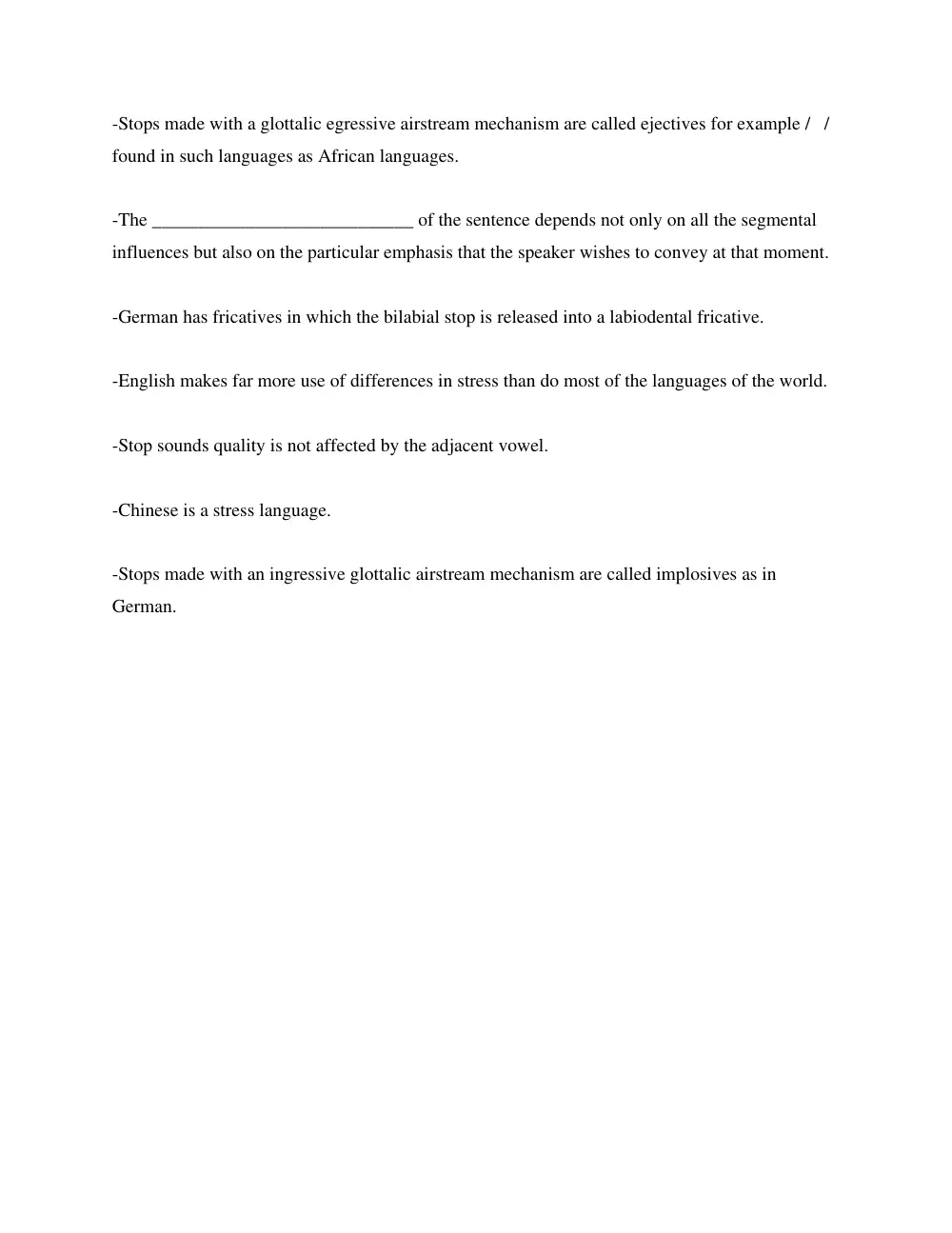
-Stops made with a glottalic egressive airstream mechanism are called ejectives for example / /
found in such languages as African languages.
-The ____________________________ of the sentence depends not only on all the segmental
influences but also on the particular emphasis that the speaker wishes to convey at that moment.
-German has fricatives in which the bilabial stop is released into a labiodental fricative.
-English makes far more use of differences in stress than do most of the languages of the world.
-Stop sounds quality is not affected by the adjacent vowel.
-Chinese is a stress language.
-Stops made with an ingressive glottalic airstream mechanism are called implosives as in
German.