
ENG 228 Final, Fall 2005
American University of Beirut · Phonology · 7 pages

More ENG 228 files
Show the text of this final exam
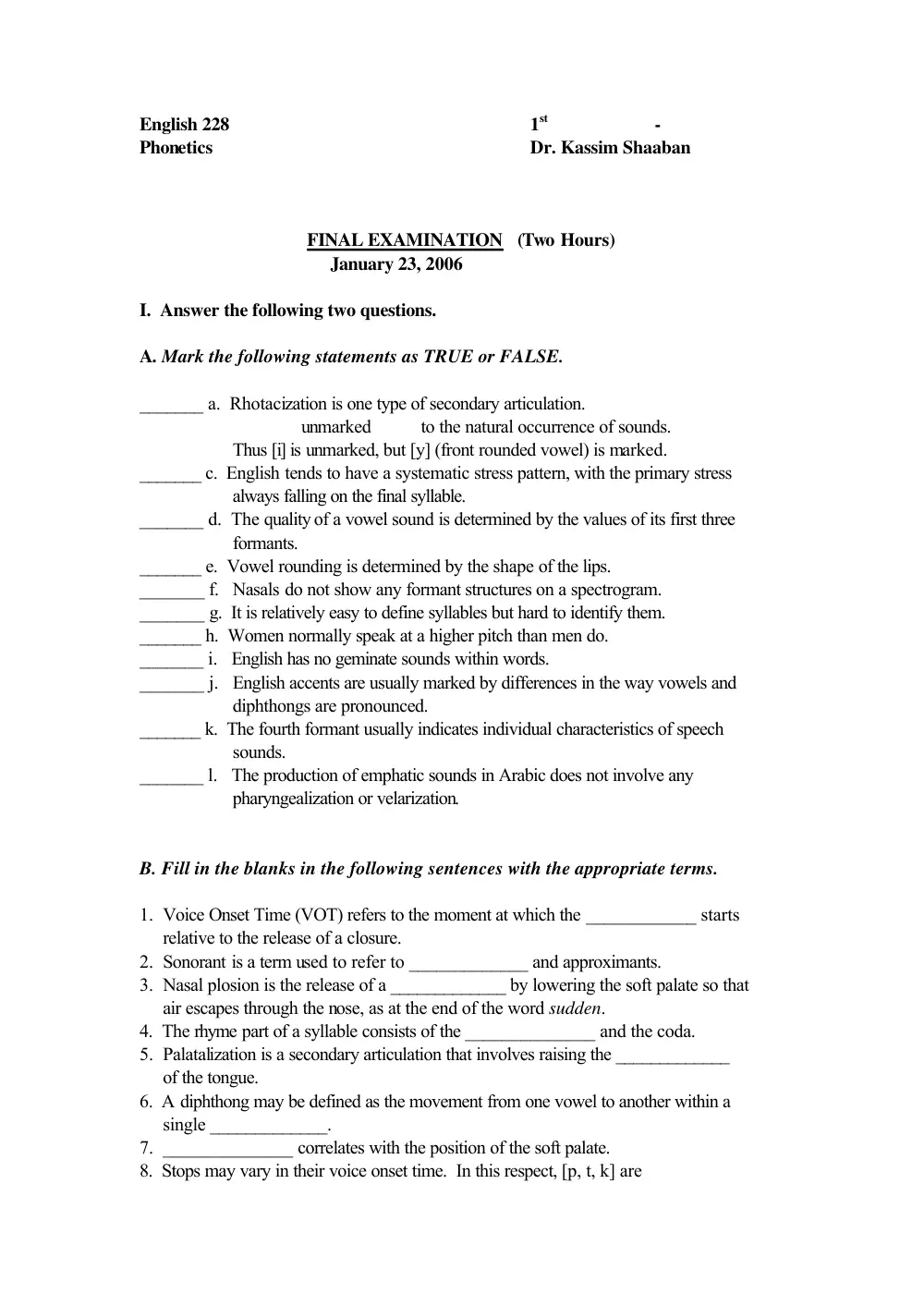
English 228
1st
-
Phonetics
Dr. Kassim Shaaban
FINAL EXAMINATION (Two Hours)
January 23, 2006
I. Answer the following two questions.
A. Mark the following statements as TRUE or FALSE.
_______ a. Rhotacization is one type of secondary articulation.
unmarked
to the natural occurrence of sounds.
Thus [i] is unmarked, but [y] (front rounded vowel) is marked.
_______ c. English tends to have a systematic stress pattern, with the primary stress
always falling on the final syllable.
_______ d. The quality of a vowel sound is determined by the values of its first three
formants.
_______ e. Vowel rounding is determined by the shape of the lips.
_______ f. Nasals do not show any formant structures on a spectrogram.
_______ g. It is relatively easy to define syllables but hard to identify them.
_______ h. Women normally speak at a higher pitch than men do.
_______ i. English has no geminate sounds within words.
_______ j. English accents are usually marked by differences in the way vowels and
diphthongs are pronounced.
_______ k. The fourth formant usually indicates individual characteristics of speech
sounds.
_______ l. The production of emphatic sounds in Arabic does not involve any
pharyngealization or velarization.
B. Fill in the blanks in the following sentences with the appropriate terms.
1. Voice Onset Time (VOT) refers to the moment at which the ____________ starts
relative to the release of a closure.
2. Sonorant is a term used to refer to _____________ and approximants.
3. Nasal plosion is the release of a _____________ by lowering the soft palate so that
air escapes through the nose, as at the end of the word sudden.
4. The rhyme part of a syllable consists of the ______________ and the coda.
5. Palatalization is a secondary articulation that involves raising the _____________
of the tongue.
6. A diphthong may be defined as the movement from one vowel to another within a
single _____________.
7. ______________ correlates with the position of the soft palate.
8. Stops may vary in their voice onset time. In this respect, [p, t, k] are
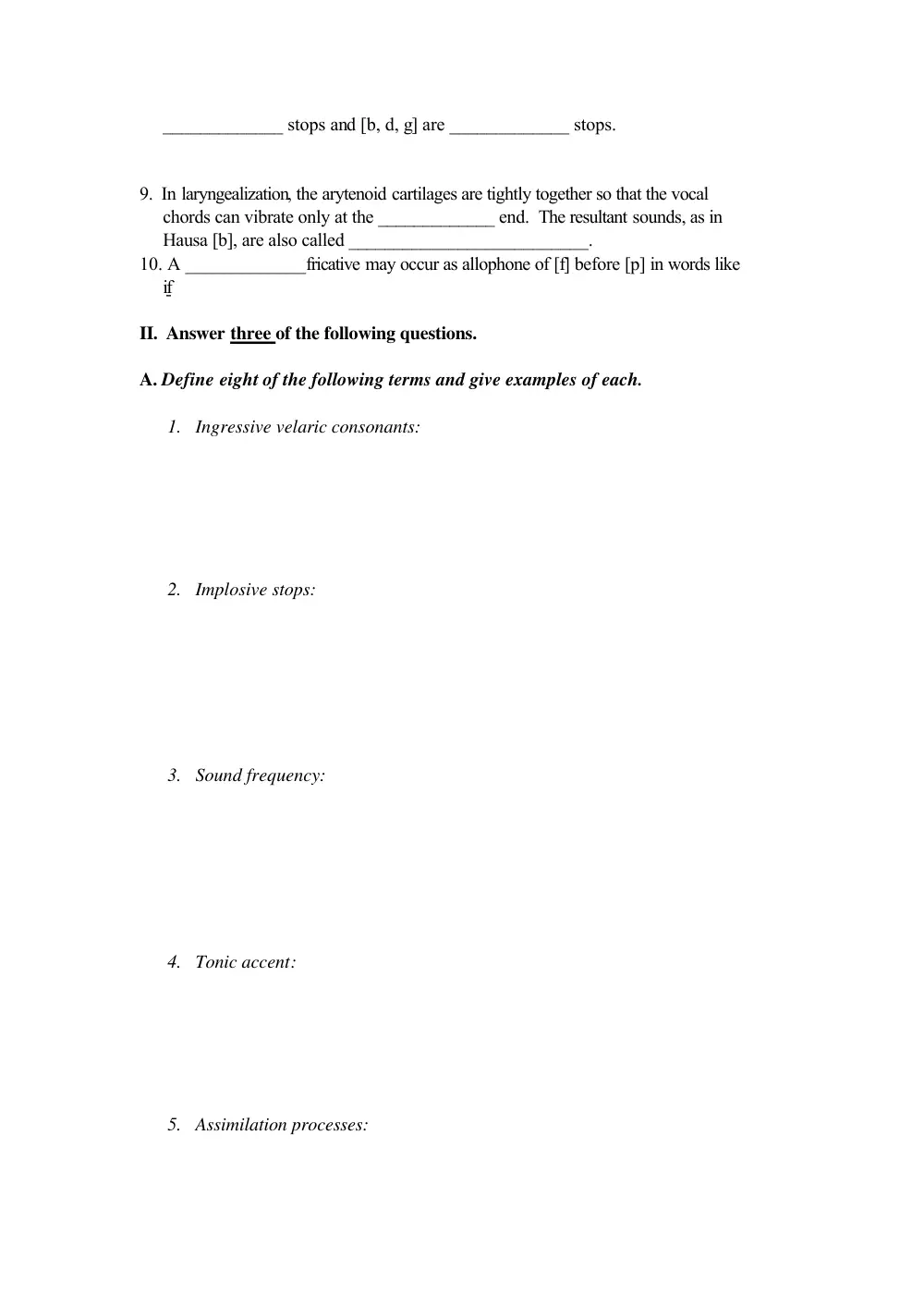
_____________ stops and [b, d, g] are _____________ stops.
9. In laryngealization, the arytenoid cartilages are tightly together so that the vocal
chords can vibrate only at the _____________ end. The resultant sounds, as in
Hausa [b], are also called __________________________.
10. A _____________fricative may occur as allophone of [f] before [p] in words like
if
II. Answer three of the following questions.
A. Define eight of the following terms and give examples of each.
1. Ingressive velaric consonants:
2. Implosive stops:
3. Sound frequency:
4. Tonic accent:
5. Assimilation processes:
6. Palatography:
7. Pharyngealization:
8. Cardinal vowels:
9. Glottalic airstream mechanism:
10. Sonority of a sound:
B. Make a broad phonemic transcription of the following utterances
(conversational style)
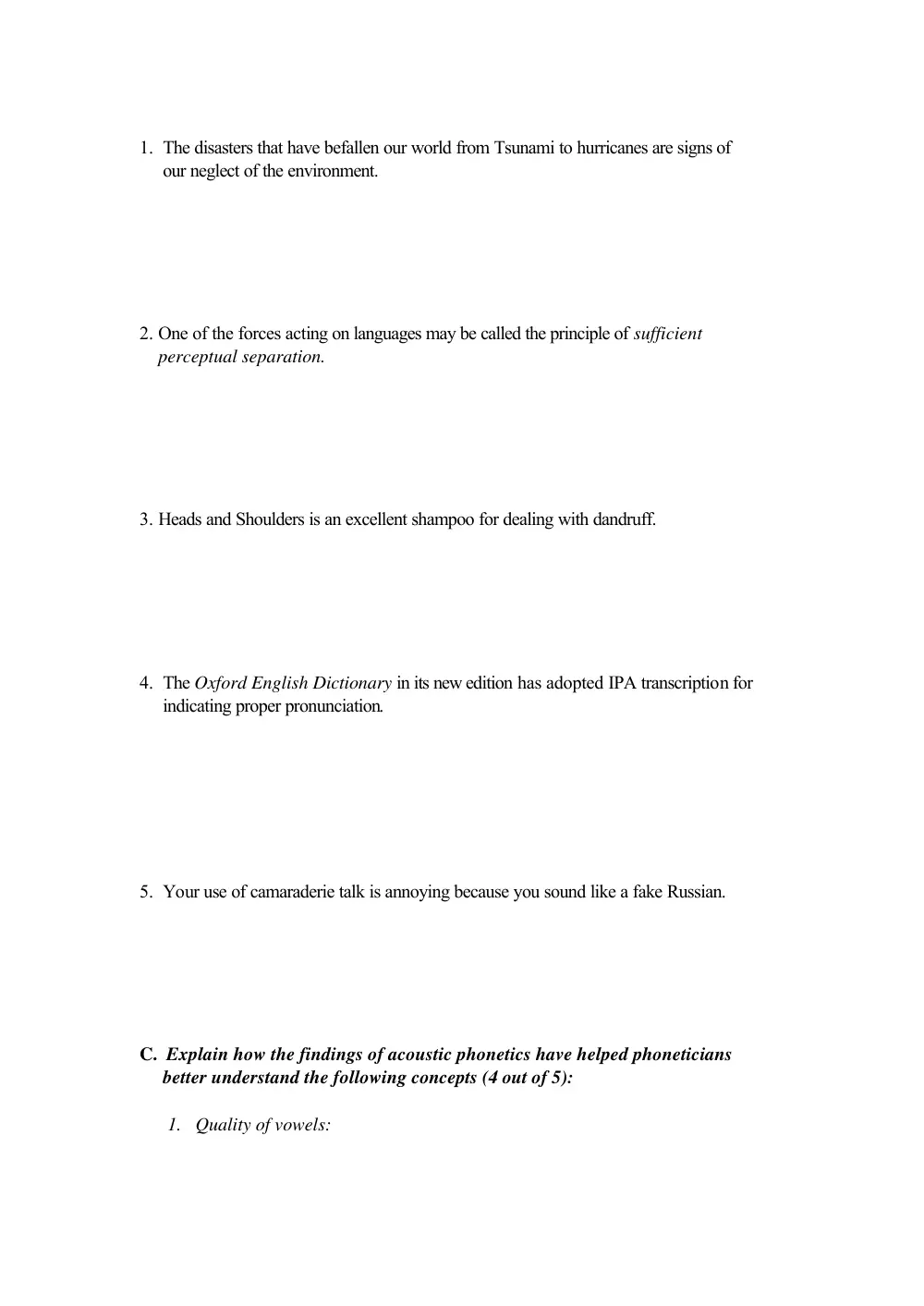
1. The disasters that have befallen our world from Tsunami to hurricanes are signs of
our neglect of the environment.
2. One of the forces acting on languages may be called the principle of sufficient
perceptual separation.
3. Heads and Shoulders is an excellent shampoo for dealing with dandruff.
4. The Oxford English Dictionary in its new edition has adopted IPA transcription for
indicating proper pronunciation.
5. Your use of camaraderie talk is annoying because you sound like a fake Russian.
C. Explain how the findings of acoustic phonetics have helped phoneticians
better understand the following concepts (4 out of 5):
1. Quality of vowels:
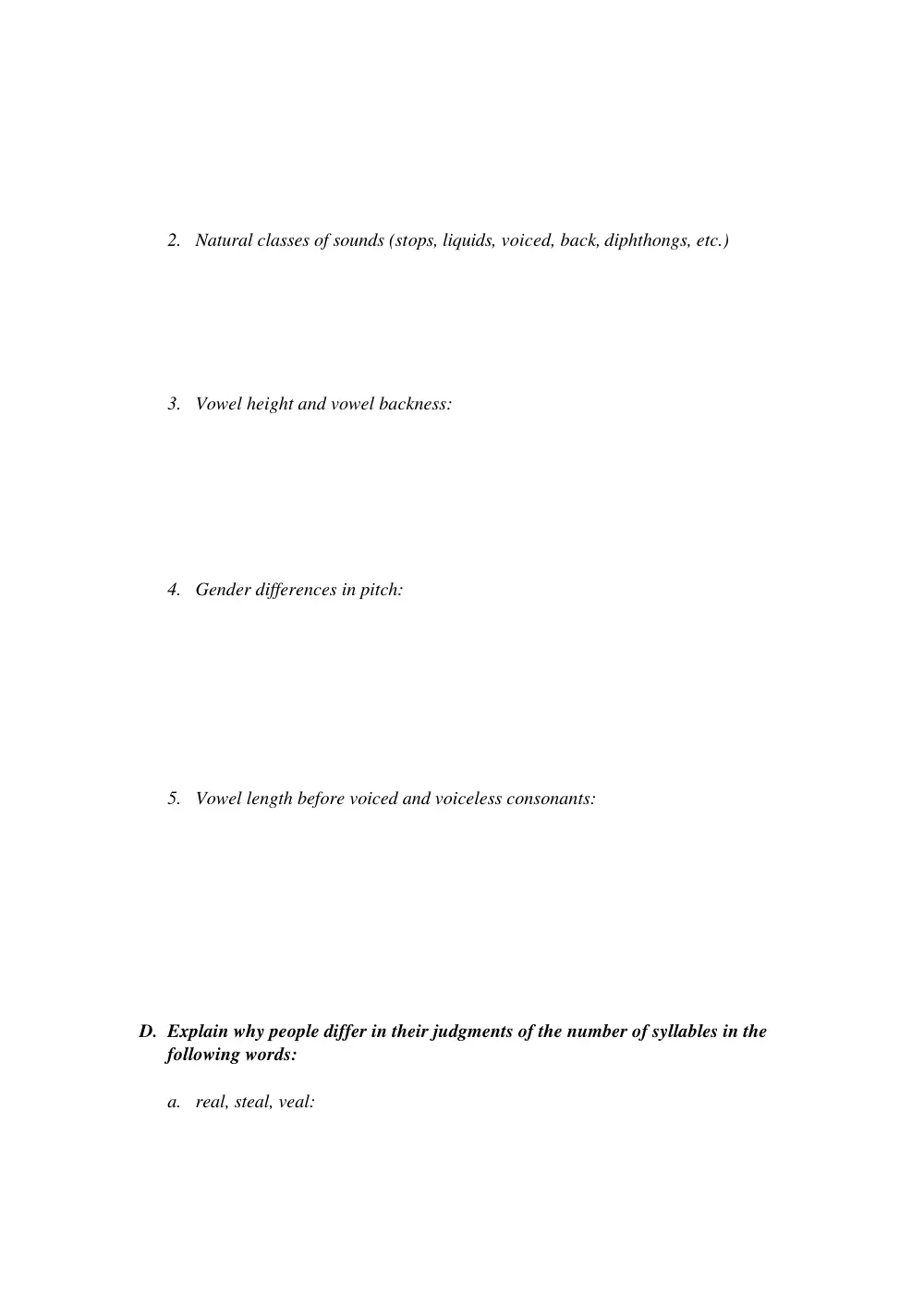
2. Natural classes of sounds (stops, liquids, voiced, back, diphthongs, etc.)
3. Vowel height and vowel backness:
4. Gender differences in pitch:
5. Vowel length before voiced and voiceless consonants:
D. Explain why people differ in their judgments of the number of syllables in the
following words:
a. real, steal, veal:
b. laboratory, dictionary, mandatory:
c. thickening, lightening, blackening:
d. merrier, heavier, happier:
e. socialism, communism, patriotism:
E.1. Indicate the intonation patterns that might occur in the following situations:
a. How long does it take you to understand? (polite question)
b.
lawyer? (Angrily)
c. Her grandmother is the judge. (surprise)
d. Johnny sat by the window, counting the cars passing by.
e. Did you hand your paper on time? (Polite Question)
E. 2. Using some of the examples in E.1, and adding to them, if necessary, explain
how intonation can be phonemic.