
ENG 228 Final, Fall 2002
American University of Beirut · Phonology · 6 pages


More ENG 228 files
Show the text of this final exam
OF BAIRUT
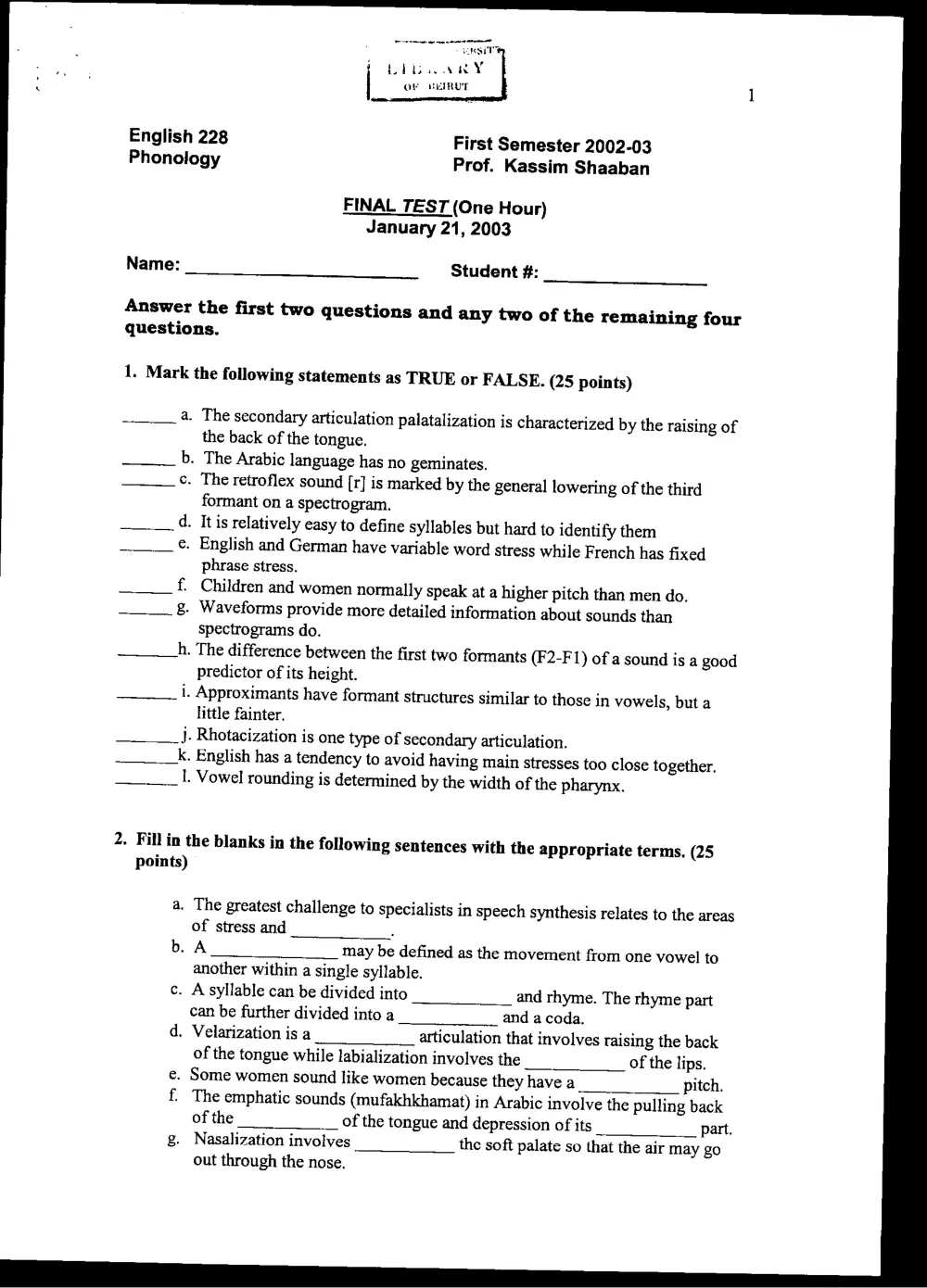
English 228 First Semester 2002-03
Phonology Prof. Kassim Shaaban
FINAL TEST (One Hour)
January 21, 2003
Name: Student #:
Cee
Answer the first two questions and any two of the remaining four
questions.
1. Mark the following statements as TRUE or FALSE. (25 points)
a. The secondary articulation palatalization is characterized by the raising of
the back of the tongue.
b. The Arabic language has no geminates,
c. The retroflex sound [r] is marked by the general lowering of the third
formant on a spectrogram.
d. It is relatively easy to define syllables but hard to identify them
e. English and German have variable word stress while French has fixed
phrase stress.
f. Children and women normally speak at a higher pitch than men do.
g. Waveforms provide more detailed information about sounds than
spectrograms do.
h. The difference between the first two formants (F2-F1) of a sound is a good
predictor of its height.
i. Approximants have formant structures similar to those in vowels, but a
little fainter,
j. Rhotacization is one type of secondary articulation.
k. English has a tendency to avoid having main stresses too close together.
1. Vowel rounding is determined by the width of the pharynx.
2. Fill in the blanks in the following sentences with the appropriate terms, (25
points)
a. The greatest challenge to specialists in speech synthesis relates to the areas
of stress and
b. A may be defined as the movement from one vowel to
another within a single syllable.
c. A syllable can be divided into and rhyme. The rhyme part
can be further divided into a and a coda.
d, Velarization is a articulation that involves raising the back
of the tongue while labialization involves the of the lips.
e. Some women sound like women because they have a pitch.
f. The emphatic sounds (mufakhkhamat) in Arabic involve the pulling back
of the of the tongue and depression of its part.
g. Nasalization involves the soft palate so that the air may go
out through the nose.
ate
fannin S ONIVERSIT
LIBRARY
Or Gener 2
em,
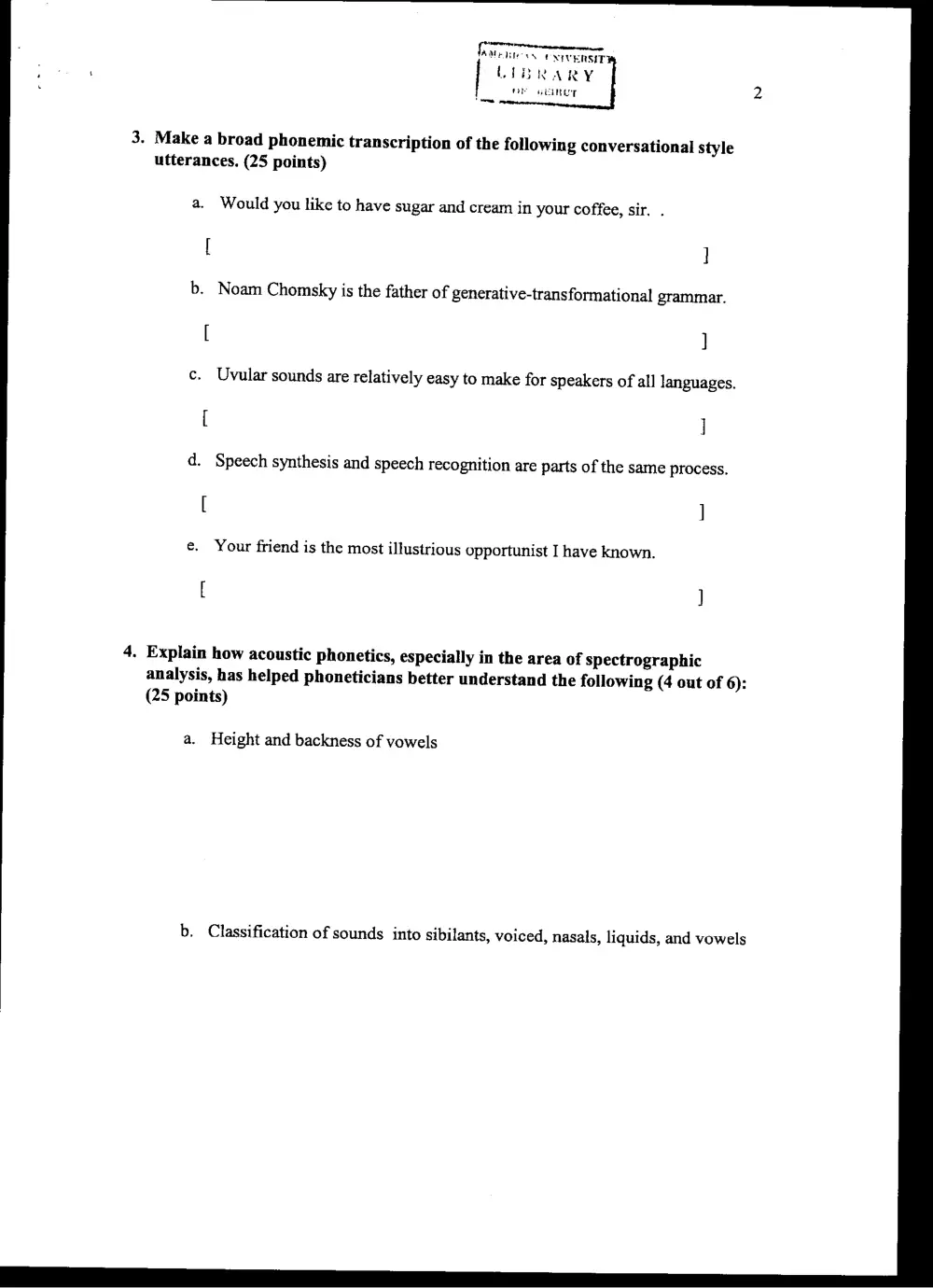
3. Make a broad phonemic transcription of the following conversational style
utterances. (25 points)
a. Would you like to have sugar and cream in your coffee, sir. .
b. Noam Chomsky is the father of generative-transformational grammar.
c. Uvular sounds are relatively easy to make for speakers of all languages.
d. Speech synthesis and speech recognition are parts of the same process.
¢. Your friend is the most illustrious opportunist I have known.
4. Explain how acoustic phonetics, especially in the area of spectrographic
analysis, has helped phoneticians better understand the following (4 out of 6):
(25 points)
a. Height and backness of vowels
b. Classification of sounds into sibilants, voiced, nasals, liquids, and vowels
ee
faael “NIVERSITY
LIBRARY
OF EHIRUT
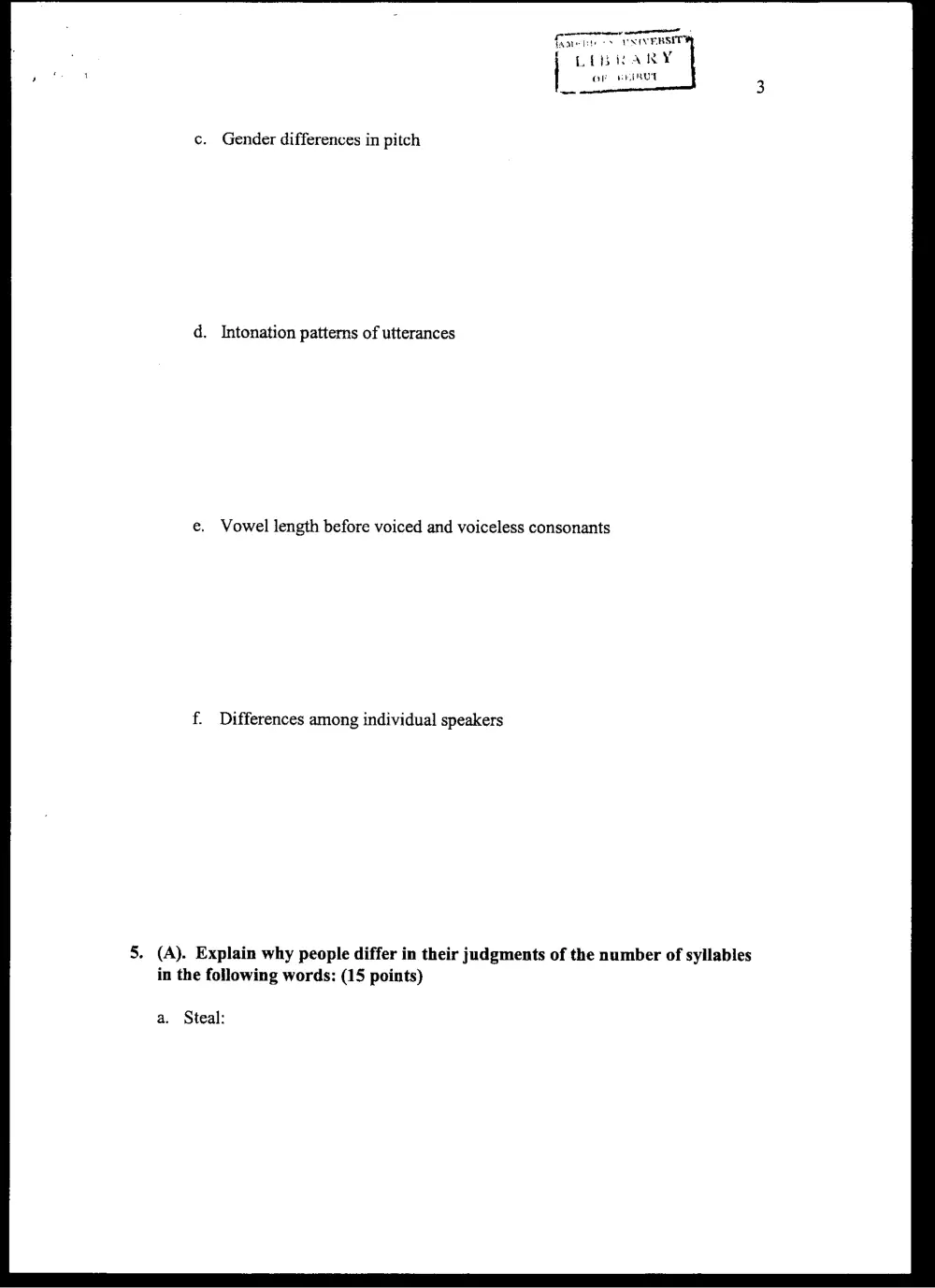
c. Gender differences in pitch
d. Intonation patterns of utterances
e. Vowel length before voiced and voiceless consonants
f. Differences among individual speakers
5. (A). Explain why people differ in their judgments of the number of syllables
in the following words: (15 points)
a. Steal:
fasconies \ CNTWERSIT
LIBKARY
OF LORE
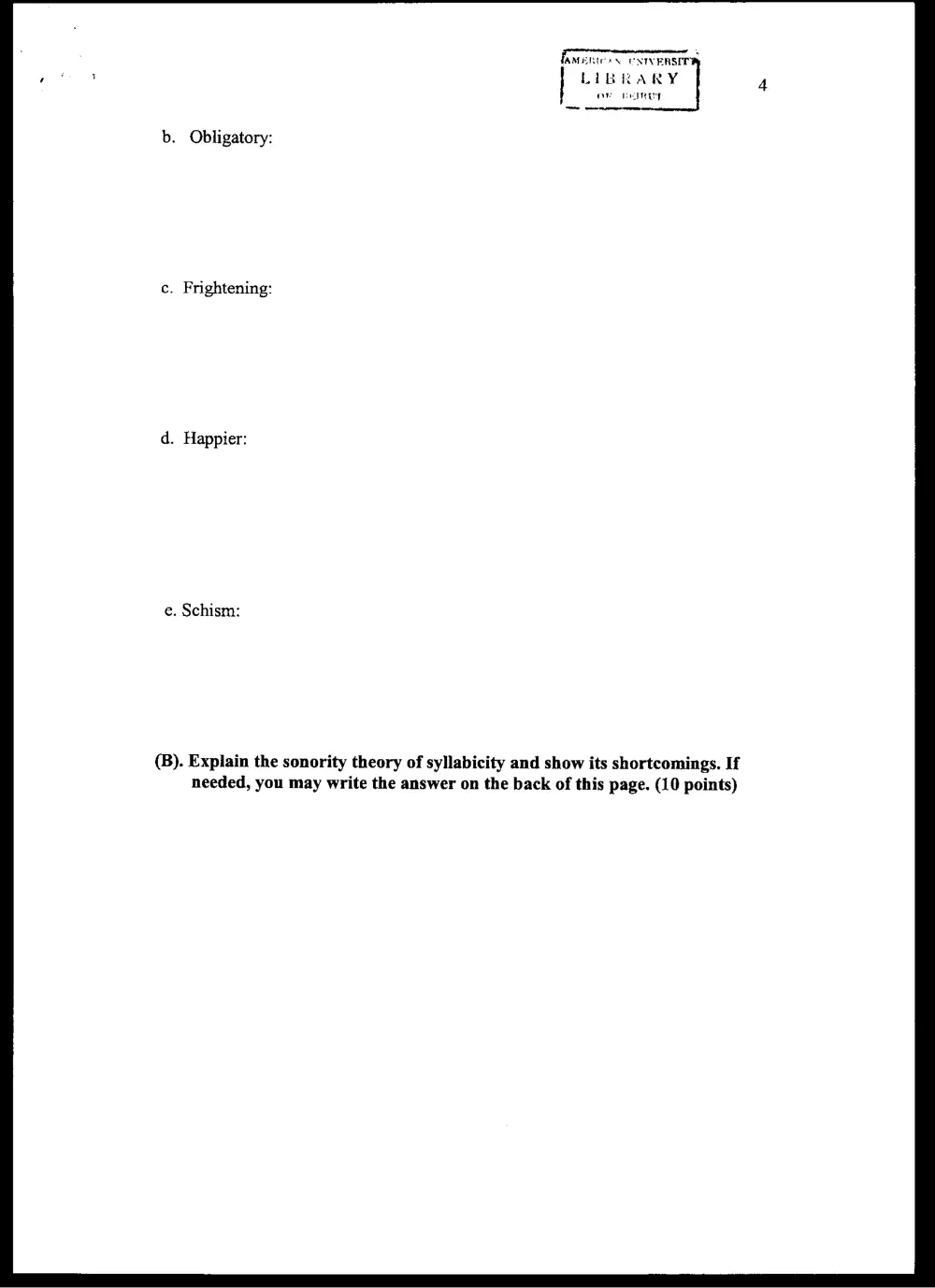
b. Obligatory:
c. Frightening:
d. Happier:
e. Schism:
(B). Explain the sonority theory of syllabicity and show its shortcomings. If
needed, you may write the answer on the back of this page. (10 points)
ae .
SAMENESS ONICERSITY
: \ LIBRARY
' Or CEinIE 5
6. Define six of the following eight terms and give examples of each. (25 points)
1, Syllabic consonants:
2. Sound loudness:
3. Vowel quality:
4. Sentence stress:
5. Syllabic prominence:
6. Cardinal vowels:
AMELIOSS UNIVERSITS
LIBRARY
OF BEIRUT 6
7. Tone languages:
8. Secondary Articulation: