
HIST 101 Final, Fall 1995
American University of Beirut · Survey of Modern Europe · 1 page
Stuck on a question? A tutor can walk you through it.
More HIST 101 files
Show the text of this final exam
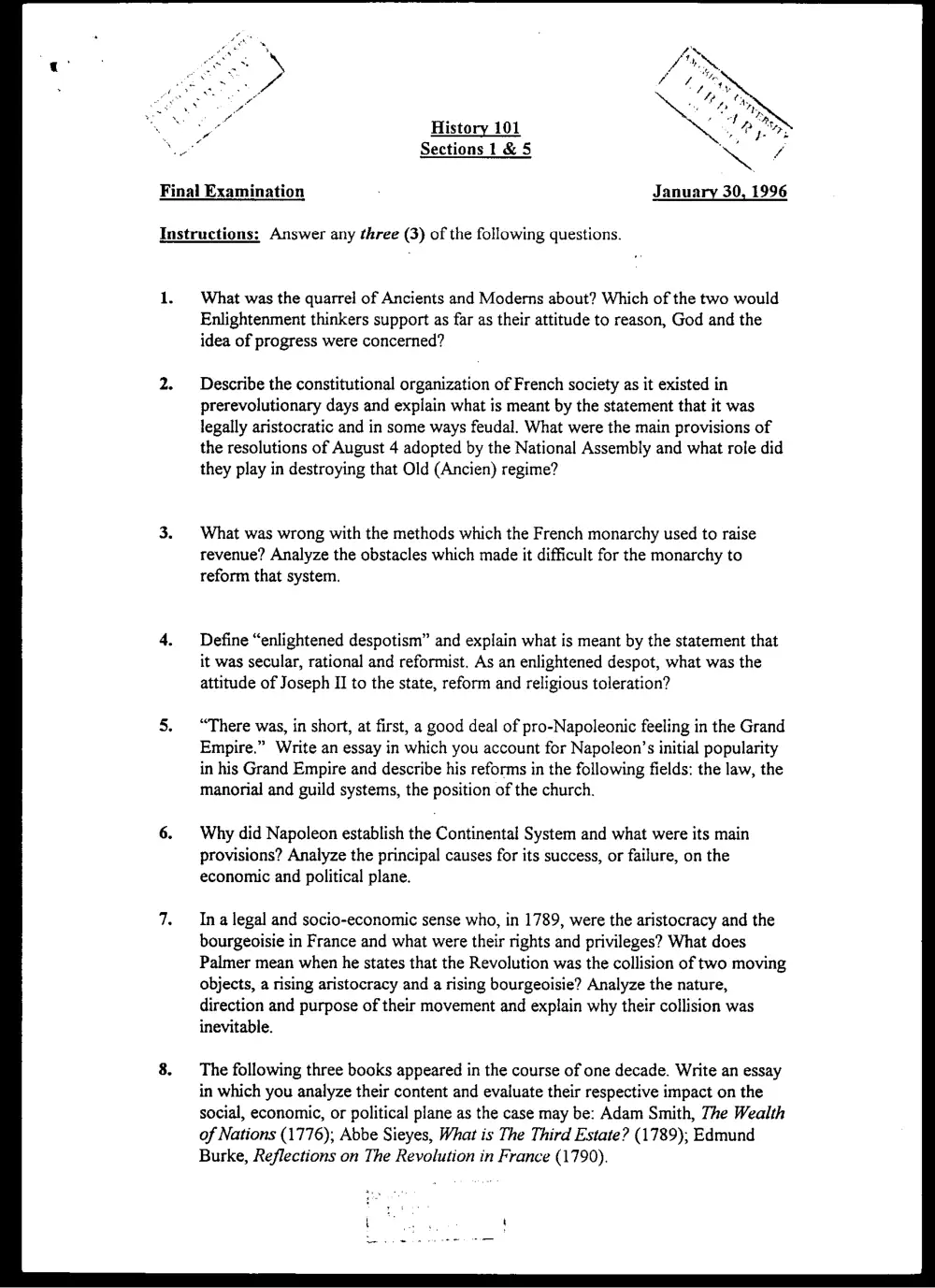
History 101
Sections 1 & 5
Final Examination . January 30, 1996
Instructions: Answer any three (3) of the following questions.
What was the quarrel of Ancients and Moderns about? Which of the two would
Enlightenment thinkers support as far as their attitude to reason, God and the
idea of progress were concerned?
Describe the constitutional organization of French society as it existed in
prerevolutionary days and explain what is meant by the statement that it was
legally aristocratic and in some ways feudal. What were the main provisions of
the resolutions of August 4 adopted by the National Assembly and what role did
they play in destroying that Old (Ancien) regime?
What was wrong with the methods which the French monarchy used to raise
revenue? Analyze the obstacles which made it difficult for the monarchy to
reform that system.
Define “enlightened despotism” and explain what is meant by the statement that
it was secular, rational and reformist. As an enlightened despot, what was the
attitude of Joseph II to the state, reform and religious toleration?
“There was, in short, at first, a good deal of pro-Napoleonic feeling in the Grand
Empire.” Write an essay in which you account for Napoleon’s initial popularity
in his Grand Empire and describe his reforms in the following fields: the law, the
manorial and guild systems, the position of the church.
Why did Napoleon establish the Continental System and what were its main
provisions? Analyze the principal causes for its success, or failure, on the
economic and political plane.
In a legal and socio-economic sense who, in 1789, were the aristocracy and the
bourgeoisie in France and what were their rights and privileges? What does
Palmer mean when he states that the Revolution was the collision of two moving
objects, a rising aristocracy and a rising bourgeoisie? Analyze the nature,
direction and purpose of their movement and explain why their collision was
inevitable.
The following three books appeared in the course of one decade. Write an essay
in which you analyze their content and evaluate their respective impact on the
social, economic, or political plane as the case may be: Adam Smith, The Wealth
of Nations (1776), Abbe Sieyes, What is The Third Estate? (1789); Edmund
Burke, Reflections on The Revolution in France (1790).