
MATH 241 Homework 4, Fall 2011
American University of Beirut · Introduction to Abstract Algebra · 6 pages · Prof. Kamal Makdisi
More MATH 241 files
Show the text of this homework
Math 241
Problem Set 4 solution manual
Exercise. A4.1
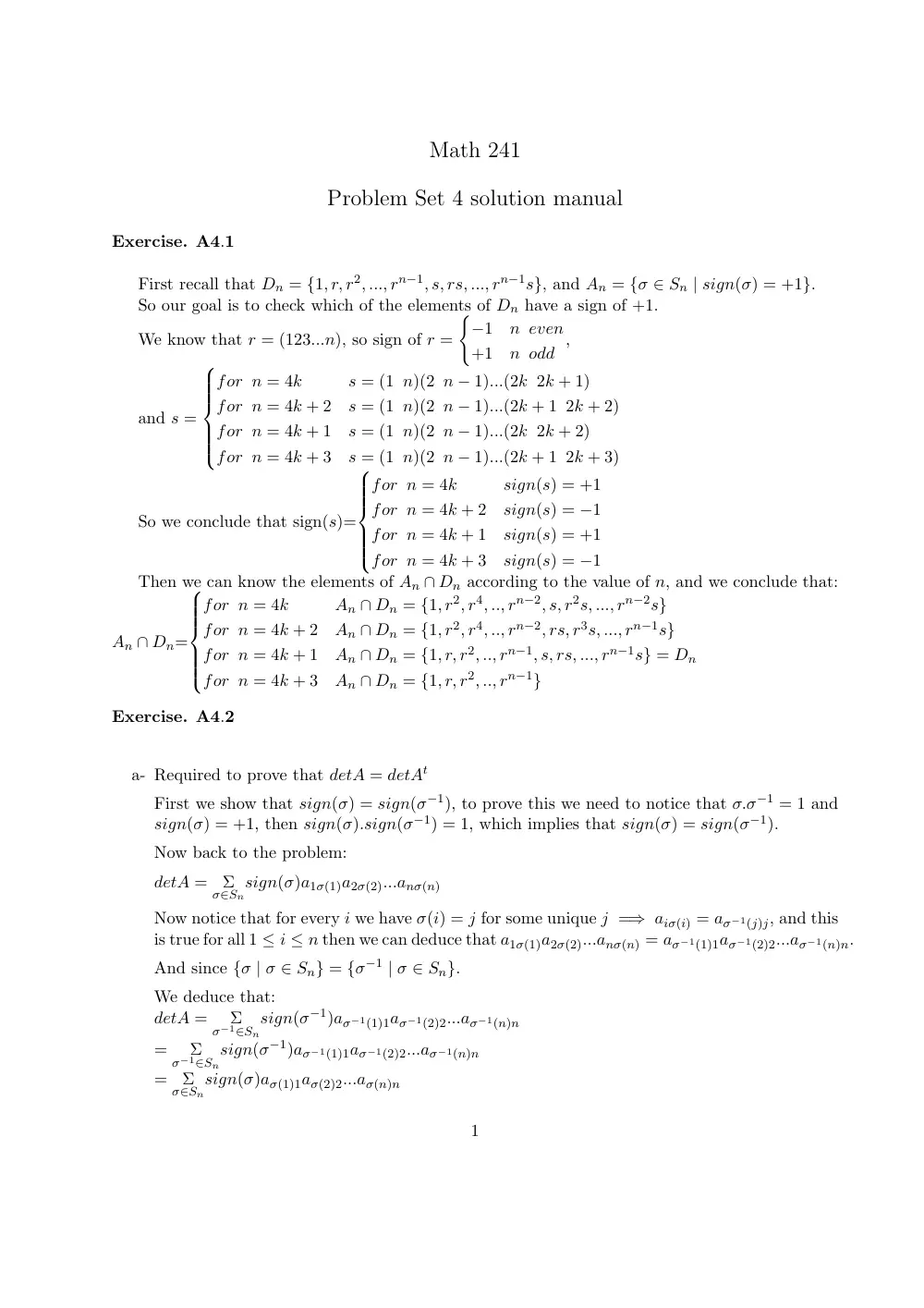
First recall that Dn = {1, r, r2, ..., rn−1, s, rs, ..., rn−1s}, and An = {σ ∈ Sn | sign(σ) = +1}.
So our goal is to check which of the elements of Dn have a sign of +1.
We know that r = (123...n), so sign of r =
�
−1
n even
+1
n odd ,
and s =
for n = 4k
s = (1 n)(2 n − 1)...(2k 2k + 1)
for n = 4k + 2
s = (1 n)(2 n − 1)...(2k + 1 2k + 2)
for n = 4k + 1
s = (1 n)(2 n − 1)...(2k 2k + 2)
for n = 4k + 3
s = (1 n)(2 n − 1)...(2k + 1 2k + 3)
So we conclude that sign(s)=
for n = 4k
sign(s) = +1
for n = 4k + 2
sign(s) = −1
for n = 4k + 1
sign(s) = +1
for n = 4k + 3
sign(s) = −1
Then we can know the elements of An ∩ Dn according to the value of n, and we conclude that:
An ∩ Dn=
for n = 4k
An ∩ Dn = {1, r2, r4, .., rn−2, s, r2s, ..., rn−2s}
for n = 4k + 2
An ∩ Dn = {1, r2, r4, .., rn−2, rs, r3s, ..., rn−1s}
for n = 4k + 1
An ∩ Dn = {1, r, r2, .., rn−1, s, rs, ..., rn−1s} = Dn
for n = 4k + 3
An ∩ Dn = {1, r, r2, .., rn−1}
Exercise. A4.2
a- Required to prove that detA = detAt
First we show that sign(σ) = sign(σ−1), to prove this we need to notice that σ.σ−1 = 1 and
sign(σ) = +1, then sign(σ).sign(σ−1) = 1, which implies that sign(σ) = sign(σ−1).
Now back to the problem:
detA =
Σ
σ∈Snsign(σ)a1σ(1)a2σ(2)...anσ(n)
Now notice that for every i we have σ(i) = j for some unique j =⇒ aiσ(i) = aσ−1(j)j, and this
is true for all 1 ≤ i ≤ n then we can deduce that a1σ(1)a2σ(2)...anσ(n) = aσ−1(1)1aσ−1(2)2...aσ−1(n)n.
And since {σ | σ ∈ Sn} = {σ−1 | σ ∈ Sn}.
We deduce that:
detA =
Σ
σ−1∈Sn
sign(σ−1)aσ−1(1)1aσ−1(2)2...aσ−1(n)n
=
Σ
σ−1∈Sn
sign(σ−1)aσ−1(1)1aσ−1(2)2...aσ−1(n)n
=
Σ
σ∈Snsign(σ)aσ(1)1aσ(2)2...aσ(n)n
1
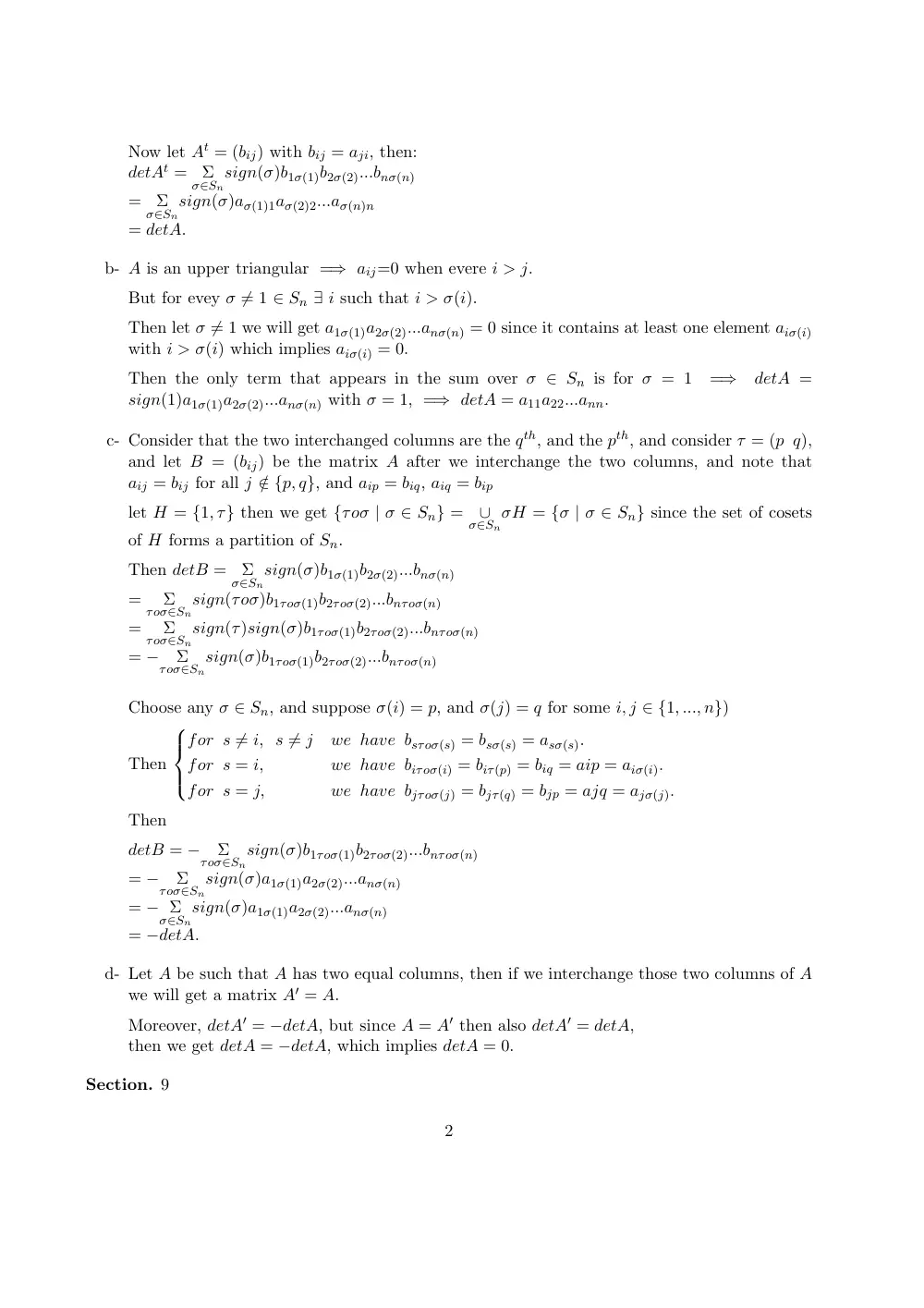
Now let At = (bij) with bij = aji, then:
detAt =
Σ
σ∈Snsign(σ)b1σ(1)b2σ(2)...bnσ(n)
=
Σ
σ∈Snsign(σ)aσ(1)1aσ(2)2...aσ(n)n
= detA.
b- A is an upper triangular =⇒ aij=0 when evere i > j.
But for evey σ ̸= 1 ∈ Sn ∃ i such that i > σ(i).
Then let σ ̸= 1 we will get a1σ(1)a2σ(2)...anσ(n) = 0 since it contains at least one element aiσ(i)
with i > σ(i) which implies aiσ(i) = 0.
Then the only term that appears in the sum over σ ∈ Sn is for σ = 1
=⇒
detA =
sign(1)a1σ(1)a2σ(2)...anσ(n) with σ = 1, =⇒ detA = a11a22...ann.
c- Consider that the two interchanged columns are the qth, and the pth, and consider τ = (p q),
and let B = (bij) be the matrix A after we interchange the two columns, and note that
aij = bij for all j /∈ {p, q}, and aip = biq, aiq = bip
let H = {1, τ} then we get {τoσ | σ ∈ Sn} =
∪
σ∈SnσH = {σ | σ ∈ Sn} since the set of cosets
of H forms a partition of Sn.
Then detB =
Σ
σ∈Snsign(σ)b1σ(1)b2σ(2)...bnσ(n)
=
Σ
τoσ∈Snsign(τoσ)b1τoσ(1)b2τoσ(2)...bnτoσ(n)
=
Σ
τoσ∈Snsign(τ)sign(σ)b1τoσ(1)b2τoσ(2)...bnτoσ(n)
= −
Σ
τoσ∈Snsign(σ)b1τoσ(1)b2τoσ(2)...bnτoσ(n)
Choose any σ ∈ Sn, and suppose σ(i) = p, and σ(j) = q for some i, j ∈ {1, ..., n})
Then
for s ̸= i, s ̸= j
we have bsτoσ(s) = bsσ(s) = asσ(s).
for s = i,
we have biτoσ(i) = biτ(p) = biq = aip = aiσ(i).
for s = j,
we have bjτoσ(j) = bjτ(q) = bjp = ajq = ajσ(j).
Then
detB = −
Σ
τoσ∈Snsign(σ)b1τoσ(1)b2τoσ(2)...bnτoσ(n)
= −
Σ
τoσ∈Snsign(σ)a1σ(1)a2σ(2)...anσ(n)
= − Σ
σ∈Snsign(σ)a1σ(1)a2σ(2)...anσ(n)
= −detA.
d- Let A be such that A has two equal columns, then if we interchange those two columns of A
we will get a matrix A′ = A.
Moreover, detA′ = −detA, but since A = A′ then also detA′ = detA,
then we get detA = −detA, which implies detA = 0.
Section. 9
2
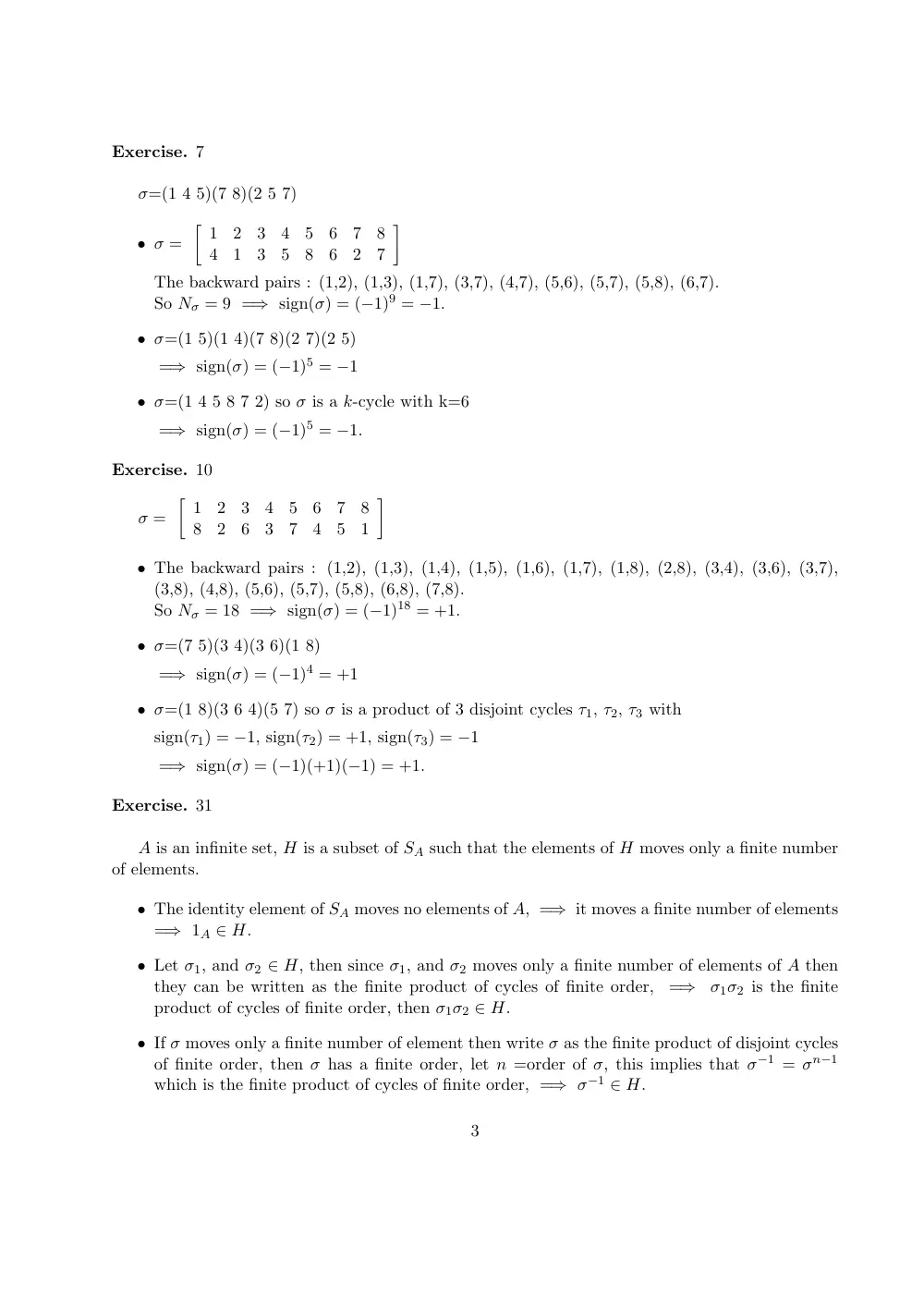
Exercise. 7
σ=(1 4 5)(7 8)(2 5 7)
• σ =
� 1
2
3
4
5
6
7
8
4
1
3
5
8
6
2
7
�
The backward pairs : (1,2), (1,3), (1,7), (3,7), (4,7), (5,6), (5,7), (5,8), (6,7).
So Nσ = 9 =⇒ sign(σ) = (−1)9 = −1.
• σ=(1 5)(1 4)(7 8)(2 7)(2 5)
=⇒ sign(σ) = (−1)5 = −1
• σ=(1 4 5 8 7 2) so σ is a k-cycle with k=6
=⇒ sign(σ) = (−1)5 = −1.
Exercise. 10
σ =
� 1
2
3
4
5
6
7
8
8
2
6
3
7
4
5
1
�
• The backward pairs : (1,2), (1,3), (1,4), (1,5), (1,6), (1,7), (1,8), (2,8), (3,4), (3,6), (3,7),
(3,8), (4,8), (5,6), (5,7), (5,8), (6,8), (7,8).
So Nσ = 18 =⇒ sign(σ) = (−1)18 = +1.
• σ=(7 5)(3 4)(3 6)(1 8)
=⇒ sign(σ) = (−1)4 = +1
• σ=(1 8)(3 6 4)(5 7) so σ is a product of 3 disjoint cycles τ1, τ2, τ3 with
sign(τ1) = −1, sign(τ2) = +1, sign(τ3) = −1
=⇒ sign(σ) = (−1)(+1)(−1) = +1.
Exercise. 31
A is an infinite set, H is a subset of SA such that the elements of H moves only a finite number
of elements.
• The identity element of SA moves no elements of A, =⇒ it moves a finite number of elements
=⇒ 1A ∈ H.
• Let σ1, and σ2 ∈ H, then since σ1, and σ2 moves only a finite number of elements of A then
they can be written as the finite product of cycles of finite order,
=⇒
σ1σ2 is the finite
product of cycles of finite order, then σ1σ2 ∈ H.
• If σ moves only a finite number of element then write σ as the finite product of disjoint cycles
of finite order, then σ has a finite order, let n =order of σ, this implies that σ−1 = σn−1
which is the finite product of cycles of finite order, =⇒ σ−1 ∈ H.
3
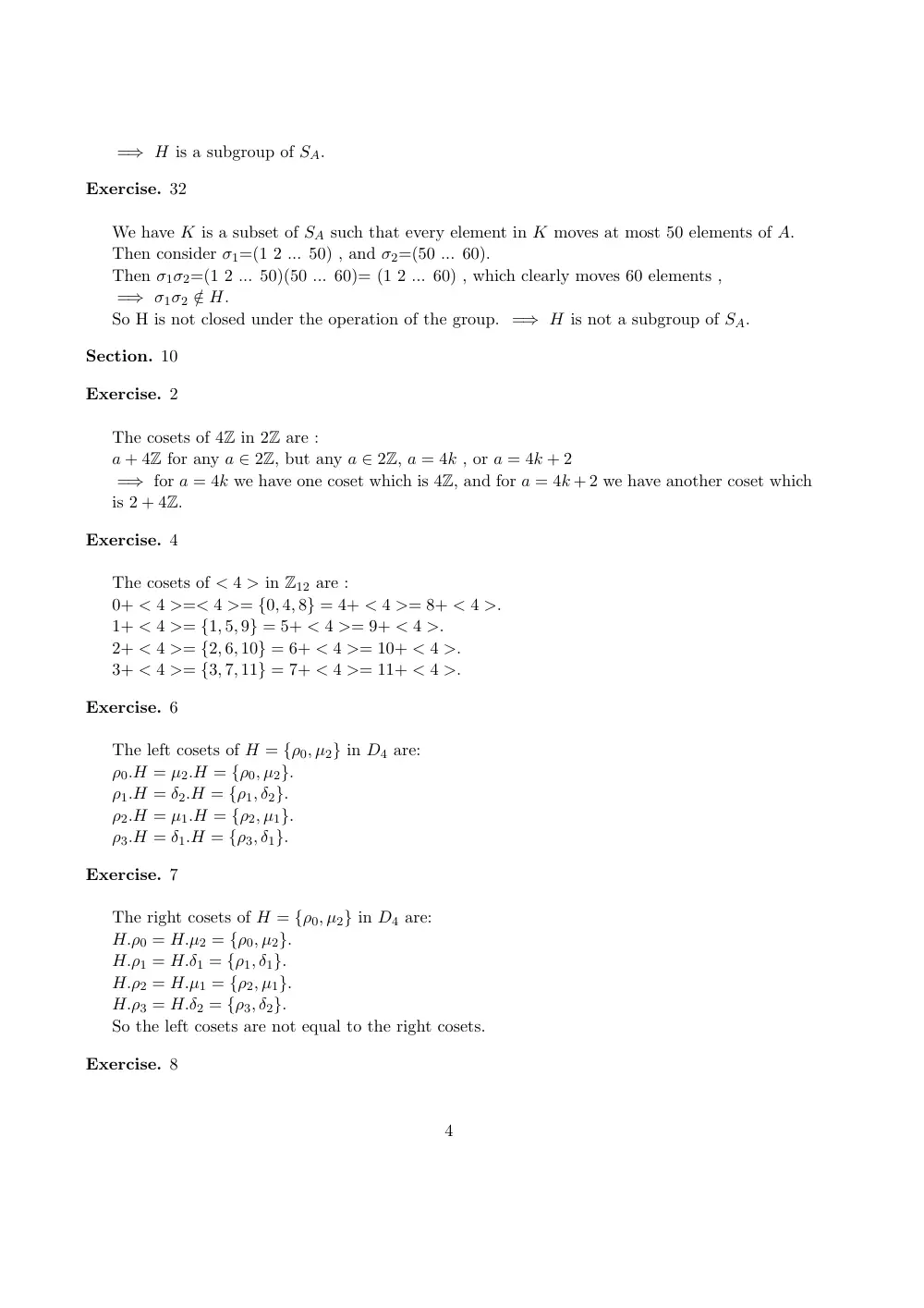
=⇒ H is a subgroup of SA.
Exercise. 32
We have K is a subset of SA such that every element in K moves at most 50 elements of A.
Then consider σ1=(1 2 ... 50) , and σ2=(50 ... 60).
Then σ1σ2=(1 2 ... 50)(50 ... 60)= (1 2 ... 60) , which clearly moves 60 elements ,
=⇒ σ1σ2 /∈ H.
So H is not closed under the operation of the group. =⇒ H is not a subgroup of SA.
Section. 10
Exercise. 2
The cosets of 4Z in 2Z are :
a + 4Z for any a ∈ 2Z, but any a ∈ 2Z, a = 4k , or a = 4k + 2
=⇒ for a = 4k we have one coset which is 4Z, and for a = 4k + 2 we have another coset which
is 2 + 4Z.
Exercise. 4
The cosets of < 4 > in Z12 are :
0+ < 4 >=< 4 >= {0, 4, 8} = 4+ < 4 >= 8+ < 4 >.
1+ < 4 >= {1, 5, 9} = 5+ < 4 >= 9+ < 4 >.
2+ < 4 >= {2, 6, 10} = 6+ < 4 >= 10+ < 4 >.
3+ < 4 >= {3, 7, 11} = 7+ < 4 >= 11+ < 4 >.
Exercise. 6
The left cosets of H = {ρ0, µ2} in D4 are:
ρ0.H = µ2.H = {ρ0, µ2}.
ρ1.H = δ2.H = {ρ1, δ2}.
ρ2.H = µ1.H = {ρ2, µ1}.
ρ3.H = δ1.H = {ρ3, δ1}.
Exercise. 7
The right cosets of H = {ρ0, µ2} in D4 are:
H.ρ0 = H.µ2 = {ρ0, µ2}.
H.ρ1 = H.δ1 = {ρ1, δ1}.
H.ρ2 = H.µ1 = {ρ2, µ1}.
H.ρ3 = H.δ2 = {ρ3, δ2}.
So the left cosets are not equal to the right cosets.
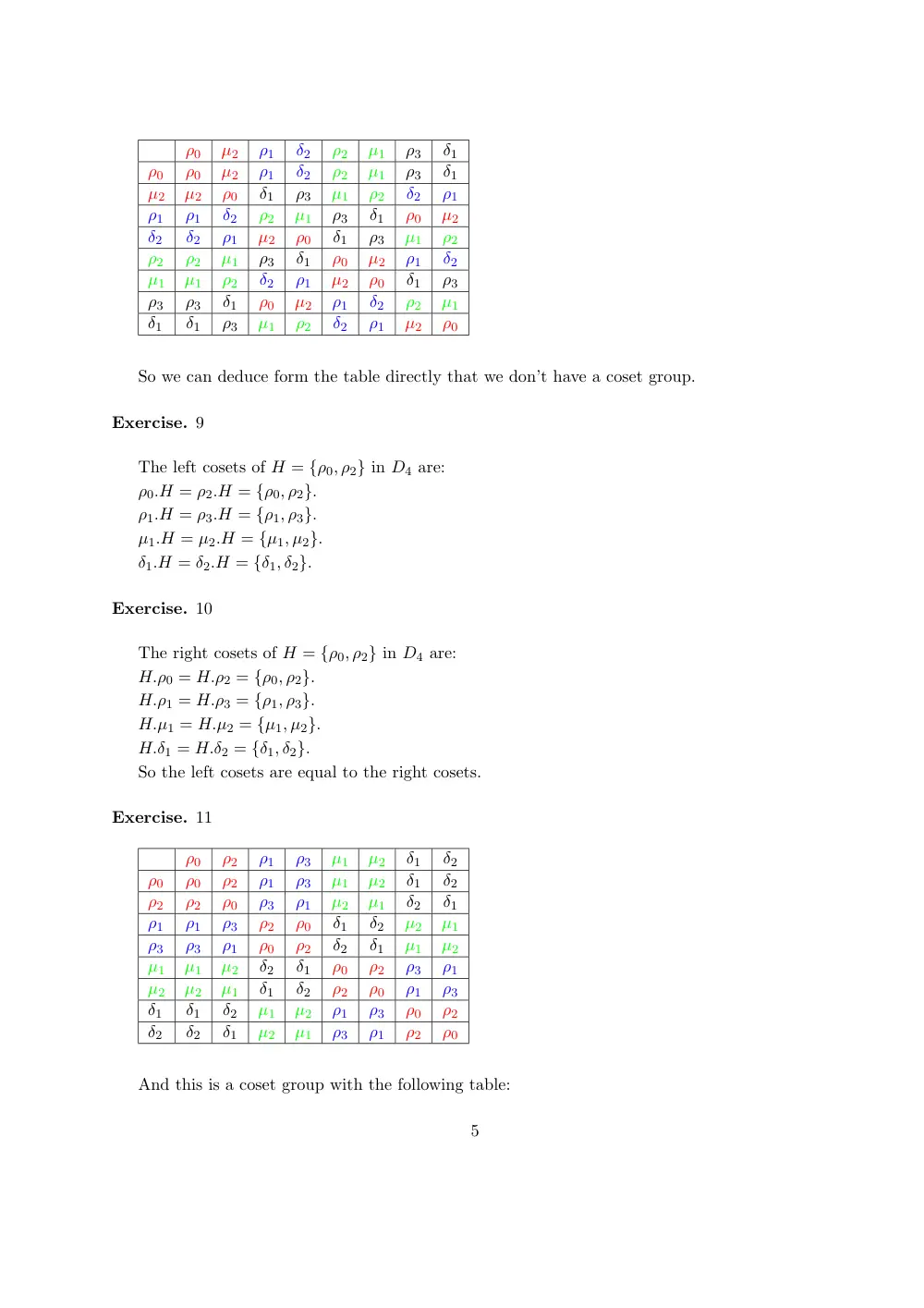
Exercise. 8
4
ρ0
µ2
ρ1
δ2
ρ2
µ1
ρ3
δ1
ρ0
ρ0
µ2
ρ1
δ2
ρ2
µ1
ρ3
δ1
µ2
µ2
ρ0
δ1
ρ3
µ1
ρ2
δ2
ρ1
ρ1
ρ1
δ2
ρ2
µ1
ρ3
δ1
ρ0
µ2
δ2
δ2
ρ1
µ2
ρ0
δ1
ρ3
µ1
ρ2
ρ2
ρ2
µ1
ρ3
δ1
ρ0
µ2
ρ1
δ2
µ1
µ1
ρ2
δ2
ρ1
µ2
ρ0
δ1
ρ3
ρ3
ρ3
δ1
ρ0
µ2
ρ1
δ2
ρ2
µ1
δ1
δ1
ρ3
µ1
ρ2
δ2
ρ1
µ2
ρ0
So we can deduce form the table directly that we don’t have a coset group.
Exercise. 9
The left cosets of H = {ρ0, ρ2} in D4 are:
ρ0.H = ρ2.H = {ρ0, ρ2}.
ρ1.H = ρ3.H = {ρ1, ρ3}.
µ1.H = µ2.H = {µ1, µ2}.
δ1.H = δ2.H = {δ1, δ2}.
Exercise. 10
The right cosets of H = {ρ0, ρ2} in D4 are:
H.ρ0 = H.ρ2 = {ρ0, ρ2}.
H.ρ1 = H.ρ3 = {ρ1, ρ3}.
H.µ1 = H.µ2 = {µ1, µ2}.
H.δ1 = H.δ2 = {δ1, δ2}.
So the left cosets are equal to the right cosets.
Exercise. 11
ρ0
ρ2
ρ1
ρ3
µ1
µ2
δ1
δ2
ρ0
ρ0
ρ2
ρ1
ρ3
µ1
µ2
δ1
δ2
ρ2
ρ2
ρ0
ρ3
ρ1
µ2
µ1
δ2
δ1
ρ1
ρ1
ρ3
ρ2
ρ0
δ1
δ2
µ2
µ1
ρ3
ρ3
ρ1
ρ0
ρ2
δ2
δ1
µ1
µ2
µ1
µ1
µ2
δ2
δ1
ρ0
ρ2
ρ3
ρ1
µ2
µ2
µ1
δ1
δ2
ρ2
ρ0
ρ1
ρ3
δ1
δ1
δ2
µ1
µ2
ρ1
ρ3
ρ0
ρ2
δ2
δ2
δ1
µ2
µ1
ρ3
ρ1
ρ2
ρ0
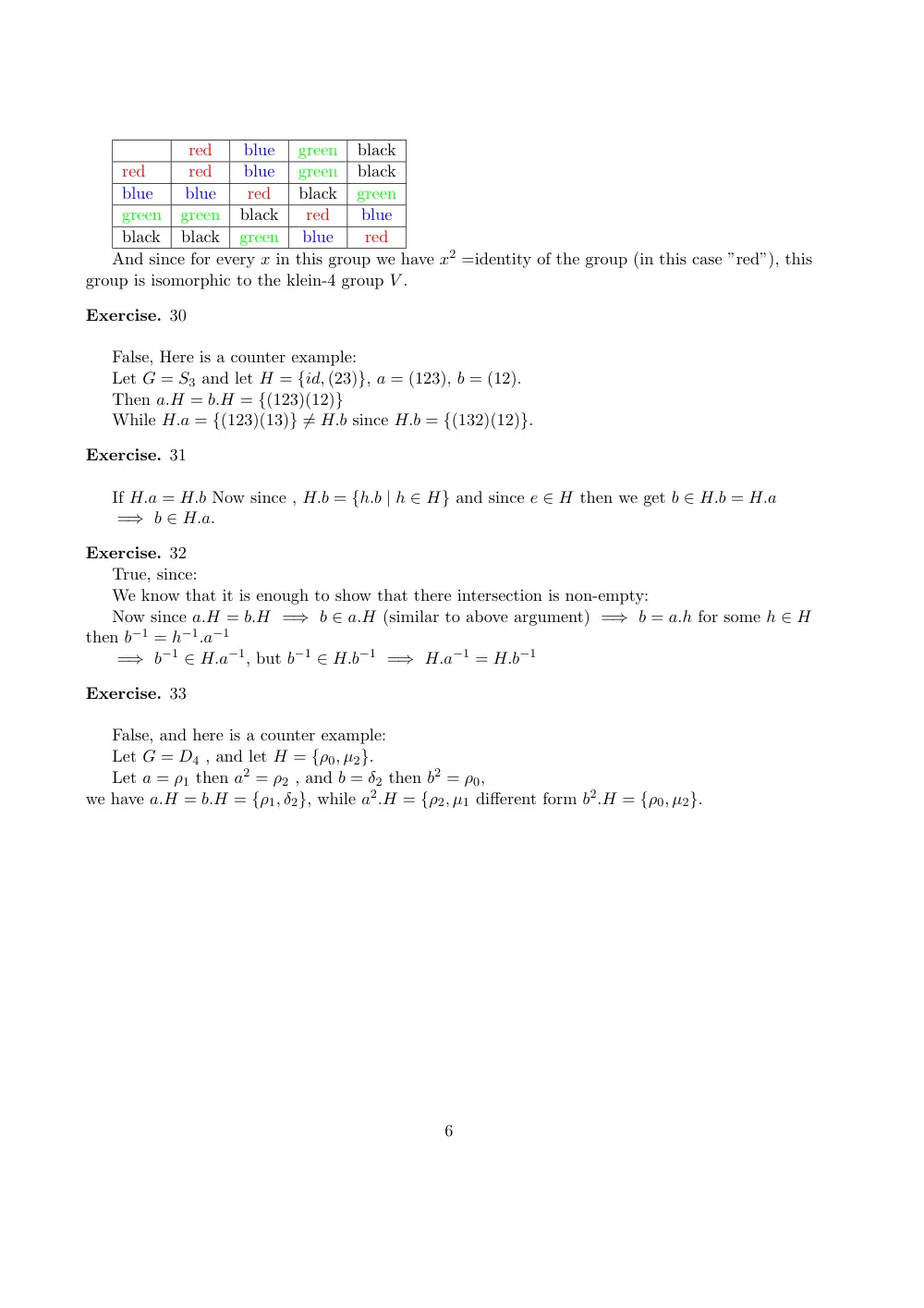
And this is a coset group with the following table:
5
red
blue
green
black
red
red
blue
green
black
blue
blue
red
black
green
green
green
black
red
blue
black
black
green
blue
red
And since for every x in this group we have x2 =identity of the group (in this case ”red”), this
group is isomorphic to the klein-4 group V .
Exercise. 30
False, Here is a counter example:
Let G = S3 and let H = {id, (23)}, a = (123), b = (12).
Then a.H = b.H = {(123)(12)}
While H.a = {(123)(13)} ̸= H.b since H.b = {(132)(12)}.
Exercise. 31
If H.a = H.b Now since , H.b = {h.b | h ∈ H} and since e ∈ H then we get b ∈ H.b = H.a
=⇒ b ∈ H.a.
Exercise. 32
True, since:
We know that it is enough to show that there intersection is non-empty:
Now since a.H = b.H =⇒ b ∈ a.H (similar to above argument) =⇒ b = a.h for some h ∈ H
then b−1 = h−1.a−1
=⇒ b−1 ∈ H.a−1, but b−1 ∈ H.b−1 =⇒ H.a−1 = H.b−1
Exercise. 33
False, and here is a counter example:
Let G = D4 , and let H = {ρ0, µ2}.
Let a = ρ1 then a2 = ρ2 , and b = δ2 then b2 = ρ0,
we have a.H = b.H = {ρ1, δ2}, while a2.H = {ρ2, µ1 different form b2.H = {ρ0, µ2}.
6