
MATH 241 Homework 5, Fall 2011
American University of Beirut · Introduction to Abstract Algebra · 4 pages · Prof. Kamal Makdisi
More MATH 241 files
Show the text of this homework
Math 241
Problem Set 5 solution manual
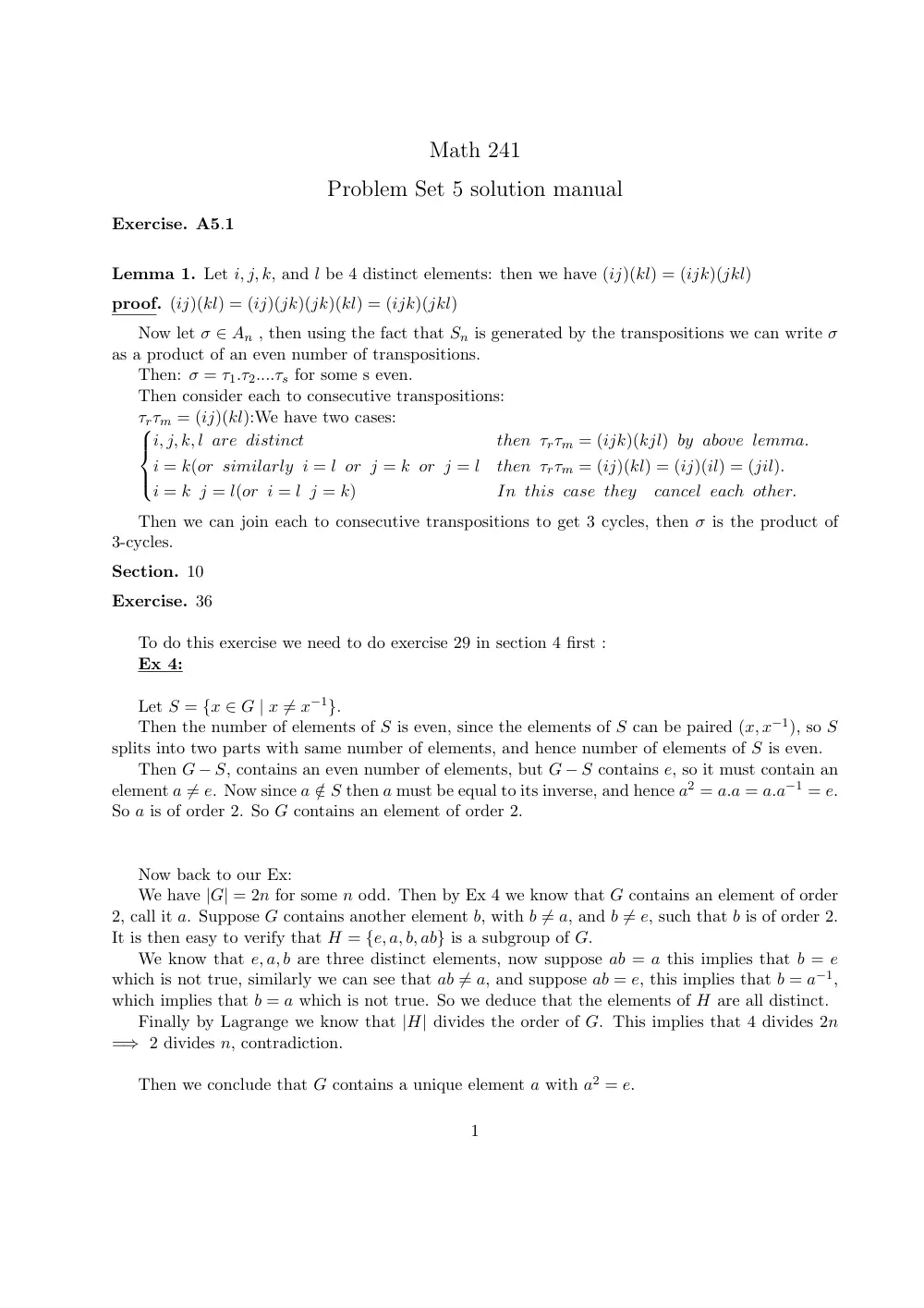
Exercise. A5.1
Lemma 1. Let i, j, k, and l be 4 distinct elements: then we have (ij)(kl) = (ijk)(jkl)
proof. (ij)(kl) = (ij)(jk)(jk)(kl) = (ijk)(jkl)
Now let σ ∈ An , then using the fact that Sn is generated by the transpositions we can write σ
as a product of an even number of transpositions.
Then: σ = τ1.τ2....τs for some s even.
Then consider each to consecutive transpositions:
τrτm = (ij)(kl):We have two cases:
i, j, k, l are distinct
then τrτm = (ijk)(kjl) by above lemma.
i = k(or similarly i = l or j = k or j = l
then τrτm = (ij)(kl) = (ij)(il) = (jil).
i = k j = l(or i = l j = k)
In this case they
cancel each other.
Then we can join each to consecutive transpositions to get 3 cycles, then σ is the product of
3-cycles.
Section. 10
Exercise. 36
To do this exercise we need to do exercise 29 in section 4 first :
Ex 4:
Let S = {x ∈ G | x ̸= x−1}.
Then the number of elements of S is even, since the elements of S can be paired (x, x−1), so S
splits into two parts with same number of elements, and hence number of elements of S is even.
Then G − S, contains an even number of elements, but G − S contains e, so it must contain an
element a ̸= e. Now since a /∈ S then a must be equal to its inverse, and hence a2 = a.a = a.a−1 = e.
So a is of order 2. So G contains an element of order 2.
Now back to our Ex:
We have |G| = 2n for some n odd. Then by Ex 4 we know that G contains an element of order
2, call it a. Suppose G contains another element b, with b ̸= a, and b ̸= e, such that b is of order 2.
It is then easy to verify that H = {e, a, b, ab} is a subgroup of G.
We know that e, a, b are three distinct elements, now suppose ab = a this implies that b = e
which is not true, similarly we can see that ab ̸= a, and suppose ab = e, this implies that b = a−1,
which implies that b = a which is not true. So we deduce that the elements of H are all distinct.
Finally by Lagrange we know that |H| divides the order of G. This implies that 4 divides 2n
=⇒ 2 divides n, contradiction.
Then we conclude that G contains a unique element a with a2 = e.
1
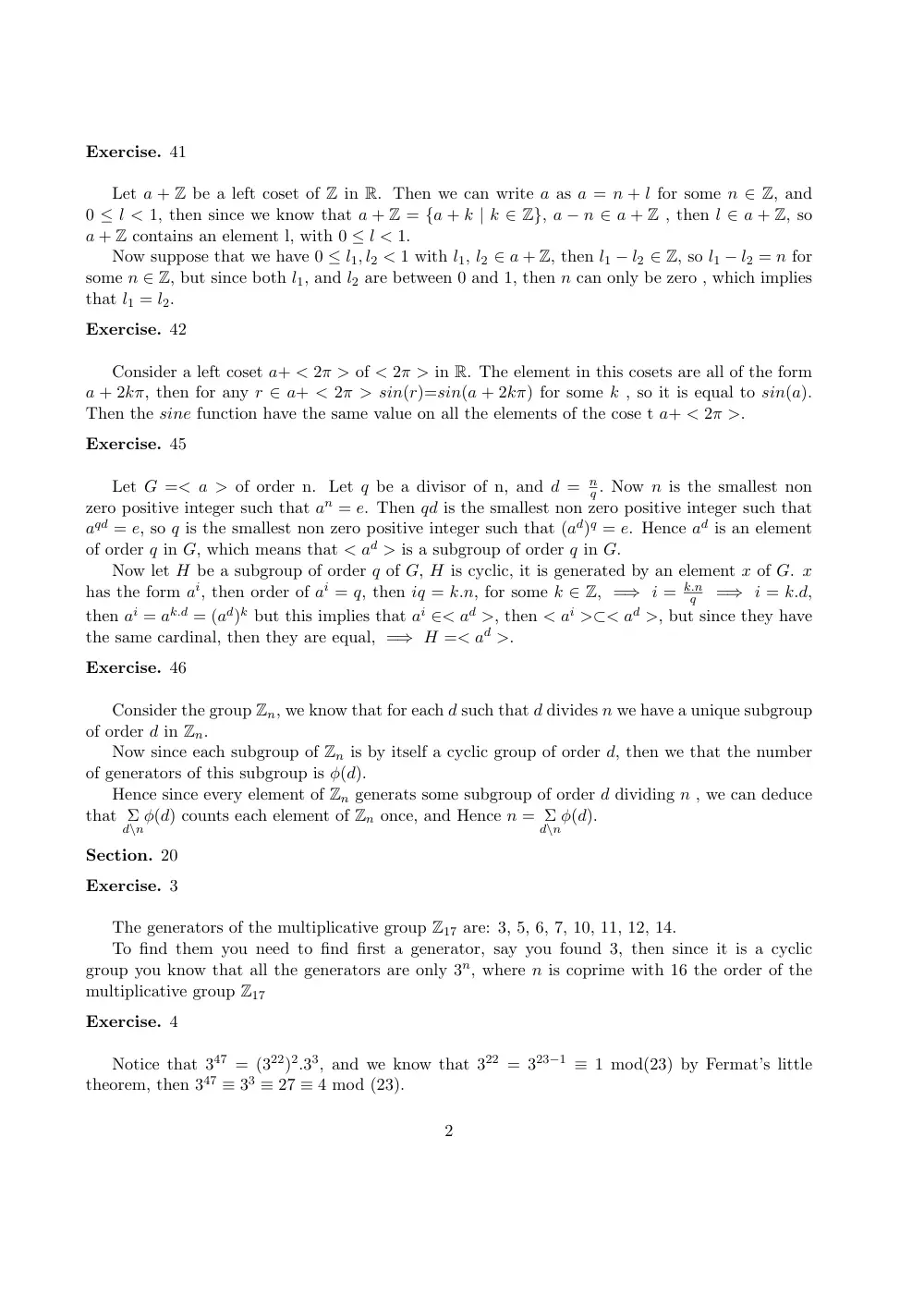
Exercise. 41
Let a + Z be a left coset of Z in R. Then we can write a as a = n + l for some n ∈ Z, and
0 ≤ l < 1, then since we know that a + Z = {a + k | k ∈ Z}, a − n ∈ a + Z , then l ∈ a + Z, so
a + Z contains an element l, with 0 ≤ l < 1.
Now suppose that we have 0 ≤ l1, l2 < 1 with l1, l2 ∈ a + Z, then l1 − l2 ∈ Z, so l1 − l2 = n for
some n ∈ Z, but since both l1, and l2 are between 0 and 1, then n can only be zero , which implies
that l1 = l2.
Exercise. 42
Consider a left coset a+ < 2π > of < 2π > in R. The element in this cosets are all of the form
a + 2kπ, then for any r ∈ a+ < 2π > sin(r)=sin(a + 2kπ) for some k , so it is equal to sin(a).
Then the sine function have the same value on all the elements of the cose t a+ < 2π >.
Exercise. 45
Let G =< a > of order n. Let q be a divisor of n, and d = n
q . Now n is the smallest non
zero positive integer such that an = e. Then qd is the smallest non zero positive integer such that
aqd = e, so q is the smallest non zero positive integer such that (ad)q = e. Hence ad is an element
of order q in G, which means that < ad > is a subgroup of order q in G.
Now let H be a subgroup of order q of G, H is cyclic, it is generated by an element x of G. x
has the form ai, then order of ai = q, then iq = k.n, for some k ∈ Z, =⇒ i = k.n
q
=⇒ i = k.d,
then ai = ak.d = (ad)k but this implies that ai ∈< ad >, then < ai >⊂< ad >, but since they have
the same cardinal, then they are equal, =⇒ H =< ad >.
Exercise. 46
Consider the group Zn, we know that for each d such that d divides n we have a unique subgroup
of order d in Zn.
Now since each subgroup of Zn is by itself a cyclic group of order d, then we that the number
of generators of this subgroup is φ(d).
Hence since every element of Zn generats some subgroup of order d dividing n , we can deduce
that Σ
d\nφ(d) counts each element of Zn once, and Hence n = Σ
d\nφ(d).
Section. 20
Exercise. 3
The generators of the multiplicative group Z17 are: 3, 5, 6, 7, 10, 11, 12, 14.
To find them you need to find first a generator, say you found 3, then since it is a cyclic
group you know that all the generators are only 3n, where n is coprime with 16 the order of the
multiplicative group Z17
Exercise. 4
Notice that 347 = (322)2.33, and we know that 322 = 323−1 ≡ 1 mod(23) by Fermat’s little
theorem, then 347 ≡ 33 ≡ 27 ≡ 4 mod (23).
2
Exercise. 8
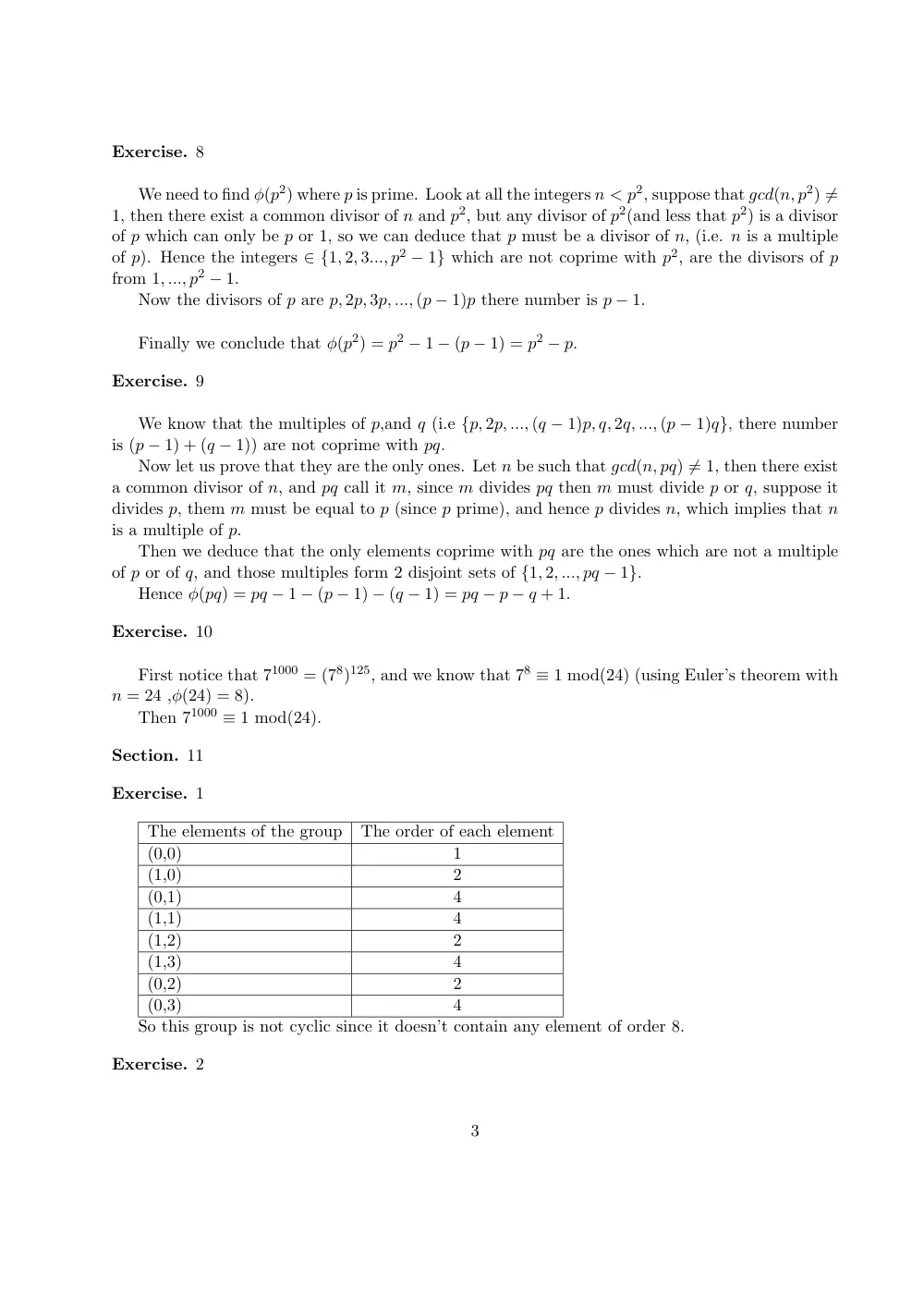
We need to find φ(p2) where p is prime. Look at all the integers n < p2, suppose that gcd(n, p2) ̸=
1, then there exist a common divisor of n and p2, but any divisor of p2(and less that p2) is a divisor
of p which can only be p or 1, so we can deduce that p must be a divisor of n, (i.e. n is a multiple
of p). Hence the integers ∈ {1, 2, 3..., p2 − 1} which are not coprime with p2, are the divisors of p
from 1, ..., p2 − 1.
Now the divisors of p are p, 2p, 3p, ..., (p − 1)p there number is p − 1.
Finally we conclude that φ(p2) = p2 − 1 − (p − 1) = p2 − p.
Exercise. 9
We know that the multiples of p,and q (i.e {p, 2p, ..., (q − 1)p, q, 2q, ..., (p − 1)q}, there number
is (p − 1) + (q − 1)) are not coprime with pq.
Now let us prove that they are the only ones. Let n be such that gcd(n, pq) ̸= 1, then there exist
a common divisor of n, and pq call it m, since m divides pq then m must divide p or q, suppose it
divides p, them m must be equal to p (since p prime), and hence p divides n, which implies that n
is a multiple of p.
Then we deduce that the only elements coprime with pq are the ones which are not a multiple
of p or of q, and those multiples form 2 disjoint sets of {1, 2, ..., pq − 1}.
Hence φ(pq) = pq − 1 − (p − 1) − (q − 1) = pq − p − q + 1.
Exercise. 10
First notice that 71000 = (78)125, and we know that 78 ≡ 1 mod(24) (using Euler’s theorem with
n = 24 ,φ(24) = 8).
Then 71000 ≡ 1 mod(24).
Section. 11
Exercise. 1
The elements of the group
The order of each element
(0,0)
1
(1,0)
2
(0,1)
4
(1,1)
4
(1,2)
2
(1,3)
4
(0,2)
2
(0,3)
4
So this group is not cyclic since it doesn’t contain any element of order 8.
Exercise. 2
3
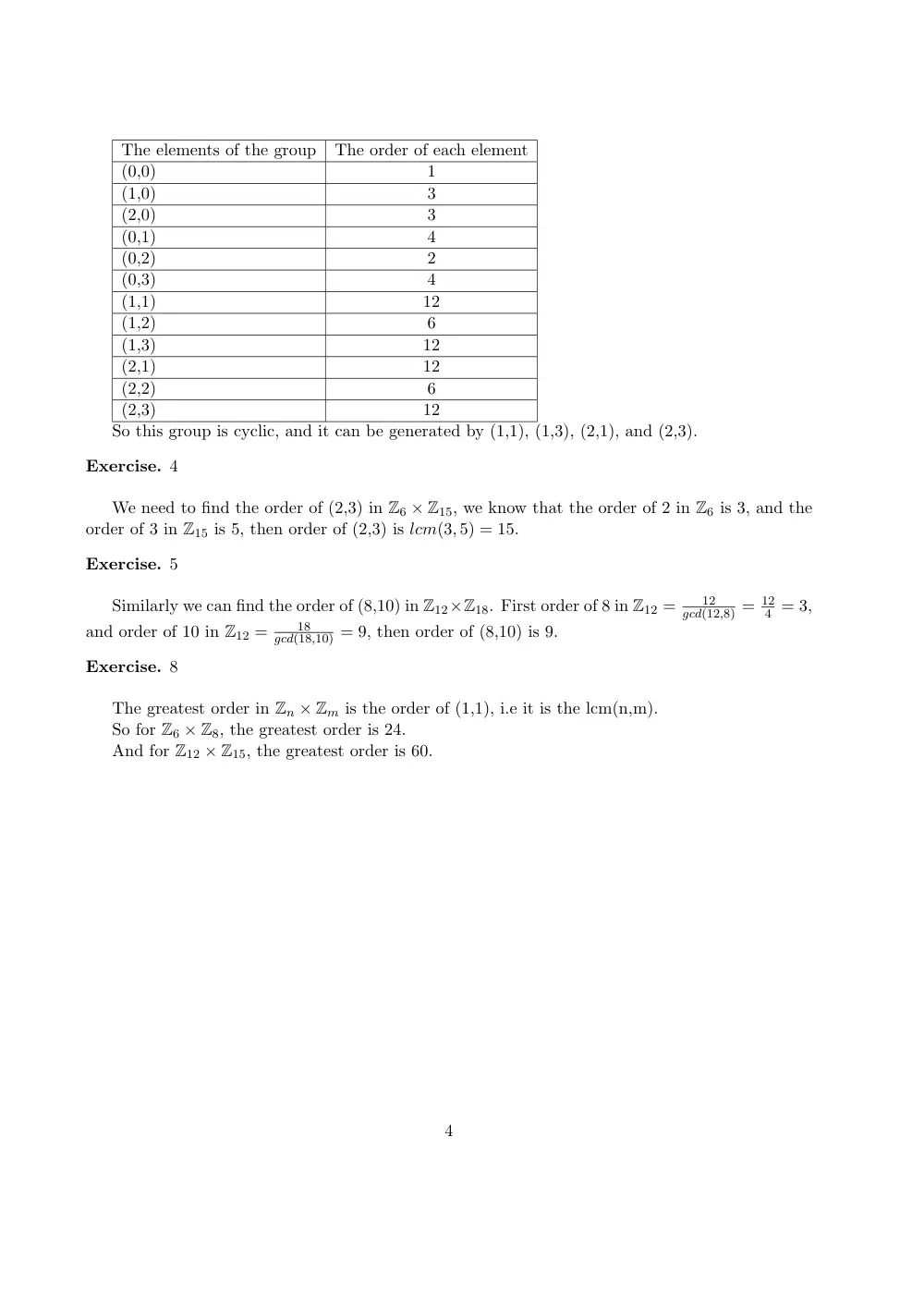
The elements of the group
The order of each element
(0,0)
1
(1,0)
3
(2,0)
3
(0,1)
4
(0,2)
2
(0,3)
4
(1,1)
12
(1,2)
6
(1,3)
12
(2,1)
12
(2,2)
6
(2,3)
12
So this group is cyclic, and it can be generated by (1,1), (1,3), (2,1), and (2,3).
Exercise. 4
We need to find the order of (2,3) in Z6 × Z15, we know that the order of 2 in Z6 is 3, and the
order of 3 in Z15 is 5, then order of (2,3) is lcm(3, 5) = 15.
Exercise. 5
Similarly we can find the order of (8,10) in Z12×Z18. First order of 8 in Z12 =
12
gcd(12,8) = 12
4 = 3,
and order of 10 in Z12 =
18
gcd(18,10) = 9, then order of (8,10) is 9.
Exercise. 8
The greatest order in Zn × Zm is the order of (1,1), i.e it is the lcm(n,m).
So for Z6 × Z8, the greatest order is 24.
And for Z12 × Z15, the greatest order is 60.
4