
MATH 241 Homework 6, Fall 2011
American University of Beirut · Introduction to Abstract Algebra · 6 pages · Prof. Kamal Makdisi

More MATH 241 files
Show the text of this homework
Math 241
Problem Set 6 solution manual
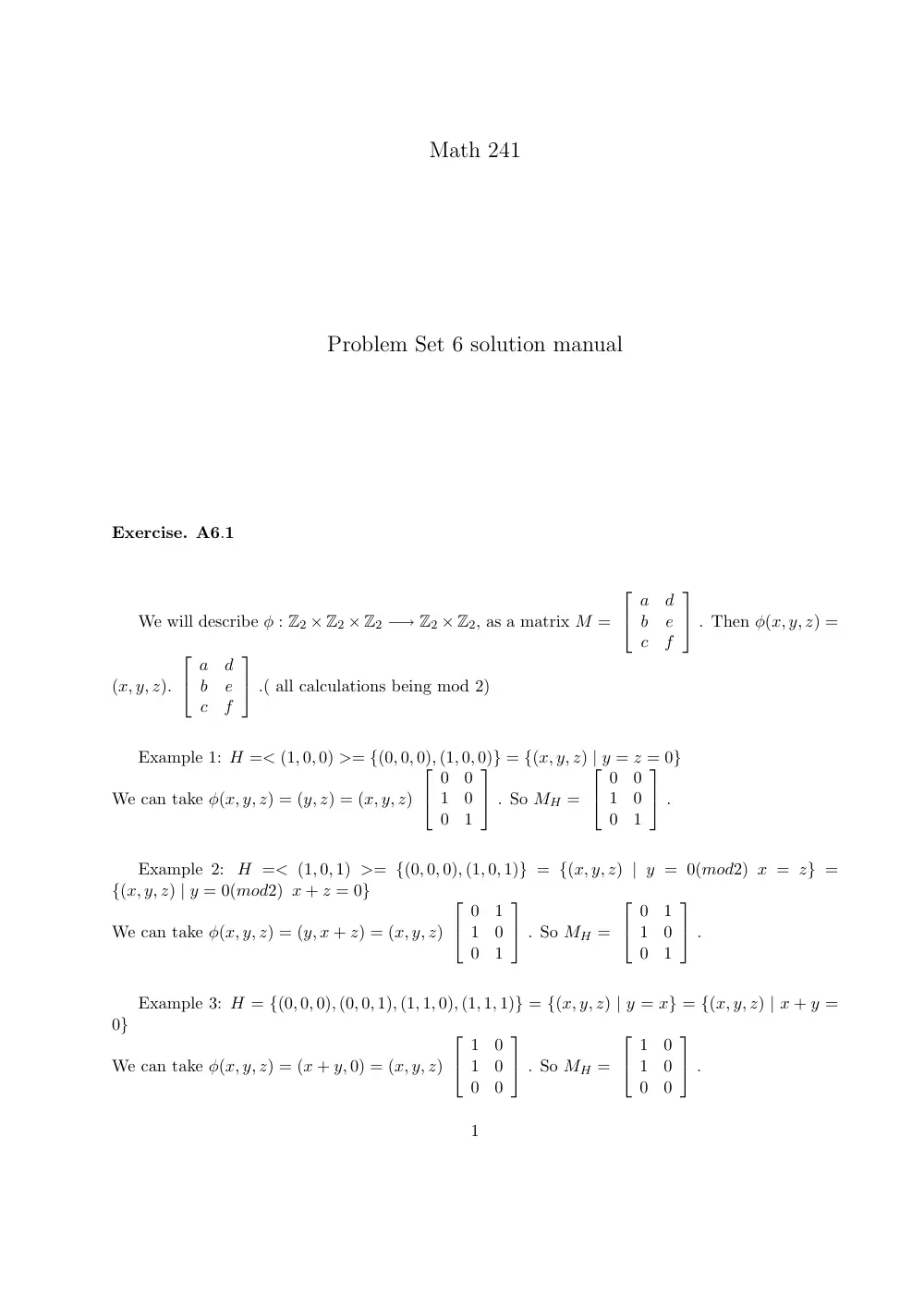
Exercise. A6.1
We will describe φ : Z2 × Z2 × Z2 −→ Z2 × Z2, as a matrix M =
a
d
b
e
c
f
. Then φ(x, y, z) =
(x, y, z).
a
d
b
e
c
f
.( all calculations being mod 2)
Example 1: H =< (1, 0, 0) >= {(0, 0, 0), (1, 0, 0)} = {(x, y, z) | y = z = 0}
We can take φ(x, y, z) = (y, z) = (x, y, z)
0
0
1
0
0
1
. So MH =
0
0
1
0
0
1
.
Example 2: H =< (1, 0, 1) >= {(0, 0, 0), (1, 0, 1)} = {(x, y, z) | y = 0(mod2) x = z} =
{(x, y, z) | y = 0(mod2) x + z = 0}
We can take φ(x, y, z) = (y, x + z) = (x, y, z)
0
1
1
0
0
1
. So MH =
0
1
1
0
0
1
.
Example 3: H = {(0, 0, 0), (0, 0, 1), (1, 1, 0), (1, 1, 1)} = {(x, y, z) | y = x} = {(x, y, z) | x + y =
0}
We can take φ(x, y, z) = (x + y, 0) = (x, y, z)
1
0
1
0
0
0
. So MH =
1
0
1
0
0
0
.
1
H
The matrix MH
< (1, 0, 0) >
0
0
1
1
1
0
< (1, 1, 0) >
1
0
1
0
0
1
< (1, 1, 1) >
1
0
1
1
0
1
< (1, 0, 1) >
1
0
0
1
1
0
< (0, 1, 0) >
1
0
0
0
1
1
< (0, 1, 1) >
0
1
1
0
1
0
< (0, 0, 1) >
1
0
1
1
0
0
{(0, 0, 0), (1, 0, 0), (1, 1, 0), (0, 1, 0)}
0
0
0
0
1
0
{(0, 0, 0), (1, 0, 0), (1, 1, 1), (0, 1, 1)}
0
0
1
0
1
0
{(0, 0, 0), (1, 0, 0), (1, 0, 1), (0, 0, 1)}
0
0
1
0
0
0
{(0, 0, 0), (0, 1, 0), (1, 1, 1), (1, 0, 1)}
1
0
0
0
1
0
{(0, 0, 0), (0, 1, 0), (0, 1, 1), (0, 0, 1)}
1
0
0
0
0
0
{(0, 0, 0), (0, 0, 1), (1, 1, 0), (1, 1, 1)}
1
0
1
0
0
0
{(0, 0, 0), (1, 1, 0), (0, 1, 1), (1, 0, 1)}
1
0
1
0
1
0
2
Section. 11
Exercise. 10
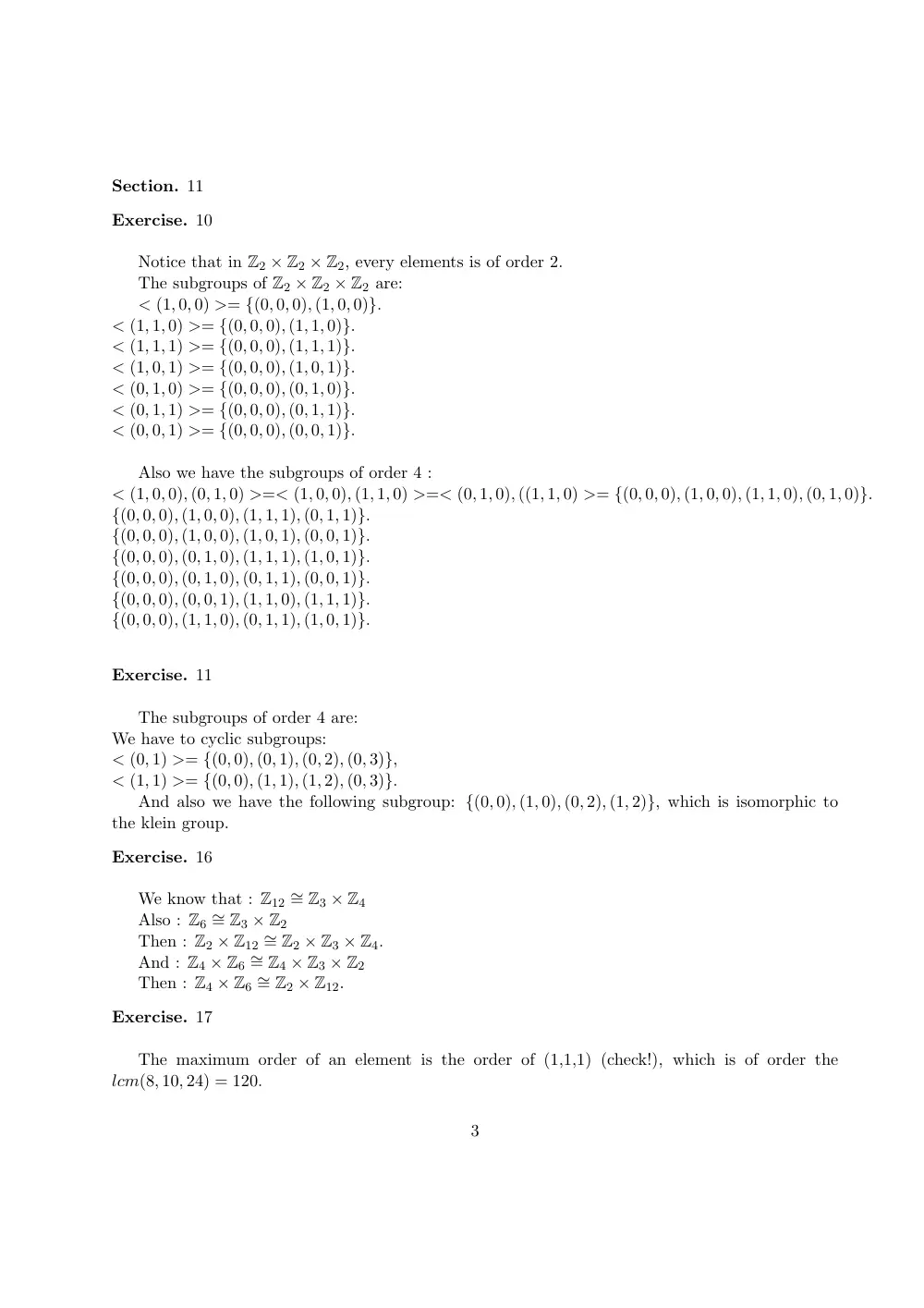
Notice that in Z2 × Z2 × Z2, every elements is of order 2.
The subgroups of Z2 × Z2 × Z2 are:
< (1, 0, 0) >= {(0, 0, 0), (1, 0, 0)}.
< (1, 1, 0) >= {(0, 0, 0), (1, 1, 0)}.
< (1, 1, 1) >= {(0, 0, 0), (1, 1, 1)}.
< (1, 0, 1) >= {(0, 0, 0), (1, 0, 1)}.
< (0, 1, 0) >= {(0, 0, 0), (0, 1, 0)}.
< (0, 1, 1) >= {(0, 0, 0), (0, 1, 1)}.
< (0, 0, 1) >= {(0, 0, 0), (0, 0, 1)}.
Also we have the subgroups of order 4 :
< (1, 0, 0), (0, 1, 0) >=< (1, 0, 0), (1, 1, 0) >=< (0, 1, 0), ((1, 1, 0) >= {(0, 0, 0), (1, 0, 0), (1, 1, 0), (0, 1, 0)}.
{(0, 0, 0), (1, 0, 0), (1, 1, 1), (0, 1, 1)}.
{(0, 0, 0), (1, 0, 0), (1, 0, 1), (0, 0, 1)}.
{(0, 0, 0), (0, 1, 0), (1, 1, 1), (1, 0, 1)}.
{(0, 0, 0), (0, 1, 0), (0, 1, 1), (0, 0, 1)}.
{(0, 0, 0), (0, 0, 1), (1, 1, 0), (1, 1, 1)}.
{(0, 0, 0), (1, 1, 0), (0, 1, 1), (1, 0, 1)}.
Exercise. 11
The subgroups of order 4 are:
We have to cyclic subgroups:
< (0, 1) >= {(0, 0), (0, 1), (0, 2), (0, 3)},
< (1, 1) >= {(0, 0), (1, 1), (1, 2), (0, 3)}.
And also we have the following subgroup: {(0, 0), (1, 0), (0, 2), (1, 2)}, which is isomorphic to
the klein group.
Exercise. 16
We know that : Z12 ∼= Z3 × Z4
Also : Z6 ∼= Z3 × Z2
Then : Z2 × Z12 ∼= Z2 × Z3 × Z4.
And : Z4 × Z6 ∼= Z4 × Z3 × Z2
Then : Z4 × Z6 ∼= Z2 × Z12.
Exercise. 17
The maximum order of an element is the order of (1,1,1) (check!), which is of order the
lcm(8, 10, 24) = 120.
3
Exercise. 18
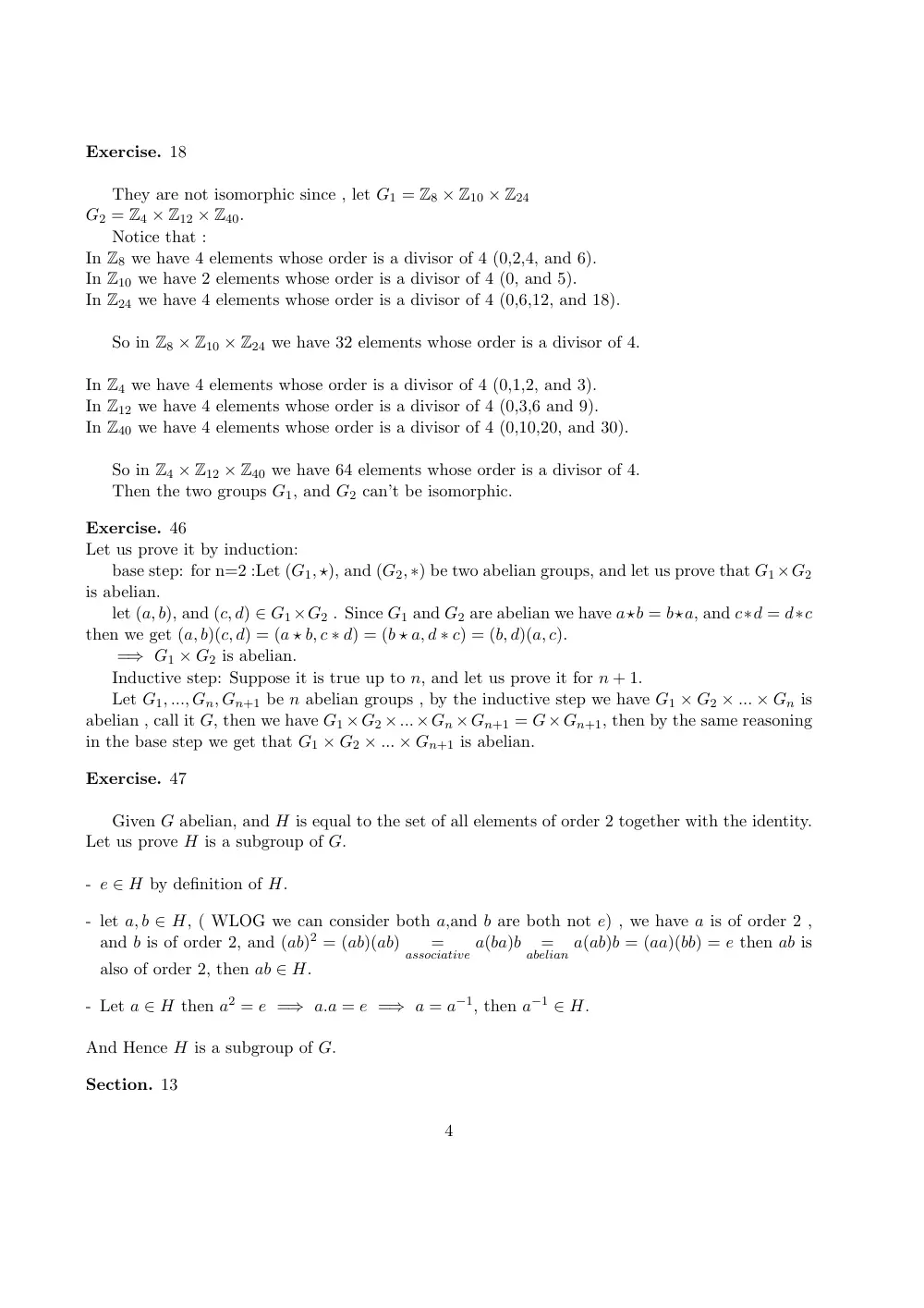
They are not isomorphic since , let G1 = Z8 × Z10 × Z24
G2 = Z4 × Z12 × Z40.
Notice that :
In Z8 we have 4 elements whose order is a divisor of 4 (0,2,4, and 6).
In Z10 we have 2 elements whose order is a divisor of 4 (0, and 5).
In Z24 we have 4 elements whose order is a divisor of 4 (0,6,12, and 18).
So in Z8 × Z10 × Z24 we have 32 elements whose order is a divisor of 4.
In Z4 we have 4 elements whose order is a divisor of 4 (0,1,2, and 3).
In Z12 we have 4 elements whose order is a divisor of 4 (0,3,6 and 9).
In Z40 we have 4 elements whose order is a divisor of 4 (0,10,20, and 30).
So in Z4 × Z12 × Z40 we have 64 elements whose order is a divisor of 4.
Then the two groups G1, and G2 can’t be isomorphic.
Exercise. 46
Let us prove it by induction:
base step: for n=2 :Let (G1, ⋆), and (G2, ∗) be two abelian groups, and let us prove that G1×G2
is abelian.
let (a, b), and (c, d) ∈ G1×G2 . Since G1 and G2 are abelian we have a⋆b = b⋆a, and c∗d = d∗c
then we get (a, b)(c, d) = (a ⋆ b, c ∗ d) = (b ⋆ a, d ∗ c) = (b, d)(a, c).
=⇒ G1 × G2 is abelian.
Inductive step: Suppose it is true up to n, and let us prove it for n + 1.
Let G1, ..., Gn, Gn+1 be n abelian groups , by the inductive step we have G1 × G2 × ... × Gn is
abelian , call it G, then we have G1 ×G2 ×...×Gn ×Gn+1 = G×Gn+1, then by the same reasoning
in the base step we get that G1 × G2 × ... × Gn+1 is abelian.
Exercise. 47
Given G abelian, and H is equal to the set of all elements of order 2 together with the identity.
Let us prove H is a subgroup of G.
- e ∈ H by definition of H.
- let a, b ∈ H, ( WLOG we can consider both a,and b are both not e) , we have a is of order 2 ,
and b is of order 2, and (ab)2 = (ab)(ab)
=
associative a(ba)b
=
abelian a(ab)b = (aa)(bb) = e then ab is
also of order 2, then ab ∈ H.
- Let a ∈ H then a2 = e =⇒ a.a = e =⇒ a = a−1, then a−1 ∈ H.
And Hence H is a subgroup of G.
Section. 13
4
Exercise. 1
φ is a homomorphism, since φ has the property φ(a + b) = a + b = φ(a) + φ(b).
Exercise. 2
φ is not a group homomorphism since φ−1(0) = [0, 1) but [0, 1) is not a subgroup of R under
addition.
Exercise. 3
φ is a homomorphism since φ has the property φ(a.b) = |a.b| = |a|.|b| = φ(a)φ(b).
Exercise. 8
φ is not a group homomorphism, since let G be a non-abelian group , and choose a, b ∈ G such
that a.b ̸= b.a, then φ(a.b) = b−1.a−1, while φ(a)φ(b) = a−1.b−1, now suppose b−1.a−1 = a−1.b−1
this implies that a.b = b.a which is not the case. So φ is not a homomorphism.
Exercise. 18
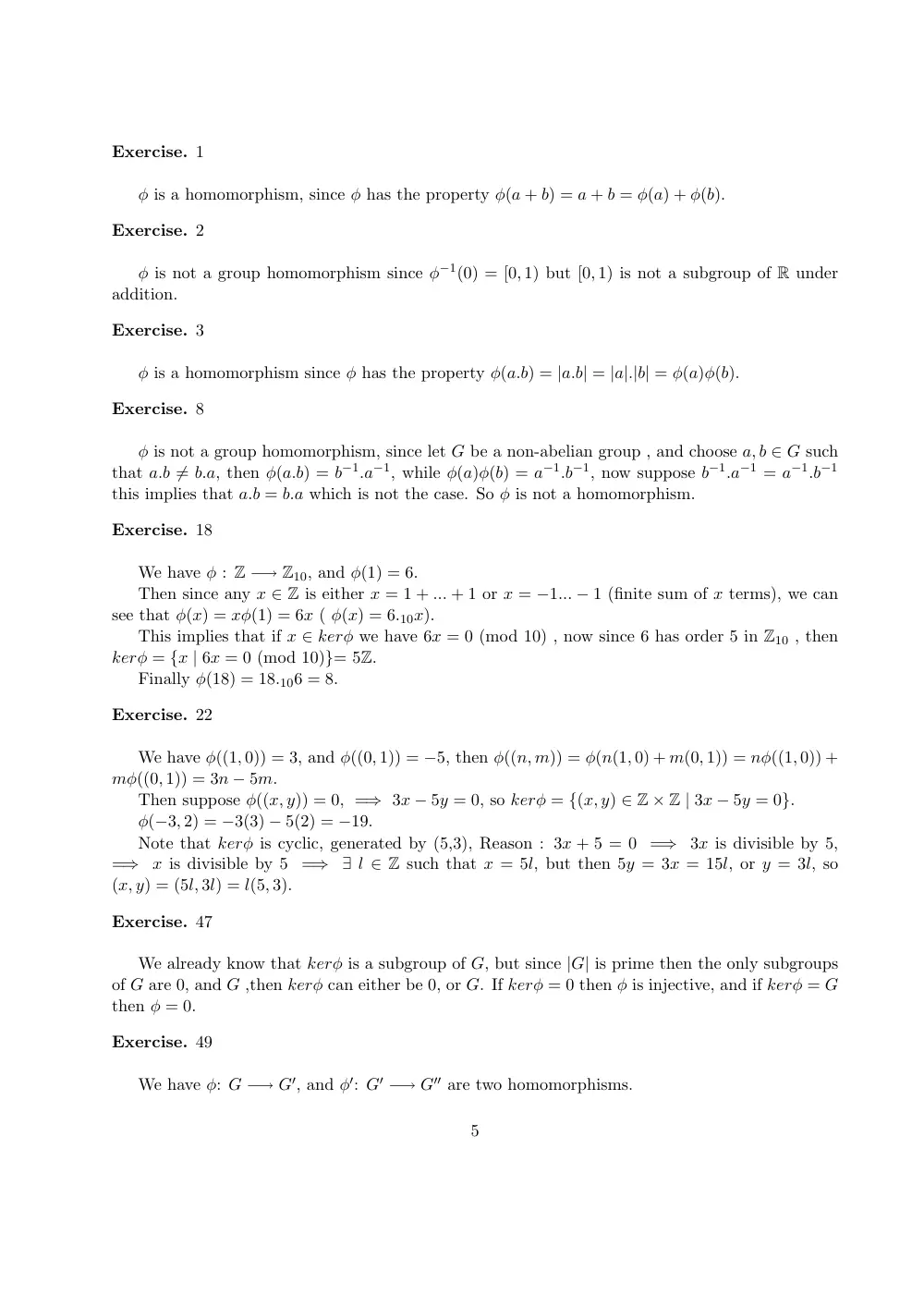
We have φ : Z −→ Z10, and φ(1) = 6.
Then since any x ∈ Z is either x = 1 + ... + 1 or x = −1... − 1 (finite sum of x terms), we can
see that φ(x) = xφ(1) = 6x ( φ(x) = 6.10x).
This implies that if x ∈ kerφ we have 6x = 0 (mod 10) , now since 6 has order 5 in Z10 , then
kerφ = {x | 6x = 0 (mod 10)}= 5Z.
Finally φ(18) = 18.106 = 8.
Exercise. 22
We have φ((1, 0)) = 3, and φ((0, 1)) = −5, then φ((n, m)) = φ(n(1, 0) + m(0, 1)) = nφ((1, 0)) +
mφ((0, 1)) = 3n − 5m.
Then suppose φ((x, y)) = 0, =⇒ 3x − 5y = 0, so kerφ = {(x, y) ∈ Z × Z | 3x − 5y = 0}.
φ(−3, 2) = −3(3) − 5(2) = −19.
Note that kerφ is cyclic, generated by (5,3), Reason : 3x + 5 = 0 =⇒ 3x is divisible by 5,
=⇒ x is divisible by 5 =⇒ ∃ l ∈ Z such that x = 5l, but then 5y = 3x = 15l, or y = 3l, so
(x, y) = (5l, 3l) = l(5, 3).
Exercise. 47
We already know that kerφ is a subgroup of G, but since |G| is prime then the only subgroups
of G are 0, and G ,then kerφ can either be 0, or G. If kerφ = 0 then φ is injective, and if kerφ = G
then φ = 0.
Exercise. 49
We have φ: G −→ G′, and φ′: G′ −→ G′′ are two homomorphisms.
5
It is easy to see that φ′oφ is a well defined mapping from G into G′′, so we only need to check
the following:
Let x, y ∈ G we need to prove that φ′oφ(x.y) = φ′oφ(x).φ′oφ(y).
Start with φ′oφ(x.y) = φ′(φ(x.y)) = φ′(φ(x).φ(y)) = φ′(φ(x)).φ′(φ(y)) = φ′oφ(x).φ′oφ(y)
This implies that the composite of two homomorphisms is a homomorphism.
Exercise. 53
φ is a homomorphism if and only if h ,and k commute (i,e hk=kh).
-Let φ be a homomorphism , then φ((1, 1)) = φ((1, 0))φ((0, 1))h.k, but φ((1, 1)) = φ((0, 1))φ((1, 0)) =
kh. which implies that hk = kh.
-Now suppose we have hk = kh , then we need to prove φ is a homomorphism, then consider
φ((a, b) + (c, d)) = φ((a + c, b + d)) = ha+ckb+d = hahckbkd = hakbhckd = φ((a, b))φ((c, d)). Notice
that here we used the fact that hc.kb = kb.hc because h, and k commute, which can be proved by
induction on b and c.
Then φ is a homomorphism.
6