
MATH 241 Homework 8, Fall 2011
American University of Beirut · Introduction to Abstract Algebra · 5 pages · Prof. Kamal Makdisi
More MATH 241 files
Show the text of this homework
Math 241
Problem Set 8 solution manual
Exercise. A8.1
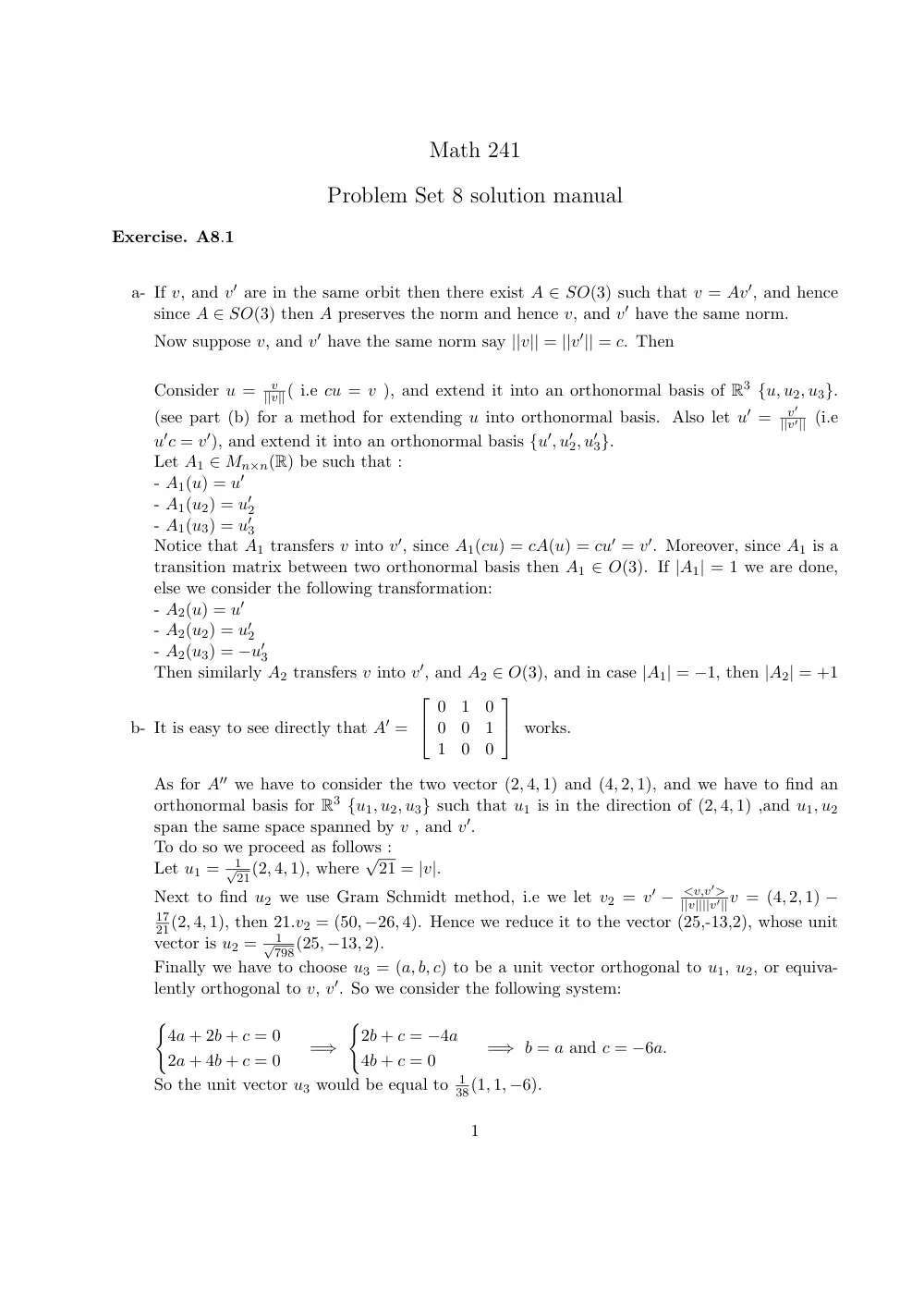
a- If v, and v′ are in the same orbit then there exist A ∈ SO(3) such that v = Av′, and hence
since A ∈ SO(3) then A preserves the norm and hence v, and v′ have the same norm.
Now suppose v, and v′ have the same norm say ||v|| = ||v′|| = c. Then
Consider u =
v
||v||( i.e cu = v ), and extend it into an orthonormal basis of R3 {u, u2, u3}.
(see part (b) for a method for extending u into orthonormal basis. Also let u′ =
v′
||v′|| (i.e
u′c = v′), and extend it into an orthonormal basis {u′, u′
2, u′
3}.
Let A1 ∈ Mn×n(R) be such that :
- A1(u) = u′
- A1(u2) = u′
2
- A1(u3) = u′
3
Notice that A1 transfers v into v′, since A1(cu) = cA(u) = cu′ = v′. Moreover, since A1 is a
transition matrix between two orthonormal basis then A1 ∈ O(3). If |A1| = 1 we are done,
else we consider the following transformation:
- A2(u) = u′
- A2(u2) = u′
2
- A2(u3) = −u′
3
Then similarly A2 transfers v into v′, and A2 ∈ O(3), and in case |A1| = −1, then |A2| = +1
b- It is easy to see directly that A′ =
0
1
0
0
0
1
1
0
0
works.
As for A′′ we have to consider the two vector (2, 4, 1) and (4, 2, 1), and we have to find an
orthonormal basis for R3 {u1, u2, u3} such that u1 is in the direction of (2, 4, 1) ,and u1, u2
span the same space spanned by v , and v′.
To do so we proceed as follows :
Let u1 =
1
√
21(2, 4, 1), where
√
21 = |v|.
Next to find u2 we use Gram Schmidt method, i.e we let v2 = v′ − <v,v′>
||v||||v′||v = (4, 2, 1) −
17
21(2, 4, 1), then 21.v2 = (50, −26, 4). Hence we reduce it to the vector (25,-13,2), whose unit
vector is u2 =
1
√
798(25, −13, 2).
Finally we have to choose u3 = (a, b, c) to be a unit vector orthogonal to u1, u2, or equiva-
lently orthogonal to v, v′. So we consider the following system:
�
4a + 2b + c = 0
2a + 4b + c = 0
=⇒
�
2b + c = −4a
4b + c = 0
=⇒ b = a and c = −6a.
So the unit vector u3 would be equal to
1
38(1, 1, −6).
1
Hence we have our orthonormal basis {u1, u2, u3}
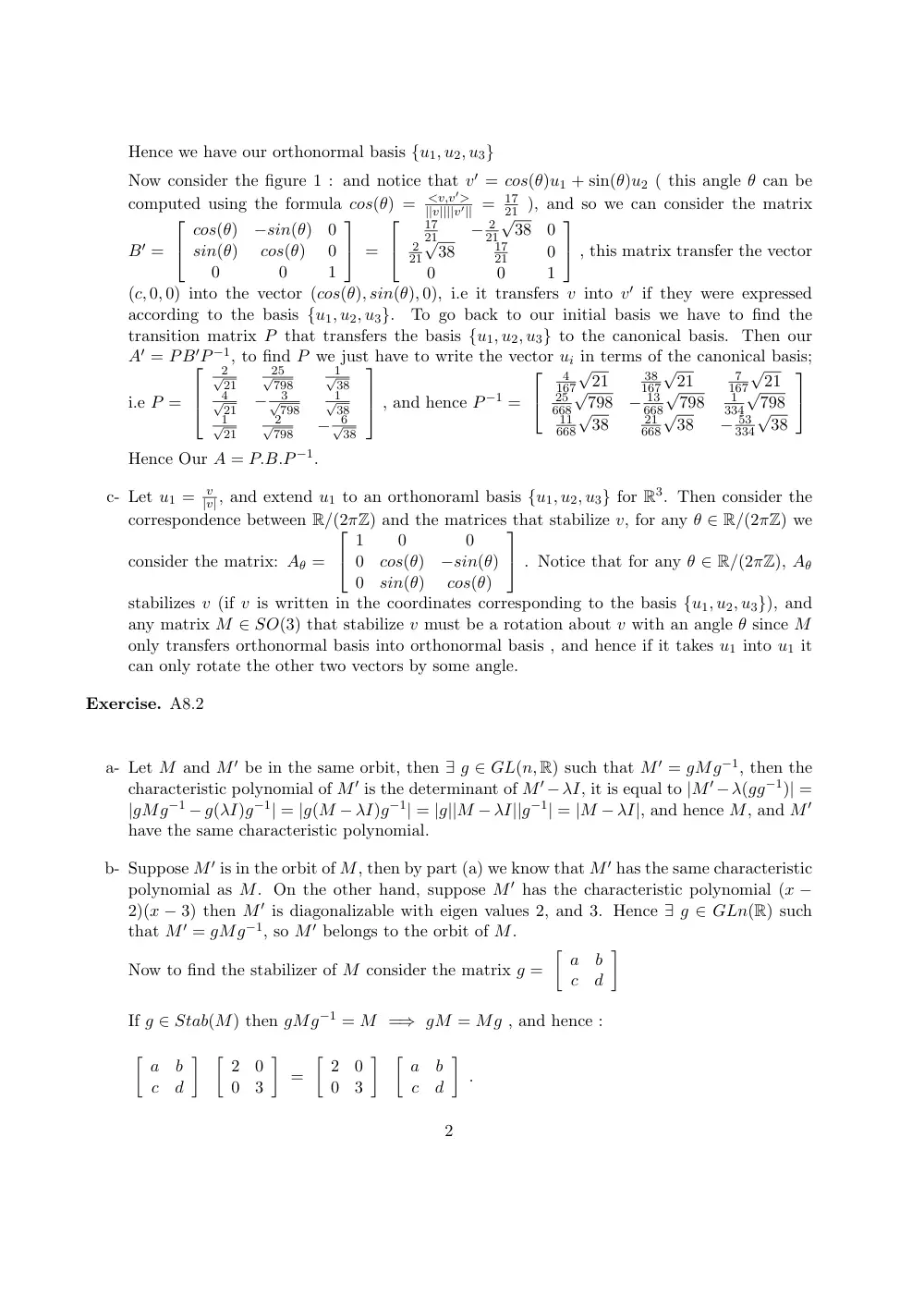
Now consider the figure 1 : and notice that v′ = cos(θ)u1 + sin(θ)u2 ( this angle θ can be
computed using the formula cos(θ) =
<v,v′>
||v||||v′|| = 17
21 ), and so we can consider the matrix
B′ =
cos(θ)
−sin(θ)
0
sin(θ)
cos(θ)
0
0
0
1
=
17
21
− 2
21
√
38
0
2
21
√
38
17
21
0
0
0
1
, this matrix transfer the vector
(c, 0, 0) into the vector (cos(θ), sin(θ), 0), i.e it transfers v into v′ if they were expressed
according to the basis {u1, u2, u3}.
To go back to our initial basis we have to find the
transition matrix P that transfers the basis {u1, u2, u3} to the canonical basis. Then our
A′ = PB′P −1, to find P we just have to write the vector ui in terms of the canonical basis;
i.e P =
2
√
21
25
√
798
1
√
38
4
√
21
−
3
√
798
1
√
38
1
√
21
2
√
798
−
6
√
38
, and hence P −1 =
4
167
√
21
38
167
√
21
7
167
√
21
25
668
√
798
− 13
668
√
798
1
334
√
798
11
668
√
38
21
668
√
38
− 53
334
√
38
Hence Our A = P.B.P −1.
c- Let u1 =
v
|v|, and extend u1 to an orthonoraml basis {u1, u2, u3} for R3. Then consider the
correspondence between R/(2πZ) and the matrices that stabilize v, for any θ ∈ R/(2πZ) we
consider the matrix: Aθ =
1
0
0
0
cos(θ)
−sin(θ)
0
sin(θ)
cos(θ)
. Notice that for any θ ∈ R/(2πZ), Aθ
stabilizes v (if v is written in the coordinates corresponding to the basis {u1, u2, u3}), and
any matrix M ∈ SO(3) that stabilize v must be a rotation about v with an angle θ since M
only transfers orthonormal basis into orthonormal basis , and hence if it takes u1 into u1 it
can only rotate the other two vectors by some angle.
Exercise. A8.2
a- Let M and M′ be in the same orbit, then ∃ g ∈ GL(n, R) such that M′ = gMg−1, then the
characteristic polynomial of M′ is the determinant of M′ −λI, it is equal to |M′ −λ(gg−1)| =
|gMg−1 − g(λI)g−1| = |g(M − λI)g−1| = |g||M − λI||g−1| = |M − λI|, and hence M, and M′
have the same characteristic polynomial.
b- Suppose M′ is in the orbit of M, then by part (a) we know that M′ has the same characteristic
polynomial as M. On the other hand, suppose M′ has the characteristic polynomial (x −
2)(x − 3) then M′ is diagonalizable with eigen values 2, and 3. Hence ∃ g ∈ GLn(R) such
that M′ = gMg−1, so M′ belongs to the orbit of M.
Now to find the stabilizer of M consider the matrix g =
� a
b
c
d
�
If g ∈ Stab(M) then gMg−1 = M =⇒ gM = Mg , and hence :
� a
b
c
d
�
� 2
0
0
3
�
=
� 2
0
0
3
�
� a
b
c
d
�
.
2
=⇒
� 2a
2b
3c
3d
�
=
� 2a
3b
2c
3d
�
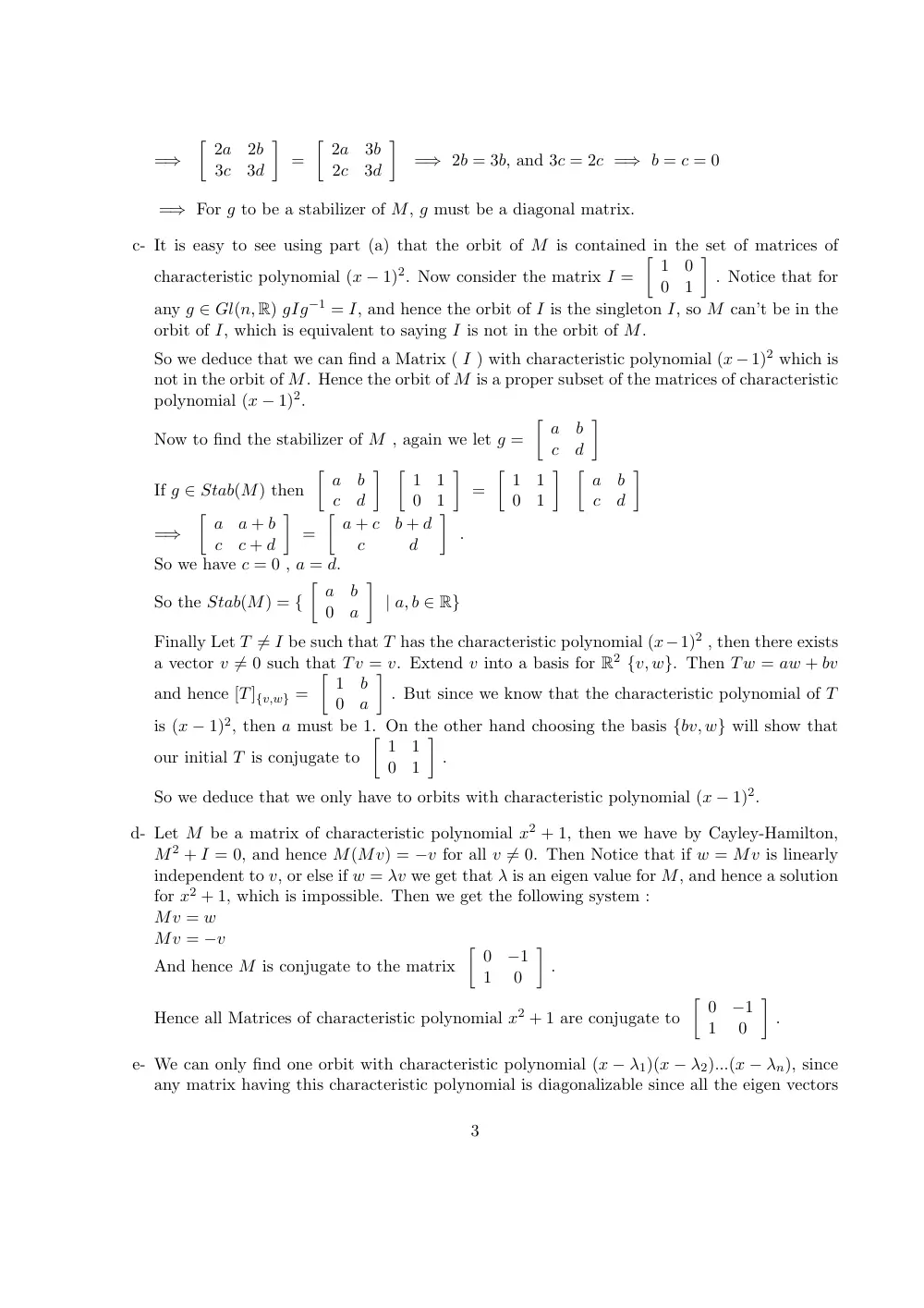
=⇒ 2b = 3b, and 3c = 2c =⇒ b = c = 0
=⇒ For g to be a stabilizer of M, g must be a diagonal matrix.
c- It is easy to see using part (a) that the orbit of M is contained in the set of matrices of
characteristic polynomial (x − 1)2. Now consider the matrix I =
� 1
0
0
1
�
. Notice that for
any g ∈ Gl(n, R) gIg−1 = I, and hence the orbit of I is the singleton I, so M can’t be in the
orbit of I, which is equivalent to saying I is not in the orbit of M.
So we deduce that we can find a Matrix ( I ) with characteristic polynomial (x − 1)2 which is
not in the orbit of M. Hence the orbit of M is a proper subset of the matrices of characteristic
polynomial (x − 1)2.
Now to find the stabilizer of M , again we let g =
� a
b
c
d
�
If g ∈ Stab(M) then
� a
b
c
d
�
� 1
1
0
1
�
=
� 1
1
0
1
�
� a
b
c
d
�
=⇒
� a
a + b
c
c + d
�
=
� a + c
b + d
c
d
�
.
So we have c = 0 , a = d.
So the Stab(M) = {
� a
b
0
a
�
| a, b ∈ R}
Finally Let T ̸= I be such that T has the characteristic polynomial (x−1)2 , then there exists
a vector v ̸= 0 such that Tv = v. Extend v into a basis for R2 {v, w}. Then Tw = aw + bv
and hence [T]{v,w} =
� 1
b
0
a
�
. But since we know that the characteristic polynomial of T
is (x − 1)2, then a must be 1. On the other hand choosing the basis {bv, w} will show that
our initial T is conjugate to
� 1
1
0
1
�
.
So we deduce that we only have to orbits with characteristic polynomial (x − 1)2.
d- Let M be a matrix of characteristic polynomial x2 + 1, then we have by Cayley-Hamilton,
M2 + I = 0, and hence M(Mv) = −v for all v ̸= 0. Then Notice that if w = Mv is linearly
independent to v, or else if w = λv we get that λ is an eigen value for M, and hence a solution
for x2 + 1, which is impossible. Then we get the following system :
Mv = w
Mv = −v
And hence M is conjugate to the matrix
� 0
−1
1
0
�
.
Hence all Matrices of characteristic polynomial x2 + 1 are conjugate to
� 0
−1
1
0
�
.
e- We can only find one orbit with characteristic polynomial (x − λ1)(x − λ2)...(x − λn), since
any matrix having this characteristic polynomial is diagonalizable since all the eigen vectors
3
are distinct, and hence it should be conjugate to the matrix
λ1
0
. . .
0
0
λ2
. . .
0
:
0
...
0
0
. . .
0
λn
.
f-
Lemma 1. Rank(PAQ)=Rank(A) for P, and Q invertible.
proof. Let us show that Rank(AQ)=Rank(A). By definition we know that the rank of AQ is
the dimension of its image, and hence since Q is invertible we can easily see that the image of
AQ is of the same dimension as the image of A. On the other hand, by rank nullity theorem,
since Ker(PA) = Ker(A) we get that Rank(PA)=Rank(A), combine the two results to get
the lemma. (Note that you when you apply Rank(PA)=Rank(A), your A represents AQ)
Now back to the problem:
By above lemma we know that any two conjugate matrices have the same rank, so we only
need to see why the third and the fourth matrix are not conjugate. Notice that if two matrices
are conjugate then their squares are too, and hence if since the square of the third matrix is
zero while the square of the fourth matrix is of rank one we get our result.
Section. 16
Exercise. 2
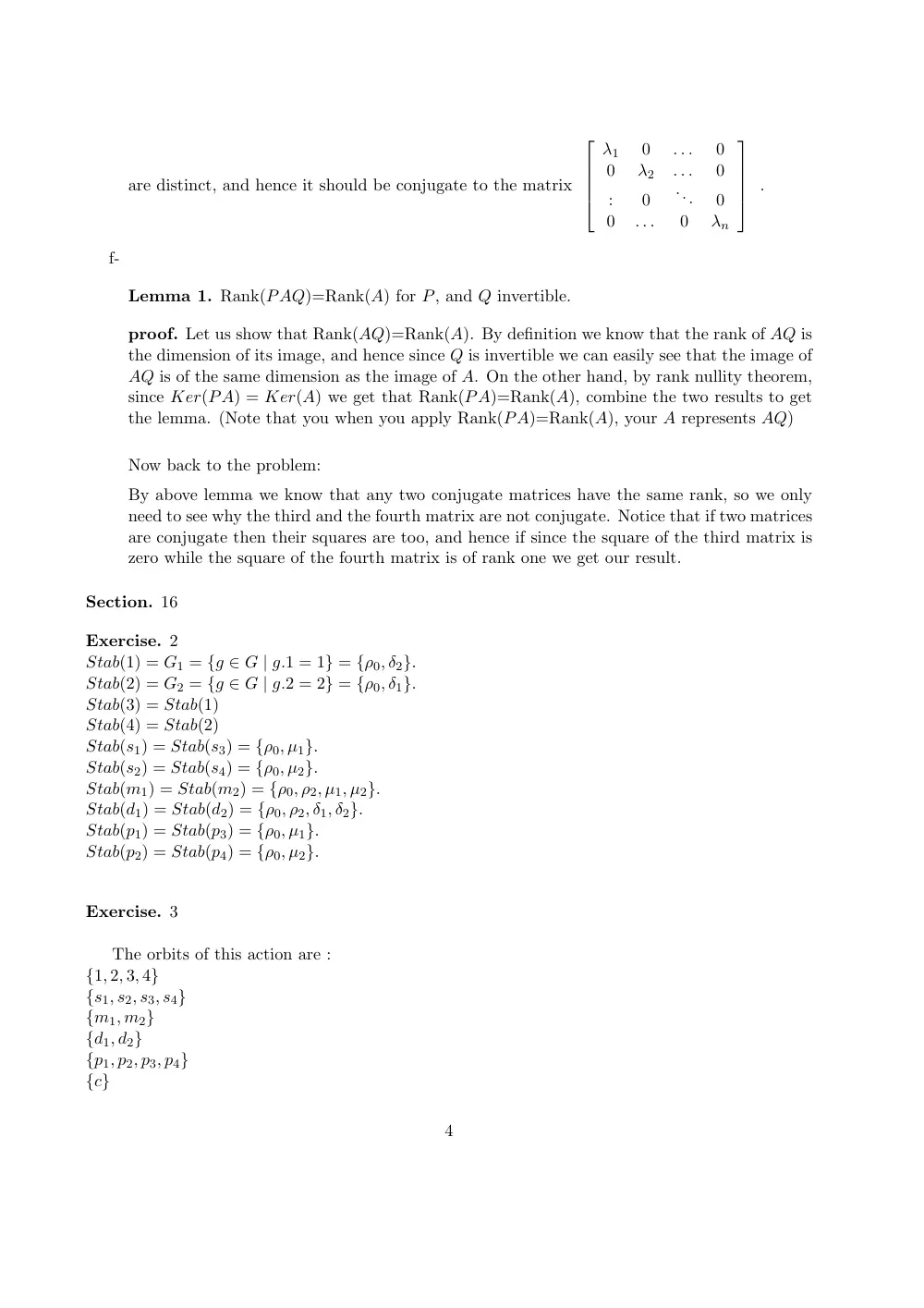
Stab(1) = G1 = {g ∈ G | g.1 = 1} = {ρ0, δ2}.
Stab(2) = G2 = {g ∈ G | g.2 = 2} = {ρ0, δ1}.
Stab(3) = Stab(1)
Stab(4) = Stab(2)
Stab(s1) = Stab(s3) = {ρ0, µ1}.
Stab(s2) = Stab(s4) = {ρ0, µ2}.
Stab(m1) = Stab(m2) = {ρ0, ρ2, µ1, µ2}.
Stab(d1) = Stab(d2) = {ρ0, ρ2, δ1, δ2}.
Stab(p1) = Stab(p3) = {ρ0, µ1}.
Stab(p2) = Stab(p4) = {ρ0, µ2}.
Exercise. 3
The orbits of this action are :
{1, 2, 3, 4}
{s1, s2, s3, s4}
{m1, m2}
{d1, d2}
{p1, p2, p3, p4}
{c}
4
Exercise. 5
A group G is said to be transitive if it has only one orbit, i,e for all x, y ∈ G, there exists a
g ∈ G such that x = g.y.
Exercise. 6
A sub-G-set is a set that contains all the orbits of its elements, i.e A is a sun-G-set if for all
x ∈ A , O(x) ∈ A. In this case A must be a union of some orbits of G.
Exercise. 9
a- Let U = {s1, s2, s3, s4}, and V = {p1, p2, p3, p4}.
Define f : U −→ V to be such that f(si) = pi.
It is clear that f is a bijection. And since the elements of D4 acts on {s1, s2, s3, s4} the same
way it acts on {p1, p2, p3, p4} f is an isomorphism
b- Suppose we have an isomorphism g between {1, 2, 3, 4} and {s1, s2, s3, s4}, then g(1) = si for
some 0 ≤ i ≤ 4, but δ2.g(1) ̸= si and g(δ2.1) = g(1) = si. Hence {1, 2, 3, 4} is not isomorphic
to {s1, s2, s3, s4}.
c- By the same argument of part (b) we can see that the only two Gsets that are isomorphic
are {s1, s2, s3, s4}, {p1, p2, p3, p4}.
Exercise. 13
a- It is easy to see that when g ∈ R acts on an element x ∈ R2 it gives another image in R2 by
the definition of rotation. ( if x = r(cos(θ), sin(θ)) the g.x = r(cos(θ + g), sin(θ + g)) ∈ R2 ).
b- The orbit of p is the circle passing throught p of center (0,0).
c- Stab(g) = Gp = {g ∈ R | g.p = p} = {g ∈ R | (cos(θ + g) = cos(θ) and sin(θ + g)sin(θ)} =
{g = 2kπ | k ∈ Z}.
5