
MATH 241 Homework 9, Fall 2011
American University of Beirut · Introduction to Abstract Algebra · 5 pages · Prof. Kamal Makdisi
More MATH 241 files
Show the text of this homework
Math 241
Problem Set 9 solution manual
Exercise. A9.1
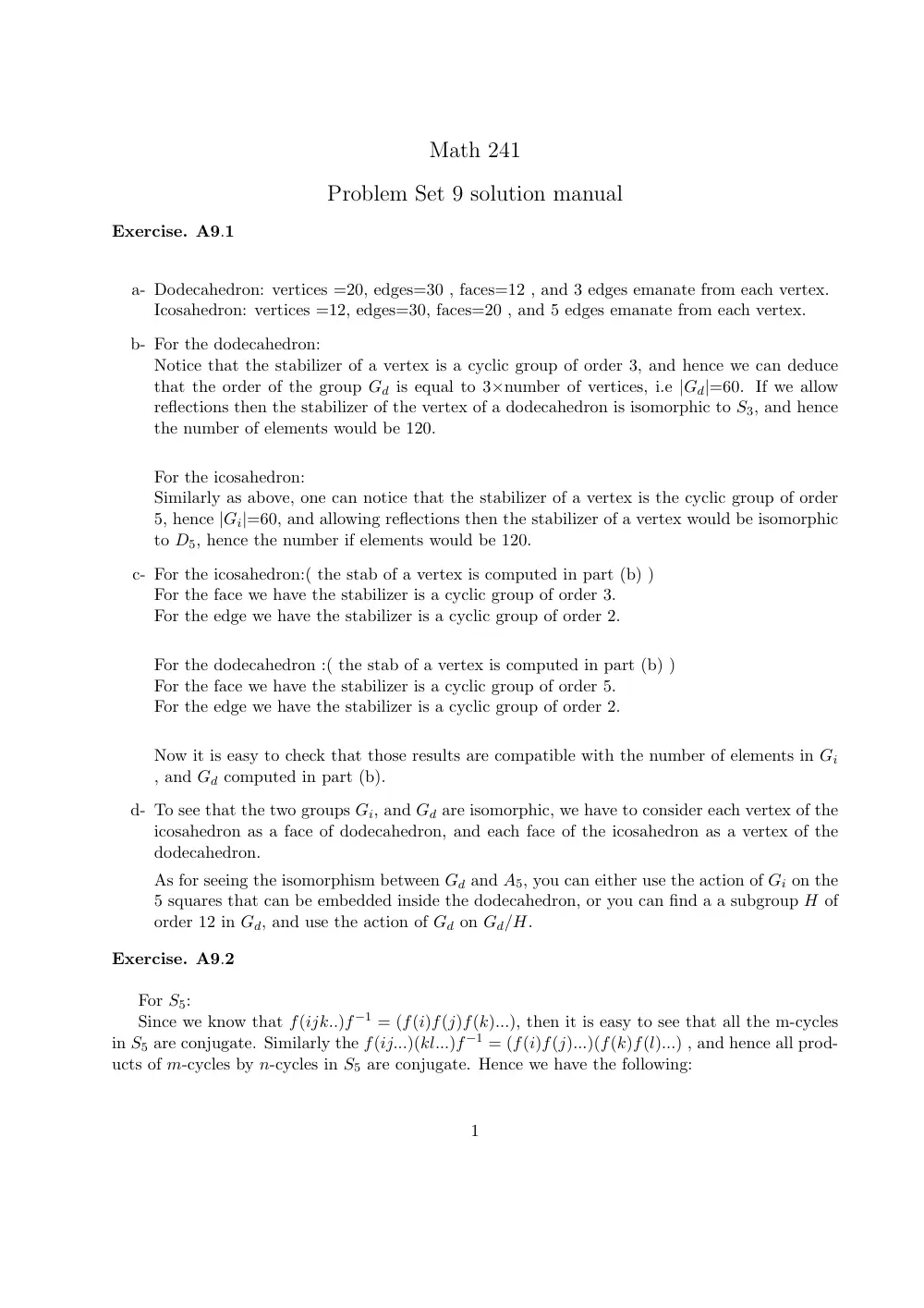
a- Dodecahedron: vertices =20, edges=30 , faces=12 , and 3 edges emanate from each vertex.
Icosahedron: vertices =12, edges=30, faces=20 , and 5 edges emanate from each vertex.
b- For the dodecahedron:
Notice that the stabilizer of a vertex is a cyclic group of order 3, and hence we can deduce
that the order of the group Gd is equal to 3×number of vertices, i.e |Gd|=60. If we allow
reflections then the stabilizer of the vertex of a dodecahedron is isomorphic to S3, and hence
the number of elements would be 120.
For the icosahedron:
Similarly as above, one can notice that the stabilizer of a vertex is the cyclic group of order
5, hence |Gi|=60, and allowing reflections then the stabilizer of a vertex would be isomorphic
to D5, hence the number if elements would be 120.
c- For the icosahedron:( the stab of a vertex is computed in part (b) )
For the face we have the stabilizer is a cyclic group of order 3.
For the edge we have the stabilizer is a cyclic group of order 2.
For the dodecahedron :( the stab of a vertex is computed in part (b) )
For the face we have the stabilizer is a cyclic group of order 5.
For the edge we have the stabilizer is a cyclic group of order 2.
Now it is easy to check that those results are compatible with the number of elements in Gi
, and Gd computed in part (b).
d- To see that the two groups Gi, and Gd are isomorphic, we have to consider each vertex of the
icosahedron as a face of dodecahedron, and each face of the icosahedron as a vertex of the
dodecahedron.
As for seeing the isomorphism between Gd and A5, you can either use the action of Gi on the
5 squares that can be embedded inside the dodecahedron, or you can find a a subgroup H of
order 12 in Gd, and use the action of Gd on Gd/H.
Exercise. A9.2
For S5:
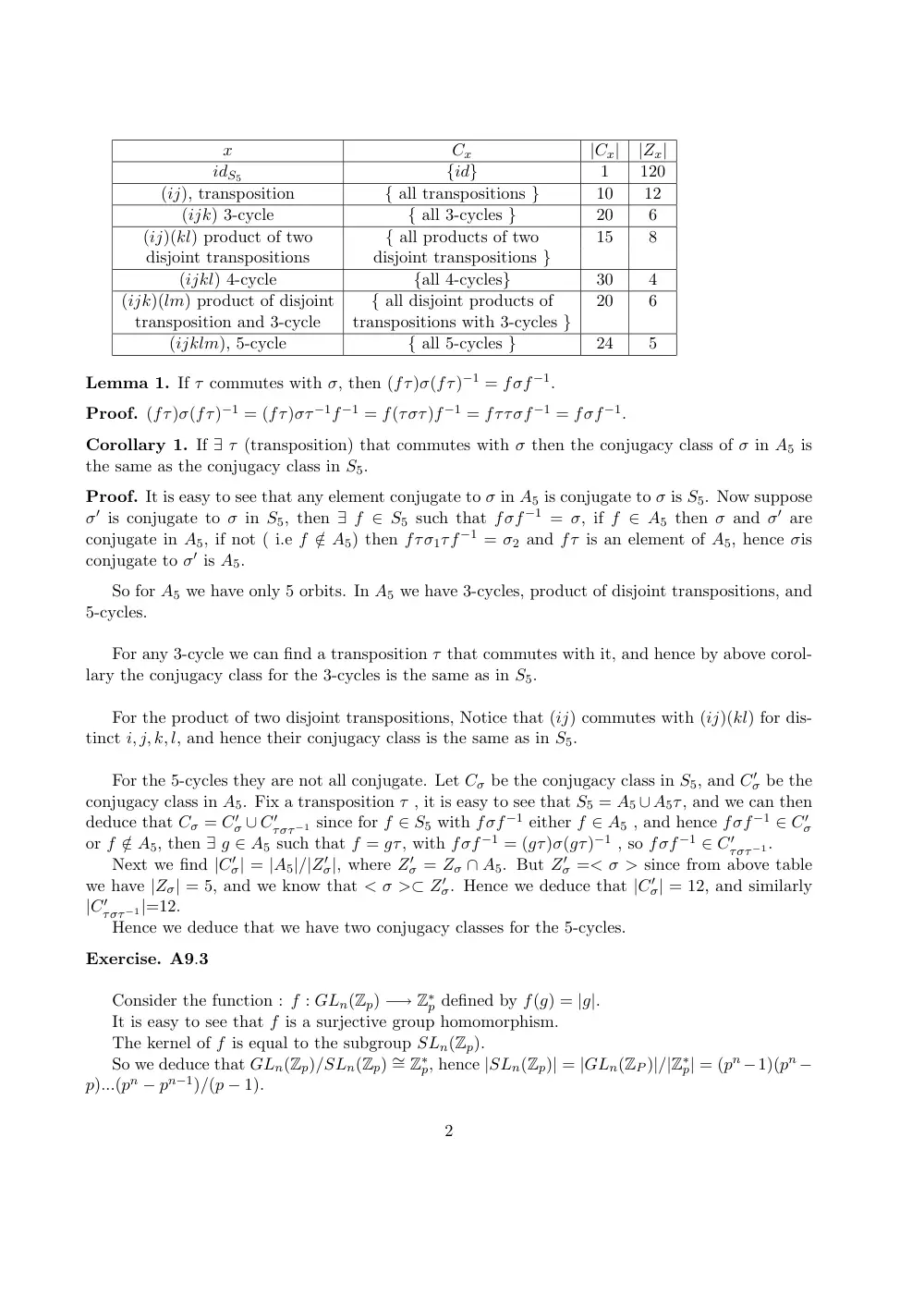
Since we know that f(ijk..)f−1 = (f(i)f(j)f(k)...), then it is easy to see that all the m-cycles
in S5 are conjugate. Similarly the f(ij...)(kl...)f−1 = (f(i)f(j)...)(f(k)f(l)...) , and hence all prod-
ucts of m-cycles by n-cycles in S5 are conjugate. Hence we have the following:
1
x
Cx
|Cx|
|Zx|
idS5
{id}
1
120
(ij), transposition
{ all transpositions }
10
12
(ijk) 3-cycle
{ all 3-cycles }
20
6
(ij)(kl) product of two
{ all products of two
15
8
disjoint transpositions
disjoint transpositions }
(ijkl) 4-cycle
{all 4-cycles}
30
4
(ijk)(lm) product of disjoint
{ all disjoint products of
20
6
transposition and 3-cycle
transpositions with 3-cycles }
(ijklm), 5-cycle
{ all 5-cycles }
24
5
Lemma 1. If τ commutes with σ, then (fτ)σ(fτ)−1 = fσf−1.
Proof. (fτ)σ(fτ)−1 = (fτ)στ −1f−1 = f(τστ)f−1 = fττσf−1 = fσf−1.
Corollary 1. If ∃ τ (transposition) that commutes with σ then the conjugacy class of σ in A5 is
the same as the conjugacy class in S5.
Proof. It is easy to see that any element conjugate to σ in A5 is conjugate to σ is S5. Now suppose
σ′ is conjugate to σ in S5, then ∃ f ∈ S5 such that fσf−1 = σ, if f ∈ A5 then σ and σ′ are
conjugate in A5, if not ( i.e f /∈ A5) then fτσ1τf−1 = σ2 and fτ is an element of A5, hence σis
conjugate to σ′ is A5.
So for A5 we have only 5 orbits. In A5 we have 3-cycles, product of disjoint transpositions, and
5-cycles.
For any 3-cycle we can find a transposition τ that commutes with it, and hence by above corol-
lary the conjugacy class for the 3-cycles is the same as in S5.
For the product of two disjoint transpositions, Notice that (ij) commutes with (ij)(kl) for dis-
tinct i, j, k, l, and hence their conjugacy class is the same as in S5.
For the 5-cycles they are not all conjugate. Let Cσ be the conjugacy class in S5, and C′
σ be the
conjugacy class in A5. Fix a transposition τ , it is easy to see that S5 = A5 ∪ A5τ, and we can then
deduce that Cσ = C′
σ ∪ C′
τστ −1 since for f ∈ S5 with fσf−1 either f ∈ A5 , and hence fσf−1 ∈ C′
σ
or f /∈ A5, then ∃ g ∈ A5 such that f = gτ, with fσf−1 = (gτ)σ(gτ)−1 , so fσf−1 ∈ C′
τστ −1.
Next we find |C′
σ| = |A5|/|Z′
σ|, where Z′
σ = Zσ ∩ A5. But Z′
σ =< σ > since from above table
we have |Zσ| = 5, and we know that < σ >⊂ Z′
σ. Hence we deduce that |C′
σ| = 12, and similarly
|C′
τστ −1|=12.
Hence we deduce that we have two conjugacy classes for the 5-cycles.
Exercise. A9.3
Consider the function : f : GLn(Zp) −→ Z∗
p defined by f(g) = |g|.
It is easy to see that f is a surjective group homomorphism.
The kernel of f is equal to the subgroup SLn(Zp).
So we deduce that GLn(Zp)/SLn(Zp) ∼= Z∗
p, hence |SLn(Zp)| = |GLn(ZP )|/|Z∗
p| = (pn −1)(pn −
p)...(pn − pn−1)/(p − 1).
2
Exercise. A9.4
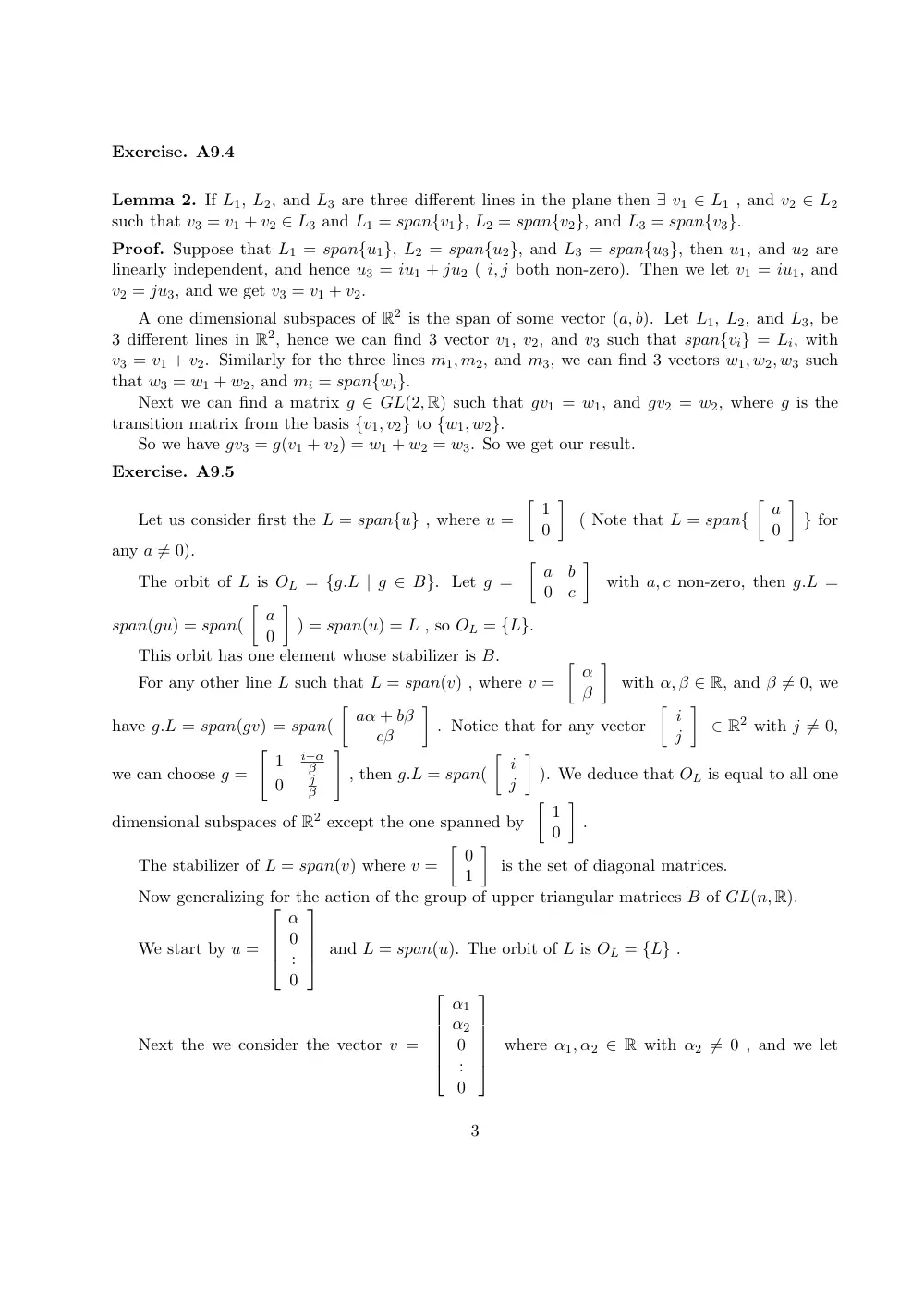
Lemma 2. If L1, L2, and L3 are three different lines in the plane then ∃ v1 ∈ L1 , and v2 ∈ L2
such that v3 = v1 + v2 ∈ L3 and L1 = span{v1}, L2 = span{v2}, and L3 = span{v3}.
Proof. Suppose that L1 = span{u1}, L2 = span{u2}, and L3 = span{u3}, then u1, and u2 are
linearly independent, and hence u3 = iu1 + ju2 ( i, j both non-zero). Then we let v1 = iu1, and
v2 = ju3, and we get v3 = v1 + v2.
A one dimensional subspaces of R2 is the span of some vector (a, b). Let L1, L2, and L3, be
3 different lines in R2, hence we can find 3 vector v1, v2, and v3 such that span{vi} = Li, with
v3 = v1 + v2. Similarly for the three lines m1, m2, and m3, we can find 3 vectors w1, w2, w3 such
that w3 = w1 + w2, and mi = span{wi}.
Next we can find a matrix g ∈ GL(2, R) such that gv1 = w1, and gv2 = w2, where g is the
transition matrix from the basis {v1, v2} to {w1, w2}.
So we have gv3 = g(v1 + v2) = w1 + w2 = w3. So we get our result.
Exercise. A9.5
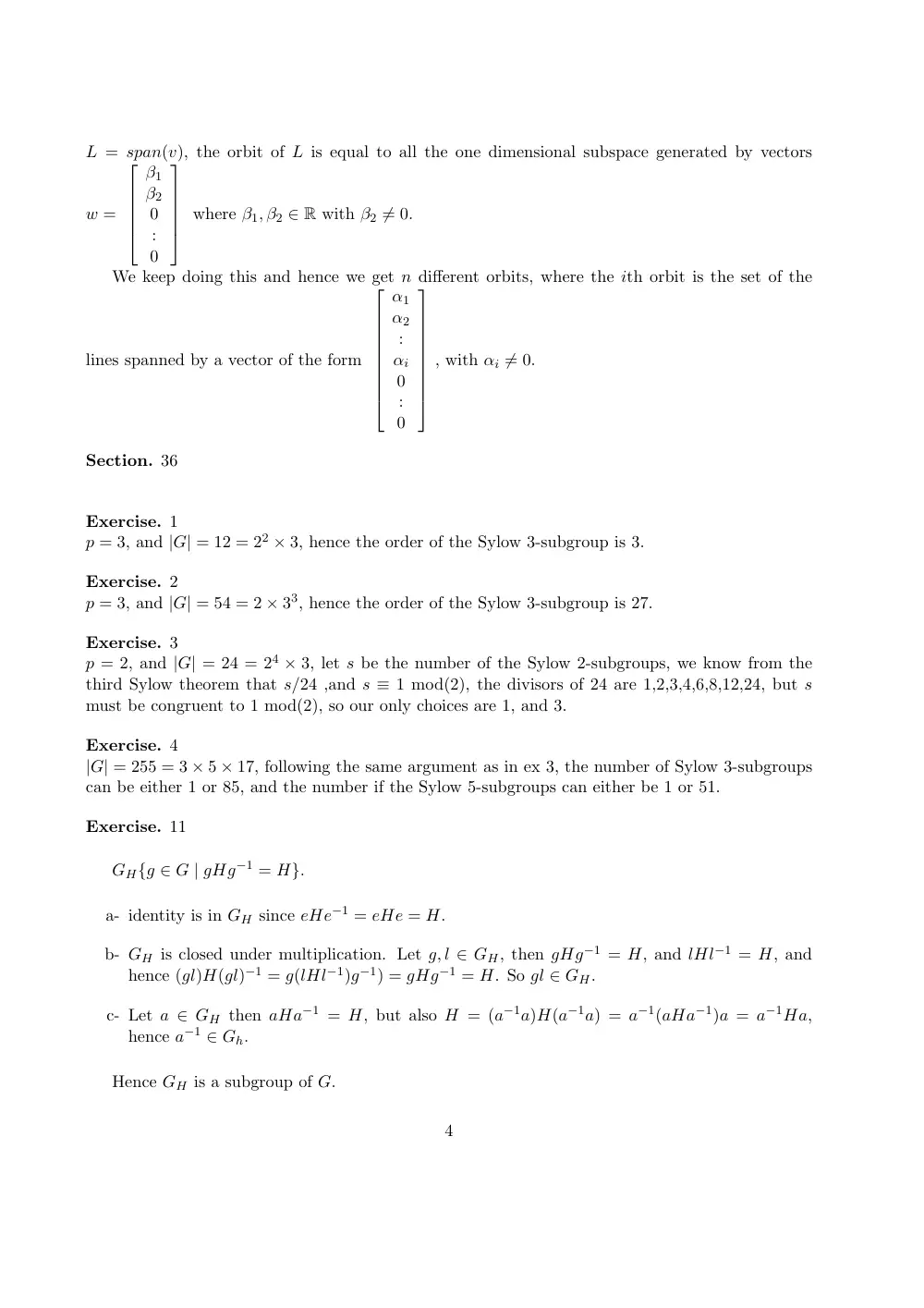
Let us consider first the L = span{u} , where u =
� 1
0
�
( Note that L = span{
� a
0
�
} for
any a ̸= 0).
The orbit of L is OL = {g.L | g ∈ B}. Let g =
� a
b
0
c
�
with a, c non-zero, then g.L =
span(gu) = span(
� a
0
�
) = span(u) = L , so OL = {L}.
This orbit has one element whose stabilizer is B.
For any other line L such that L = span(v) , where v =
� α
β
�
with α, β ∈ R, and β ̸= 0, we
have g.L = span(gv) = span(
� aα + bβ
cβ
�
. Notice that for any vector
� i
j
�
∈ R2 with j ̸= 0,
we can choose g =
�
1
i−α
β
0
j
β
�
, then g.L = span(
� i
j
�
). We deduce that OL is equal to all one
dimensional subspaces of R2 except the one spanned by
� 1
0
�
.
The stabilizer of L = span(v) where v =
� 0
1
�
is the set of diagonal matrices.
Now generalizing for the action of the group of upper triangular matrices B of GL(n, R).
We start by u =
α
0
:
0
and L = span(u). The orbit of L is OL = {L} .
Next the we consider the vector v =
α1
α2
0
:
0
where α1, α2 ∈ R with α2 ̸= 0 , and we let
3
L = span(v), the orbit of L is equal to all the one dimensional subspace generated by vectors
w =
β1
β2
0
:
0
where β1, β2 ∈ R with β2 ̸= 0.
We keep doing this and hence we get n different orbits, where the ith orbit is the set of the
lines spanned by a vector of the form
α1
α2
:
αi
0
:
0
, with αi ̸= 0.
Section. 36
Exercise. 1
p = 3, and |G| = 12 = 22 × 3, hence the order of the Sylow 3-subgroup is 3.
Exercise. 2
p = 3, and |G| = 54 = 2 × 33, hence the order of the Sylow 3-subgroup is 27.
Exercise. 3
p = 2, and |G| = 24 = 24 × 3, let s be the number of the Sylow 2-subgroups, we know from the
third Sylow theorem that s/24 ,and s ≡ 1 mod(2), the divisors of 24 are 1,2,3,4,6,8,12,24, but s
must be congruent to 1 mod(2), so our only choices are 1, and 3.
Exercise. 4
|G| = 255 = 3 × 5 × 17, following the same argument as in ex 3, the number of Sylow 3-subgroups
can be either 1 or 85, and the number if the Sylow 5-subgroups can either be 1 or 51.
Exercise. 11
GH{g ∈ G | gHg−1 = H}.
a- identity is in GH since eHe−1 = eHe = H.
b- GH is closed under multiplication. Let g, l ∈ GH, then gHg−1 = H, and lHl−1 = H, and
hence (gl)H(gl)−1 = g(lHl−1)g−1) = gHg−1 = H. So gl ∈ GH.
c- Let a ∈ GH then aHa−1 = H, but also H = (a−1a)H(a−1a) = a−1(aHa−1)a = a−1Ha,
hence a−1 ∈ Gh.
Hence GH is a subgroup of G.
4
Exercise. 12
G has a unique Sylow p-subgroup called P. Let g ∈ G be any element gPg−1 is another Sylow
p-subgroup , hence gPg−1 = P, since P is unique, and hence all the conjugates of P are equal to
P, so P is normal. Then G has a non-trivial normal subgroup, so G is not simple.
Exercise. 13
|G| = 45 = 32 × 5.
G has a Sylow 3-subgroup of order 9, using the same argument used in number 3 we can deduce
that it is a unique subgroup, and hence by number 12 it is normal. So G has a normal subgroup of
order 9.
5