
MECH 310 Problems Chapter 3 Solutions, Fall 2011
American University of Beirut · Thermodynamics I · 5 pages · with solution

More MECH 310 files
- Essay Chapter 3 · Fall 2017ChapterView
- Problems Solution Manual Chapter 9 · Fall 2011Chapter · with solutionView
- Problems Chapter 6 Solutions · Fall 2011Chapter · with solutionView
- Problems Chapter 9 Extra Problems · Fall 2011ChapterView
- Problems Solution Manual Chapter 2 · Fall 2011Chapter · with solutionView
- Problems Chapter 7 Solutions · Fall 2011Chapter · with solutionView
- Problems Chapter 4 Solutions · Fall 2011Chapter · with solutionView
- Problems Chapter 5 Solutions · Fall 2011Chapter · with solutionView
Show the text of this chapter
1
MECH 310 Thermodynamics I
October 10, 2011
American University of Beirut, Fall 2011
Handout # 1
Chapter 03 Solved Problems
Problem 3.23
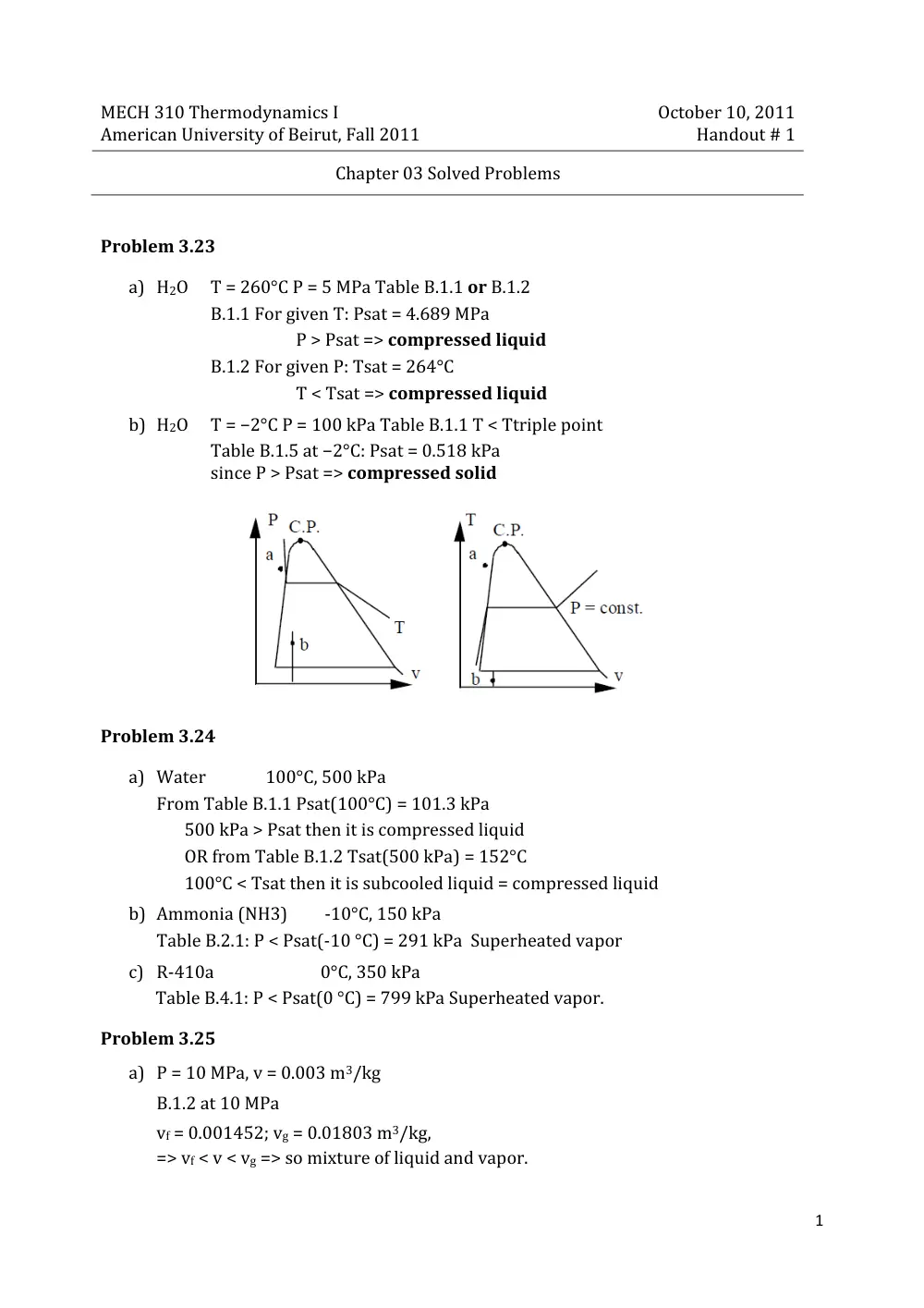
a) H2O T = 260°C P = 5 MPa Table B.1.1 or B.1.2
B.1.1 For given T: Psat = 4.689 MPa
P > Psat => compressed liquid
B.1.2 For given P: Tsat = 264°C
T < Tsat => compressed liquid
b) H2O T = −2°C P = 100 kPa Table B.1.1 T < Ttriple point
Table B.1.5 at −2°C: Psat = 0.518 kPa
since P > Psat => compressed solid
Problem 3.24
a) Water
100°C, 500 kPa
From Table B.1.1 Psat(100°C) = 101.3 kPa
500 kPa > Psat then it is compressed liquid
OR from Table B.1.2 Tsat(500 kPa) = 152°C
100°C < Tsat then it is subcooled liquid = compressed liquid
b) Ammonia (NH3)
-10°C, 150 kPa
Table B.2.1: P < Psat(-10 °C) = 291 kPa Superheated vapor
c) R-410a
0°C, 350 kPa
Table B.4.1: P < Psat(0 °C) = 799 kPa Superheated vapor.
Problem 3.25
a) P = 10 MPa, v = 0.003 m3/kg
B.1.2 at 10 MPa
vf = 0.001452; vg = 0.01803 m3/kg,
=> vf < v < vg => so mixture of liquid and vapor.
2
b) 1 MPa, 190°C : Only one of the two look-ups is needed
P < Psat = 1254.4 kPa so it is superheated vapor
T > Tsat = 179.91°C so it is superheated vapor
c) 200°C, 0.1 m3/kg: B.1.1
vf = 0.001156 m3/kg; vg = 0.12736 m3/kg,
=> vf < v < vg => so mixture of liquid and vapor.
d) 10 kPa, 10°C : Only one of the two look-ups is needed
B.1.1: P > Pg = 1.2276 kPa so compressed liquid
B.1.2: T < Tsat = 45.8°C so compressed liquid
Problem 3.33
P [kPa]
T [°C]
v [m3/kg]
x
a) 500
20
0.001002
Undefined
b) 500
151.86
0.20
0.532
c) 1400
200
0.14302
Undefined
d) 8581
300
0.01762
0.8
a) Table B.1.1 P > Psat so it is compressed liquid => Table B.1.4
b) Table B.1.2 vf < v < vg so two phase L + V
x = (v – vf)/vfg = (0.2 – 0.001093) / 0.3738 = 0.532
T = Tsat = 151.86°C
c) Only one of the two look-up is needed
Table B.1.1 200°C
P < Psat = => superheated vapor
Table B.1.2 1400 kPa
T > Tsat = 195°C
Table B.1.3 sub-table for 1400 kPa gives the state properties
d) Table B.1.1 since quality is given it is two-phase
v = vf + x × vfg = 0.001404 + 0.8 × 0.02027 = 0.01762 m3/kg
Problem 3.35
a) –15°C, 500 kPa
Table B.4.1: P > Psat = 480.4 kPa, so compressed liquid.
v ≈ vf = 0.000815 m3/kg
3
b) 20°C, 1000 kPa
Table B.4.1: P < Psat = 1444 kPa, so superheated vapor
Table B.4.2: v = 0.02838 m3/kg
c) 20°C, quality 25%
Table B.4.1: vf = 0.000815 m3/kg, vfg = 0.01666 m3/kg so
v = vf + x vfg = 0.000815 + 0.25 × 0.01666 = 0.00498 m3/kg
Problem 3.40
You want a pot of water to boil at 105°C. How heavy a lid should you put on the 15 cm
diameter pot when Patm = 101 kPa?
Table B.1.1 at 105°C : Psat = 120.8 kPa
= 0.01767 m2
Fnet = (Psat –Patm) A = (120.8 - 101) kPa × 0.01767 m2= 0.3498 kN = 350 N
Fnet = mLID g
mLID = Fnet/g = 350/9.807 = 35.7 kg
Problem 3.41
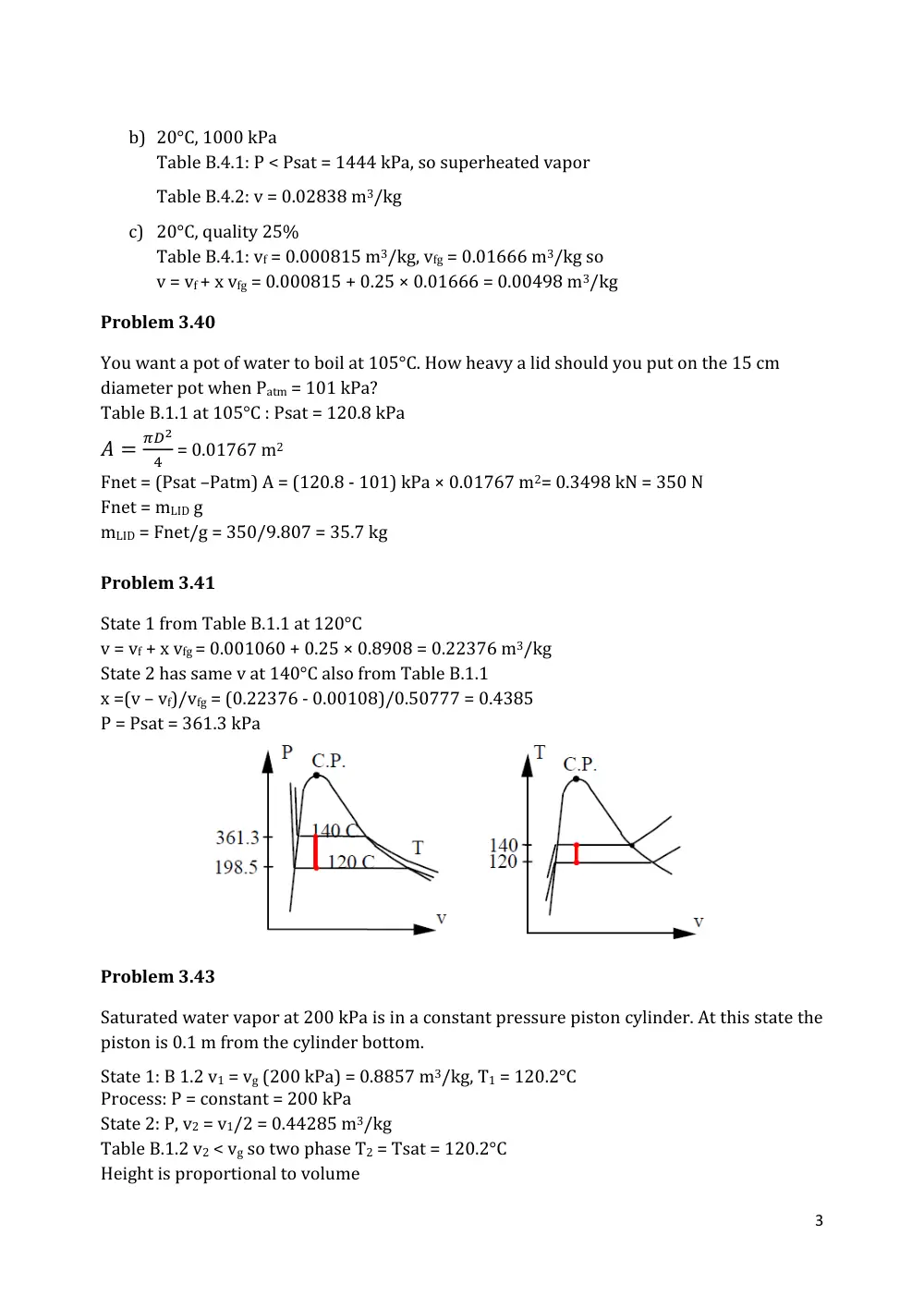
State 1 from Table B.1.1 at 120°C
v = vf + x vfg = 0.001060 + 0.25 × 0.8908 = 0.22376 m3/kg
State 2 has same v at 140°C also from Table B.1.1
x =(v – vf)/vfg = (0.22376 - 0.00108)/0.50777 = 0.4385
P = Psat = 361.3 kPa
Problem 3.43
Saturated water vapor at 200 kPa is in a constant pressure piston cylinder. At this state the
piston is 0.1 m from the cylinder bottom.
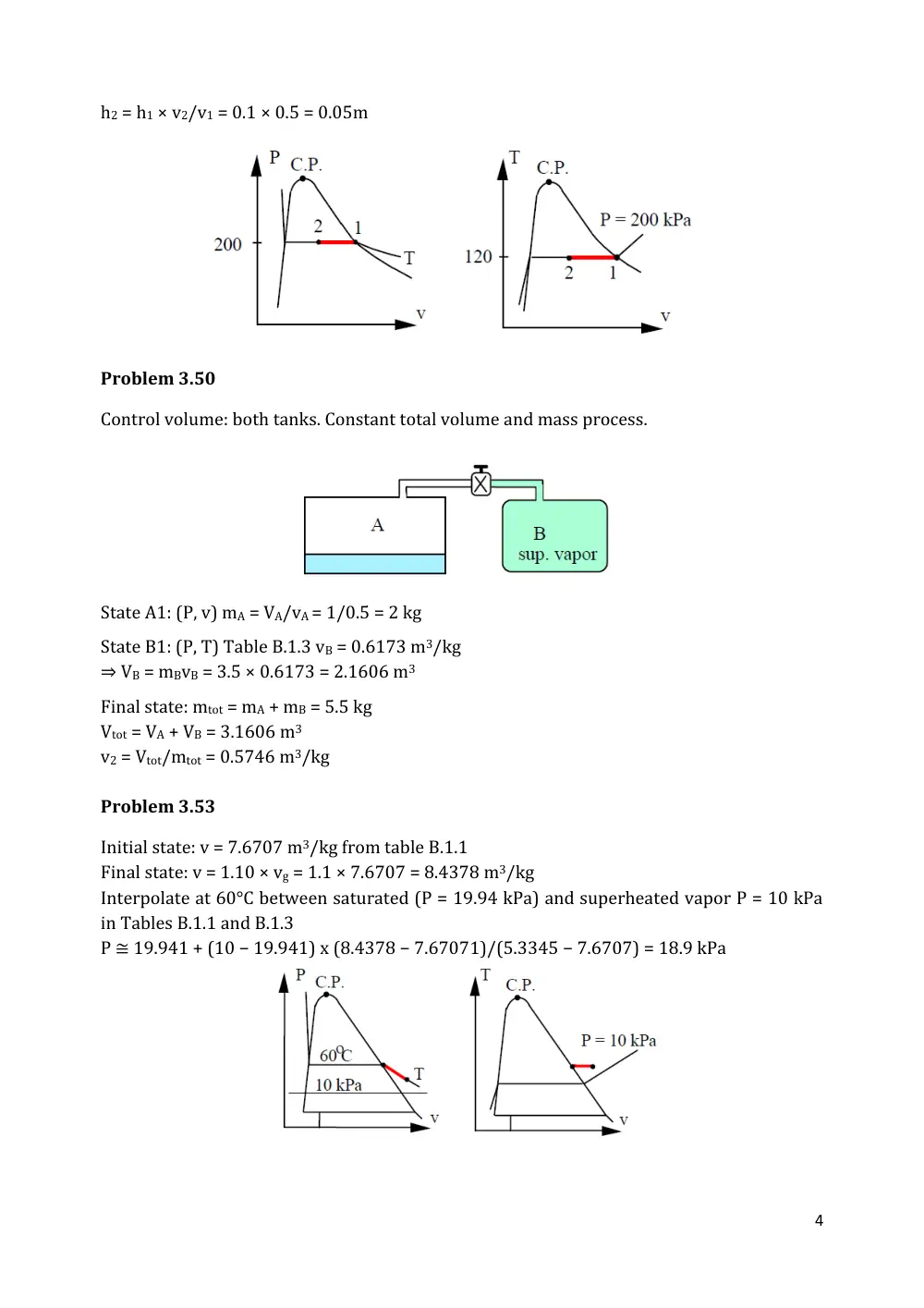
State 1: B 1.2 v1 = vg (200 kPa) = 0.8857 m3/kg, T1 = 120.2°C
Process: P = constant = 200 kPa
State 2: P, v2 = v1/2 = 0.44285 m3/kg
Table B.1.2 v2 < vg so two phase T2 = Tsat = 120.2°C
Height is proportional to volume
4
h2 = h1 × v2/v1 = 0.1 × 0.5 = 0.05m
Problem 3.50
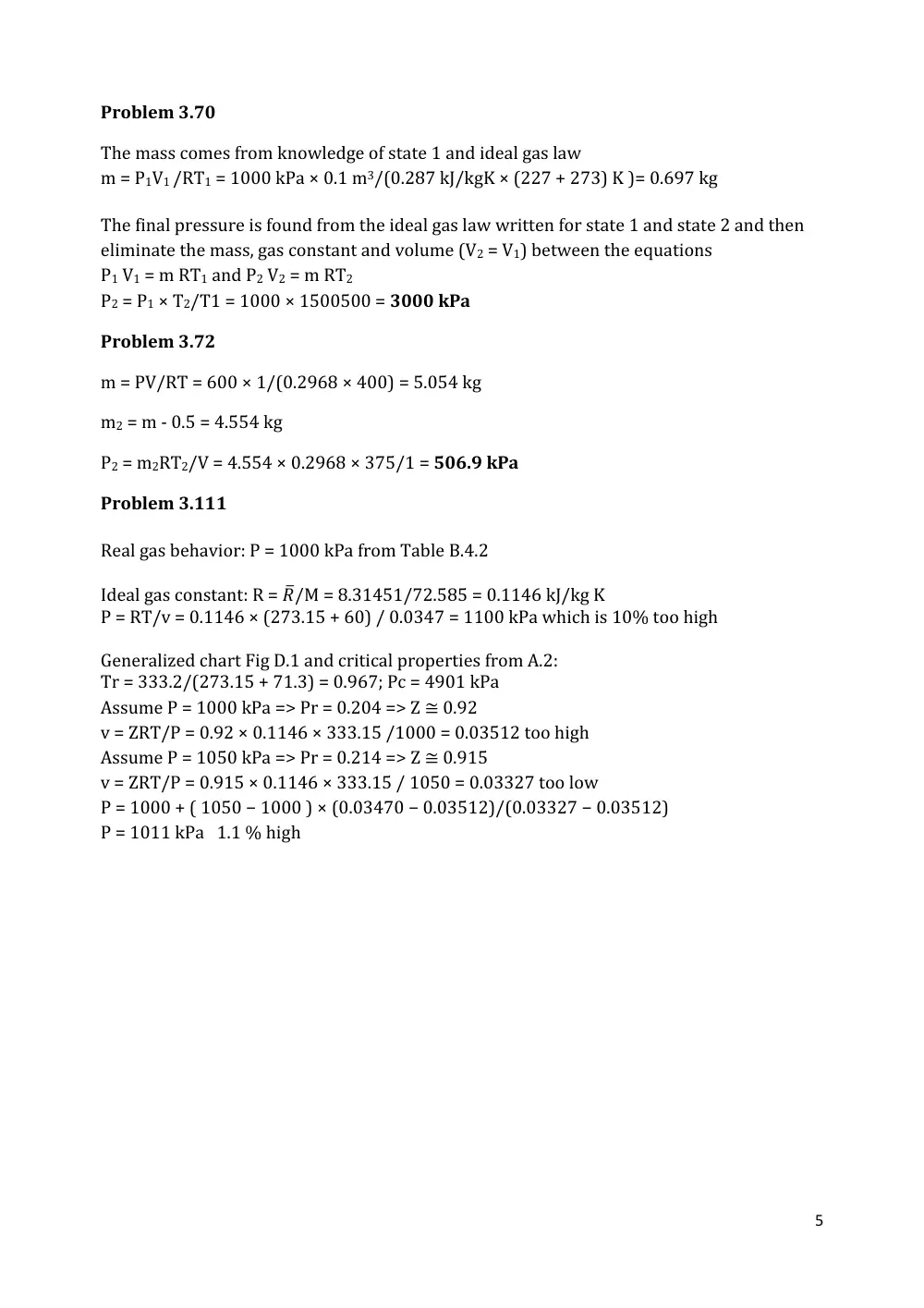
Control volume: both tanks. Constant total volume and mass process.
State A1: (P, v) mA = VA/vA = 1/0.5 = 2 kg
State B1: (P, T) Table B.1.3 vB = 0.6173 m3/kg
⇒ VB = mBvB = 3.5 × 0.6173 = 2.1606 m3
Final state: mtot = mA + mB = 5.5 kg
Vtot = VA + VB = 3.1606 m3
v2 = Vtot/mtot = 0.5746 m3/kg
Problem 3.53
Initial state: v = 7.6707 m3/kg from table B.1.1
Final state: v = 1.10 × vg = 1.1 × 7.6707 = 8.4378 m3/kg
Interpolate at 60°C between saturated (P = 19.94 kPa) and superheated vapor P = 10 kPa
in Tables B.1.1 and B.1.3
P ≅ 19.941 + (10 − 19.941) x (8.4378 − 7.67071)/(5.3345 − 7.6707) = 18.9 kPa
5
Problem 3.70
The mass comes from knowledge of state 1 and ideal gas law
m = P1V1 /RT1 = 1000 kPa × 0.1 m3/(0.287 kJ/kgK × (227 + 273) K )= 0.697 kg
The final pressure is found from the ideal gas law written for state 1 and state 2 and then
eliminate the mass, gas constant and volume (V2 = V1) between the equations
P1 V1 = m RT1 and P2 V2 = m RT2
P2 = P1 × T2/T1 = 1000 × 1500500 = 3000 kPa
Problem 3.72
m = PV/RT = 600 × 1/(0.2968 × 400) = 5.054 kg
m2 = m - 0.5 = 4.554 kg
P2 = m2RT2/V = 4.554 × 0.2968 × 375/1 = 506.9 kPa
Problem 3.111
Real gas behavior: P = 1000 kPa from Table B.4.2
Ideal gas constant: R = /M = 8.31451/72.585 = 0.1146 kJ/kg K
P = RT/v = 0.1146 × (273.15 + 60) / 0.0347 = 1100 kPa which is 10% too high
Generalized chart Fig D.1 and critical properties from A.2:
Tr = 333.2/(273.15 + 71.3) = 0.967; Pc = 4901 kPa
Assume P = 1000 kPa => Pr = 0.204 => Z ≅ 0.92
v = ZRT/P = 0.92 × 0.1146 × 333.15 /1000 = 0.03512 too high
Assume P = 1050 kPa => Pr = 0.214 => Z ≅ 0.915
v = ZRT/P = 0.915 × 0.1146 × 333.15 / 1050 = 0.03327 too low
P = 1000 + ( 1050 − 1000 ) × (0.03470 − 0.03512)/(0.03327 − 0.03512)
P = 1011 kPa 1.1 % high