
MECH 310 Problems Chapter 9 Extra Problems, Fall 2011
American University of Beirut · Thermodynamics I · 3 pages
More MECH 310 files
- Essay Chapter 3 · Fall 2017ChapterView
- Problems Solution Manual Chapter 9 · Fall 2011Chapter · with solutionView
- Problems Chapter 5 Solutions · Fall 2011Chapter · with solutionView
- Problems Chapter 8 Solutions · Fall 2011Chapter · with solutionView
- Problems Solution Manual Chapter 2 · Fall 2011Chapter · with solutionView
- Problems Chapter 6 Solutions · Fall 2011Chapter · with solutionView
- Problems Chapter 3 Solutions · Fall 2011Chapter · with solutionView
- Problems Chapter 4 Solutions · Fall 2011Chapter · with solutionView
Show the text of this chapter
Extra problem 1
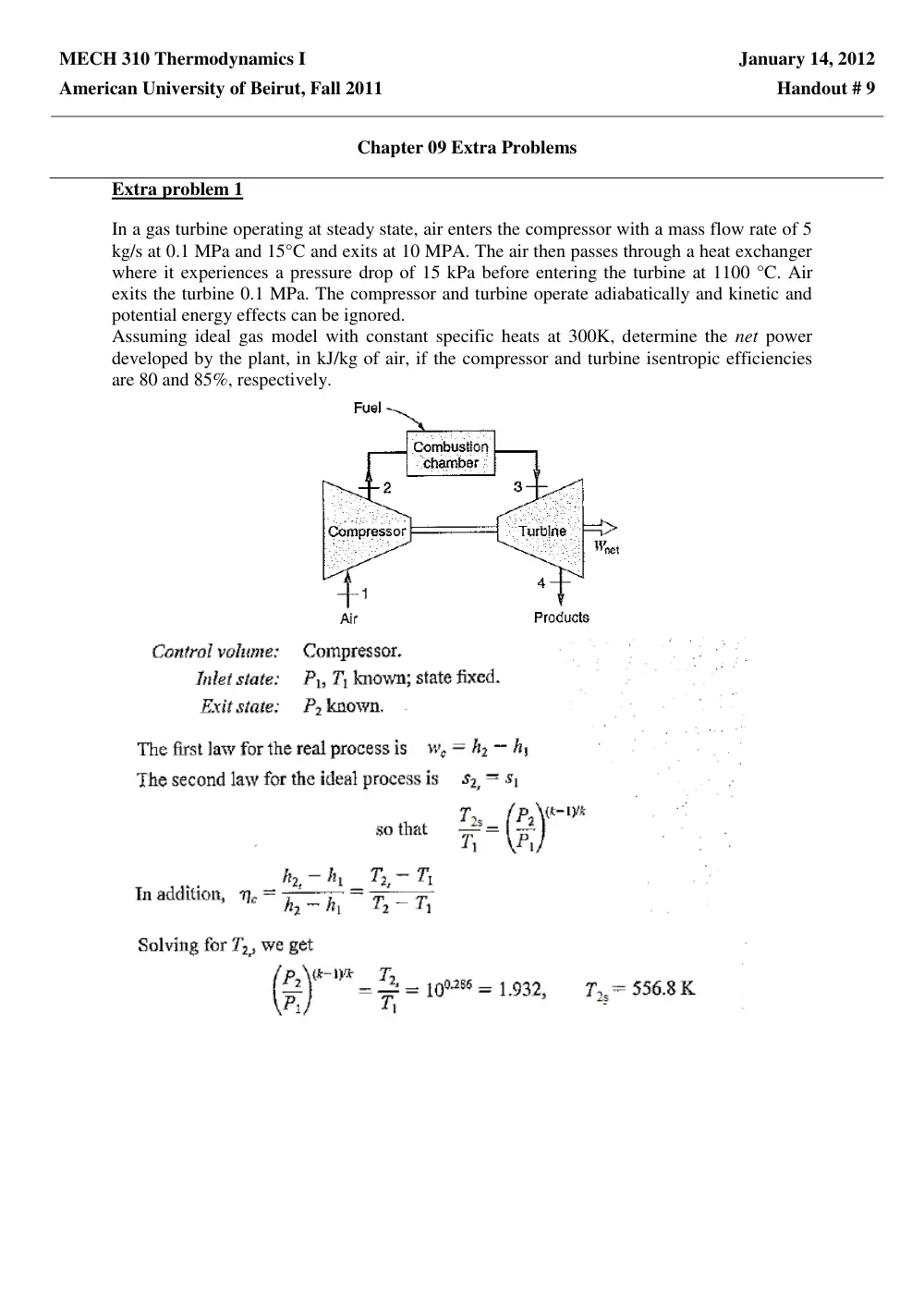
In a gas turbine operating at steady state, air enters the compressor with a mass flow rate of 5
kg/s at 0.1 MPa and 15°C and exits at 10 MPA. The air then passes through a heat exchanger
where it experiences a pressure drop of 15 kPa before entering the turbine at 1100 °C. Air
exits the turbine 0.1 MPa. The compressor and turbine operate adiabatically and kinetic and
potential energy effects can be ignored.
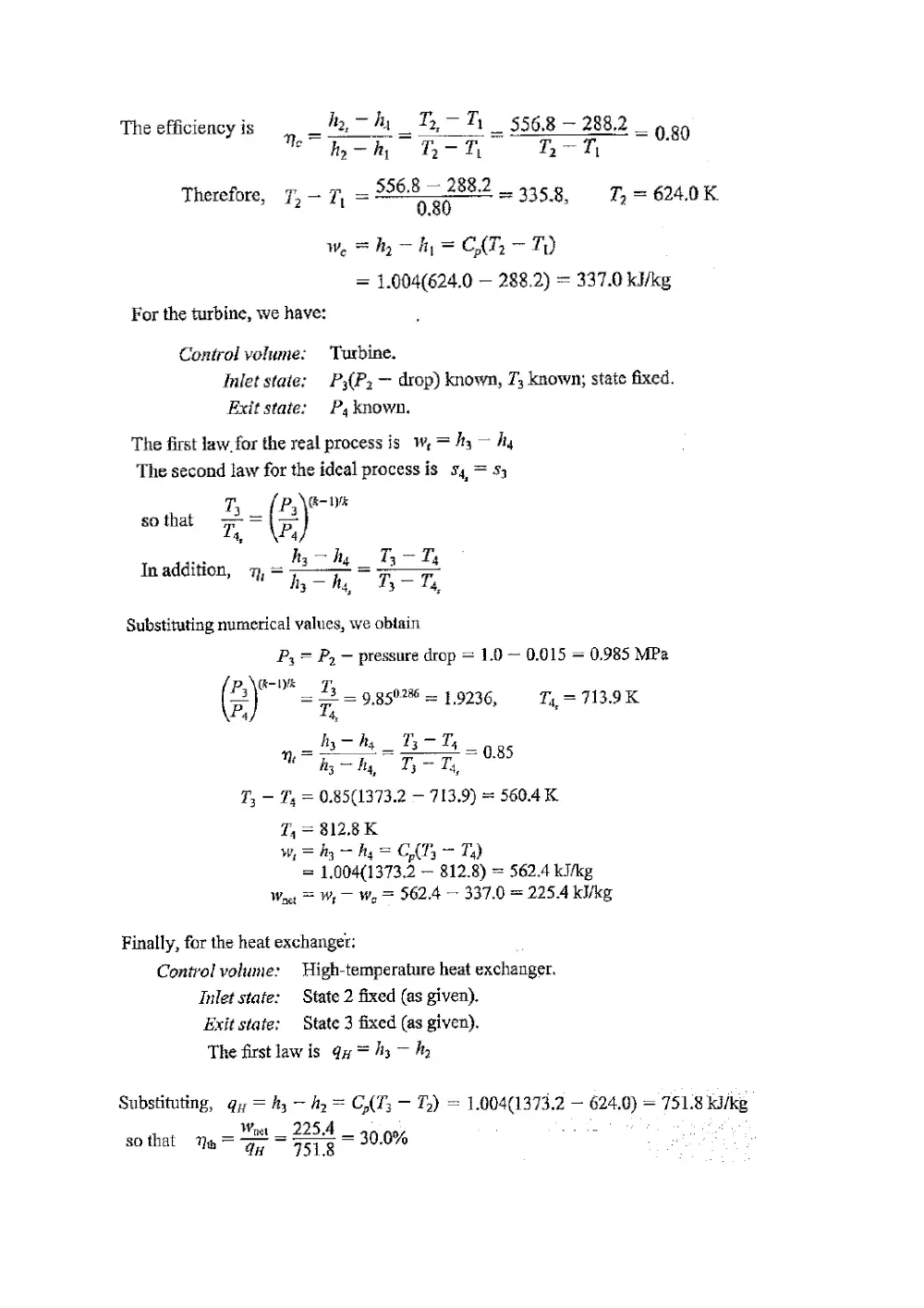
Assuming ideal gas model with constant specific heats at 300K, determine the net power
developed by the plant, in kJ/kg of air, if the compressor and turbine isentropic efficiencies
are 80 and 85%, respectively.
MECH 310 Thermodynamics I
January 14, 2012
American University of Beirut, Fall 2011
Handout # 9
Chapter 09 Extra Problems
Extra problem 2
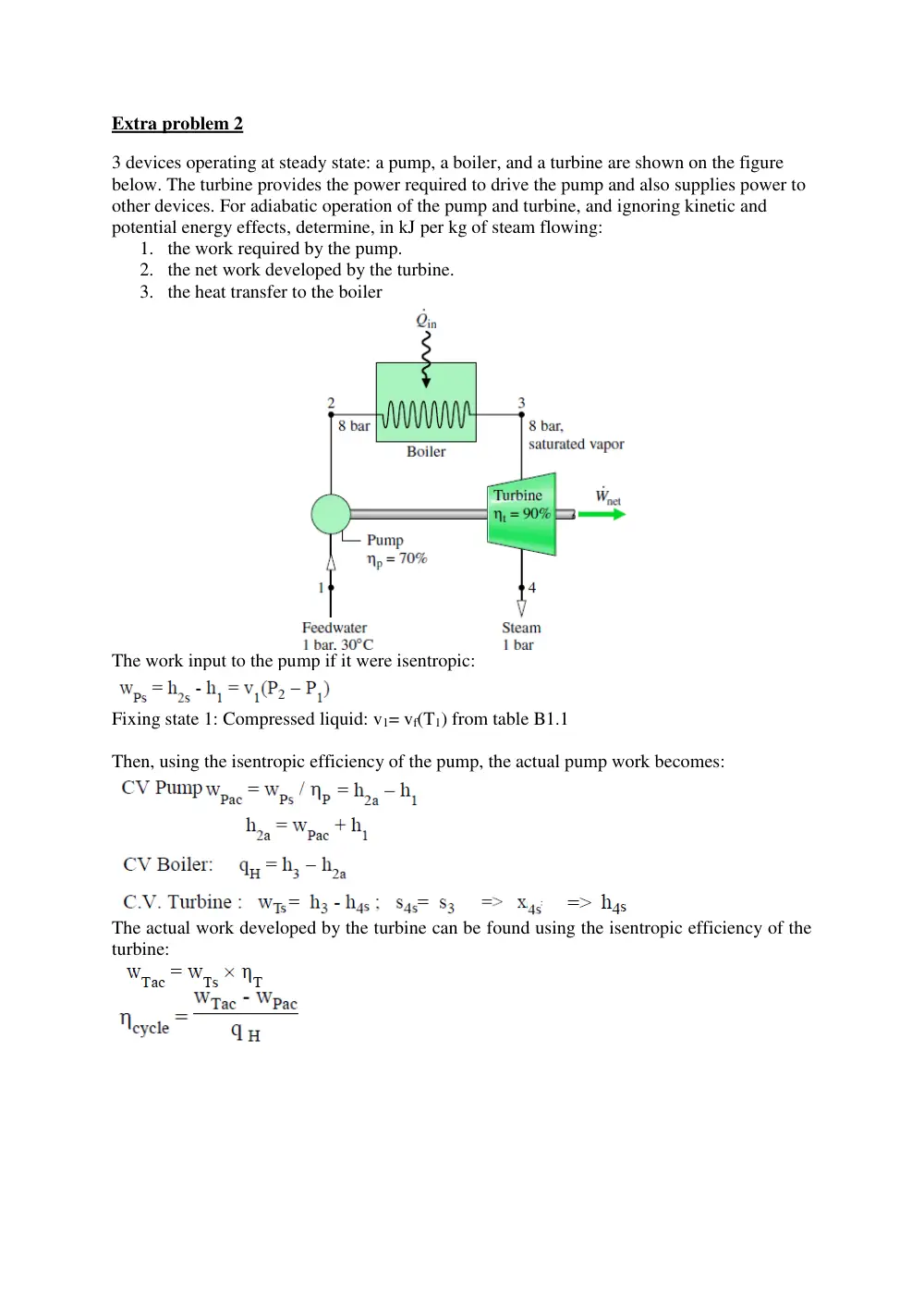
3 devices operating at steady state: a pump, a boiler, and a turbine are shown on the figure
below. The turbine provides the power required to drive the pump and also supplies power to
other devices. For adiabatic operation of the pump and turbine, and ignoring kinetic and
potential energy effects, determine, in kJ per kg of steam flowing:
1. the work required by the pump.
2. the net work developed by the turbine.
3. the heat transfer to the boiler
The work input to the pump if it were isentropic:
Fixing state 1: Compressed liquid: v1= vf(T1) from table B1.1
Then, using the isentropic efficiency of the pump, the actual pump work becomes:
The actual work developed by the turbine can be found using the isentropic efficiency of the
turbine: