
MECH 310 Problems Solution Manual Chapter 9, Fall 2011
American University of Beirut · Thermodynamics I · 198 pages · with solution

Showing the first 10 of 198 pages. Download the PDF to see all of it.
More MECH 310 files
- Essay Chapter 3 · Fall 2017ChapterView
- Problems Solution Manual Chapter 8 · Fall 2011Chapter · with solutionView
- Problems Chapter 5 Solutions · Fall 2011Chapter · with solutionView
- Problems Chapter 8 Solutions · Fall 2011Chapter · with solutionView
- Problems Chapter 9 Extra Problems · Fall 2011ChapterView
- Problems Chapter 6 Solutions · Fall 2011Chapter · with solutionView
- Problems Chapter 3 Solutions · Fall 2011Chapter · with solutionView
- Problems Chapter 4 Solutions · Fall 2011Chapter · with solutionView
Show the text of this chapter
SOLUTION MANUAL
CHAPTER 9
Borgnakke and Sonntag
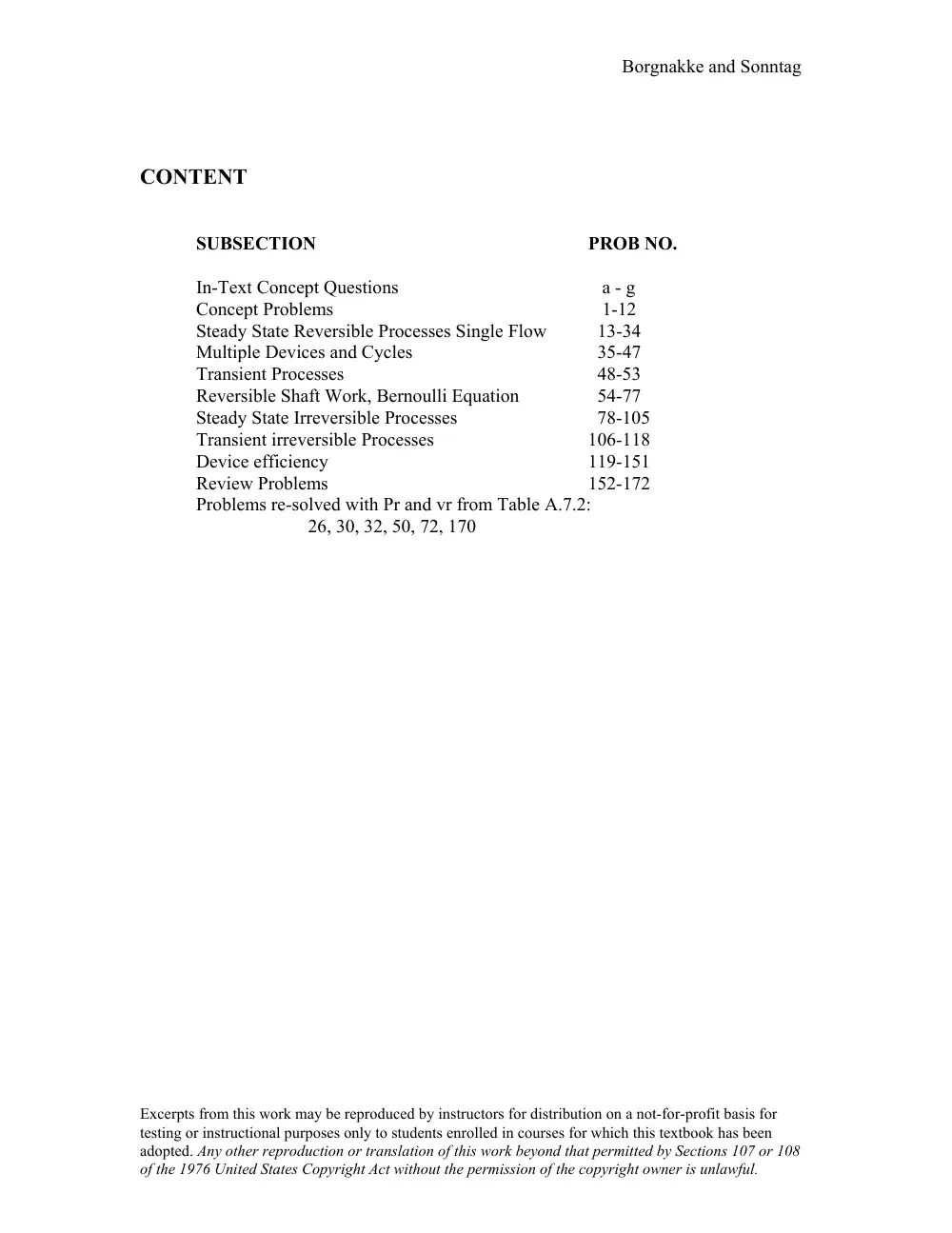
CONTENT
SUBSECTION
PROB NO.
In-Text Concept Questions
a - g
Concept Problems
1-12
Steady State Reversible Processes Single Flow
13-34
Multiple Devices and Cycles
35-47
Transient Processes
48-53
Reversible Shaft Work, Bernoulli Equation
54-77
Steady State Irreversible Processes
78-105
Transient irreversible Processes
106-118
Device efficiency
119-151
Review Problems
152-172
Problems re-solved with Pr and vr from Table A.7.2:
26, 30, 32, 50, 72, 170
Excerpts from this work may be reproduced by instructors for distribution on a not-for-profit basis for
testing or instructional purposes only to students enrolled in courses for which this textbook has been
adopted. Any other reproduction or translation of this work beyond that permitted by Sections 107 or 108
of the 1976 United States Copyright Act without the permission of the copyright owner is unlawful.
Borgnakke and Sonntag
In-Text Concept Questions
Excerpts from this work may be reproduced by instructors for distribution on a not-for-profit basis for
testing or instructional purposes only to students enrolled in courses for which this textbook has been
adopted. Any other reproduction or translation of this work beyond that permitted by Sections 107 or 108
of the 1976 United States Copyright Act without the permission of the copyright owner is unlawful.
Borgnakke and Sonntag
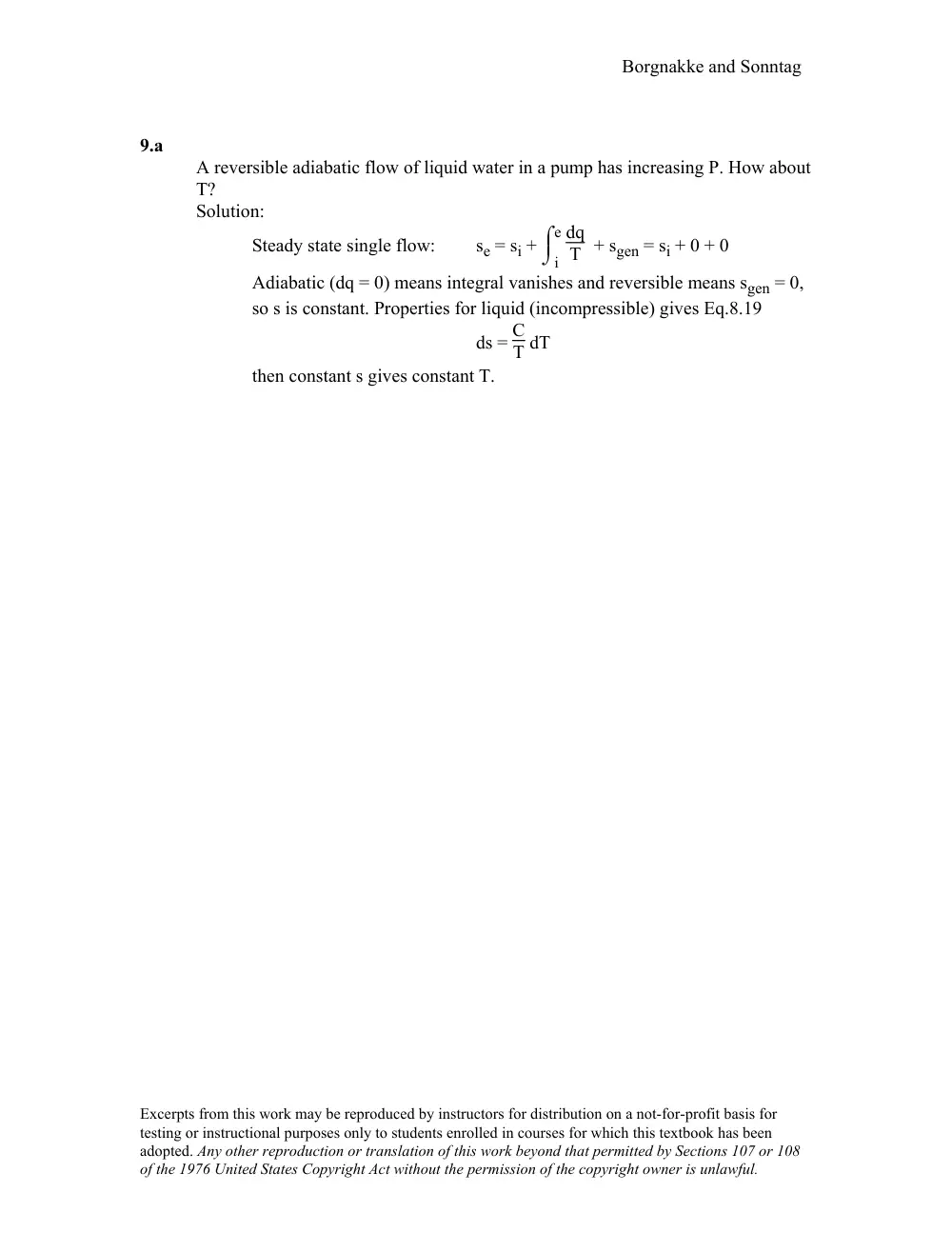
9.a
A reversible adiabatic flow of liquid water in a pump has increasing P. How about
T?
Solution:
Steady state single flow:
se = si + ⌡⌠
i
e dq
T + sgen = si + 0 + 0
Adiabatic (dq = 0) means integral vanishes and reversible means sgen = 0,
so s is constant. Properties for liquid (incompressible) gives Eq.8.19
ds = C
T dT
then constant s gives constant T.
Excerpts from this work may be reproduced by instructors for distribution on a not-for-profit basis for
testing or instructional purposes only to students enrolled in courses for which this textbook has been
adopted. Any other reproduction or translation of this work beyond that permitted by Sections 107 or 108
of the 1976 United States Copyright Act without the permission of the copyright owner is unlawful.
Borgnakke and Sonntag
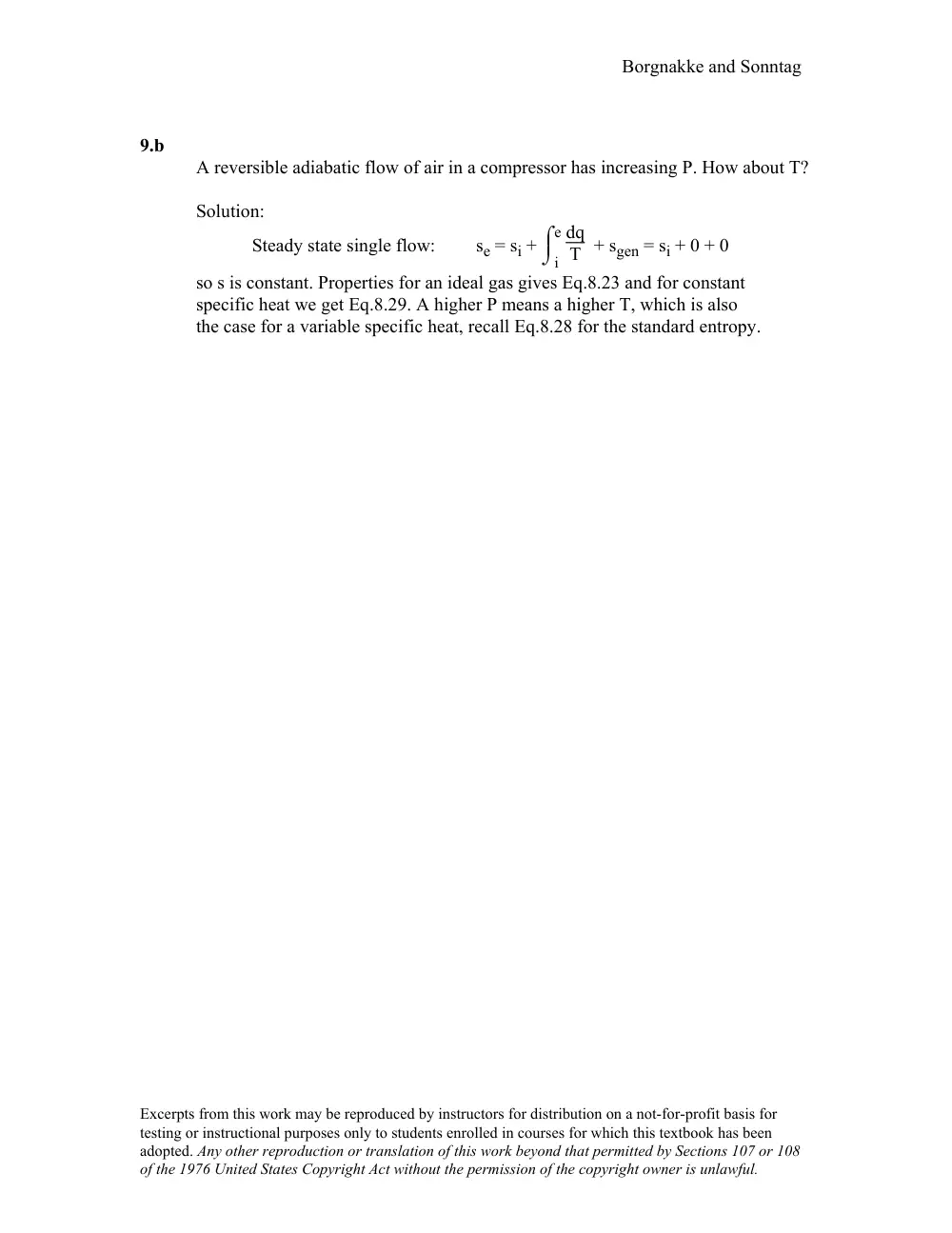
9.b
A reversible adiabatic flow of air in a compressor has increasing P. How about T?
Solution:
Steady state single flow:
se = si + ⌡⌠
i
e dq
T + sgen = si + 0 + 0
so s is constant. Properties for an ideal gas gives Eq.8.23 and for constant
specific heat we get Eq.8.29. A higher P means a higher T, which is also
the case for a variable specific heat, recall Eq.8.28 for the standard entropy.
Excerpts from this work may be reproduced by instructors for distribution on a not-for-profit basis for
testing or instructional purposes only to students enrolled in courses for which this textbook has been
adopted. Any other reproduction or translation of this work beyond that permitted by Sections 107 or 108
of the 1976 United States Copyright Act without the permission of the copyright owner is unlawful.
Borgnakke and Sonntag
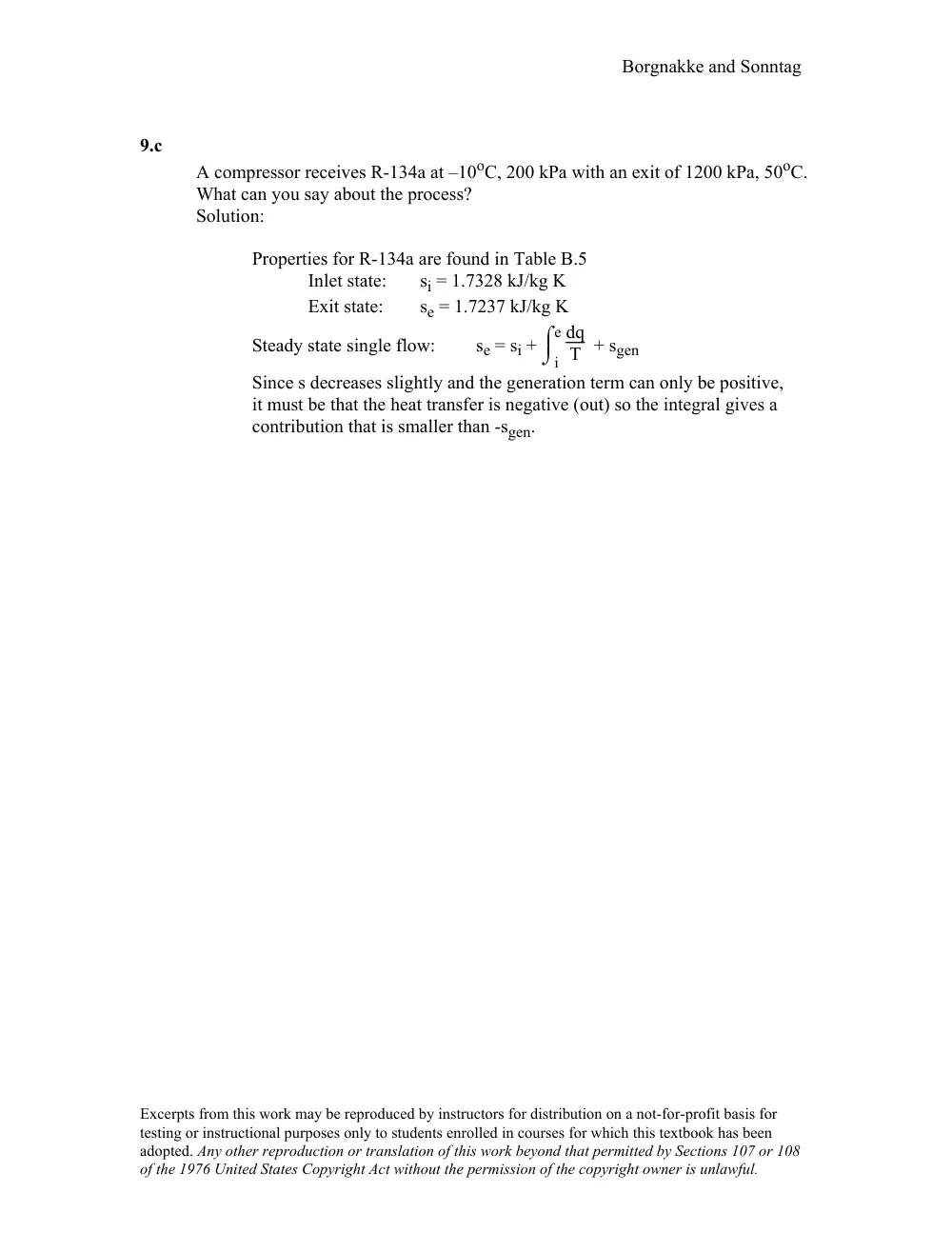
9.c
A compressor receives R-134a at –10oC, 200 kPa with an exit of 1200 kPa, 50oC.
What can you say about the process?
Solution:
Properties for R-134a are found in Table B.5
Inlet state:
si = 1.7328 kJ/kg K
Exit state:
se = 1.7237 kJ/kg K
Steady state single flow:
se = si + ⌡⌠
i
e dq
T + sgen
Since s decreases slightly and the generation term can only be positive,
it must be that the heat transfer is negative (out) so the integral gives a
contribution that is smaller than -sgen.
Excerpts from this work may be reproduced by instructors for distribution on a not-for-profit basis for
testing or instructional purposes only to students enrolled in courses for which this textbook has been
adopted. Any other reproduction or translation of this work beyond that permitted by Sections 107 or 108
of the 1976 United States Copyright Act without the permission of the copyright owner is unlawful.
Borgnakke and Sonntag
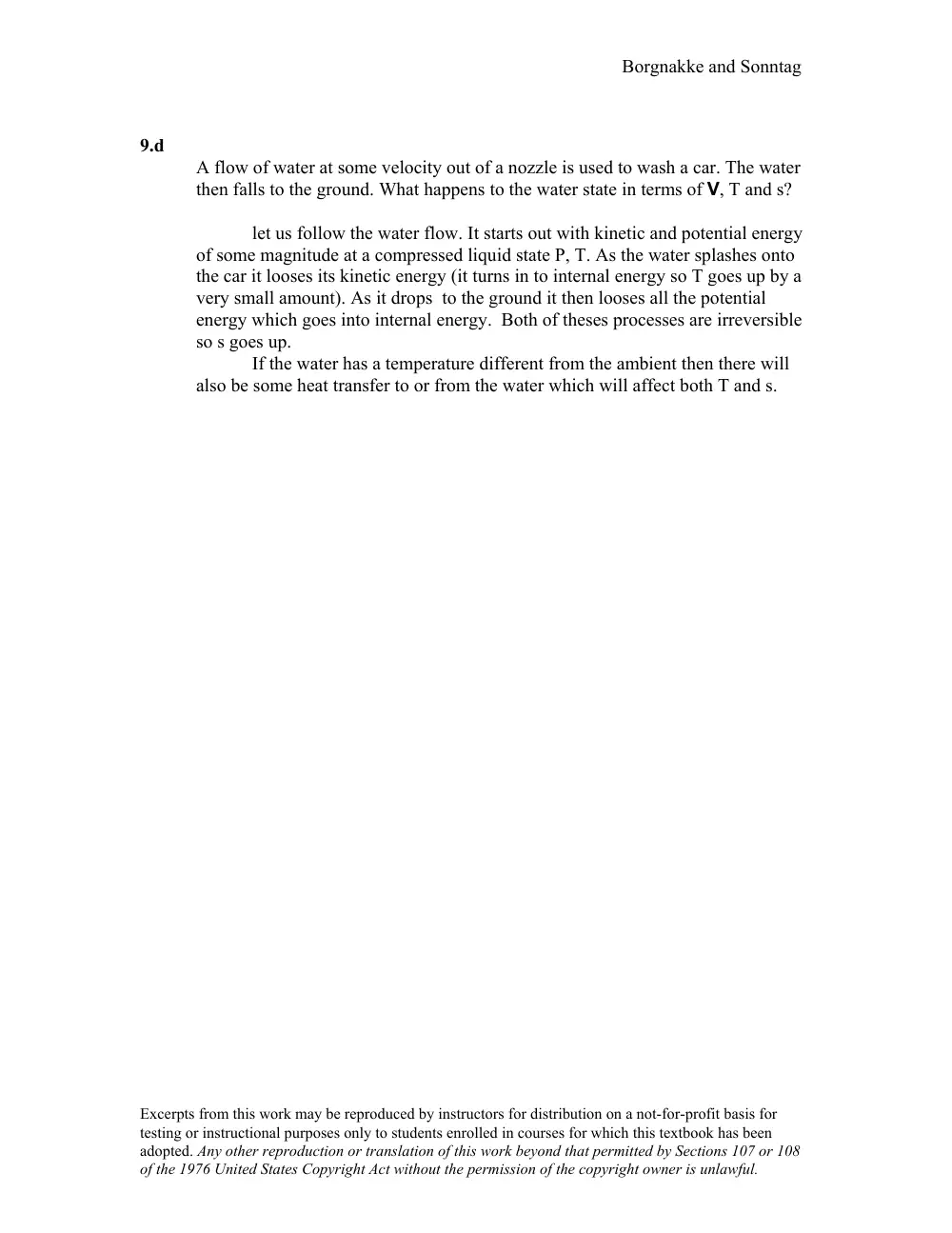
9.d
A flow of water at some velocity out of a nozzle is used to wash a car. The water
then falls to the ground. What happens to the water state in terms of V, T and s?
let us follow the water flow. It starts out with kinetic and potential energy
of some magnitude at a compressed liquid state P, T. As the water splashes onto
the car it looses its kinetic energy (it turns in to internal energy so T goes up by a
very small amount). As it drops to the ground it then looses all the potential
energy which goes into internal energy. Both of theses processes are irreversible
so s goes up.
If the water has a temperature different from the ambient then there will
also be some heat transfer to or from the water which will affect both T and s.
Excerpts from this work may be reproduced by instructors for distribution on a not-for-profit basis for
testing or instructional purposes only to students enrolled in courses for which this textbook has been
adopted. Any other reproduction or translation of this work beyond that permitted by Sections 107 or 108
of the 1976 United States Copyright Act without the permission of the copyright owner is unlawful.
Borgnakke and Sonntag
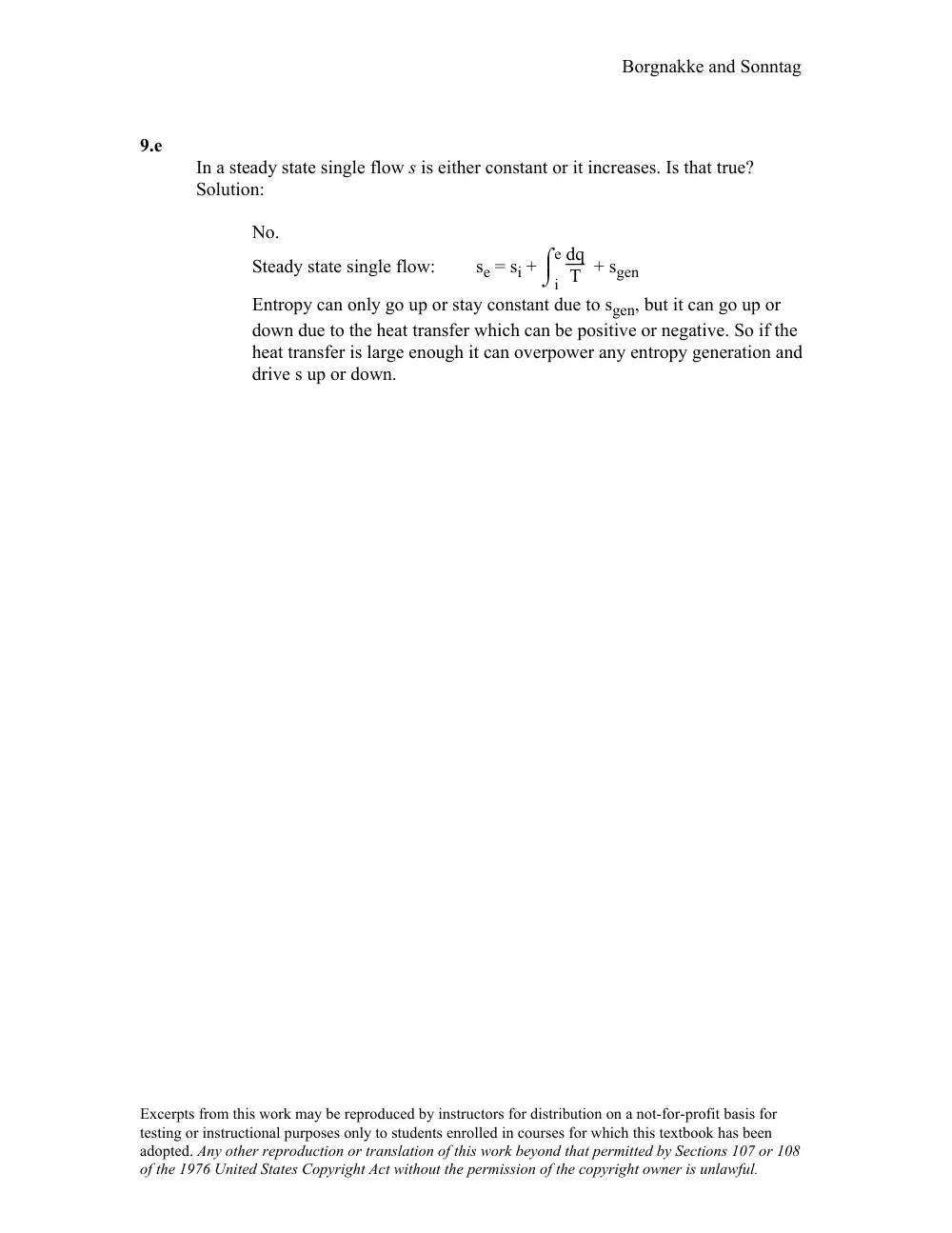
9.e
In a steady state single flow s is either constant or it increases. Is that true?
Solution:
No.
Steady state single flow:
se = si + ⌡⌠
i
e dq
T + sgen
Entropy can only go up or stay constant due to sgen, but it can go up or
down due to the heat transfer which can be positive or negative. So if the
heat transfer is large enough it can overpower any entropy generation and
drive s up or down.
Excerpts from this work may be reproduced by instructors for distribution on a not-for-profit basis for
testing or instructional purposes only to students enrolled in courses for which this textbook has been
adopted. Any other reproduction or translation of this work beyond that permitted by Sections 107 or 108
of the 1976 United States Copyright Act without the permission of the copyright owner is unlawful.
Borgnakke and Sonntag
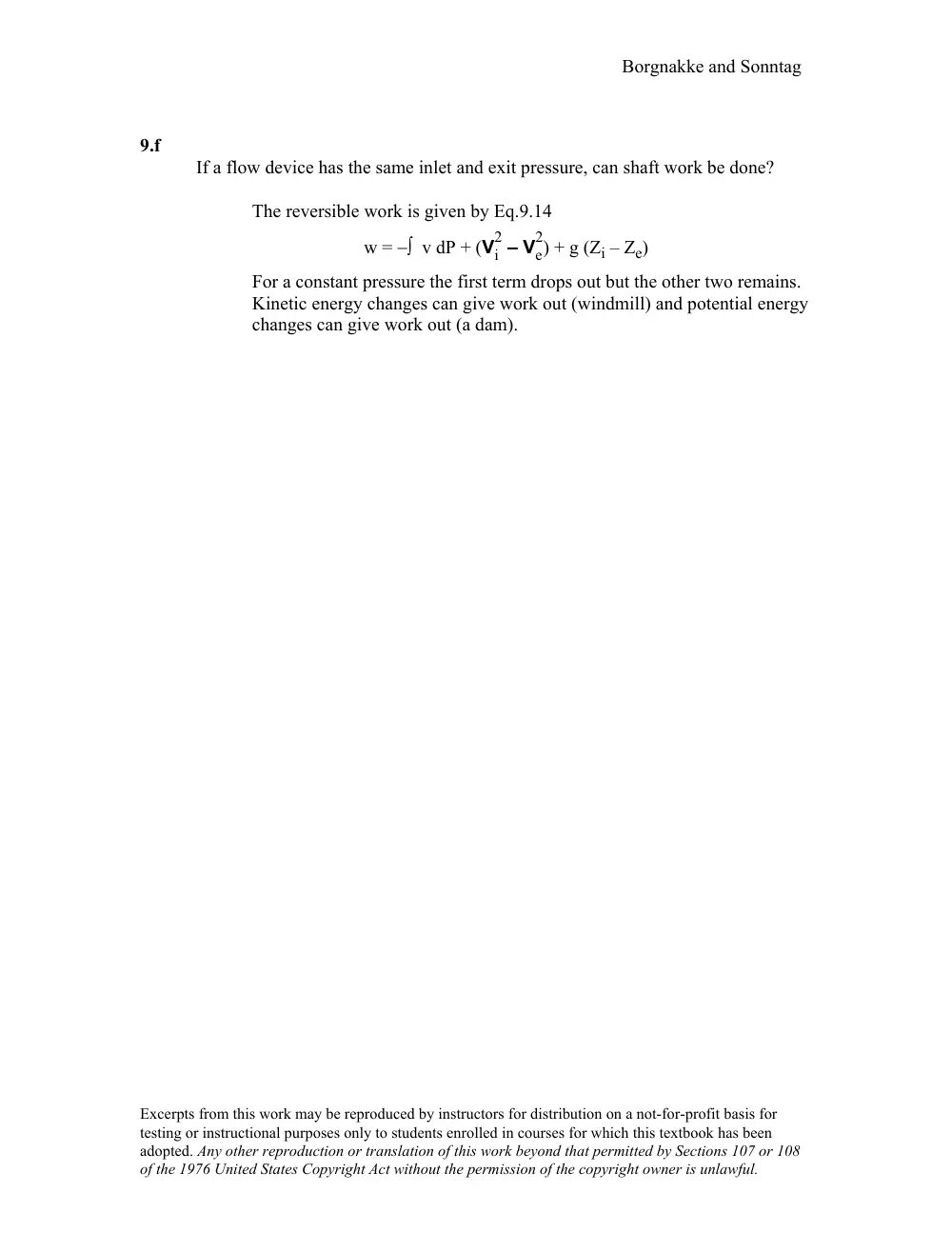
9.f
If a flow device has the same inlet and exit pressure, can shaft work be done?
The reversible work is given by Eq.9.14
w = −∫ v dP + (V2
i – V2
e) + g (Zi – Ze)
For a constant pressure the first term drops out but the other two remains.
Kinetic energy changes can give work out (windmill) and potential energy
changes can give work out (a dam).
Excerpts from this work may be reproduced by instructors for distribution on a not-for-profit basis for
testing or instructional purposes only to students enrolled in courses for which this textbook has been
adopted. Any other reproduction or translation of this work beyond that permitted by Sections 107 or 108
of the 1976 United States Copyright Act without the permission of the copyright owner is unlawful.
Borgnakke and Sonntag
9.g
A polytropic flow process with n = 0 might be which device?
As the polytropic process is Pvn = C, then n = 0 is a constant pressure process.
This can be a pipe flow, a heat exchanger flow (heater or cooler) or a boiler.
Excerpts from this work may be reproduced by instructors for distribution on a not-for-profit basis for
testing or instructional purposes only to students enrolled in courses for which this textbook has been
adopted. Any other reproduction or translation of this work beyond that permitted by Sections 107 or 108
of the 1976 United States Copyright Act without the permission of the copyright owner is unlawful.
Borgnakke and Sonntag
Concept Problems
Excerpts from this work may be reproduced by instructors for distribution on a not-for-profit basis for
testing or instructional purposes only to students enrolled in courses for which this textbook has been
adopted. Any other reproduction or translation of this work beyond that permitted by Sections 107 or 108
of the 1976 United States Copyright Act without the permission of the copyright owner is unlawful.
Borgnakke and Sonntag
9.1
If we follow a mass element going through a reversible adiabatic flow process what
can we say about the change of state?
Following a mass (this is a control mass)
du = dq – dw = 0 – Pdv = – Pdv;
compression/expansion changes u
ds = dq/T + dsgen = 0 + 0 ⇒
s = constant, isentropic process.
Excerpts from this work may be reproduced by instructors for distribution on a not-for-profit basis for
testing or instructional purposes only to students enrolled in courses for which this textbook has been
adopted. Any other reproduction or translation of this work beyond that permitted by Sections 107 or 108
of the 1976 United States Copyright Act without the permission of the copyright owner is unlawful.
Borgnakke and Sonntag
9.2
Which process will make the statement in concept question e) on page 267 true?
Solution:
If the process is said to be adiabatic then:
Steady state adiabatic single flow:
se = si + sgen ≥ si
Excerpts from this work may be reproduced by instructors for distribution on a not-for-profit basis for
testing or instructional purposes only to students enrolled in courses for which this textbook has been
adopted. Any other reproduction or translation of this work beyond that permitted by Sections 107 or 108
of the 1976 United States Copyright Act without the permission of the copyright owner is unlawful.
Borgnakke and Sonntag
9.3
A reversible process in a steady flow with
negligible kinetic and potential energy
changes is shown in the diagrams. Indicate
the change he - hi and transfers w and q as
positive, zero or negative
i
P
v
T
s
e
i
e
dw = – v dP > 0 P drops so work is positive out.
dq = T ds = 0 s is constant, and process reversible so adiabatic.
he - hi = q – w = 0 – w < 0 so enthalpy drops
Excerpts from this work may be reproduced by instructors for distribution on a not-for-profit basis for
testing or instructional purposes only to students enrolled in courses for which this textbook has been
adopted. Any other reproduction or translation of this work beyond that permitted by Sections 107 or 108
of the 1976 United States Copyright Act without the permission of the copyright owner is unlawful.
Borgnakke and Sonntag
9.4
A reversible process in a steady flow of air
with negligible kinetic and potential energy
changes is shown in the diagrams. Indicate
the change he - hi and transfers w and q as
positive, zero or negative
i
P
v
T
s
e
i
e
dw = – v dP > 0 P drops so work is positive out.
dq = T ds > 0 s is increasing and process reversible so q is positive.
he - hi = 0 as they are functions of T and thus the same.
Excerpts from this work may be reproduced by instructors for distribution on a not-for-profit basis for
testing or instructional purposes only to students enrolled in courses for which this textbook has been
adopted. Any other reproduction or translation of this work beyond that permitted by Sections 107 or 108
of the 1976 United States Copyright Act without the permission of the copyright owner is unlawful.
Borgnakke and Sonntag
9.5
A reversible steady isobaric flow has 1 kW of heat added with negligible changes
in KE and PE, what is the work transfer?
P = C: Shaft work Eq. 9.14:
dw = – v dP + ∆KE + ∆PE – T dsgen = 0 + 0 + 0 – 0 = 0
Excerpts from this work may be reproduced by instructors for distribution on a not-for-profit basis for
testing or instructional purposes only to students enrolled in courses for which this textbook has been
adopted. Any other reproduction or translation of this work beyond that permitted by Sections 107 or 108
of the 1976 United States Copyright Act without the permission of the copyright owner is unlawful.
Borgnakke and Sonntag
9.6
An air compressor has a significant heat transfer out. See example 9.4 for how
high T becomes if there is no heat transfer. Is that good, or should it be insulated?
That depends on the use of the compressed air. If there is no need for the
high T, say it is used for compressed air tools, then the heat transfer will lower T
and result in lower specific volume reducing the work. For those applications the
compressor may have fins mounted on its surface to promote the heat transfer. In
very high pressure compression it is done in stages between which is a heat
exchanger called an intercooler.
This is a small compressor
driven by an electric motor.
Used to charge air into car
tires.
Excerpts from this work may be reproduced by instructors for distribution on a not-for-profit basis for
testing or instructional purposes only to students enrolled in courses for which this textbook has been
adopted. Any other reproduction or translation of this work beyond that permitted by Sections 107 or 108
of the 1976 United States Copyright Act without the permission of the copyright owner is unlawful.
Borgnakke and Sonntag
9.7
Friction in a pipe flow causes a slight pressure decrease and a slight temperature
increase. How does that affect entropy?
Solution:
The friction converts flow work (P drops) into internal energy (T up if
single phase). This is an irreversible process and s increases.
If liquid: Eq. 8.19:
ds = C
T dT so s follows T
If ideal gas Eq. 8.23: ds = Cp
dT
T − R dP
P (both terms increase)
Excerpts from this work may be reproduced by instructors for distribution on a not-for-profit basis for
testing or instructional purposes only to students enrolled in courses for which this textbook has been
adopted. Any other reproduction or translation of this work beyond that permitted by Sections 107 or 108
of the 1976 United States Copyright Act without the permission of the copyright owner is unlawful.
Borgnakke and Sonntag
9.8
To increase the work out of a turbine for a given inlet and exit pressure how
should the inlet state be changed?
w = – ∫ v dP + …..
Eq.9.13
For a given change in pressure boosting v will result in larger work term. So for
larger inlet T we get a larger v and thus larger work. That is why we increase T
by combustion in a gasturbine before the turbine section.
Excerpts from this work may be reproduced by instructors for distribution on a not-for-profit basis for
testing or instructional purposes only to students enrolled in courses for which this textbook has been
adopted. Any other reproduction or translation of this work beyond that permitted by Sections 107 or 108
of the 1976 United States Copyright Act without the permission of the copyright owner is unlawful.
Borgnakke and Sonntag
9.9
An irreversible adiabatic flow of liquid water in a pump has higher P. How about
T?
Solution:
Steady state single flow:
se = si + ⌡⌠
i
e dq
T + sgen = si + 0 + sgen
so s is increasing. Properties for liquid (incompressible) gives Eq.8.19
where an increase in s gives an increasse in T.
Excerpts from this work may be reproduced by instructors for distribution on a not-for-profit basis for
testing or instructional purposes only to students enrolled in courses for which this textbook has been
adopted. Any other reproduction or translation of this work beyond that permitted by Sections 107 or 108
of the 1976 United States Copyright Act without the permission of the copyright owner is unlawful.
Borgnakke and Sonntag
9.10
The shaft work in a pump to increase the pressure is small compared to the shaft
work in an air compressor for the same pressure increase. Why?
The reversible work is given by Eq. 9.13 or 9.14 if reversible and no
kinetic or potential energy changes
w = −∫ v dP
The liquid has a very small value for v compared to a large value for a gas.
Excerpts from this work may be reproduced by instructors for distribution on a not-for-profit basis for
testing or instructional purposes only to students enrolled in courses for which this textbook has been
adopted. Any other reproduction or translation of this work beyond that permitted by Sections 107 or 108
of the 1976 United States Copyright Act without the permission of the copyright owner is unlawful.
Borgnakke and Sonntag
9.11
Liquid water is sprayed into the hot gases before they enter the turbine section of
a large gasturbine power plant. It is claimed that the larger mass flow rate
produces more work. Is that the reason?
No. More mass through the turbine does give more work, but the added
mass is only a few percent. As the liquid vaporizes the specific volume increases
dramatically which gives a much larger volume flow throught the turbine and that
gives more work output.
W. = m. w = −m. ∫ v dP = −∫ m. v dP = −∫ V. dP
This should be seen relative to the small work required to bring the liquid water
up to the higher turbine inlet pressure from the source of water (presumably
atmospheric pressure).
Excerpts from this work may be reproduced by instructors for distribution on a not-for-profit basis for
testing or instructional purposes only to students enrolled in courses for which this textbook has been
adopted. Any other reproduction or translation of this work beyond that permitted by Sections 107 or 108
of the 1976 United States Copyright Act without the permission of the copyright owner is unlawful.
Borgnakke and Sonntag
9.12
A tank contains air at 400 kPa, 300 K and a valve opens up for flow out to the
outside which is at 100 kPa, 300 K. What happens to the air temperature inside?
As mass flows out of the tank the pressure will drop, the air that remains
basically goes through a simple (adiabatic if process is fast enough) expansion
process so the temperature also drops. If the flow rate out is very small and the
process thus extremely slow, enough heat transfer may take place to keep the
temperature constant.
Excerpts from this work may be reproduced by instructors for distribution on a not-for-profit basis for
testing or instructional purposes only to students enrolled in courses for which this textbook has been
adopted. Any other reproduction or translation of this work beyond that permitted by Sections 107 or 108
of the 1976 United States Copyright Act without the permission of the copyright owner is unlawful.
Borgnakke and Sonntag
Steady state reversible processes single flow
Excerpts from this work may be reproduced by instructors for distribution on a not-for-profit basis for
testing or instructional purposes only to students enrolled in courses for which this textbook has been
adopted. Any other reproduction or translation of this work beyond that permitted by Sections 107 or 108
of the 1976 United States Copyright Act without the permission of the copyright owner is unlawful.
Borgnakke and Sonntag
9.13
An evaporator has R-410a at -20oC and quality 20% flowing in with the exit flow
being saturated vapor at -20oC. Consider the heating to be a reversible process
and find the specific heat transfer from the entropy equation.
Entropy Eq.9.8:
se = si + ∫ dq/T + sgen = si + q/T + 0
q = T (se – si) = T (sg – si)
Inlet:
si = 0.1154 + xi 0.9625 = 0.3079 kJ/kg-K
Exit:
sg = 1.0779 kJ/kg-K
q = (273.15 – 20) (1.0779 – 0.3079) = 194.926 kJ/kg
Remark: It fits with he – hi = (1 – xi) hfg = 0.8 × 243.65 = 194.92 kJ/kg
Excerpts from this work may be reproduced by instructors for distribution on a not-for-profit basis for
testing or instructional purposes only to students enrolled in courses for which this textbook has been
adopted. Any other reproduction or translation of this work beyond that permitted by Sections 107 or 108
of the 1976 United States Copyright Act without the permission of the copyright owner is unlawful.
Borgnakke and Sonntag
9.14
A reversible isothermal expander (a turbine with heat transfer) has an inlet flow
of carbon dioxide at 3 MPa, 40oC and an exit flow at 1 MPa, 40oC. Find the
specific heat transfer from the entropy equation and the specific work from the
energy equation assuming ideal gas.
Energy Eq.6.13: 0 = hi − he + q − w
Entropy Eq.9.8:
0 = si − se + ∫ dq/T + sgen = si - se + q/T + 0
q = T (se – si) = T(CPo ln
Te
Ti − R ln
Pe
Pi ) = − RT ln
Pe
Pi
= −0.1889 kJ/kg-K × 313.15 K × ln 1
3 = 64.99 kJ/kg
w = hi − he + q = q = 64.99 kJ/kg
Excerpts from this work may be reproduced by instructors for distribution on a not-for-profit basis for
testing or instructional purposes only to students enrolled in courses for which this textbook has been
adopted. Any other reproduction or translation of this work beyond that permitted by Sections 107 or 108
of the 1976 United States Copyright Act without the permission of the copyright owner is unlawful.
Borgnakke and Sonntag
9.15
Solve the previous Problem using Table B.3
Energy Eq.6.13: 0 = hi − he + q − w
Entropy Eq.9.8:
0 = si − se + ∫ dq/T + sgen = si - se + q/T + 0
Inlet state:
hi = 378.55 kJ/kg, si = 1.4104 kJ/kg-K
Exit state:
he = 398.05 kJ/kg, se = 1.6633 kJ/kg-K
q = T (se – si) = 313.15 (1.6633 – 1.4104) = 79.2 kJ/kg
w = hi − he + q = 378.55 – 398.05 + 79.2 = 59.7 kJ/kg
Remark: When it is not an ideal gas h is a fct. of both T and P.
Excerpts from this work may be reproduced by instructors for distribution on a not-for-profit basis for
testing or instructional purposes only to students enrolled in courses for which this textbook has been
adopted. Any other reproduction or translation of this work beyond that permitted by Sections 107 or 108
of the 1976 United States Copyright Act without the permission of the copyright owner is unlawful.
Borgnakke and Sonntag
9.16
A first stage in a turbine receives steam at 10 MPa, 800°C with an exit pressure
of 800 kPa. Assume the stage is adiabatic and negelect kinetic energies. Find the
exit temperature and the specific work.
Solution:
C.V. Stage 1 of turbine.
The stage is adiabatic so q = 0 and we will assume
reversible so sgen = 0
WT
i
e
Energy Eq.6.13: wT = hi - he
Entropy Eq.9.8:
se = si + ∫ dq/T + sgen = si + 0 + 0
Inlet state: B.1.3: hi = 4114.9 kJ/kg,
si = 7.4077 kJ/kg K
Exit state: 800 kPa, s = si
Table B.1.3 ⇒
T ≅ 349.7°C, he = 3161 kJ/kg
wT = 4114.9 – 3161 = 953.9 kJ/kg
v
P
s
T
i
i
e s
e s
800 kPa
10 MPa
Excerpts from this work may be reproduced by instructors for distribution on a not-for-profit basis for
testing or instructional purposes only to students enrolled in courses for which this textbook has been
adopted. Any other reproduction or translation of this work beyond that permitted by Sections 107 or 108
of the 1976 United States Copyright Act without the permission of the copyright owner is unlawful.
Borgnakke and Sonntag
9.17
Steam enters a turbine at 3 MPa, 450°C, expands in a reversible adiabatic process
and exhausts at 10 kPa. Changes in kinetic and potential energies between the
inlet and the exit of the turbine are small. The power output of the turbine is 800
kW. What is the mass flow rate of steam through the turbine?
Solution:
C.V. Turbine, Steady single inlet and exit flows. Adiabatic: Q
.
= 0.
Continuity Eq.6.11: m.
i = m.
e = m. ,
Energy Eq.6.12: m. hi = m. he + W.
T,
Entropy Eq.9.8: m. si + 0/ = m. se ( Reversible S
.
gen = 0 )
Explanation for the
work term is in Sect.
9.3, Eq.9.14
2
1
P
v
T
s
1
2
Inlet state: Table B.1.3 hi = 3344 kJ/kg, si = 7.0833 kJ/kg K
Exit state: Pe , se = si ⇒ Table B.1.2 saturated as se < sg
xe = (7.0833 - 0.6492)/7.501 = 0.8578,
he = 191.81 + 0.8578 × 2392.82 = 2244.4 kJ/kg
m. = W.
T/wT = W.
T/(hi - he) =
800
3344 - 2244.4 kW
kJ/kg = 0.728 kg/s
Excerpts from this work may be reproduced by instructors for distribution on a not-for-profit basis for
testing or instructional purposes only to students enrolled in courses for which this textbook has been
adopted. Any other reproduction or translation of this work beyond that permitted by Sections 107 or 108
of the 1976 United States Copyright Act without the permission of the copyright owner is unlawful.
Borgnakke and Sonntag
9.18
A reversible adiabatic compressor receives 0.05 kg/s saturated vapor R-410a at
200 kPa and has an exit presure of 800 kPa. Neglect kinetic energies and find the
exit temperature and the minimum power needed to drive the unit.
Solution:
C.V. Compressor, Steady single inlet and exit flows. Adiabatic: Q
.
= 0.
Continuity Eq.6.11: m.
i = m.
e = m. ,
Energy Eq.6.12: m. hi = m. he + W.
C,
Entropy Eq.9.8: m. si + 0/ = m. se ( Reversible S
.
gen = 0 )
Inlet state: B 4.2.: hi = 264.27 kJ/kg, si = 1.1192 kJ/kg K
Exit state: Pe , se = si ⇒ Table B.4.2
he = 302.65 kJ/kg, Te ≅ 22.7°C
–wc = he - hi = 302.65 – 264.27 = 38.38 kJ/kg
– W.
c = Power In = –wcm. = 38.38 × 0.05 = 1.92 kW
Explanation for the
work term is in Sect.
9.3, Eq.9.18
2
1
P
v
T
s
1
2
Excerpts from this work may be reproduced by instructors for distribution on a not-for-profit basis for
testing or instructional purposes only to students enrolled in courses for which this textbook has been
adopted. Any other reproduction or translation of this work beyond that permitted by Sections 107 or 108
of the 1976 United States Copyright Act without the permission of the copyright owner is unlawful.
Borgnakke and Sonntag
9.19
In a heat pump that uses R-134a as the working fluid, the R-134a enters the
compressor at 150 kPa, −10°C at a rate of 0.1 kg/s. In the compressor the R-134a
is compressed in an adiabatic process to 1 MPa. Calculate the power input
required to the compressor, assuming the process to be reversible.
Solution:
C.V. Compressor, Steady single inlet and exit flows. Adiabatic: Q
.
= 0.
Continuity Eq.6.11: m.
1 = m.
2 = m. ,
Energy Eq.6.12: m. h1 = m. h2 + W.
C,
Entropy Eq.9.8: m. s1 + 0/ = m. s2 ( Reversible S
.
gen = 0 )
Inlet state: Table B.5.2 h1 = 393.84 kJ/kg, s1 = 1.7606 kJ/kg K
Exit state: P2 = 1 MPa & s2 = s1 ⇒ h2 = 434.9 kJ/kg
W
.
c = m. wc = m. (h1 - h2) = 0.1 × (393.84 - 434.9) = -4.1 kW
Explanation for the
work term is in
Sect. 9.3
Eq.9.14
2
1
P
v
T
s
1
2
Excerpts from this work may be reproduced by instructors for distribution on a not-for-profit basis for
testing or instructional purposes only to students enrolled in courses for which this textbook has been
adopted. Any other reproduction or translation of this work beyond that permitted by Sections 107 or 108
of the 1976 United States Copyright Act without the permission of the copyright owner is unlawful.
Borgnakke and Sonntag
9.20
A compressor in a commercial refrigerator receives R-410a at -25oC and x = 1.
The exit is at 2000 kPa and the process assumed reversible and adiabatic. Neglect
kinetic energies and find the exit temperature and the specific work.
CV Compressor. q = 0.
Energy Eq.6.13: wC = hi - he
Entropy Eq.9.8:
se = si + ∫ dq/T + sgen = si + 0 + 0
Inlet state: B.4.1: hi = 269.77 kJ/kg,
si = 1.0893 kJ/kg K
Exit state: 1000 kPa, s = si
Table B.4.2 ⇒
T ≅ 60.4°C,
he = 321.13 kJ/kg
wC = 269.77 – 321.13 = –51.4 kJ/kg
Excerpts from this work may be reproduced by instructors for distribution on a not-for-profit basis for
testing or instructional purposes only to students enrolled in courses for which this textbook has been
adopted. Any other reproduction or translation of this work beyond that permitted by Sections 107 or 108
of the 1976 United States Copyright Act without the permission of the copyright owner is unlawful.
Borgnakke and Sonntag
9.21
A boiler section boils 3 kg/s saturated liquid water at 2000 kPa to saturated vapor
in a reversible constant pressure process. Assume you do not know that there is
no work. Prove that there is no shaftwork using the first and second laws of
thermodynamics.
Solution:
C.V. Boiler. Steady, single inlet and single exit flows.
Energy Eq.6.13: hi + q = w + he;
Entropy Eq.9.8:
si + q/T = se
States: Table B.1.2, T = Tsat = 212.42°C = 485.57 K
hi = hf = 908.77 kJ/kg,
si = 2.4473 kJ/kg K
he = hg = 2799.51 kJ/kg,
se = 6.3408 kJ/kg K
q = T(se – si) = 485.57(6.3408 – 2.4473) = 1890.6 kJ/kg
w = hi + q – he = 908.77 + 1890.6 – 2799.51 = -0.1 kJ/kg
It should be zero (non-zero due to round off in values of s, h and Tsat).
cb
Often it is a long pipe
and not a chamber
Excerpts from this work may be reproduced by instructors for distribution on a not-for-profit basis for
testing or instructional purposes only to students enrolled in courses for which this textbook has been
adopted. Any other reproduction or translation of this work beyond that permitted by Sections 107 or 108
of the 1976 United States Copyright Act without the permission of the copyright owner is unlawful.
Borgnakke and Sonntag
9.22
Atmospheric air at -45°C, 60 kPa enters the front diffuser of a jet engine with a
velocity of 900 km/h and frontal area of 1 m2. After the adiabatic diffuser the
velocity is 20 m/s. Find the diffuser exit temperature and the maximum pressure
possible.
Solution:
C.V. Diffuser, Steady single inlet and exit flow, no work or heat transfer.
Energy Eq.6.13: hi + V
2
i/2 = he + V
2
e/2, and he − hi = Cp(Te − Ti)
Entropy Eq.9.8: si + ∫ dq/T + sgen = si + 0 + 0 = se (Reversible, adiabatic)
Heat capacity and ratio of specific heats from Table A.5: CPo = 1.004 kJ
kg K,
k = 1.4, the energy equation then gives:
1.004[ Te - (-45)] = 0.5[(900×1000/3600)2 - 202 ]/1000 = 31.05 kJ/kg
=> Te = −14.05 °C = 259.1 K
Constant s for an ideal gas is expressed in Eq.8.23:
Pe = Pi (Te/Ti)
k
k-1 = 60 (259.1/228.1)3.5 = 93.6 kPa
Fan
1
2
P
v
T
s
2
1
1
2
Excerpts from this work may be reproduced by instructors for distribution on a not-for-profit basis for
testing or instructional purposes only to students enrolled in courses for which this textbook has been
adopted. Any other reproduction or translation of this work beyond that permitted by Sections 107 or 108
of the 1976 United States Copyright Act without the permission of the copyright owner is unlawful.
Borgnakke and Sonntag
9.23
A compressor is surrounded by cold R-134a so it works as an isothermal
compressor. The inlet state is 0°C, 100 kPa and the exit state is saturated vapor.
Find the specific heat transfer and specific work.
Solution:
C.V. Compressor. Steady, single inlet and single exit flows.
Energy Eq.6.13: hi + q = w + he;
Entropy Eq.9.8:
si + q/T = se
Inlet state: Table B.5.2, hi = 403.4 kJ/kg,
si = 1.8281 kJ/kg K
Exit state: Table B.5.1, he = 398.36 kJ/kg,
se = 1.7262 kJ/kg K
q = T(se – si) = 273.15(1.7262 – 1.8281) = - 27.83 kJ/kg
w = 403.4 + (-27.83) – 398.3