
MECH 310 Problems Chapter 4 Solutions, Fall 2011
American University of Beirut · Thermodynamics I · 5 pages · with solution
More MECH 310 files
- Essay Chapter 3 · Fall 2017ChapterView
- Problems Solution Manual Chapter 9 · Fall 2011Chapter · with solutionView
- Problems Chapter 6 Solutions · Fall 2011Chapter · with solutionView
- Problems Chapter 9 Extra Problems · Fall 2011ChapterView
- Problems Solution Manual Chapter 2 · Fall 2011Chapter · with solutionView
- Problems Chapter 7 Solutions · Fall 2011Chapter · with solutionView
- Problems Chapter 3 Solutions · Fall 2011Chapter · with solutionView
- Problems Chapter 5 Solutions · Fall 2011Chapter · with solutionView
Show the text of this chapter
1
MECH 310 Thermodynamics I
October 21, 2011
American University of Beirut, Fall 2011
Handout # 2
Chapter 04 Solved Problems
Problem 4.20
W = ∫ F dx = F Δx = 1500 N × 100 m =150 000 J = 150 kJ
W = ∫ F dz = ∫ mg dz = mg ΔZ = 500 kg × 9.807 m/s2 × 3 m = 14 710 J = 14.7 kJ
Wtotal = 150 kJ+14.7 kJ= 164.7 kJ
Problem 4.22
W = ∫ F dx = ∫ P dV = ∫ PA dx = PAx H = PΔV
ΔV = W/P = 1 kJ/1200 kPa = 0.000 833 m3
Both cases the height is H = ΔV/A
H1 = 0.000833/0.01 = 0.0833 m
H2 = 0.000833/0.03 = 0.0278 m
Problem 4.27
Control volume radiator.
After the valve is closed no more flow, constant volume and mass.
1: x1 = 1, P1 = 110 kPa ⇒ v1 = vg = 1.566 m3/kg from Table B.1.2
2: T2 = 25°C
Process: v2 = v1 = 1.566 m3/kg = [0.001003 + x2 × 43.359] m3/kg
x2 = 1.566 – 0.001003/43.359 = 0.0361
State 2 : T2 , x2 From Table B.1.1 P2 = Psat = 3.169 kPa
Work is 0 since constant volume process
Problem 4.28
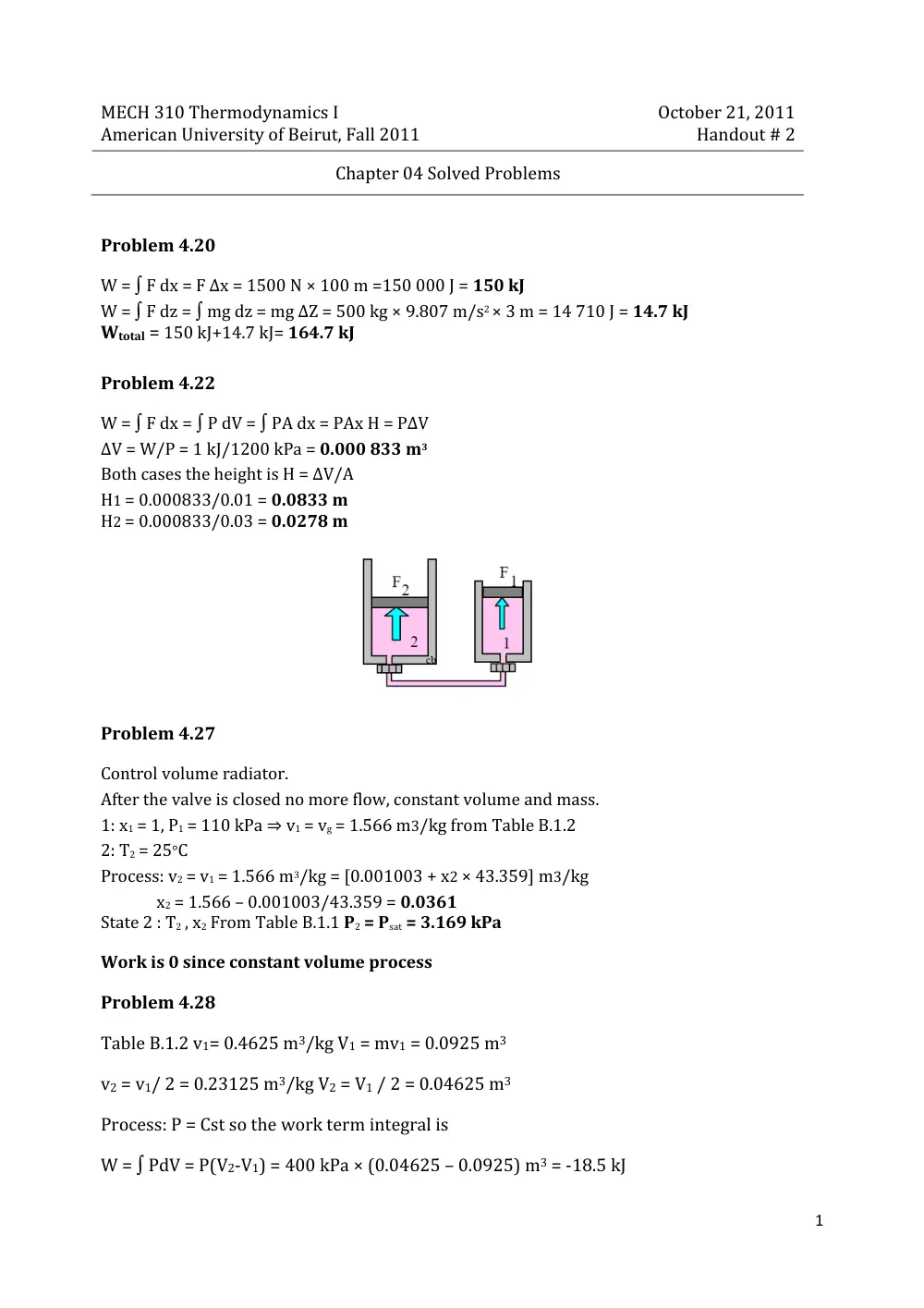
Table B.1.2 v1= 0.4625 m3/kg V1 = mv1 = 0.0925 m3
v2 = v1/ 2 = 0.23125 m3/kg V2 = V1 / 2 = 0.04625 m3
Process: P = Cst so the work term integral is
W = ∫ PdV = P(V2-V1) = 400 kPa × (0.04625 – 0.0925) m3 = -18.5 kJ
2
Problem 4.30
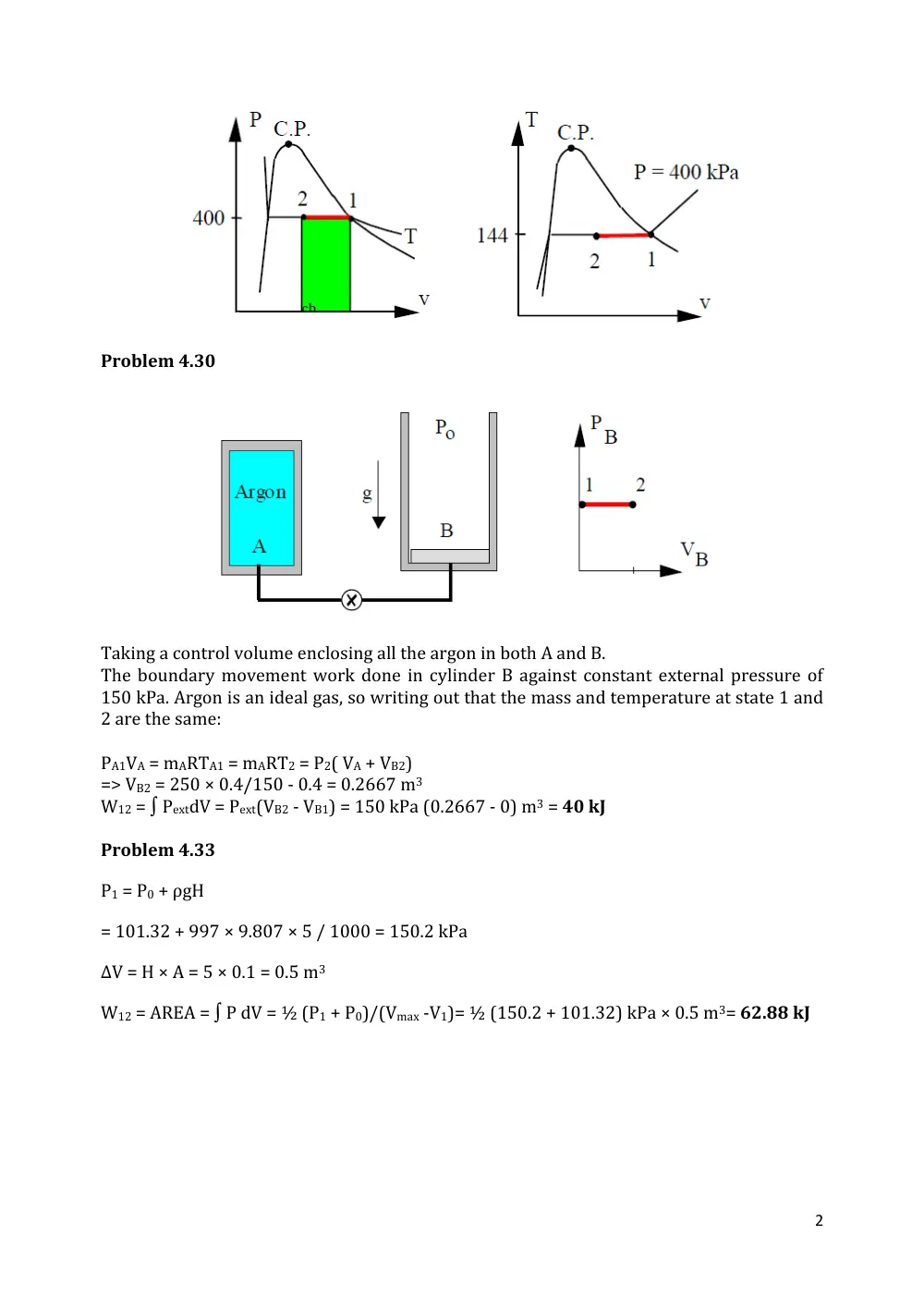
Taking a control volume enclosing all the argon in both A and B.
The boundary movement work done in cylinder B against constant external pressure of
150 kPa. Argon is an ideal gas, so writing out that the mass and temperature at state 1 and
2 are the same:
PA1VA = mARTA1 = mART2 = P2( VA + VB2)
=> VB2 = 250 × 0.4/150 - 0.4 = 0.2667 m3
W12 = ∫ PextdV = Pext(VB2 - VB1) = 150 kPa (0.2667 - 0) m3 = 40 kJ
Problem 4.33
P1 = P0 + ρgH
= 101.32 + 997 × 9.807 × 5 / 1000 = 150.2 kPa
ΔV = H × A = 5 × 0.1 = 0.5 m3
W12 = AREA = ∫ P dV = ½ (P1 + P0)/(Vmax -V1)= ½ (150.2 + 101.32) kPa × 0.5 m3= 62.88 kJ
3
Problem 4.35
a.
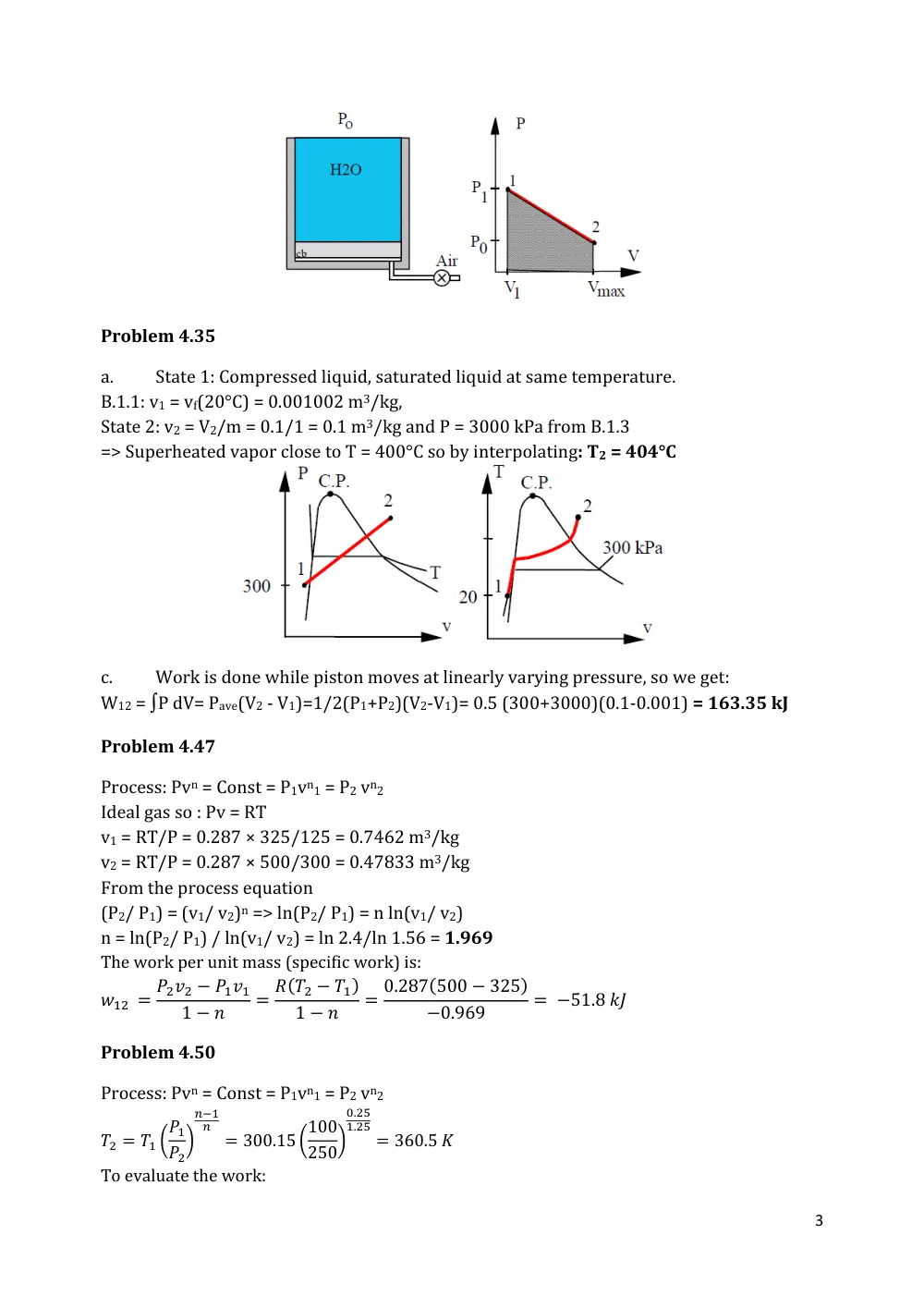
State 1: Compressed liquid, saturated liquid at same temperature.
B.1.1: v1 = vf(20°C) = 0.001002 m3/kg,
State 2: v2 = V2/m = 0.1/1 = 0.1 m3/kg and P = 3000 kPa from B.1.3
=> Superheated vapor close to T = 400°C so by interpolating: T2 = 404°C
c.
Work is done while piston moves at linearly varying pressure, so we get:
W12 = ∫P dV= Pave(V2 - V1)=1/2(P1+P2)(V2-V1)= 0.5 (300+3000)(0.1-0.001) = 163.35 kJ
Problem 4.47
Process: Pvn = Const = P1vn1 = P2 vn2
Ideal gas so : Pv = RT
v1 = RT/P = 0.287 × 325/125 = 0.7462 m3/kg
v2 = RT/P = 0.287 × 500/300 = 0.47833 m3/kg
From the process equation
(P2/ P1) = (v1/ v2)n => ln(P2/ P1) = n ln(v1/ v2)
n = ln(P2/ P1) / ln(v1/ v2) = ln 2.4/ln 1.56 = 1.969
The work per unit mass (specific work) is:
Problem 4.50
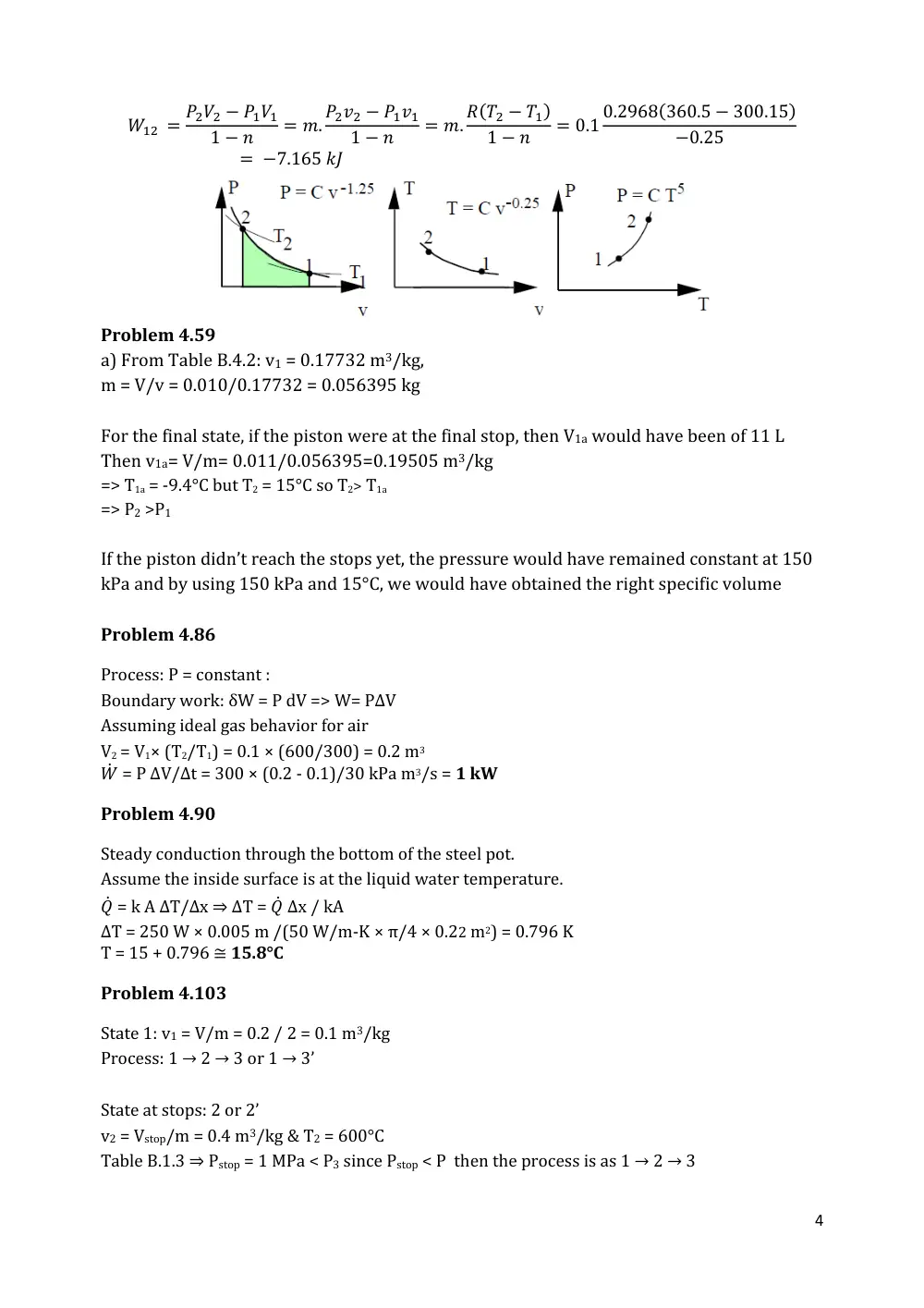
Process: Pvn = Const = P1vn1 = P2 vn2
To evaluate the work:
4
Problem 4.59
a) From Table B.4.2: v1 = 0.17732 m3/kg,
m = V/v = 0.010/0.17732 = 0.056395 kg
For the final state, if the piston were at the final stop, then V1a would have been of 11 L
Then v1a= V/m= 0.011/0.056395=0.19505 m3/kg
=> T1a = -9.4°C but T2 = 15°C so T2> T1a
=> P2 >P1
If the piston didn’t reach the stops yet, the pressure would have remained constant at 150
kPa and by using 150 kPa and 15°C, we would have obtained the right specific volume
Problem 4.86
Process: P = constant :
Boundary work: δW = P dV => W= PΔV
Assuming ideal gas behavior for air
V2 = V1× (T2/T1) = 0.1 × (600/300) = 0.2 m3
= P ΔV/Δt = 300 × (0.2 - 0.1)/30 kPa m3/s = 1 kW
Problem 4.90
Steady conduction through the bottom of the steel pot.
Assume the inside surface is at the liquid water temperature.
= k A ΔT/Δx ⇒ ΔΤ = Δx / kΑ
ΔT = 250 W × 0.005 m /(50 W/m-K × π/4 × 0.22 m2) = 0.796 K
T = 15 + 0.796 ≅ 15.8°C
Problem 4.103
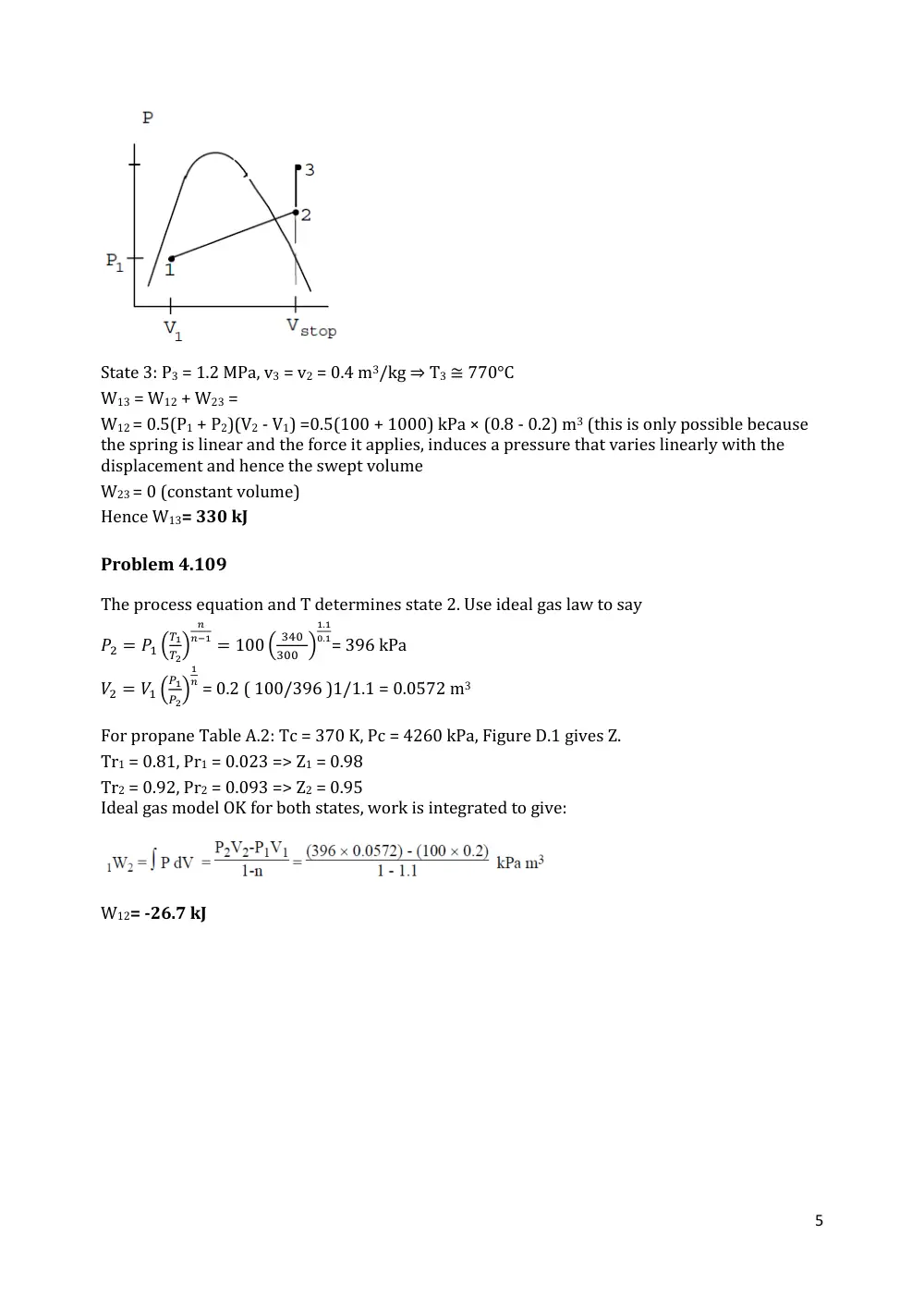
State 1: v1 = V/m = 0.2 / 2 = 0.1 m3/kg
Process: 1 → 2 → 3 or 1 → 3’
State at stops: 2 or 2’
v2 = Vstop/m = 0.4 m3/kg & T2 = 600°C
Table B.1.3 ⇒ Pstop = 1 MPa < P3 since Pstop < P then the process is as 1 → 2 → 3
5
State 3: P3 = 1.2 MPa, v3 = v2 = 0.4 m3/kg ⇒ T3 ≅ 770°C
W13 = W12 + W23 =
W12 = 0.5(P1 + P2)(V2 - V1) =0.5(100 + 1000) kPa × (0.8 - 0.2) m3 (this is only possible because
the spring is linear and the force it applies, induces a pressure that varies linearly with the
displacement and hence the swept volume
W23 = 0 (constant volume)
Hence W13= 330 kJ
Problem 4.109
The process equation and T determines state 2. Use ideal gas law to say
= 396 kPa
= 0.2 ( 100/396 )1/1.1 = 0.0572 m3
For propane Table A.2: Tc = 370 K, Pc = 4260 kPa, Figure D.1 gives Z.
Tr1 = 0.81, Pr1 = 0.023 => Z1 = 0.98
Tr2 = 0.92, Pr2 = 0.093 => Z2 = 0.95
Ideal gas model OK for both states, work is integrated to give:
W12= -26.7 kJ