
MECH 310 Problems Solution Manual Chapter 2, Fall 2011
American University of Beirut · Thermodynamics I · 103 pages · with solution


Showing the first 10 of 103 pages. Download the PDF to see all of it.
More MECH 310 files
- Essay Chapter 3 · Fall 2017ChapterView
- Problems Solution Manual Chapter 9 · Fall 2011Chapter · with solutionView
- Problems Chapter 5 Solutions · Fall 2011Chapter · with solutionView
- Problems Chapter 8 Solutions · Fall 2011Chapter · with solutionView
- Problems Chapter 9 Extra Problems · Fall 2011ChapterView
- Problems Chapter 6 Solutions · Fall 2011Chapter · with solutionView
- Problems Chapter 3 Solutions · Fall 2011Chapter · with solutionView
- Problems Chapter 4 Solutions · Fall 2011Chapter · with solutionView
Show the text of this chapter
SOLUTION MANUAL
CHAPTER 2
Borgnakke and Sonntag
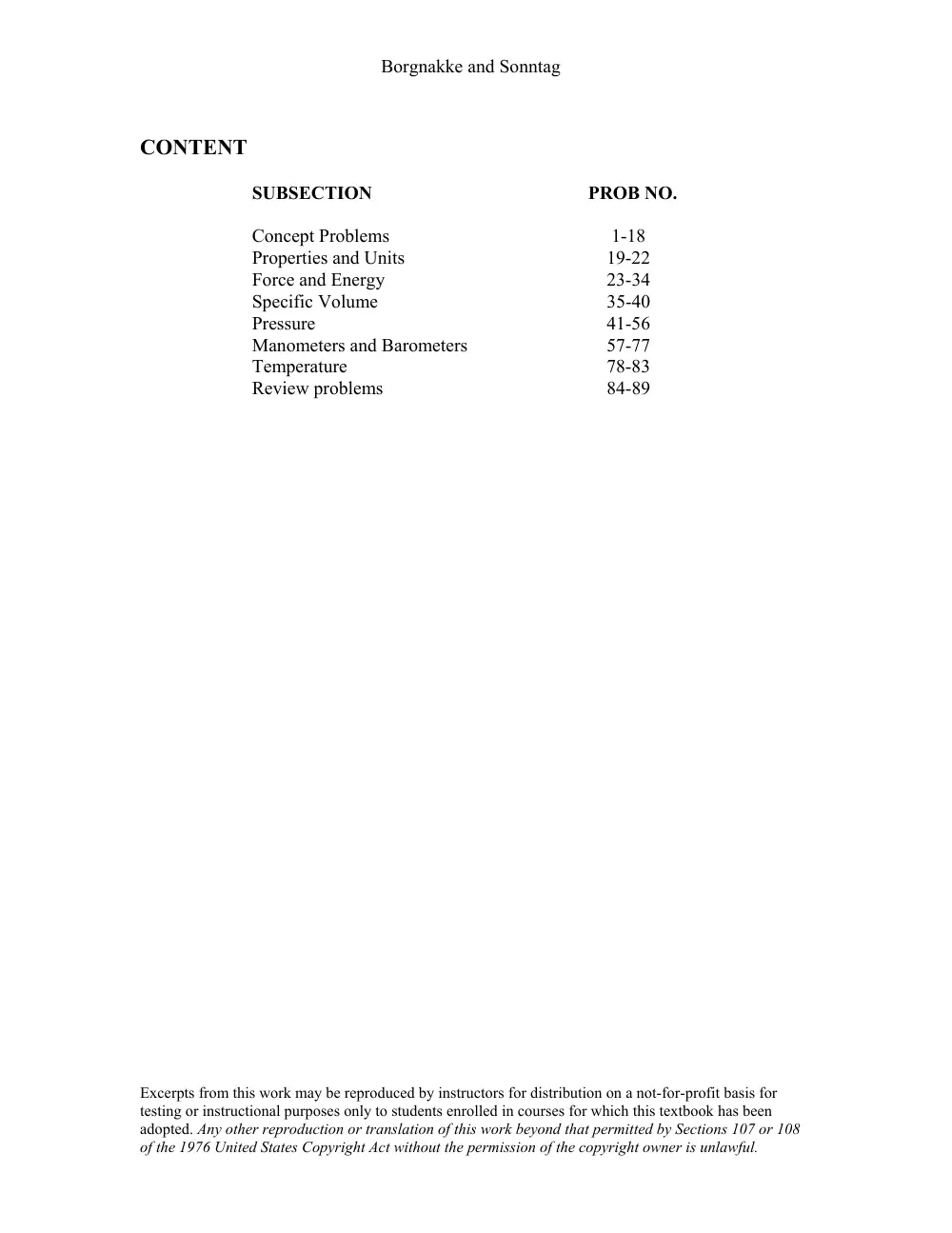
CONTENT
SUBSECTION
PROB NO.
Concept Problems
1-18
Properties and Units
19-22
Force and Energy
23-34
Specific Volume
35-40
Pressure
41-56
Manometers and Barometers
57-77
Temperature
78-83
Review problems
84-89
Excerpts from this work may be reproduced by instructors for distribution on a not-for-profit basis for
testing or instructional purposes only to students enrolled in courses for which this textbook has been
adopted. Any other reproduction or translation of this work beyond that permitted by Sections 107 or 108
of the 1976 United States Copyright Act without the permission of the copyright owner is unlawful.
Borgnakke and Sonntag
In-Text Concept Questions
Excerpts from this work may be reproduced by instructors for distribution on a not-for-profit basis for
testing or instructional purposes only to students enrolled in courses for which this textbook has been
adopted. Any other reproduction or translation of this work beyond that permitted by Sections 107 or 108
of the 1976 United States Copyright Act without the permission of the copyright owner is unlawful.
Borgnakke and Sonntag
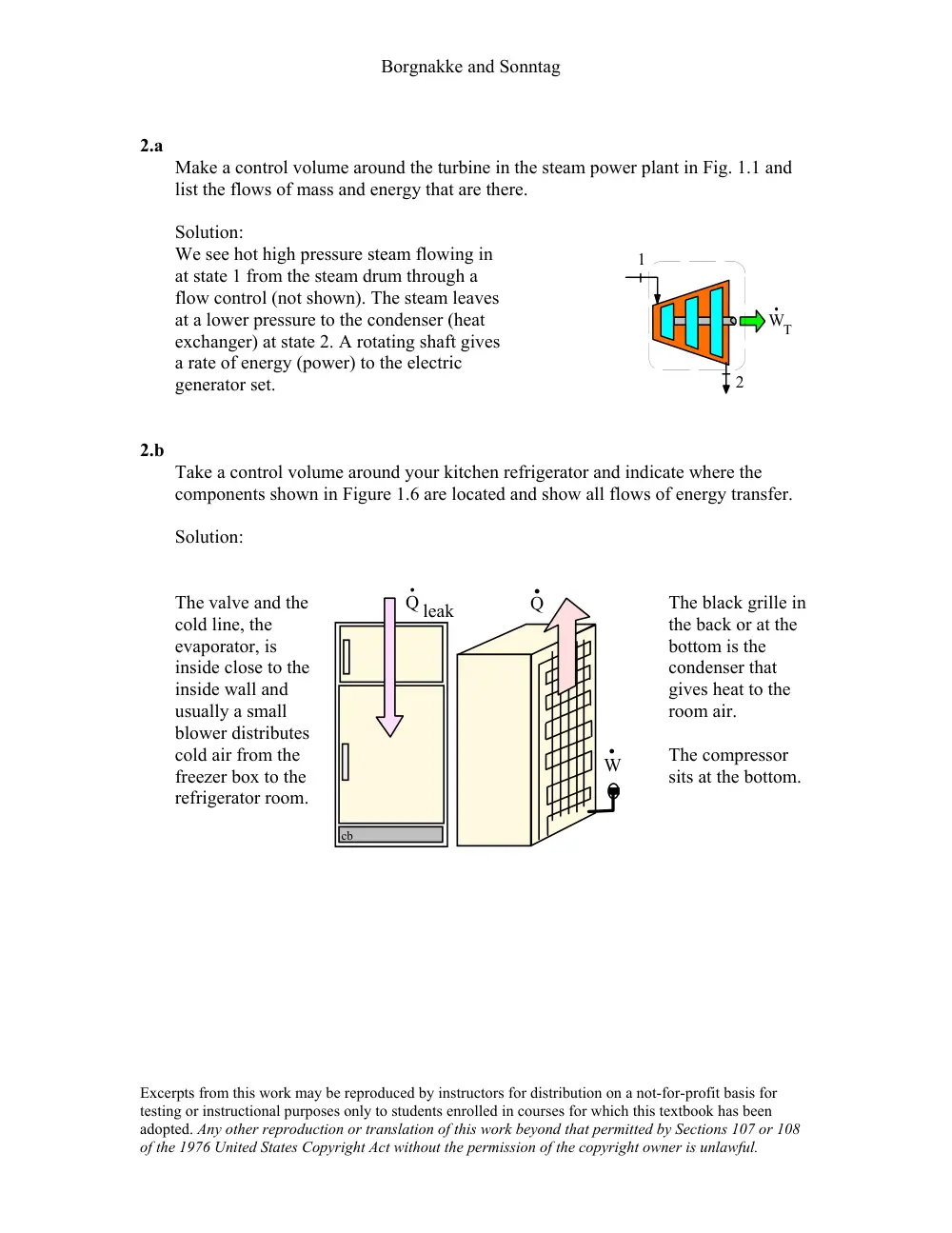
2.a
Make a control volume around the turbine in the steam power plant in Fig. 1.1 and
list the flows of mass and energy that are there.
Solution:
We see hot high pressure steam flowing in
at state 1 from the steam drum through a
flow control (not shown). The steam leaves
at a lower pressure to the condenser (heat
exchanger) at state 2. A rotating shaft gives
a rate of energy (power) to the electric
generator set.
WT
1
2
2.b
Take a control volume around your kitchen refrigerator and indicate where the
components shown in Figure 1.6 are located and show all flows of energy transfer.
Solution:
The valve and the
cold line, the
evaporator, is
inside close to the
inside wall and
usually a small
blower distributes
cold air from the
freezer box to the
refrigerator room.
cb
W.
Q.
Q leak
The black grille in
the back or at the
bottom is the
condenser that
gives heat to the
room air.
The compressor
sits at the bottom.
Excerpts from this work may be reproduced by instructors for distribution on a not-for-profit basis for
testing or instructional purposes only to students enrolled in courses for which this textbook has been
adopted. Any other reproduction or translation of this work beyond that permitted by Sections 107 or 108
of the 1976 United States Copyright Act without the permission of the copyright owner is unlawful.
Borgnakke and Sonntag
2.c
Why do people float high in the water when swimming in the Dead Sea as compared
with swimming in a fresh water lake?
As the dead sea is very salty its density is
higher than fresh water density. The
buoyancy effect gives a force up that equals
the weight of the displaced water. Since
density is higher the displaced volume is
smaller for the same force.
Excerpts from this work may be reproduced by instructors for distribution on a not-for-profit basis for
testing or instructional purposes only to students enrolled in courses for which this textbook has been
adopted. Any other reproduction or translation of this work beyond that permitted by Sections 107 or 108
of the 1976 United States Copyright Act without the permission of the copyright owner is unlawful.
Borgnakke and Sonntag
2.d
Density of liquid water is ρ = 1008 – T/2 [kg/m3] with T in oC. If the temperature
increases, what happens to the density and specific volume?
Solution:
The density is seen to decrease as the temperature increases.
∆ρ = – ∆T/2
Since the specific volume is the inverse of the density v = 1/ρ it will increase.
2.e
A car tire gauge indicates 195 kPa; what is the air pressure inside?
The pressure you read on the gauge is a gauge pressure, ∆P, so the absolute
pressure is found as
`
P = Po + ∆P = 101 + 195 = 296 kPa
Excerpts from this work may be reproduced by instructors for distribution on a not-for-profit basis for
testing or instructional purposes only to students enrolled in courses for which this textbook has been
adopted. Any other reproduction or translation of this work beyond that permitted by Sections 107 or 108
of the 1976 United States Copyright Act without the permission of the copyright owner is unlawful.
Borgnakke and Sonntag
2.f
Can I always neglect ∆P in the fluid above location A in figure 2.12? What does that
depend on?
If the fluid density above A is low relative to the manometer fluid then you
neglect the pressure variation above position A, say the fluid is a gas like air and the
manometer fluid is like liquid water. However, if the fluid above A has a density of
the same order of magnitude as the manometer fluid then the pressure variation with
elevation is as large as in the manometer fluid and it must be accounted for.
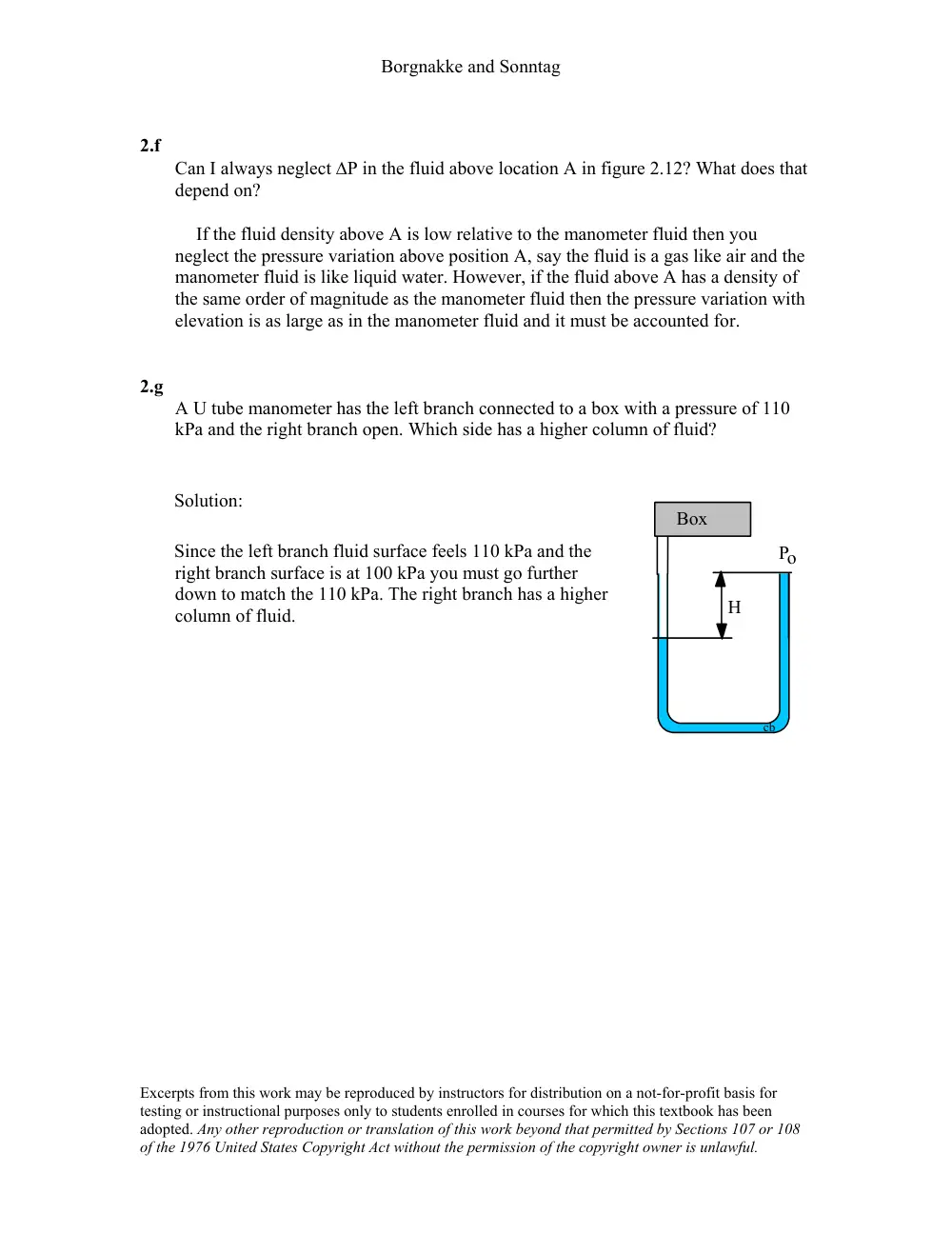
2.g
A U tube manometer has the left branch connected to a box with a pressure of 110
kPa and the right branch open. Which side has a higher column of fluid?
Solution:
Since the left branch fluid surface feels 110 kPa and the
right branch surface is at 100 kPa you must go further
down to match the 110 kPa. The right branch has a higher
column of fluid.
cb
Po
Box
H
Excerpts from this work may be reproduced by instructors for distribution on a not-for-profit basis for
testing or instructional purposes only to students enrolled in courses for which this textbook has been
adopted. Any other reproduction or translation of this work beyond that permitted by Sections 107 or 108
of the 1976 United States Copyright Act without the permission of the copyright owner is unlawful.
Borgnakke and Sonntag
Concept Problems
Excerpts from this work may be reproduced by instructors for distribution on a not-for-profit basis for
testing or instructional purposes only to students enrolled in courses for which this textbook has been
adopted. Any other reproduction or translation of this work beyond that permitted by Sections 107 or 108
of the 1976 United States Copyright Act without the permission of the copyright owner is unlawful.
Borgnakke and Sonntag
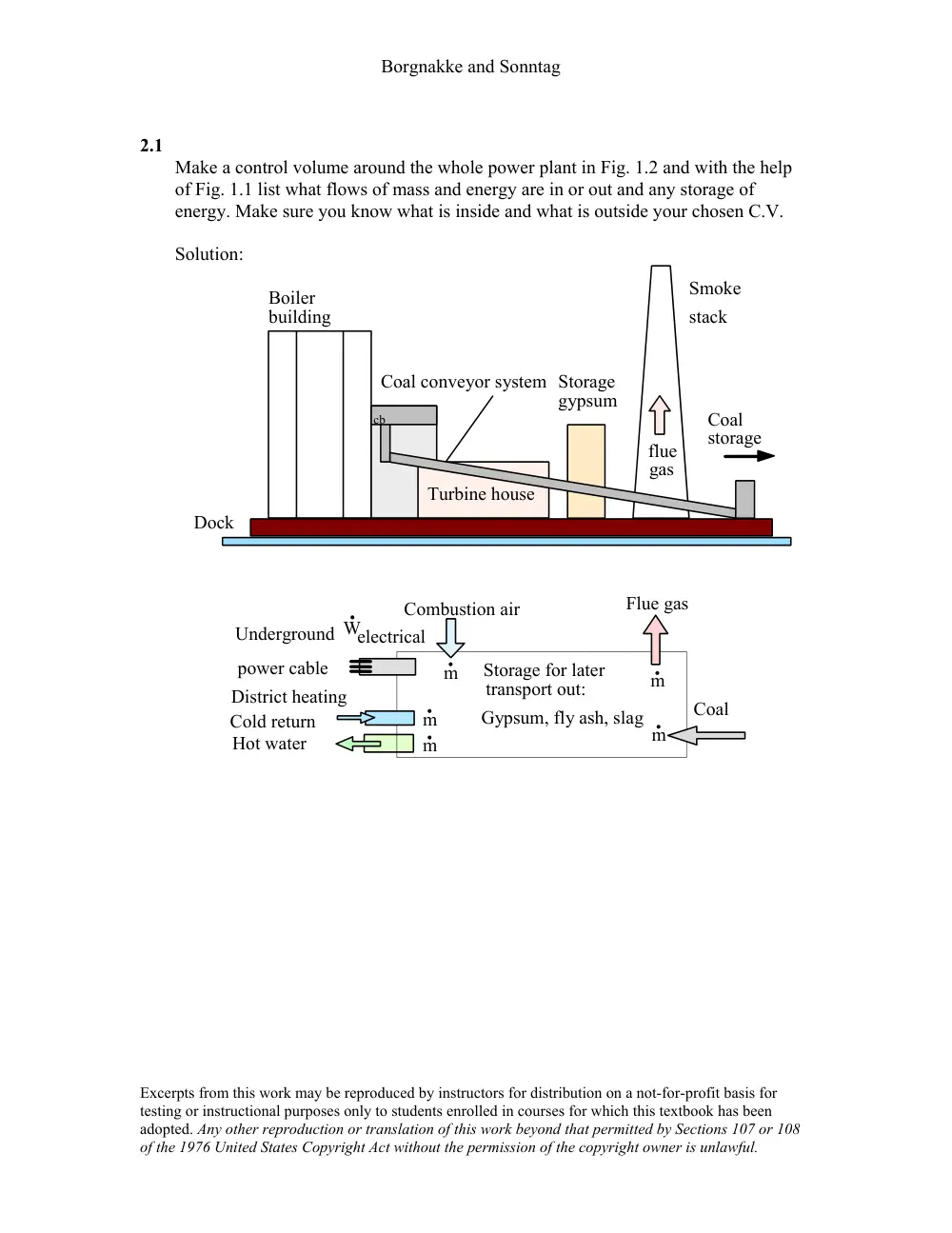
2.1
Make a control volume around the whole power plant in Fig. 1.2 and with the help
of Fig. 1.1 list what flows of mass and energy are in or out and any storage of
energy. Make sure you know what is inside and what is outside your chosen C.V.
Solution:
Smoke
stack
Boiler
building
Coal conveyor system
Dock
Turbine house
Storage
gypsum
Coal
storage
flue
gas
cb
Underground
power cable
W electrical
Hot water
District heating
m
Coal
m
m
Flue gas
Storage for later
Gypsum, fly ash, slag
transport out:
Cold return
m
m
Combustion air
Excerpts from this work may be reproduced by instructors for distribution on a not-for-profit basis for
testing or instructional purposes only to students enrolled in courses for which this textbook has been
adopted. Any other reproduction or translation of this work beyond that permitted by Sections 107 or 108
of the 1976 United States Copyright Act without the permission of the copyright owner is unlawful.
Borgnakke and Sonntag
Excerpts from this work may be reproduced by instructors for distribution on a not-for-profit basis for
testing or instructional purposes only to students enrolled in courses for which this textbook has been
adopted. Any other reproduction or translation of this work beyond that permitted by Sections 107 or 108
of the 1976 United States Copyright Act without the permission of the copyright owner is unlawful.
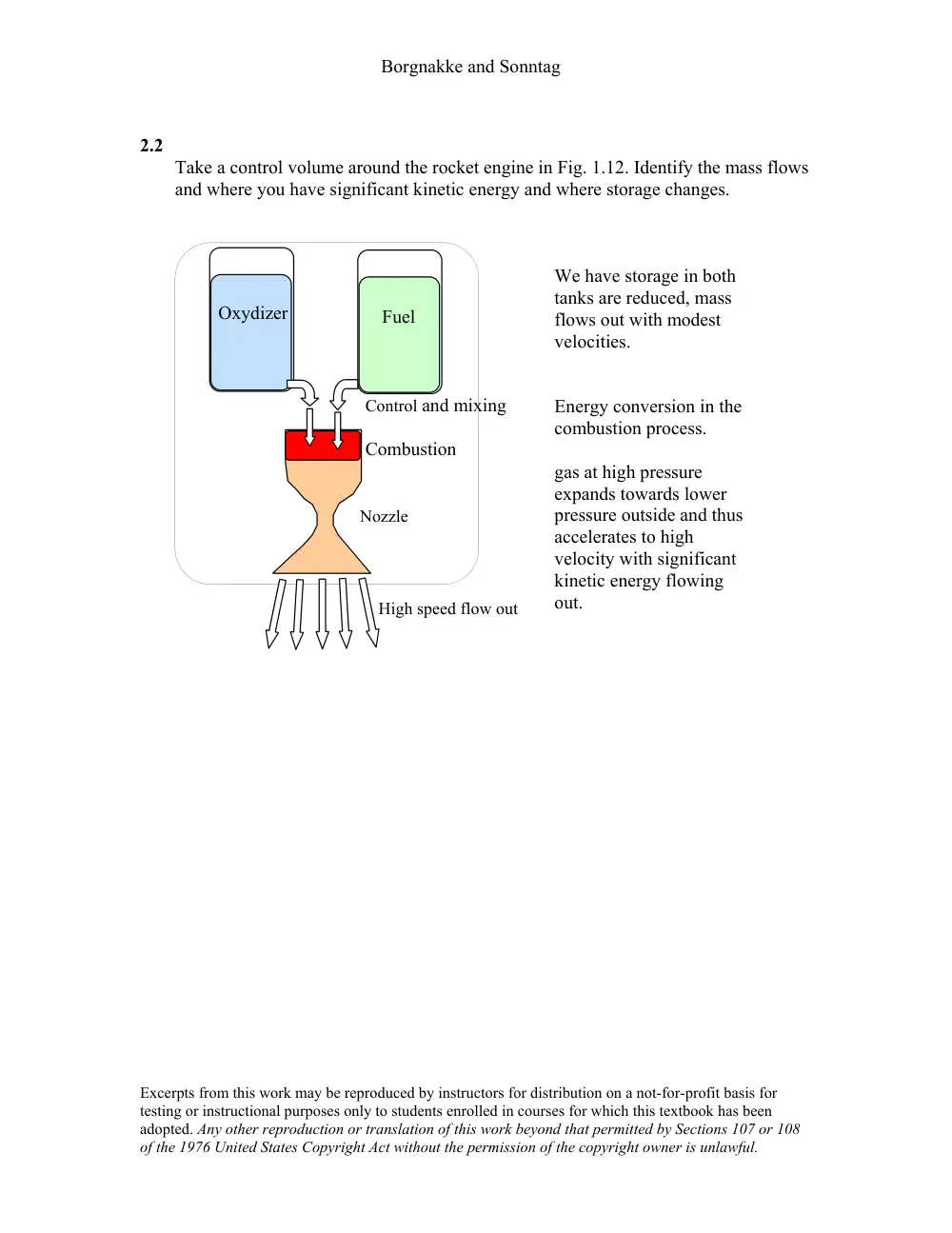
2.2
Take a control volume around the rocket engine in Fig. 1.12. Identify the mass flows
and where you have significant kinetic energy and where storage changes.
We have storage in both
tanks are reduced, mass
flows out with modest
velocities.
Energy conversion in the
combustion process.
gas at high pressure
expands towards lower
pressure outside and thus
accelerates to high
velocity with significant
kinetic energy flowing
out.
Control and mixing
Combustion
Oxydizer
Fuel
Nozzle
High speed flow out
Borgnakke and Sonntag
Excerpts from this work may be reproduced by instructors for distribution on a not-for-profit basis for
testing or instructional purposes only to students enrolled in courses for which this textbook has been
adopted. Any other reproduction or translation of this work beyond that permitted by Sections 107 or 108
of the 1976 United States Copyright Act without the permission of the copyright owner is unlawful.
2.3
Make a control volume that includes the steam flow around in the main turbine loop
in the nuclear propulsion system in Fig.1.3. Identify mass flows (hot or cold) and
energy transfers that enter or leave the C.V.
Solution:
The electrical power
also leaves the C.V.
to be used for lights,
instruments and to
charge the batteries.
1
1
Hot steam from generator
c Electric
power gen.
WT
cb
Welectrical
3
2
5
4
Condensate
to steam gen.
cold
7
6
Cooling by seawater
Borgnakke and Sonntag
2.4
Separate the list P, F, V, v, ρ, T, a, m, L, t, and V into intensive, extensive, and non-
properties.
Solution:
Intensive properties are independent upon mass: P, v, ρ, T
Extensive properties scales with mass:
V, m
Non-properties:
F, a, L, t, V
Comment: You could claim that acceleration a and velocity V are physical
properties for the dynamic motion of the mass, but not thermal properties.
Excerpts from this work may be reproduced by instructors for distribution on a not-for-profit basis for
testing or instructional purposes only to students enrolled in courses for which this textbook has been
adopted. Any other reproduction or translation of this work beyond that permitted by Sections 107 or 108
of the 1976 United States Copyright Act without the permission of the copyright owner is unlawful.
Borgnakke and Sonntag
2.5
An electric dip heater is put into a cup of water and heats it from 20oC to 80oC.
Show the energy flow(s) and storage and explain what changes.
Solution:
Electric power is converted in the heater
element (an electric resistor) so it becomes
hot and gives energy by heat transfer to
the water. The water heats up and thus
stores energy and as it is warmer than the
cup material it heats the cup which also
stores some energy. The cup being
warmer than the air gives a smaller
amount of energy (a rate) to the air as a
heat loss.
Welectric
Q loss
C
B
Excerpts from this work may be reproduced by instructors for distribution on a not-for-profit basis for
testing or instructional purposes only to students enrolled in courses for which this textbook has been
adopted. Any other reproduction or translation of this work beyond that permitted by Sections 107 or 108
of the 1976 United States Copyright Act without the permission of the copyright owner is unlawful.
Borgnakke and Sonntag
2.6
Water in nature exists in different phases such as solid, liquid and vapor (gas).
Indicate the relative magnitude of density and specific volume for the three phases.
Solution:
Values are indicated in Figure 2.7 as density for common substances. More
accurate values are found in Tables A.3, A.4 and A.5
Water as solid (ice) has density of around 900 kg/m3
Water as liquid has density of around 1000 kg/m3
Water as vapor has density of around 1 kg/m3 (sensitive to P and T)
Ice cube
Liquid drop
Cloud*
* Steam (water vapor) can not be seen what you see are tiny drops suspended in air from
which we infer that there was some water vapor before it condensed.
Excerpts from this work may be reproduced by instructors for distribution on a not-for-profit basis for
testing or instructional purposes only to students enrolled in courses for which this textbook has been
adopted. Any other reproduction or translation of this work beyond that permitted by Sections 107 or 108
of the 1976 United States Copyright Act without the permission of the copyright owner is unlawful.
Borgnakke and Sonntag
2.7
Is density a unique measure of mass distribution in a volume? Does it vary? If so, on
what kind of scale (distance)?
Solution:
Density is an average of mass per unit volume and we sense if it is not evenly
distributed by holding a mass that is more heavy in one side than the other.
Through the volume of the same substance (say air in a room) density varies only
little from one location to another on scales of meter, cm or mm. If the volume
you look at has different substances (air and the furniture in the room) then it can
change abruptly as you look at a small volume of air next to a volume of
hardwood.
Finally if we look at very small scales on the order of the size of atoms the density
can vary infinitely, since the mass (electrons, neutrons and positrons) occupy very
little volume relative to all the empty space between them.
Excerpts from this work may be reproduced by instructors for distribution on a not-for-profit basis for
testing or instructional purposes only to students enrolled in courses for which this textbook has been
adopted. Any other reproduction or translation of this work beyond that permitted by Sections 107 or 108
of the 1976 United States Copyright Act without the permission of the copyright owner is unlawful.
Borgnakke and Sonntag
2.8
Density of fibers, rock wool insulation, foams and cotton is fairly low. Why is that?
Solution:
All these materials consist of some solid substance and mainly air or other gas.
The volume of fibers (clothes) and rockwool that is solid substance is low relative
to the total volume that includes air. The overall density is
ρ = m
V =
msolid + mair
Vsolid + Vair
where most of the mass is the solid and most of the volume is air. If you talk
about the density of the solid only, it is high.
Excerpts from this work may be reproduced by instructors for distribution on a not-for-profit basis for
testing or instructional purposes only to students enrolled in courses for which this textbook has been
adopted. Any other reproduction or translation of this work beyond that permitted by Sections 107 or 108
of the 1976 United States Copyright Act without the permission of the copyright owner is unlawful.
Borgnakke and Sonntag
2.9
How much mass is there approximately in 1 L of engine oil? Atmospheric air?
Solution:
A volume of 1 L equals 0.001 m3, see Table A.1. From Table A.4 the density is
885 kg/m3 so we get
m = ρV = 885 kg/m3 × 0.001 m3 = 0.885 kg
For the air we see in Figure 2.7 that density is about 1 kg/m3 so we get
m = ρV = 1 kg/m3 × 0.001 m3 = 0.001 kg
A more accurate value from Table A.5 is ρ = 1.17 kg/m3 at 100 kPa, 25oC.
Excerpts from this work may be reproduced by instructors for distribution on a not-for-profit basis for
testing or instructional purposes only to students enrolled in courses for which this textbook has been
adopted. Any other reproduction or translation of this work beyond that permitted by Sections 107 or 108
of the 1976 United States Copyright Act without the permission of the copyright owner is unlawful.
Borgnakke and Sonntag
2.10
Can you carry 1 m3 of liquid water?
Solution:
The density of liquid water is about 1000 kg/m3 from Figure 2.7, see also Table
A.3. Therefore the mass in one cubic meter is
m = ρV = 1000 kg/m3 × 1 m3 = 1000 kg
and we can not carry that in the standard gravitational field.
Excerpts from this work may be reproduced by instructors for distribution on a not-for-profit basis for
testing or instructional purposes only to students enrolled in courses for which this textbook has been
adopted. Any other reproduction or translation of this work beyond that permitted by Sections 107 or 108
of the 1976 United States Copyright Act without the permission of the copyright owner is unlawful.
Borgnakke and Sonntag
2.11
A heavy cabinet has four adjustable feet on it. What feature of the feet will ensure
that they do not make dents in the floor?
Answer:
The area that is in contact with the floor supports the total mass in the
gravitational field.
F = PA = mg
so for a given mass the smaller the area is the larger the pressure becomes.
Excerpts from this work may be reproduced by instructors for distribution on a not-for-profit basis for
testing or instructional purposes only to students enrolled in courses for which this textbook has been
adopted. Any other reproduction or translation of this work beyond that permitted by Sections 107 or 108
of the 1976 United States Copyright Act without the permission of the copyright owner is unlawful.
Borgnakke and Sonntag
2.12
The pressure at the bottom of a swimming pool is evenly distributed. Suppose we
look at a cast iron plate of 7272 kg lying on the ground with an area of 100 m2. What
is the average pressure below that? Is it just as evenly distributed as the pressure at
the bottom of the pool?
Solution:
The pressure is force per unit area from page 25:
P = F/A = mg/A = 7272 kg × (9.81 m/s2) / 100 m2 = 713.4 Pa
The iron plate being cast can be reasonable plane and flat, but it is stiff and rigid.
However, the ground is usually uneven so the contact between the plate and the
ground is made over an area much smaller than the 100 m2. Thus the local
pressure at the contact locations is much larger than the quoted value above.
The pressure at the bottom of the swimming pool is very even due to the ability of
the fluid (water) to have full contact with the bottom by deforming itself. This is
the main difference between a fluid behavior and a solid behavior.
Iron plate
Ground
Excerpts from this work may be reproduced by instructors for distribution on a not-for-profit basis for
testing or instructional purposes only to students enrolled in courses for which this textbook has been
adopted. Any other reproduction or translation of this work beyond that permitted by Sections 107 or 108
of the 1976 United States Copyright Act without the permission of the copyright owner is unlawful.
Borgnakke and Sonntag
Excerpts from this work may be reproduced by instructors for distribution on a not-for-profit basis for
testing or instructional purposes only to students enrolled in courses for which this textbook has been
adopted. Any other reproduction or translation of this work beyond that permitted by Sections 107 or 108
of the 1976 United States Copyright Act without the permission of the copyright owner is unlawful.
2.13
Two divers swim at 20 m depth. One of them swims right in under a supertanker; the
other stays away from the tanker. Who feels a greater pressure?
Solution:
Each one feels the local pressure which is the static pressure only a function of
depth.
Pocean= P0 + ∆P = P0 + ρgH
So they feel exactly the same pressure.
Borgnakke and Sonntag
2.14
A manometer with water shows a ∆P of Po/10; what is the column height difference?
Solution:
∆P = Po/10 = ρHg
H = Po/(10 ρ g) =
101.3 × 1000 Pa
10 × 997 kg/m3 × 9.80665 m/s2
= 1.036 m
Excerpts from this work may be reproduced by instructors for distribution on a not-for-profit basis for
testing or instructional purposes only to students enrolled in courses for which this textbook has been
adopted. Any other reproduction or translation of this work beyond that permitted by Sections 107 or 108
of the 1976 United States Copyright Act without the permission of the copyright owner is unlawful.
Borgnakke and Sonntag
2.15
A water skier does not sink too far down in the water if the speed is high enough.
What makes that situation different from our static pressure calculations?
The water pressure right under the ski is not a static pressure but a static plus
dynamic pressure that pushes the water away from the ski. The faster you go, the
smaller amount of water is displaced but at a higher velocity.
Excerpts from this work may be reproduced by instructors for distribution on a not-for-profit basis for
testing or instructional purposes only to students enrolled in courses for which this textbook has been
adopted. Any other reproduction or translation of this work beyond that permitted by Sections 107 or 108
of the 1976 United States Copyright Act without the permission of the copyright owner is unlawful.
Borgnakke and Sonntag
2.16
What is the smallest temperature in degrees Celsuis you can have? Kelvin?
Solution:
The lowest temperature is absolute zero which is
at zero degrees Kelvin at which point the
temperature in Celsius is negative
TK = 0 K = −273.15 oC
Excerpts from this work may be reproduced by instructors for distribution on a not-for-profit basis for
testing or instructional purposes only to students enrolled in courses for which this textbook has been
adopted. Any other reproduction or translation of this work beyond that permitted by Sections 107 or 108
of the 1976 United States Copyright Act without the permission of the copyright owner is unlawful.
Borgnakke and Sonntag
2.17
Convert the formula for water density in In-text Concept Question “e” to be for T in
degrees Kelvin.
Solution:
ρ = 1008 – TC/2 [kg/m3]
We need to express degrees Celsius in degrees Kelvin
TC = TK – 273.15
and substitute into formula
ρ = 1008 – TC/2 = 1008 – (TK – 273.15)/2 = 1144.6 – TK/2
Excerpts from this work may be reproduced by instructors for distribution on a not-for-profit basis for
testing or instructional purposes only to students enrolled in courses for which this textbook has been
adopted. Any other reproduction or translation of this work beyond that permitted by Sections 107 or 108
of the 1976 United States Copyright Act without the permission of the copyright owner is unlawful.
Borgnakke and Sonntag
2.18
A thermometer that indicates the temperature with a liquid column has a bulb with a
larger volume of liquid, why is that?
The expansion of the liquid volume with temperature is rather small so by having
a larger volume expand with all the volume increase showing in the very small
diameter column of fluid greatly increases the signal that can be read.
Excerpts from this work may be reproduced by instructors for distribution on a not-for-profit basis for
testing or instructional purposes only to students enrolled in courses for which this textbook has been
adopted. Any other reproduction or translation of this work beyond that permitted by Sections 107 or 108
of the 1976 United States Copyright Act without the permission of the copyright owner is unlawful.
Borgnakke and Sonntag
Properties and units
Excerpts from this work may be reproduced by instructors for distribution on a not-for-profit basis for
testing or instructional purposes only to students enrolled in courses for which this textbook has been
adopted. Any other reproduction or translation of this work beyond that permitted by Sections 107 or 108
of the 1976 United States Copyright Act without the permission of the copyright owner is unlawful.
Borgnakke and Sonntag
2.19
An apple “weighs” 60 g and has a volume of 75 cm3 in a refrigerator at 8oC.
What is the apple density? List three intensive and two extensive properties of the
apple.
Solution:
ρ = m
V =
0.06
0.000 075 kg
m3 = 800 kg
m3
Intensive
ρ = 800 kg
m3 ;
v = 1
ρ = 0.001 25 m3
kg
T = 8°C;
P = 101 kPa
Extensive
m = 60 g = 0.06 kg
V = 75 cm3 = 0.075 L = 0.000 075 m3
Excerpts from this work may be reproduced by instructors for distribution on a not-for-profit basis for
testing or instructional purposes only to students enrolled in courses for which this textbook has been
adopted. Any other reproduction or translation of this work beyond that permitted by Sections 107 or 108
of the 1976 United States Copyright Act without the permission of the copyright owner is unlawful.
Borgnakke and Sonntag
2.20
A steel cylinder of mass 2 kg contains 4 L of liquid water at 25oC at 200 kPa.
Find the total mass and volume of the system. List two extensive and three
intensive properties of the water
Solution:
Density of steel in Table A.3: ρ = 7820 kg/m3
Volume of steel:
V = m/ρ =
2 kg
7820 kg/m3 = 0.000 256 m3
Density of water in Table A.4: ρ = 997 kg/m3
Mass of water:
m = ρV = 997 kg/m3 ×0.004 m3 = 3.988 kg
Total mass:
m = msteel + mwater = 2 + 3.988 = 5.988 kg
Total volume:
V = Vsteel + Vwater = 0.000 256 + 0.004
= 0.004 256 m3 = 4.26 L
Extensive properties: m, V
Intensive properties: ρ (or v = 1/ρ), T, P
Excerpts from this work may be reproduced by instructors for distribution on a not-for-profit basis for
testing or instructional purposes only to students enrolled in courses for which this textbook has been
adopted. Any other reproduction or translation of this work beyond that permitted by Sections 107 or 108
of the 1976 United States Copyright Act without the permission of the copyright owner is unlawful.
Borgnakke and Sonntag
2.21
A storage tank of stainless steel contains 7 kg of oxygen gas and 5 kg of nitrogen
gas. How many kmoles are in the tank?
Table A.2: MO2 = 31.999 ; MN2 = 28.013
nO2 = mO2 / MO2 =
7
31.999 = 0.21876 kmol
nO2 = mN2 / MN2 =
5
28.013 = 0.17848 kmol
ntot = nO2 + nN2 = 0.21876 + 0.17848 = 0.3972 kmol
Excerpts from this work may be reproduced by instructors for distribution on a not-for-profit basis for
testing or instructional purposes only to students enrolled in courses for which this textbook has been
adopted. Any other reproduction or translation of this work beyond that permitted by Sections 107 or 108
of the 1976 United States Copyright Act without the permission of the copyright owner is unlawful.
Borgnakke and Sonntag
2.22
One kilopond (1 kp) is the weight of 1 kg in the standard gravitational field. How
many Newtons (N) is that?
F = ma = mg
1 kp = 1 kg × 9.807 m/s2 = 9.807 N
Excerpts from this work may be reproduced by instructors for distribution on a not-for-profit basis for
testing or instructional purposes only to students enrolled in courses for which this textbook has been
adopted. Any other reproduction or translation of this work beyond that permitted by Sections 107 or 108
of the 1976 United States Copyright Act without the permission of the copyright owner is unlawful.
Borgnakke and Sonntag
Force and Energy
Excerpts from this work may be reproduced by instructors for distribution on a not-for-profit basis for
testing or instructional purposes only to students enrolled in courses for which this textbook has been
adopted. Any other reproduction or translation of this work beyond that permitted by Sections 107 or 108
of the 1976 United States Copyright Act without the permission of the copyright owner is unlawful.
Borgnakke and Sonntag
2.23
The “standard” acceleration (at sea level and 45° latitude) due to gravity is
9.80665 m/s2. What is the force needed to hold a mass of 2 kg at rest in this
gravitational field? How much mass can a force of 1 N support?
Solution:
ma = 0 = ∑ F = F - mg
F = mg = 2 kg × 9.80665 m/s2 = 19.613 N
F = mg
=>
m = F
g =
1 N
9.80665 m/s2 = 0.102 kg
m
F
g
Excerpts from this work may be reproduced by instructors for distribution on a not-for-profit basis for
testing or instructional purposes only to students enrolled in courses for which this textbook has been
adopted. Any other reproduction or translation of this work beyond that permitted by Sections 107 or 108
of the 1976 United States Copyright Act without the permission of the copyright owner is unlawful.
Borgnakke and Sonntag
Excerpts from this work may be reproduced by instructors for distribution on a not-for-profit basis for
testing or instructional purposes only to students enrolled in courses for which this textbook has been
adopted. Any other reproduction or translation of this work beyond that permitted by Sections 107 or 108
of the 1976 United States Copyright Act without the permission of the copyright owner is unlawful.
2.24
A steel piston of 2.5 kg is in the standard gravitational field where a force of 25 N
is applied vertically up. Find the acceleration of the piston.
Solution:
Fup = ma = F – mg
a = F – mg
m
= F
m – g
= 25 N
2.5 kg – 9.807 m/s2
= 0.193 ms-2
g
F
Borgnakke and Sonntag
2.25
When you move up from the surface of the earth the gravitation is reduced as g =
9.807 − 3.32 × 10⁻⁶ z, with z as the elevation in meters. How many percent is the
weight of an airplane reduced when it cruises at 11 000 m?
Solution:
go= 9.807 ms-2
gH = 9.807 – 3.32 × 10-6 × 11 000 = 9.7705 ms-2
Wo = m go ; WH = m gH
WH/Wo = gH/go = 9.7705
9.807 = 0.9963
Reduction = 1 – 0.9963 = 0.0037 or 0.37%
i.e. we can neglect that for most applications.
Excerpts from this work may be reproduced by instructors for distribution on a not-for-profit basis for
testing or instructional purposes only to students enrolled in courses for which this textbook has been
adopted. Any other reproduction or translation of this work beyond that permitted by Sections 107 or 108
of the 1976 United States Copyright Act without the permission of the copyright owner is unlawful.
Borgnakke and Sonntag
2.26
A model car rolls down an incline with a slope so the gravitational “pull” in the
direction of motion is one third of the standard gravitational force (see Problem
2.23). If the car has a mass of 0.06 kg find the acceleration.
Solution:
ma = ∑ F = mg / 3
a = mg / 3m = g/3
= 9.80665 (m/s2) / 3
= 3.27 m/s2
g
This acceleration does not depend on the mass of the model car.
Excerpts from this work may be reproduced by instructors for distribution on a not-for-profit basis for
testing or instructional purposes only to students enrolled in courses for which this textbook has been
adopted. Any other reproduction or translation of this work beyond that permitted by Sections 107 or 108
of the 1976 United States Copyright Act without the permission of the copyright owner is unlawful.
Borgnakke and Sonntag
2.27
A van drives at 60 km/h and is brought to a full stop with constant deceleration in
5 seconds. If the total car and driver mass is 2075 kg find the necessary force.
Solution:
Acceleration is the time rate of change of velocity.
a = dV
dt = 60 × 1000
3600 × 5 = 3.333 m/s2
ma = ∑ F ;
Fnet = ma = 2075 kg × 3.333 m/s2 = 6916 N
Excerpts from this work may be reproduced by instructors for distribution on a not-for-profit b