
PHYS 101 Chapter 1, Spring 2016
American University of Beirut · Introductory Physics I · 21 pages · Mr. Charbel Madi


Showing the first 10 of 21 pages. Download the PDF to see all of it.
More PHYS 101 files
Show the text of this chapter
Measurement
Chapter 1
Copyright © 2014 John Wiley & Sons, Inc. All rights reserved.
© 2014 John Wiley & Sons, Inc. All rights reserved.
1-1 Measuring Things, Including Lengths
1.01 Identify the base
quantities in the SI system.
1.02 Name the most frequently
used prefixes for SI units.
1.03 Change units (here for
length, area, and volume) by
using chain-link conversions.
1.04 Explain that the meter is
defined in terms of the speed
of light in a vacuum.
Learning Objectives
1-1 Measuring Things, Including Lengths
Science is based on the precise measurement and exploration of
physical phenomena described by physical quantities. We discover
science by learning how to measure these quantities (length, mass,
time, pressure, temperature,…). Physics (most basic of the sciences)
Therefore, we need:
1. Rules for measurement and comparison
2. Units for measurement
A unit:
Is the unique name (kg, second, meter, Pascal, etc.) assigned to the
measure of a quantity (mass, time, length, pressure, etc.) by comparison
with a standard.
Standard corresponds to exactly 1.0 unit of the quantity (e.g. standard
for length is 1.0 meter; any other length whatsoever must now be
expressed in terms of that standard)
© 2014 John Wiley & Sons, Inc. All rights reserved.
1-1 Measuring Things, Including Lengths
There are many different physical quantities, but not all
are independent: distance vs. speed (distance/time)
Base quantities (international agreement):
Are seven fundamental quantities such as length, time
Three are needed for mechanics: length, time, mass
All have been assigned standards
Are used to define all other physical quantities
Base standards must be:
Accessible, so precise measurements can be taken
Invariable, so measurements do not change over time
© 2014 John Wiley & Sons, Inc. All rights reserved.
1-1 Measuring Things, Including Lengths
SI units (the metric system) form the International System of
Units (agreed upon in 1971, consisting of seven quantities: m,
Kg, s, A, K, mol, cd)
SI base units include
Meters (length)
Seconds (time)
Kilograms (mass)
SI has many derived units, which are written in terms of base
units
Joules (work-energy): 1 J = 1 kg m2/s2
Watts (power): 1 W = 1 J/s = 1 kg m2/s3
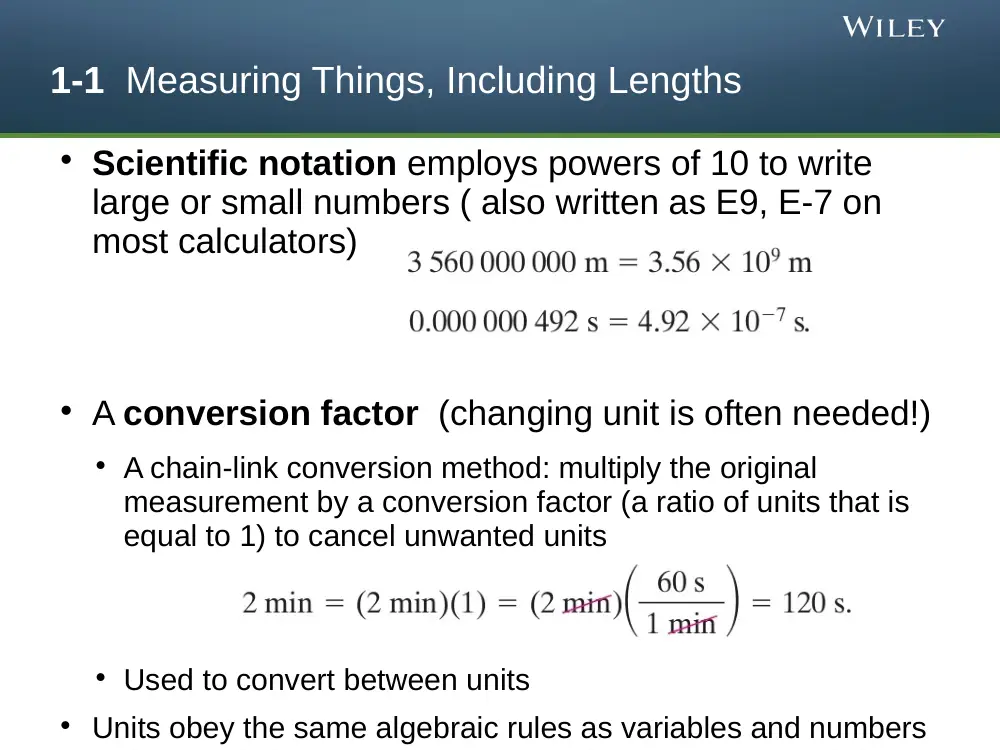
1-1 Measuring Things, Including Lengths
Scientific notation employs powers of 10 to write
large or small numbers ( also written as E9, E-7 on
most calculators)
A conversion factor (changing unit is often needed!)
A chain-link conversion method: multiply the original
measurement by a conversion factor (a ratio of units that is
equal to 1) to cancel unwanted units
Used to convert between units
Units obey the same algebraic rules as variables and numbers
1-1 Measuring Things, Including Lengths
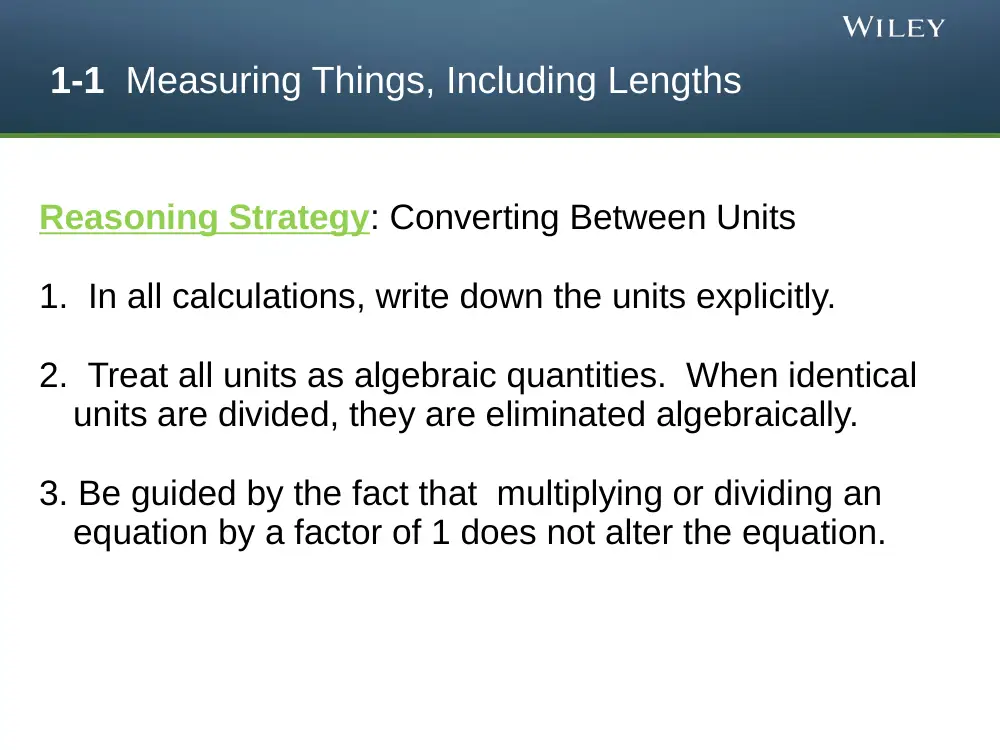
Reasoning Strategy: Converting Between Units
1. In all calculations, write down the units explicitly.
2. Treat all units as algebraic quantities. When identical
units are divided, they are eliminated algebraically.
3. Be guided by the fact that multiplying or dividing an
equation by a factor of 1 does not alter the equation.
1-1 Measuring Things, Including Lengths
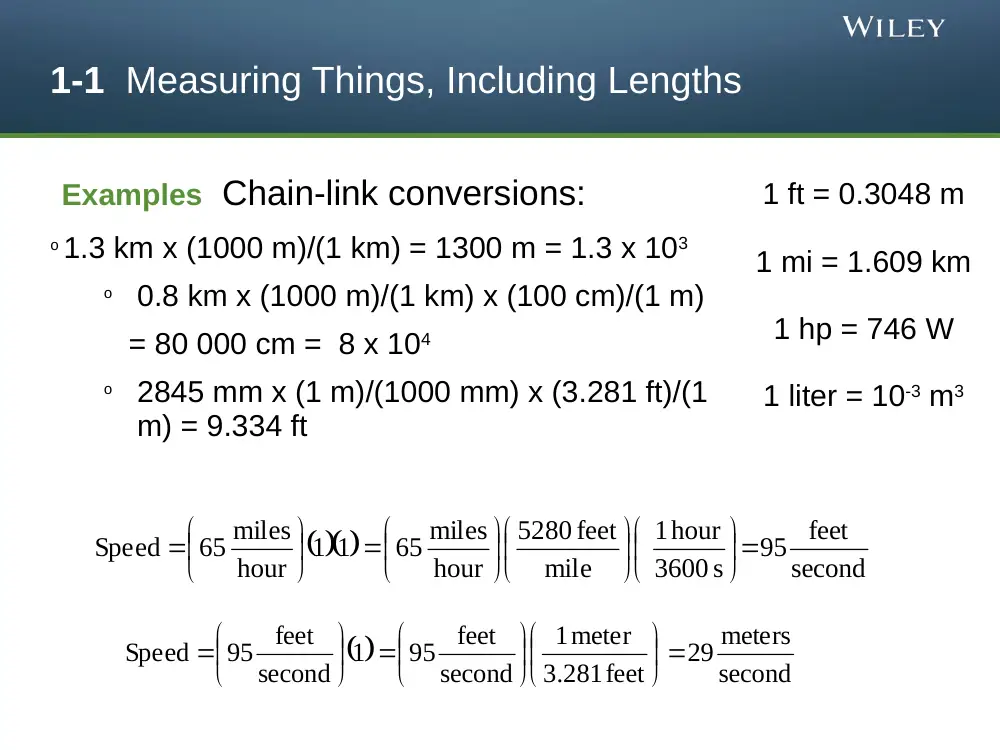
Examples Chain-link conversions:
o1.3 km x (1000 m)/(1 km) = 1300 m = 1.3 x 10³
o
0.8 km x (1000 m)/(1 km) x (100 cm)/(1 m)
= 80 000 cm = 8 x 10⁴
o
2845 mm x (1 m)/(1000 mm) x (3.281 ft)/(1
m) = 9.334 ft
second
feet
95
s
3600
1 hour
mile
feet
5280
hour
65 miles
1 1
hour
Speed 65 miles
second
29 meters
feet
3.281
meter
1
second
feet
95
1
second
feet
Speed 95
1 ft = 0.3048 m
1 mi = 1.609 km
1 hp = 746 W
1 liter = 10-3 m3
© 2014 John Wiley & Sons, Inc. All rights reserved.
1-1 Measuring Things, Including Lengths
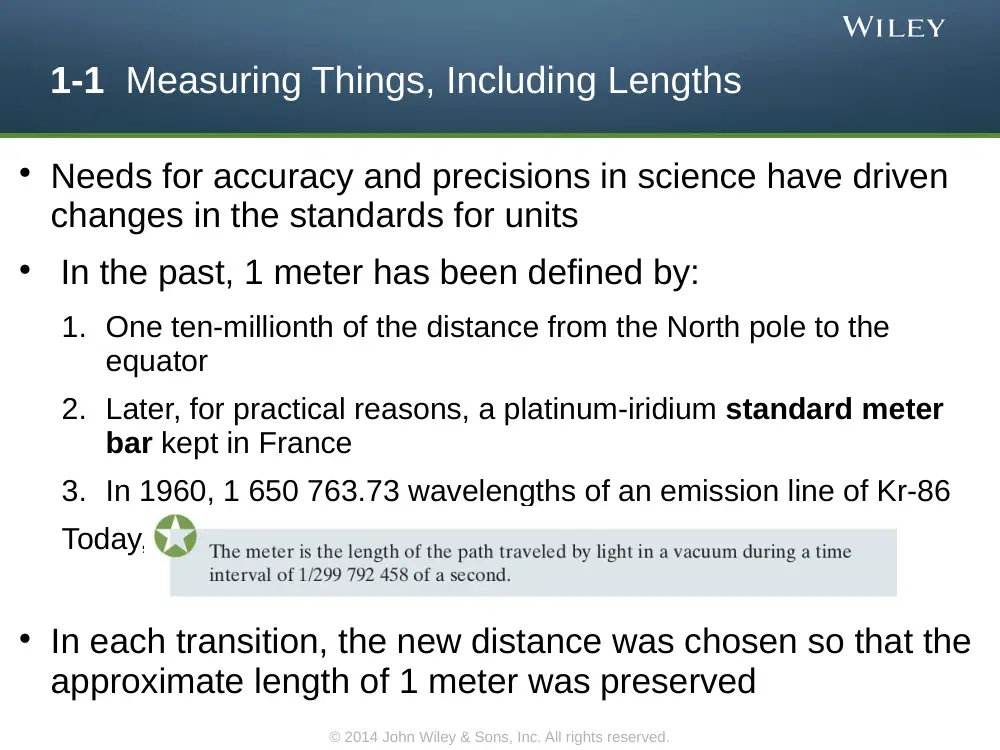
Needs for accuracy and precisions in science have driven
changes in the standards for units
In the past, 1 meter has been defined by:
1. One ten-millionth of the distance from the North pole to the
equator
2. Later, for practical reasons, a platinum-iridium standard meter
bar kept in France
3. In 1960, 1 650 763.73 wavelengths of an emission line of Kr-86
Today,
In each transition, the new distance was chosen so that the
approximate length of 1 meter was preserved
© 2014 John Wiley & Sons, Inc. All rights reserved.
1-1 Measuring Things, Including Lengths
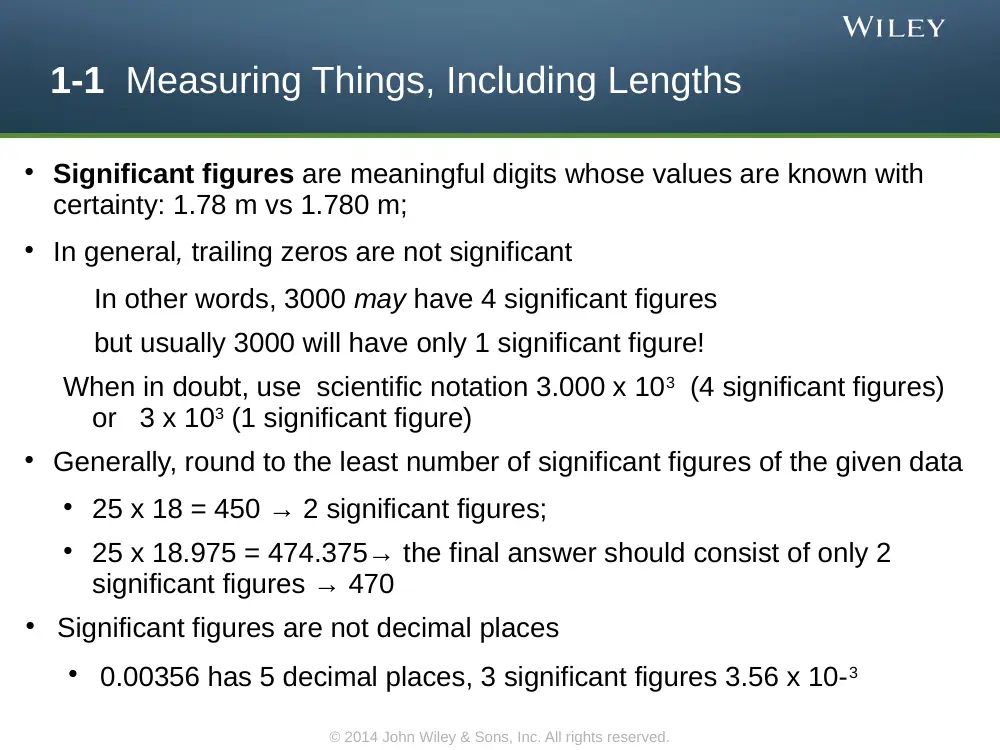
Significant figures are meaningful digits whose values are known with
certainty: 1.78 m vs 1.780 m;
In general, trailing zeros are not significant
In other words, 3000 may have 4 significant figures
but usually 3000 will have only 1 significant figure!
When in doubt, use scientific notation 3.000 x 10³ (4 significant figures)
or 3 x 10³ (1 significant figure)
Generally, round to the least number of significant figures of the given data
25 x 18 = 450 → 2 significant figures;
25 x 18.975 = 474.375→ the final answer should consist of only 2
significant figures → 470
Significant figures are not decimal places
0.00356 has 5 decimal places, 3 significant figures 3.56 x 10⁻³
© 2014 John Wiley & Sons, Inc. All rights reserved.
As a rule, when numbers are multiplied or divided,
the number of significant figures in the final answer
equals the smallest number of significant figures in
any of the original factors.
As a rule, when numbers are added or subtracted,
the last significant figure in the final answer occurs in
the last column containing a number that results
from a combination of digits that are all significant.
2.5 + 11 + 5.26 = 18.76 19
1-1 Measuring Things, Including Lengths
1-2 Time
Any standard of time needs to be able to answer:
o
When did a thing happen?
o
What was its duration?
Times follow the same conversion process as lengths
Standards of time in the past have included (any phenomenon that
repeats itself is a candidate):
1. Average time for the Earth to rotate once: 1 day being set to
86,400 seconds
2. Quartz clock (piezo-electric material that uses an electronic
oscillator that is regulated by a quartz crystal to keep time)
3. Cesium Atomic clocks (uncertainty of 1 sec in 60 millions years)
© 2014 John Wiley & Sons, Inc. All rights reserved.
1-2 Time
The variation in the length of a day as measured by an
atomic clock:
Figure 1-2
The vertical scale here
amounts to only 3 ms, or
0.003 s.
This shows the precision
of atomic clocks, and the
relative imprecision of
Earth's rotation (affected
by tides, winds)
© 2014 John Wiley & Sons, Inc. All rights reserved.
1-3 Mass
The standard kilogram is a cylinder of platinum and
iridium stored in France.
Accurate copies have been sent around the world,
other masses can be measured by comparing them
against these copies
The atomic mass unit (u) is a second mass standard
1 atom of Carbon-12 is assigned a mass 12 u (international
agreement)
Used for measuring masses of atoms and molecules
1 u = 1.660 538 86 x 10-27 kg (+/- 10 x 10-35 kg)
Masses follow the same conversion process as
lengths and times
© 2014 John Wiley & Sons, Inc. All rights reserved.
1-3 Mass
For uniformly (homogeneous) system, we define the
Mass per unit volume of that system to be the density
Eq. (1-8)
Examples Calculate . . .
o
Density of material: (18 kg) / (0.032 m3) = 560 kg/m3
o
Mass of object: (380 kg/m3) x (0.0040 m3) = 1.5 kg
o
Volume of object: (250 kg) / (1280 kg/m3) = 0.20 m3
© 2014 John Wiley & Sons, Inc. All rights reserved.
Measurement
Defined by relationships to
base quantities
Each defined by a standard,
and given a unit
SI Units
International System of Units
Each base unit has an
accessible standard of
measurement
Length
Meter is defined by the
distance traveled by light in a
vacuum in a specified time
interval
Changing Units
Use chain-link conversions
Write conversion factors as
unity
Manipulate units as algebraic
quantities
1 Summary
© 2014 John Wiley & Sons, Inc. All rights reserved.
Time
Second is defined in terms of
oscillations of light emitted by a
cesium-133 source
Atomic clocks are used as the
time standard
Mass
Kilogram is defined in terms of
a platinum-iridium standard
mass
Atomic-scale masses are
measured in u, defined as mass
of a carbon-12 atom
Density
Mass/volume
Eq. (1-8)
1 Summary
DIMENSIONAL ANALYSIS
DIMENSIONAL ANALYSIS
Distance has the dimension of length, [L]
Dimension of mass is [M]
Dimension of time is [T]
All physical quantities are expressed by specifying both a
number and a unit. Dimension refers to the physical nature of
a physical quantity and the type of unit used to specify it.
Many physical quantities (derived units) are in terms of a
combination of fundamental dimensions (base units) such as
[L], [M], and [T]
2
2
1 vt
x
Is the following equation dimensionally correct?
L T
T T
L
L
2
DIMENSIONAL ANALYSIS is used to check mathematical
relations for the consistency of their dimensions
DIMENSIONAL ANALYSIS
Is the following equation dimensionally correct?
vt
x
L
T T
L
L
DIMENSIONAL ANALYSIS alone can not
identify the correct the relation
DIMENSIONAL ANALYSIS