
PHYS 101 Exam 2, Spring 2015
American University of Beirut · Introductory Physics I · 8 pages · Dr. Hani Hamzeh

More PHYS 101 files
Show the text of this exam
Physics 101
Quiz 2
Time: 90 minutes
April 16, 2015
Name: _____________________________________________________
ID: ________________________________________________________
Please give your answers in the table below; only this page will be corrected.
Q. #
Answer
1.
E
2.
B
3.
D
4.
C
5.
B
6.
A
7.
B
8.
D
9.
C
10. C
11. B
12. B
13. D
14. B
15. D
16. E
17. E
18. D
19. D
20. E
21. D
22. A
Page 2
Multiple Choice
Identify the choice that best completes the statement or answers the question.
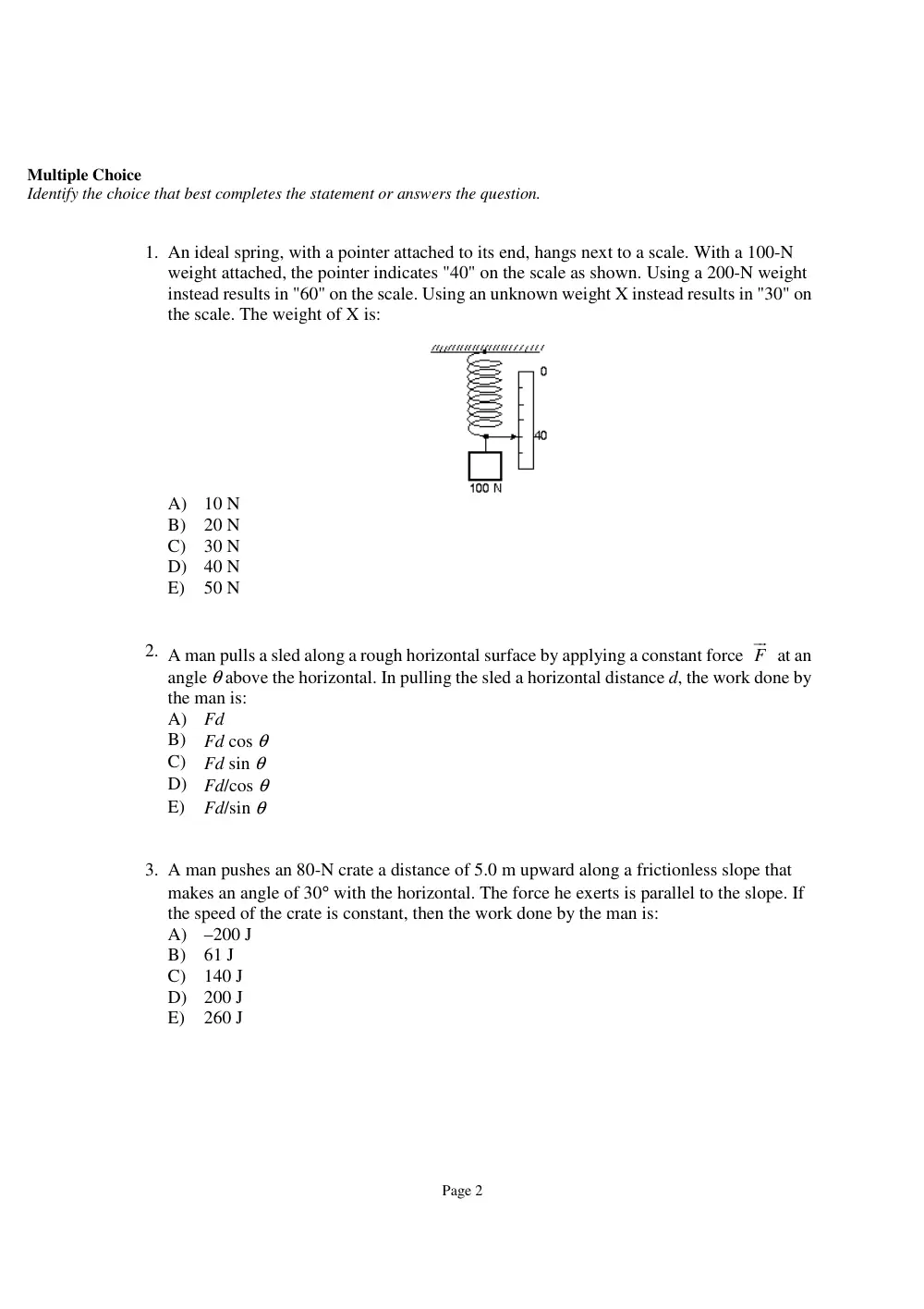
1. An ideal spring, with a pointer attached to its end, hangs next to a scale. With a 100-N
weight attached, the pointer indicates "40" on the scale as shown. Using a 200-N weight
instead results in "60" on the scale. Using an unknown weight X instead results in "30" on
the scale. The weight of X is:
A) 10 N
B) 20 N
C) 30 N
D) 40 N
E)
50 N
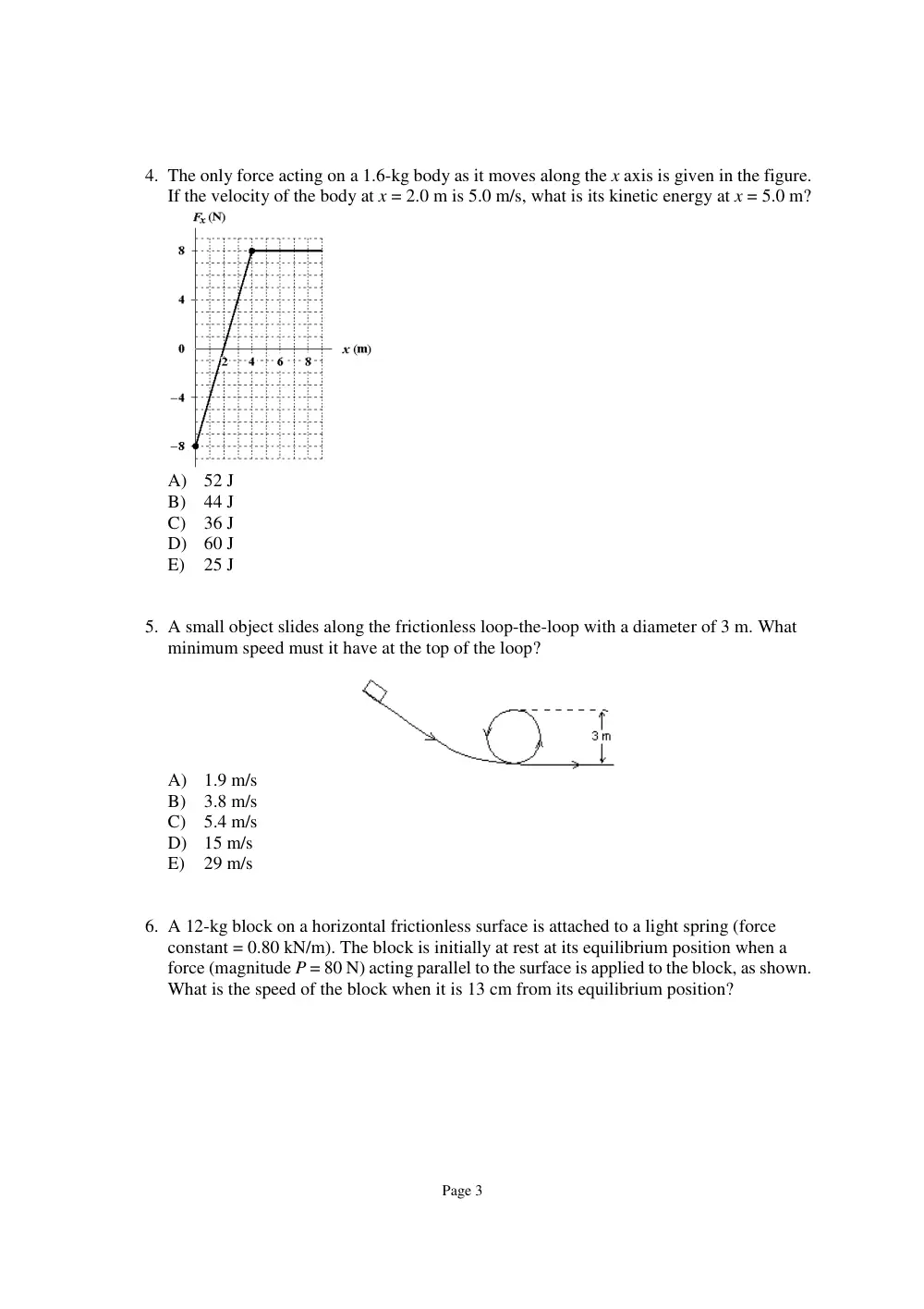
2. A man pulls a sled along a rough horizontal surface by applying a constant force F
��
at an
angle θ above the horizontal. In pulling the sled a horizontal distance d, the work done by
the man is:
A) Fd
B) Fd cos θ
C) Fd sin θ
D) Fd/cos θ
E)
Fd/sin θ
3. A man pushes an 80-N crate a distance of 5.0 m upward along a frictionless slope that
makes an angle of 30° with the horizontal. The force he exerts is parallel to the slope. If
the speed of the crate is constant, then the work done by the man is:
A) –200 J
B) 61 J
C) 140 J
D) 200 J
E)
260 J
Page 3
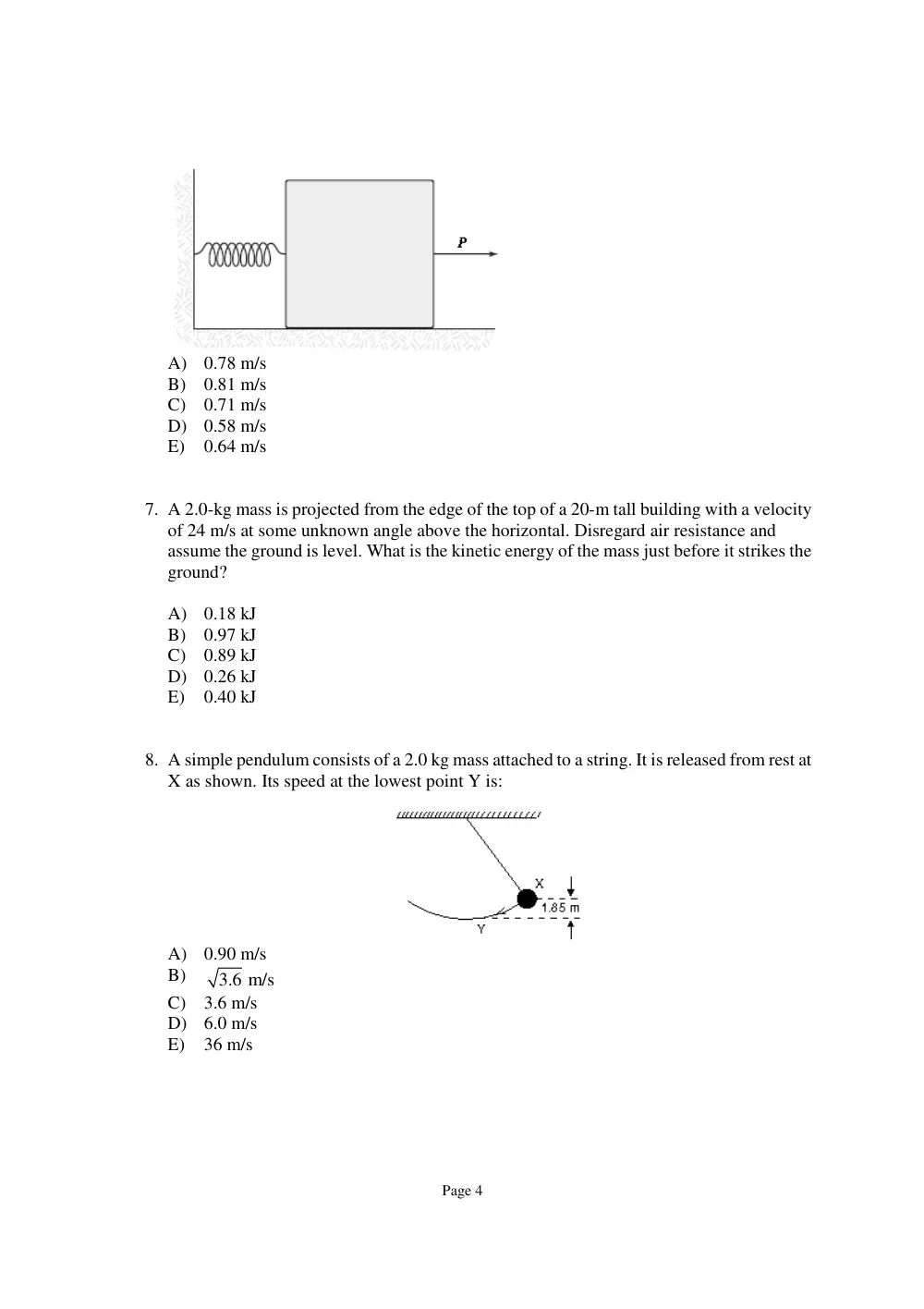
4. The only force acting on a 1.6-kg body as it moves along the x axis is given in the figure.
If the velocity of the body at x = 2.0 m is 5.0 m/s, what is its kinetic energy at x = 5.0 m?
A) 52 J
B) 44 J
C) 36 J
D) 60 J
E)
25 J
5. A small object slides along the frictionless loop-the-loop with a diameter of 3 m. What
minimum speed must it have at the top of the loop?
A) 1.9 m/s
B) 3.8 m/s
C) 5.4 m/s
D) 15 m/s
E)
29 m/s
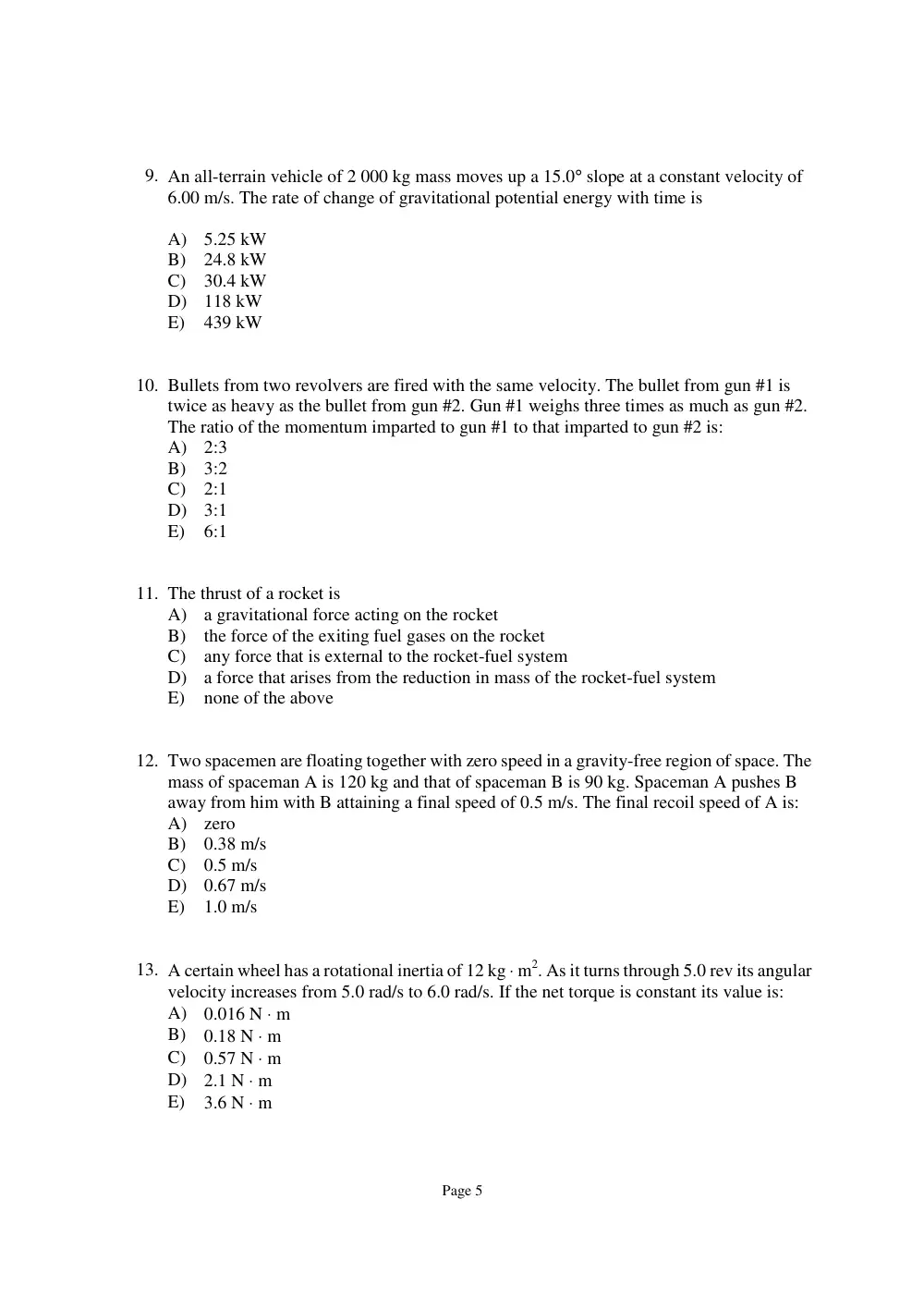
6. A 12-kg block on a horizontal frictionless surface is attached to a light spring (force
constant = 0.80 kN/m). The block is initially at rest at its equilibrium position when a
force (magnitude P = 80 N) acting parallel to the surface is applied to the block, as shown.
What is the speed of the block when it is 13 cm from its equilibrium position?
Page 4
A) 0.78 m/s
B) 0.81 m/s
C) 0.71 m/s
D) 0.58 m/s
E)
0.64 m/s
7. A 2.0-kg mass is projected from the edge of the top of a 20-m tall building with a velocity
of 24 m/s at some unknown angle above the horizontal. Disregard air resistance and
assume the ground is level. What is the kinetic energy of the mass just before it strikes the
ground?
A) 0.18 kJ
B) 0.97 kJ
C) 0.89 kJ
D) 0.26 kJ
E)
0.40 kJ
8. A simple pendulum consists of a 2.0 kg mass attached to a string. It is released from rest at
X as shown. Its speed at the lowest point Y is:
A) 0.90 m/s
B)
3.6 m/s
C) 3.6 m/s
D) 6.0 m/s
E)
36 m/s
Page 5
9. An all-terrain vehicle of 2 000 kg mass moves up a 15.0° slope at a constant velocity of
6.00 m/s. The rate of change of gravitational potential energy with time is
A) 5.25 kW
B) 24.8 kW
C) 30.4 kW
D) 118 kW
E)
439 kW
10. Bullets from two revolvers are fired with the same velocity. The bullet from gun #1 is
twice as heavy as the bullet from gun #2. Gun #1 weighs three times as much as gun #2.
The ratio of the momentum imparted to gun #1 to that imparted to gun #2 is:
A) 2:3
B) 3:2
C) 2:1
D) 3:1
E)
6:1
11. The thrust of a rocket is
A) a gravitational force acting on the rocket
B) the force of the exiting fuel gases on the rocket
C) any force that is external to the rocket-fuel system
D) a force that arises from the reduction in mass of the rocket-fuel system
E)
none of the above
12. Two spacemen are floating together with zero speed in a gravity-free region of space. The
mass of spaceman A is 120 kg and that of spaceman B is 90 kg. Spaceman A pushes B
away from him with B attaining a final speed of 0.5 m/s. The final recoil speed of A is:
A) zero
B) 0.38 m/s
C) 0.5 m/s
D) 0.67 m/s
E)
1.0 m/s
13. A certain wheel has a rotational inertia of 12 kg ⋅ m2. As it turns through 5.0 rev its angular
velocity increases from 5.0 rad/s to 6.0 rad/s. If the net torque is constant its value is:
A) 0.016 N ⋅ m
B) 0.18 N ⋅ m
C) 0.57 N ⋅ m
D) 2.1 N ⋅ m
E)
3.6 N ⋅ m
Page 6
14. At the instant a 2.0-kg particle has a velocity of 4.0 m/s in the positive x direction, a 3.0-kg
particle has a velocity of 5.0 m/s in the positive y direction. What is the speed of the center
of mass of the two-particle system?
A) 3.8 m/s
B) 3.4 m/s
C) 5.0 m/s
D) 4.4 m/s
E)
4.6 m/s
15. A disk has a rotational inertia of 6.0 kg ⋅ m2 and a constant angular acceleration of 2.0
rad/s2. If it starts from rest the work done during the first 5.0 s by the net torque acting on
it is:
A) 0
B) 30 J
C) 60 J
D) 300 J
E)
600 J
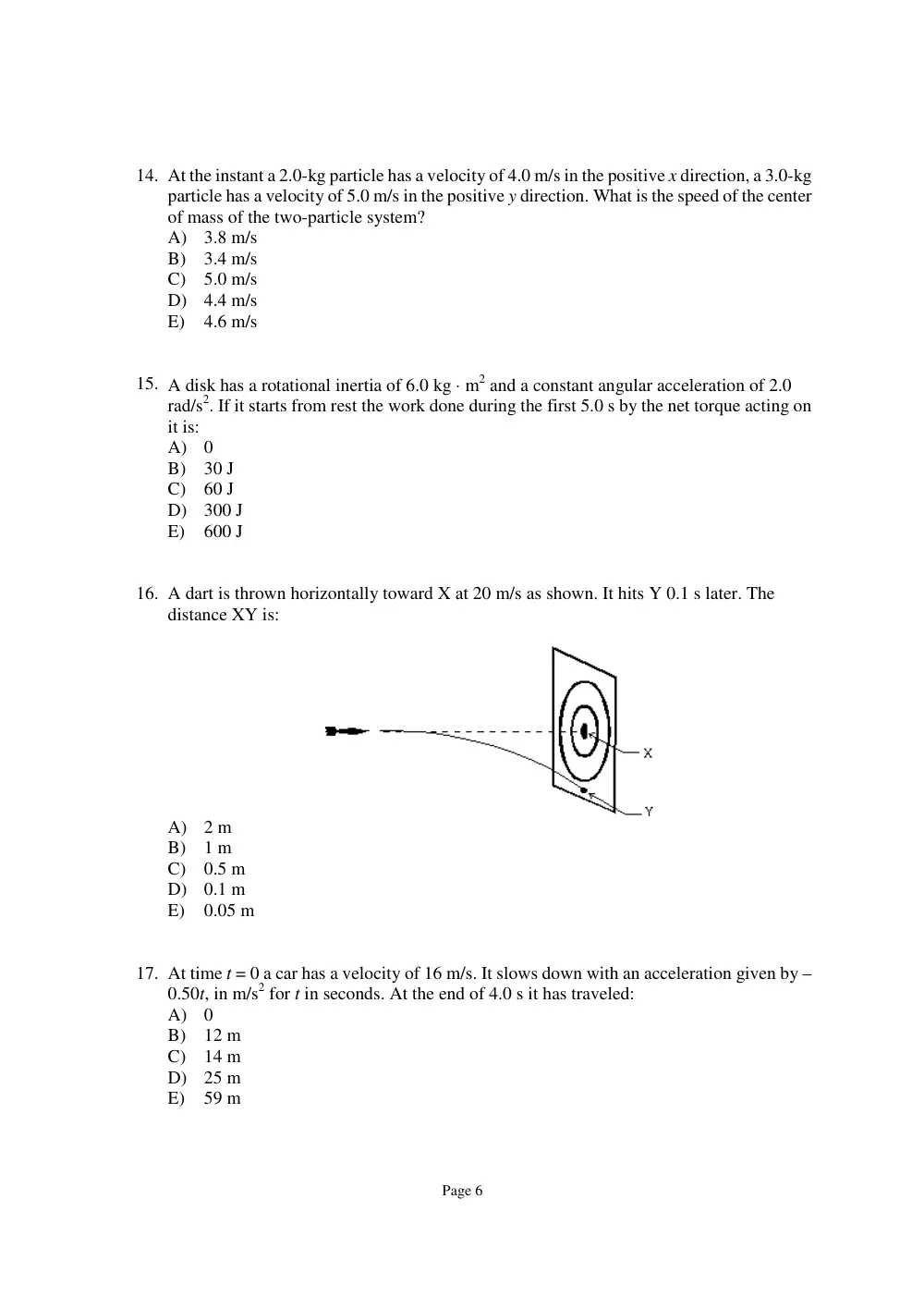
16. A dart is thrown horizontally toward X at 20 m/s as shown. It hits Y 0.1 s later. The
distance XY is:
A) 2 m
B) 1 m
C) 0.5 m
D) 0.1 m
E)
0.05 m
17. At time t = 0 a car has a velocity of 16 m/s. It slows down with an acceleration given by –
0.50t, in m/s2 for t in seconds. At the end of 4.0 s it has traveled:
A) 0
B) 12 m
C) 14 m
D) 25 m
E)
59 m
Page 7
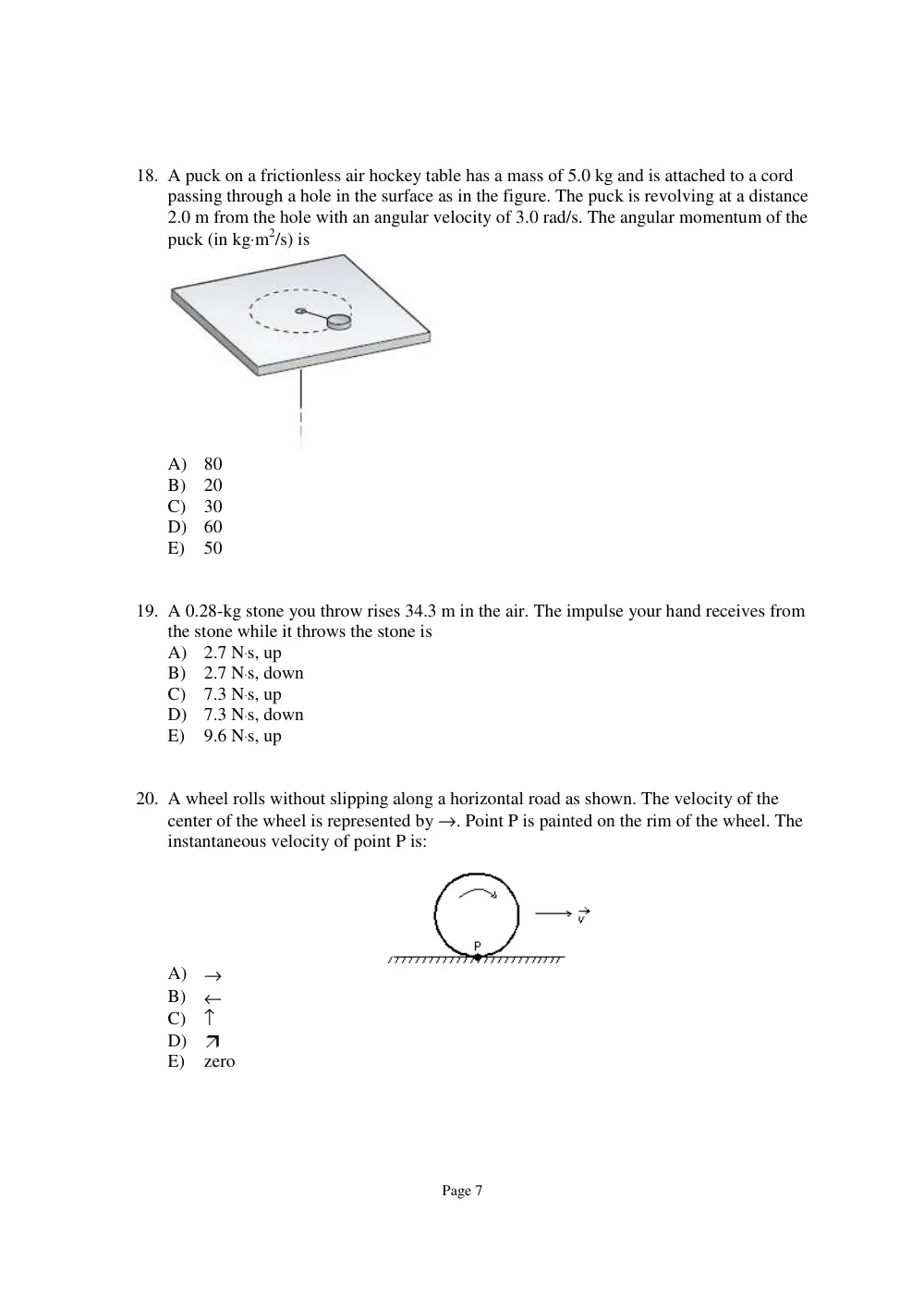
18. A puck on a frictionless air hockey table has a mass of 5.0 kg and is attached to a cord
passing through a hole in the surface as in the figure. The puck is revolving at a distance
2.0 m from the hole with an angular velocity of 3.0 rad/s. The angular momentum of the
puck (in kg⋅m2/s) is
A) 80
B) 20
C) 30
D) 60
E)
50
19. A 0.28-kg stone you throw rises 34.3 m in the air. The impulse your hand receives from
the stone while it throws the stone is
A) 2.7 N s, up
B) 2.7 N s, down
C) 7.3 N s, up
D) 7.3 N s, down
E)
9.6 N s, up
20. A wheel rolls without slipping along a horizontal road as shown. The velocity of the
center of the wheel is represented by →. Point P is painted on the rim of the wheel. The
instantaneous velocity of point P is:
A) →
B) ←
C) ↑
D)
E)
zero
Page 8
21. When the speed of a rear-drive car is increasing on a horizontal road the direction of the
frictional force on the tires is:
A) forward for all tires
B) backward for all tires
C) forward for the front tires and backward for the rear tires
D) backward for the front tires and forward for the rear tires
E)
zero
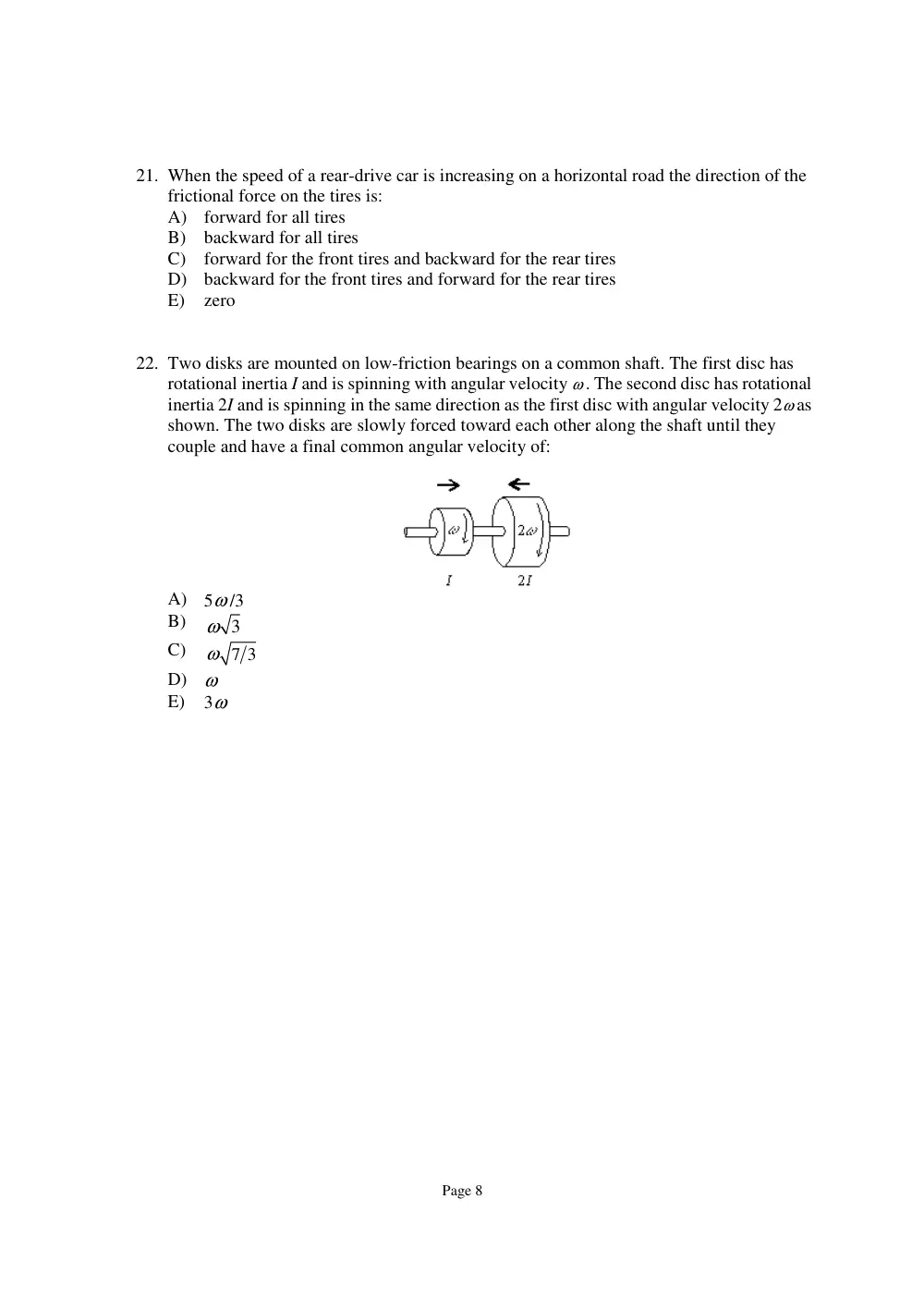
22. Two disks are mounted on low-friction bearings on a common shaft. The first disc has
rotational inertia I and is spinning with angular velocity ω . The second disc has rotational
inertia 2I and is spinning in the same direction as the first disc with angular velocity 2ω as
shown. The two disks are slowly forced toward each other along the shaft until they
couple and have a final common angular velocity of:
A) 5ω /3
B)
ω 3
C)
ω 7 3
D) ω
E)
3ω