
PHYS 101 Final, Fall 1998
American University of Beirut · Introductory Physics I · 8 pages
More PHYS 101 files
Show the text of this final exam
Physics 101 February 11, 1999
Final Exam Time: 2 hours
NAME:
LD. No.:
Encircle your section:
Section 1 SMTTF S. Isber
Section 2 1OMTTF T. Zableet
Section 3 1IMTTF T. Zableet
Section 5 12MTWF B. Bodakian
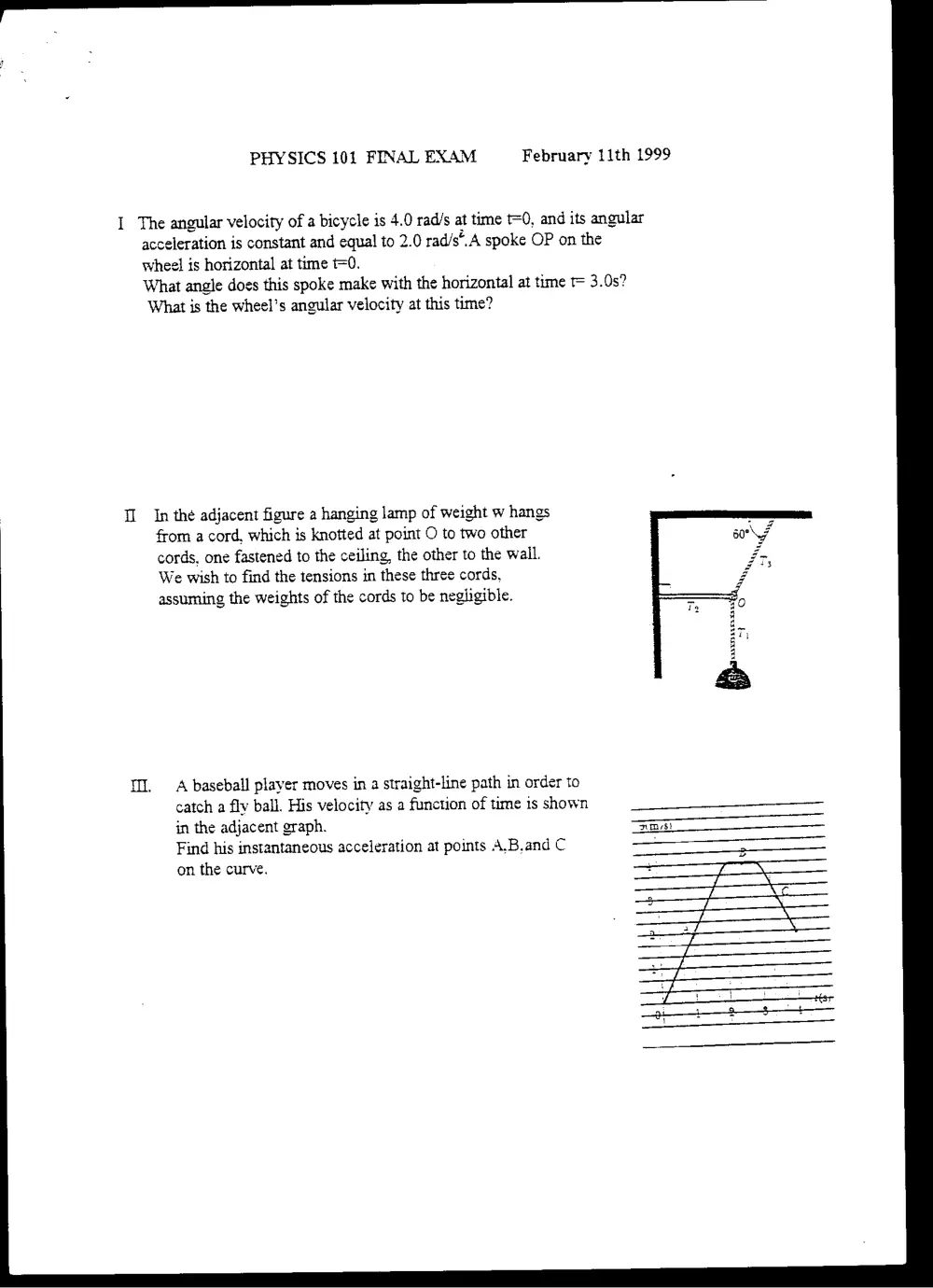
PHYSICS 101 FINAL EXAM February 11th 1999
I The angular velocity of a bicycle is 4.0 rad/s at time t=0, and its angular
acceleration is constant and equal to 2.0 rad/s*.A spoke OP on the
wheel is horizontal at time 0.
What angle does this spoke make with the horizontal at time t= 3.0s?
What is the wheel’s angular velocity at this time?
Tl In the adjacent figure a hanging lamp of weight w hangs
from a cord, which is knotted at point O to two other
cords, one fastened to the ceiling, the other to the wail.
We wish to find the tensions in these three cords,
assuming the weights of the cords to be negligible.
I. A baseball player moves in a straight-line path in order to
catch a fly ball. His velocity as a function of time is shown
in the adjacent graph.
Find his instantaneous acceleration at points A.B.and C
on the curve. : =
Wubs$)
ab
Mm
tp
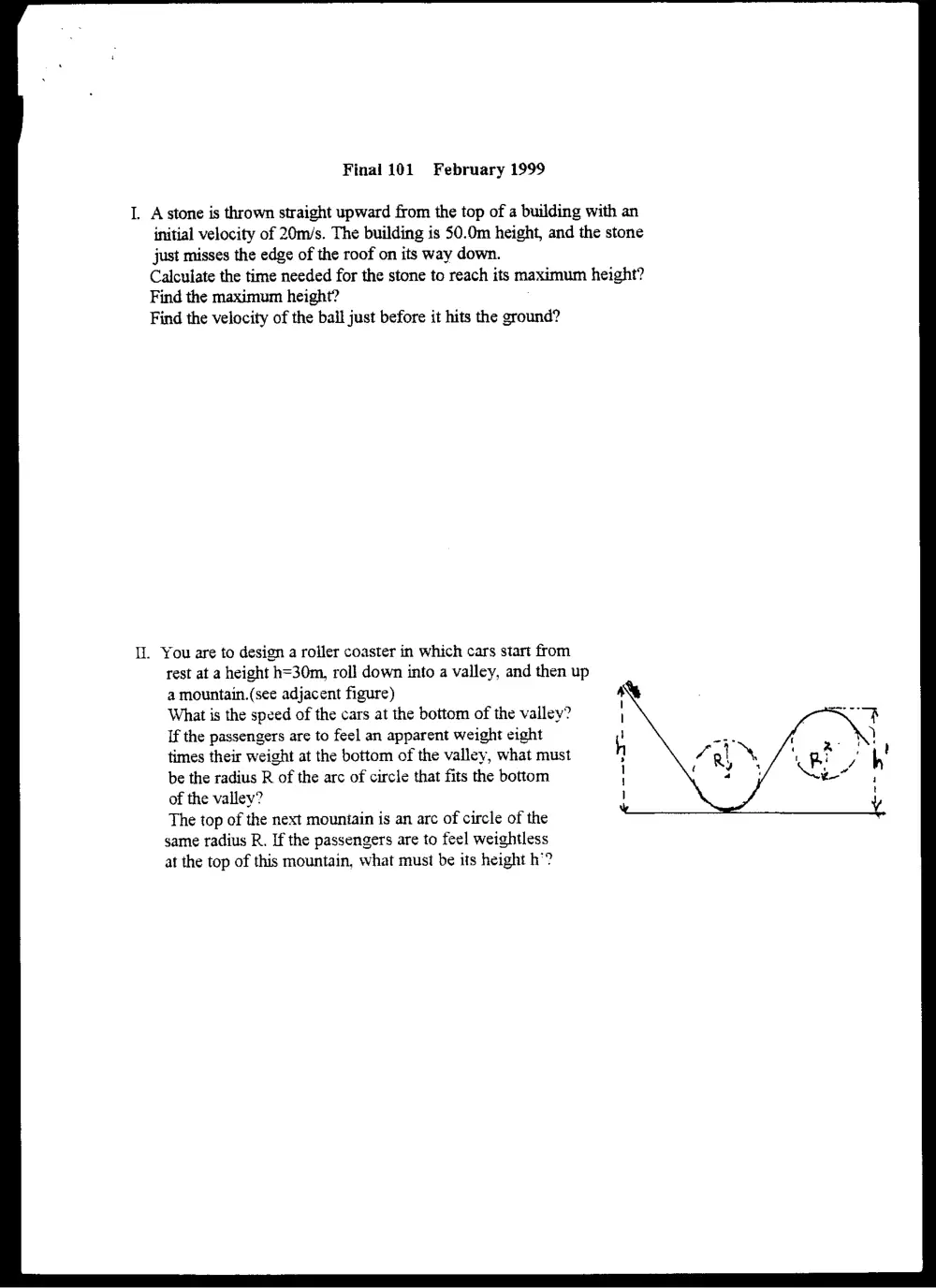
Final 101 February 1999
I. A stone is thrown straight upward from the top of a building with an
initial velocity of 20m/s. The building is 50.0m height, and the stone
just misses the edge of the roof on its way down.
Calculate the time needed for the stone to reach its maximum height?
Find the maximum height?
Find the velocity of the bail just before it hits the ground?
I. You are to design a roller coaster in which cars start from
rest at a height h=30m, roll down into a valley, and then up
a mountain.(see adjacent figure)
What is the speed of the cars at the bottom of the valley?
If the passengers are to feel an apparent weight eight
times their weight at the bottom of the valley, what must
be the radius R of the arc of circle that fits the bottom
of the valley?
The top of the next mountain is an arc of circle of the
game radius R. If the passengers are to feel weightless
at the top of this mountain, what must be its height h’?
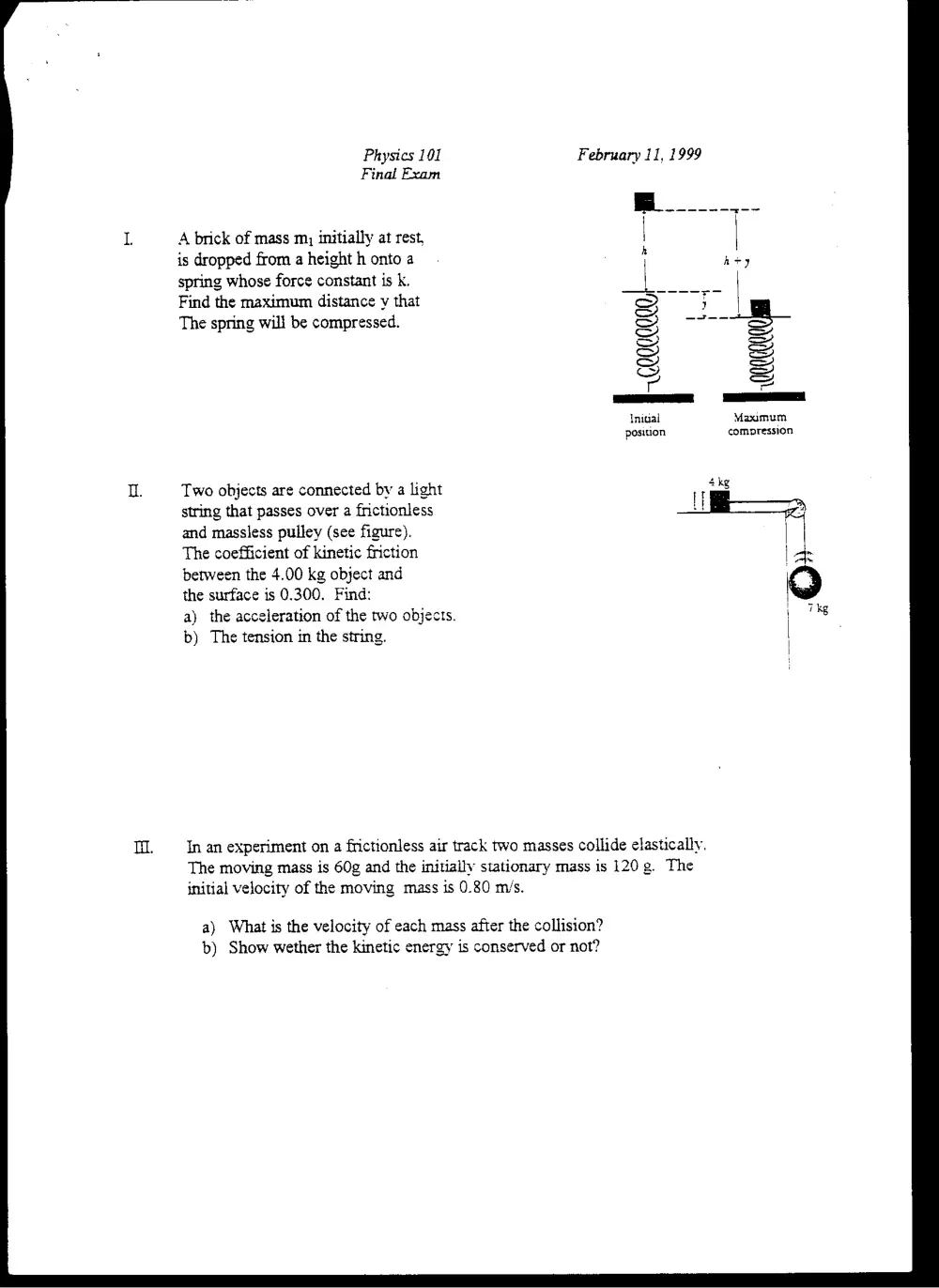
Physics 101 February 11, 1999
Final Exam
L A brick of mass m, initially at rest, | |
is dropped from a height h onto a h hey
spring whose force constant is k. | |
Find the maximum distance y that > 5
The spring will be compressed. = 2-8
S =
= =
YS =>
S =
T =
——
Iniaal Maxmum
posiuon compression
0. Two objects are connected by a light
string that passes over a frictionless
and massless pulley (see figure).
The coefficient of kinetic friction
between the 4.00 kg object and
the surface is 0.300. Find:
a) the acceleration of the two objects.
b) The tension in the string.
I. In an experiment on a frictionless air track two masses collide elastically.
The moving mass is 60g and the initially stationary mass is 120 g. The
initial velocity of the moving mass is 0.80 mvs.
a) What is the velocity of each mass after the collision?
b) Show wether the kinetic energy is conserved or not?
Physics 101 February 11, 1999
Final Exam
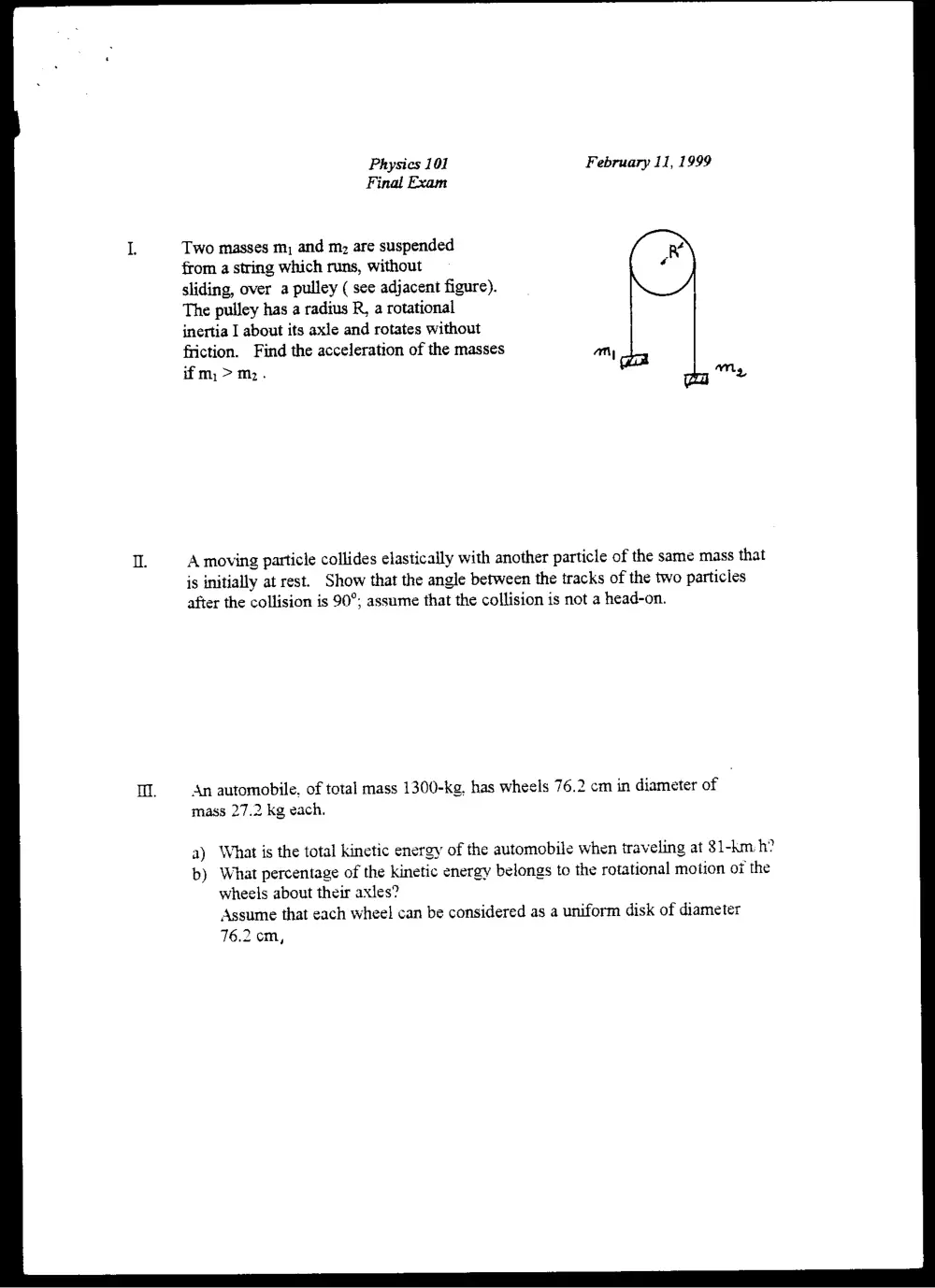
Two masses m and m are suspended
from a string which runs, without
sliding, over a pulley ( see adjacent figure).
The pulley has a radius R, a rotational
inertia I about its axle and rotates without
friction. Find the acceleration of the masses
ifm, > m2.
A moving particle collides elastically with another particle of the same mass that
is initially at rest. Show that the angle between the tracks of the two particles
after the collision is 90°; assume that the collision is not a head-on.
An automobile, of total mass 1300-kg, has wheels 76.2 cm in diameter of
mass 27.2 kg each.
a) What is the total kinetic energy of the automobile when traveling at $1-km:h?
b) What percentage of the kinetic energy belongs to the rotational motion of the
wheels about their axles?
Assume that each wheel can be considered as a uniform disk of diameter
76.2 cm,
Physics 101 February 11,1999
Finai Exam
LA ballistic pendulum consists of a block of wood of mass M = 4.0 kg suspended from
thin wires. Initially it is at rest. A bullet of mass m = 10g strikes the block
horizontally and remains stuck to it. The impact of the bullet puts the block in motion
causing it to swing upward to a height h = 20 cm. What was the speed of the bullet
before the impact?
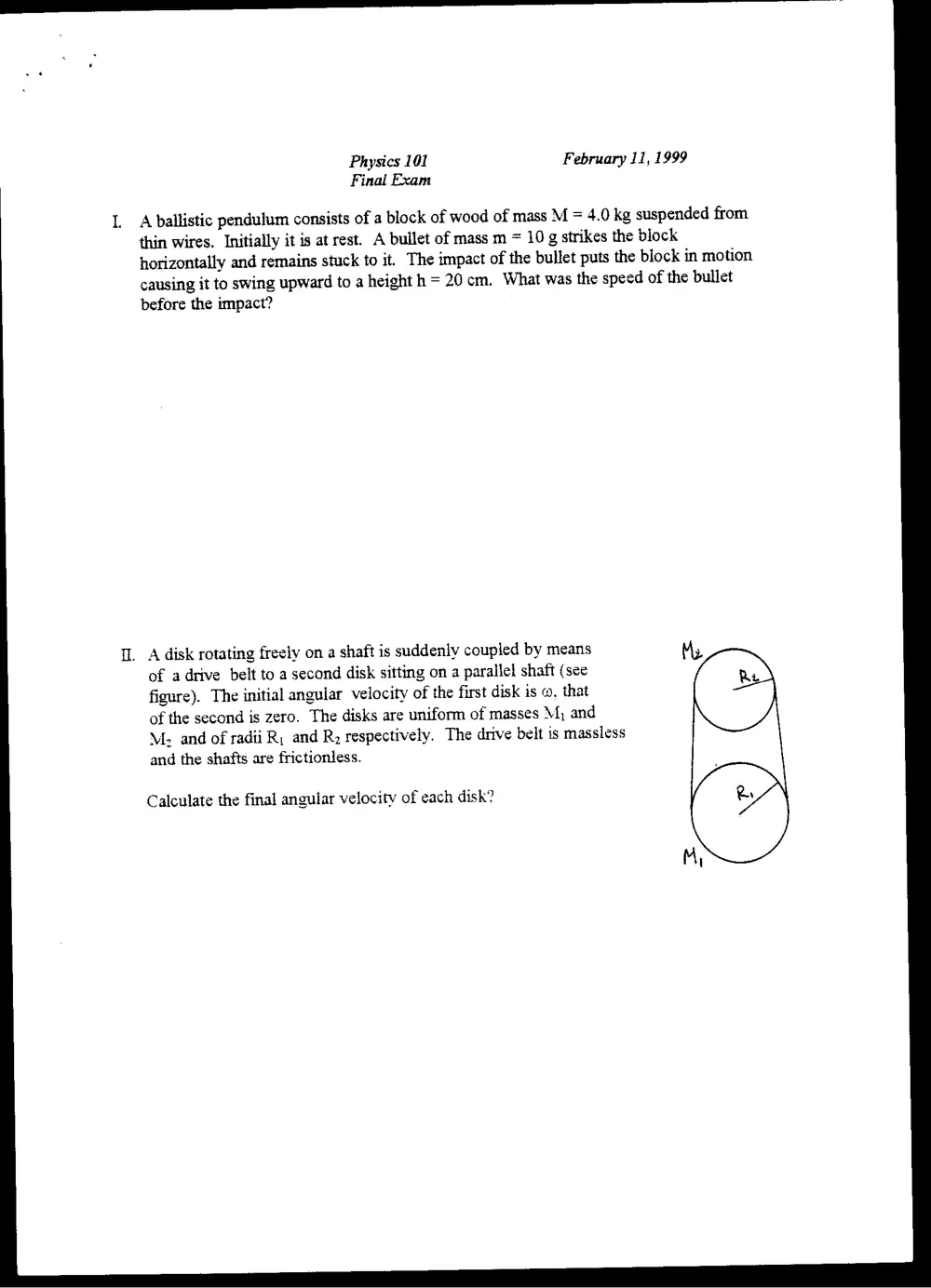
DL. A disk rotating freely on a shaft is suddenly coupled by means Mz
of adrive belt to a second disk sitting on a parallel shaft (see
figure). The initial angular velocity of the first disk is «, that
of the second is zero. The disks are uniform of masses Mj and
M and of radii R, and R, respectively. The drive belt is massless
and the shafts are frictionless.
Calculate the final angular velocity of each disk?
Physics 101 February 11, 1999
Final Exam
A 3.94kg block extends a spring 15.7 cm from its unstretched position. The
block is removed and a 0.520 kg object is hung from the same spring. The
system is put into oscillation. Find the period of its oscillation?
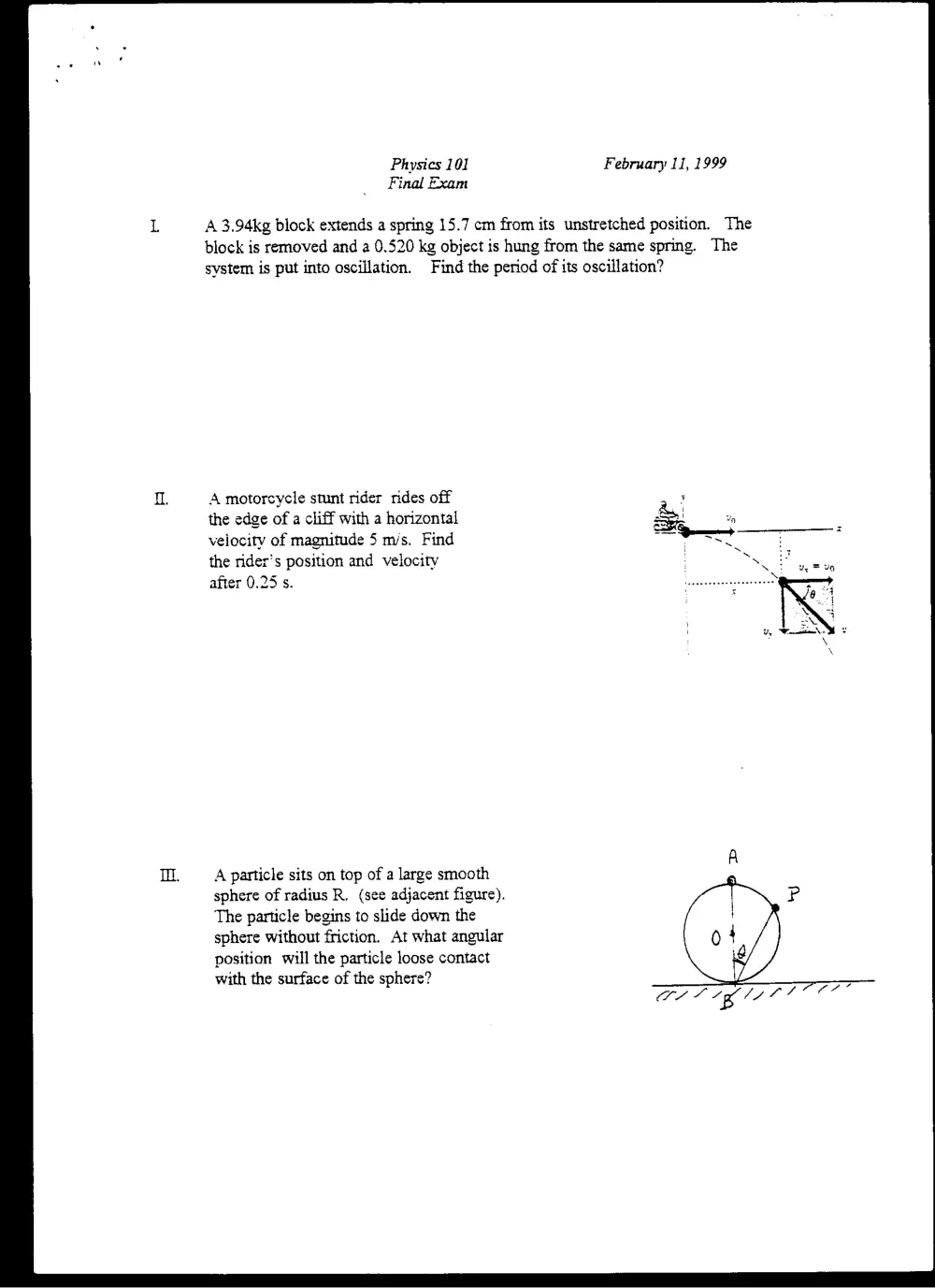
A motorcycle stunt rider rides off
the edge of a cliff with a horizontal
velocity of magnitude 5 m/s. Find
the rider’s position and velocity
after 0.25 s.
A particle sits on top of a large smooth
sphere of radius R. (see adjacent figure).
The particle begins to slide down the
sphere without friction. At what angular
position will the particle loose contact
with the surface of the sphere? 2
aaa aaa cee
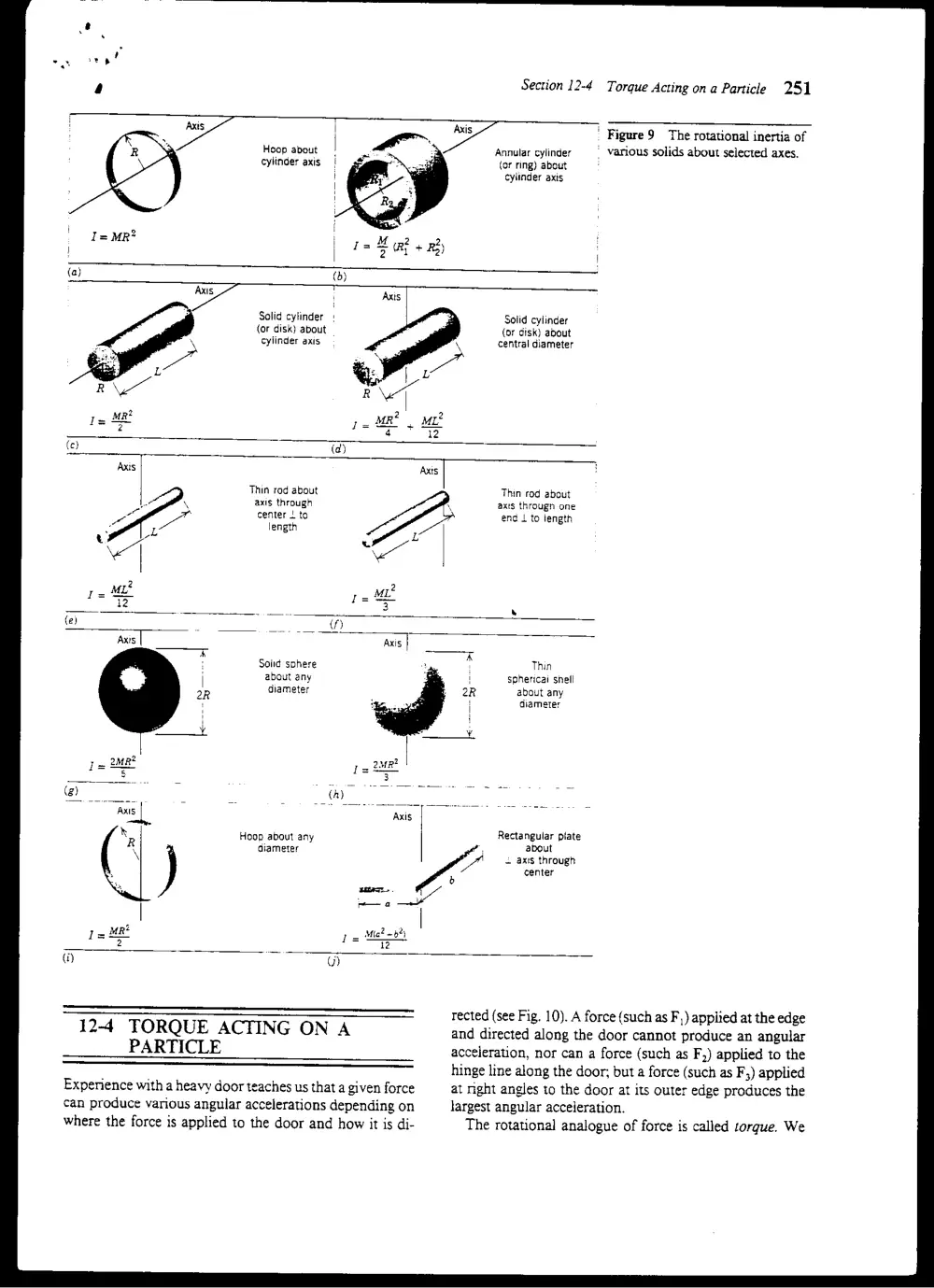
Section 12-4 Torque Acting on a Particle 251
Hoop about
cylinder axis
' Figure 9 The rotational inertia of
Annular cylinder ' various solids about selected axes.
(or ring) about
cylinder axis
I
|
|
|
(
Solid cytinder +
(or disk) about
cylinder axis
Solid cylinder
(or disk) about
central diameter
Thin rod about
axis through
center - to
length
Thin rod about
axts througn one
end 1 to length
Solid sphere
about any
diameter
Hoop about any
diameter
Thin
sphericai shell
about any
diameter
Rectangular plate
about
4 axis through
center
12-4 TORQUE ACTING ON A
PARTICLE
—————
Experience with a heavy door teaches us that a given force
can produce various angular accelerations depending on
where the force is applied to the door and how it is di-
rected (see Fig. 10). A force (such as F,) applied at the edge
and directed along the door cannot produce an angular
acceleration, nor can a force (such as F,) applied to the
hinge line along the door; but a force (such as F;) applied
at night angles to the door at its outer edge produces the
largest angular acceleration.
The rotational analogue of force is called torque. We