
PHYS 101 Final, Fall 1997
American University of Beirut · Introductory Physics I · 7 pages


More PHYS 101 files
Show the text of this final exam
February 7, 1998
Time : 2 hours
Section
Don't forget your Name, 1D. # and section
sect. 1. 11, MWF & 1F Dr. Tabbal
sect. 2. 9, TT & 11, TT Dr. Zableet
sect.4. 10, 1T &2-4¥ Dr. Trad
sect. 5. 11, MTTE Dr. Abou-Ghantous
You can see your corrected paper on Wednesday February 11, 1998 in Room 121
from 10:00 a.m. till 1:00 pom.
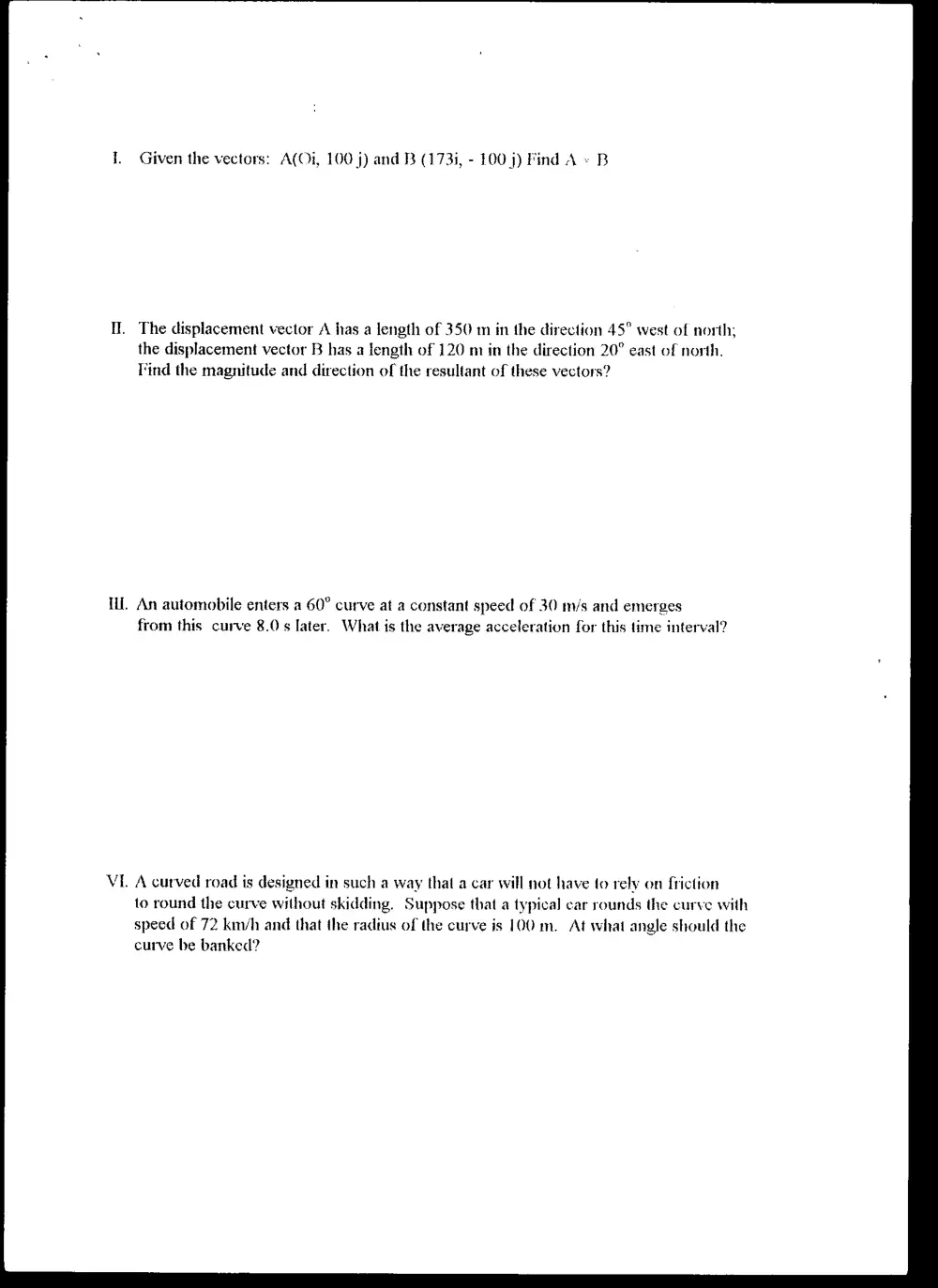
I. Given the vectors: A(Oi, 100 j) and B (173i, - 100 j) Find A = B
U1. The displacement vector A has a length of 350 m in the direction 45° west of north;
the displacement vector B has a fength of 120 m in the direction 20° east of north.
Vind the magnitude and direction of the resultant of these vectors?
IU. An automobile enters a 60° curve at a constant speed of 30 m/s and emerges
from this curve 8.0 s later. What is the average acceleration for this time interval?
VL A curved road is designed in such a way that a car will not have {o rely on friction
to round the curve without skidding. Suppose that a typical car rounds the curve with
speed of 72 kn/h and that the radius of the curve is 100 m. At what angle should the
curve be banked?
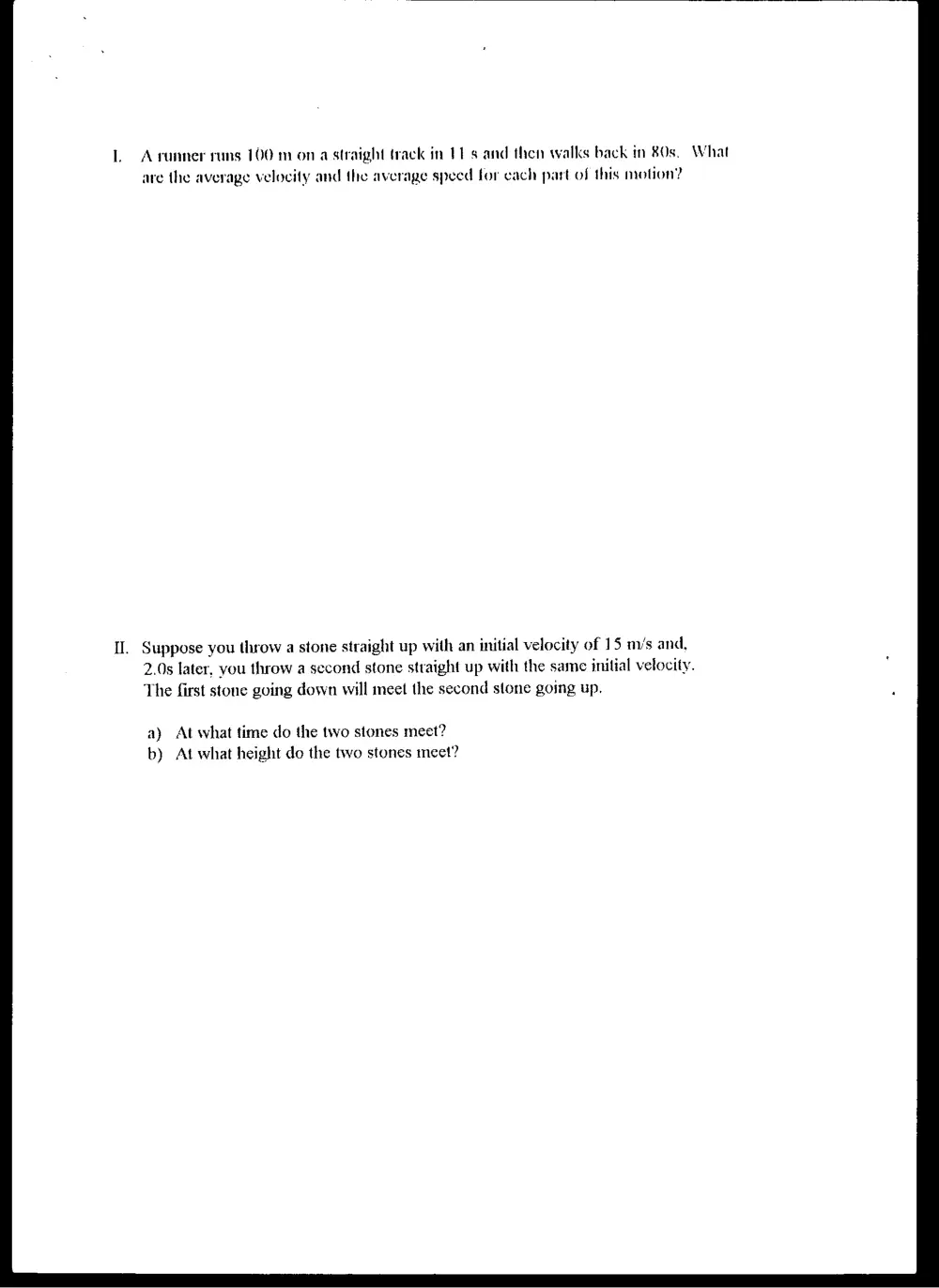
I Asunner runs 100 m ona straight (rack in 11s and then walks back in 80s. What
are the average velocity and the average speed for cach part of this motion?
Il. Suppose you throw a stone straight up with an initial velocity of 15 m/s and,
2.0s later, you throw a second stone straight up with the same inilial velocity.
The first stone going down will meet the second stone going up. .
a) At what time do the two stones meet?
b) At what height do the two stones meet?
1. Achild of mass 40.0 kg takes a side ona slide of height 6.0 m. The child starts
from rest at the top. Determine her speed at the bottom assuming there is no friction.
U. A 5.0 kg object with a speed of 30 m/s strikes a steel plate at an angle of 45° and
rebounds at ihe same speed and angle.
a) Find the linear momentum of the object (magnitude and direction)
b) Determine the impulse experienced by the ball and the average force exerted by
the ball on the wall if it stays in contact for 20 ms.
c) Draw a diagram.
IH. Two pendulums, each of length 1 = 1.0m, are situated as shown
in the figure. The first pendulum is released from a height h = 10cm
and strikes the second. If the collision is completely inelastic, how
high does the center of mass rise after the collision?
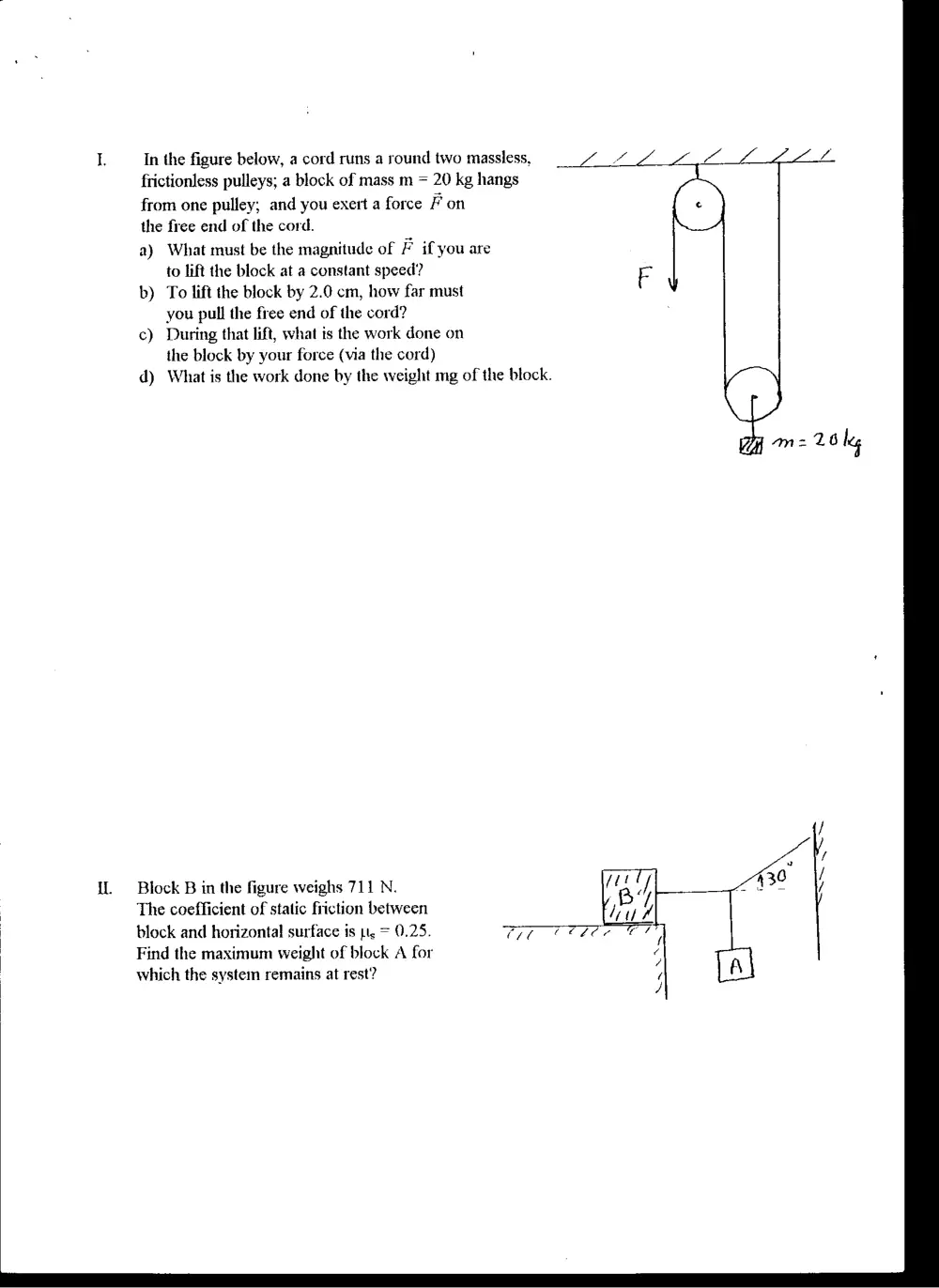
I.
In the figure below, a cord runs a round two massless, Z x Lf.
frictionless pulleys; a block of mass m = 20 kg hangs
from one pulley; and you exert a force Fon
the free end of the cord.
a) What must be the magnitude of F ifyou are
to lift the block at a constant speed? FE
b) To lift the block by 2.0 cm, how far must
you pull the free end of the cord?
c) During that lift, what is the work done on
the block by your force (via the cord)
d) What is the work done by the weight mg of the block.
“m= 26 kg
Block B in the figure weighs 711 N.
The coefficient of static friction between
block and horizontal surface is 1, = 0.25.
Find the maximum weight of block A for
which the system remains at rest?
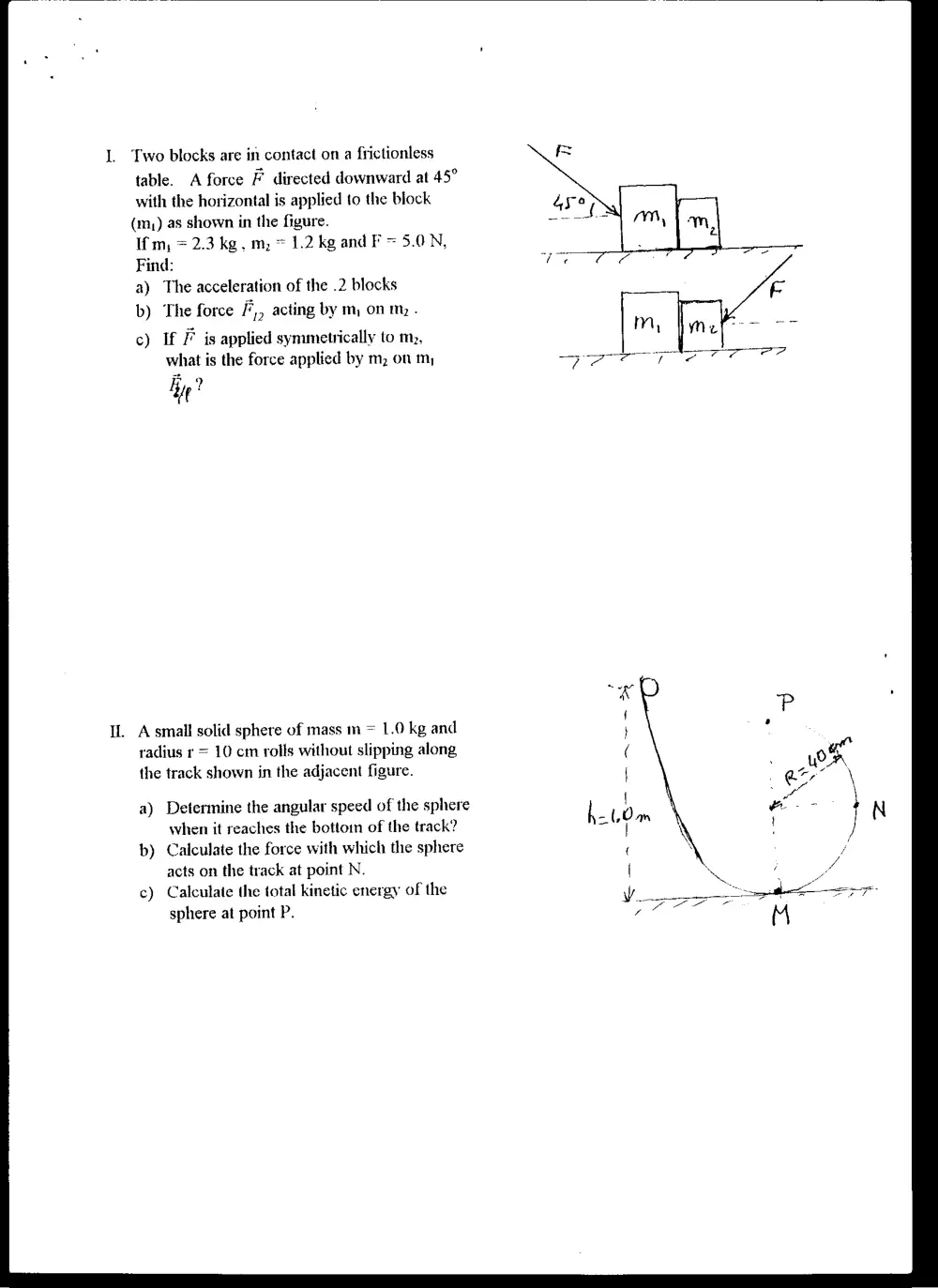
I. Two blocks are in contact on a frictionless
table. A force # directed downward at 45°
with the horizontal is applied to the block
(m,) as shown in the figure.
If m, = 2.3 kg, m, = 1.2 kg and F = 5.0N,
Find:
a) The acceleration of the .2 blocks
b) The force Fy acting by m, on m, .
c) If F is applied symmetrically to m2,
what is the force applied by m, on m,
hy?
IL A small solid sphere of mass m = 1.0 kg and
radius r = 10 cm rolls without slipping along,
the track shown in the adjacent figure.
a) Determine the angular speed of the sphere
when it reaches the bottom of the track?
b) Calculate the force with which the sphere
acts on the track at point N.
c) Calculate the total kinetic energy of the
sphere at point P.
‘Poop
} ,
wh
a
h-lOm a : N
( \ /
| i “
WV. ee eae
I. You are given a circular metal plate of radius 2R
from which a disk of radius R has been removed.
Find the position of the center of mass of this
object, if the center of mass of the 2R radius metal
plate has coordinates of (0,0).
U. A constant torque of 20 N.m is exerted on a pivoted wheel for 10 s, during which
the angular velocity of the wheel increases from zero to 100 rev/min. The external
torque is then removed and the wheel is brought to rest by friction torque in its
bearings in 100 s. Compute.
(a) the moment of inertia of the wheel
(b) the friction torque
(c) the total number of revolutions made by the wheel during its decelerated motion.
IIL. A solid cylinder of mass 15 kg, 30 cin in diameter, is pivoted about a horizontal axis through
its center and a rope wrapped around the surface of the cylinder carries at iis end a block
of mass 0.5 kg.
(a) How far does the block descend in 5 s, starting from rest?
(b) What is the tension in the rope?