
PHYS 101 Final, Fall 1995
American University of Beirut · Introductory Physics I · 9 pages



More PHYS 101 files
Show the text of this final exam
AMMTCAN CNIVEDSIV
LIBRARY
OF LEIRUT
Physics 101
Final Exam
Feb 34, 1996
Time : 2 hours
ID. No.
. Encircle your section
sect. 1. 11, MWF & 1, F
sect. 2, 9,TT & 11, TT
sect.3. 9,TT & 2-4 F
Dr. Bodakian
Dr. Zableet
Dr. Katul
Physics 101 Final Exam Feb. 3'd, 1996
Time : 2 hours
Part A:
I. The apparent weight of a 60-kg man in an elevator going up with an acceleration of
2.0 ns is in N :
77
a) $30 b) 590 c) 650 4) 710
©) none of the above, my answer is:
IL A body sliding down a 30° incline of 11, = 0.20, has a constant acceleration of
a) 2g b) g c) 9/2 d) g/3
€) none of the above, my answer is :
TV. A 0.15-kg ball ia moving at a speed of 40 m/s when itis struck by a bat that reverses its
direction and gives it a speed of 60 m/s.
What average force was exerted by the bat if it was in contact with the ball for 5.0 ms.
a)1500N —_b) 600'N ©)2500N — d) 3000N
a
€) none of the above, my answer is :
ees
¥. A soccer player kicks a ball at an angle of 37° above the horizontal with an initial peed
of 15 m/s. Assuming that the ball reaches the highest point of its trajectory, at what
time will it be reached 7
155s 0.928 193s 0.565
€) none of the above, my answer is :
eee
Physics 101 Final Exam Feb. 314, 1996
Time ; 2 hours
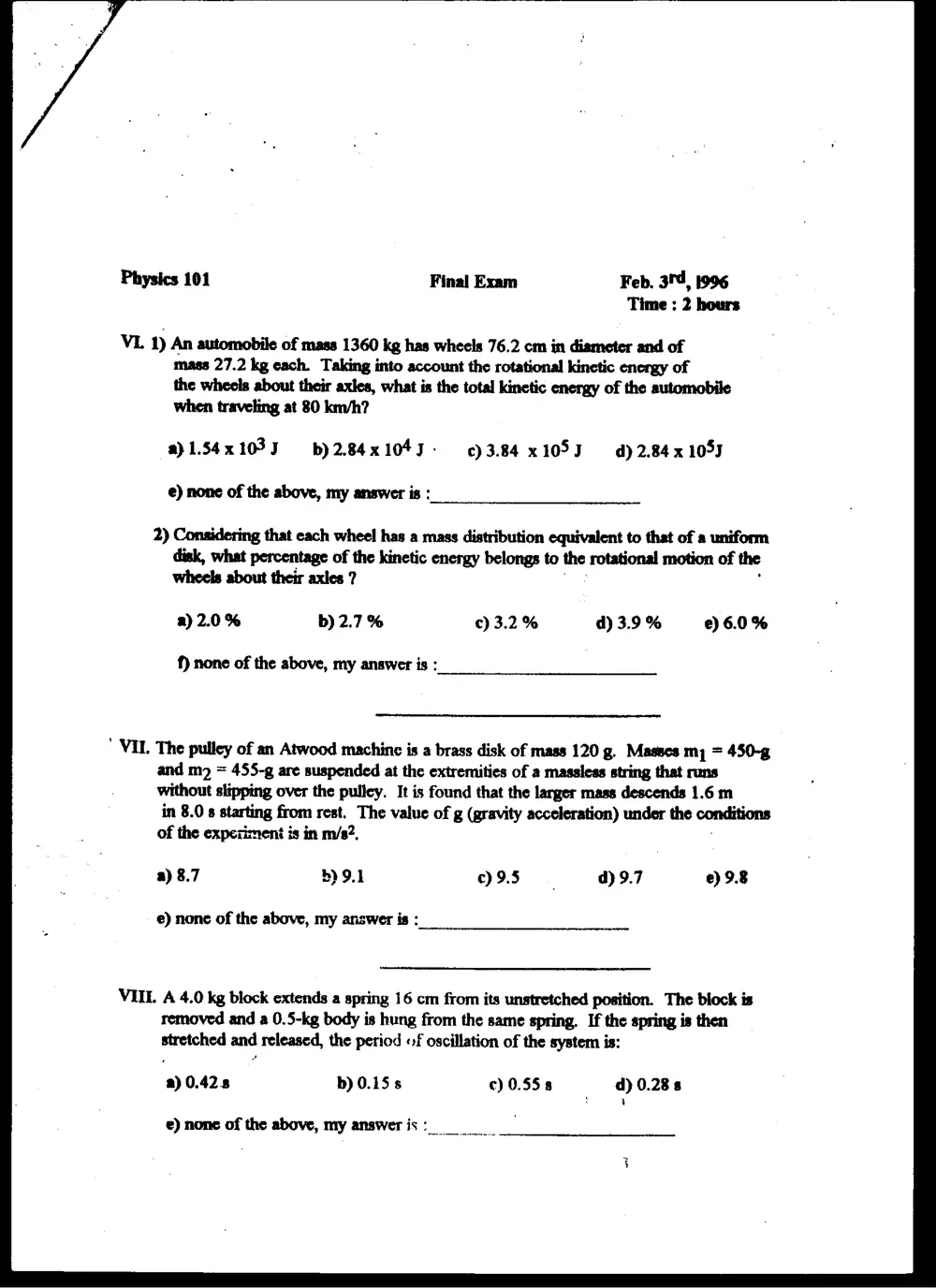
VL 1) An automobile of mass 1360 kg has wheels 76.2 cm in diameter and of
mass 27.2 kg cach. Taking into account the rotational kinetic energy of
the wheels about their axles, what is the total kinetic energy of the automobile
when traveling at 80 knv/h?
a} 1.54x1033 by2.84x1043- 6)3.84 x10⁵J = d) 2.841055
e) none of the above, my answer is :
2) Considering that each wheel has a mass distribution equivalent to that of a uniform
dink, what percentage of the kinetic energy belongs to the rotational motion of the
wheels about their axles ?
a) 2.0% b) 2.7 % ©) 3.2% d) 3.9% e) 6.0%
f) none of the above, my answer is :
’ VIL. The pulley of an Atwood machine is a brass disk of mass 120 g, Masses m = 450-g
and mz = 455-g are suspended at the extremities of a massless string that runs
without slipping over the pulley. It is found that the larger mass descends 1.6 m
in 8.0 8 starting from rest. The value of g (gravity acceleration) under the conditions
of the experiment is in m/s2.
a) 8.7 4) 9.1 )95 9.7 e) 9.8
e) none of the above, my answer is :
VIIL A 4.0 kg block extends a spring 16 cm from its unstretched position. The block is
removed and a 0.5-kg body is hung from the same spring, If the spring is then
stretched and released, the period of oscillation of the system is:
a) 0.42.8 b) 0.155 ¢) 0.558 d) 0.28 8
: y
e) none of the above, my answer is :
3
Physics 101 Final Exam
Part B;
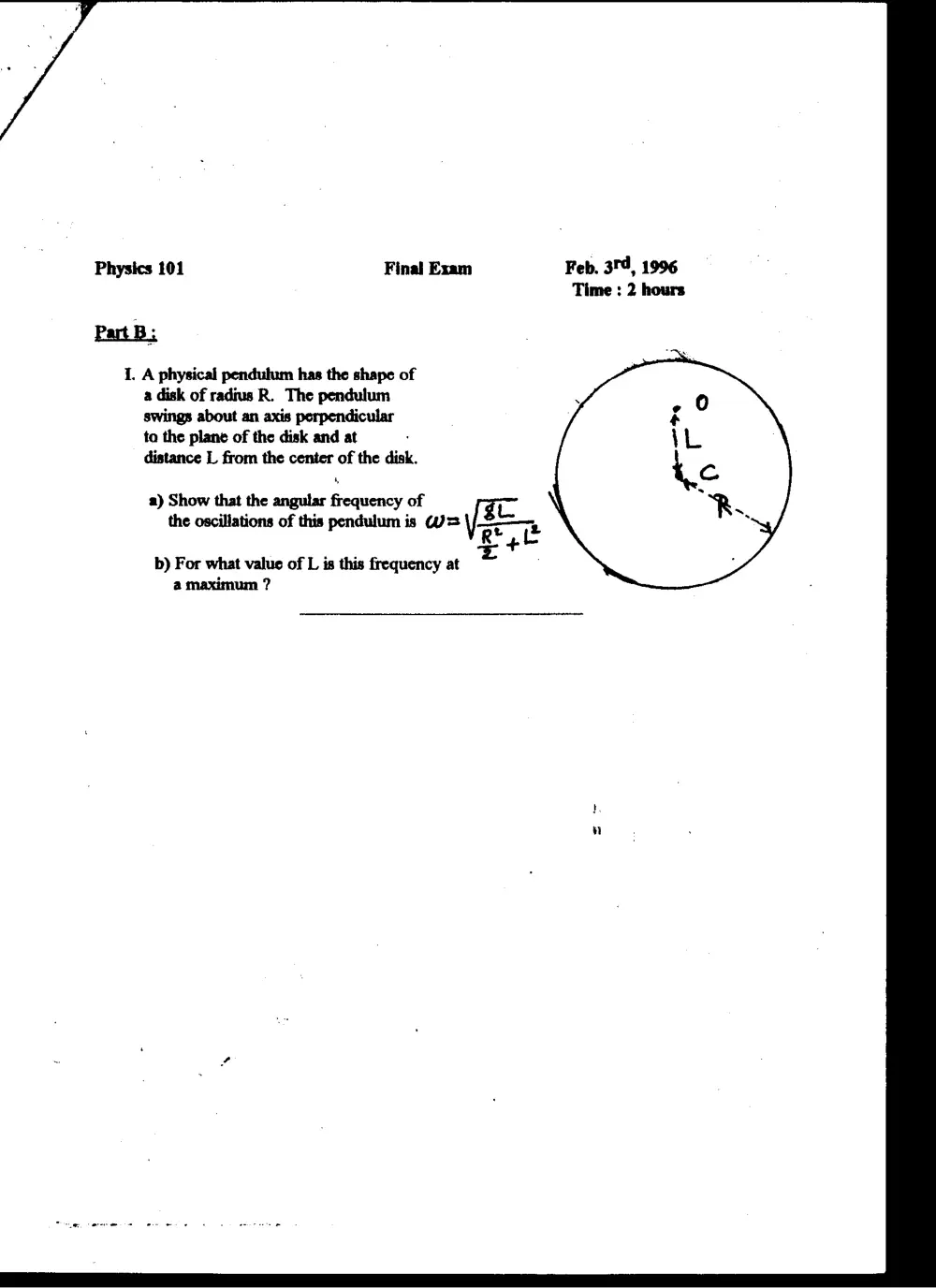
1. A physical pendulum has the shape of
a disk of radius R. The pendulum
swings about an axis perpendicular
to the plane of the disk and at .
distance L from the center of the disk.
a) Show that the angular frequency of c
the oscillations of this pendulum is (= yee,
+
b) For what value of L is this frequency at =
a maximum ?
Feb. 374, 1996
Time ; 2 hours
ni
Physics 101 Final Exam
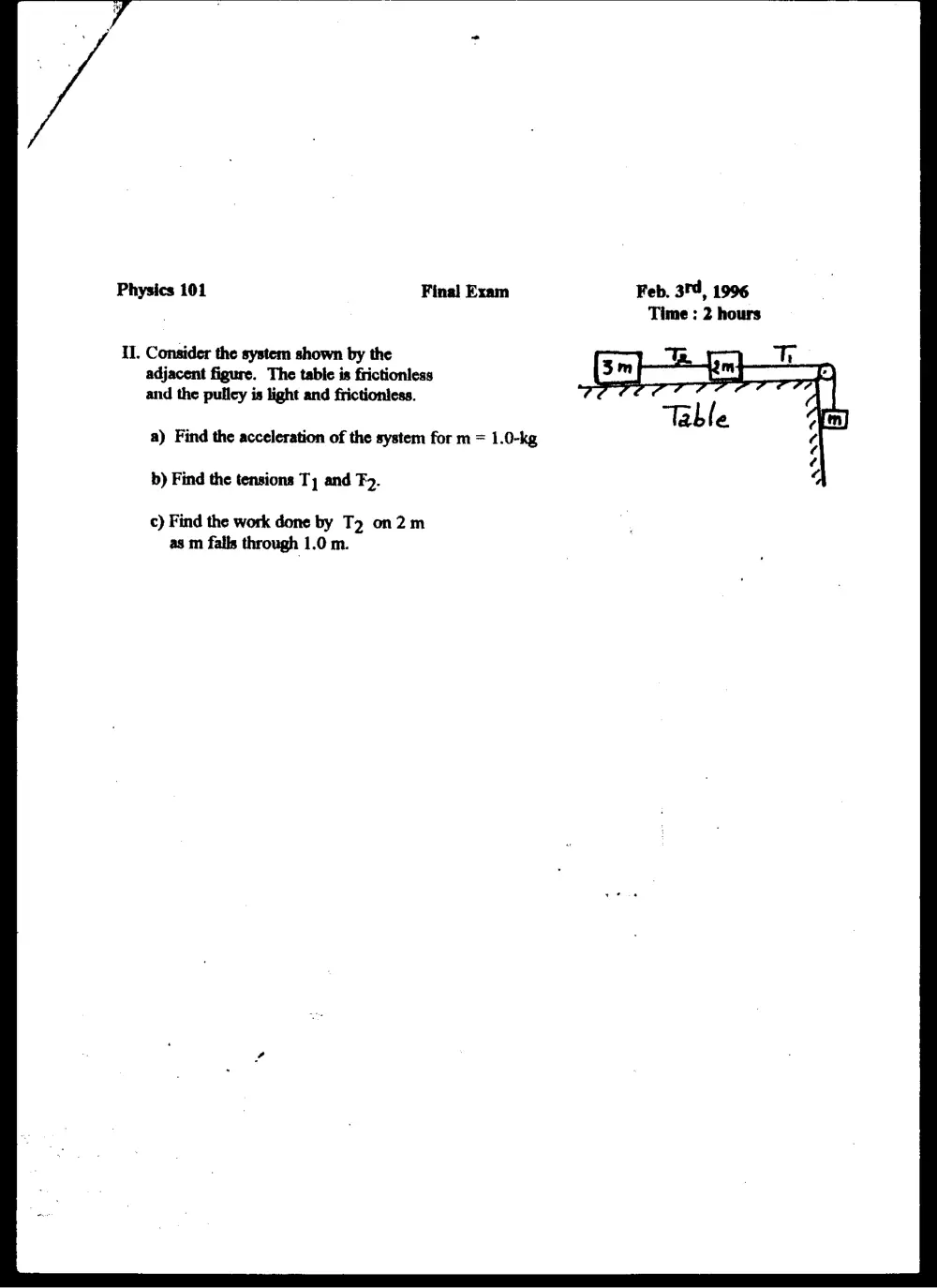
II. Consider the system shown by the
adjacent figure. The table is frictionless
and the pulley is light and frictionless.
a) Find the acceleration of the system for m = 1.0-kg
b) Find the tensions T; and F.
c) Find the work done by T2 on 2m
as m falls through 1.0 m.
Feb. 3°4, 1996
Time : 2 hours
\ S ”
Physics 101 Final Exam Feb. 3'4, 1996
Time : 2 hours
of ‘ ;
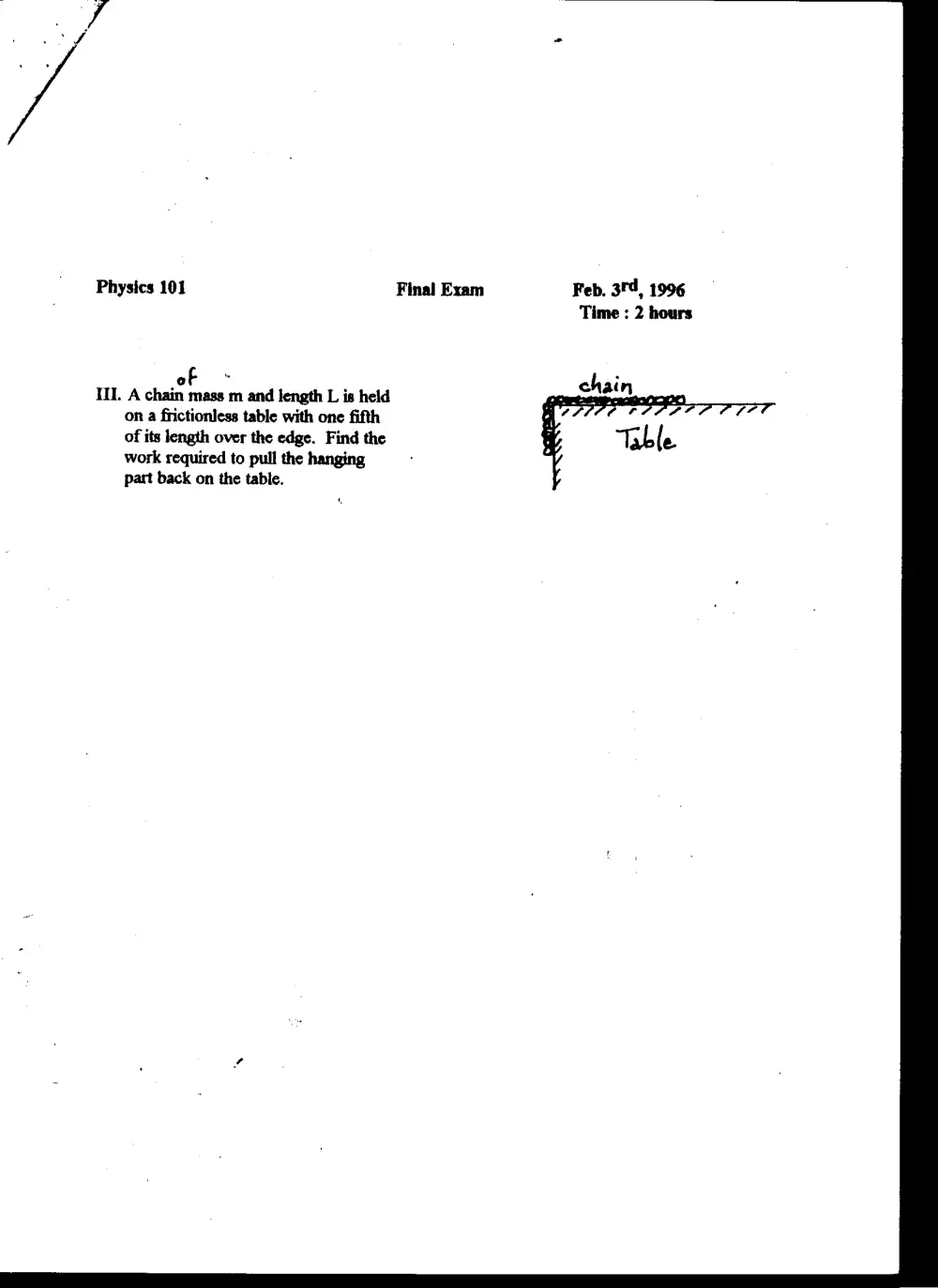
UI. A chain mass m and length L is held chain 53 7
on a frictionless table with one fifth O00EE ©
of its length over the edge. Find the “Tab le
work required to pull the hanging .
part back on the table.
Physics 101 Final Exam
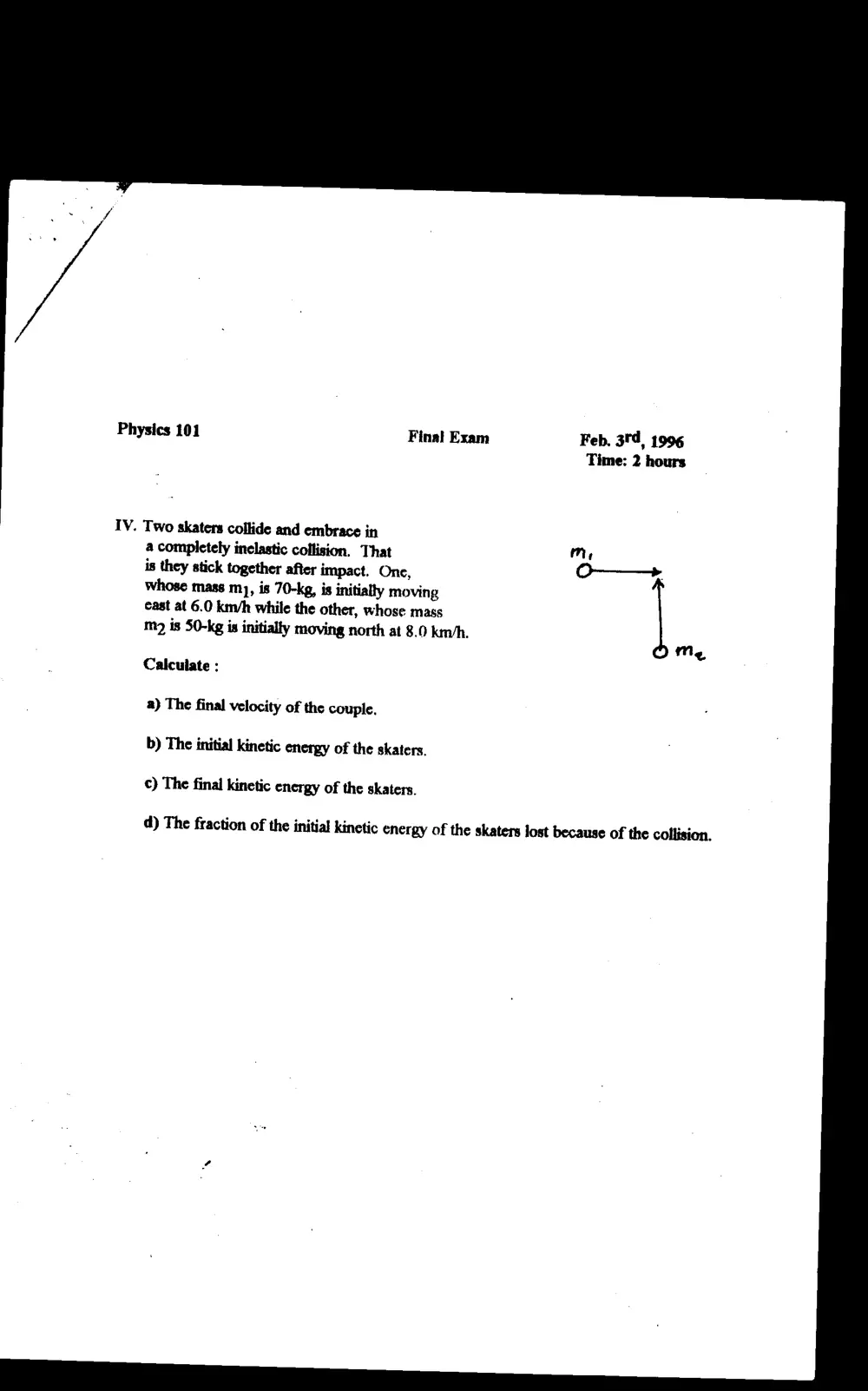
IV. Two skaters collide and embrace in
a completely inelastic collision. That
is they stick together after impact. One,
whose mass my, is 70-kg, is initialty moving
cast at 6.0 knvh while the other, whose mass
m is 50-kg is initially moving north at 8.0 kiwh.
Calculate :
a) The final velocity of the couple.
b) The initial kinetic energy of the skaters.
¢) The final kinetic energy of the skaters,
d) The fraction of the initial kinetic energy of the skaters lost because of the collision.
Physics 101 Final Exam Feb. 3'4 , 1996
V. A uniform disk rotates about a fixed axis, starting from rest and accelerating with
a constant angular acceleration. At one time it is rotating at 10 rew/s. After
completing 60 more complete revolutions its angular speed is 15 rev/s.
Calculate :
a) Its angular acceleration in rev/s?
b) The time required to complete the 60 revolutions.
c) The time required from the start to attain the 10 rev/s angular speed.
Final Exam Feb. 3°d , 1996
Time : 2 hours
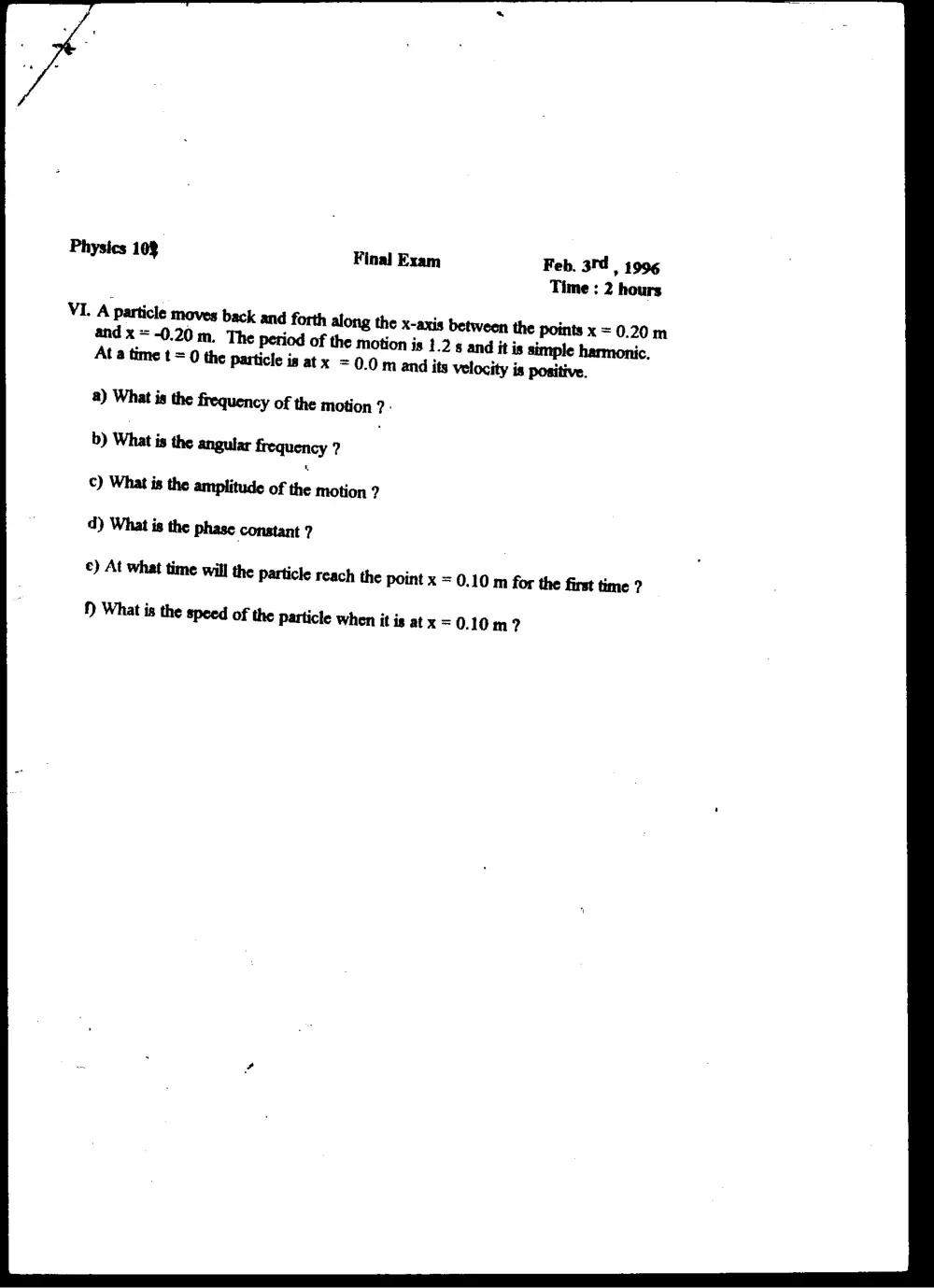
‘axis between the points x = 0.20 m
is 1.2 5 and itis simple harmonic,
= 0.0 m and its velocity is Positive.
a) What is the frequency of the motion 7:
b) What is the angular frequency ?
c) What is the amplitude of the motion ?
d) What is the phase constant ?
©) At what time will the particle reach the point x = 0.10 m for the firs time ?
) What is the speed of the particle when it is at x = 0.10 m?