
PHYS 205 Lecture, Fall 2003
American University of Beirut · Modern Physics for Life Sciences · 10 pages

More PHYS 205 files
Show the text of this lab
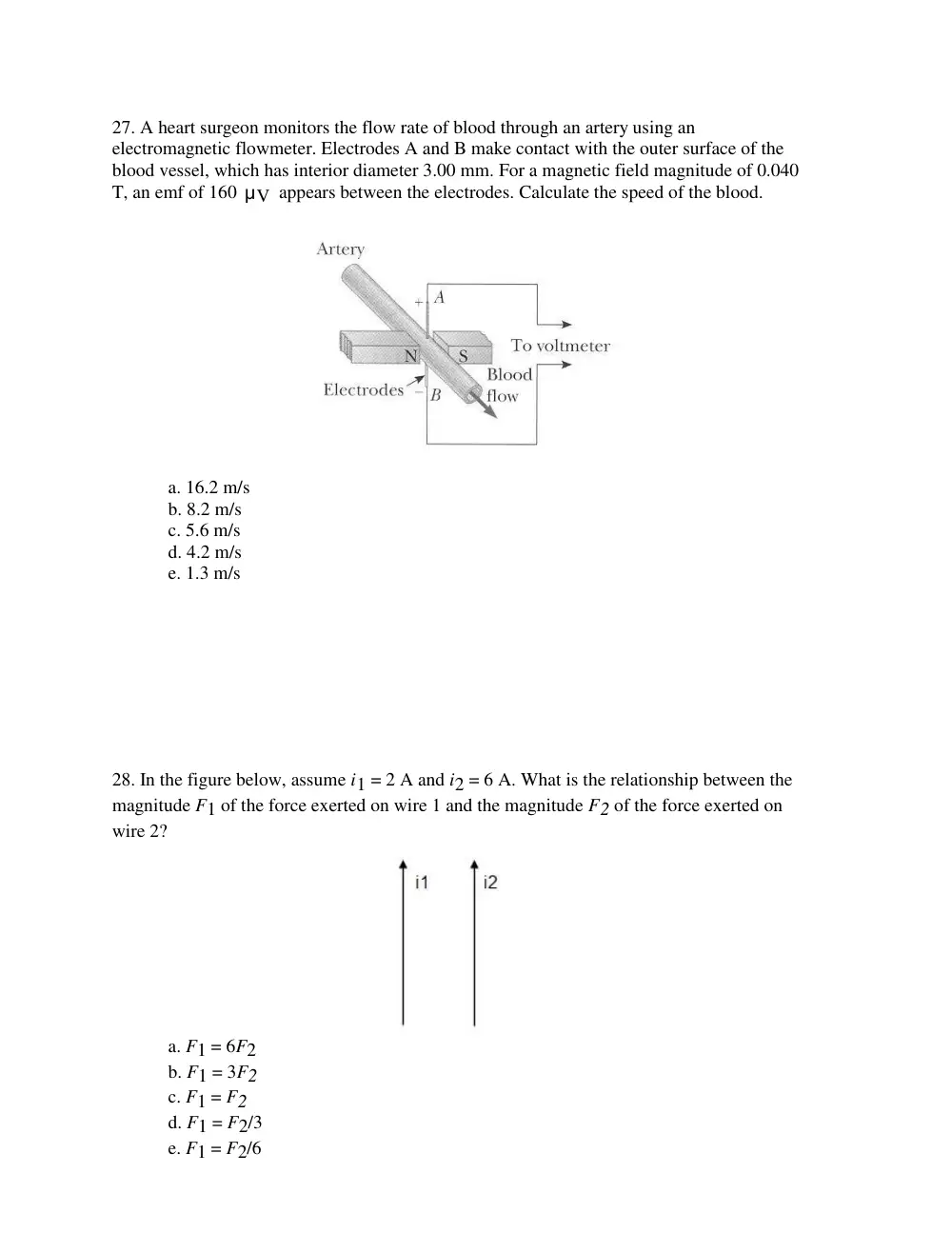
27. A heart surgeon monitors the flow rate of blood through an artery using an
electromagnetic flowmeter. Electrodes A and B make contact with the outer surface of the
blood vessel, which has interior diameter 3.00 mm. For a magnetic field magnitude of 0.040
T, an emf of 160
μV
appears between the electrodes. Calculate the speed of the blood.
a. 16.2 m/s
b. 8.2 m/s
c. 5.6 m/s
d. 4.2 m/s
e. 1.3 m/s
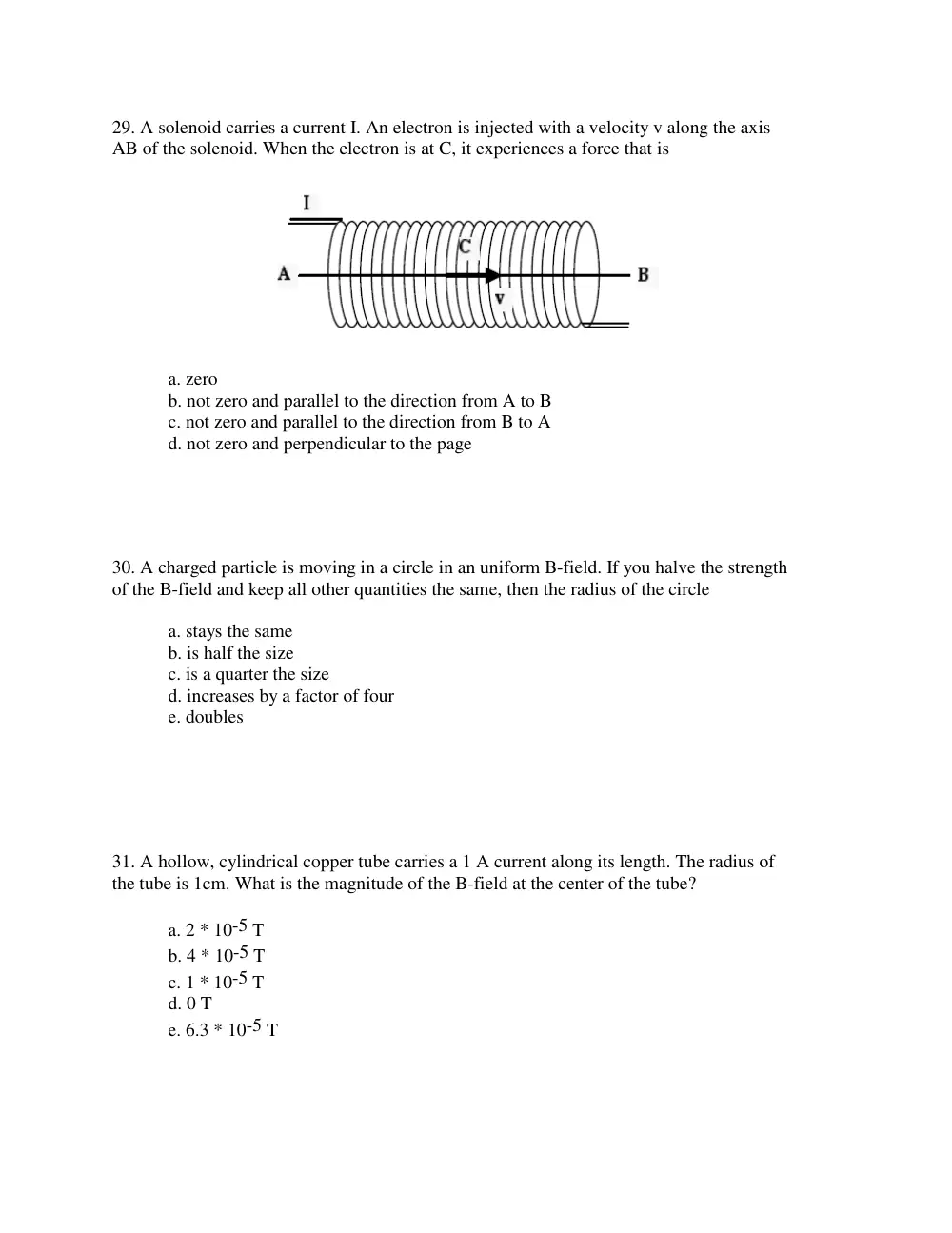
28. In the figure below, assume i1 = 2 A and i2 = 6 A. What is the relationship between the
magnitude F1 of the force exerted on wire 1 and the magnitude F2 of the force exerted on
wire 2?
a. F1 = 6F2
b. F1 = 3F2
c. F1 = F2
d. F1 = F2/3
e. F1 = F2/6
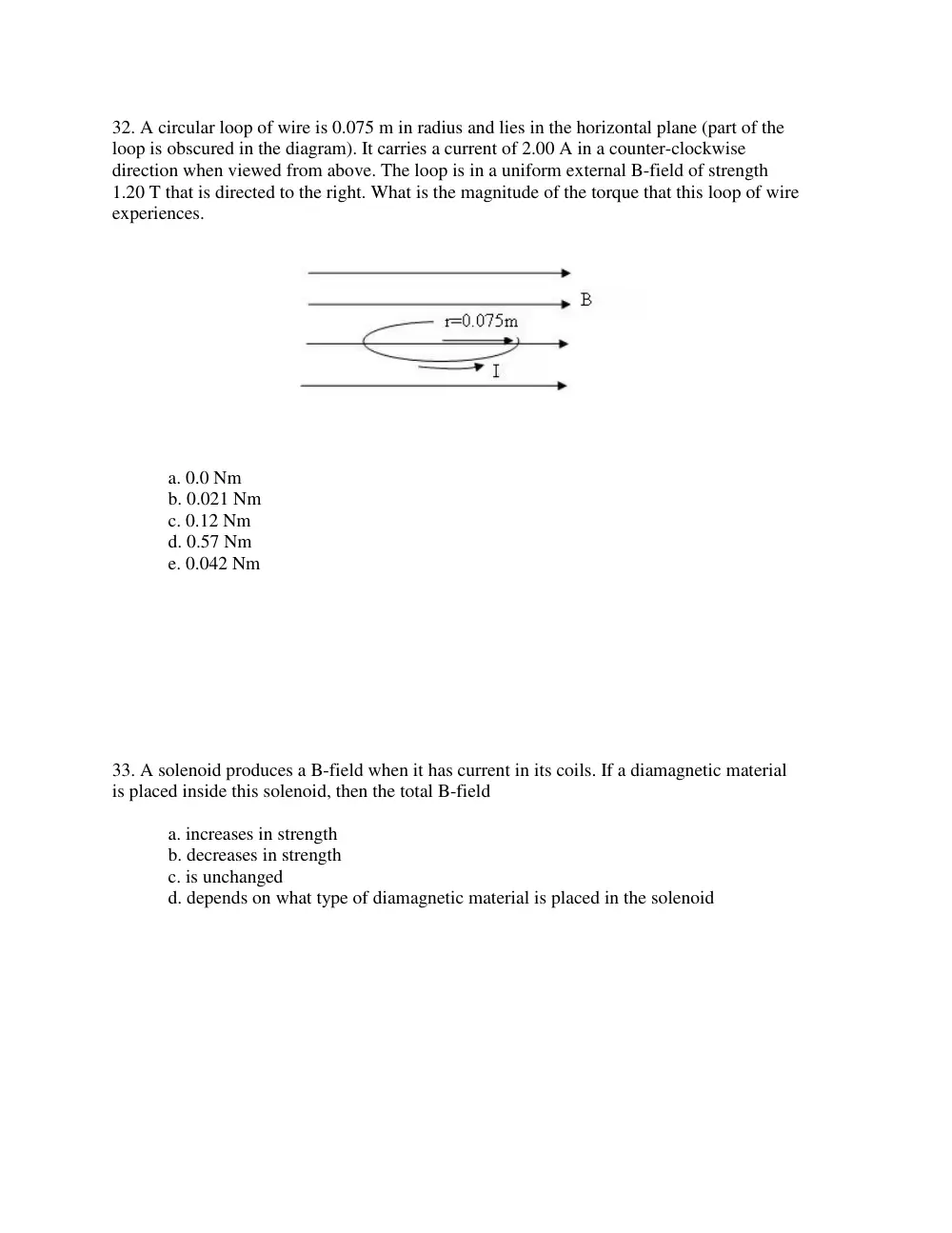
29. A solenoid carries a current I. An electron is injected with a velocity v along the axis
AB of the solenoid. When the electron is at C, it experiences a force that is
a. zero
b. not zero and parallel to the direction from A to B
c. not zero and parallel to the direction from B to A
d. not zero and perpendicular to the page
30. A charged particle is moving in a circle in an uniform B-field. If you halve the strength
of the B-field and keep all other quantities the same, then the radius of the circle
a. stays the same
b. is half the size
c. is a quarter the size
d. increases by a factor of four
e. doubles
31. A hollow, cylindrical copper tube carries a 1 A current along its length. The radius of
the tube is 1cm. What is the magnitude of the B-field at the center of the tube?
a. 2 * 10-5 T
b. 4 * 10-5 T
c. 1 * 10-5 T
d. 0 T
e. 6.3 * 10-5 T
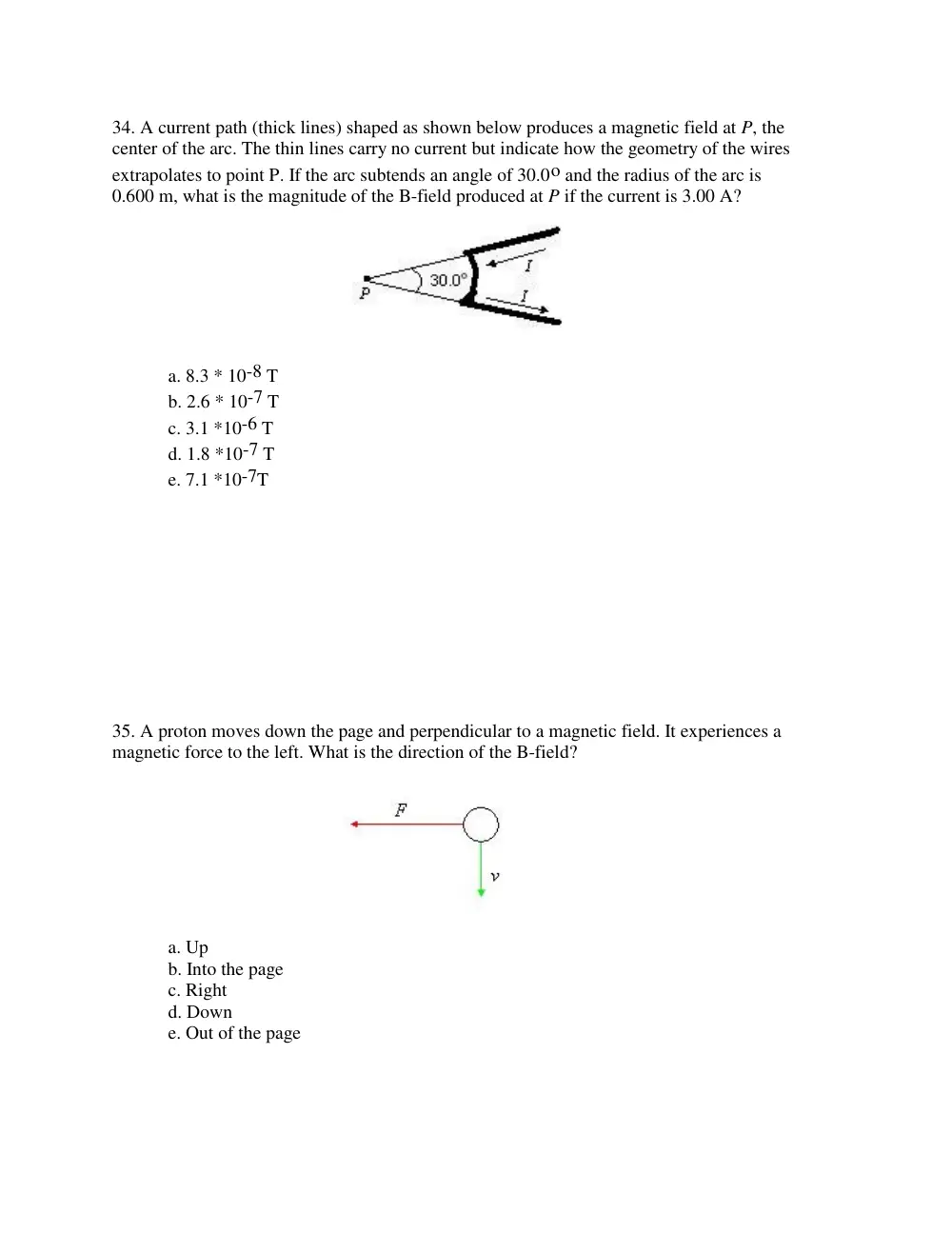
32. A circular loop of wire is 0.075 m in radius and lies in the horizontal plane (part of the
loop is obscured in the diagram). It carries a current of 2.00 A in a counter-clockwise
direction when viewed from above. The loop is in a uniform external B-field of strength
1.20 T that is directed to the right. What is the magnitude of the torque that this loop of wire
experiences.
a. 0.0 Nm
b. 0.021 Nm
c. 0.12 Nm
d. 0.57 Nm
e. 0.042 Nm
33. A solenoid produces a B-field when it has current in its coils. If a diamagnetic material
is placed inside this solenoid, then the total B-field
a. increases in strength
b. decreases in strength
c. is unchanged
d. depends on what type of diamagnetic material is placed in the solenoid
34. A current path (thick lines) shaped as shown below produces a magnetic field at P, the
center of the arc. The thin lines carry no current but indicate how the geometry of the wires
extrapolates to point P. If the arc subtends an angle of 30.0o and the radius of the arc is
0.600 m, what is the magnitude of the B-field produced at P if the current is 3.00 A?
a. 8.3 * 10-8 T
b. 2.6 * 10-7 T
c. 3.1 *10-6 T
d. 1.8 *10-7 T
e. 7.1 *10-7T
35. A proton moves down the page and perpendicular to a magnetic field. It experiences a
magnetic force to the left. What is the direction of the B-field?
a. Up
b. Into the page
c. Right
d. Down
e. Out of the page
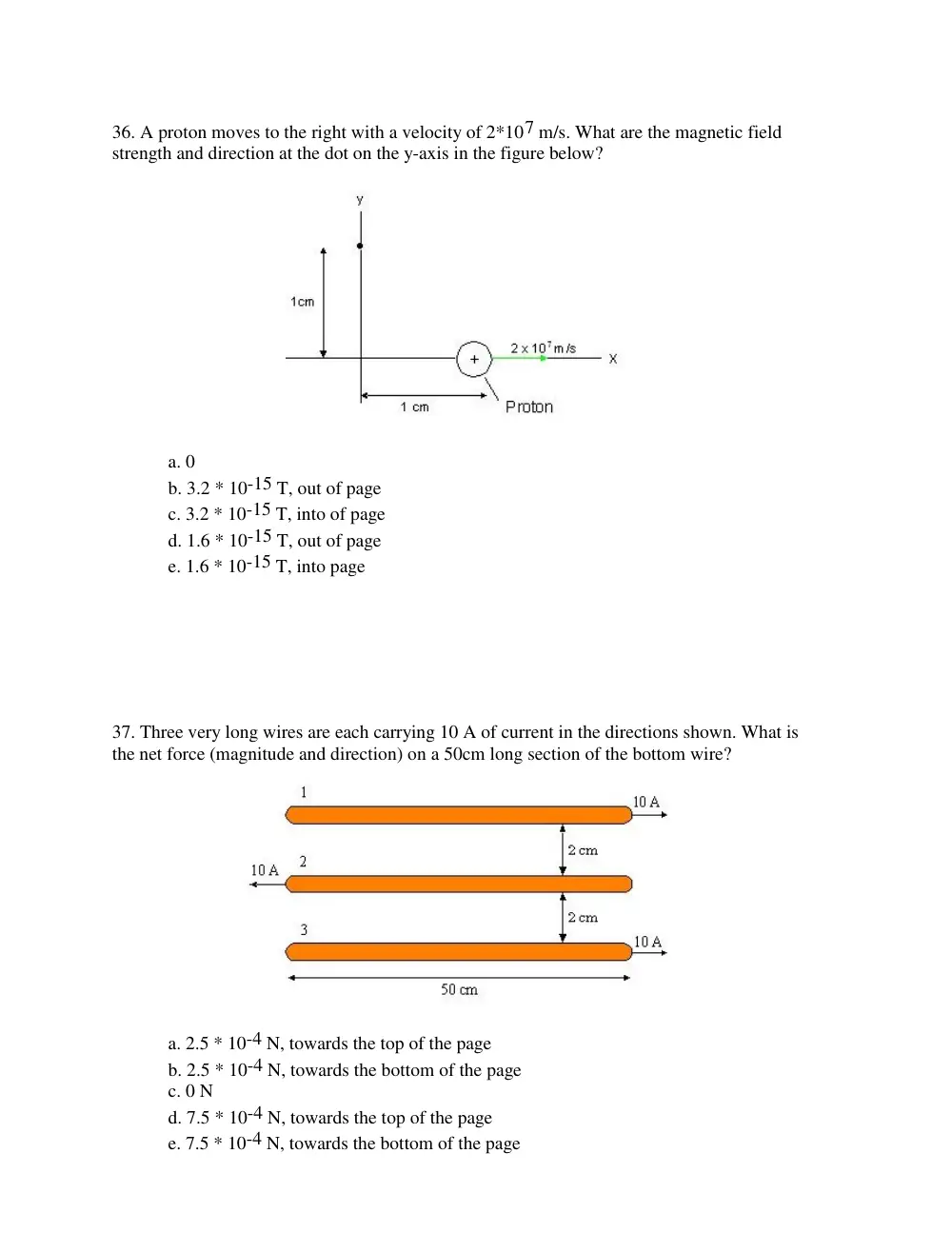
36. A proton moves to the right with a velocity of 2*107 m/s. What are the magnetic field
strength and direction at the dot on the y-axis in the figure below?
a. 0
b. 3.2 * 10-15 T, out of page
c. 3.2 * 10-15 T, into of page
d. 1.6 * 10-15 T, out of page
e. 1.6 * 10-15 T, into page
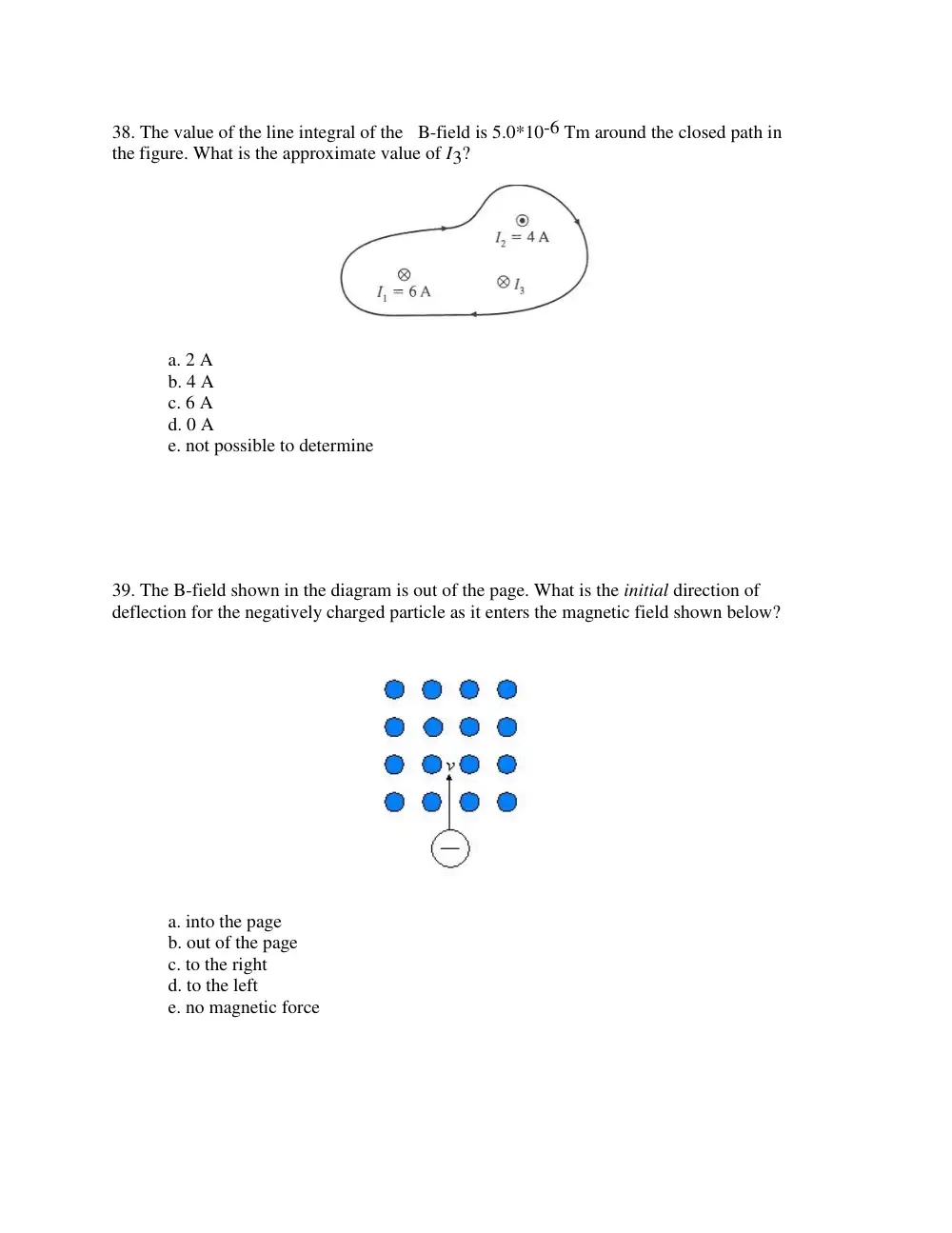
37. Three very long wires are each carrying 10 A of current in the directions shown. What is
the net force (magnitude and direction) on a 50cm long section of the bottom wire?
a. 2.5 * 10-4 N, towards the top of the page
b. 2.5 * 10-4 N, towards the bottom of the page
c. 0 N
d. 7.5 * 10-4 N, towards the top of the page
e. 7.5 * 10-4 N, towards the bottom of the page
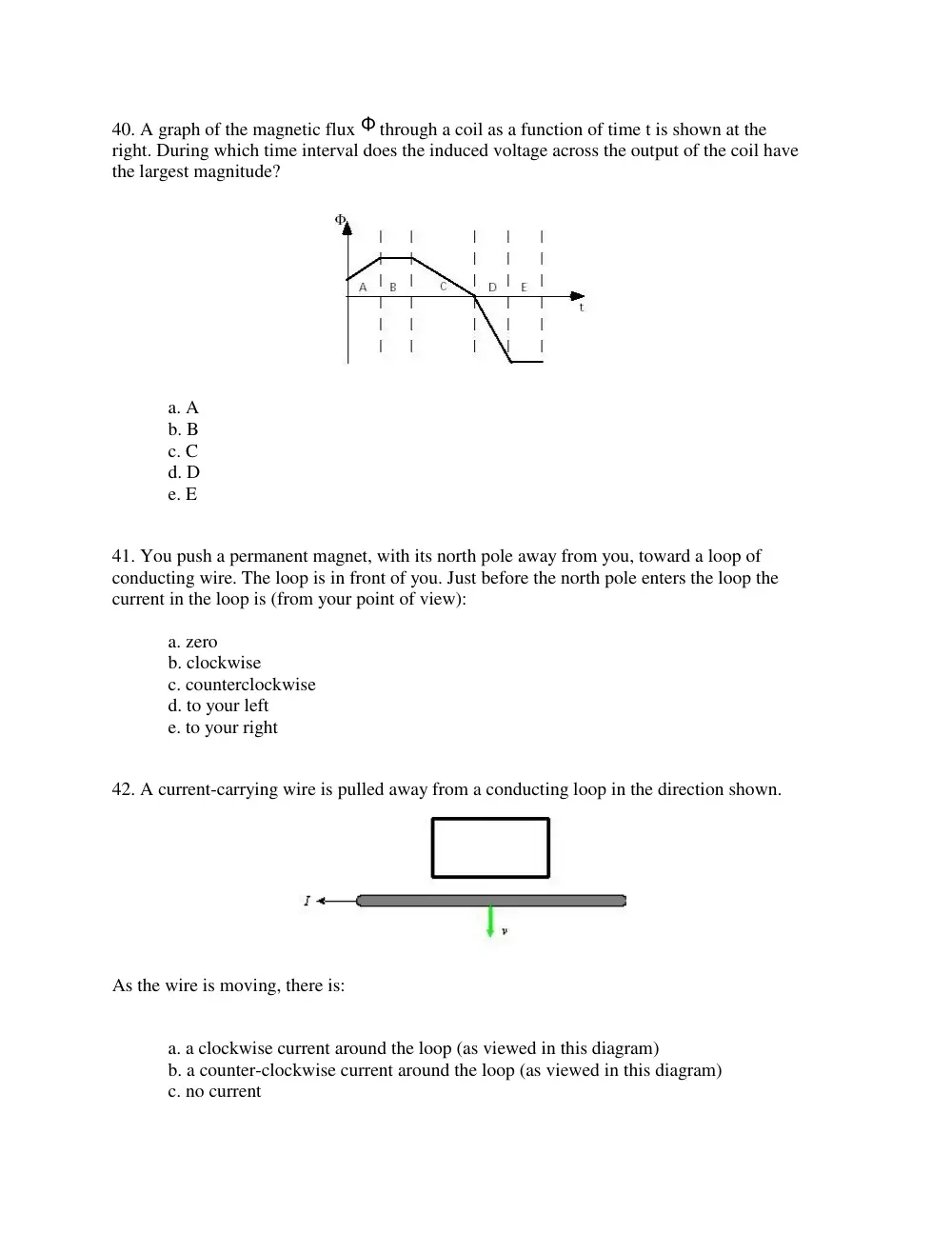
38. The value of the line integral of the � B-field is 5.0*10-6 Tm around the closed path in
the figure. What is the approximate value of I3?
a. 2 A
b. 4 A
c. 6 A
d. 0 A
e. not possible to determine
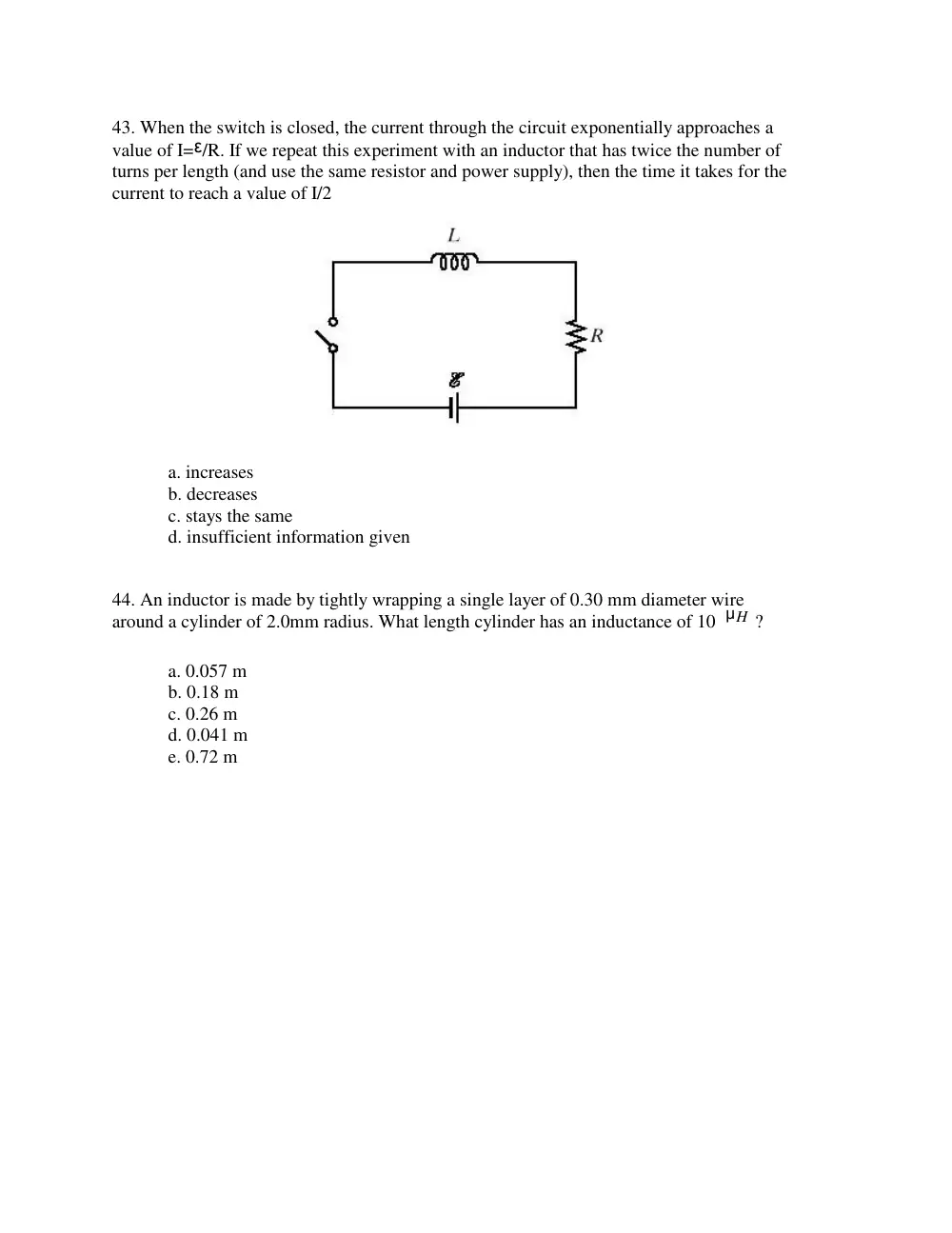
39. The B-field shown in the diagram is out of the page. What is the initial direction of
deflection for the negatively charged particle as it enters the magnetic field shown below?
a. into the page
b. out of the page
c. to the right
d. to the left
e. no magnetic force
40. A graph of the magnetic flux
Φ through a coil as a function of time t is shown at the
right. During which time interval does the induced voltage across the output of the coil have
the largest magnitude?
a. A
b. B
c. C
d. D
e. E
41. You push a permanent magnet, with its north pole away from you, toward a loop of
conducting wire. The loop is in front of you. Just before the north pole enters the loop the
current in the loop is (from your point of view):
a. zero
b. clockwise
c. counterclockwise
d. to your left
e. to your right
42. A current-carrying wire is pulled away from a conducting loop in the direction shown.
As the wire is moving, there is:
a. a clockwise current around the loop (as viewed in this diagram)
b. a counter-clockwise current around the loop (as viewed in this diagram)
c. no current
43. When the switch is closed, the current through the circuit exponentially approaches a
value of I=ε/R. If we repeat this experiment with an inductor that has twice the number of
turns per length (and use the same resistor and power supply), then the time it takes for the
current to reach a value of I/2
a. increases
b. decreases
c. stays the same
d. insufficient information given
44. An inductor is made by tightly wrapping a single layer of 0.30 mm diameter wire
around a cylinder of 2.0mm radius. What length cylinder has an inductance of 10
μH
?
a. 0.057 m
b. 0.18 m
c. 0.26 m
d. 0.041 m
e. 0.72 m
45. A series circuit has a power supply, a switch, a resistor and an inductor. The switch jas
been closed for a long-time and the current in the circuit is fully established. At a time t=0
the switch is opened. The current will be ___ of its full value after two time constants.
a. 63%
b. 86%
c. 14%
d. 37%
e. 0%
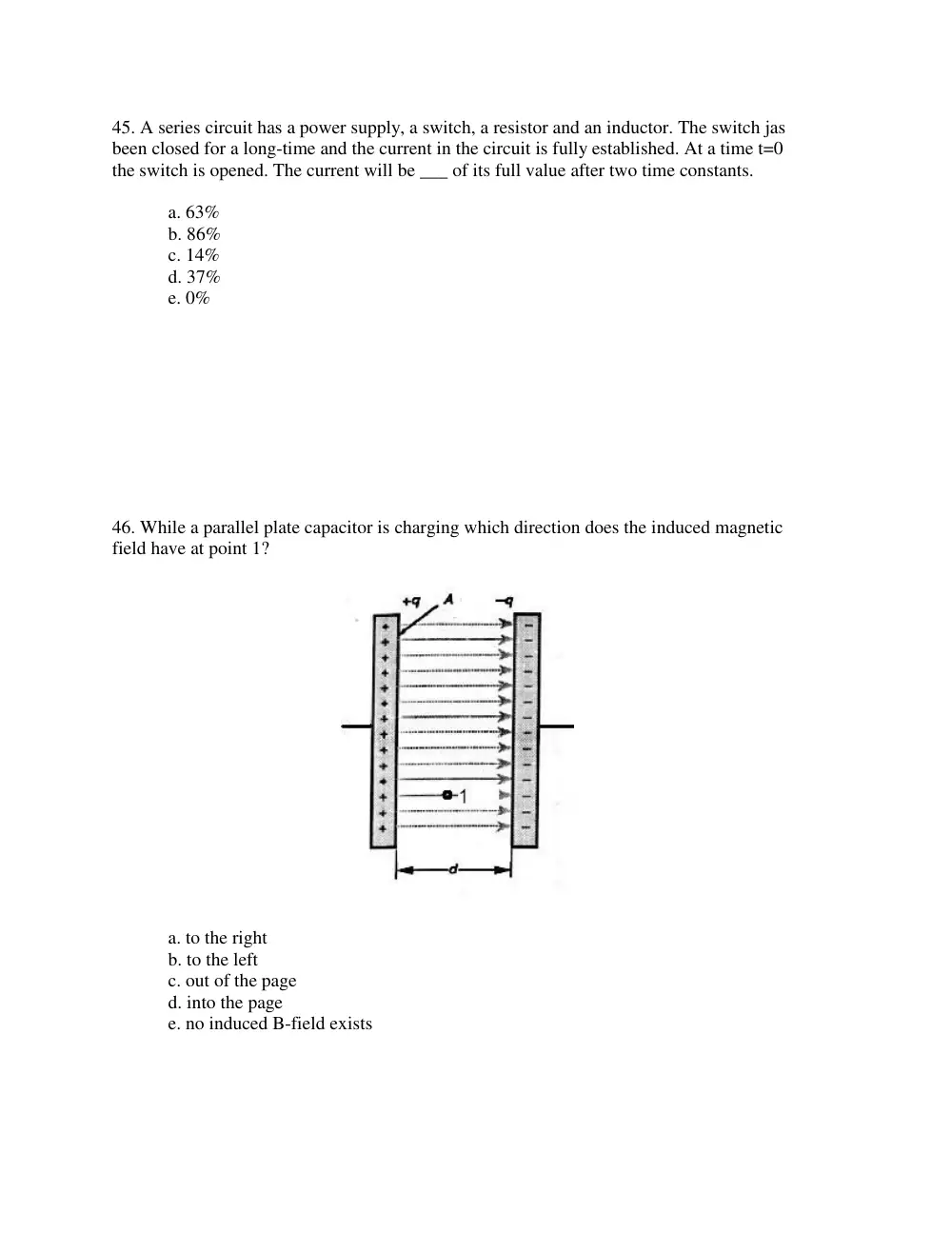
46. While a parallel plate capacitor is charging which direction does the induced magnetic
field have at point 1?
a. to the right
b. to the left
c. out of the page
d. into the page
e. no induced B-field exists
47. The circuit element shown is an ideal inductor. The potential at a is lower than the
potential at b. Which of the following statements about the inductor current I could be true?
a. I is from a to b and steady.
b. I is from a to b and increasing.
c. I is from a to b and decreasing.
d. I is from b to a and steady.