
PHYS 205 Chapter 31, Fall 2017
American University of Beirut · Modern Physics for Life Sciences · 27 pages · Mr. Roy Aad

Showing the first 10 of 27 pages. Download the PDF to see all of it.
More PHYS 205 files
Show the text of this chapter
Chapter 31
Nuclear Physics and
Radioactivity
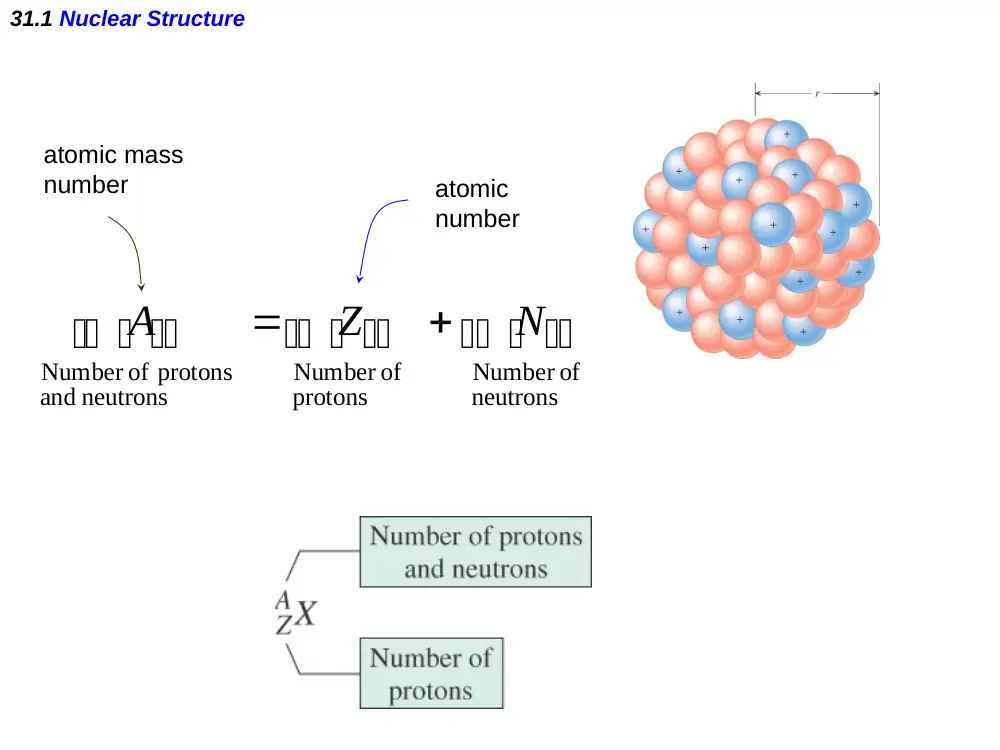
31.1 Nuclear Structure
The atomic nucleus consists
of positively charged protons
and neutral neutrons.
31.1 Nuclear Structure
neutrons
of
Number
protons
of
Number
neutrons
and
of protons
Number
N
Z
A
atomic
number
atomic mass
number
31.1 Nuclear Structure
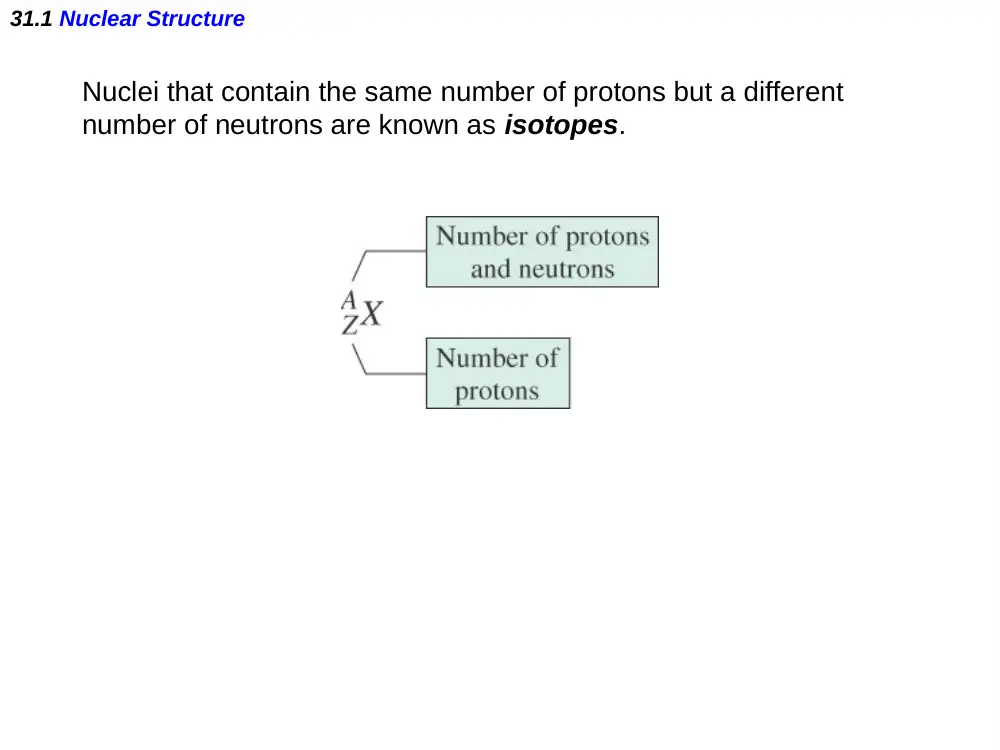
Nuclei that contain the same number of protons but a different
number of neutrons are known as isotopes.
31.1 Nuclear Structure
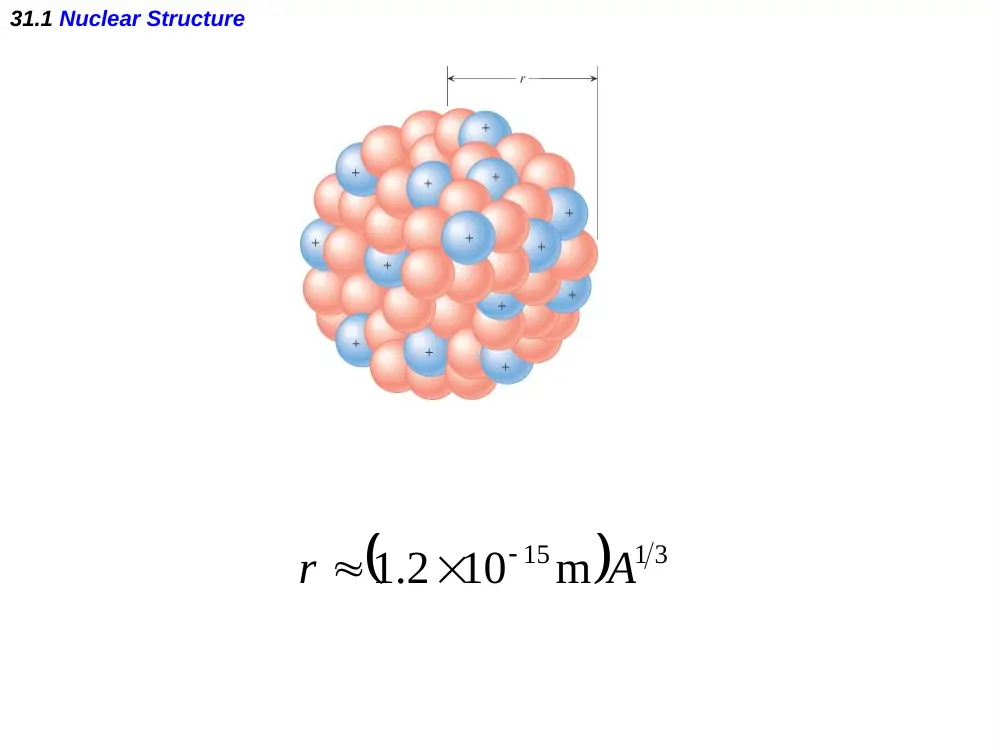
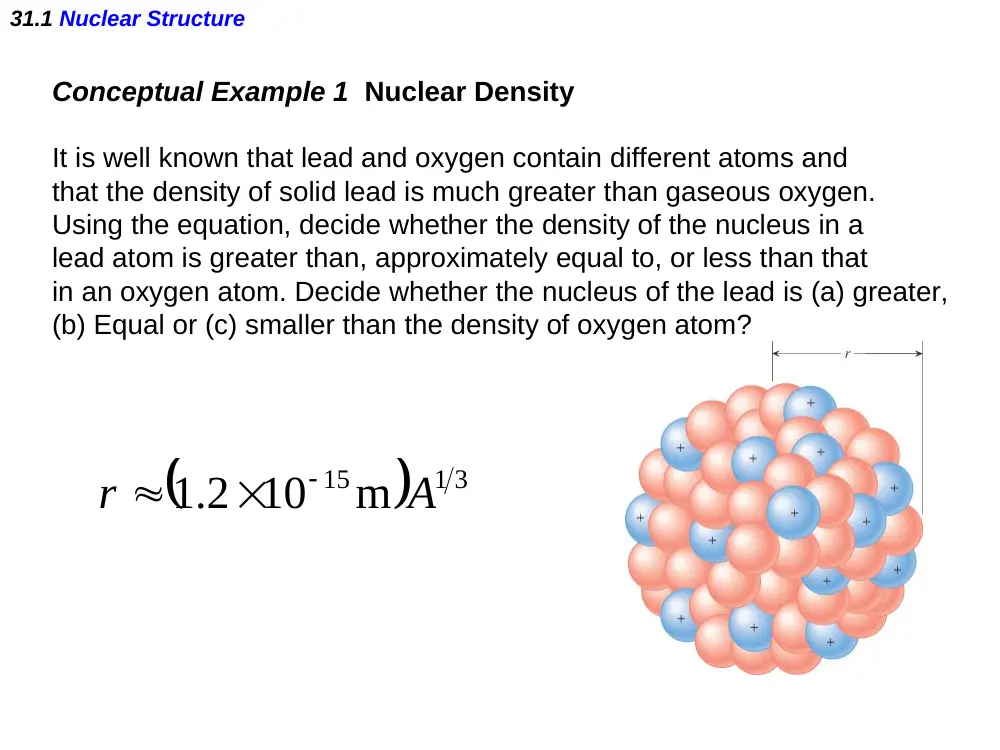
1 3
10 15m
2.1
A
r
31.1 Nuclear Structure
1 3
10 15m
2.1
A
r
Conceptual Example 1 Nuclear Density
It is well known that lead and oxygen contain different atoms and
that the density of solid lead is much greater than gaseous oxygen.
Using the equation, decide whether the density of the nucleus in a
lead atom is greater than, approximately equal to, or less than that
in an oxygen atom. Decide whether the nucleus of the lead is (a) greater,
(b) Equal or (c) smaller than the density of oxygen atom?
31.2 The Strong Nuclear Force and the Stability of the Nucleus
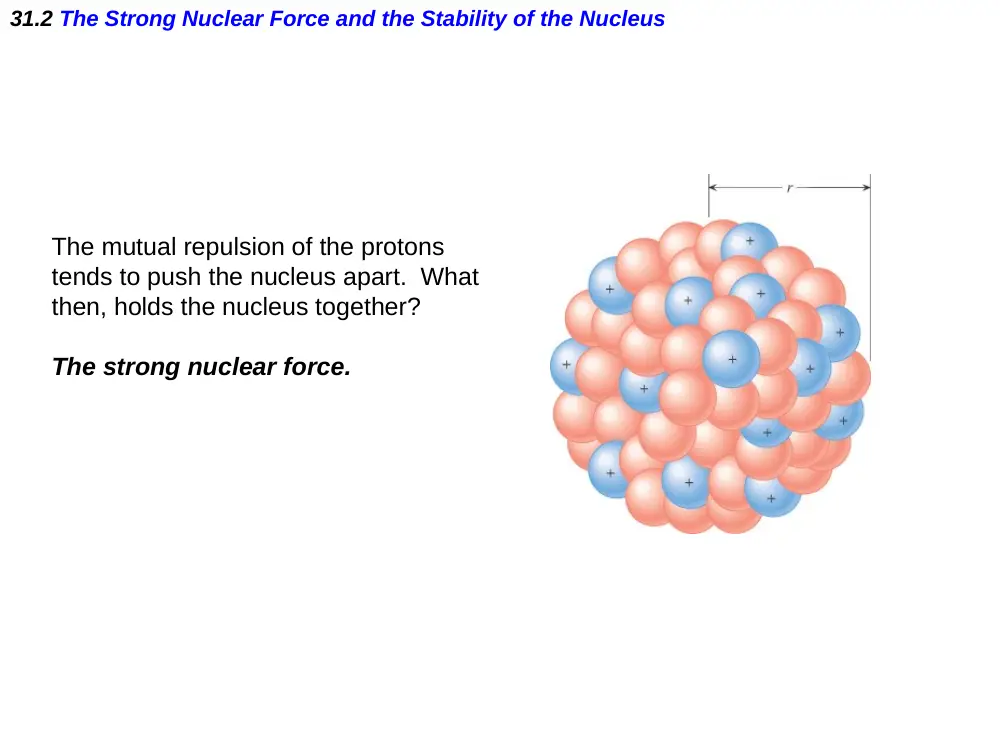
The mutual repulsion of the protons
tends to push the nucleus apart. What
then, holds the nucleus together?
The strong nuclear force.
31.2 The Strong Nuclear Force and the Stability of the Nucleus
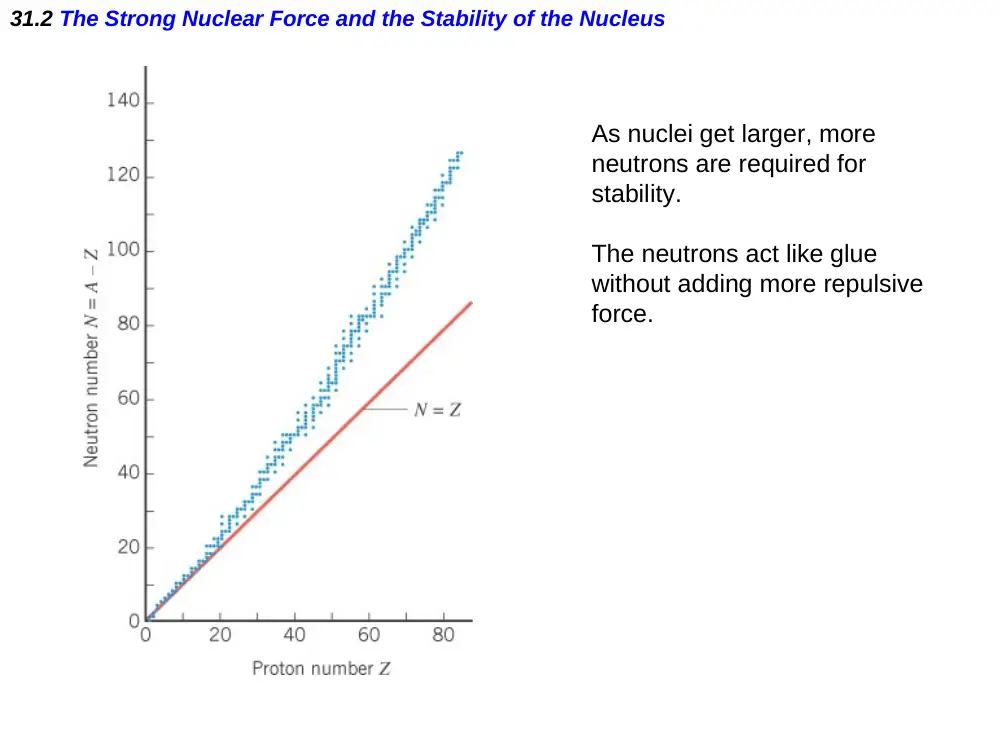
As nuclei get larger, more
neutrons are required for
stability.
The neutrons act like glue
without adding more repulsive
force.
31.3 The Mass Deficit of the Nucleus and Nuclear Binding Energy
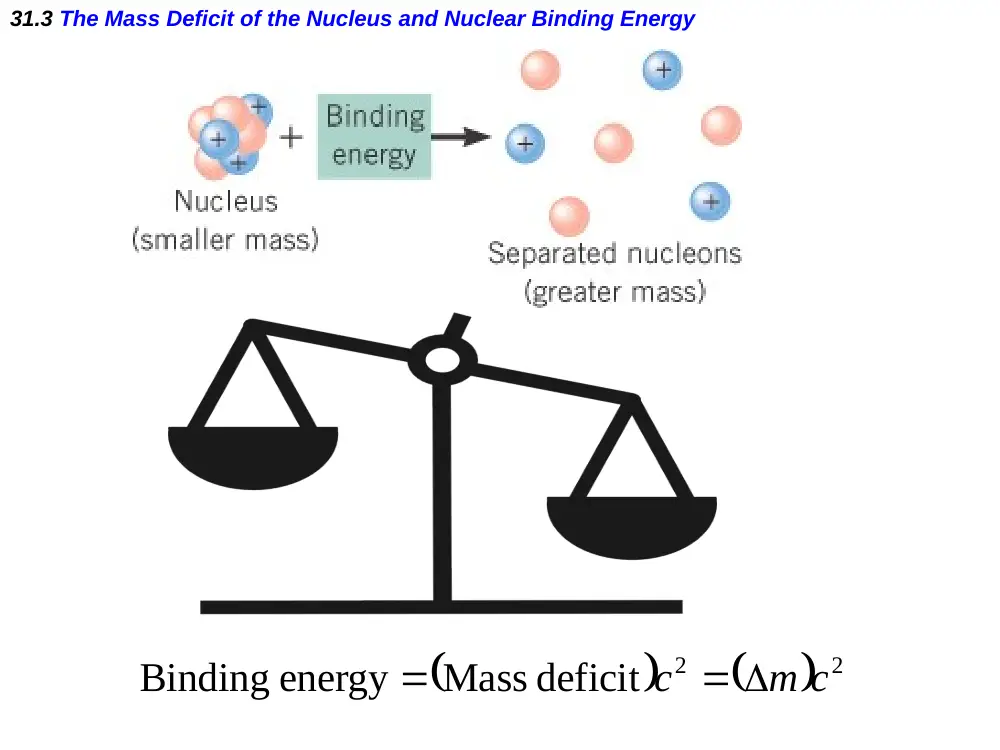
2
2
Mass deficit
Binding energy
m c
c
31.3 The Mass Deficit of the Nucleus and Nuclear Binding Energy
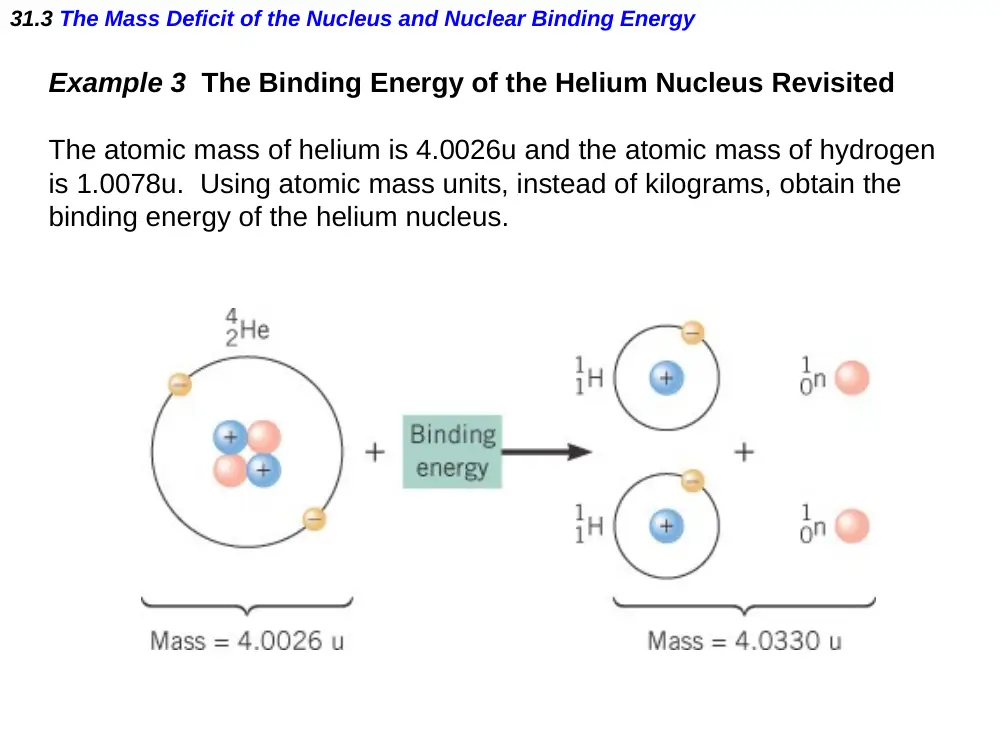
Example 3 The Binding Energy of the Helium Nucleus Revisited
The atomic mass of helium is 4.0026u and the atomic mass of hydrogen
is 1.0078u. Using atomic mass units, instead of kilograms, obtain the
binding energy of the helium nucleus.
31.3 The Mass Deficit of the Nucleus and Nuclear Binding Energy
.0 0304 u
.4 0026 u
.4 0330 u
m
931 5. MeV
u 1
28 3. MeV
Binding energy
31.3 The Mass Deficit of the Nucleus and Nuclear Binding Energy
31.4 Radioactivity
A magnetic field separates three types of particles emitted by
radioactive nuclei.
31.4 Radioactivity
α DECAY
D He
P
2
2
4
2
A
Z
A
Z
31.4 Radioactivity
A smoke
detector
31.4 Radioactivity
β DECAY
D e
P
0
1
1
A
Z
A
Z
31.4 Radioactivity
γ DECAY
P
P
A
Z
A
Z
excited energy
state
lower energy
state
31.4 Radioactivity
Gamma knife
31.5 The Neutrino
During beta decay, energy is released. However, it is found that
most beta particles do not have enough kinetic energy to account for
all of the energy released.
The additional energy is carried away by a neutrino.
Pa e
Th
0
1
234
91
234
90
31.6 Radioactive Decay and Activity
The half-life of a radioactive
decay is the time in which ½
of the radioactive nuclei
disintegrate.
t
Noe
N
2
ln
2
T1
31.6 Radioactive Decay and Activity
31.7 Radioactive Dating
31.7 Radioactive Dating
Conceptual Example 12 Dating a Bottle of Wine
A bottle of red wine is thought to have been sealed about 5 years
ago. The wine contains a number of different atoms, including carbon,
oxygen, and hydrogen. The radioactive isotope of carbon is the
familiar C-14 with ½ life 5730 yr. The radioactive isotope of oxygen
is O-15 with a ½ life of 122.2 s. The radioactive isotope of hydrogen
is called tritium and has a ½ life of 12.33 yr. The activity of each
of these isotopes is known at the time the bottle was sealed. However,
only one of the isotopes is useful for determining the age of the
wine. Which is it?
31.8 Radioactive Decay Series
The sequential decay of one nucleus after another is
called a radioactive decay series.
31.8 Radioactive Decay Series
31.9 Radiation Detectors
A Geiger counter
31.9 Radiation Detectors
A scintillation
counter