
PHYS 210 Homework, Spring 2008
American University of Beirut · Introductory Physics II · 29 pages



Showing the first 10 of 29 pages. Download the PDF to see all of it.
More PHYS 210 files
Show the text of this homework
1,2,3,7,11,12,13,16, 8,20,22,23,24,
25, 27, 30, 31, 32, 33,
38,40,43,46,49,51,54,61,62,71
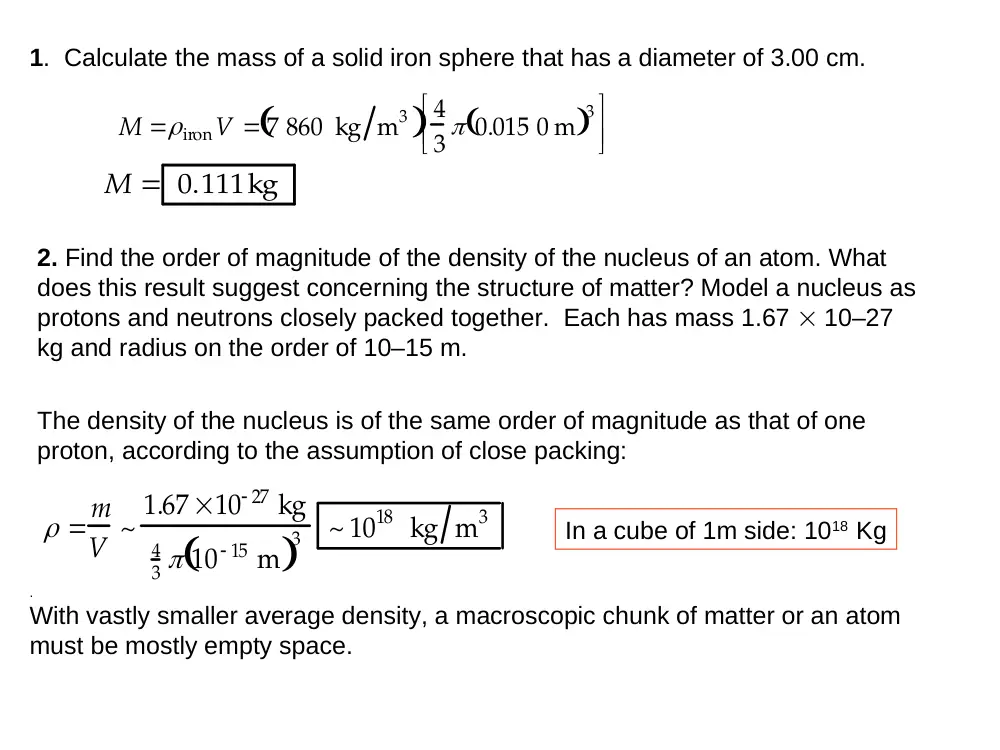
1. Calculate the mass of a solid iron sphere that has a diameter of 3.00 cm.
M ironV 7 860 kg m3
4
3 0.015 0 m
3
M 0.111 kg
The density of the nucleus is of the same order of magnitude as that of one
proton, according to the assumption of close packing:
m
V ~
1.67 10 27 kg
4
3 10 15 m
3
~ 1018 kg m3
.
With vastly smaller average density, a macroscopic chunk of matter or an atom
must be mostly empty space.
In a cube of 1m side: 1018 Kg
2. Find the order of magnitude of the density of the nucleus of an atom. What
does this result suggest concerning the structure of matter? Model a nucleus as
protons and neutrons closely packed together. Each has mass 1.67 10–27
kg and radius on the order of 10–15 m.
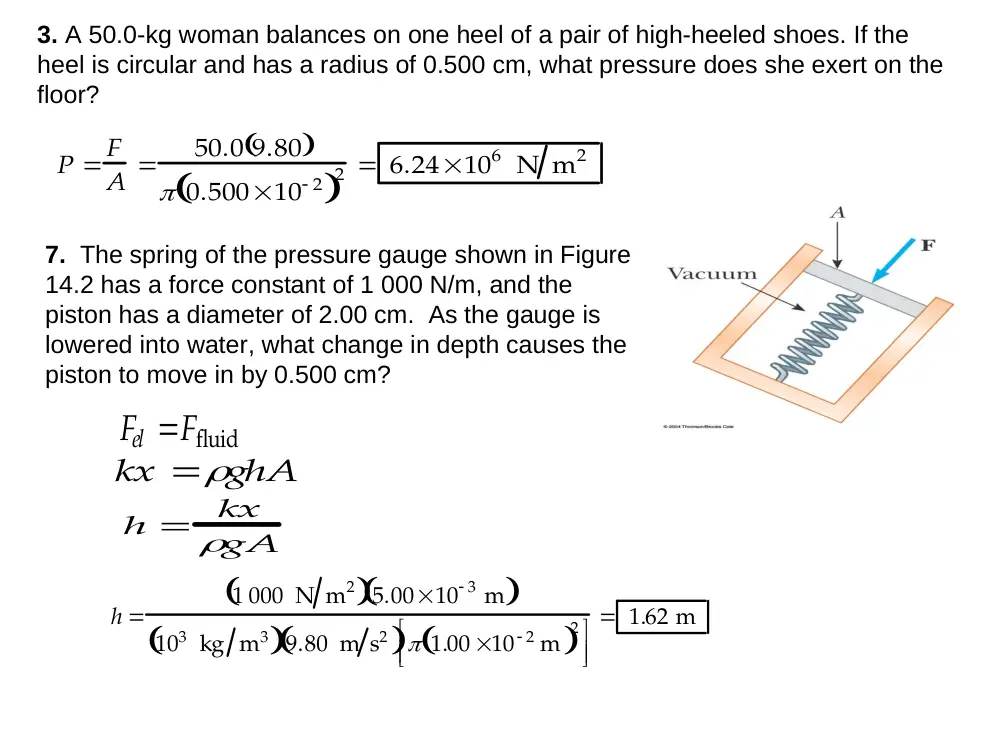
3. A 50.0-kg woman balances on one heel of a pair of high-heeled shoes. If the
heel is circular and has a radius of 0.500 cm, what pressure does she exert on the
floor?
P F
A
50.0 9.80
0.50010 2
2 6.24106 N m2
Fel Ffluid
kx ghA
h kx
gA
h
1 000 N m2
5.0010 3 m
103 kg m3
9.80 m s2
1.00 10 2 m
2
1.62 m
7. The spring of the pressure gauge shown in Figure
14.2 has a force constant of 1 000 N/m, and the
piston has a diameter of 2.00 cm. As the gauge is
lowered into water, what change in depth causes the
piston to move in by 0.500 cm?
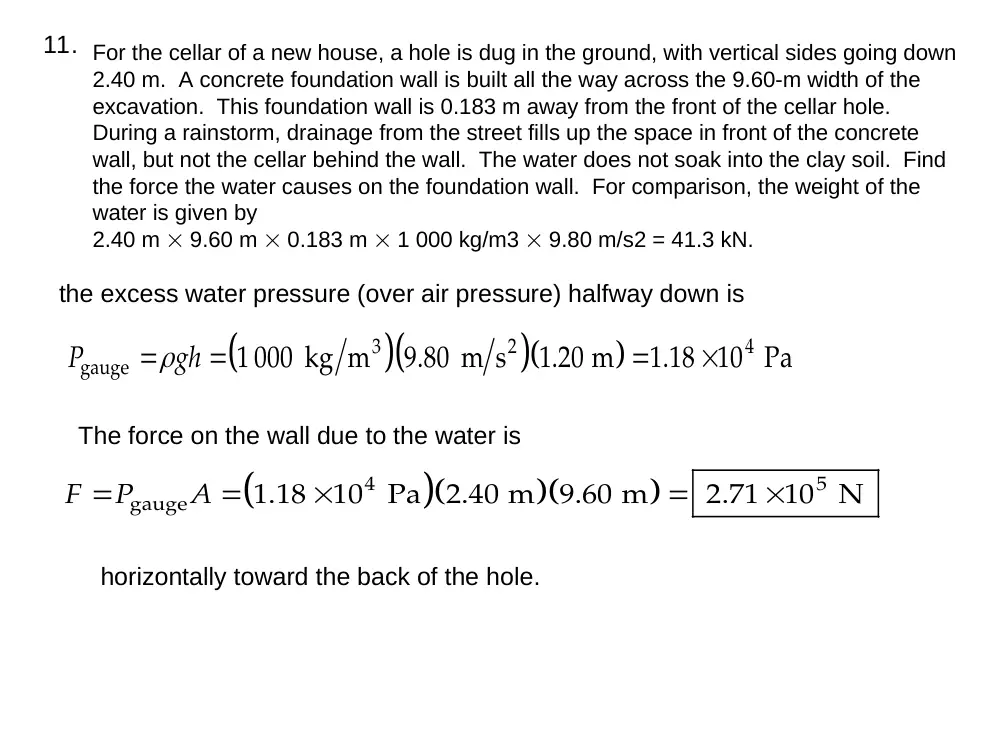
11.
the excess water pressure (over air pressure) halfway down is
3
2
4
gauge
1 000 kg m
9.80 m s
1.20 m
1.18
10 Pa
P
gh
The force on the wall due to the water is
4
5
gauge
1.18
10 Pa
2.40 m
9.60 m
2.71
10 N
F
P
A
horizontally toward the back of the hole.
For the cellar of a new house, a hole is dug in the ground, with vertical sides going down
2.40 m. A concrete foundation wall is built all the way across the 9.60-m width of the
excavation. This foundation wall is 0.183 m away from the front of the cellar hole.
During a rainstorm, drainage from the street fills up the space in front of the concrete
wall, but not the cellar behind the wall. The water does not soak into the clay soil. Find
the force the water causes on the foundation wall. For comparison, the weight of the
water is given by
2.40 m 9.60 m 0.183 m 1 000 kg/m3 9.80 m/s2 = 41.3 kN.
The pressure of the bottom due to the water is Pb = gz = 1.96 x 10⁴ Pa.
So Fb = Pb Ab = 5.88 N.
On each end, Fe = Pav.Aend = (Pb/2).Aend = 9.8 x103 x 20 = 196 kN
On each side, Fs = Pav Aside = 9.8 x103 x 60 = 588 kN
Aend
1
2
3
Aside
a
g
bubble
gf
12. A swimming pool has dimensions 30.0 m 10.0 m and a flat bottom. When the
pool is filled to a depth of 2.00 m with fresh water, what is the force caused by the
water on the bottom? On each end? On each side?
13. .A sealed spherical shell of diameter d is rigidly attached
to a cart, which is moving horizontally with an acceleration a
as in Figure P14.13. The sphere is nearly filled with a fluid
having density
P P0 g eff h P0 1
2 d
g2 a2
.
In the reference frame of the fluid, the cart’s acceleration causes
a
fictitious force to act backward, as if the acceleration of gravity
where
tan 1 a
g
from
2
2
a
g
Directed downward at
From the vertical. The center of the spherical shell is at depth d/2
Below the air buble and the pressure is:
16.
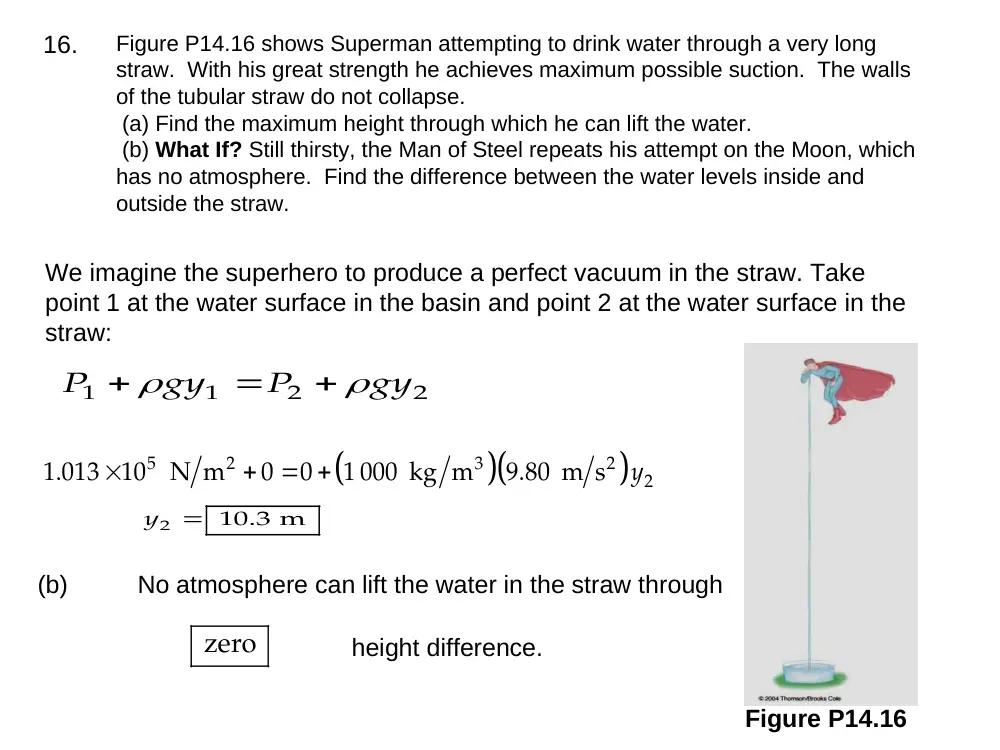
We imagine the superhero to produce a perfect vacuum in the straw. Take
point 1 at the water surface in the basin and point 2 at the water surface in the
straw:
1
1
2
2
P
gy
P
gy
5
2
3
2
2
1.013
10 N m
0
0
1 000 kg m
9.80 m s
y
2
10.3 m
y
(b)
No atmosphere can lift the water in the straw through
zero
height difference.
Figure P14.16 shows Superman attempting to drink water through a very long
straw. With his great strength he achieves maximum possible suction. The walls
of the tubular straw do not collapse.
(a) Find the maximum height through which he can lift the water.
(b) What If? Still thirsty, the Man of Steel repeats his attempt on the Moon, which
has no atmosphere. Find the difference between the water levels inside and
outside the straw.
Figure P14.16
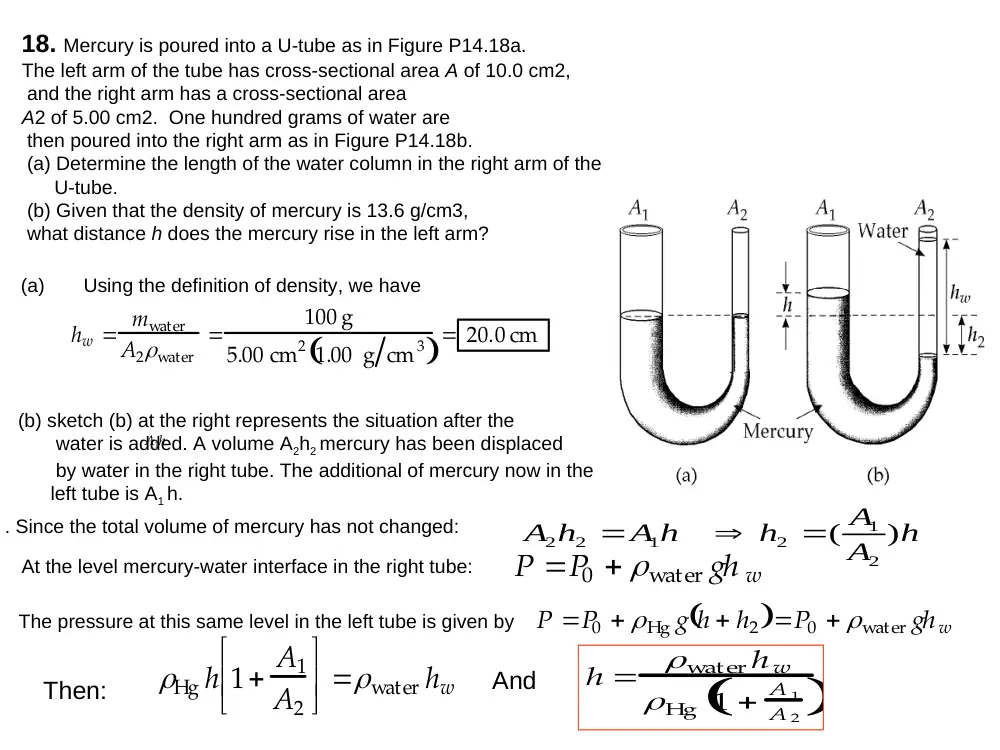
At the level mercury-water interface in the right tube:
18. Mercury is poured into a U-tube as in Figure P14.18a.
The left arm of the tube has cross-sectional area A of 10.0 cm2,
and the right arm has a cross-sectional area
A2 of 5.00 cm2. One hundred grams of water are
then poured into the right arm as in Figure P14.18b.
(a) Determine the length of the water column in the right arm of the
U-tube.
(b) Given that the density of mercury is 13.6 g/cm3,
what distance h does the mercury rise in the left arm?
hw mwater
A2water
100 g
5.00 cm2 1.00 g cm 3
20.0 cm
A1h
(a)
Using the definition of density, we have
(b) sketch (b) at the right represents the situation after the
water is added. A volume A2h2 mercury has been displaced
by water in the right tube. The additional of mercury now in the
left tube is A1 h.
. Since the total volume of mercury has not changed:
h
A
A
h
A h
A h
)
(
2
1
2
1
2 2
P P0 water gh w
The pressure at this same level in the left tube is given by P P0 Hg g h h2
P0 water ghw
Hg h 1 A1
A2
water hw
Then:
And
h
water h w
Hg 1 A 1
A 2
0
Hg
2
0
1
2
and
.
A
w
B
w
P
P
gh
gh
P
P
g h
h
h
Hg
1
2
1
13.6
1 1.00 cm
12.6 cm
w
h
h
B
A
h
h 1
h 2
water
Mercury
Let h be the height of the water column added to the right side
of the U–tube. Then when equilibrium is reached, the situation
is as shown in the sketch at right. Now consider two points, A and B
shown in the sketch, at the level of the e water–mercury interface.
By Pascal’s Principle, the absolute pressure at B is the same
as that at A. But,
1
2
Hg
2
w
w
w
w
h
h
h
h
h
,
, or
B
A
p
p
20. A U-tube of uniform cross-sectional area, open to the atmosphere, is
partially filled with mercury. Water is then poured into both arms. If the
equilibrium configuration of the tube is as shown in Figure P14.20, with
h2 = 1.00 cm, determine the value of h1.
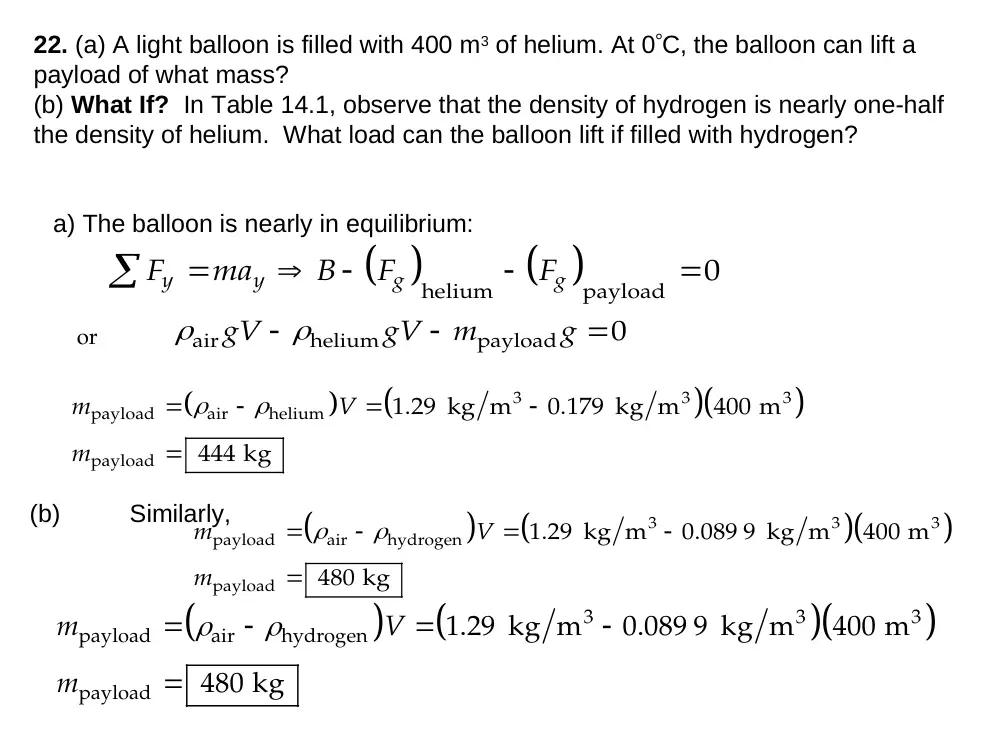
22. (a) A light balloon is filled with 400 m3 of helium. At 0C, the balloon can lift a
payload of what mass?
(b) What If? In Table 14.1, observe that the density of hydrogen is nearly one-half
the density of helium. What load can the balloon lift if filled with hydrogen?
a) The balloon is nearly in equilibrium:
helium
payload
0
y
y
g
g
F
ma
B
F
F
or
air
helium
payload
0
gV
gV
m
g
3
3
3
payload
air
helium
payload
1.29 kg m
0.179 kg m
400 m
444 kg
m
V
m
(b)
Similarly,
3
3
3
payload
air
hydrogen
payload
1.29 kg m
0.089 9 kg m
400 m
480 kg
m
V
m
3
3
3
payload
air
hydrogen
payload
1.29 kg m
0.089 9 kg m
400 m
480 kg
m
V
m
23.A Ping-Pong ball has a diameter of 3.80 cm and average density of
0.084 0 g/cm3. What force is required to hold it completely submerged
under water?
At equilibrium
F 0
Fapp
mg
B
where B is the buoyant force.
Fapp
B
mg
water
Vol
B
g
ball
Vol
m
3
water
ball
water
ball
4
Vol
3
Fapp
g
r g
3
2
2
3
3
3
4
1.90
10
m
9.80 m s
10 kg m
84.0 kg m
0.258 N
3
Fapp
24. A Styrofoam slab has thickness h and density. When a swimmer of mass m
is resting on it, the slab floats in fresh water with its top at the same level as
the water surface. Find the area of the slab.
g
s
F
m
V g
b
w
F
Vg
must be equal to
V
Ah
s
w
m
Ah
Ah
,
w
s
m
A
h
25. A piece of aluminum with mass 1.00 kg and
density 2 700 kg/m3 is suspended from a string
and
then completely immersed in a container of water
(Figure P14.25). Calculate the tension in the string
(a) before and
(b) after the metal is immersed.
Fig 14.25
(a)
Before the metal is immersed
1
0
Fy
T
Mg
2
1
1.00 kg 9.80 m s
9.80 N
T
Mg
(b)
After the metal is immersed:
2
0
Fy
T
B
Mg
2
w
T
Mg
B
Mg
V g
3
1.00 kg
2 700 kg m
M
V
3
2
2
3
1.00 kg
9.80 N
1 000 kg m
9.80 m s
6.17 N
2 700 kg m
T
Mg
B
27.
0
P
P
gh
5
2
0
1.013
10 N m
P
h 5.00 cm
5
2
top
1.017 9 10 N m
P
For h=1.70 m, one gets
5
2
bot
1.029 7
10 N m
P
Since the areas of the top and bottom are
2
2
2
0.100 m
10
m
A
3
top
top
1.017 9
10 N
F
P
A
3
bot
1.029 7
10 N
F
One finds
0
T
B
Mg
b)
3
3
3
3
2
10 kg m
1.20
10
m
9.80 m s
11.8 N
w
B
Vg
10.0 9.80
98.0 N
Mg
98.0
11.8
86.2 N
T
Mg
B
3
bot
top
1.029 7
1.017 9
10 N
11.8 N
F
F
c)
which is equal to B found in part (b).
A 10.0-kg block of metal measuring 12.0 cm 10.0 cm 10.0 cm is suspended
from a scale and immersed in water as in Figure P14.25b. The 12.0-cm dimension
is vertical, and the top of the block is 5.00 cm below the surface of the water.
(a) What are the forces acting on the top and on the bottom of the block?
(Take P0 = 1.013 0 105 N/m2.)
(b) What is the reading of the spring scale?
(c) Show that the buoyant force equals the difference between the forces at the top
and bottom of the block.
30. A spherical aluminum ball of mass 1.26 kg contains an empty spherical cavity
that is concentric with the ball. The ball just barely floats in water.
Calculate
(a) the outer radius of the ball and
(b) the radius of the cavity.
(a) The weight of the ball must be equal to the buoyant force of the water:
m
r
g
r
mg
shell
shell
water
.6 70
4
3
(b)
The mass of the ball is determined by the density of aluminum:
cm
r
r
r
V
m
c
c
shell
Al
Al
.5 74
)
(
3
4
3
3
Let A represent the horizontal cross-sectional area of the rod, which
we presume to be constant. The rod is in equilibrium:
0
y
F
0
whole rod
fluid
immersed
0
mg
B
V
g
V
g
0ALg
A L
h g
0L
L
h
the density of the liquid is
.
31. Determination of the density of a fluid has many important
applications. A car battery contains sulfuric acid, for which density is
a measure of concentration. For the battery to function properly the
density must be inside a range specified by the manufacturer.
Similarly, the effectiveness of antifreeze in your car’s engine coolant
depends on the density of the mixture (usually ethylene glycol and
water). When you donate blood to a blood bank, its screening
includes determination of the density of the blood, since higher
density correlates with higher hemoglobin content. A hydrometer is
an instrument used to determine liquid density. A simple one is
sketched in Figure P14.31. The bulb of a syringe is squeezed and
released to let the atmosphere lift a sample of the liquid of length L 0
floats partially immersed in the liquid of density. A length h of the rod
Protrudes above the surface of the liquid.
Show that the density of the liquid is given by
h
L
L
0
Fig. 14.31
33. How many cubic meters of helium are required to lift a balloon with a 400-kg payload
to a height of 8 000 m?. (Take =o.180 kg/m). Assume that the balloon maintains a
constant volume and that the density of air decreases with the altitude z according to
the expression
8000
/
0
z
air
e
where z is the height measured in meters and 0 =1.25 Kg/m3 is the density
at sea level.
The balloon stops when :
3
1430
)
(
m
M
V
He
air
M
Mg
airVg
HeVg
Mg
gV
gV
He
air
It is in equilibrium
38. A horizontal pipe 10.0 cm in diameter has a smooth reduction to a pipe 5.00
cm in diameter. If the pressure of the water in the larger pipe is 8.00 104 Pa
and the pressure in the smaller pipe is 6.00 104 Pa, at what rate does water
flow through the pipes?
By Bernoulli’s equation,
4
2
2
4
2
2
4
2
2
2
2
1
1
8.00
10 N m
1 000
6.00
10 N m
1 000 16
2
2
1
2.00
10 N m
1 000 15
2
1.63 m s
1 000
5.00
10
1.63 m s
12.8 kg s
v
v
v
v
dm
Av
dt
40. A village maintains a large tank with an open top, containing water for emergencies.
The water can drain from the tank through a hose of diameter
6.60 cm. The hose ends with a nozzle of diameter 2.20 cm. A rubber stopper is inserted
into the nozzle. The water level in the tank is kept 7.50 m above the nozzle.
(a) Calculate the friction force exerted on the stopper by the nozzle.
(b) The stopper is removed. What mass of water flows from the nozzle in 2.00 h? (c)
Calculate the gauge pressure of the flowing water in the hose just behind the nozzle.
Take point at the free surface of the water in the tank and inside the nozzle
(a) With the cork in place
2
2
1
1
1
2
2
2
1
1
2
2
P
gy
v
P
gy
v
3
2
0
2
1 000 kg m 9.8 m s 7.5 m
0
0
0
P
P
becomes
4
2
0
7.35
10 Pa
P
P
For the stopper
xF 0
water
air
2
0
2
4
0
7.35
10 Pa
0.011 m
27.9 N
F
F
f
P A
P A
f
f
(b) Now Bernoulli’s equation gives
4
3
2
0
0
2
2
1
7.35 10 Pa
0
0
1 000 kg m
2
12.1 m s
P
P
v
v
Continuation next page
The quantity leaving the nozzle in 2 h is
Continuation of problem 40
2
3
4
2
1 000 kg m
0.011 m
12.1 m s 7 200 s= 3.32
10 kg
V
Av t
(c) Take point 1 in the wide hose and 2 just outside the nozzle.
Continuity :equation
1 1
2
2
2
2
1
1
2
2
1
1
1
2
2
2
2
2
3
3
1
0
4
2
4
1
0
6.6 cm
2.2 cm
12.1 m s
2
2
12.1 m s
1.35 m s
9
1
1
2
2
1
1
0
1 000 kg m
1.35 m s
0
1 000 kg m
12.1 m s
2
2
7.35
10 Pa
9.07
10 Pa
7.26
10 Pa
A v
A v
v
v
P
gy
v
P
gy
v
P
P
P
P
43. The Figure shows a stream of water in steady flow from
a kitchen faucet. At the faucet the diameter of the stream is
0.960 cm. The stream fills a 125-cm3 container in 16.3 s.
Find the diameter of the stream 13.0 cm below the opening
of the faucet.
Stream fills a tank of volume 125 cm3 in 13.6 s, therefore:
cm s
s
cm
r
A
/
10 6.
v
16 3.
125
)v
(
v
1
3
1
2
1
At 13 cm below, we obtain the velocity by using the Bernoulli's equation:
s
m
gy
p
gy
p
/
6.1
v
v
2
1
v
2
1
2
2
2
2
0
2
1
1
0
Using the continuity equation, we obtain the diameter of the flow at 13 cm:
cm
d
m s
d
s
cm
or
A
A
247
.0
/ )
6.1(
/ 2)
(
16 3.
125
v
v
2
3
2
2
1
1
46.
Old Faithful Geyser in
Yellowstone Park (Fig. P14.46) erupts at
approximately 1-h intervals, and the
height of the water column reaches 40.0
m. (a) Model the rising stream as a
series of separate drops. Analyze the
free-fall motion of one of the drops to
determine the speed at which the water
leaves the ground. (b) What If? Model
the rising stream as an ideal fluid in
streamline flow. Use Bernoulli’s equation
to determine the speed of the water as it
leaves ground level. (c) What is the
pressure (above atmospheric) in the
heated underground chamber if its depth
is 175 m? You may assume that the
chamber is large compared with the
geyser’s vent.
Solution on next slide
Solution for 46
a) For upward flight of a water-drop projectile from geyser vent to fountain-top:
2
2
2
2
.
0
2( 9.8)( 40)
28
/
yf
yi
y
yi
yi
v
v
a
y
v
v
m s
b) Between geyser vent and fountain-top:
2
2
1
1
1
2
2
2
1
1
2
2
p
v
gy
p
v
gy
Air so low in density, that very nearly p1 = p2 = 1atm. Then
2
1
1
1
0
0
9.8 40
28
/
2 v
v
m s
c) Between the chamber and fountain-top:
2
2
1
1
1
2
2
2
1
1
2
2
p
v
gy
p
v
gy
1
0
1
0
0 1000 9.8( 175)
0 1000 9.8(40)
2.11
p
p
p
p
MPa
49. A Pitot tube can be used to determine the velocity of air flow by measuring the
difference between the total pressure and the static pressure (Fig. P14.49). If the
fluid in the tube is mercury, density Hg = 13 600 kg/m3, and
h = 5.00 cm, find the speed of air flow. (Assume that the air is stagnant at point A
and take air = 1.25 kg/m3.)
Figure P14.49
2
air
Hg
2
v
P
g h
Hg
air
2
103 m s
g h
v
51. A siphon is used to drain water from a tank, as illustrated in Figure P14.51. The
siphon has a uniform diameter. Assume steady flow without friction.
(a) If the distance h = 1.00 m, find the speed of outflow at the end of the siphon.
(b) What If? What is the limitation on the height of the top of the siphon above the
water surface? (For the flow of the liquid to be continuous, the pressure must
not drop below the vapor pressure of the liquid.)
Figure P14.51
2
0
0
3
1
0
0
2
P
gh
P
v
3
2
v
gh
h 1.00 m
3
4.43 m s
v
2
2
2
0
3
1
1
0
2
2
P
gy
v
P
v
b)
2
3
v
v
since
0
P
P
gy
0
P
since
5
0
3
3
2
1.013 10 Pa
10.3 m
10 kg m
9.8 m s
P
y
g
54.Figure P14.54 shows a water tank with a valve at the bottom. If this valve is opened, what is the maximum height attained by the water
stream coming out of the right side of the tank? Assume that h = 10.0 m, L = 2.00 m, and = 30.0, and that the
cross-sectional area at A is very large compared with that at B.
Figure P14.54
Consider the diagram and apply Bernoulli’s equation to
points A and B, taking at the level of point B, and
recognizing that is approximately zero. This gives:
2
2
1
0
sin
2
1
0
2
A
w
w
B
w
B
w
P
g h
L
P
v
g
Now, recognize that
atmosphere
A
B
P
P
P
since both points are open to the atmosphere (neglecting variation of atmospheric
pressure with altitude). Thus, we obtain
2
2
sin
2 9.80 m s
10.0 m
2.00 m sin30.0
13.3 m s
B
B
v
g h
L
v
Now the problem reduces to one of projectile motion with
sin 30.0
6.64 m s
yi
B
v
v
2
2
2
yf
yi
v
v
a
y
then
gives at the top of the arc
max
y
y
where
0
vyf
2
2
max
0
6.64 m s
2
9.80 m s
0
y
ymax= =2.25m, above the level where the water emerges
1
6 gwH 3
61. Review problem.
With reference to Figure 14.5, show that the
total torque exerted by the water behind the dam about a
horizontal axis through O is
Show that the effective line of action of the total force exerted by the
water is at a distance H/3 above O.
H
h
y
dy
w
dF
0
0
0
3
( )
( )
1
( )
(
)
6
H
H
H
d
ydF
yp y dA
yp y wdy
p y
g H
y
gwH
Torque:
The total force is
2
0
0
0
1
( )
( )
2
H
H
H
F
dF
p y dA
p y wdy
gwH
If this were applied at a height yeff such that the torque remains unchanged, we
have
2
3
1
1
2
6
3
eff
eff
eff
H
Fy
gwH
y
gwH
y
62. In about 1657 Otto von Guericke, inventor of the air pump,
evacuated a sphere made of two brass hemispheres. Two teams of
eight horses each could pull the hemispheres apart only on some
trials, and then "with greatest difficulty," with the resulting sound
likened to a cannon firing (Fig. P14.62). (a) Show that the force F
required to pull the evacuated hemispheres apart is
R2(P0 – P), where R is the radius of the hemispheres and P
is the pressure inside the hemispheres, which is much less
than P0. (b) Determine the force if
P = 0.100P0 and R = 0.300 m.
Figure P14.62
(a)
The pressure on the surface of the two
hemispheres is constant at all points, and the force on
each element of surface area is directed along the radius
of the hemispheres. The applied force along the axis
must balance the force on the “effective” area, which is
the projection of the actual surface onto a plane
perpendicular to the x axis,
2
A
R
2
0
F
P
P
R
2
4
0
0
0
0.100
0.300 m
0.254
2.58
10 N
F
P
P
P
(b) For the values given
71.
A U-tube open at both ends is
partially filled with water (Fig. P14.71a). Oil
having a density 750 kg/m3 is then poured
into the right arm and forms a column
L = 5.00 cm high (Fig. P 14.71b). (a)
Determine the difference h in the heights of
the two liquid surfaces.
(b) The right arm is then shielded from any
air motion while air is blown across the top
of the left arm until the surfaces of the two
liquids are at the same height (Fig.
P14.71c). Determine the speed of the air
being blown across the left arm. Take the
density of air as 1.29 kg/m3.
Fig. 14.71
Solution on next page
3
/
750
m
kg
oil
L=5.0 cm
a) What is h?
Consider interface water-oil (points A and B)
gL
p
P
h
g L
p
P
oil
B
w
A
0
0
)
(
w
oil
w
B
A
h
P
P
b) Right arm shielded (no air motion)
Using Bernoulli's equation:
2
2
2
v
2
1
0)
(
2
1
v
2
1
air
A
B
B
A
B
air
air
B
A
air
air
A
p
p
y
y
g y
p
g y
p
3
/
750
m
kg
air
To determine
A
B
p
p
we use Pascal’s law
At the Interface C and D:
v
)
(
A
B
oil
air
B
D
w
air
A
C
p
p
gL
gH
p
p
gL
gH
p
p
Solution of 14.71