
PHYS 210 Homework, Spring 2008
American University of Beirut · Introductory Physics II · 18 pages



Showing the first 10 of 18 pages. Download the PDF to see all of it.
More PHYS 210 files
Show the text of this homework
Homework: chapter 7
Energy
Homework: chapter 7
Energy
4,6,7,8,10,11,12,15,17,18,20,26,28,32,3
4,56,58,60,65
(a)
5
2
3.35
10
9.80 100 J
3.28
10
J
W
mgh
R
mg
2
air resistance
3.28
10
J
W
(b)
Since
,
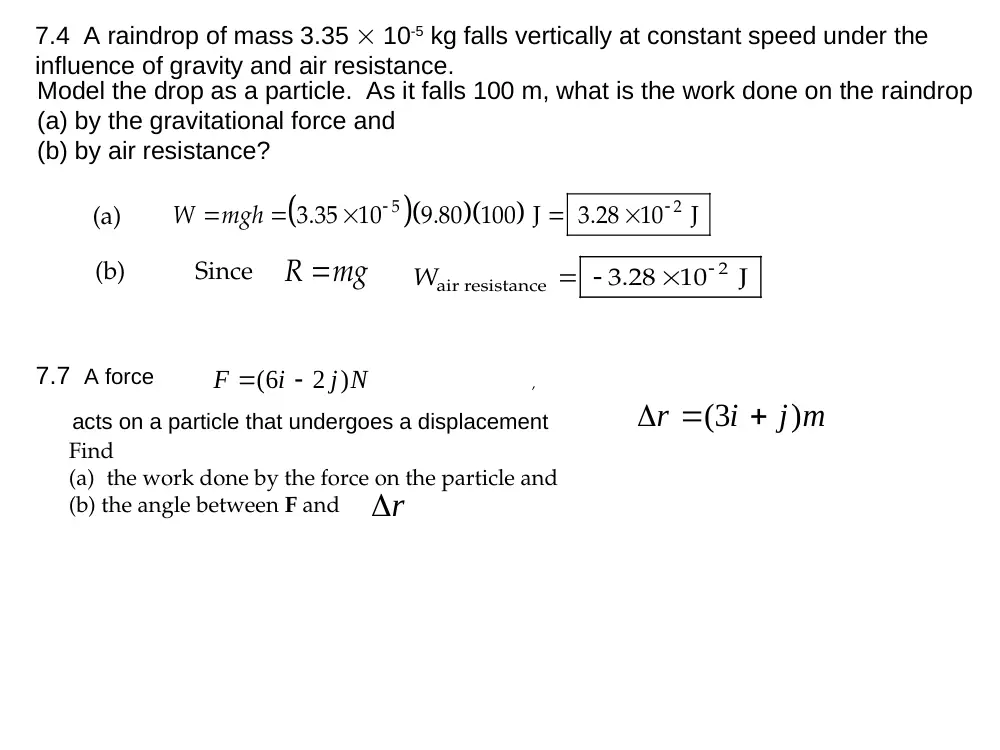
7.4 A raindrop of mass 3.35 10-5 kg falls vertically at constant speed under the
influence of gravity and air resistance.
Model the drop as a particle. As it falls 100 m, what is the work done on the raindrop
(a) by the gravitational force and
(b) by air resistance?
7.7 A force
j N
i
F
2 )
6
(
acts on a particle that undergoes a displacement
j m
i
r
)
3
(
Find
(a) the work done by the force on the particle and
(b) the angle between F and
r
7.8 Find the scalar product of the vectors in Figure P7.8.
Figure P7.8
A 3ˆ i ˆ j ˆ k
B ˆ i 2ˆ j 5ˆ k
C 2ˆ j 3 ˆ k
Find: C · (A – B).
7.10 For the vectors:
and
and
We must first find the angle between the two
vectors. It is:
28
42
=90 -42-28=20
cos
32.8 N
0.173 m s cos20.0
Fv
F v
N m
J
5.33
5.33
5.33 W
s
s
F v
ˆ
ˆ
ˆ
ˆ
ˆ
ˆ
3.00
2.00
5.00
A
B
i
j
k
i
j
k
ˆ
ˆ
ˆ
4.00
6.00
ˆ
ˆ
ˆ
ˆ
ˆ
2.00
3.00
4.00
6.00
0
2.00
18.0
16.0
A
B
i
j
k
C A
B
j
k
i
j
k
f
i
W
Fdx
area under curve from to
(a)
ix 0
8.00 m
fx
0
8
1
8.00 m
6.00 N
24.0 J
2
W
8
10
1
2.00 m
3.00 N
3.00 J
2
W
(b)
0
10
0
8
8
10
24.0
3.00
21.0 J
W
W
W
c)
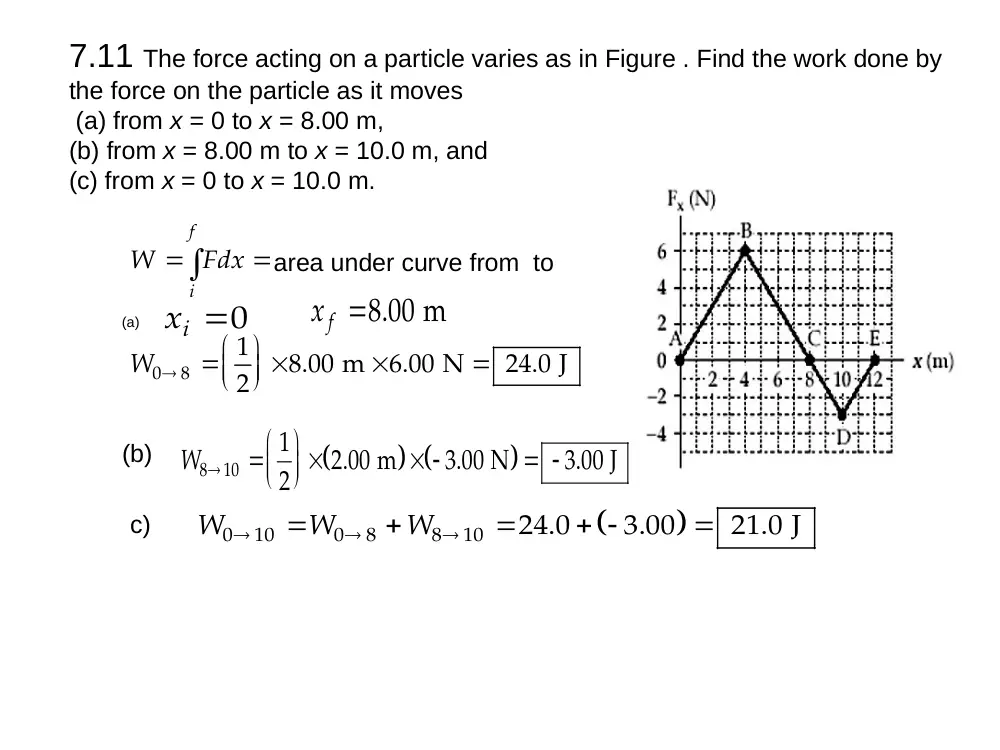
7.11 The force acting on a particle varies as in Figure . Find the work done by
the force on the particle as it moves
(a) from x = 0 to x = 8.00 m,
(b) from x = 8.00 m to x = 10.0 m, and
(c) from x = 0 to x = 10.0 m.
8
16 N
Fx
x
(a)
See figure to the right
3.00 N
5.00 m
7.50 J
2
W
net
2.00 m 16.0 N
1.00 m 8.00 N
12.0 J
2
2
W
b)
c)
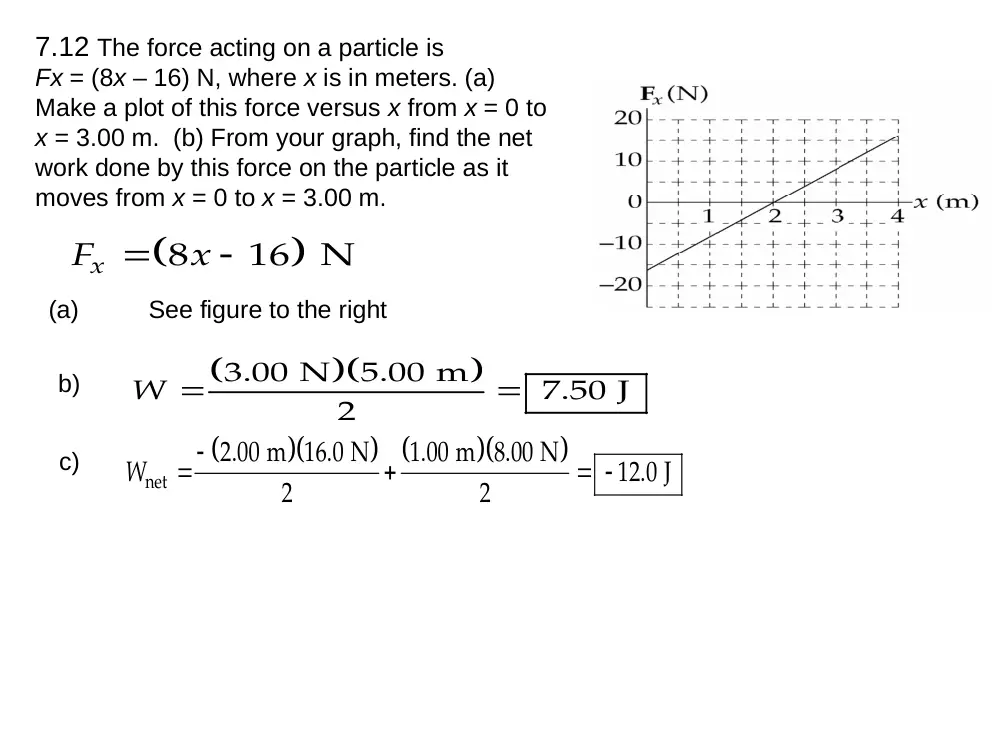
7.12 The force acting on a particle is
Fx = (8x – 16) N, where x is in meters. (a)
Make a plot of this force versus x from x = 0 to
x = 3.00 m. (b) From your graph, find the net
work done by this force on the particle as it
moves from x = 0 to x = 3.00 m.
3
2
4.00
9.80 N
1.57
10 N m
2.50
10
m
Mg
F
k
y
y
3
1.50
9.80
0.938 cm
1.57
10
mg
y
k
For 1.50 kg mass
a)
2
1
2 ky
2
3
2
1 1.57
10 N m
4.00
10
m
1.25 J
2
Work
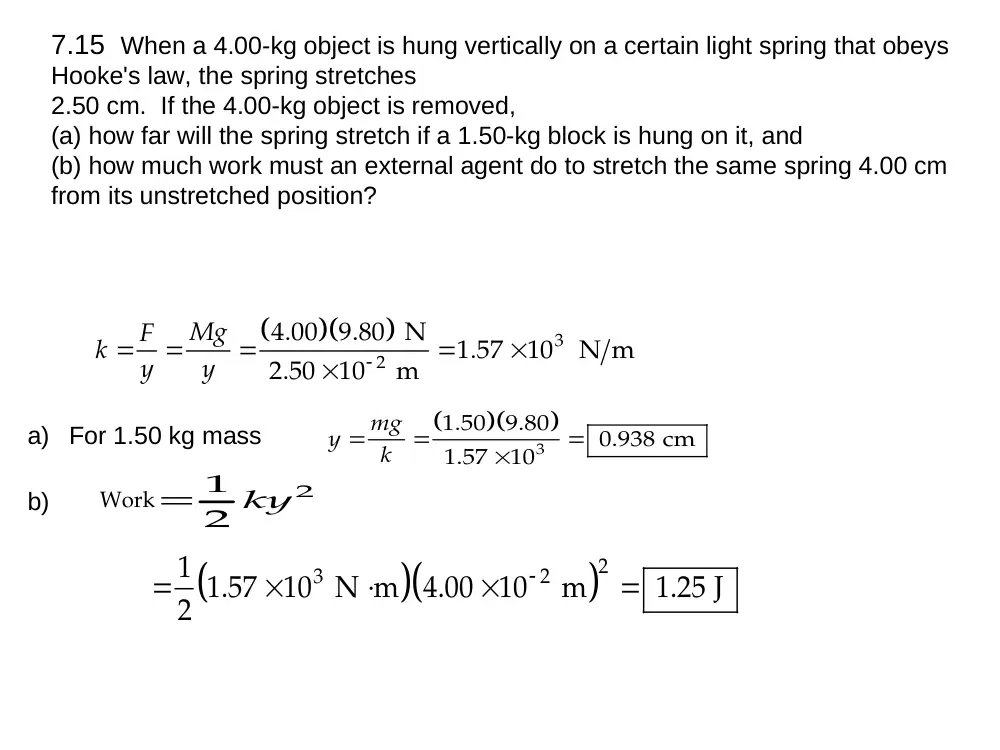
7.15 When a 4.00-kg object is hung vertically on a certain light spring that obeys
Hooke's law, the spring stretches
2.50 cm. If the 4.00-kg object is removed,
(a) how far will the spring stretch if a 1.50-kg block is hung on it, and
(b) how much work must an external agent do to stretch the same spring 4.00 cm
from its unstretched position?
b)
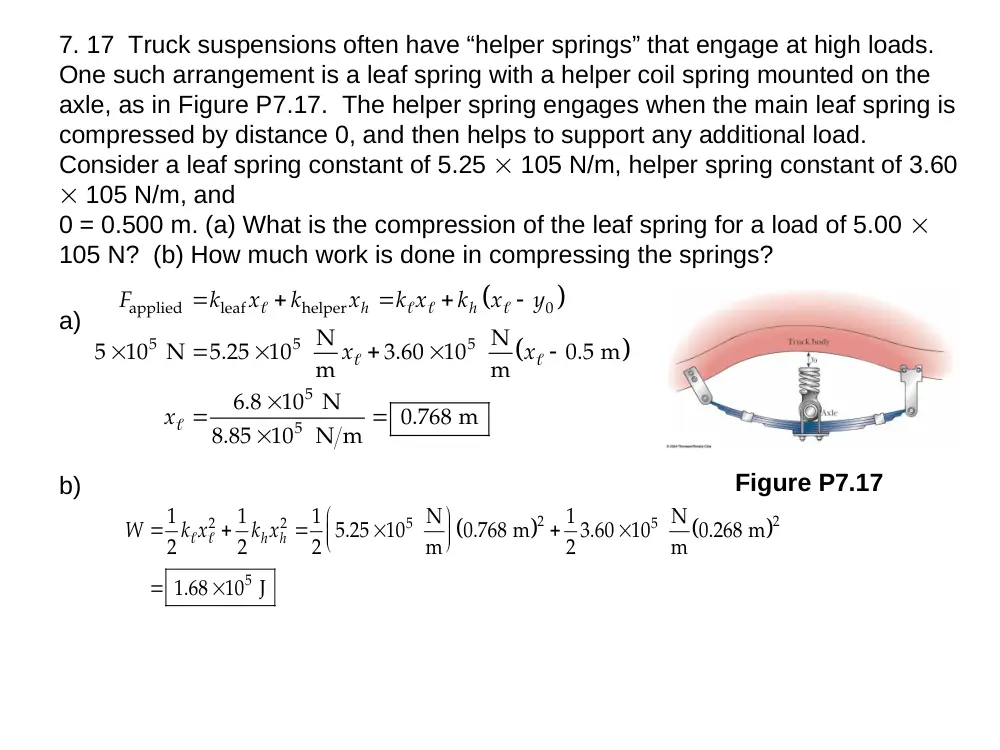
7. 17 Truck suspensions often have “helper springs” that engage at high loads.
One such arrangement is a leaf spring with a helper coil spring mounted on the
axle, as in Figure P7.17. The helper spring engages when the main leaf spring is
compressed by distance 0, and then helps to support any additional load.
Consider a leaf spring constant of 5.25 105 N/m, helper spring constant of 3.60
105 N/m, and
0 = 0.500 m. (a) What is the compression of the leaf spring for a load of 5.00
105 N? (b) How much work is done in compressing the springs?
Figure P7.17
applied
leaf
helper
0
5
5
5
5
5
N
N
5
10 N
5.25
10
3.60
10
0.5 m
m
m
6.8
10 N
0.768 m
8.85
10 N m
h
h
F
k
x
k
x
k x
k
x
y
x
x
x
2
2
2
2
5
5
5
1
1
1
N
1
N
5.25
10
0.768 m
3.60
10
0.268 m
2
2
2
m
2
m
1.68
10 J
h
h
W
k x
k x
a)
b)
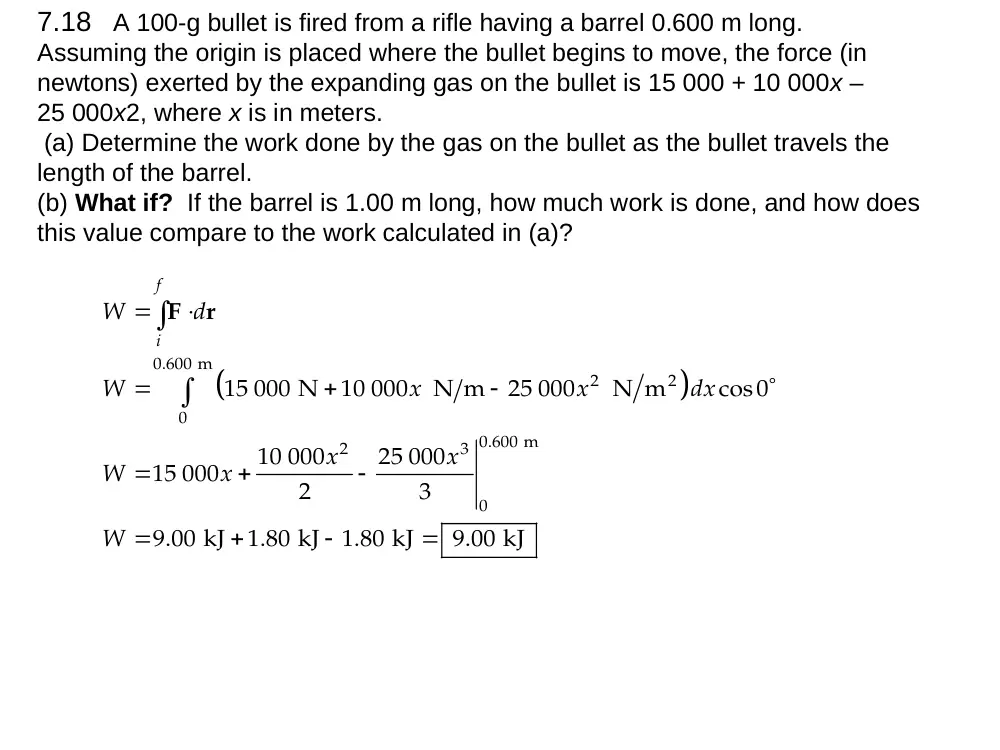
7.18 A 100-g bullet is fired from a rifle having a barrel 0.600 m long.
Assuming the origin is placed where the bullet begins to move, the force (in
newtons) exerted by the expanding gas on the bullet is 15 000 + 10 000x –
25 000x2, where x is in meters.
(a) Determine the work done by the gas on the bullet as the bullet travels the
length of the barrel.
(b) What if? If the barrel is 1.00 m long, how much work is done, and how does
this value compare to the work calculated in (a)?
0.600 m
2
2
0
0.600 m
2
3
0
15 000 N
10 000 N m
25 000
N m
cos0
10 000
25 000
15 000
2
3
9.00 kJ
1.80 kJ
1.80 kJ
9.00 kJ
f
i
W
d
W
x
x
dx
x
x
W
x
W
F
r
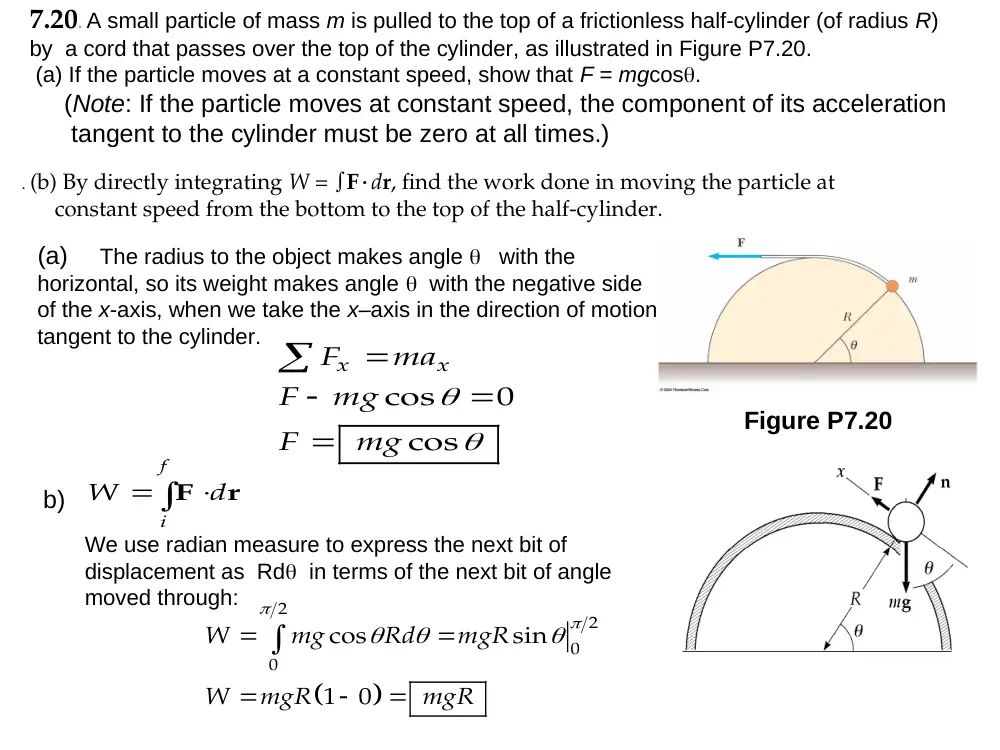
7.20. A small particle of mass m is pulled to the top of a frictionless half-cylinder (of radius R)
by a cord that passes over the top of the cylinder, as illustrated in Figure P7.20.
(a) If the particle moves at a constant speed, show that F = mgcos.
(Note: If the particle moves at constant speed, the component of its acceleration
tangent to the cylinder must be zero at all times.)
. (b) By directly integrating W = Fdr, find the work done in moving the particle at
constant speed from the bottom to the top of the half-cylinder.
Figure P7.20
(a)
The radius to the object makes angle with the
horizontal, so its weight makes angle with the negative side
of the x-axis, when we take the x–axis in the direction of motion
tangent to the cylinder.
cos
0
cos
x
x
F
ma
F
mg
F
mg
f
i
W
d
F
r
b)
We use radian measure to express the next bit of
displacement as Rd in terms of the next bit of angle
moved through:
2
2
0
0
cos
sin
1
0
W
mg
Rd
mgR
W
mgR
mgR
7.26 A 3.00-kg object has a velocity .
(a) What is its kinetic energy at this time?
(b) Find the total work done on the object if its velocity changes to .
(Note: From the definition of the dot product, v2 = v·v.)
ˆ
ˆ
6.00
2.00
m s
i
v
i
j
2
2
40.0 m s
i
ix
iy
v
v
v
2
2
2
1
1 3.00 kg
40.0 m
s
60.0 J
2
2
i
i
K
mv
ˆ
ˆ
8.00
4.00
f
v
i
j
b)
2
2
2
64.0
16.0
80.0 m
s
ff
f
v
v
v
2
2
1
3.00 80.0
60.0
60.0 J
2
2
fi
fi
K
K
K
m v
v
Problem 7.28:
A 4.00-kg particle is subject to a total
force that varies with position as
shown in the Figure. The particle
starts from rest at x = 0. What is its
speed at
(a) x = 5.00 m,
(b) x = 10.0 m,
(c) x = 15.0 m?
(a) We use the work-energy theorem
i
f
K
K
W
J
F dx
W
x
5.7
2 5 3
1
under the curve
area
5
0
But :
m s
J
K
K
f
i
/
1.94
v
2 4v
1
7.5
0
2
b) And c) homework
Can you do the integration analytically?, if not ask me later
7.32 A 2.00-kg block is attached to a spring of force constant 500 N/m as in
Figure 7.10. The block is pulled 5.00 cm to the right of equilibrium and
released from rest. Find the speed of the block as it passes through
equilibrium if
(a) the horizontal surface is frictionless and
(b) the coefficient of friction between block and surface is 0.350.
2
2
2
2
1
1
1 500
5.00
10
0
0.625 J
2
2
2
s
i
f
W
kx
kx
2
2
2
1
1
1
0
2
2
2
s
fi
f
W
mv
mv
mv
2
2 0.625 m s
0.791 m s
2.00
f
W
v
m
2
2
1
1
2
2
i
k
s
f
mv
f
x
W
mv
b)
2
2
1
0
0.350
2.00
9.80
0.050 0 J
0.625 J
2
1
0.282 J
2.00 kg
2
2 0.282 m s
0.531 m s
2.00
f
f
f
mv
v
v
7.34 A 15.0-kg block is dragged over a rough, horizontal surface by a 70.0-N
force acting at 20.0° above the horizontal. The block is displaced 5.00 m,
and the coefficient of kinetic friction is 0.300. Find the work done on the
block by
(a) the 70-N force,
(b) the normal force, and
(c) the gravitational force.
(d) What is the increase in internal energy of the block-surface system due to
friction?
(e) Find the total change in the block’s kinetic energy.
y
y
F
ma
70.0 N sin20.0
147 N
0
n
123 N
n
0.300 123 N
36.9 N
k
k
f
n
cos
70.0 N
5.00 m cos20.0
329 J
W
F r
cos
123 N
5.00 m cos90.0
0 J
W
F r
a)
b)
cos
147 N 5.00 m cos90.0
0
W
F r
c)
int
36.9 N
5.00 m
185 J
E
F x
d)
int
329 J
185 J
144 J
fi
K
K
K
W
E
e)
7.56 Two springs with negligible masses, one with spring constant k1 and the other with spring
constant k2, are attached to the endstops of a level air track as in Figure P7.56. A glider attached to
both springs is located between them. When the glider is in equilibrium, spring 1 is stretched by
extension xi1 to the right of its unstretched length and spring 2 is stretched by xi2 to the left. Now a
horizontal force Fapp is applied to the glider to move it a distance x a to the right from its equilibrium
position. Show that in this process
(a) the work done on spring 1 is k1 (xa
2 +2xa x i1) ,
(b) the work done on spring 2 is k2 (xa
2 – 2xa xi2)
(c) xi2 is related to xi1 by xi2=k1 xi1/k2 and
(d) the total work done by the force F app is (k1 + k2 )xa
2
1
1
2
2
2
1
1
1
1
1
1
1
1
1
1
2
2
2
i
a
i
f
x
x
i
a
i
a
a
i
i
x
W
F dx
k x dx
k
x
x
x
k
x
x x
a)
2
2
2
2
2
2
2
2
2
2
2
2
1
1
2
2
2
i
a
i
x
x
i
a
i
a
a
i
x
W
k x dx
k
x
x
x
k
x
x x
b)
1
1
2
2
i
i
k x
k x
1
1
2
2
i
i
k x
x
k
Before the horizontal force is applied, the springs exert equal forces:
2
2
1
2
1
1
1
2
2
2
2
2
1
1
1
2
1
1
2
2
2
1
2
1
1
2
2
1
1
2
2
1
2
a
a
i
a
a
i
i
a
a
a
i
a
a
W
W
k x
k x x
k x
k x x
k x
k x
k x
k x x
k x
k
k
k
x
d)
7.58 A particle is attached between two identical springs on a horizontal frictionless
table. Both springs have spring constant k and are initially unstressed.
(a) If the particle is pulled a distance x along a direction perpendicular to the initial
configuration of the springs, as in Figure P7.58, show that the force exerted by the
springs on the particle is
F 2kx 1
L
x2 L2
ˆ i
(b) Determine the amount of work done by this force
in moving the particle from x = A to x = 0.
Figure P7.58
The new length of each spring is , so its extension
is
and the force it exerts is toward its fixed end. The y
components of the two spring forces add to zero. Their x components add to
2
2
x
L
2
2
x
L
L
2
2
k
x
L
L
2
2
2
2
2
2
ˆ
ˆ
2
2
1
x
L
k
x
L
L
kx
x
L
x
L
F
i
i
f
x
i
W
F dx
0
2
2
2
1
A
L
W
kx
dx
x
L
0
0
1 2
2
2
2
2
A
A
W
k x dx
kL
x
L
x dx
1 2 0
0
2
2
2
2
2
1 2
A
A
x
L
x
W
k
kL
2
2
2
2
2
2
W
kL
kA
kL A
L
7.60 Review problem. Two constant forces act on a 5.00-kg object moving in the xy
plane, as shown in Figure P7.60. Force F1 is 25.0 N at 35.0, while F2 is 42.0 N at 150. At
time t = 0, the object is at the origin and has a velocity
4.00ˆ i 2.50ˆ j
m/ s
a) Express the two forces in unit-vector notation. Use unit-vector notation for your other
answers.
(b) Find the total force on the object.
(c) Find the object’s acceleration. Now, considering the instant t = 3.00 s,
(d) find the object’s velocity,
(e) its location,
(f) its kinetic energy from , and
(g) its kinetic energy from
1
2 mvi
2
F r
Figure P7.60
1
ˆ
ˆ
ˆ
ˆ
25.0 N
cos35.0
sin 35.0
20.5
14.3
N
F
i
j
i
j
2
ˆ
ˆ
ˆ
ˆ
42.0 N cos150
sin150
36.4
21.0
N
F
i
j
i
j
1
2
ˆ
ˆ
15.9
35.3
N
F
F
F
i
j
2
ˆ
ˆ
3.18
7.07
m s
m
F
a
i
j
a)
b)
c)
d)
2
ˆ
ˆ
ˆ
ˆ
4.00
2.50
m s
3.18
7.07
m s
3.00 s
fi
t
v
v
a
i
j
i
j
7.60 Continuation
2
1
2
fi
it
t
r
r
v
a
e)
2
2
1
ˆ
ˆ
ˆ
ˆ
0
4.00
2.50
m s
3.00 s
3.18
7.07
m s
3.00 s
2
ˆ
ˆ
2.30
39.3
m
f
f
r
i
j
i
j
r
r
i
j
2
2
2
2
1
1 5.00 kg
5.54
23.7
m s
1.48 kJ
2
2
K ff
mv
f)
2
1
2
K fi
mv
F
r
g)
2
2
2
1 5.00 kg
4.00
2.50
m s
15.9 N
2.30 m
35.3 N 39.3 m
2
55.6 J
1 426 J
1.48 kJ
f
f
K
K
End 7.60
7.65 In diatomic molecules, the constituent atoms exert attractive forces on each other at
large distances and repulsive forces at short distances. For many molecules, the Lennard-
Jones law is a good approximation to the magnitude of these forces:
F F0 2
r
13
r
7
where r is the center-to-center distance between the atoms in the molecule, is a length
parameter, and F0 is the force when
r = . For an oxygen molecule,
F0 = 9.60 10-11 N and = 3.50 10-10 m. Determine the work done by this force if the
atoms are pulled apart from r = 4.00 10-10 m to r = 9.00 10-10 m.
13
13
7
7
0
0
13
12
7
6
0
0
13
12
12
7
6
6
7
13
0
0
6
6
12
12
0
0
77
6
6
134
12
12
2
2
12
6
6
6
6
6
1.03
10
1.89
10
1.03
1
f
i
f
i
r
f
i
r
r
r
fi
fi
fi
fi
fi
fi
W
d
F
r
F
r
dr
F
r
F
r
W
F
r
r
F
r
r
F
F
W
r
r
r
r
W
r
r
r
r
W
F
r
77
6
6
60
134
12
8
120
21
21
21
0
1.88
10
2.44
10
10
1.89
10
3.54
10
5.96
10
10
2.49
10
J
1.12
10
J
1.37
10
J
W