
PHYS 210 Syllabus, Spring 2019
American University of Beirut · Introductory Physics II · 4 pages
More PHYS 210 files
- Lab Report · Fall 2015LabView
- Lecture · Spring 2008LabView
- Lab Reports Solved · Fall 2006Lab · with solutionView
- Final Collection Finals with Solution · Spring 2017Final exam · with solutionView
- Final 2015 · Spring 2017Final examView
- Problems Chapter 8 · Fall 2015ChapterView
- Problems Chapter 5 · Fall 2015ChapterView
- Problems Chapter 6 · Fall 2015ChapterView
Show the text of this lab
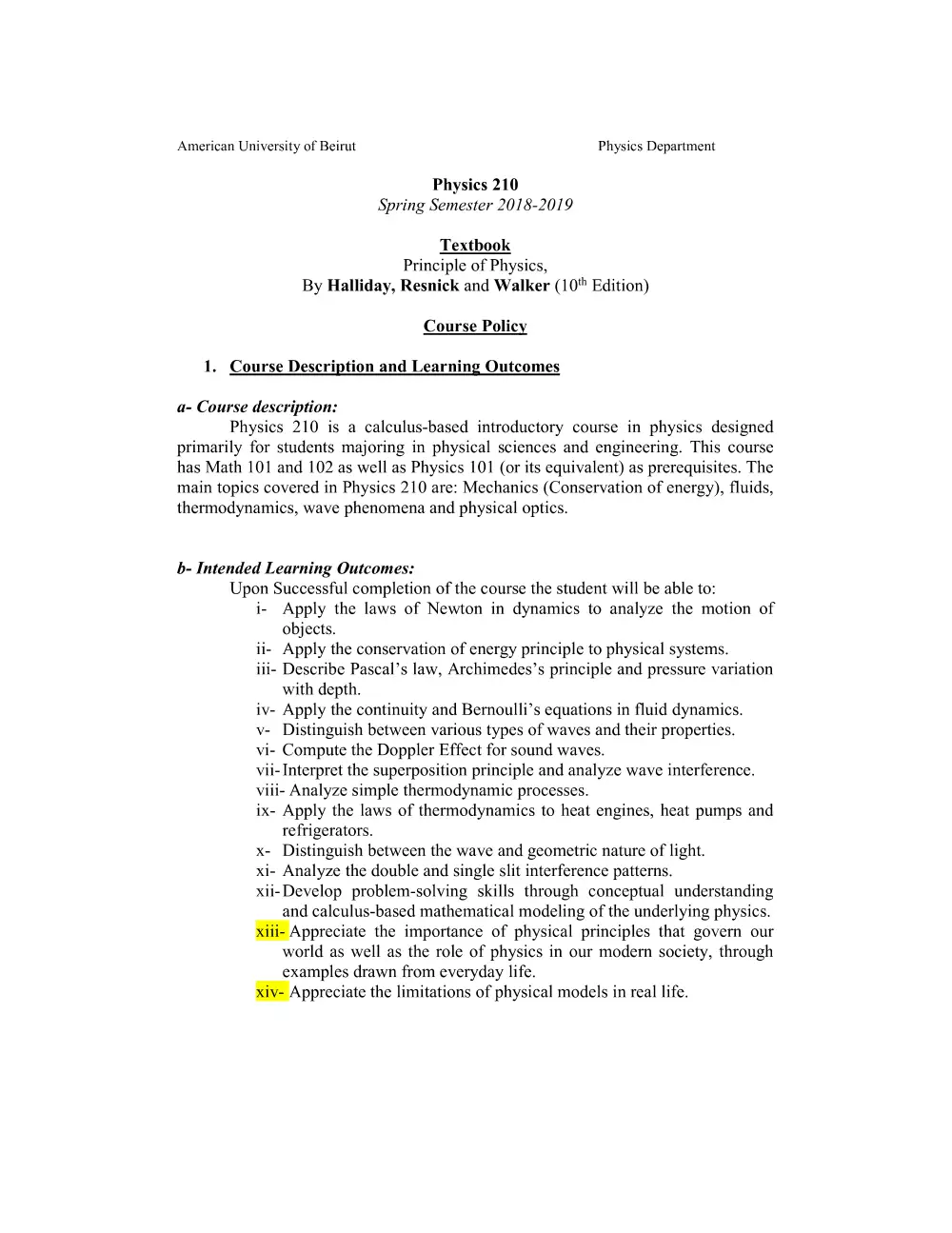
American University of Beirut Physics Department
Physics 210
Spring Semester 2018-2019
Textbook
Principle of Physics,
By Halliday, Resnick and Walker (10" Edition)
Course Policy
1. Course Description and Learning Outcomes
a- Course description:
Physics 210 is a calculus-based introductory course in physics designed
primarily for students majoring in physical sciences and engineering. This course
has Math 101 and 102 as well as Physics 101 (or its equivalent) as prerequisites. The
main topics covered in Physics 210 are: Mechanics (Conservation of energy), fluids,
thermodynamics, wave phenomena and physical optics.
b- Intended Learning Outcomes:
Upon Successful completion of the course the student will be able to:
i- Apply the laws of Newton in dynamics to analyze the motion of
objects.
ii- Apply the conservation of energy principle to physical systems.
iii- Describe Pascal’s law, Archimedes’s principle and pressure variation
with depth.
iv- Apply the continuity and Bernoulli’s equations in fluid dynamics.
y- Distinguish between various types of waves and their properties.
vi- Compute the Doppler Effect for sound waves.
vii- Interpret the superposition principle and analyze wave interference.
vili- Analyze simple thermodynamic processes.
ix- Apply the laws of thermodynamics to heat engines, heat pumps and
refrigerators.
x- Distinguish between the wave and geometric nature of light.
xi- Analyze the double and single slit interference patterns.
xii- Develop problem-solving skills through conceptual understanding
and calculus-based mathematical modeling of the underlying physics.
xiii- Appreciate the importance of physical principles that govern our
world as well as the role of physics in our modern society, through
examples drawn from everyday life.
xiv- Appreciate the limitations of physical models in real life.
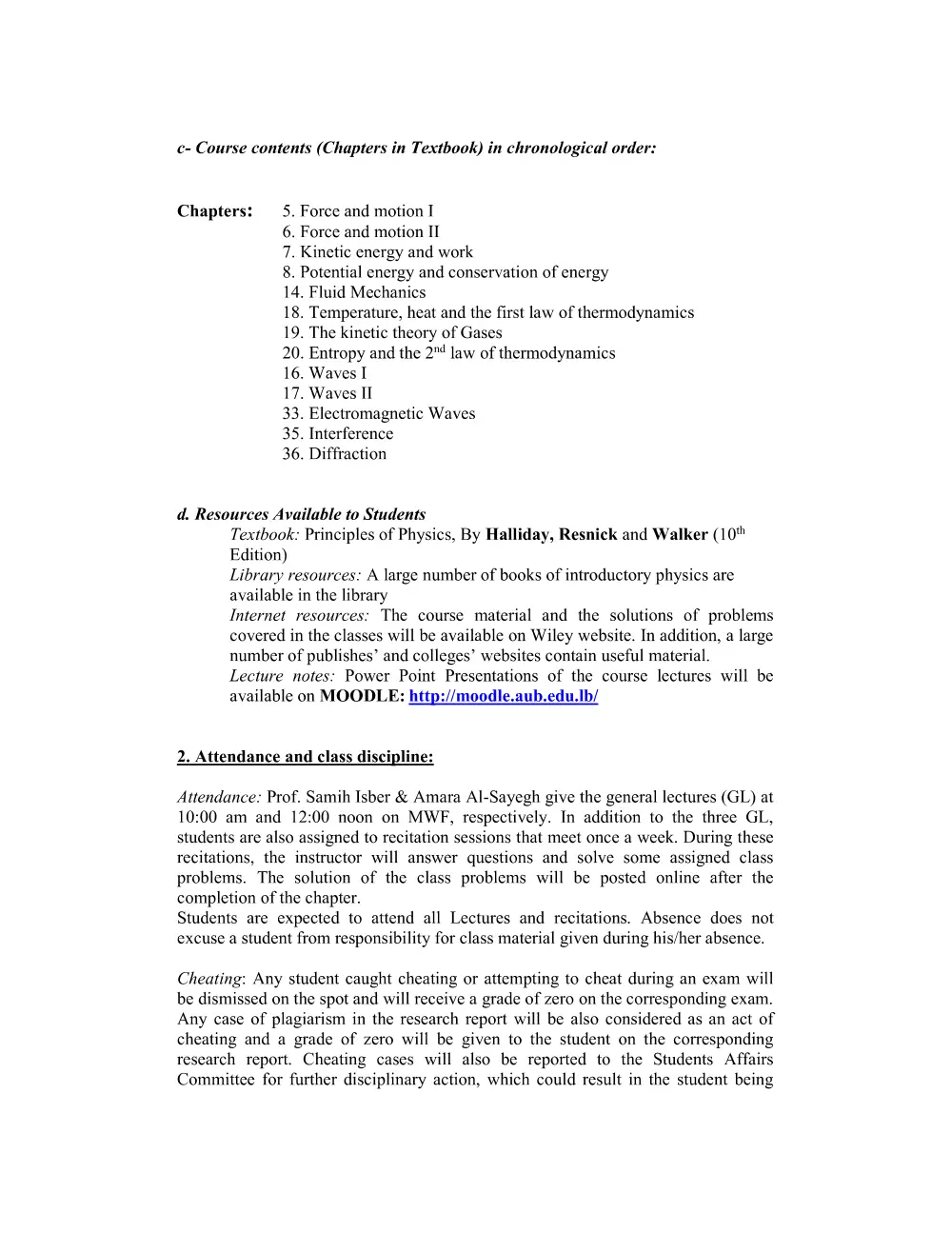
c- Course contents (Chapters in Textbook) in chronological order:
Chapters: 5. Force and motion I
6. Force and motion IIT
7. Kinetic energy and work
8. Potential energy and conservation of energy
14, Fluid Mechanics
18. Temperature, heat and the first law of thermodynamics
19. The kinetic theory of Gases
20. Entropy and the 2" law of thermodynamics
16. Waves I
17. Waves II
33. Electromagnetic Waves
35. Interference
36. Diffraction
d. Resources Available to Students
Textbook: Principles of Physics, By Halliday, Resnick and Walker (10%
Edition)
Library resources: A large number of books of introductory physics are
available in the library
Internet resources: The course material and the solutions of problems
covered in the classes will be available on Wiley website. In addition, a large
number of publishes’ and colleges’ websites contain useful material.
Lecture notes: Power Point Presentations of the course lectures will be
available on MOODLE: http://moodle.aub.edu.|b/
2. Attendance and class discipline:
Attendance: Prof. Samih Isber & Amara Al-Sayegh give the general lectures (GL) at
10:00 am and 12:00 noon on MWF, respectively. In addition to the three GL,
students are also assigned to recitation sessions that meet once a week. During these
recitations, the instructor will answer questions and solve some assigned class
problems. The solution of the class problems will be posted online after the
completion of the chapter.
Students are expected to attend all Lectures and recitations. Absence does not
excuse a student from responsibility for class material given during his/her absence.
Cheating: Any student caught cheating or attempting to cheat during an exam will
be dismissed on the spot and will receive a grade of zero on the corresponding exam.
Any case of plagiarism in the research report will be also considered as an act of
cheating and a grade of zero will be given to the student on the corresponding
research report. Cheating cases will also be reported to the Students Affairs
Committee for further disciplinary action, which could result in the student being
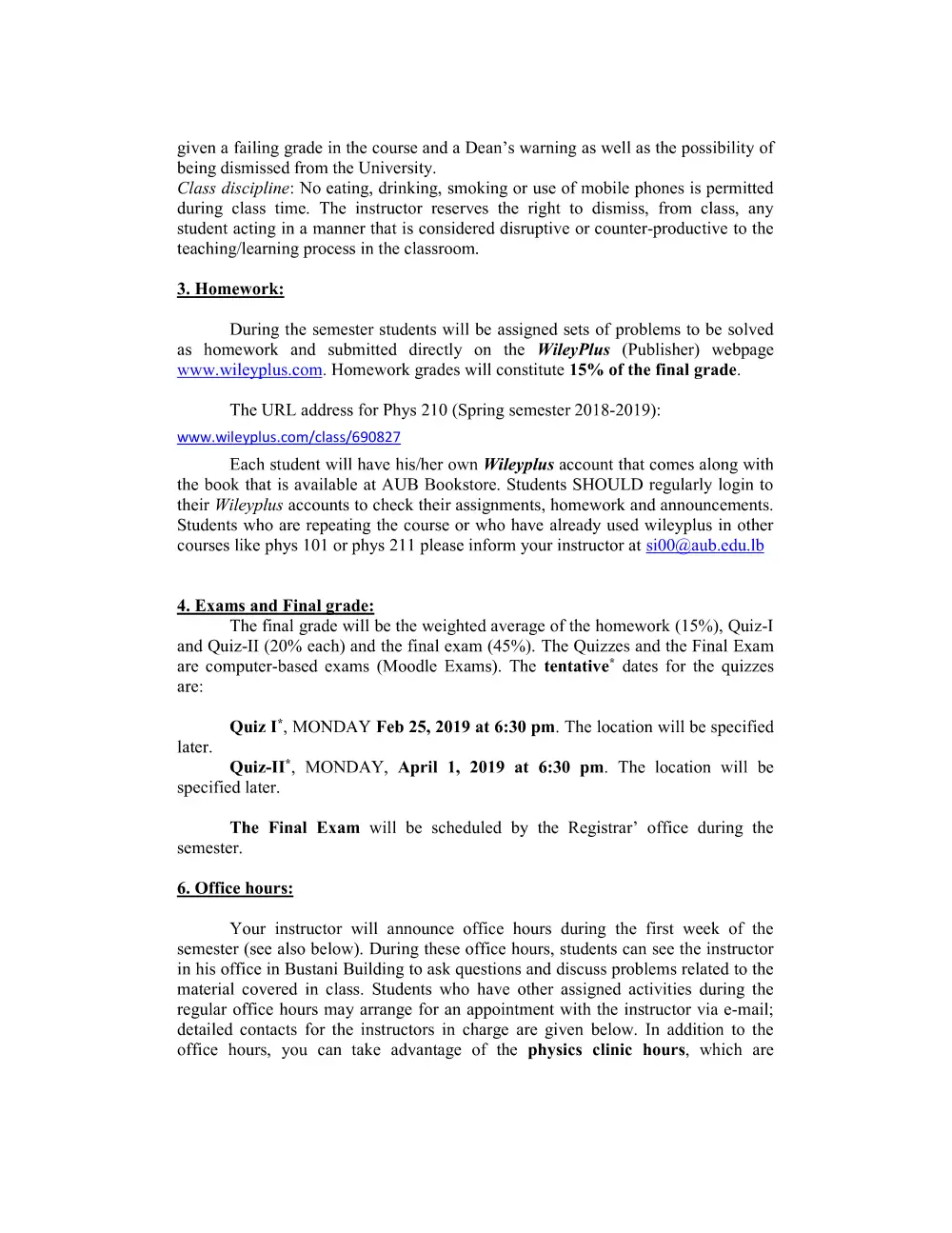
given a failing grade in the course and a Dean’s warning as well as the possibility of
being dismissed from the University.
Class discipline: No eating, drinking, smoking or use of mobile phones is permitted
during class time. The instructor reserves the right to dismiss, from class, any
student acting in a manner that is considered disruptive or counter-productive to the
teaching/learning process in the classroom.
3. Homework:
During the semester students will be assigned sets of problems to be solved
as homework and submitted directly on the WileyPlus (Publisher) webpage
www.wileyplus.com. Homework grades will constitute 15% of the final grade.
The URL address for Phys 210 (Spring semester 2018-2019):
www.wileyplus.com/class/690827
Each student will have his/her own Wileyplus account that comes along with
the book that is available at AUB Bookstore. Students SHOULD regularly login to
their Wileyplus accounts to check their assignments, homework and announcements.
Students who are repeating the course or who have already used wileyplus in other
courses like phys 101 or phys 211 please inform your instructor at si00@aub.edu.lb
4, Exams and Final grade:
The final grade will be the weighted average of the homework (15%), Quiz-I
and Quiz-II (20% each) and the final exam (45%). The Quizzes and the Final Exam
are computer-based exams (Moodle Exams). The tentative” dates for the quizzes
are:
Quiz I’, MONDAY Feb 25, 2019 at 6:30 pm. The location will be specified
later.
Quiz-II*, MONDAY, April 1, 2019 at 6:30 pm. The location will be
specified later.
The Final Exam will be scheduled by the Registrar’ office during the
semester.
6. Office hours:
Your instructor will announce office hours during the first week of the
semester (see also below). During these office hours, students can see the instructor
in his office in Bustani Building to ask questions and discuss problems related to the
material covered in class. Students who have other assigned activities during the
regular office hours may arrange for an appointment with the instructor via e-mail;
detailed contacts for the instructors in charge are given below. In addition to the
office hours, you can take advantage of the physics clinic hours, which are
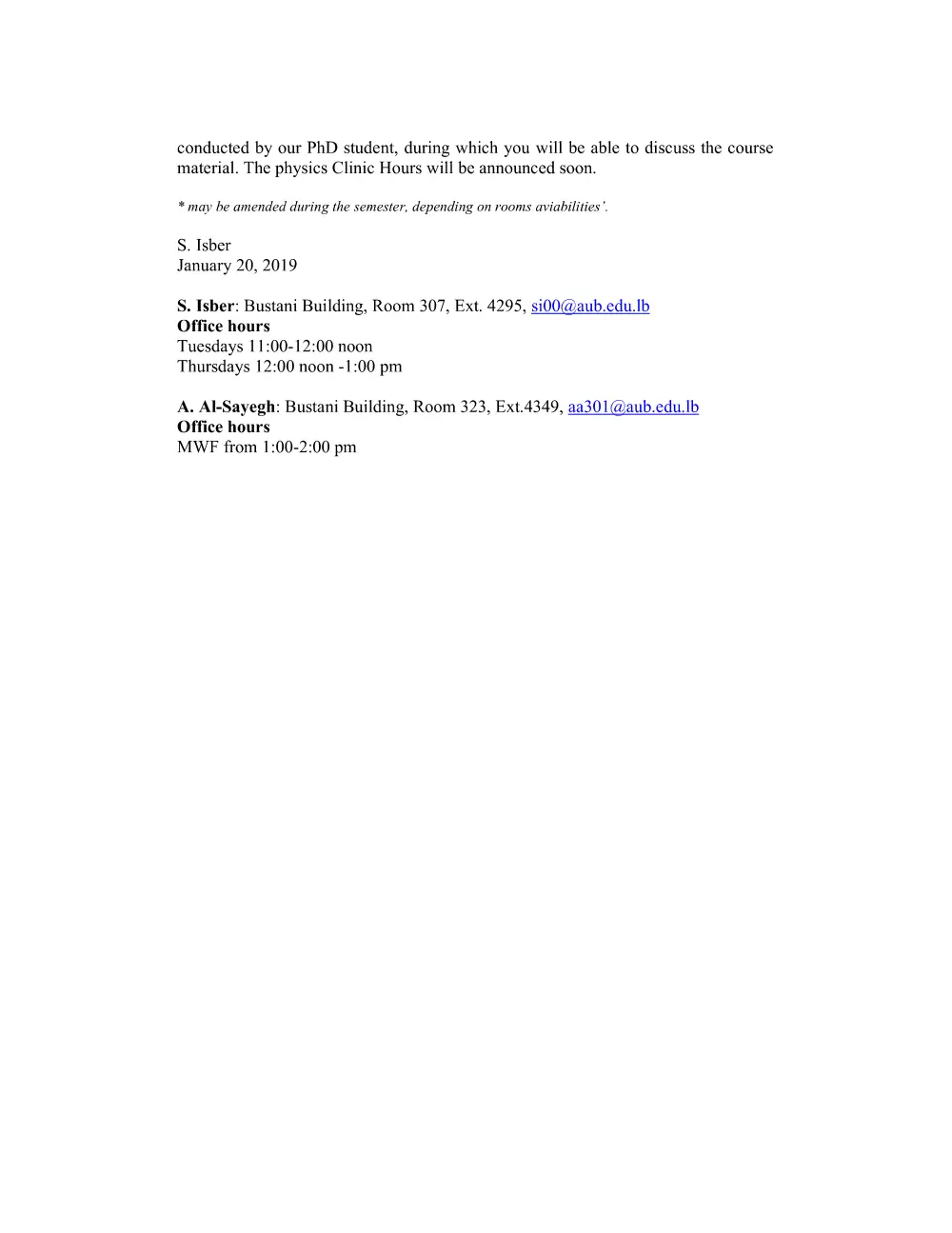
conducted by our PhD student, during which you will be able to discuss the course
material. The physics Clinic Hours will be announced soon.
* may be amended during the semester, depending on rooms aviabilities’.
S. Isber
January 20, 2019
S. Isber: Bustani Building, Room 307, Ext. 4295, si00@aub.edu.Ib
Office hours
Tuesdays 11:00-12:00 noon
Thursdays 12:00 noon -1:00 pm
A. Al-Sayegh: Bustani Building, Room 323, Ext.4349, aa301@aub.edu.Ib
Office hours
MWF from 1:00-2:00 pm