
PHYS 210 Homework, Spring 2008
American University of Beirut · Introductory Physics II · 20 pages

Showing the first 10 of 20 pages. Download the PDF to see all of it.
More PHYS 210 files
Show the text of this homework
Homework: chapter 5
Newton’s Laws of Motion
Homework: chapter 5
Newton’s Laws of Motion
2,3,4,7,14,15,16,18,19,21,22,27,34,36,
40,46,54,55,58,62,69
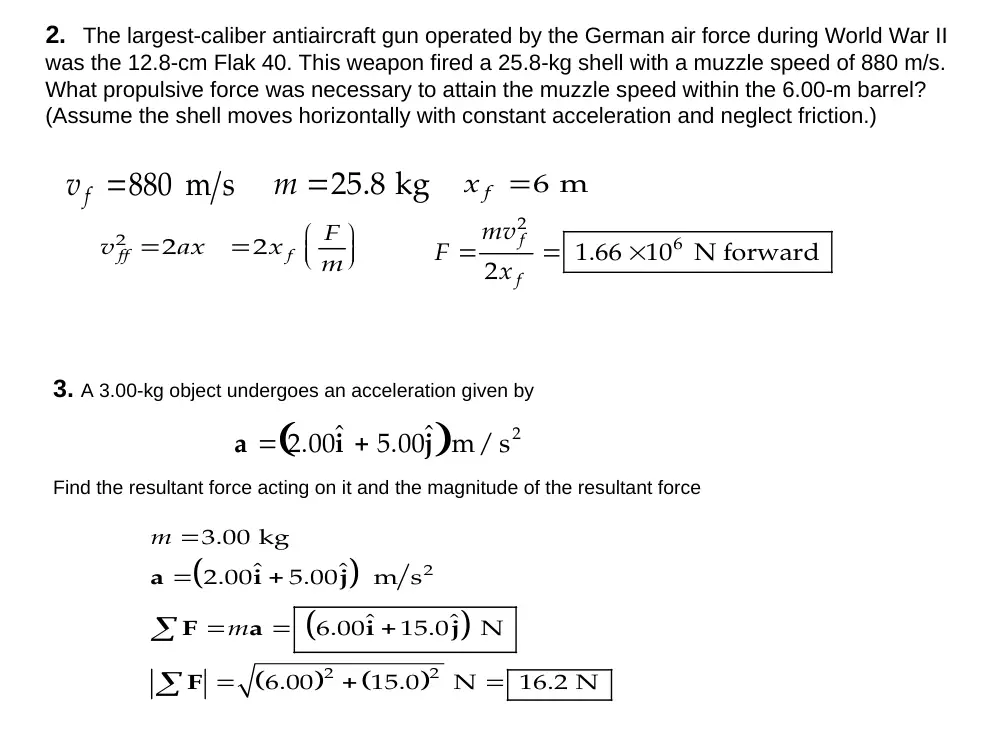
3. A 3.00-kg object undergoes an acceleration given by
a 2.00ˆ i 5.00ˆ j
m/ s2
Find the resultant force acting on it and the magnitude of the resultant force
2. The largest-caliber antiaircraft gun operated by the German air force during World War II
was the 12.8-cm Flak 40. This weapon fired a 25.8-kg shell with a muzzle speed of 880 m/s.
What propulsive force was necessary to attain the muzzle speed within the 6.00-m barrel?
(Assume the shell moves horizontally with constant acceleration and neglect friction.)
fv 880 m s
m 25.8 kg
6 m
x f
2
2
2
ff
f
F
v
ax
x
m
2
6
1.66
10 N forward
2
f
f
mv
F
x
2
2
2
3.00 kg
ˆ
ˆ
2.00
5.00
m s
ˆ
ˆ
6.00
15.0
N
6.00
15.0
N
16.2 N
m
m
a
i
j
F
a
i
j
F
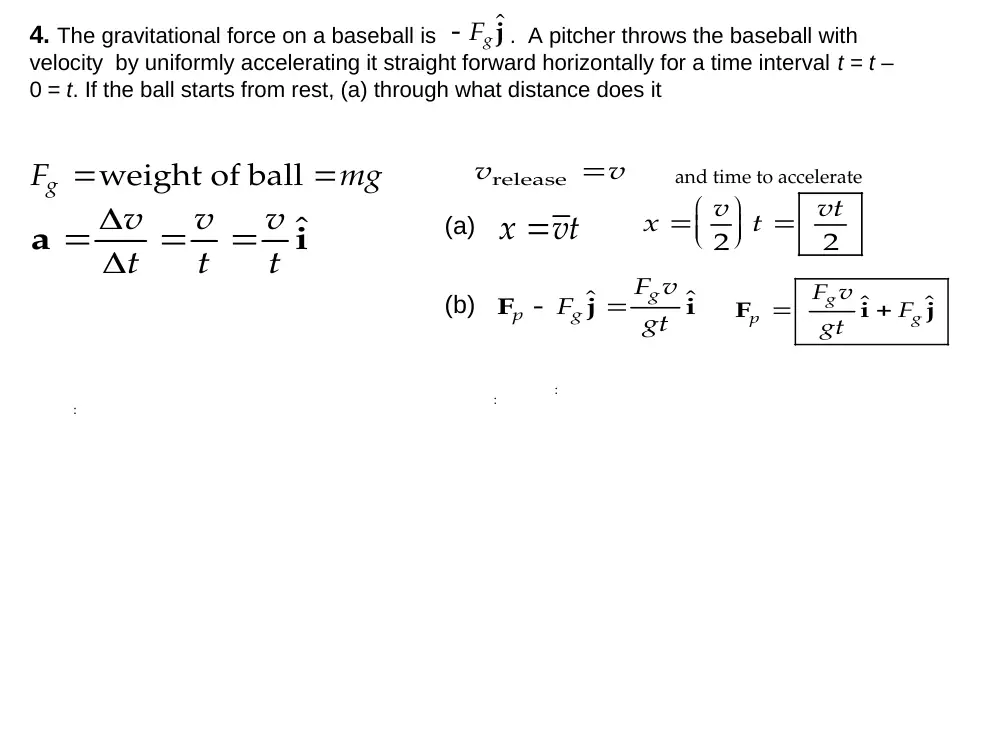
Fgˆ j
4. The gravitational force on a baseball is . A pitcher throws the baseball with
velocity by uniformly accelerating it straight forward horizontally for a time interval t = t –
0 = t. If the ball starts from rest, (a) through what distance does it
ˆ
v
v
v
t
t
t
a
i
weight of ball
Fg
mg
vrelease
v
:
and time to accelerate
:
:
x
vt
(a)
2
2
v
vt
x
t
ˆ
ˆ
g
p
g
F v
F
gt
F
j
i
(b)
ˆ
ˆ
g
p
g
F v
F
gt
F
i
j
7. An electron of mass 9.11 10–31 kg has an initial speed of 3.00 105 m/s. It travels in a
straight line, and its speed increases to 7.00 105 m/s in a distance of 5.00 cm. Assuming
its acceleration is constant,
(a) determine the force exerted on the electron and
(b) (b) compare this force with the weight of the electron, which we neglected.
F
ma
2
2
2
fi
f
v
v
ax
2
2
2
fi
f
v
v
a
x
2
2
2
2
5
2
5
2
31
18
2
7.00
10 m s
3.00
10 m s
9.11 10
kg
3.64
10
N .
2 0.050 0 m
fi
f
v
v
F
m
x
F
(b) The weight of the electron is
31
2
30
9.11 10
kg 9.80 m s
8.93 10
N
gF
mg
The accelerating force is
11
4.08
10
times the weight of the electron.
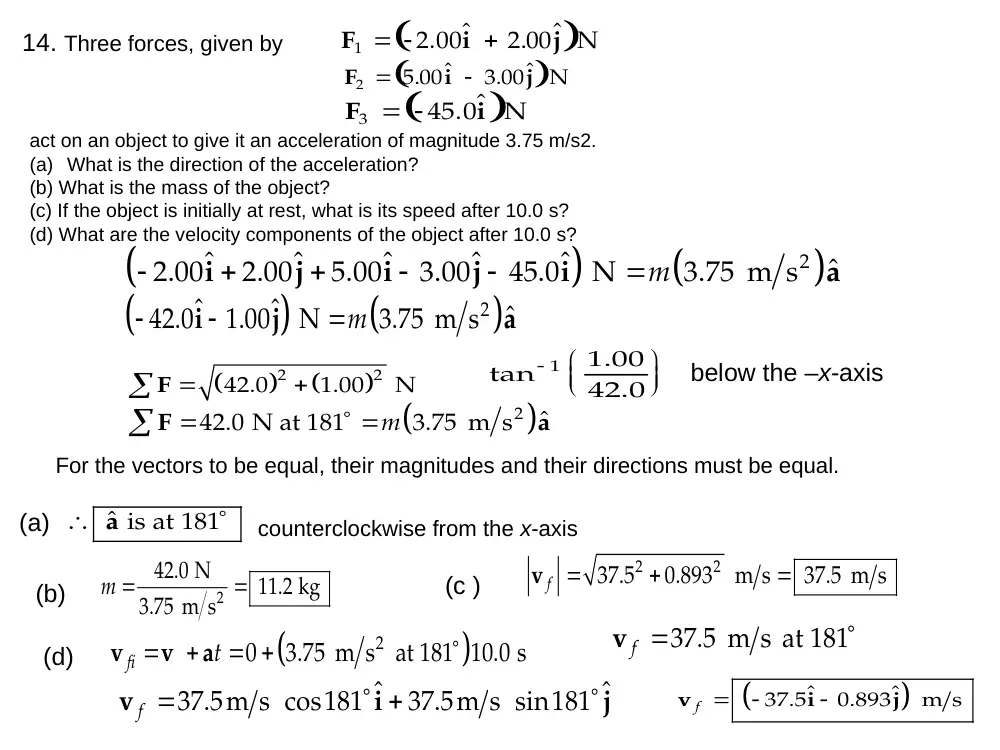
14. Three forces, given by
F1 2.00ˆ i 2.00ˆ j
N
F2 5.00ˆ i 3.00ˆ j
N
F3 45.0ˆ i
N
act on an object to give it an acceleration of magnitude 3.75 m/s2.
(a) What is the direction of the acceleration?
(b) What is the mass of the object?
(c) If the object is initially at rest, what is its speed after 10.0 s?
(d) What are the velocity components of the object after 10.0 s?
2
ˆ
ˆ
ˆ
ˆ
ˆ
ˆ
2.00
2.00
5.00
3.00
45.0
N
m 3.75 m s
i
j
i
j
i
a
2
ˆ
ˆ
ˆ
42.0
1.00
N
m 3.75 m s
i
j
a
2
2
42.0
1.00
N
F
1
1.00
tan
42.0
below the –x-axis
2 ˆ
42.0 N at 181
m 3.75 m s
F
a
For the vectors to be equal, their magnitudes and their directions must be equal.
ˆ is at 181
a
counterclockwise from the x-axis
2
42.0 N
11.2 kg
3.75 m s
m
(b)
(a)
2
2
37.5
0.893 m s
37.5 m s
f
v
(c )
2
0
3.75 m s at 181 10.0 s
fi
t
v
v
a
(d)
f 37.5 m s at 181
v
ˆ
ˆ
37.5m s cos181
37.5m s sin181
f
v
i
j
ˆ
ˆ
37.5
0.893
m s
f
v
i
j
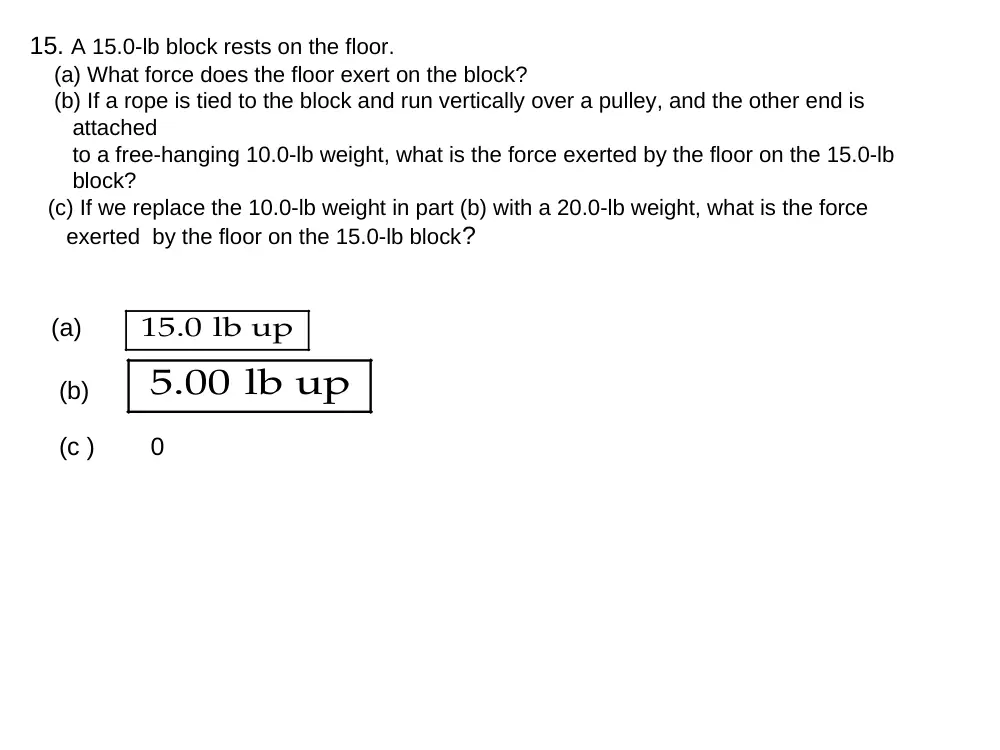
15. A 15.0-lb block rests on the floor.
(a) What force does the floor exert on the block?
(b) If a rope is tied to the block and run vertically over a pulley, and the other end is
attached
to a free-hanging 10.0-lb weight, what is the force exerted by the floor on the 15.0-lb
block?
(c) If we replace the 10.0-lb weight in part (b) with a 20.0-lb weight, what is the force
exerted by the floor on the 15.0-lb block?
15.0 lb up
5.00 lb up
(a)
(b)
(c ) 0
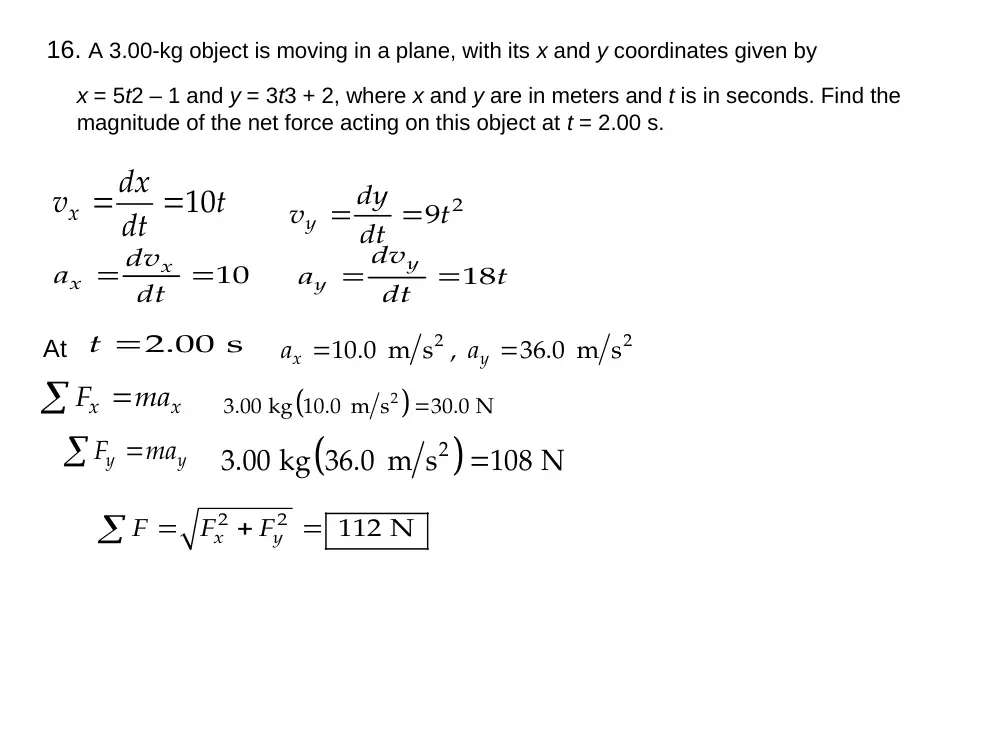
16. A 3.00-kg object is moving in a plane, with its x and y coordinates given by
x = 5t2 – 1 and y = 3t3 + 2, where x and y are in meters and t is in seconds. Find the
magnitude of the net force acting on this object at t = 2.00 s.
10
x
dx
v
t
dt
9 2
y
dy
v
t
dt
10
x
x
dv
a
dt
18
y
y
dv
a
t
dt
t 2.00 s
At
2
2
10.0 m s ,
36.0 m s
x
y
a
a
x
x
F
ma
3.00 kg 10.0 m s2
30.0 N
y
y
F
ma
3.00 kg 36.0 m s2
108 N
2
2
112 N
x
y
F
F
F
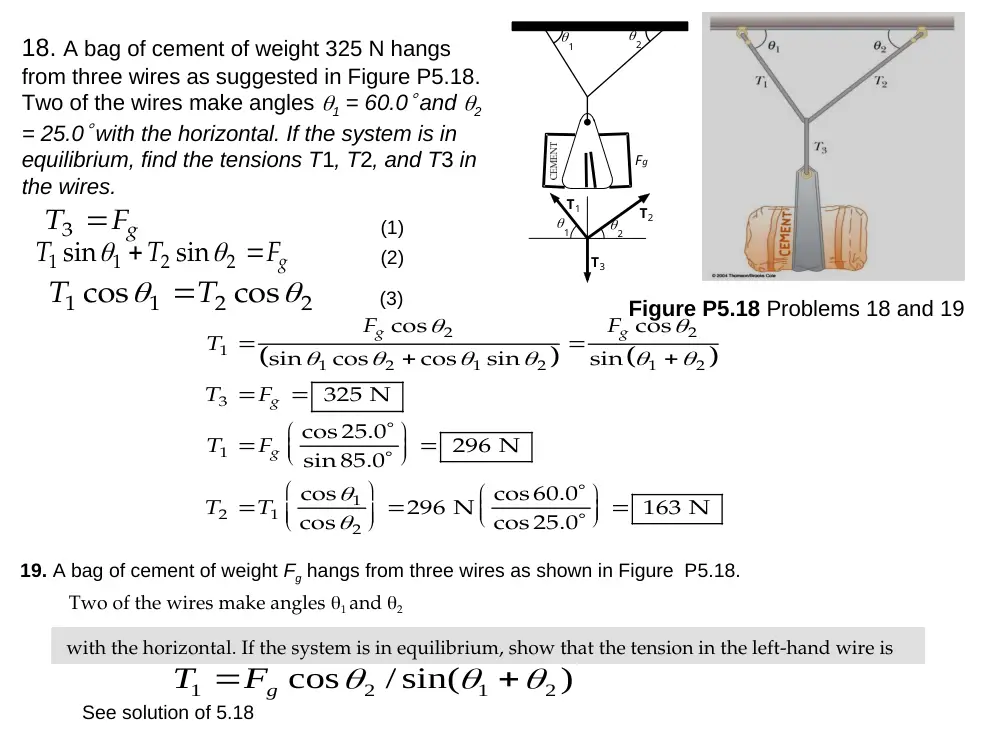
19. A bag of cement of weight Fg hangs from three wires as shown in Figure P5.18.
Two of the wires make angles 1 and 2
with the horizontal. If the system is in equilibrium, show that the tension in the left-hand wire is
)
/ sin(
cos
2
1
2
1
Fg
T
See solution of 5.18
1
1
2
F
2
T 3
T 2
T 1
g
18. A bag of cement of weight 325 N hangs
from three wires as suggested in Figure P5.18.
Two of the wires make angles 1 = 60.0 and 2
= 25.0 with the horizontal. If the system is in
equilibrium, find the tensions T1, T2, and T3 in
the wires.
Figure P5.18 Problems 18 and 19
3
g
T
F
1
1
2
2
sin
sin
g
T
T
F
(1)
(2)
1
1
2
2
cos
cos
T
T
(3)
2
2
1
1
2
1
2
1
2
3
1
1
2
1
2
cos
cos
sin
cos
cos
sin
sin
325 N
cos 25.0
296 N
sin 85.0
cos
cos60.0
296 N
163 N
cos
cos 25.0
g
g
g
g
F
F
T
T
F
T
F
T
T
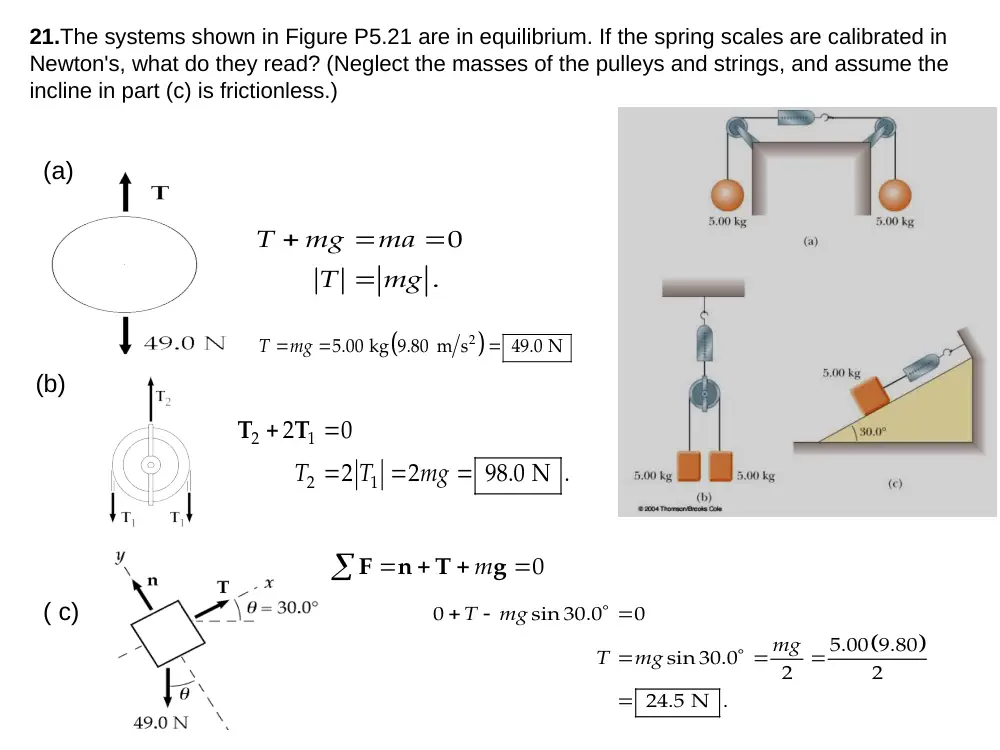
21.The systems shown in Figure P5.21 are in equilibrium. If the spring scales are calibrated in
Newton's, what do they read? (Neglect the masses of the pulleys and strings, and assume the
incline in part (c) is frictionless.)
0
.
T
mg
ma
T
mg
5.00 kg 9.80 m s2
49.0 N
T
mg
(a)
(b)
( c)
2
1
2
1
2
0
2
2
98.0 N .
T
T
mg
T
T
0
m
F
n
T
g
0
sin 30.0
0
5.00 9.80
sin 30.0
2
2
24.5 N .
T
mg
mg
T
mg
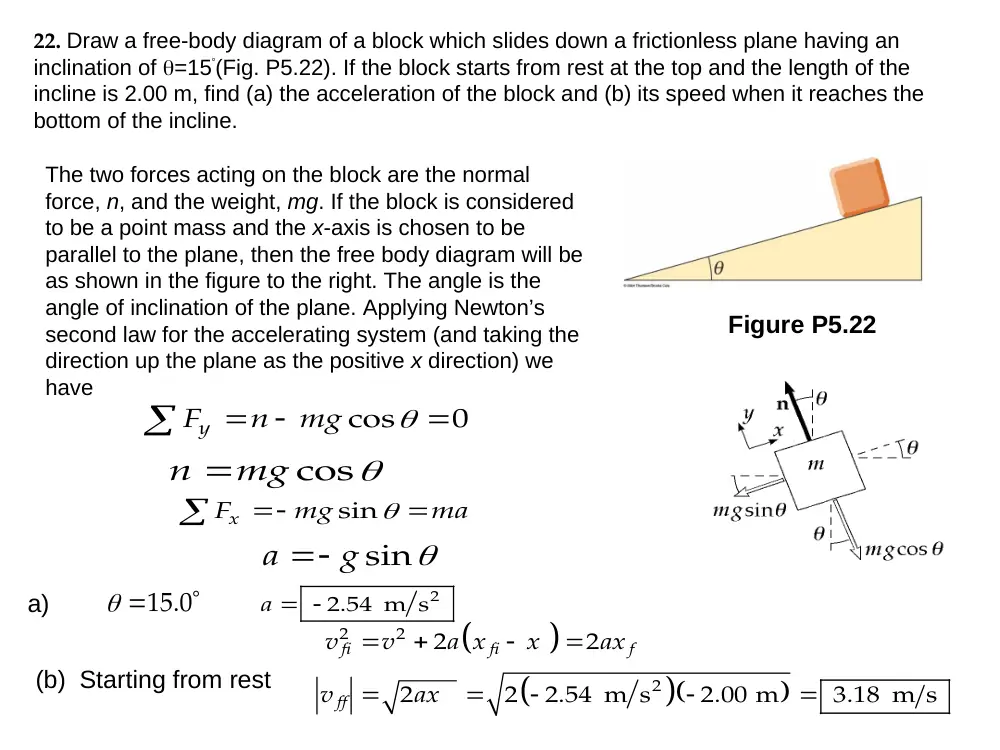
22. Draw a free-body diagram of a block which slides down a frictionless plane having an
inclination of =15(Fig. P5.22). If the block starts from rest at the top and the length of the
incline is 2.00 m, find (a) the acceleration of the block and (b) its speed when it reaches the
bottom of the incline.
Figure P5.22
The two forces acting on the block are the normal
force, n, and the weight, mg. If the block is considered
to be a point mass and the x-axis is chosen to be
parallel to the plane, then the free body diagram will be
as shown in the figure to the right. The angle is the
angle of inclination of the plane. Applying Newton’s
second law for the accelerating system (and taking the
direction up the plane as the positive x direction) we
have
cos
0
Fy
n
mg
cos
n
mg
sin
Fx
mg
ma
sin
a
g
15.0
a)
2.54 m s2
a
(b) Starting from rest
2
2
2
2
2
2
2
2.54 m s
2.00 m
3.18 m s
fi
fi
f
ff
v
v
a x
x
ax
v
ax
27.A tow truck pulls a car that is stuck in the mud, with a force of 2 500 N as in Fig. P5.27. The tow cable
is under tension and therefore pulls downward and to the left on the pin at its upper end. The light pin is
held in equilibrium by forces exerted by the two bars A and B. Each bar is a strut: that is, each is a bar
whose weight is small compared to the forces it exerts, and which exerts forces only through hinge pins at
its ends. Each strut exerts a force directed parallel to its length. Determine the force of tension or
compression in each strut. Proceed as follows: Make a guess as to which way (pushing or pulling) each
force acts on the top pin. Draw a free-body diagram of the pin. Use the condition for equilibrium of the pin
to translate the free-body diagram into equations. From the equations calculate the forces exerted by
struts A and B. If you obtain a positive answer, you correctly guessed the direction
Figure P5.27
30°
50°
A
B
2 500 N
A
2 500 N cos30°
cos50°
2 500 N sin30°
B
sin50°
B
We assume the vertical bar is in compression, pushing
up on the pin with force A, and the tilted bar is in tension,
exerting force B on the pin at -50
3
3
3
0 :
2 500 Ncos30
cos50
0
3.37
10 N
0 :
2 500 Nsin30
3.37
10 N sin50
0
3.83
10 N
x
y
F
B
B
F
A
A
Positive answers confirm that
B is in tension and is in compression.
A
34.An object of mass m1 on a frictionless horizontal table is connected to an object of mass
m2 through a very light pulley P1 and a light fixed pulley P2 as shown in Figure P5.34. (a) If
a1 and a2 are the accelerations of m1 and m2, respectively, what is the relation between
these accelerations? Express (b) the tensions in the strings and (c) the accelerations a1 and
a2 in terms of the masses m1, and m2, and g.
.
.
Pulley P1 has acceleration a2
Since m1 moves twice the distance P1 moves in the same
Time, m1 has twice the acceleration of P1 or
2
1
2a
a
From the figure, and using
2
2
2 2
1
1 1
1 2
2
1
:
1
2
2
2
0
3
F
ma
m g
T
m a
T
m a
m a
T
T
Equation (1) becomes
2
1
2 2
2
m g
T
m a
This equation combined with Equation (2) yields
1
2
1
2
1
2
2
T
m
m
m g
m
1
2
1
1
1
2
2
2
m m
T
g
m
m
1
2
2
1
1
2
4
m m
T
g
m
m
1
T
(c) From the values of
2
1
1
1
1
1
2
2
2
m g
T
a
m
m
m
2
2
1
1
2
1
2
4
m g
a
a
m
m
36.
A 25.0-kg block is initially at rest on a horizontal surface. A horizontal force of 75.0
N is required to set the block in motion. After it is in motion, a horizontal force of 60.0 N is
required to keep the block moving with constant speed. Find the coefficients of static and
kinetic friction from this information.
f
F
g
n
F
f
n
For equilibrium:
75.0 N
0.306
25.0 9.80 N
g
s
f
F
n
F
60.0 N
0.245
25.0 9.80 N
k
40. A woman at an airport is towing her 20.0-kg suitcase at constant speed by pulling on a
strap at an angle above the horizontal (Fig. P5.40). She pulls on the strap with a 35.0-N
force, and the friction force on the suitcase is 20.0 N. Draw a free-body diagram of the
suitcase.
(a) What angle does the strap make with the horizontal?
(b) What normal force does the ground exert on the suitcase?
suitcase
20.0 kg
m
35.0 N
F
:
20.0 N
cos
0
:
sin
0
x
x
y
y
g
F
ma
F
F
ma
n
F
F
cos
20.0 N
20.0 N
cos
0.571
35.0 N
55.2
F
sin
196
35.0 0.821
N
g
n
F
F
167 N
n
(b)
46.
A block of mass 3.00 kg is pushed up against a wall by a force P that makes a 50.0
angle with the horizontal as shown in Figure P5.46. The coefficient of static friction between
the block and the wall is 0.250. Determine the possible values for the magnitude of P that
allow the block to remain stationary.
Figure P5.46
(Case 1, impending upward motion)
, max
, max
0 :
cos50.0
0
:
cos50.0
0.250 0.643
0.161
x
s
s
s
s
F
P
n
f
n
f
P
P
P
max
0 :
sin50.0
0.161
3.00 9.80
0
48.6 N
yF
P
P
P
(Case 2, impending downward motion)
, max
0.161
sf
P
min
0 :
sin50.0
0.161
3.00 9.80
0
31.7 N
yF
P
P
P
Free Body Diagram
54. Three blocks are in contact with each other on a frictionless, horizontal surface, as in Figure P5.54. A
horizontal force F is applied to m1. If m1 = 2.00 kg, m2 = 3.00 kg,
m3 = 4.00 kg, and F = 18.0 N, draw a separate free-body diagram for each block and find
(a) the acceleration of the blocks,
(b) the resultant force on each block, and
(c) the magnitudes of the contact forces between the blocks.
(d) You are working on a construction project. A coworker is nailing up plasterboard on one side of a
light partition, and you are on the opposite side, providing “backing” by leaning against the wall with
your back pushing on it. Every blow makes your back sting. The supervisor helps you to put a heavy
block of wood between the wall and your back.
Using the situation analyzed in parts (a), (b), and (c) as a model,
explain how this works to make your job more comfortable.
Figure P5.54
(a)
(3)
(2)
(1)
3
2
1
Q
a
m
Q
P
a
m
P
F
a
m
Add these equations to get:
F
m a
m
m
)
(
3
2
1
You see that the masses are accelerated together, or
they behave like one mass of 9 kg.
4 kg 2 m s2
8.00 N net force on the 4 kg
Q
(b)
2
8 N
3 kg 2 m s
6.00 N net force on the 3 kg
P
P=14N
Continuation : next page
Continuation of problem 5.54:
(d)
The 3-kg block models the heavy block of wood. The contact force on
your back is represented by Q, which is much less than the force F. The difference
between F and Q is the net force causing acceleration of the 5-kg pair of objects.
The acceleration is real and nonzero, but lasts for so short a time that it never is
associated with a large velocity. The frame of the building and your legs exert
forces, small relative to the hammer blow, to bring the partition, block, and you to
rest again over a time large relative to the hammer blow. This problem lends itself
to interesting lecture demonstrations. One person can hold a lead brick in one
hand while another hits the brick with a hammer.
T Mg
5
(a)
3
2
5
T
T
T
3
2
1
4
T
T
T
T
Since pulleys are frictionless:
3
2
3
1
T
T
T
T
2
2
2
2
5
Mg
T
T
T
1
2
3
2
Mg
T
T
T
And:
T5
Mg
1
F
T
(b) since
2
Mg
F
55.An object of mass M is held in place by an applied force F
and a pulley system as shown in Figure P5.55. The pulleys are
massless and frictionless. Find
(a) the tension in each section of rope, T1, T2, T3, T4, and T5
and
(b) the magnitude of F. Suggestion: Draw a free-body
diagram for each pulley.
You need a force ½ of the weight
with 2 pulleys
58. Review problem (challenging)
A block of mass m = 2.00 kg is released from rest at h = 0.500 m above the surface of a
table, at the top of a =30 incline as shown in Figure P5.58. The frictionless incline is
fixed on a table of height H = 2.00 m.
(a) Determine the acceleration of the block as it slides down the incline.
(b) What is the velocity of the block as it leaves the incline?
(c) How far from the table will the block hit the floor?
(d) How much time has elapsed between when the block is released and when it hits the
floor?
(e) Does the mass of the block affect any of the above calculations?
(a)
/ 2
8.4
/ 2
sin 30
m s
g
a
mg
ma
(b)
m
h
d
ad
0.1
5.0
/
5.0
/ sin
,
2
v
v
2
i
2
f
s
m
f
/
.3 13
8.9
v
( c) This is a projectile motion with initial velocity vi =3.13m/s
flight
flight
t
t
R
(v cos30 )
v
f
x
t flight
From the vertical motion:
2
y
0
2
1
v
at
t
y
y
2)
(
2
1
(v sin 30 )
0.2
0
flight
flight
f
g t
t
m
Quadratic equation
Physical solution is :
m
R
s
t flight
.1 36
5.0
We did not use m
Figure P5.69
69.A van accelerates down a hill (Fig. P5.69), going from rest to 30.0 m/s in 6.00 s.
During the acceleration, a toy (m = 0.100 kg) hangs by a string from the van's ceiling. The
acceleration is such that the string remains perpendicular to the ceiling. Determine (a)
the angle and
(b) The in the string
Free body diagram:
x
y
a
mg
T
Starting from rest, vi =0 and
/ 2
0.5
)
( 0.6
0
v
v
m s
a
s
a
t
a
i
30 7.
sin
mg
ma
N
mg
T
0.84
cos