
PHYS 210 Homework, Spring 2008
American University of Beirut · Introductory Physics II · 26 pages



Showing the first 10 of 26 pages. Download the PDF to see all of it.
More PHYS 210 files
Show the text of this homework
Homework: chapter 8
Potential Energy
Homework: chapter 8
Potential Energy
1,3,4,5,6,9,10,20,21,22,25,26,31,33,36,
41,45,46,54,57,61,65
8.1 A 1 000–kg roller coaster train is initially at the top of a rise, at point A. It then
moves 135 ft, at an angle of 40.0° below the horizontal, to a lower point B.
(a) Choose point B to be the zero level for gravitational potential energy. Find
the potential energy of the roller coaster–Earth system at points A and B, and the
change in potential energy as the coaster moves.
(b) Repeat part (a), setting the zero reference level at point A.
(a) With our choice for the zero level for potential
energy when the car is at point B,
B
0
U
When the car is at point A, the potential energy of the
car-Earth system is given by
UA
mgy
where y is the vertical height above zero level. With135
ft=41.1m , this height is found as:
41.1 m sin 40.0
26.4 m
y
2
5
A
1 000 kg 9.80 m s
26.4 m
2.59 10 J
U
The change in potential energy as the car moves from A to B is
5
5
B
A
0
2.59
10 J
2.59
10 J
U
U
With our choice of the zero level when the car is at point A, we have
8.1 Continuation
The potential energy when the car is at point B is given by where y is the vertical distance of
point B below point A. In part (a), we found the magnitude of this distance to be 26.5 m.
Because this distance is now below the zero reference level, it is a negative number
A
0
U
2
5
B
1 000 kg
9.80 m s
26.5 m
2.59
10 J
U
The change in potential energy when the car moves from A to B is
5
5
B
A
2.59
10 J
0
2.59
10 J
U
U
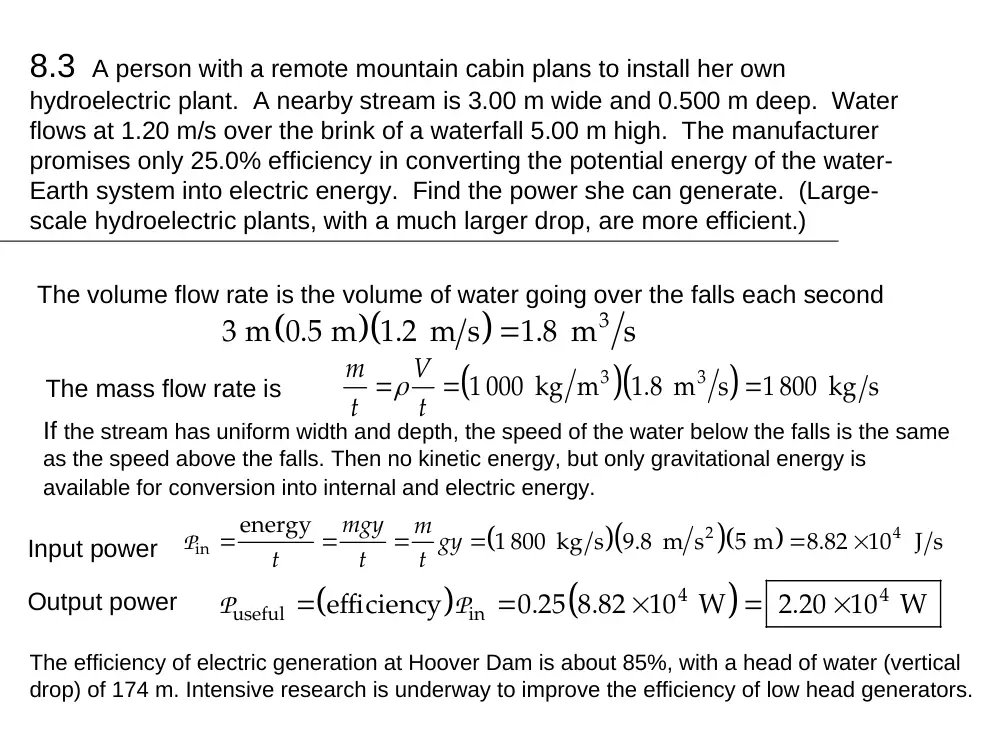
8.3 A person with a remote mountain cabin plans to install her own
hydroelectric plant. A nearby stream is 3.00 m wide and 0.500 m deep. Water
flows at 1.20 m/s over the brink of a waterfall 5.00 m high. The manufacturer
promises only 25.0% efficiency in converting the potential energy of the water-
Earth system into electric energy. Find the power she can generate. (Large-
scale hydroelectric plants, with a much larger drop, are more efficient.)
The volume flow rate is the volume of water going over the falls each second
3
3 m 0.5 m 1.2 m s
1.8 m
s
3
3
1 000 kg m
1.8 m
s
1 800 kg s
m
V
t
t
The mass flow rate is
If the stream has uniform width and depth, the speed of the water below the falls is the same
as the speed above the falls. Then no kinetic energy, but only gravitational energy is
available for conversion into internal and electric energy.
2
4
in
energy
1 800 kg s 9.8 m s
5 m
8.82
10 J s
mgy
m gy
t
t
t
P
4
4
useful
in
efficiency
0.25 8.82
10 W
2.20
10 W
P
P
Input power
Output power
The efficiency of electric generation at Hoover Dam is about 85%, with a head of water (vertical
drop) of 174 m. Intensive research is underway to improve the efficiency of low head generators.
8.4 At 11:00 AM on September 7, 2001, more than one million British school children
jumped up and down for one minute. The curriculum focus of the “Giant Jump” was on
earthquakes, but it was integrated with many other topics, such as exercise, geography,
cooperation, testing hypotheses, and setting world records. Children built their own
seismographs, which registered local effects.
(a) Find the mechanical energy released in the experiment. Assume that 1 050 000 children
of average mass 36.0 kg jump twelve times each, raising their centers of mass by 25.0 cm
each time and briefly resting between one jump and the next. The free-fall acceleration in
Britain is 9.81 m/s2.
(b) (b) Most of the energy is converted very rapidly into internal energy within the bodies of
the children and the floors of the school buildings. Of the energy that propagates into the
ground, most produces high frequency “microtremor” vibrations that are rapidly damped
and cannot travel far. Assume that 0.01% of the energy is carried away by a long-range
seismic wave. The magnitude of an earthquake on the Richter scale is given by
M log E 4.8
1.5
One child in one jump converts chemical energy into mechanical energy in the
amount that her body has as gravitational energy at the top of her jump:
(a)
36 kg 9.81 m s2
0.25 m
88.3 J
mgy
For all of the jumps of the children the energy is
6
9
12 1.05
10
88.3 J
1.11 10 J
8.4 continuation
9
5
0.011.11
10 J
1.11
10 J
E 100
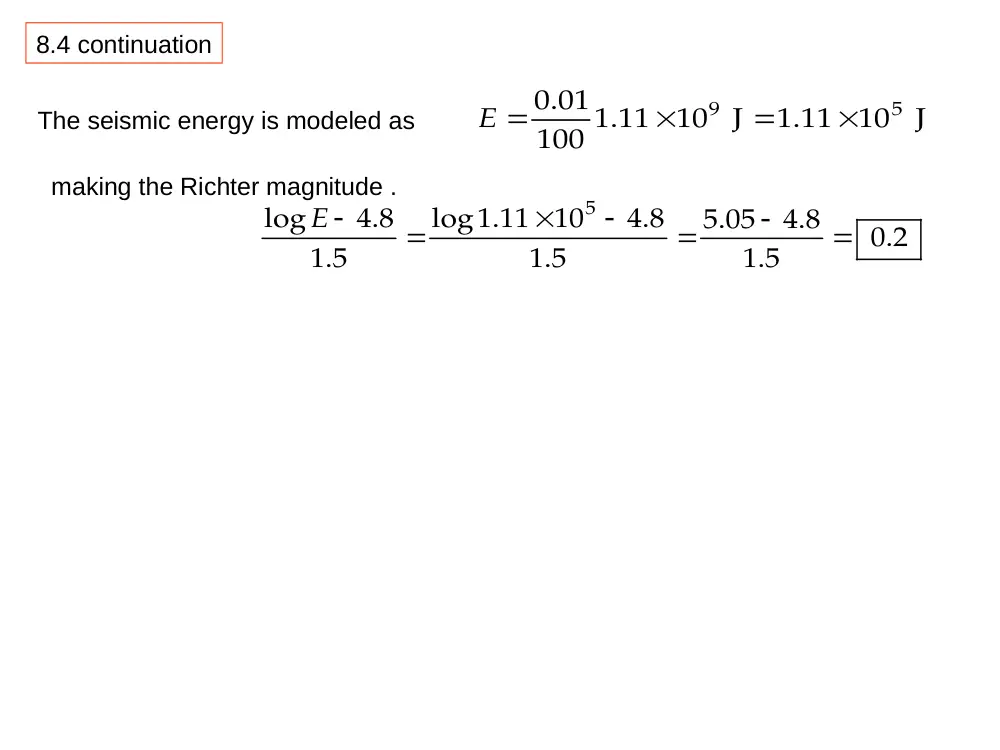
The seismic energy is modeled as
5
log
4.8
log1.11
10
4.8
5.05
4.8
0.2
1.5
1.5
1.5
E
making the Richter magnitude .
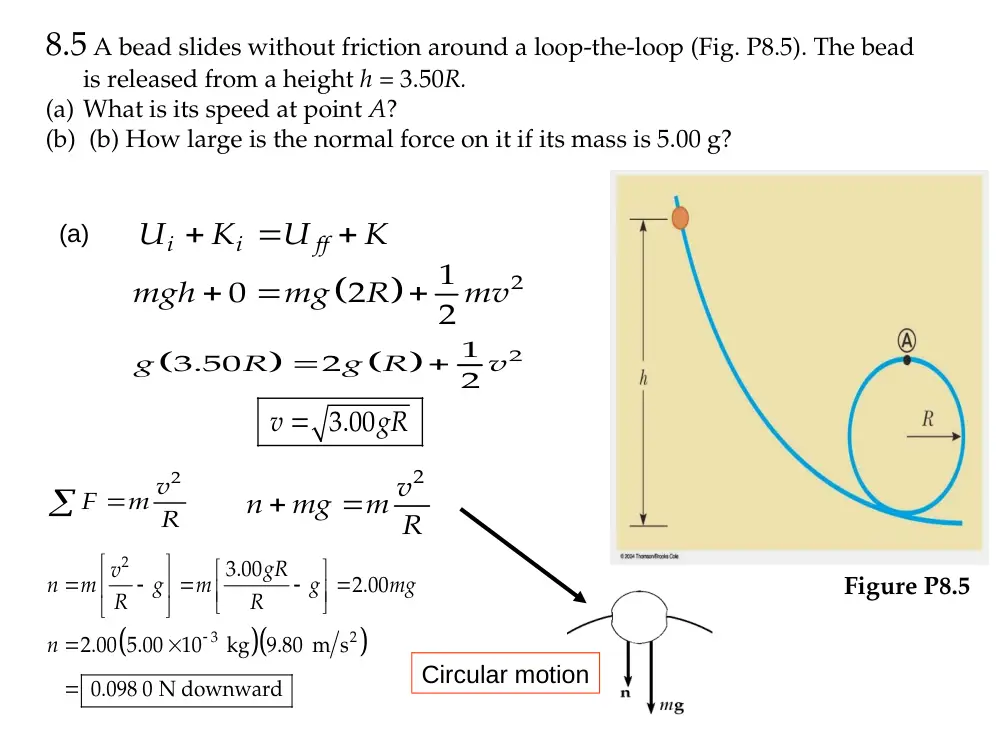
8.5 A bead slides without friction around a loop-the-loop (Fig. P8.5). The bead
is released from a height h = 3.50R.
(a) What is its speed at point A?
(b) (b) How large is the normal force on it if its mass is 5.00 g?
Figure P8.5
(a)
i
i
ff
U
K
U
K
2
1
0
2
2
mgh
mg
R
mv
2
1
3.50
2
2
g
R
g R
v
3.00
v
gR
v2
F
m R
v2
n
mg
m R
2
3
2
3.00
2.00
2.00 5.00
10
kg 9.80 m s
0.098 0 N downward
gR
v
n
m
g
m
g
mg
R
R
n
Circular motion
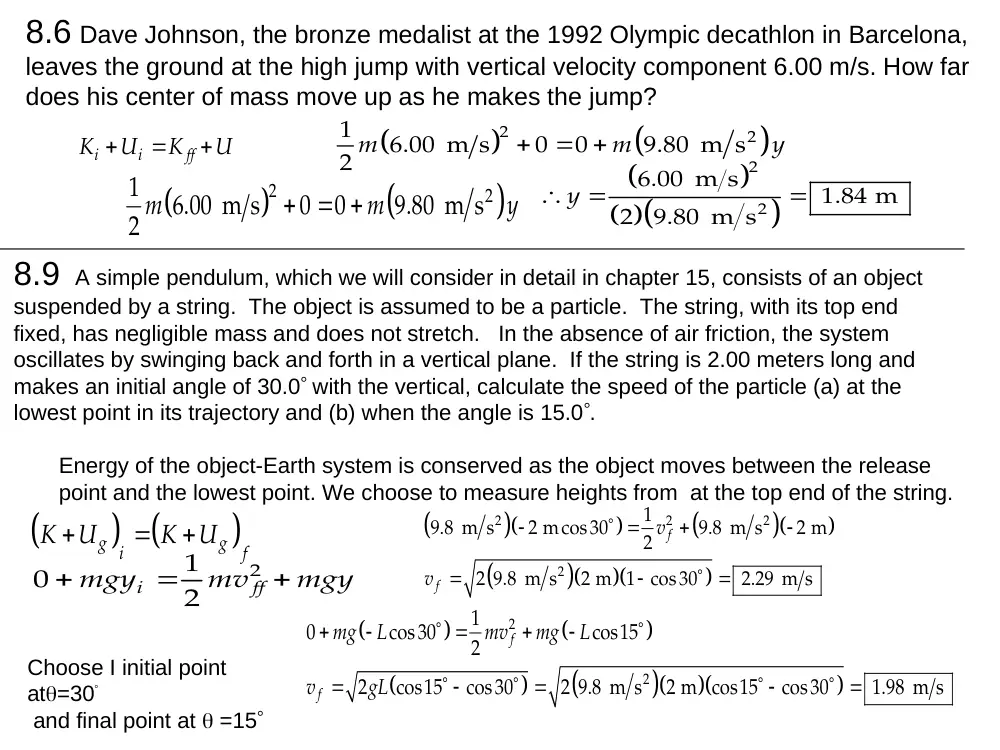
8.6 Dave Johnson, the bronze medalist at the 1992 Olympic decathlon in Barcelona,
leaves the ground at the high jump with vertical velocity component 6.00 m/s. How far
does his center of mass move up as he makes the jump?
8.9 A simple pendulum, which we will consider in detail in chapter 15, consists of an object
suspended by a string. The object is assumed to be a particle. The string, with its top end
fixed, has negligible mass and does not stretch. In the absence of air friction, the system
oscillates by swinging back and forth in a vertical plane. If the string is 2.00 meters long and
makes an initial angle of 30.0 with the vertical, calculate the speed of the particle (a) at the
lowest point in its trajectory and (b) when the angle is 15.0.
2
2
1
6.00 m s
0
0
9.80 m s
2 m
m
y
i
i
ff
K
U
K
U
2
2
1
6.00 m s
0
0
9.80 m s
2
m
m
y
2
2
6.00 m s
1.84 m
2
9.80 m s
y
Energy of the object-Earth system is conserved as the object moves between the release
point and the lowest point. We choose to measure heights from at the top end of the string.
g
g
i
f
K
U
K
U
2
1
0
2
i
ff
mgy
mv
mgy
2
2
2
2
1
9.8 m s
2 mcos30
9.8 m s
2 m
2
2 9.8 m s
2 m 1
cos30
2.29 m s
f
f
v
v
Choose I initial point
at=30
and final point at =15
2
2
1
0
cos30
cos15
2
2
cos15
cos30
2 9.8 m s
2 m cos15
cos30
1.98 m s
f
f
mg
L
mv
mg
L
v
gL
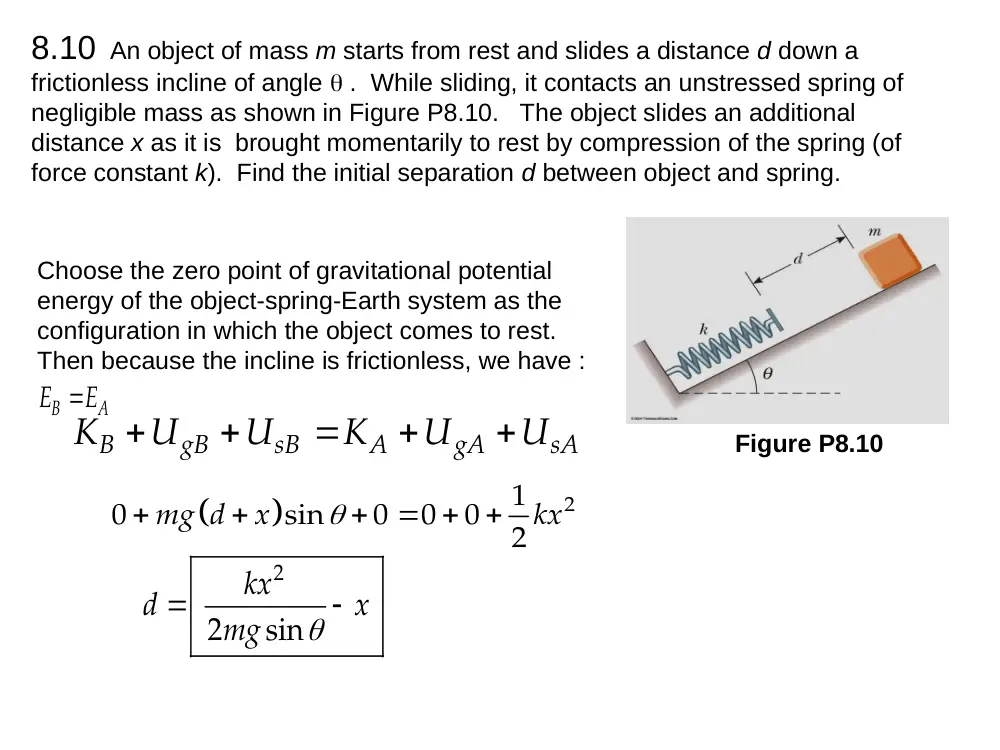
8.10 An object of mass m starts from rest and slides a distance d down a
frictionless incline of angle . While sliding, it contacts an unstressed spring of
negligible mass as shown in Figure P8.10. The object slides an additional
distance x as it is brought momentarily to rest by compression of the spring (of
force constant k). Find the initial separation d between object and spring.
Figure P8.10
Choose the zero point of gravitational potential
energy of the object-spring-Earth system as the
configuration in which the object comes to rest.
Then because the incline is frictionless, we have :
B
A
E
E
B
gB
sB
A
gA
sA
K
U
U
K
U
U
2
1
0
sin
0
0
0
2
mg d
x
kx
2
2
sin
kx
d
x
mg
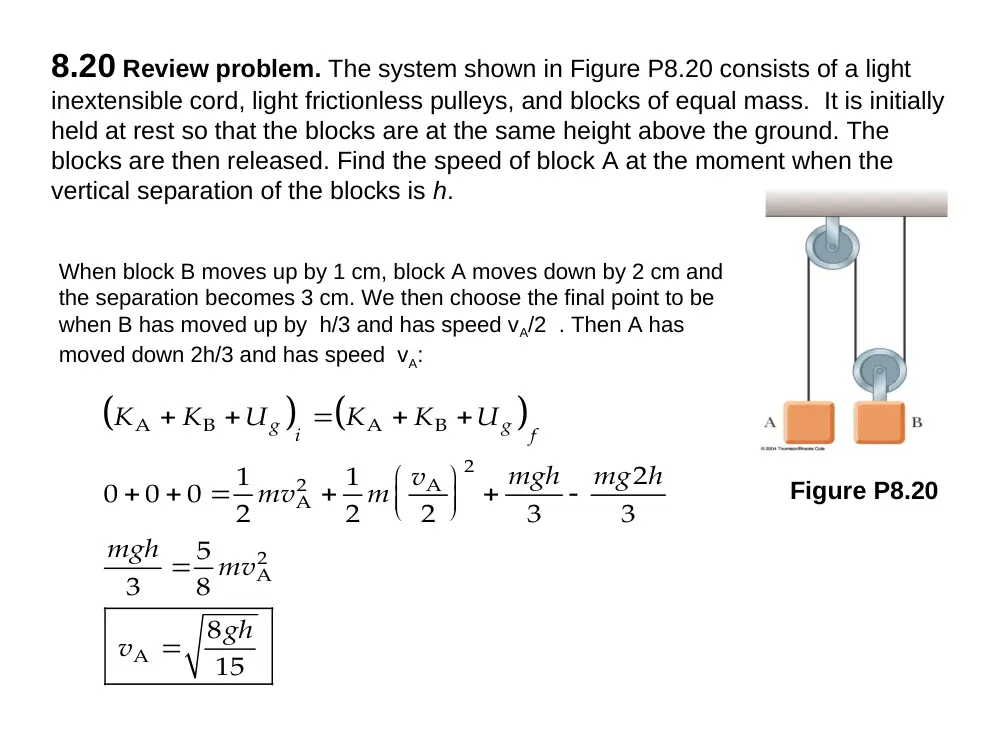
8.20 Review problem. The system shown in Figure P8.20 consists of a light
inextensible cord, light frictionless pulleys, and blocks of equal mass. It is initially
held at rest so that the blocks are at the same height above the ground. The
blocks are then released. Find the speed of block A at the moment when the
vertical separation of the blocks is h.
Figure P8.20
When block B moves up by 1 cm, block A moves down by 2 cm and
the separation becomes 3 cm. We then choose the final point to be
when B has moved up by h/3 and has speed vA/2 . Then A has
moved down 2h/3 and has speed vA:
A
B
A
B
2
2
A
A
2
A
A
2
1
1
0
0
0
2
2
2
3
3
5
3
8
8
15
g
g
i
f
K
K
U
K
K
U
mgh
mg h
v
mv
m
mgh
mv
gh
v
8.21 A 4.00-kg particle moves from the origin to position C, having coordinates
x = 5.00 m and y = 5.00 m. One force on the particle is the gravitational force
acting in the negative y direction (Fig. P8.21). Using Equation 7.3, calculate the
work done by the gravitational force in going from O to C along
(a) OAC,
(b) OBC,
(c) OC. Your results should all be identical. Why?
Figure P8.21
4.00 kg 9.80 m s2
39.2 N
gF
mg
Work along OAC= work along OA + work along AC
39.2 N
5.00 m cos180
39.2 N
5.00 m cos90.0
196 J
(b) W along OBC W along OB + W along BC
196J
5.0
39.2
0
cos180
90
cos
m
OC
F
OA
F
g
g
Fg OC cos135
(c )
Work along OC
1
39.2 N 5.00
2 m
196 J
2
All the same: sure
the force is conservative
8.22 (a) Suppose that a constant force acts on an object. The force does
not vary with time, nor with the position or the velocity of the object. Start with
the general definition for work done by a force
and show that the force is conservative. (b) As a special case, suppose that
the force
acts on a particle that moves from O to C in Figure P8.21 (see previuos
problem). Calculate the work done by F if the particle moves along each one
of the three paths OAC, OBC, and OC. (Your three answers should be
identical.)
f
i
d
W
r
F
F 3ˆ i 4ˆ j
N
, which depends only on end points, not path.
fi
W
d
F
r
F
r
r
(a)
5.00 m
5.00 m
0
0
ˆ
ˆ
ˆ
ˆ
3
4
3.00 N
4.00 N
W
d
dx
dy
dx
dy
F
r
i
j
i
j
5.00 m
5.00 m
0
0
3.00 N
4.00 N
15.0 J
20.0 J
35.0 J
W
x
y
The same calculation applies for all paths.
(b)
8.25 A single constant force
acts on a 4.00-kg particle.
(a) Calculate the work done by this force if the particle moves from the origin to
the point having the vector position .
Does this result depend on the path? Explain.
(b) What is the speed of the particle at r if its speed at the origin is 4.00 m/s?
(c) What is the change in its potential energy?
F 3ˆ i 5ˆ j
N
r 2ˆ i 3ˆ j
m
ˆ
ˆ
3.00
5.00
N
F
i
j
4.00 kg
ˆ
ˆ
2.00
3.00
m
3.00 2.00
5.00
3.00
9.00 J
m
W
r
i
j
The result does not depend on the path since the force is conservative.
W
K
2
2
4.00
4.00
9.00
4.00
2
2
v
(b)
32.0
9.00
3.39 m s
2.00
v
9.00 J
U
W
(c )
Method like in problem 8.22
(a)
8.26 At time ti, the kinetic energy of a particle is 30.0 J and the potential
energy of the system to which it belongs is 10.0 J. At some later time tf, the
kinetic energy of the particle is 18.0 J.
(a) ) If only conservative forces act on the particle, what are the potential energy
and the total energy at time tf ?
(b) If the potential energy of the system at time tf is 5.00 J, are there any
nonconservative forces acting on the particle? Explain.
fi
fi
U
K
K
U
30.0
18.0
10.0
22.0 J
U f
(a)
40.0 J
E
(b) Yes there was a nonconservative force acting, because the mechanical energy
is not conserved
8.31 The coefficient of friction between the 3.00-kg block and the surface in
Figure P8.31 is 0.400. The system starts from rest. What is the speed of the 5.00-
kg ball when it has fallen 1.50 m?
Figure P8.31
f
f
f
i
nc
U
K
U
K
W
2
2
2
1
2
1
1
2
2
m gh
fh
m v
m v
1
f
n
m g
2
2
1
1
2
1
2
m gh
m gh
m
m
v
2
1
2
1
2
2 m
m
hg
v
m
m
2 9.80 m s2
1.50 m
5.00 kg
0.400 3.00 kg
3.74 m s
8.00 kg
v
8.33 A 5.00-kg block is set into motion up an inclined plane with an initial
speed of 8.00 m/s (Fig. P8.33). The block comes to rest after traveling
3.00 m along the plane, which is inclined at an angle of 30.0° to the
horizontal. For this motion determine
(a) the change in the block's kinetic energy,
(b) the change in the potential energy of the block-Earth system, and
(c) the friction force exerted on the block (assumed to be constant).
(d) What is the coefficient of kinetic friction?
Figure P8.33
2
2
2
1
1
160 J
2
2
fi
i
K
m v
v
mv
3.00 m sin 30.0
73.5 J
U
mg
(c )The mechanical energy converted due to
friction is 86.5 J
(b)
a)
86.5 J
28.8 N
f 3.00 m
cos 30.0
28.8 N
k
k
f
n
mg
2
28.8 N
0.679
5.00 kg
9.80 m s
cos30.0
k
(d)
8.36 A 50.0-kg block and 100-kg block are connected by a string as in Figure
P8.36. The pulley is frictionless and of negligible mass. The coefficient of kinetic
friction between the 50-kg block and incline is 0.250. Determine the change in
the kinetic energy of the 50-kg block as it moves from A to B, a distance of
20.0 m.
Figure P8.36
mech
3
4
2
2
2
2
cos37.0
0
cos37.0
400 N
0.250 400 N
100 N
100 20.0
50.0 9.80 20.0sin37.0
5.90
10
100 9.80
20.0
1.96
10
1
2
1
2
y
A
B
A
B
A
A
fi
B
B
fi
A
A
fi
B
B
fi
F
n
mg
n
mg
f
n
f x
E
U
U
K
K
U
m g h
h
U
m g h
h
K
m
v
v
K
m
v
v
2
B
A
A
A
m
K
K
m
3.92 kJ
KA
8.41 A single conservative force acts on a 5.00-kg particle. The equation
Fx = (2x + 4) N describes the force, where x is in meters. As the particle moves
along the x axis from x = 1.00 m to x = 5.00 m, calculate
(a) the work done by this force,
(b) the change in the potential energy of the system, and
(c) the kinetic energy of the particle at x = 5.00 m if its speed is 3.00 m/s at
x = 1.00 m.
5.00 m
5.00 m
2
1
1
2
2
4
4
25.0
20.0
1.00
4.00
40.0 J
2
x
x
W
F dx
x
dx
x
0
K
U
a)
b)
40.0 J
U
K
W
2
1
2
f
mv
K
K
2
1
62.5 J
2
f
mv
K
K
c)
Problem 8.45
For the potential energy curve shown in the
Figure.
(a) determine whether the force Fx is positive,
negative, or zero at the five points
indicated.
(b) Indicate points of stable, unstable, and
neutral equilibrium. (c) Sketch the curve for
Fx versus x from x = 0 to x = 9.5 m.
(a) The force is given by
dx
dU
Fx
Fx is zero at points A, C and E;
is positive at point B
and negative at point D.
( c )
x(m)
Fx
qualitatively
(b) A and E are unstable, and C is stable.
8.46 A particle moves along a line where the potential energy of its system depends
on its position r as graphed in Figure P8.46. In the limit as r increases without bound,
U(r) approaches +1 J.
(a) Identify each equilibrium position for this particle. Indicate whether each is a point
of stable, unstable or neutral equilibrium.
(b) The particle will be bound if the total energy of the system is in what range? Now
suppose that the system has energy 3 J. Determine
(c) the range of positions where the particle can be found,
(d) its maximum kinetic energy,
(e) the location where it has maximum kinetic energy, and
(f) the binding energy of the system—that is, the additional
energy that it would have to be given in order for the
particle to move out to r .
Figure P8.46
There is an equilibrium point wherever the
graph of potential energy is horizontal:
At r=1.5mm and 3.2 mm, the equilibrium is
stable.
At r=2.3 mm , the equilibrium is unstable.
A particle moving out toward r approaches
neutral equilibrium.
(a)
stable
unstable
The system energy E cannot be less than –5.6 J. The
particle is bound if
(b)
5.6 J
1 J
E
If the system energy is –3 J, its potential energy must be less than or equal to
–3 J. Thus, the particle’s position is limited to .
(c )
0.6 mm
3.6 mm
r
K
U
E
8.46 Continuation
(d )
max
min
3.0 J
5.6 J
2.6 J
K
E
U
Then:
Kinetic energy is a maximum when the potential energy is a minimum, at
(e)
1.5 mm
r
W 4 J
3 J
1 J
W
Hence, the binding energy is
(f)
This is what you need
to overcome the binding
of this system, to escape it
Try to solve 8.48: it is a nice problem
8.54 A 2.00-kg block situated on a rough incline is connected to a spring of
negligible mass having a spring constant of 100 N/m (Fig. P8.54). The pulley is
frictionless. The block is released from rest when the spring is unstretched. The
block moves 20.0 cm down the incline before coming to rest.
Find the coefficient of kinetic friction between block and incline.
Figure P8.54
The gain in internal energy due to friction
represents a loss in mechanical energy
that must be equal to the change in the
kinetic energy plus the change in the
potential energy. Therefore,
2
1
cos
sin
2
kmgx
K
kx
mgx
0
i
f
v
v
But:
K=0
100 0.200 2
2.00 9.80 cos37.0
0.200
2.00 9.80 sin 37.0
0.200
2
k
0.115
k
Then:
8.61 A block of mass 0.500 kg is pushed against a horizontal spring of
negligible mass until the spring is compressed a distance x (Fig.
P8.61).
The force constant of the spring is 450 N/m. When it is released, the
block travels along a frictionless, horizontal surface to point B, the
bottom of a vertical circular track of radius R = 1.00 m, and continues
to move up the track. The speed of the block at the bottom of the
track is vB = 12.0 m/s, and the block experiences an average friction
force of 7.00 N while sliding up the track.
(a) What is x?
(b) What speed do you predict for the for the
block at the top of the track
(c ) Does the block actually reach the top of
the track, or does it fall off before reaching
the top?
Figure P8.61
(a)
2
2
1
1
2
2
kx
mv
2
2
1
1
450 N m
0.500 kg 12.0 m s
2
2
0.400 m
x
x
8.61 continuation
2
2
2
2
2
2
1
1
2
2
1
1
0.500 kg
9.80 m s
2.00 m
0.500 kg
0.500 kg 12.0 m s
2
2
7.00 N
1.00 m
0.250
4.21
4.10 m s
T
T
B
B
T
T
T
mgh
mv
mgh
mv
f
R
v
v
v
(b)
ac
g
Does block fall off at or before top of track? Block falls if
2
2
2
4.10
16.8 m s
1.00
T
c
v
a
R
ca
g
therefore
and the block fails to leave the track
8.65 Jane, whose mass is 50.0 kg, needs to swing across a river (having
width D) filled with man-eating crocodiles to save Tarzan from danger. She
must swing into a wind exerting constant horizontal force F, on a vine having
length L and initially making an angle with the vertical (Fig. P8.65). Taking D
= 50.0 m, F = 110 N, L = 40.0 m, and = 50.0, (a) with what minimum speed
must Jane begin her swing in order to just make it to the other side? (b) Once
the rescue is complete, Tarzan and Jane must swing back across the river.
With what minimum speed must they begin their swing? Assume that Tarzan
has a mass of 80.0 kg.
Figure P8.65
Jane wants to save
Tarzan, wow
Solution on next side
The geometry reveals :
sin
sin
D
L
L
50.0 m
40.0 m sin 50
sin
28.9
wind
2
2
2
2
2
4
3
4
1
cos
1
0
cos
2
1 50 kg
50 kg 9.8 m s
40 mcos50
110 N 50 m
50 kg 9.8 m s
40 mcos28.9
2
1 50 kg
1.26
10 J
5.5
10 J
1.72
10 J
2
2 947 J
6.15 m s
50 kg
g
g
i
f
i
i
i
i
K
U
W
K
U
mv
mg
L
FD
mg
L
v
v
v
2
2
2
2
2
4
4
1
cos
1
0
cos
2
1 130 kg
130 kg 9.8 m s
40 mcos28.9
110 N 50 m
2
130 kg 9.8 m s
40 mcos50
1 130 kg
4.46
10 J
5 500 J
3.28
10 J
2
2 6 340 J
9.87 m s
130 kg
i
i
i
i
mv
mg
L
FD
mg
L
v
v
v
(a)
(b )