
PHYS 210 Notes Q1, Fall 2014
American University of Beirut · Introductory Physics II · 3 pages
More PHYS 210 files
- Notes Chapter 19 · Spring 2011NotesView
- Notes Chapter 20 · Spring 2011NotesView
- Useful File Quiz 1 Review Notes · Fall 2010NotesView
- Syllabus · Spring 2019LabView
- Final Collection Finals with Solution · Spring 2017Final exam · with solutionView
- Final 2015 · Spring 2017Final examView
- Problems Chapter 8 · Fall 2015ChapterView
- Useful File Solution Manual · Fall 2015File · with solutionView
Show the text of this notes
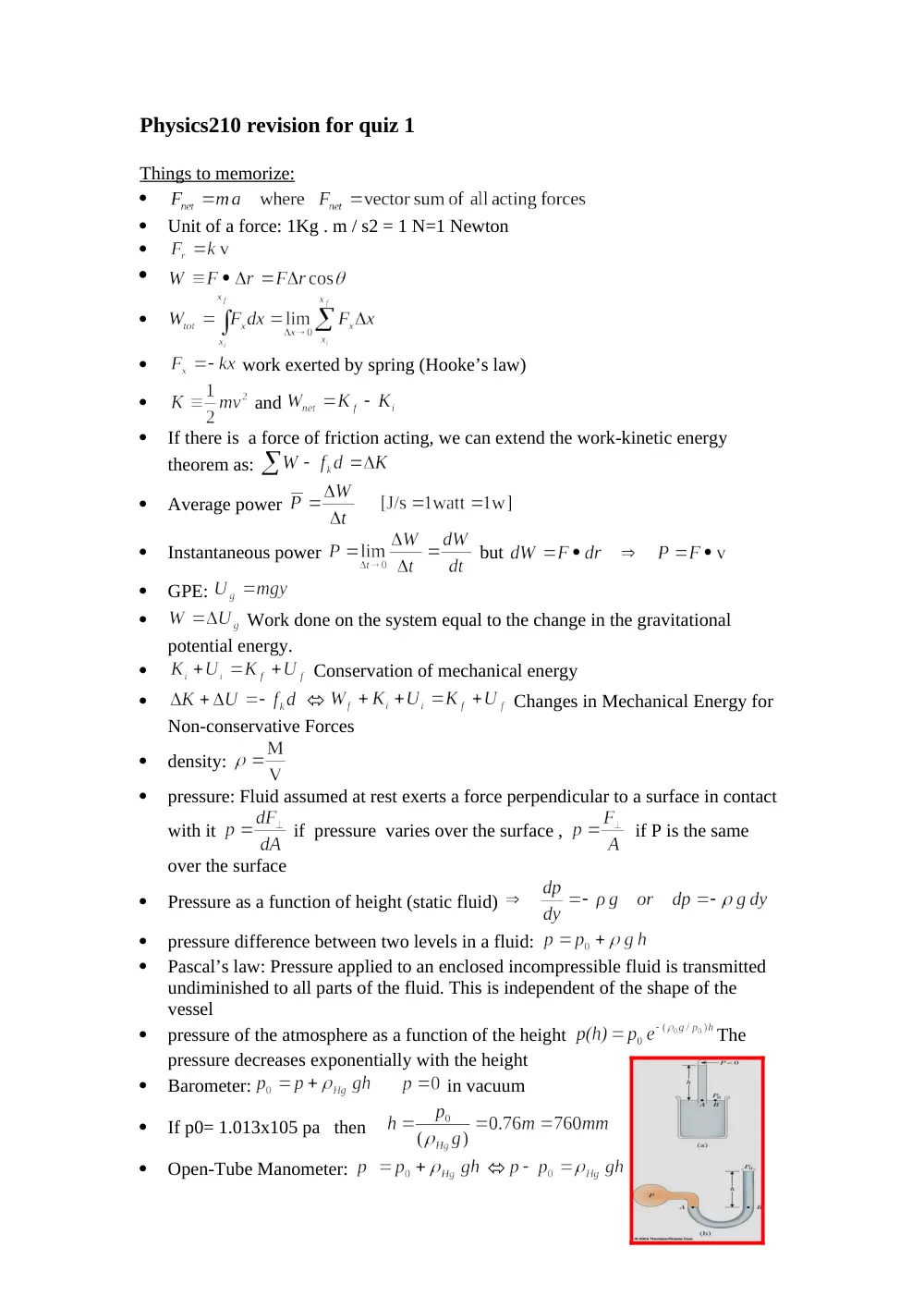
Physics210 revision for quiz 1
Things to memorize:
Unit of a force: 1Kg . m / s2 = 1 N=1 Newton
work exerted by spring (Hooke’s law)
and
If there is a force of friction acting, we can extend the work-kinetic energy
theorem as:
Average power
Instantaneous power
but
GPE:
Work done on the system equal to the change in the gravitational
potential energy.
Conservation of mechanical energy
Changes in Mechanical Energy for
Non-conservative Forces
density:
pressure: Fluid assumed at rest exerts a force perpendicular to a surface in contact
with it
if pressure varies over the surface ,
if P is the same
over the surface
Pressure as a function of height (static fluid)
pressure difference between two levels in a fluid:
Pascal’s law: Pressure applied to an enclosed incompressible fluid is transmitted
undiminished to all parts of the fluid. This is independent of the shape of the
vessel
pressure of the atmosphere as a function of the height
The
pressure decreases exponentially with the height
Barometer:
in vacuum
If p0= 1.013x10⁵ pa then
Open-Tube Manometer:
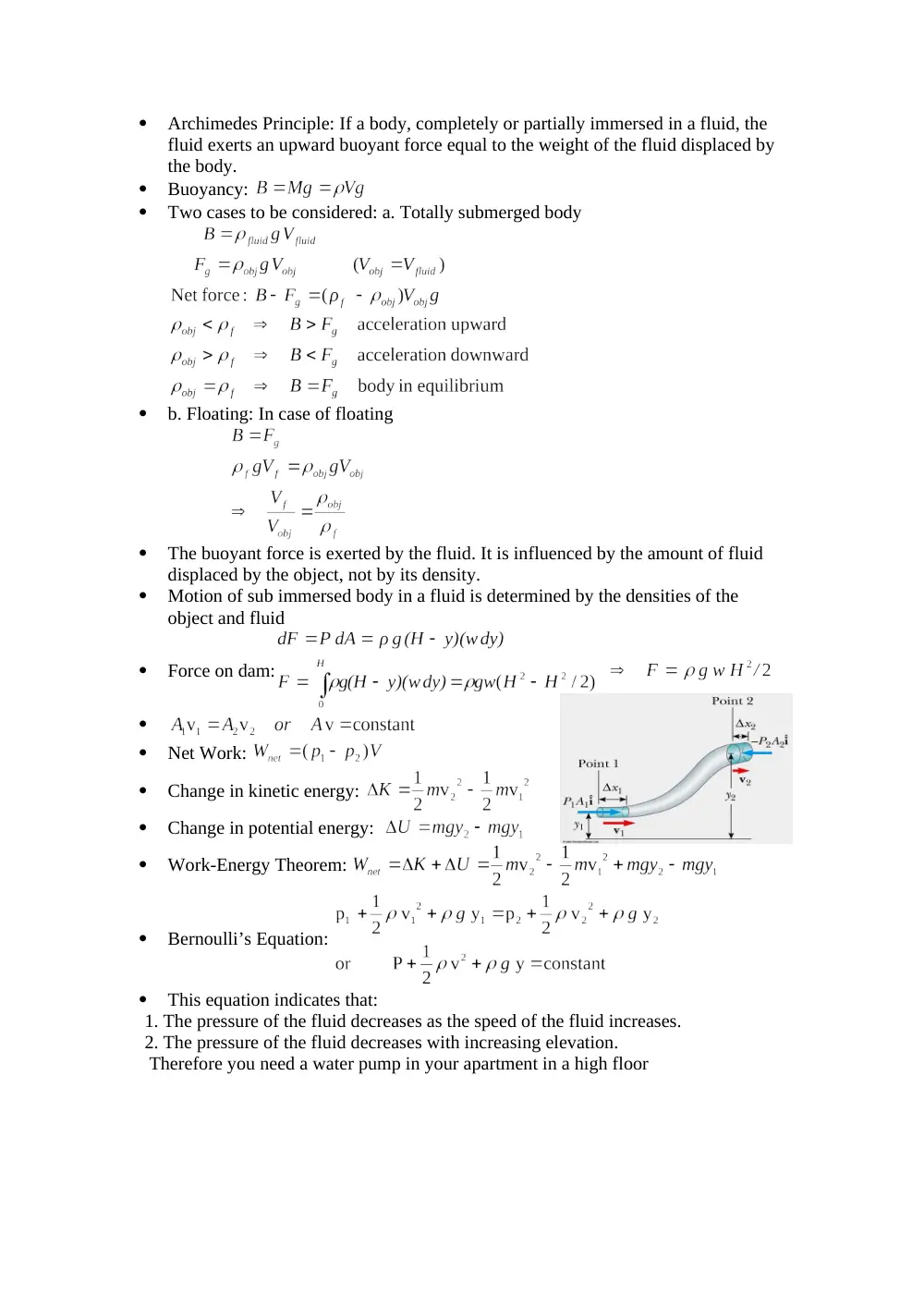
Archimedes Principle: If a body, completely or partially immersed in a fluid, the
fluid exerts an upward buoyant force equal to the weight of the fluid displaced by
the body.
Buoyancy:
Two cases to be considered: a. Totally submerged body
b. Floating: In case of floating
The buoyant force is exerted by the fluid. It is influenced by the amount of fluid
displaced by the object, not by its density.
Motion of sub immersed body in a fluid is determined by the densities of the
object and fluid
Force on dam:
Net Work:
Change in kinetic energy:
Change in potential energy:
Work-Energy Theorem:
Bernoulli’s Equation:
This equation indicates that:
1. The pressure of the fluid decreases as the speed of the fluid increases.
2. The pressure of the fluid decreases with increasing elevation.
Therefore you need a water pump in your apartment in a high floor
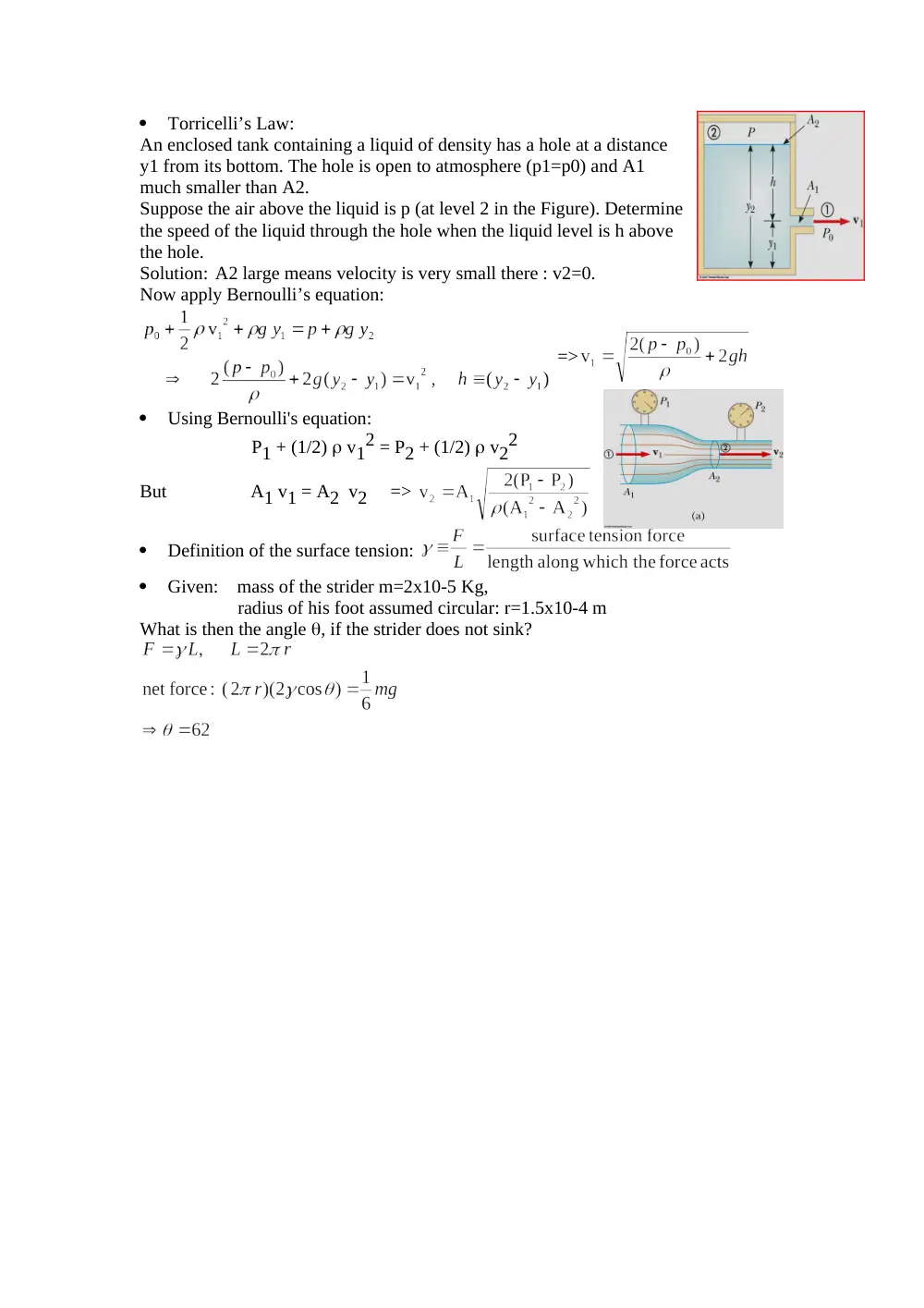
Torricelli’s Law:
An enclosed tank containing a liquid of density has a hole at a distance
y1 from its bottom. The hole is open to atmosphere (p1=p0) and A1
much smaller than A2.
Suppose the air above the liquid is p (at level 2 in the Figure). Determine
the speed of the liquid through the hole when the liquid level is h above
the hole.
Solution: A2 large means velocity is very small there : v2=0.
Now apply Bernoulli’s equation:
=>
Using Bernoulli's equation:
P1 + (1/2) r v12 = P2 + (1/2) r v22
But A1 v1 = A2 v2 =>
Definition of the surface tension:
Given: mass of the strider m=2x10⁻⁵ Kg,
radius of his foot assumed circular: r=1.5x10⁻⁴ m
What is then the angle q, if the strider does not sink?