
PHYS 210 Useful File Solution Manual, Fall 2015
American University of Beirut · Introductory Physics II · 1643 pages · with solution



Showing the first 10 of 1643 pages. Download the PDF to see all of it.
More PHYS 210 files
- Other · Spring 2008FileView
- Syllabus · Spring 2019LabView
- Final Collection Finals with Solution · Spring 2017Final exam · with solutionView
- Final 2015 · Spring 2017Final examView
- Problems Chapter 8 · Fall 2015ChapterView
- Questions TEST BANK · Fall 2015ProblemsView
- Problems Chapter 5 · Fall 2015ChapterView
- Lab Report · Fall 2015LabView
Show the text of this file
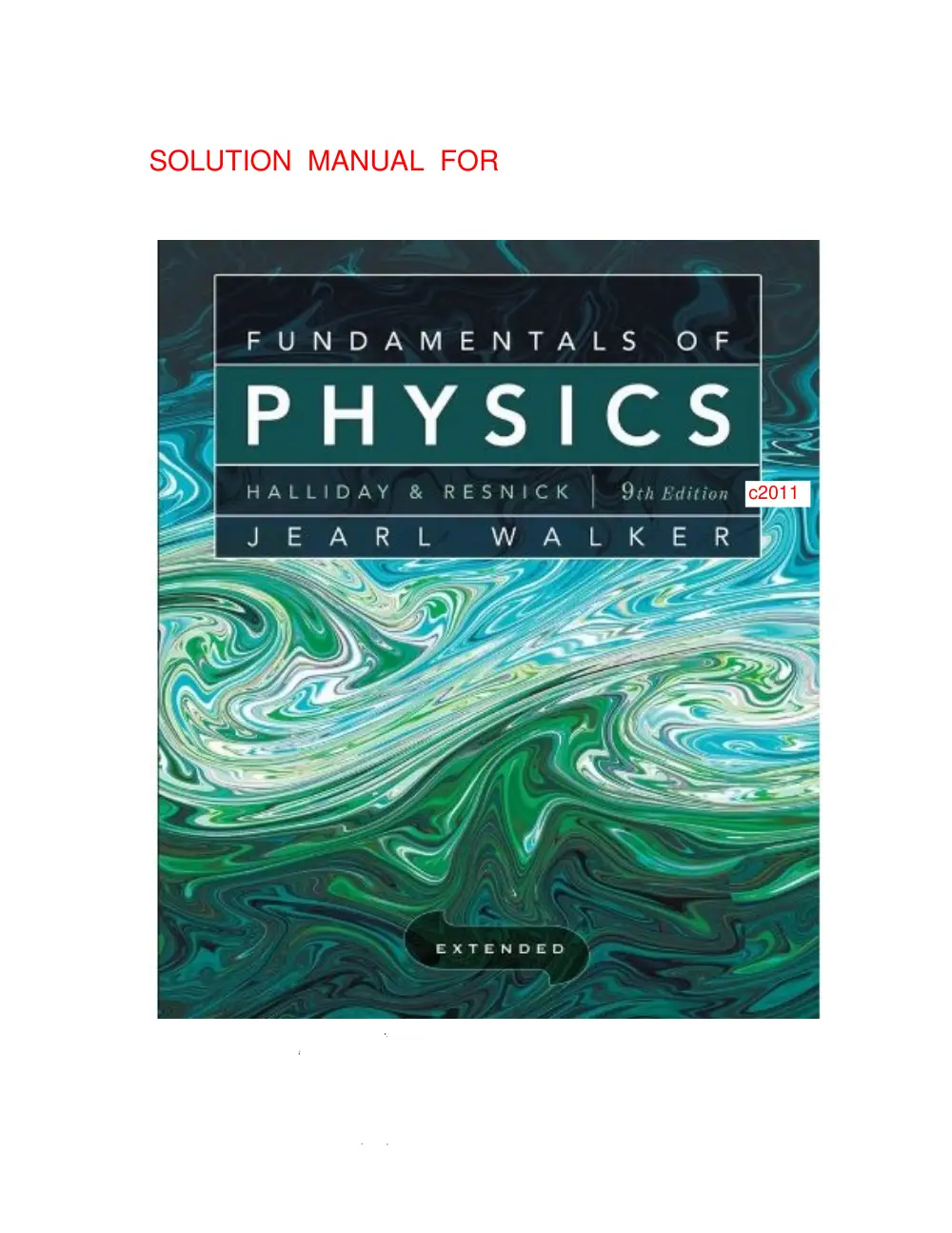
SOLUTION MANUAL FOR
c2011
VOLUME 1.
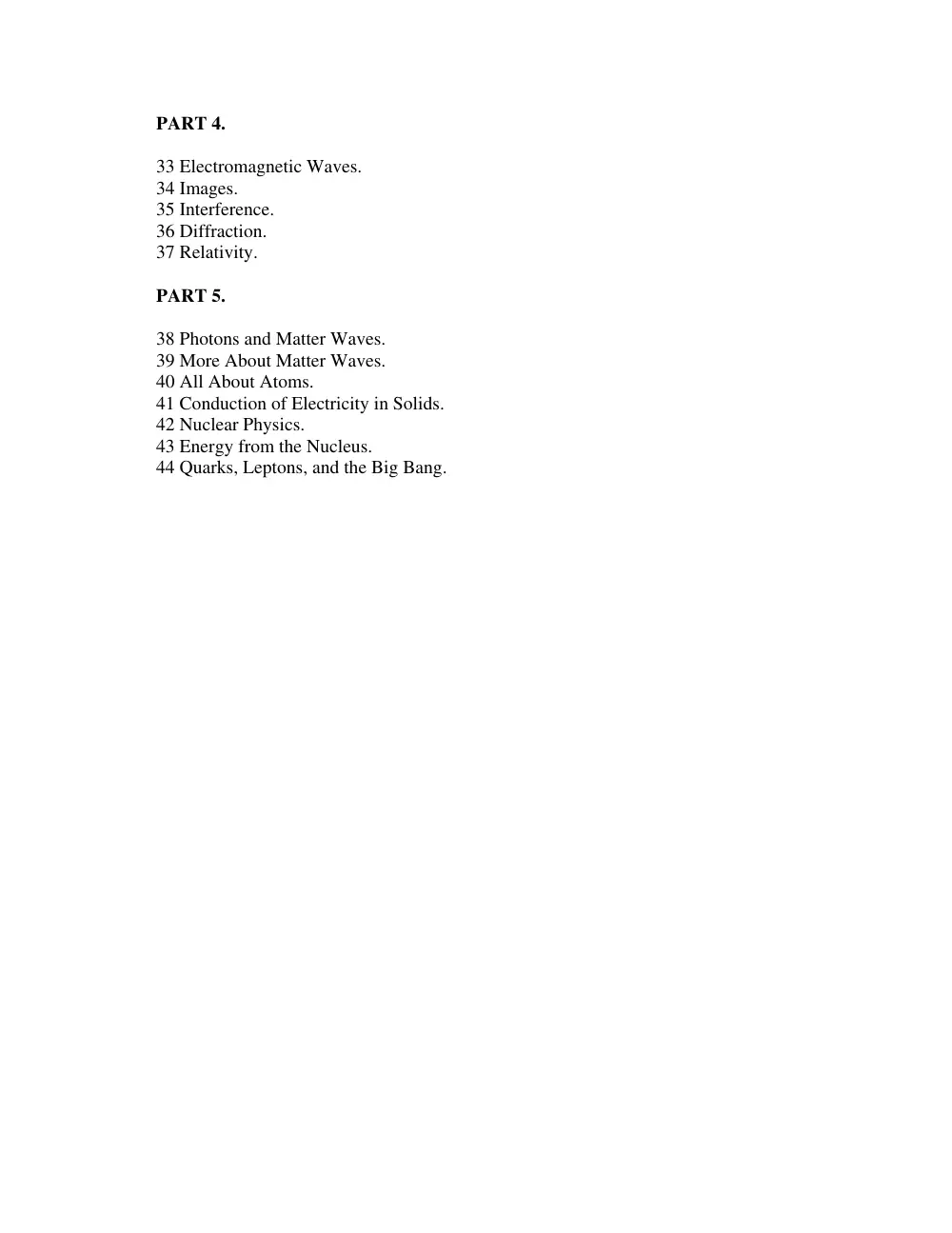
PART 1.
1 Measurement.
2 Motion Along a Straight Line.
3 Vectors.
4 Motion in Two and Three Dimensions.
5 Force and Motion — I.
6 Force and Motion — II.
7 Kinetic Energy and Work.
8 Potential Energy and Conservation of Energy.
9 Center of Mass and Linear Momentum.
10 Rotation.
11 Rolling, Torque, and Angular Momentum.
PART 2.
12 Equilibrium and Elasticity.
13 Gravitation.
14 Fluids.
15 Oscillations.
16 Waves — I.
17 Waves — II.
18 Temperature, Heat, and the First Law of Thermodynamics.
19 The Kinetic Theory of Gases.
20 Entropy and the Second Law of Thermodynamics.
VOLUME 2.
PART 3.
21 Electric Charge.
22 Electric Fields.
23 Gauss’ Law.
24 Electric Potential.
25 Capacitance.
26 Current and Resistance.
27 Circuits.
28 Magnetic Fields.
29 Magnetic Fields Due to Currents.
30 Induction and Inductance.
31 Electromagnetic Oscillations and Alternating Current.
32 Maxwell’s Equations; Magnetism of Matter.
PART 4.
33 Electromagnetic Waves.
34 Images.
35 Interference.
36 Diffraction.
37 Relativity.
PART 5.
38 Photons and Matter Waves.
39 More About Matter Waves.
40 All About Atoms.
41 Conduction of Electricity in Solids.
42 Nuclear Physics.
43 Energy from the Nucleus.
44 Quarks, Leptons, and the Big Bang.
1
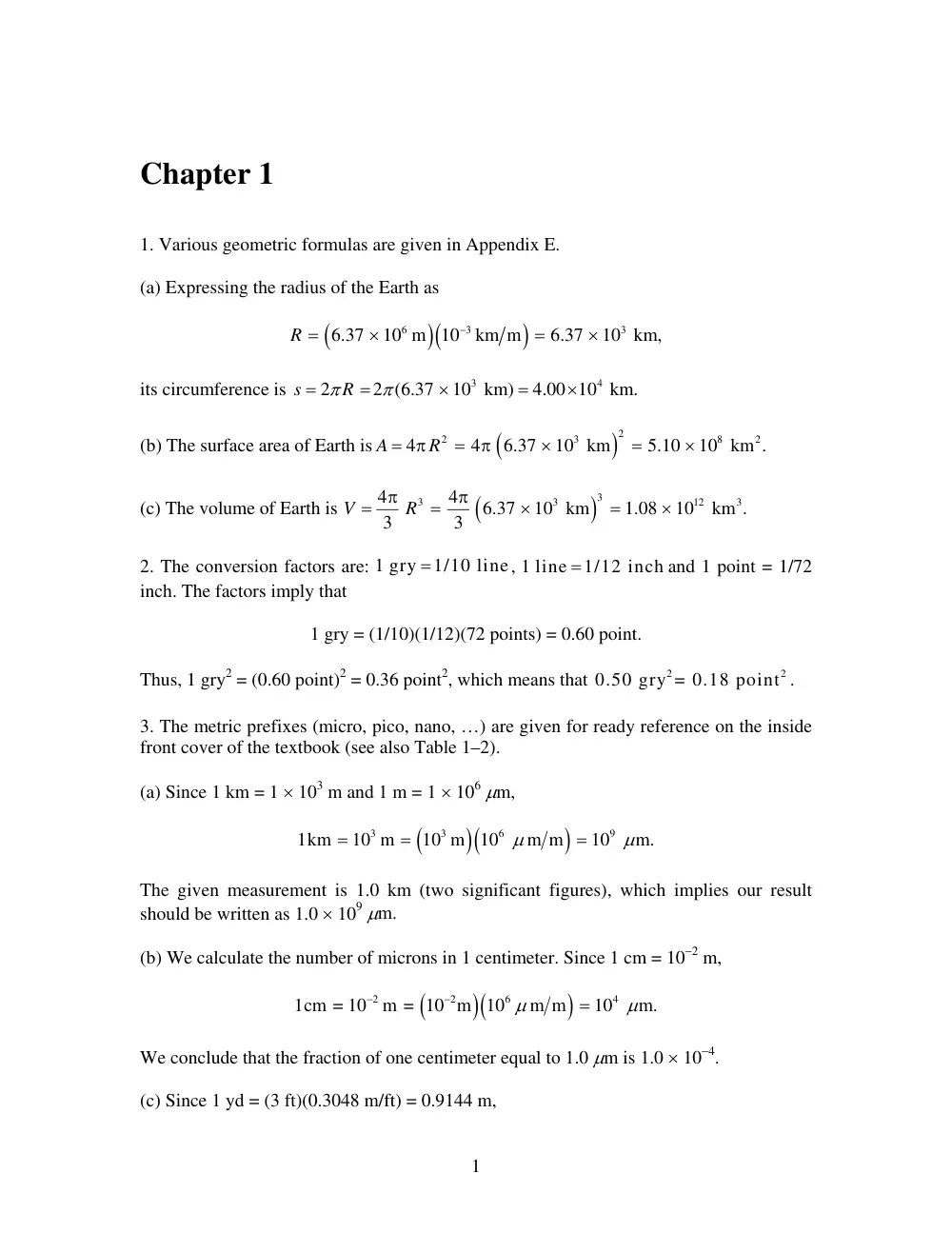
Chapter 1
1. Various geometric formulas are given in Appendix E.
(a) Expressing the radius of the Earth as
(
)(
)
6
3
3
6.37
10 m 10
km m
6.37
10 km,
R
−
=
×
=
×
its circumference is
3
4
2
2 (6.37
10 km)
4.00 10 km.
s
π R
π
=
=
×
=
×
(b) The surface area of Earth is
(
)
2
2
3
8
2
4
4
6.37
10 km
5.10
10 km .
A
= π R
=
π
×
=
×
(c) The volume of Earth is
(
)
3
3
3
12
3
4
4
6.37
10 km
1.08
10
km .
3
3
V
π R
π
=
=
×
=
×
2. The conversion factors are: 1 gry
=1/10 line
, 1 line
=1/12 inch
and 1 point = 1/72
inch. The factors imply that
1 gry = (1/10)(1/12)(72 points) = 0.60 point.
Thus, 1 gry2 = (0.60 point)2 = 0.36 point2, which means that
2
2
0.50 gry = 0.18 point .
3. The metric prefixes (micro, pico, nano, …) are given for ready reference on the inside
front cover of the textbook (see also Table 1–2).
(a) Since 1 km = 1 × 10³ m and 1 m = 1 × 106 μm,
(
)(
)
3
3
6
9
1km
10 m
10 m 10
m m
10
m.
=
=
=
μ
μ
The given measurement is 1.0 km (two significant figures), which implies our result
should be written as 1.0 × 109 μm.
(b) We calculate the number of microns in 1 centimeter. Since 1 cm = 10−2 m,
(
)(
)
2
2
6
4
1cm = 10
m = 10 m 10
m m
10
m.
−
−
=
μ
μ
We conclude that the fraction of one centimeter equal to 1.0 μm is 1.0 × 10⁻⁴.
(c) Since 1 yd = (3 ft)(0.3048 m/ft) = 0.9144 m,
CHAPTER 1
2
(
)(
)
6
5
1.0 yd = 0.91m 10
m m
9.1
10
m.
=
×
μ
μ
4. (a) Using the conversion factors 1 inch = 2.54 cm exactly and 6 picas = 1 inch, we
obtain
(
)
1 inch
6 picas
0.80 cm = 0.80 cm
1.9 picas.
2.54 cm
1 inch
⎛
⎞⎛
⎞ ≈
⎜
⎟⎜
⎟
⎝
⎠⎝
⎠
(b) With 12 points = 1 pica, we have
(
)
1 inch
6 picas
12 points
0.80 cm = 0.80 cm
23 points.
2.54 cm
1 inch
1 pica
⎛
⎞⎛
⎞⎛
⎞ ≈
⎜
⎟⎜
⎟⎜
⎟
⎝
⎠⎝
⎠⎝
⎠
5. Given that 1 furlong
= 201.168 m
, 1rod
= 5.0292 m
and 1chain
= 20.117 m
, we find
the relevant conversion factors to be
1 rod
1.0 furlong
201.168 m
(201.168 m)
40 rods,
5.0292 m
=
=
=
and
1 chain
1.0 furlong
201.168 m
(201.168 m)
10 chains
20.117 m
=
=
=
.
Note the cancellation of m (meters), the unwanted unit. Using the given conversion
factors, we find
(a) the distance d in rods to be
(
) 40 rods
4.0 furlongs
4.0 furlongs
160 rods,
1 furlong
d =
=
=
(b) and that distance in chains to be
(
)10 chains
4.0 furlongs
4.0 furlongs
40 chains.
1 furlong
d =
=
=
6. We make use of Table 1-6.
(a) We look at the first (“cahiz”) column: 1 fanega is equivalent to what amount of cahiz?
We note from the already completed part of the table that 1 cahiz equals a dozen fanega.
Thus, 1 fanega = 1
12 cahiz, or 8.33 × 10⁻² cahiz. Similarly, “1 cahiz = 48 cuartilla” (in the
already completed part) implies that 1 cuartilla = 1
48 cahiz, or 2.08 × 10⁻² cahiz.
Continuing in this way, the remaining entries in the first column are 6.94 × 10⁻³ and
3.47 10−3
×
.
3
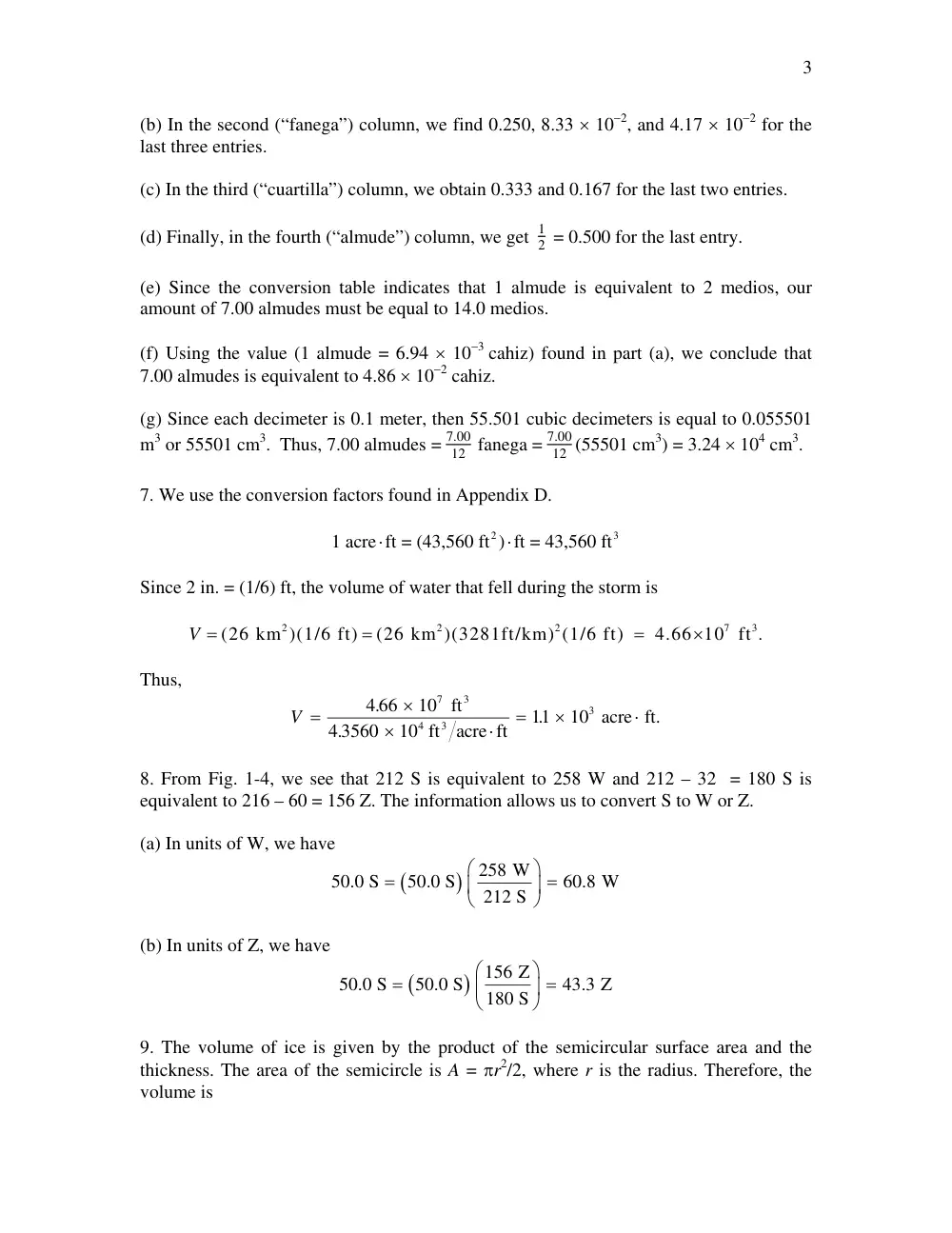
(b) In the second (“fanega”) column, we find 0.250, 8.33 × 10⁻², and 4.17 × 10⁻² for the
last three entries.
(c) In the third (“cuartilla”) column, we obtain 0.333 and 0.167 for the last two entries.
(d) Finally, in the fourth (“almude”) column, we get 1
2 = 0.500 for the last entry.
(e) Since the conversion table indicates that 1 almude is equivalent to 2 medios, our
amount of 7.00 almudes must be equal to 14.0 medios.
(f) Using the value (1 almude = 6.94 × 10⁻³ cahiz) found in part (a), we conclude that
7.00 almudes is equivalent to 4.86 × 10⁻² cahiz.
(g) Since each decimeter is 0.1 meter, then 55.501 cubic decimeters is equal to 0.055501
m3 or 55501 cm3. Thus, 7.00 almudes = 7.00
12 fanega = 7.00
12 (55501 cm3) = 3.24 × 104 cm3.
7. We use the conversion factors found in Appendix D.
2
1 acre ft = (43,560 ft ) ft = 43,560 ft3
⋅
⋅
Since 2 in. = (1/6) ft, the volume of water that fell during the storm is
2
2
2
7
3
(26 km )(1/6 ft)
(26 km )(3281ft/km) (1/6 ft)
4.66 10 ft .
V =
=
=
×
Thus,
V =
×
×
⋅
=
×
⋅
4 66
10
4 3560
10
11
10
7
4
3
.
.
.
ft
ft
acre ft
acre ft.
3
3
8. From Fig. 1-4, we see that 212 S is equivalent to 258 W and 212 – 32 = 180 S is
equivalent to 216 – 60 = 156 Z. The information allows us to convert S to W or Z.
(a) In units of W, we have
(
)
258 W
50.0 S
50.0 S
60.8 W
212 S
⎛
⎞
=
=
⎜
⎟
⎝
⎠
(b) In units of Z, we have
(
) 156 Z
50.0 S
50.0 S
43.3 Z
180 S
⎛
⎞
=
=
⎜
⎟
⎝
⎠
9. The volume of ice is given by the product of the semicircular surface area and the
thickness. The area of the semicircle is A = πr2/2, where r is the radius. Therefore, the
volume is
CHAPTER 1
4
2
2
V
= π r z
where z is the ice thickness. Since there are 103 m in 1 km and 102 cm in 1 m, we have
(
)
3
2
5
10 m
10 cm
2000km
2000
10 cm.
1km
1m
r
⎛
⎞ ⎛
⎞
=
=
×
⎜
⎟ ⎜
⎟
⎝
⎠ ⎝
⎠
In these units, the thickness becomes
(
)
2
2
10 cm
3000m
3000m
3000
10 cm
1m
z
⎛
⎞
=
=
=
×
⎜
⎟
⎝
⎠
which yields
(
) (
)
2
5
2
22
3
2000
10 cm
3000
10 cm
1.9
10
cm .
2
V
= π
×
×
=
×
10. Since a change of longitude equal to 360°corresponds to a 24 hour change, then one
expects to change longitude by360 / 24 15
°
=
° before resetting one's watch by 1.0 h.
11. (a) Presuming that a French decimal day is equivalent to a regular day, then the ratio
of weeks is simply 10/7 or (to 3 significant figures) 1.43.
(b) In a regular day, there are 86400 seconds, but in the French system described in the
problem, there would be 105 seconds. The ratio is therefore 0.864.
12. A day is equivalent to 86400 seconds and a meter is equivalent to a million
micrometers, so
37
10
14
86400
31
6
.
.
.
m
m m
day
s day
m s
b
gc
h
b
gb
g
μ
μ
=
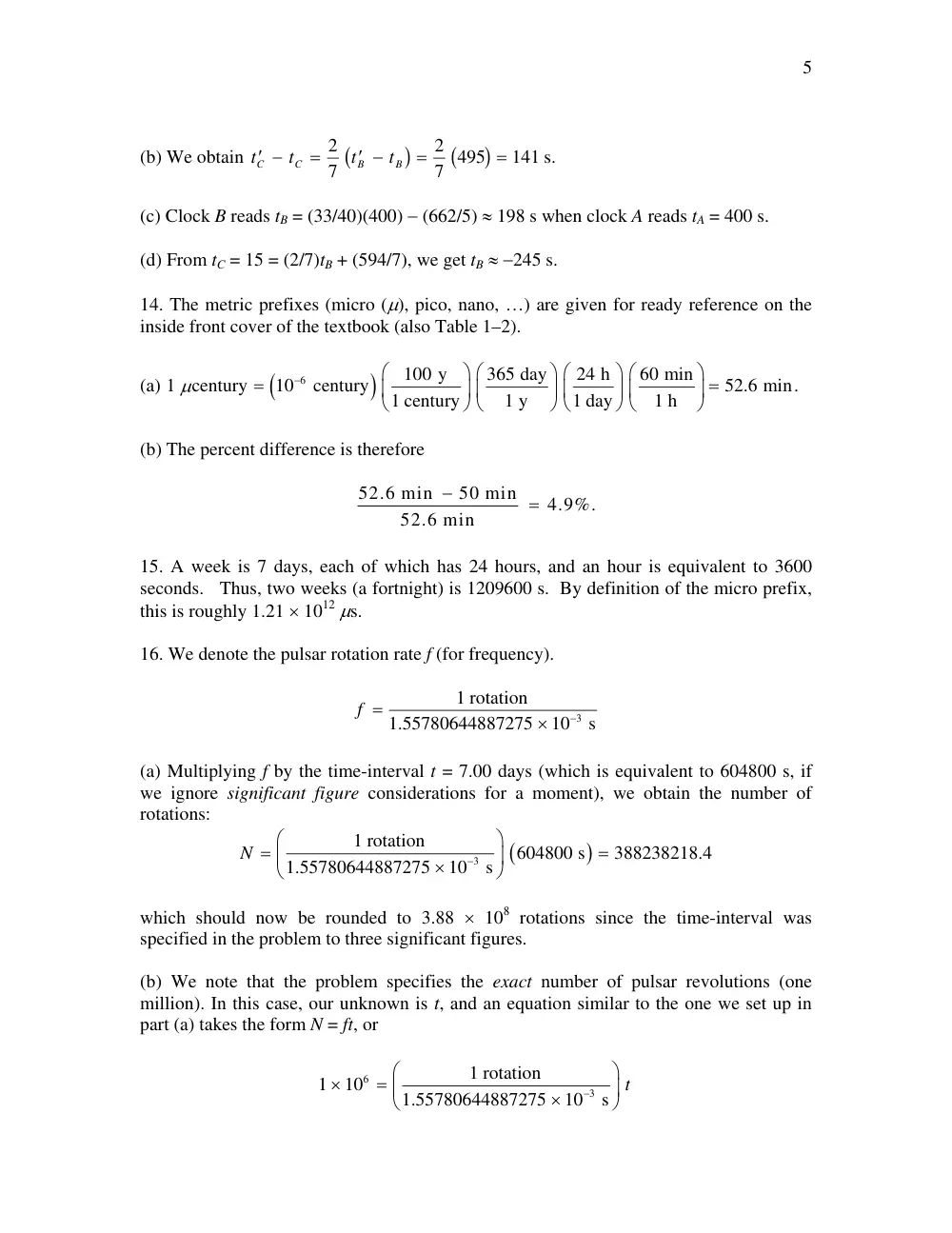
13. The time on any of these clocks is a straight-line function of that on another, with
slopes ≠ 1 and y-intercepts ≠ 0. From the data in the figure we deduce
2
594
33
662
,
.
7
7
40
5
C
B
B
A
t
t
t
t
=
+
=
−
These are used in obtaining the following results.
(a) We find
(
)
33
495 s
40
B
B
A
A
t
t
t
t
′
′
−
=
−
=
when t'A − tA = 600 s.
5
(b) We obtain ′ −
=
′ −
=
=
t
t
t
t
C
C
B
B
2
7
2
7 495
141
b
g
b g
s.
(c) Clock B reads tB = (33/40)(400) − (662/5) ≈ 198 s when clock A reads tA = 400 s.
(d) From tC = 15 = (2/7)tB + (594/7), we get tB ≈ −245 s.
14. The metric prefixes (micro (μ), pico, nano, …) are given for ready reference on the
inside front cover of the textbook (also Table 1–2).
(a)
(
)
6
100 y
365 day
24 h
60 min
1
century
10
century
52.6 min.
1 century
1 y
1 day
1 h
μ
−
⎛
⎞ ⎛
⎞ ⎛
⎞ ⎛
⎞
=
=
⎜
⎟ ⎜
⎟ ⎜
⎟ ⎜
⎟
⎝
⎠ ⎝
⎠ ⎝
⎠ ⎝
⎠
(b) The percent difference is therefore
52.6 min
50 min
4.9%.
52.6 min
−
=
15. A week is 7 days, each of which has 24 hours, and an hour is equivalent to 3600
seconds. Thus, two weeks (a fortnight) is 1209600 s. By definition of the micro prefix,
this is roughly 1.21 × 10¹² μs.
16. We denote the pulsar rotation rate f (for frequency).
3
1 rotation
1.55780644887275
10
s
f
−
=
×
(a) Multiplying f by the time-interval t = 7.00 days (which is equivalent to 604800 s, if
we ignore significant figure considerations for a moment), we obtain the number of
rotations:
(
)
3
1 rotation
604800 s
388238218.4
1.55780644887275
10
s
N
−
⎛
⎞
=
=
⎜
⎟
×
⎝
⎠
which should now be rounded to 3.88 × 10⁸ rotations since the time-interval was
specified in the problem to three significant figures.
(b) We note that the problem specifies the exact number of pulsar revolutions (one
million). In this case, our unknown is t, and an equation similar to the one we set up in
part (a) takes the form N = ft, or
6
3
1 rotation
1
10
1.55780644887275
10
s
t
−
⎛
⎞
×
= ⎜
⎟
×
⎝
⎠
CHAPTER 1
6
which yields the result t = 1557.80644887275 s (though students who do this calculation
on their calculator might not obtain those last several digits).
(c) Careful reading of the problem shows that the time-uncertainty per revolution is
3 10 17
− s
± ×
. We therefore expect that as a result of one million revolutions, the
uncertainty should be
17
6
11
(
3 10
)(1 10 )=
3 10
s
−
−
± ×
×
± ×
.
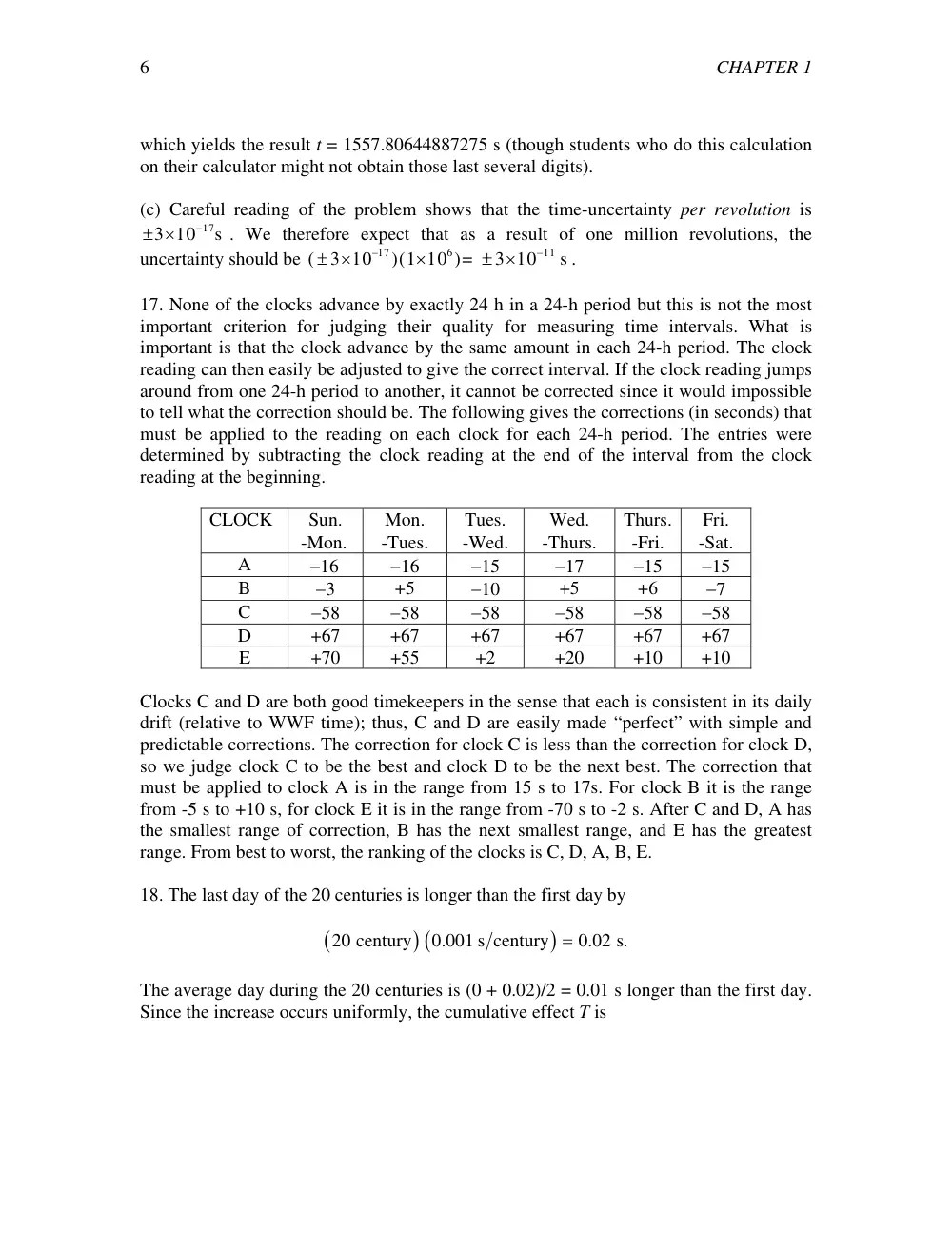
17. None of the clocks advance by exactly 24 h in a 24-h period but this is not the most
important criterion for judging their quality for measuring time intervals. What is
important is that the clock advance by the same amount in each 24-h period. The clock
reading can then easily be adjusted to give the correct interval. If the clock reading jumps
around from one 24-h period to another, it cannot be corrected since it would impossible
to tell what the correction should be. The following gives the corrections (in seconds) that
must be applied to the reading on each clock for each 24-h period. The entries were
determined by subtracting the clock reading at the end of the interval from the clock
reading at the beginning.
Sun.
Mon.
Tues.
Wed.
Thurs.
Fri.
CLOCK
-Mon.
-Tues.
-Wed.
-Thurs.
-Fri.
-Sat.
A
−16
−16
−15
−17
−15
−15
B
−3
+5
−10
+5
+6
−7
C
−58
−58
−58
−58
−58
−58
D
+67
+67
+67
+67
+67
+67
E
+70
+55
+2
+20
+10
+10
Clocks C and D are both good timekeepers in the sense that each is consistent in its daily
drift (relative to WWF time); thus, C and D are easily made “perfect” with simple and
predictable corrections. The correction for clock C is less than the correction for clock D,
so we judge clock C to be the best and clock D to be the next best. The correction that
must be applied to clock A is in the range from 15 s to 17s. For clock B it is the range
from -5 s to +10 s, for clock E it is in the range from -70 s to -2 s. After C and D, A has
the smallest range of correction, B has the next smallest range, and E has the greatest
range. From best to worst, the ranking of the clocks is C, D, A, B, E.
18. The last day of the 20 centuries is longer than the first day by
(
) (
)
20 century
0.001 s century
= 0.02 s.
The average day during the 20 centuries is (0 + 0.02)/2 = 0.01 s longer than the first day.
Since the increase occurs uniformly, the cumulative effect T is
7
(
)(
)
(
)
average increase in length of a day
number of days
0.01 s
365.25 day
2000 y
day
y
7305 s
T =
⎛
⎞ ⎛
⎞
= ⎜
⎟ ⎜
⎟
⎝
⎠ ⎝
⎠
=
or roughly two hours.
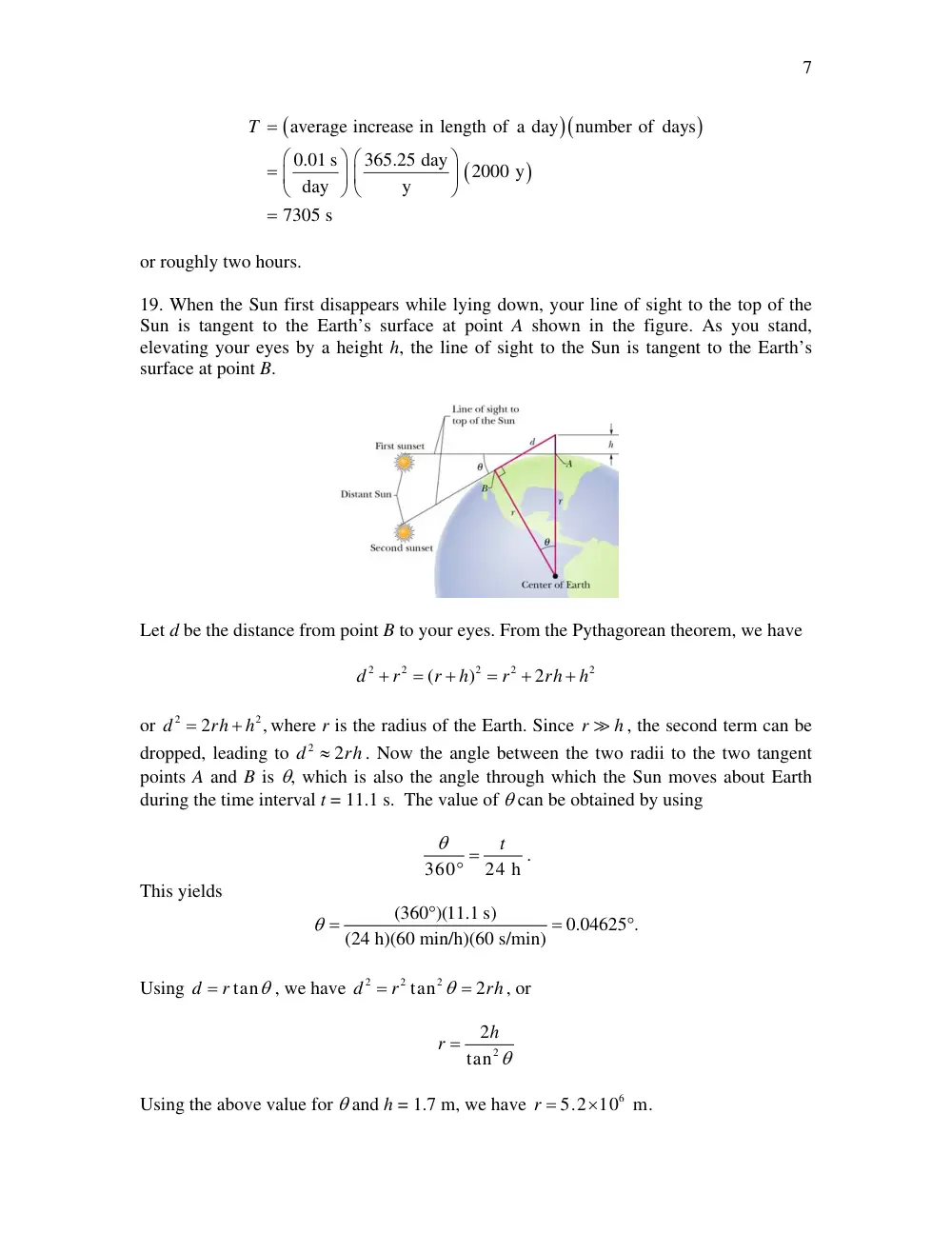
19. When the Sun first disappears while lying down, your line of sight to the top of the
Sun is tangent to the Earth’s surface at point A shown in the figure. As you stand,
elevating your eyes by a height h, the line of sight to the Sun is tangent to the Earth’s
surface at point B.
Let d be the distance from point B to your eyes. From the Pythagorean theorem, we have
2
2
2
2
2
(
)
2
d
r
r
h
r
rh
h
+
=
+
=
+
+
or
2
2
2
,
d
rh
h
=
+
where r is the radius of the Earth. Since r
� h
, the second term can be
dropped, leading to
2
2
d
≈ rh
. Now the angle between the two radii to the two tangent
points A and B is θ, which is also the angle through which the Sun moves about Earth
during the time interval t = 11.1 s. The value of θ can be obtained by using
360
24 h
t
θ
° =
.
This yields
(360 )(11.1 s)
0.04625 .
(24 h)(60 min/h)(60 s/min)
θ
°
=
=
°
Using
tan
d
r
θ
=
, we have
2
2
tan2
2
d
r
rh
θ
=
=
, or
2
2
tan
h
r
θ
=
Using the above value for θ and h = 1.7 m, we have
6
r = 5.2 10 m.
×
CHAPTER 1
8
20. (a) We find the volume in cubic centimeters
(
)
3
3
5
3
231 in
2.54 cm
193 gal = 193 gal
7.31
10 cm
1gal
1in
⎛
⎞ ⎛
⎞ =
×
⎜
⎟ ⎜
⎟
⎝
⎠
⎝
⎠
and subtract this from 1 × 106 cm3 to obtain 2.69 × 105 cm3. The conversion gal → in3 is
given in Appendix D (immediately below the table of Volume conversions).
(b) The volume found in part (a) is converted (by dividing by (100 cm/m)3) to 0.731 m3,
which corresponds to a mass of
1000 kg m 0.731 m
= 731 kg
3
2
c
hc
h
using the density given in the problem statement. At a rate of 0.0018 kg/min, this can be
filled in
5
731kg
4.06
10 min = 0.77 y
0.0018 kg min =
×
after dividing by the number of minutes in a year (365 days)(24 h/day) (60 min/h).
21. If ME is the mass of Earth, m is the average mass of an atom in Earth, and N is the
number of atoms, then ME = Nm or N = ME/m. We convert mass m to kilograms using
Appendix D (1 u = 1.661 × 10⁻²⁷ kg). Thus,
N
M
m
E
=
=
×
×
=
×
−
598
10
40
1661
10
9 0
10
24
27
49
.
.
.
.
kg
u
kg u
b
gc
h
22. The density of gold is
3
3
19.32 g
19.32 g/cm .
1 cm
m
ρ = V
=
=
(a) We take the volume of the leaf to be its area A multiplied by its thickness z. With
density ρ = 19.32 g/cm3 and mass m = 27.63 g, the volume of the leaf is found to be
V
= m
ρ =
1430
.
.
cm3
We convert the volume to SI units:
9
(
)
3
3
6
3
1m
1.430 cm
1.430
10
m .
100 cm
V
−
⎛
⎞
=
=
×
⎜
⎟
⎝
⎠
Since V = Az with z = 1 × 10⁻⁶ m (metric prefixes can be found in Table 1–2), we obtain
A =
×
×
=
−
−
1430
10
1
10
1430
6
6
.
.
.
m
m
m
3
2
(b) The volume of a cylinder of length � is V
= A
� where the cross-section area is that of
a circle: A = πr2. Therefore, with r = 2.500 × 10⁻⁶ m and V = 1.430 × 10⁻⁶ m3, we obtain
4
2
7.284
10 m
72.84 km.
V
= πr
=
×
=
�
23. We introduce the notion of density:
ρ = m
V
and convert to SI units: 1 g = 1 × 10⁻³ kg.
(a) For volume conversion, we find 1 cm3 = (1 × 10⁻²m)3 = 1 × 10⁻⁶m3. Thus, the density
in kg/m3 is
3
3
3
3
3
3
6
3
1 g
10
kg
cm
1 g cm
1
10 kg m .
cm
g
10
m
−
−
⎛
⎞ ⎛
⎞
⎛
⎞
=
=
×
⎜
⎟ ⎜
⎟
⎜
⎟
⎝
⎠ ⎝
⎠ ⎝
⎠
Thus, the mass of a cubic meter of water is 1000 kg.
(b) We divide the mass of the water by the time taken to drain it. The mass is found from
M = ρV (the product of the volume of water and its density):
(
) (
)
3
3
3
6
5700 m
1
10 kg m
5.70
10 kg.
M =
×
=
×
The time is t = (10h)(3600 s/h) = 3.6 × 10⁴ s, so the mass flow rate R is
6
4
5.70
10 kg
158 kg s.
3.6
10 s
M
R
t
×
=
=
=
×
24. The metric prefixes (micro (μ), pico, nano, …) are given for ready reference on the
inside front cover of the textbook (see also Table 1–2). The surface area A of each grain
of sand of radius r = 50 μm = 50 × 10−6 m is given by A = 4π(50 × 10−6)2 = 3.14 × 10⁻⁸
m2 (Appendix E contains a variety of geometry formulas). We introduce the notion of
CHAPTER 1
10
density,
/
ρ = m V
, so that the mass can be found from m = ρV, where ρ = 2600 kg/m3.
Thus, using V = 4πr3/3, the mass of each grain is
(
)
3
6
3
9
3
4
50
10
m
4
2600 kg
1.36
10
kg.
3
m
3
r
m
V
π
π
ρ
ρ
−
−
×
⎛
⎞
⎛
⎞
=
=
=
=
×
⎜
⎟
⎜
⎟
⎝
⎠
⎝
⎠
We observe that (because a cube has six equal faces) the indicated surface area is 6 m2.
The number of spheres (the grains of sand) N that have a total surface area of 6 m2 is
given by
2
8
8
2
6 m
1.91
10 .
3.14
10
m
N
−
=
=
×
×
Therefore, the total mass M is
(
) (
)
8
9
1.91
10
1.36
10
kg
0.260 kg.
M
Nm
−
=
=
×
×
=
25. The volume of the section is (2500 m)(800 m)(2.0 m) = 4.0 × 10⁶ m3. Letting “d”
stand for the thickness of the mud after it has (uniformly) distributed in the valley, then
its volume there would be (400 m)(400 m)d. Requiring these two volumes to be equal,
we can solve for d. Thus, d = 25 m. The volume of a small part of the mud over a patch
of area of 4.0 m2 is (4.0)d = 100 m3. Since each cubic meter corresponds to a mass of
1900 kg (stated in the problem), then the mass of that small part of the mud is
5
1.9 10 kg
×
.
26. (a) The volume of the cloud is (3000 m)π(1000 m)2 = 9.4 × 10⁹ m3. Since each cubic
meter of the cloud contains from 50 × 106 to 500 × 106 water drops, then we conclude
that the entire cloud contains from 4.7 × 10¹⁸ to 4.7 × 10¹⁹ drops. Since the volume of
each drop is 4
3 π(10 × 10− 6 m)3 = 4.2 × 10⁻¹⁵ m3, then the total volume of water in a cloud
is from
2 103
×
to
2 104
×
m3.
(b) Using the fact that
3
3
3
3
1 L
1 10 cm
1 10 m
−
= ×
= ×
, the amount of water estimated in
part (a) would fill from
2 106
×
to
2 107
×
bottles.
(c) At 1000 kg for every cubic meter, the mass of water is from
2 106
×
to
2 107
×
kg.
The coincidence in numbers between the results of parts (b) and (c) of this problem is due
to the fact that each liter has a mass of one kilogram when water is at its normal density
(under standard conditions).
27. We introduce the notion of density,
/
ρ = m V
, and convert to SI units: 1000 g = 1 kg,
and 100 cm = 1 m.
(a) The density ρ of a sample of iron is
11
(
)
3
3
3
1 kg
100 cm
7.87 g cm
7870 kg/m .
1000 g
1 m
ρ
⎛
⎞ ⎛
⎞
=
=
⎜
⎟ ⎜
⎟
⎝
⎠ ⎝
⎠
If we ignore the empty spaces between the close-packed spheres, then the density of an
individual iron atom will be the same as the density of any iron sample. That is, if M is
the mass and V is the volume of an atom, then
26
29
3
3
3
9.27
10
kg
1.18
10
m .
7.87
10 kg m
M
V
−
−
×
=
=
=
×
×
ρ
(b) We set V = 4πR3/3, where R is the radius of an atom (Appendix E contains several
geometry formulas). Solving for R, we find
(
)
1 3
29
3
1 3
10
3 1.18
10
m
3
1.41
10
m.
4
4
V
R
−
−
⎛
⎞
×
⎛
⎞
⎜
⎟
=
=
=
×
⎜
⎟
⎜
⎟
π
π
⎝
⎠
⎝
⎠
The center-to-center distance between atoms is twice the radius, or 2.82 × 10⁻¹⁰ m.
28. If we estimate the “typical” large domestic cat mass as 10 kg, and the “typical” atom
(in the cat) as 10 u ≈ 2 × 10⁻²⁶ kg, then there are roughly (10 kg)/( 2 × 10⁻²⁶ kg) ≈ 5 ×
1026 atoms. This is close to being a factor of a thousand greater than Avogadro’s number.
Thus this is roughly a kilomole of atoms.
29. The mass in kilograms is
28 9
100
16
10
10
0 3779
.
.
piculs
gin
1picul
tahil
1gin
chee
1tahil
hoon
1 chee
1hoong
b
gFHG
IKJFHG
IKJFHG
IKJFHG
IKJFHG
IKJ
which yields 1.747 × 10⁶ g or roughly 1.75× 10³ kg.
30. To solve the problem, we note that the first derivative of the function with respect to
time gives the rate. Setting the rate to zero gives the time at which an extreme value of
the variable mass occurs; here that extreme value is a maximum.
(a) Differentiating
0.8
( )
5.00
3.00
20.00
m t
t
t
=
−
+
with respect to t gives
4.00 0.2
3.00.
dm
t
dt
−
=
−
The water mass is the greatest when
/
dm dt = 0,
or at
(4.00/3.00)1/0.2
4.21s.
t =
=
CHAPTER 1
12
(b) At
t = 4.21s,
the water mass is
0.8
(
4.21s)
5.00(4.21)
3.00(4.21)
20.00
23.2 g.
m t =
=
−
+
=
(c) The rate of mass change at
t = 2.00 s
is
0.2
2.00 s
2
g
1kg
60 s
4.00(2.00)
3.00 g/s
0.48 g/s
0.48 s 1000 g 1 min
2.89 10
kg/min.
t
dm
dt
−
=
−
⎡
⎤
=
−
=
=
⋅
⋅
⎣
⎦
=
×
(d) Similarly, the rate of mass change at
t = 5.00 s
is
0.2
2.00 s
3
g
1kg
60 s
4.00(5.00)
3.00 g/s
0.101g/s
0.101 s 1000 g 1 min
6.05 10
kg/min.
t
dm
dt
−
=
−
⎡
⎤
=
−
= −
= −
⋅
⋅
⎣
⎦
= −
×
31. The mass density of the candy is
4
3
4
3
3
0.0200 g
4.00 10
g/mm
4.00 10
kg/cm .
50.0 mm
m
V
ρ
−
−
=
=
=
×
=
×
If we neglect the volume of the empty spaces between the candies, then the total mass of
the candies in the container when filled to height h is
,
M
= ρAh
where
2
(14.0 cm)(17.0 cm)
238 cm
A =
=
is the base area of the container that remains
unchanged. Thus, the rate of mass change is given by
4
3
2
(
)
(4.00 10
kg/cm )(238 cm )(0.250 cm/s)
0.0238 kg/s
1.43 kg/min.
dM
d
Ah
A dh
dt
dt
dt
ρ
ρ
−
=
=
=
×
=
=
32. The total volume V of the real house is that of a triangular prism (of height h = 3.0 m
and base area A = 20 × 12 = 240 m2) in addition to a rectangular box (height h´ = 6.0 m
and same base). Therefore,
3
1
1800 m .
2
2
h
V
hA
h A
h
A
⎛
⎞
′
′
=
+
=
+
=
⎜
⎟
⎝
⎠
(a) Each dimension is reduced by a factor of 1/12, and we find
Vdoll
3
3
m
m
=
FHG IKJ ≈
1800
1
12
10
3
c
h
.
.
13
(b) In this case, each dimension (relative to the real house) is reduced by a factor of 1/144.
Therefore,
Vminiature
m3
6.0
10
m
=
FHG
IKJ
≈
×
−
1800
1
144
3
4
3
c
h
.
33. In this problem we are asked to differentiate between three types of tons:
displacement ton, freight ton and register ton, all of which are units of volume. The three
different tons are given in terms of barrel bulk, with
3
1 barrel bulk
0.1415 m
4.0155 U.S. bushels
=
=
using
1 m3
= 28.378 U.S. bushels.
Thus, in terms of U.S. bushels, we have
4.0155 U.S. bushels
1 displacement ton
(7 barrels bulk)
28.108 U.S. bushels
1 barrel bulk
⎛
⎞
=
×
=
⎜
⎟
⎝
⎠
4.0155 U.S. bushels
1 freight ton
(8 barrels bulk)
32.124 U.S. bushels
1 barrel bulk
4.0155 U.S. bushels
1 register ton
(20 barrels bulk)
80.31 U.S. bushels
1 barrel bulk
⎛
⎞
=
×
=
⎜
⎟
⎝
⎠
⎛
⎞
=
×
=
⎜
⎟
⎝
⎠
(a) The difference between 73 “freight” tons and 73 “displacement” tons is
73(freight tons
displacement tons)
73(32.124 U.S. bushels
28.108 U.S. bushels)
293.168 U.S. bushels
293 U.S. bushels
ΔV
=
−
=
−
=
≈
(b) Similarly, the difference between 73 “register” tons and 73 “displacement” tons is
3
73(register tons
displacement tons)
73(80.31 U.S. bushels
28.108 U.S. bushels)
3810.746 U.S. bushels
3.81 10 U.S. bushels
ΔV
=
−
=
−
=
≈
×
34. The customer expects a volume V1 = 20 × 7056 in3 and receives V2 = 20 × 5826 in.3,
the difference being
3
1
2
24600 in.
V
V
V
Δ
=
−
=
, or
(
)
3
3
3
2.54cm
1L
24600 in.
403L
1 inch
1000 cm
V
⎛
⎞ ⎛
⎞
Δ
=
=
⎜
⎟ ⎜
⎟
⎝
⎠
⎝
⎠
where Appendix D has been used.
35. The first two conversions are easy enough that a formal conversion is not especially
called for, but in the interest of practice makes perfect we go ahead and proceed formally:
CHAPTER 1
14
(a)
(
)
2 peck
11 tuffets = 11 tuffets
22 pecks
1 tuffet
⎛
⎞ =
⎜
⎟
⎝
⎠
.
(b)
(
)
0.50 Imperial bushel
11 tuffets = 11 tuffets
5.5 Imperial bushels
1 tuffet
⎛
⎞ =
⎜
⎟
⎝
⎠
.
(c)
(
)
36.3687 L
11 tuffets = 5.5 Imperial bushel
200 L
1 Imperial bushel
⎛
⎞ ≈
⎜
⎟
⎝
⎠
.
36. Table 7 can be completed as follows:
(a) It should be clear that the first column (under “wey”) is the reciprocal of the first
row – so that 9
10 = 0.900, 3
40 = 7.50 × 10⁻², and so forth. Thus, 1 pottle = 1.56 × 10⁻³ wey
and 1 gill = 8.32 × 10⁻⁶ wey are the last two entries in the first column.
(b) In the second column (under “chaldron”), clearly we have 1 chaldron = 1 chaldron
(that is, the entries along the “diagonal” in the table must be 1’s). To find out how many
chaldron are equal to one bag, we note that 1 wey = 10/9 chaldron = 40/3 bag so that 1
12
chaldron = 1 bag. Thus, the next entry in that second column is 1
12 = 8.33 × 10⁻².
Similarly, 1 pottle = 1.74 × 10⁻³ chaldron and 1 gill = 9.24 × 10⁻⁶ chaldron.
(c) In the third column (under “bag”), we have 1 chaldron = 12.0 bag, 1 bag = 1 bag, 1
pottle = 2.08 × 10⁻² bag, and 1 gill = 1.11 × 10⁻⁴ bag.
(d) In the fourth column (under “pottle”), we find 1 chaldron = 576 pottle, 1 bag = 48
pottle, 1 pottle = 1 pottle, and 1 gill = 5.32 × 10⁻³ pottle.
(e) In the last column (under “gill”), we obtain 1 chaldron = 1.08 × 10⁵ gill, 1 bag = 9.02
× 103 gill, 1 pottle = 188 gill, and, of course, 1 gill = 1 gill.
(f) Using the information from part (c), 1.5 chaldron = (1.5)(12.0) = 18.0 bag. And since
each bag is 0.1091 m3 we conclude 1.5 chaldron = (18.0)(0.1091) = 1.96 m3.
37. The volume of one unit is 1 cm3 = 1 × 10⁻⁶ m3, so the volume of a mole of them is
6.02 × 1023 cm3 = 6.02 × 10¹⁷ m3. The cube root of this number gives the edge length:
5
8.4 10 m3
×
. This is equivalent to roughly 8 × 10² km.
38. (a) Using the fact that the area A of a rectangle is (width) × (length), we find
15
(
)
(
)(
)
(
) (
)(
)
total
2
2
3.00acre
25.0perch
4.00perch
40 perch
4 perch
3.00 acre
100perch
1acre
580 perch .
A
=
+
⎛
⎞
=
+
⎜
⎟
⎝
⎠
=
We multiply this by the perch2 → rood conversion factor (1 rood/40 perch2) to obtain the
answer: Atotal = 14.5 roods.
(b) We convert our intermediate result in part (a):
(
)
2
2
5
2
total
16.5ft
580 perch
1.58
10 ft .
1perch
A
⎛
⎞
=
=
×
⎜
⎟
⎝
⎠
Now, we use the feet → meters conversion given in Appendix D to obtain
(
)
2
5
2
4
2
total
1m
1.58
10 ft
1.47
10 m .
3.281ft
A
⎛
⎞
=
×
=
×
⎜
⎟
⎝
⎠
39. This problem compares the U.K gallon with U.S. gallon, two non-SI units for volume.
The interpretation of the type of gallons, whether U.K. or U.S., affects the amount of
gasoline one calculates for traveling a given distance.
If the fuel consumption rate is R (in miles/gallon), then the amount of gasoline (in
gallons) needed for a trip of distance d (in miles) would be
(miles)
(gallon)
(miles/gallon)
d
V
= R
Since the car was manufactured in the U.K., the fuel consumption rate is calibrated based
on U.K. gallon, and the correct interpretation should be “40 miles per U.K. gallon.” In
U.K., one would think of gallon as U.K. gallon; however, in the U.S., the word “gallon”
would
naturally
be
interpreted
as
U.S.
gallon.
Note
also
that
since
1 U.K. gallon
= 4.5460900 L
and 1 U.S. gallon
= 3.7854118 L
, the relationship between
the two is
1 U.S. gallon
1 U.K. gallon
(4.5460900 L)
1.20095 U.S. gallons
3.7854118 L
⎛
⎞
=
=
⎜
⎟
⎝
⎠
(a) The amount of gasoline actually required is
750 miles
18.75 U. K. gallons
18.8 U. K. gallons
V′ = 40 miles/U. K. gallon
=
≈
CHAPTER 1
16
This means that the driver mistakenly believes that the car should need 18.8 U.S. gallons.
(b) Using the conversion factor found above, the actual amount required is equivalent to
(
)
1.20095 U.S. gallons
18.75 U. K. gallons
22.5 U.S. gallons
1 U.K. gallon
V
⎛
⎞
′ =
×
≈
⎜
⎟
⎝
⎠
.
40. Equation 1-9 gives (to very high precision!) the conversion from atomic mass units to
kilograms. Since this problem deals with the ratio of total mass (1.0 kg) divided by the
mass of one atom (1.0 u, but converted to kilograms), then the computation reduces to
simply taking the reciprocal of the number given in Eq. 1-9 and rounding off
appropriately. Thus, the answer is 6.0 × 1026.
41. Using the (exact) conversion 1 in = 2.54 cm = 0.0254 m, we find that
0.0254 m
1 ft
12 in.
(12 in.)
0.3048 m
1in.
⎛
⎞
=
=
×
=
⎜
⎟
⎝
⎠
and
3
3
3
1 ft
(0.3048 m)
0.0283 m
=
=
for volume (these results also can be found in
Appendix D). Thus, the volume of a cord of wood is
3
(8 ft) (4 ft) (4 ft)
128 ft
V =
×
×
=
.
Using the conversion factor found above, we obtain
3
3
3
3
3
0.0283 m
1cord
128 ft
(128 ft )
3.625 m
1 ft
V
⎛
⎞
=
=
=
×
=
⎜
⎟
⎝
⎠
which implies that
3
1
1 m
cord
0.276 cord
0.3 cord
3.625
⎛
⎞
=
=
≈
⎜
⎟
⎝
⎠
.
42. (a) In atomic mass units, the mass of one molecule is (16 + 1 + 1)u = 18 u. Using Eq.
1-9, we find
(
)
27
26
1.6605402
10
kg
18u = 18u
3.0
10
kg.
1u
−
−
⎛
⎞
×
=
×
⎜
⎟
⎝
⎠
(b) We divide the total mass by the mass of each molecule and obtain the (approximate)
number of water molecules:
21
46
26
1.4
10
5
10 .
3.0
10
N
−
×
≈
≈
×
×
43. A million milligrams comprise a kilogram, so 2.3 kg/week is 2.3 × 10⁶ mg/week.
Figuring 7 days a week, 24 hours per day, 3600 second per hour, we find 604800 seconds
are equivalent to one week. Thus, (2.3 × 10⁶ mg/week)/(604800 s/week) = 3.8 mg/s.
44. The volume of the water that fell is
17
(
) (
)
(
)
(
)
(
) (
)
2
2
2
6
2
6
3
1000 m
0.0254 m
26 km
2.0 in.
26 km
2.0 in.
1 km
1 in.
26
10 m
0.0508 m
1.3
10 m .
V
⎛
⎞
⎛
⎞
=
=
⎜
⎟
⎜
⎟
⎝
⎠
⎝
⎠
=
×
=
×
We write the mass-per-unit-volume (density) of the water as:
3
3
1
10 kg m .
m
= V
=
×
ρ
The mass of the water that fell is therefore given by m = ρV:
(
) (
)
3
3
6
3
9
1
10 kg m
1.3
10 m
1.3
10 kg.
m =
×
×
=
×
45. The number of seconds in a year is 3.156 × 10⁷. This is listed in Appendix D and
results from the product
(365.25 day/y) (24 h/day) (60 min/h) (60 s/min).
(a) The number of shakes in a second is 108; therefore, there are indeed more shakes per
second than there are seconds per year.
(b) Denoting the age of the universe as 1 u-day (or 86400 u-sec), then the time during
which humans have existed is given by
10
10
10
6
10
4
=
− u -day,
which may also be expressed as 10
86400
1
8 6
−4
FHG
IKJ =
u -day
u -sec
u -day
u -sec.
c
h
.
46. The volume removed in one year is
V = (75
10 m ) (26 m)
2
10 m
4
2
7
3
×
≈
×
which we convert to cubic kilometers: V =
×
FHG
IKJ
=
2
10
1
0 020
7
3
m
km
1000 m
km
3
3
c
h
.
.
47. We convert meters to astronomical units, and seconds to minutes, using
CHAPTER 1
18
8
1000 m
1 km
1 AU
1.50
10 km
60 s
1 min.
=
=
×
=
Thus, 3.0 × 10⁸ m/s becomes
8
8
3.0
10 m
1 km
AU
60 s
0.12 AU min.
s
1000 m
1.50
10 km
min
⎛
⎞ ⎛
⎞ ⎛
⎞ ⎛
⎞
×
⎟
⎟
⎟
⎜
⎜
⎜
⎟
⎜
⎟
⎟
⎟
=
⎜
⎟
⎜
⎜
⎜
⎟
⎟
⎟
⎟⎟
⎜
⎜
⎜
⎜
⎟
⎟
⎟ ⎜
⎜
⎜
⎝
⎠
×
⎝
⎠ ⎝
⎠
⎝
⎠
48. Since one atomic mass unit is
24
1u
1.66 10
g
−
=
×
(see Appendix D), the mass of one
mole of atoms is about
24
23
(1.66 10
g)(6.02 10 )
1g.
m
−
=
×
×
=
On the other hand, the mass
of one mole of atoms in the common Eastern mole is
75 g
10 g
m′ = 7.5
=
Therefore, in atomic mass units, the average mass of one atom in the common Eastern
mole is
23
23
10 g
1.66 10
g
10 u.
6.02 10
A
m
N
−
′ =
=
×
=
×
49. (a) Squaring the relation 1 ken = 1.97 m, and setting up the ratio, we obtain
1
1
197
1
3 88
2
ken
m
m
m
2
2
2
2
=
=
.
.
.
(b) Similarly, we find
1
1
197
1
7 65
3
3
ken
m
m
m
3
3
3
=
=
.
.
.
(c) The volume of a cylinder is the circular area of its base multiplied by its height. Thus,
(
) (
)
2
2
3
3.00
5.50
156 ken .
πr h
= π
=
(d) If we multiply this by the result of part (b), we determine the volume in cubic meters:
(155.5)(7.65) = 1.19 × 10³ m3.
50. According to Appendix D, a nautical mile is 1.852 km, so 24.5 nautical miles would
be 45.374 km. Also, according to Appendix D, a mile is 1.609 km, so 24.5 miles is
39.4205 km. The difference is 5.95 km.
51. (a) For the minimum (43 cm) case, 9 cubits converts as follows:
19
(
) 0.43m
9cubits
9cubits
3.9m.
1cubit
⎛
⎞
=
=
⎜
⎟
⎝
⎠
And for the maximum (53 cm) case we obtain
(
) 0.53m
9cubits
9cubits
4.8m.
1cubit
⎛
⎞
=
=
⎜
⎟
⎝
⎠
(b) Similarly, with 0.43 m → 430 mm and 0.53 m → 530 mm, we find 3.9 × 103 mm and
4.8 × 103 mm, respectively.
(c) We can convert length and diamete