
PHYS 210 Problems Chapter 8, Fall 2015
American University of Beirut · Introductory Physics II · 3 pages
More PHYS 210 files
Show the text of this chapter
Class Problems Chapter 8
••19
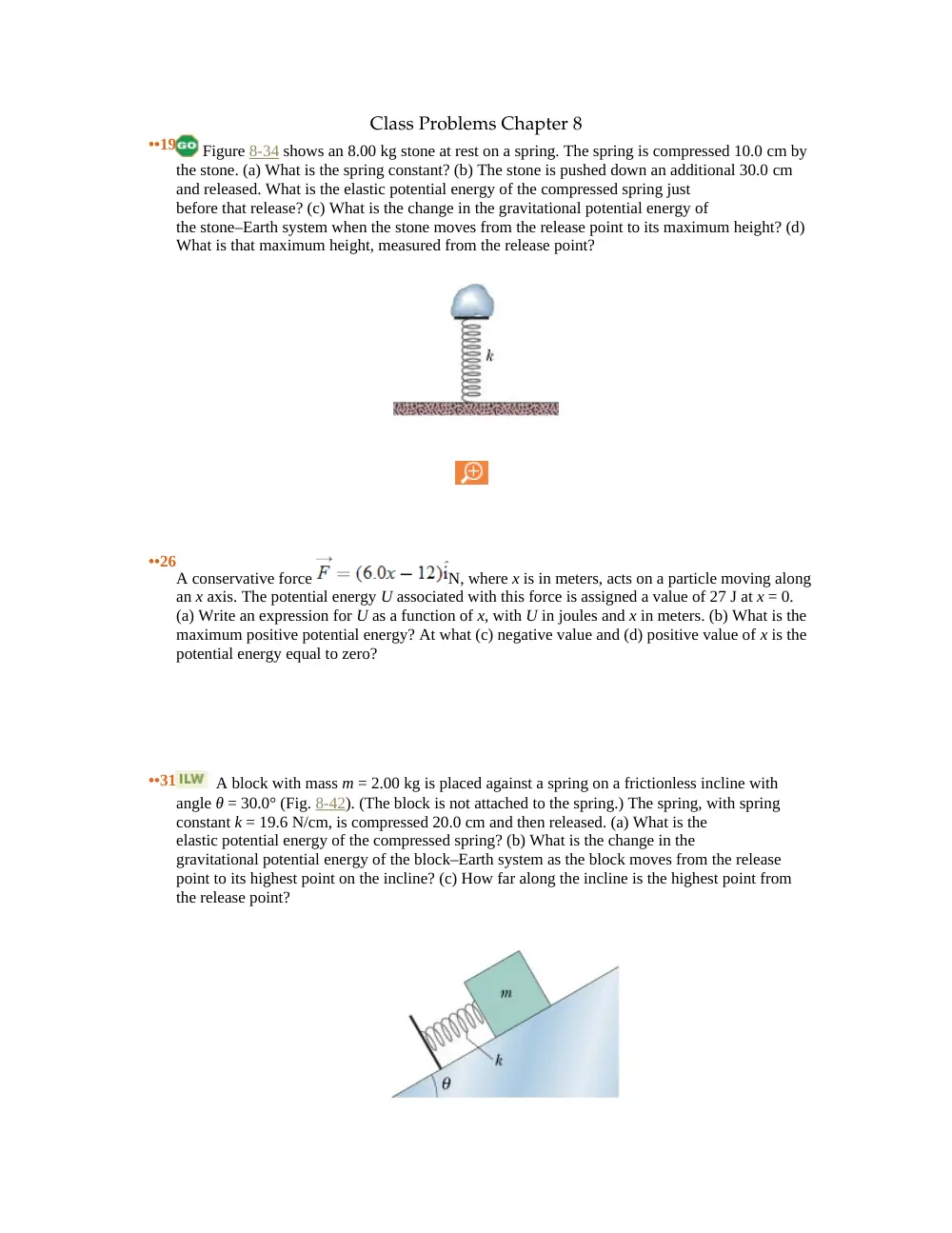
Figure 8-34 shows an 8.00 kg stone at rest on a spring. The spring is compressed 10.0 cm by
the stone. (a) What is the spring constant? (b) The stone is pushed down an additional 30.0 cm
and released. What is the elastic potential energy of the compressed spring just
before that release? (c) What is the change in the gravitational potential energy of
the stone–Earth system when the stone moves from the release point to its maximum height? (d)
What is that maximum height, measured from the release point?
••26
A conservative force
N, where x is in meters, acts on a particle moving along
an x axis. The potential energy U associated with this force is assigned a value of 27 J at x = 0.
(a) Write an expression for U as a function of x, with U in joules and x in meters. (b) What is the
maximum positive potential energy? At what (c) negative value and (d) positive value of x is the
potential energy equal to zero?
••31
A block with mass m = 2.00 kg is placed against a spring on a frictionless incline with
angle θ = 30.0° (Fig. 8-42). (The block is not attached to the spring.) The spring, with spring
constant k = 19.6 N/cm, is compressed 20.0 cm and then released. (a) What is the
elastic potential energy of the compressed spring? (b) What is the change in the
gravitational potential energy of the block–Earth system as the block moves from the release
point to its highest point on the incline? (c) How far along the incline is the highest point from
the release point?
Figure 8-42
Problem 31.
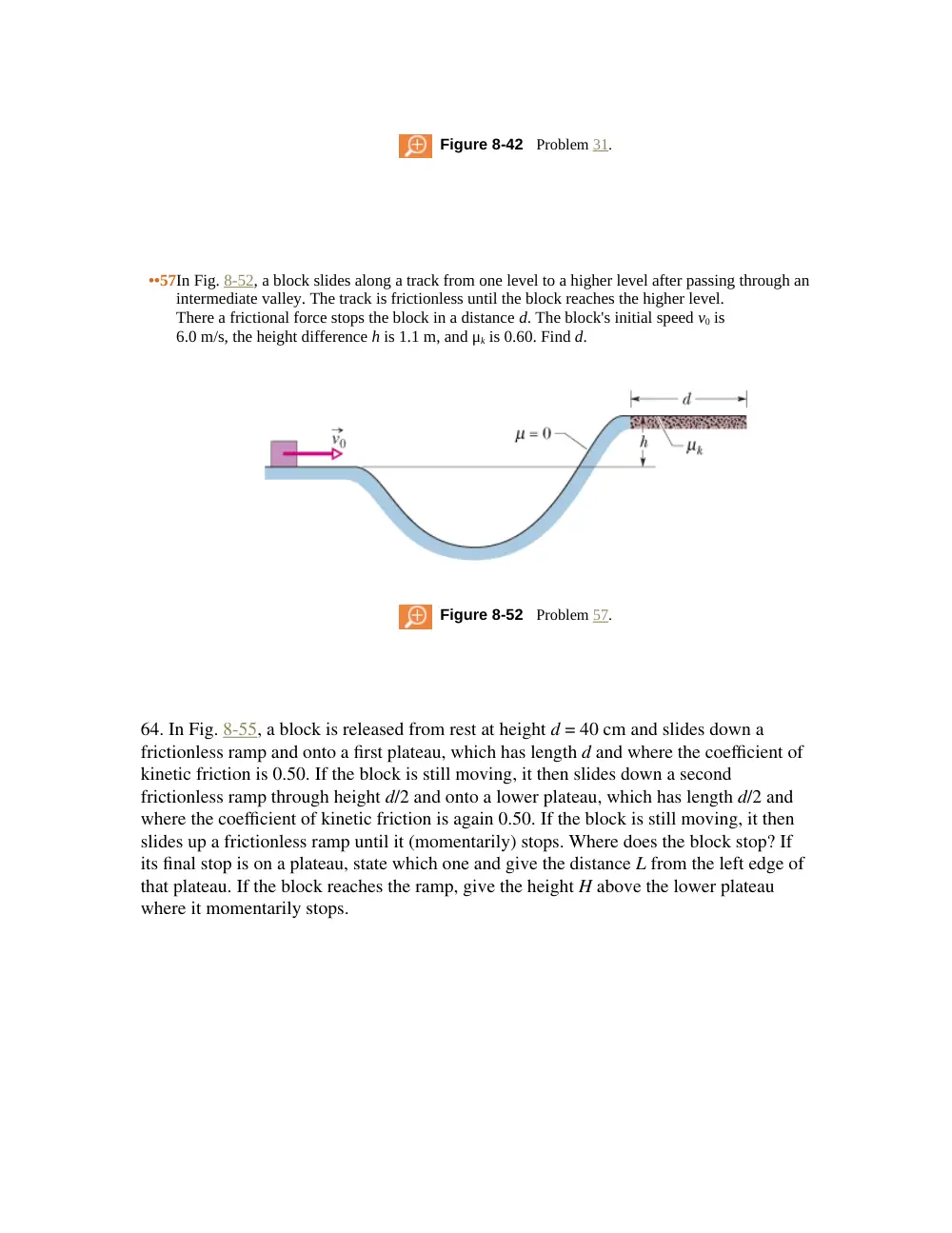
••57In Fig. 8-52, a block slides along a track from one level to a higher level after passing through an
intermediate valley. The track is frictionless until the block reaches the higher level.
There a frictional force stops the block in a distance d. The block's initial speed v0 is
6.0 m/s, the height difference h is 1.1 m, and μk is 0.60. Find d.
Figure 8-52
Problem 57.
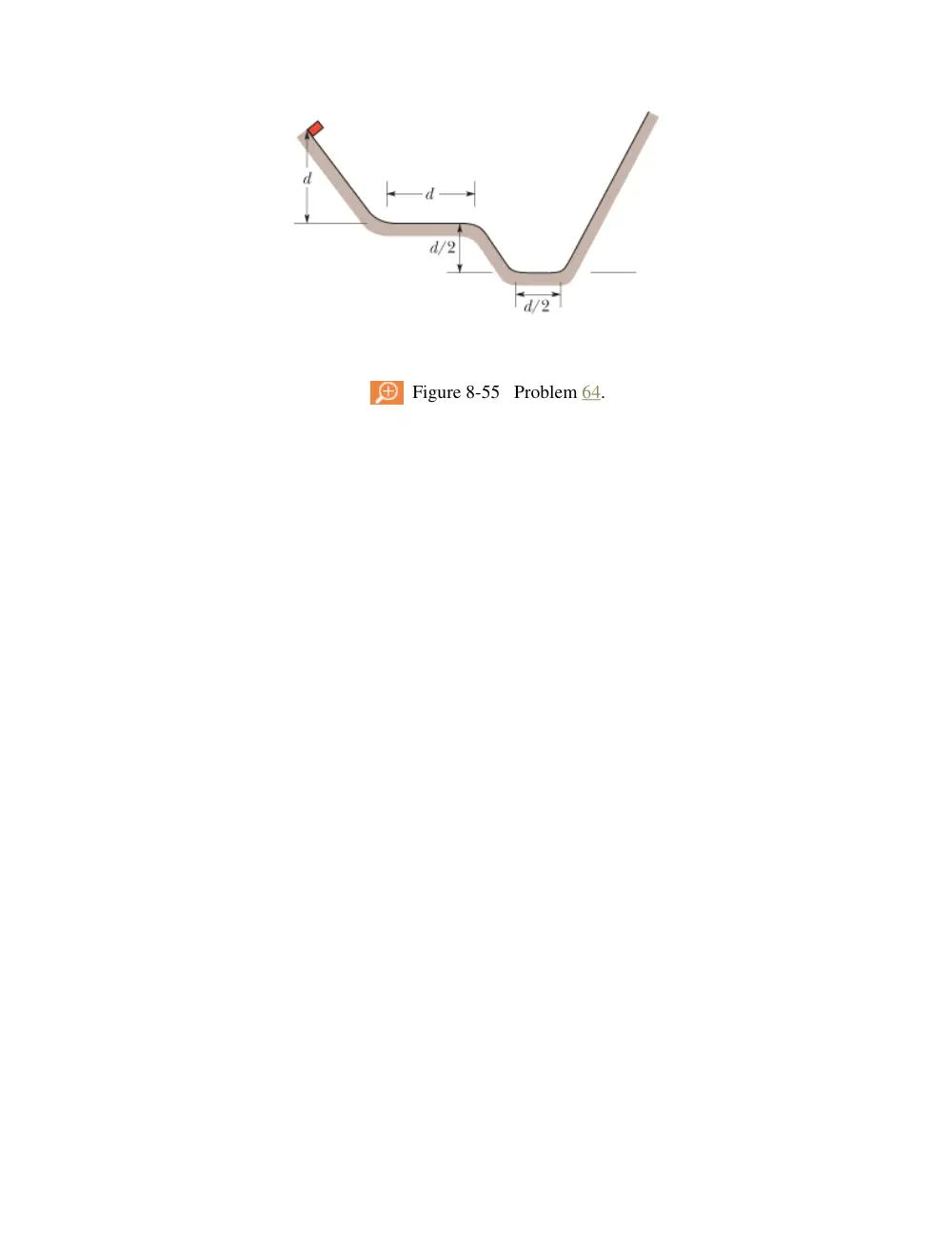
64. In Fig. 8-55, a block is released from rest at height d = 40 cm and slides down a
frictionless ramp and onto a first plateau, which has length d and where the coefficient of
kinetic friction is 0.50. If the block is still moving, it then slides down a second
frictionless ramp through height d/2 and onto a lower plateau, which has length d/2 and
where the coefficient of kinetic friction is again 0.50. If the block is still moving, it then
slides up a frictionless ramp until it (momentarily) stops. Where does the block stop? If
its final stop is on a plateau, state which one and give the distance L from the left edge of
that plateau. If the block reaches the ramp, give the height H above the lower plateau
where it momentarily stops.
Figure 8-55 Problem 64.