
PHYS 210 Problems Chapter 5, Fall 2015
American University of Beirut · Introductory Physics II · 3 pages
More PHYS 210 files
Show the text of this chapter
Chapter V
Class problems Solution
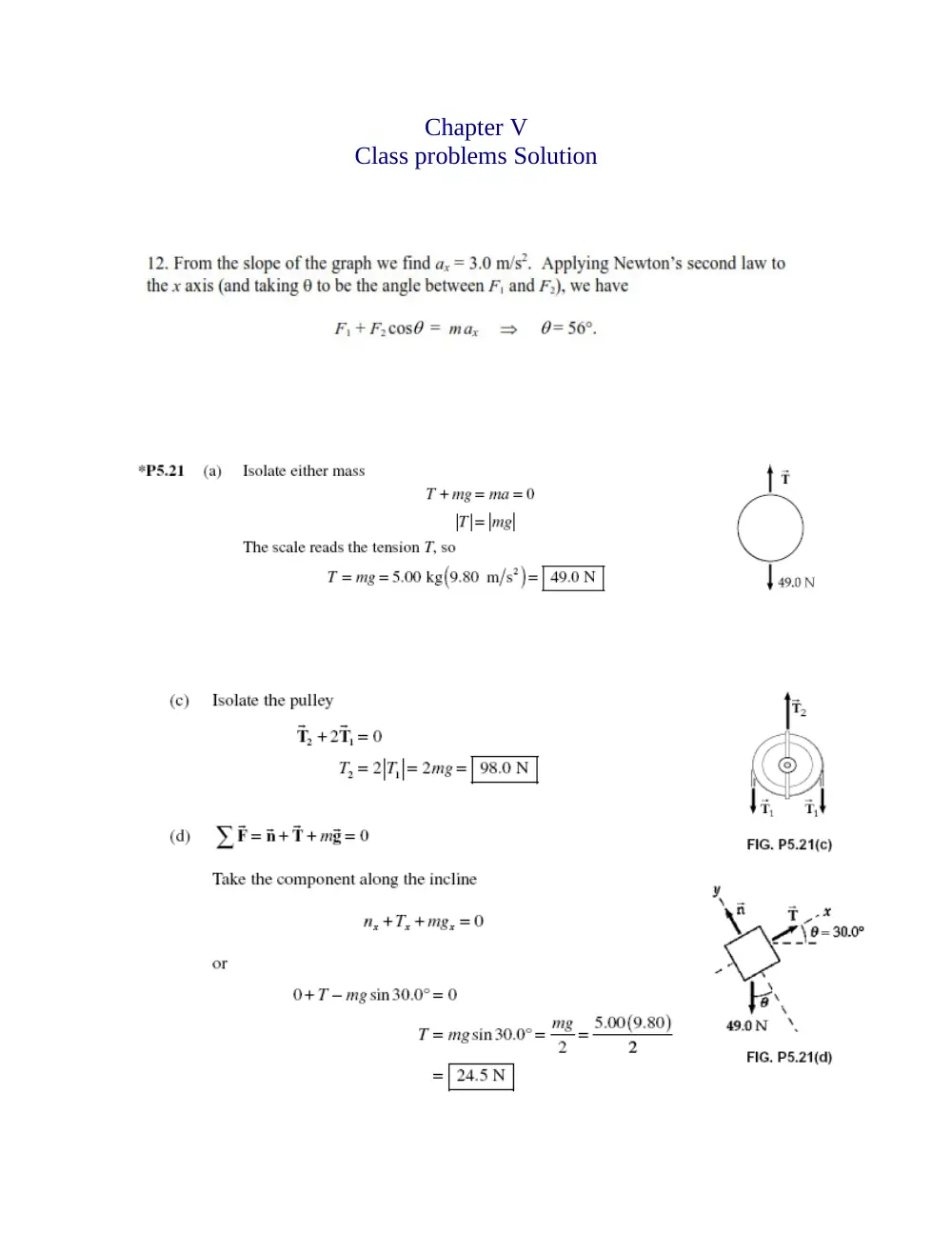
12. From the slope of the graph we find a, = 3.0 m/s". Applying Newton’s second law to
the x axis (and taking 6 to be the angle between F; and F;), we have
F,+F,cos0= ma, => 0@0=56°.
*P5.21 (a) Isolate either mass f ;
T+mg=ma=0 >
\T|= |mg| C)
The scale reads the tension T, so
T =mg=5.00 kg(9.80 m/s?)=]49.0N | oon
(c) Isolate the pulley |F
T,+27,=0 Ar
T, = 2|T,|= 2mg =| 98.0 N
NTL
hin Gt
(d) \F=i+T+mg=0 FIG. P5.24(c}
Take the component along the incline
4 =
neem N ao 0=30.0°
or
0+T—-—mgsin30.0°= 0 bas
5.00(9.80 ‘
T = mesin30.0° = = a 490N ,
FIG. P5.21(d)
=| 24.5N
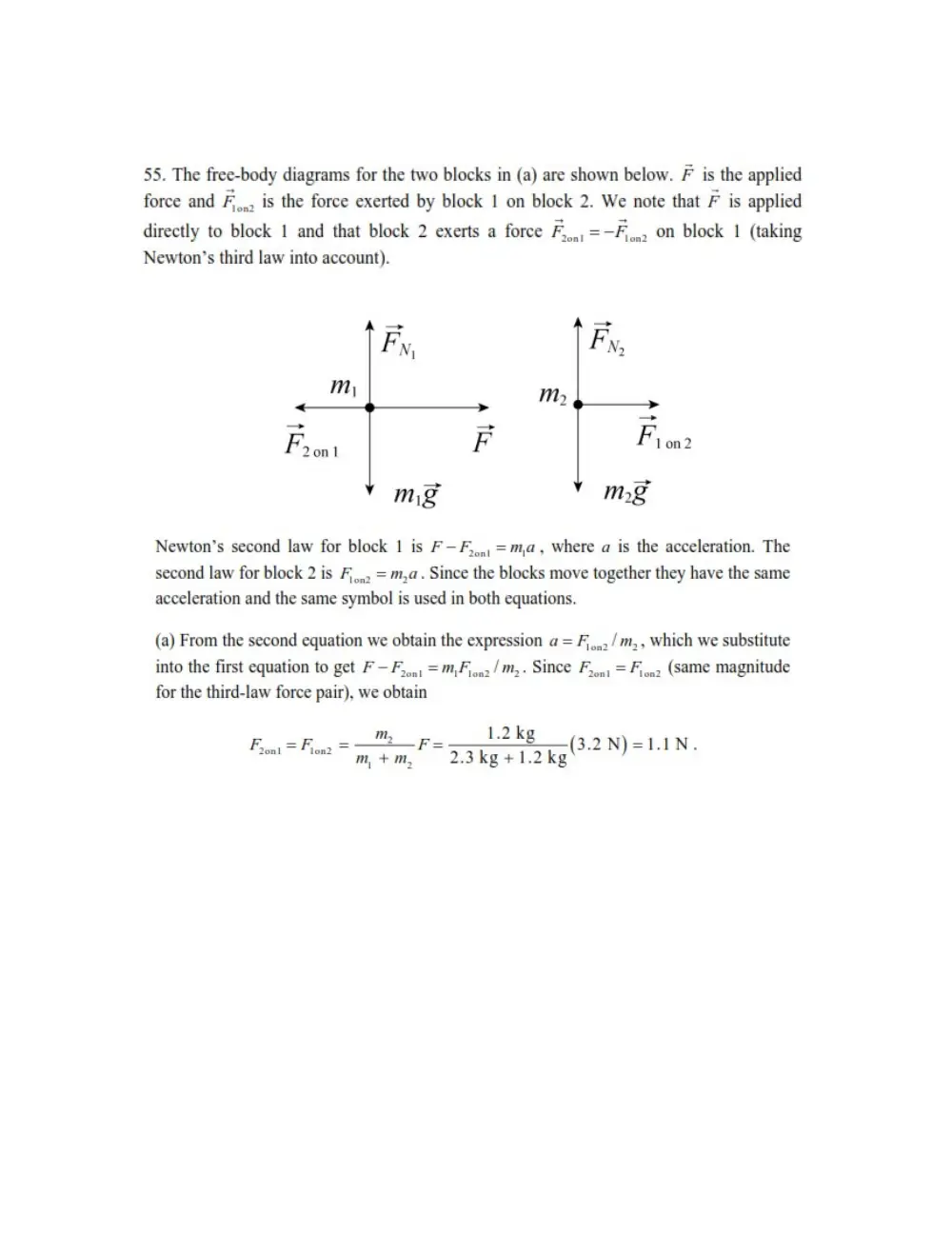
55. The free-body diagrams for the two blocks in (a) are shown below. F is the applied
force and Fee, is the force exerted by block | on block 2. We note that F is applied
directly to block 1 and that block 2 exerts a force F. -F_,, on block | (taking
Newton’s third law into account).
onl — ond
Newton’s second law for block | is F—F,
2onl
=m, where a is the acceleration. The
second law for block 2 is F,,,, =m,a. Since the blocks move together they have the same
acceleration and the same symbol is used in both equations.
(a) From the second equation we obtain the expression a = F,,,, /m,, which we substitute
into the first equation to get F—F,,,, =m,F,,,,/m,. Since F,,,, =F,,,. (same magnitude
for the third-law force pair), we obtain
_ 1.2kg
m+m, 2.3kg+1.2kg
iI
P|
TT
o
(3.2 N)=1.1N.
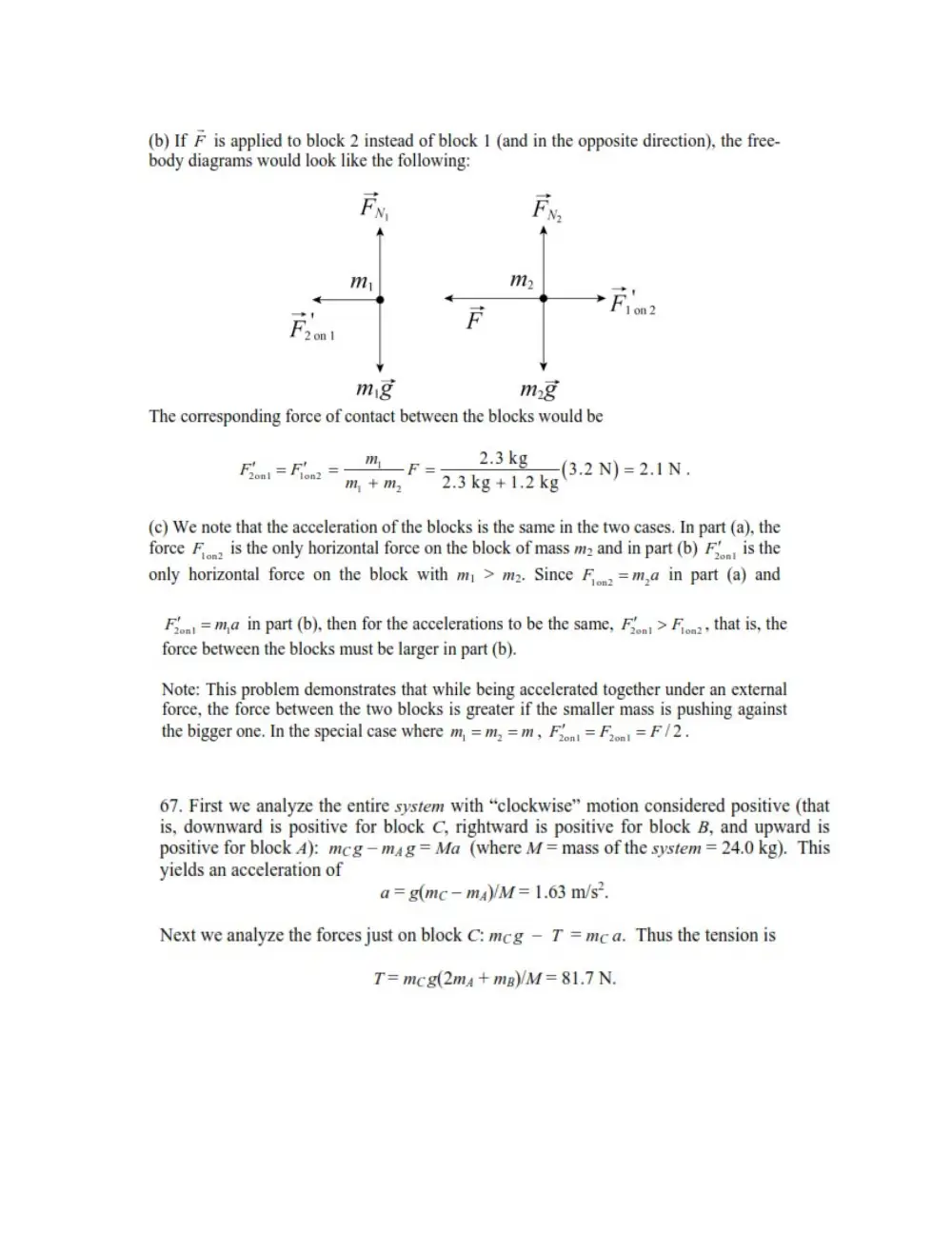
(b) If F is applied to block 2 instead of block 1 (and in the opposite direction), the free-
body diagrams would look like the following:
Fy, Fy,
m, mM, =,
bi — F, on2
F, on | F
mg mg
The corresponding force of contact between the blocks would be
2
i. =f.=—a—F 2355 (3.2 N)=2.1N.
ton? mm, +m, 2.3 kg + 1.2kg
(c) We note that the acceleration of the blocks is the same in the two cases. In part (a), the
force F,,_, is the only horizontal force on the block of mass m, and in part (b) Fy, is the
only horizontal force on the block with m, > m2. Since F,,.,=m,a in part (a) and
Fj,,, = ma in part (b), then for the accelerations to be the same, Fy, > F,,,2- that is, the
force between the blocks must be larger in part (b).
Note: This problem demonstrates that while being accelerated together under an external
force, the force between the two blocks is greater if the smaller mass is pushing against
the bigger one. In the special case where m, =m, =m, Fj,,, = Fy,,, =F /2-
67. First we analyze the entire system with “clockwise” motion considered positive (that
is, downward is positive for block C, rightward is positive for block B, and upward is
positive for block 4): meg—m4g= Ma (where M= mass of the system = 24.0 kg). This
yields an acceleration of
a=g(mc — my)(M= 1.63 m/s’.
Next we analyze the forces just on block C: mcg — T =mca. Thus the tension is
T= mcg(2my+ mgVM=81.7N.