
PSYC 201 Questions Chapter 2, Fall 2015
American University of Beirut · Psyc-201 · 55 pages
Showing the first 10 of 55 pages. Download the PDF to see all of it.
More PSYC 201 files
- Chapter 12 · Spring 2018ChapterView
- Chapter 13 · Spring 2018ChapterView
- Chapter 15 · Spring 2018ChapterView
- Chapter 17 · Spring 2018ChapterView
- Questions Chapter 2 Test Bank · Spring 2017ChapterView
- Questions Chapter 1 Test Bank · Spring 2017ChapterView
- Problems Chapter 7 · Summer 2016ChapterView
- Questions Chapter 10 · Spring 2015ChapterView
Show the text of this chapter
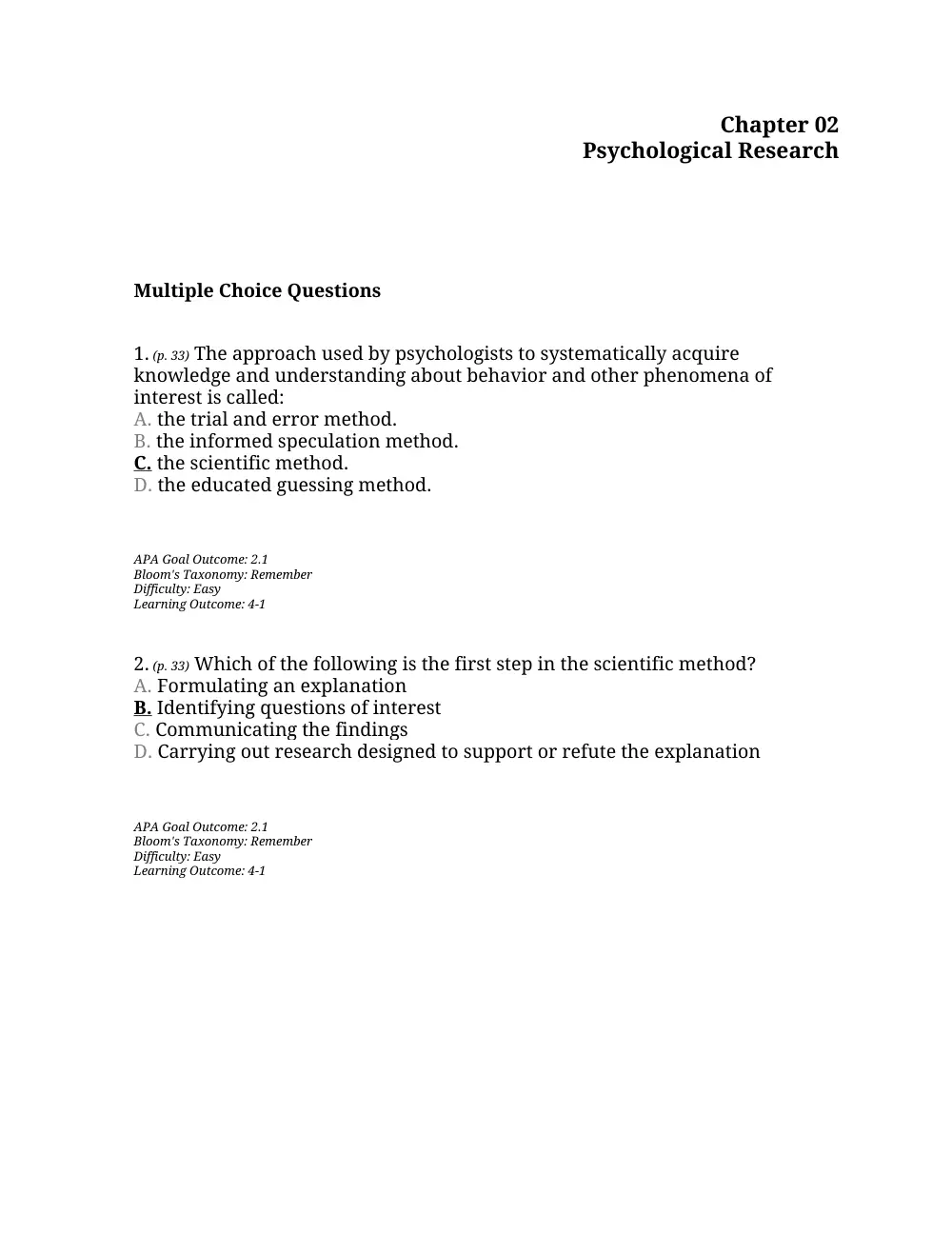
Chapter 02
Psychological Research
Multiple Choice Questions
1. (p. 33) The approach used by psychologists to systematically acquire
knowledge and understanding about behavior and other phenomena of
interest is called:
A. the trial and error method.
B. the informed speculation method.
C. the scientific method.
D. the educated guessing method.
APA Goal Outcome: 2.1
Bloom's Taxonomy: Remember
Difficulty: Easy
Learning Outcome: 4-1
2. (p. 33) Which of the following is the first step in the scientific method?
A. Formulating an explanation
B. Identifying questions of interest
C. Communicating the findings
D. Carrying out research designed to support or refute the explanation
APA Goal Outcome: 2.1
Bloom's Taxonomy: Remember
Difficulty: Easy
Learning Outcome: 4-1
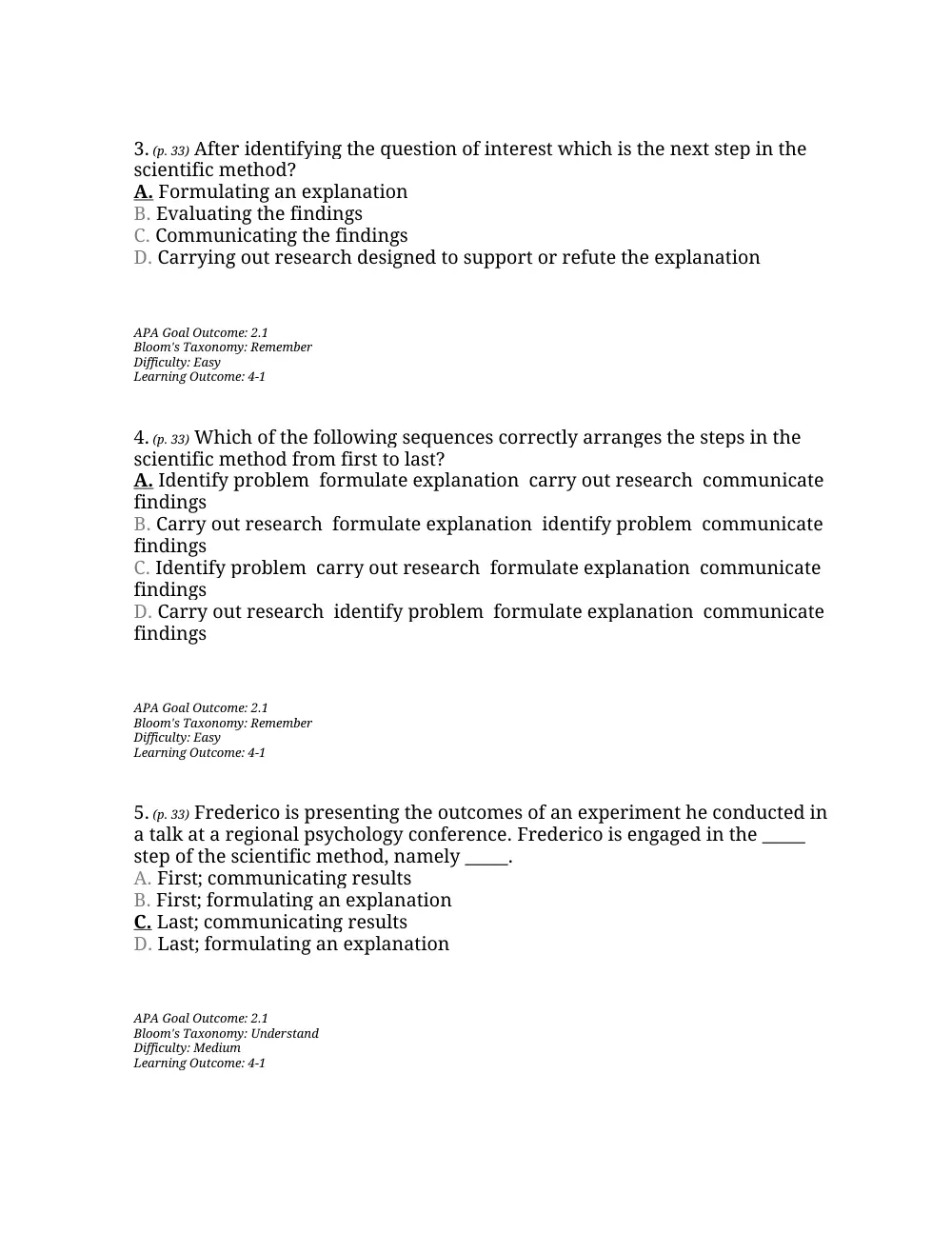
3. (p. 33) After identifying the question of interest which is the next step in the
scientific method?
A. Formulating an explanation
B. Evaluating the findings
C. Communicating the findings
D. Carrying out research designed to support or refute the explanation
APA Goal Outcome: 2.1
Bloom's Taxonomy: Remember
Difficulty: Easy
Learning Outcome: 4-1
4. (p. 33) Which of the following sequences correctly arranges the steps in the
scientific method from first to last?
A. Identify problem formulate explanation carry out research communicate
findings
B. Carry out research formulate explanation identify problem communicate
findings
C. Identify problem carry out research formulate explanation communicate
findings
D. Carry out research identify problem formulate explanation communicate
findings
APA Goal Outcome: 2.1
Bloom's Taxonomy: Remember
Difficulty: Easy
Learning Outcome: 4-1
5. (p. 33) Frederico is presenting the outcomes of an experiment he conducted in
a talk at a regional psychology conference. Frederico is engaged in the _____
step of the scientific method, namely _____.
A. First; communicating results
B. First; formulating an explanation
C. Last; communicating results
D. Last; formulating an explanation
APA Goal Outcome: 2.1
Bloom's Taxonomy: Understand
Difficulty: Medium
Learning Outcome: 4-1
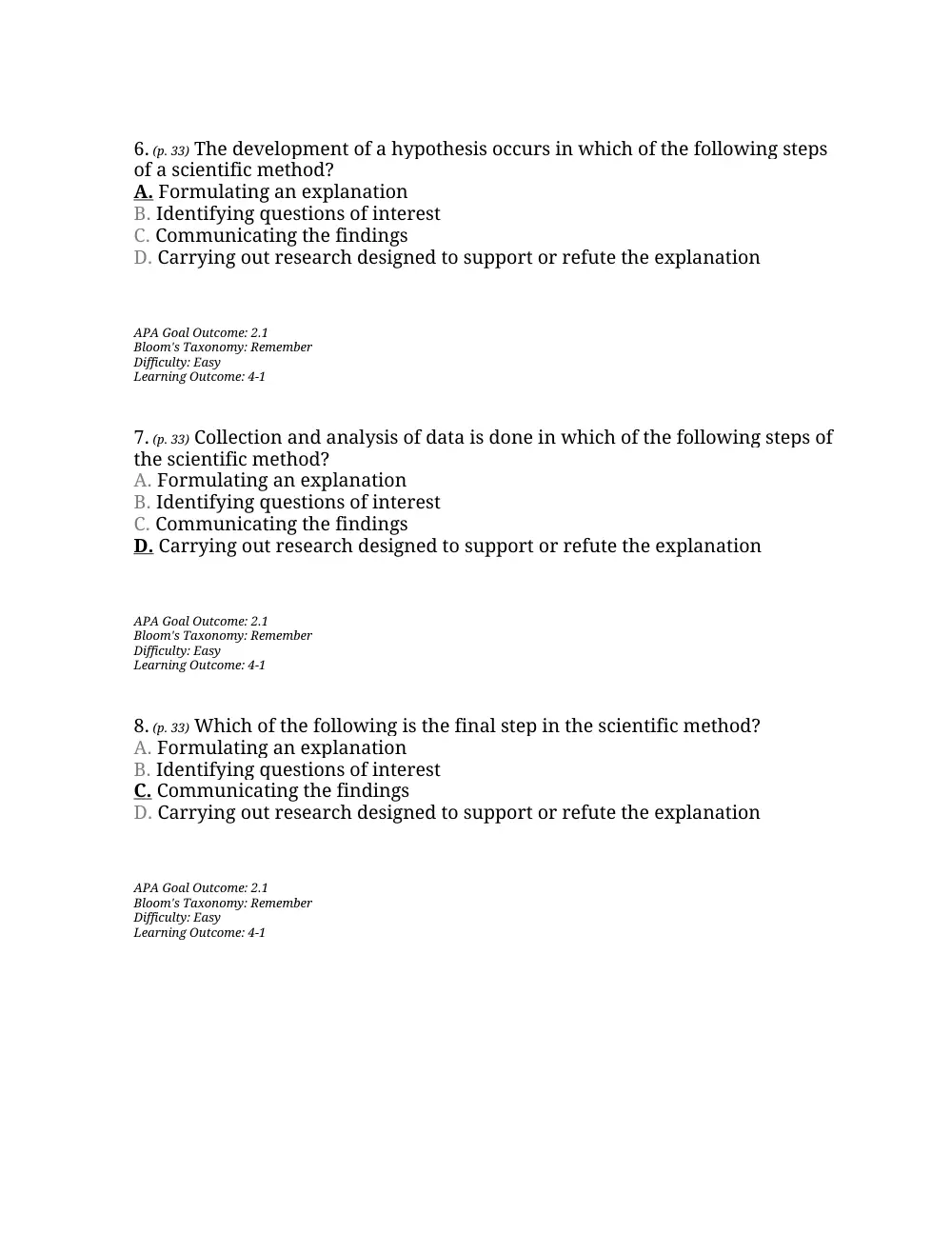
6. (p. 33) The development of a hypothesis occurs in which of the following steps
of a scientific method?
A. Formulating an explanation
B. Identifying questions of interest
C. Communicating the findings
D. Carrying out research designed to support or refute the explanation
APA Goal Outcome: 2.1
Bloom's Taxonomy: Remember
Difficulty: Easy
Learning Outcome: 4-1
7. (p. 33) Collection and analysis of data is done in which of the following steps of
the scientific method?
A. Formulating an explanation
B. Identifying questions of interest
C. Communicating the findings
D. Carrying out research designed to support or refute the explanation
APA Goal Outcome: 2.1
Bloom's Taxonomy: Remember
Difficulty: Easy
Learning Outcome: 4-1
8. (p. 33) Which of the following is the final step in the scientific method?
A. Formulating an explanation
B. Identifying questions of interest
C. Communicating the findings
D. Carrying out research designed to support or refute the explanation
APA Goal Outcome: 2.1
Bloom's Taxonomy: Remember
Difficulty: Easy
Learning Outcome: 4-1
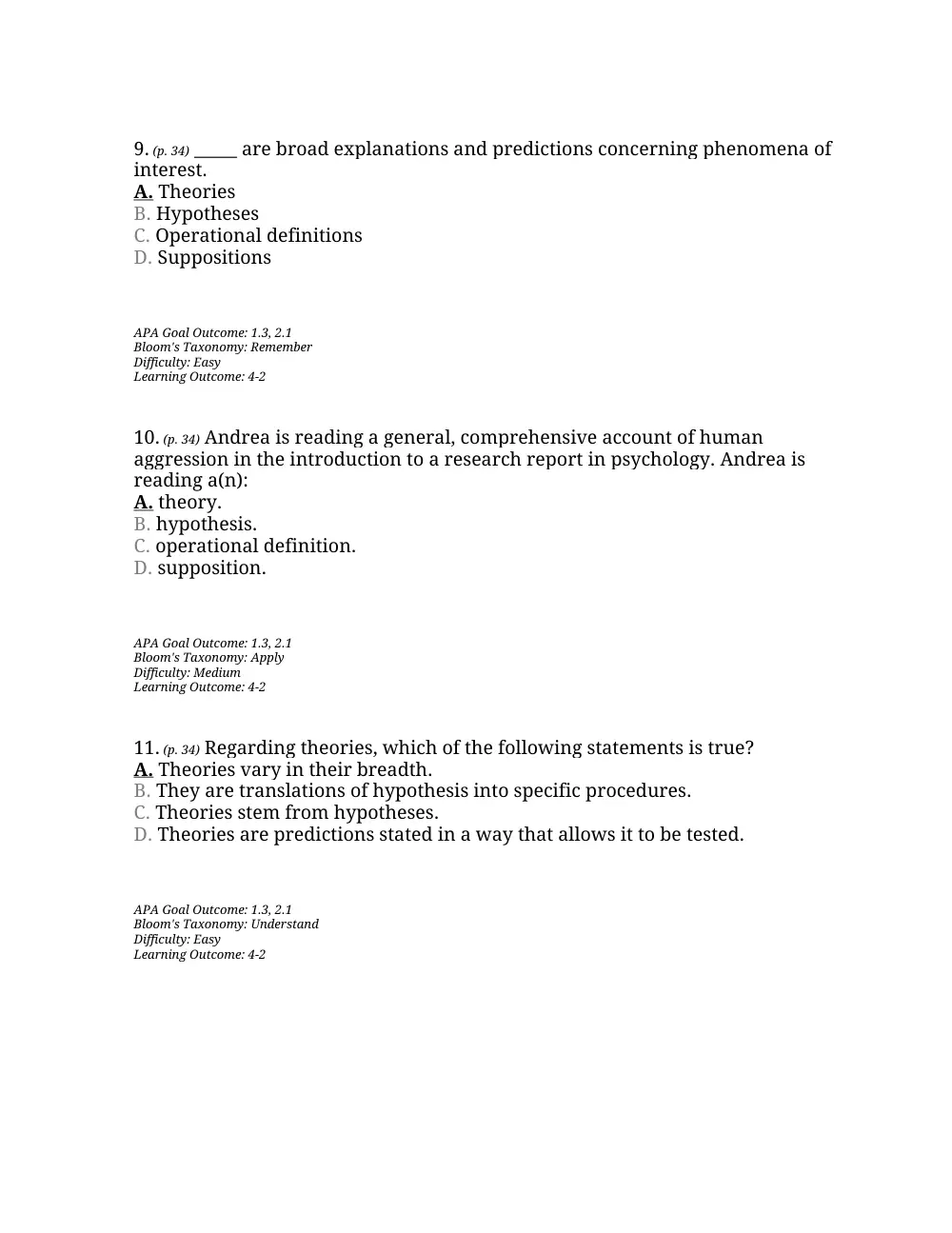
9. (p. 34) _____ are broad explanations and predictions concerning phenomena of
interest.
A. Theories
B. Hypotheses
C. Operational definitions
D. Suppositions
APA Goal Outcome: 1.3, 2.1
Bloom's Taxonomy: Remember
Difficulty: Easy
Learning Outcome: 4-2
10. (p. 34) Andrea is reading a general, comprehensive account of human
aggression in the introduction to a research report in psychology. Andrea is
reading a(n):
A. theory.
B. hypothesis.
C. operational definition.
D. supposition.
APA Goal Outcome: 1.3, 2.1
Bloom's Taxonomy: Apply
Difficulty: Medium
Learning Outcome: 4-2
11. (p. 34) Regarding theories, which of the following statements is true?
A. Theories vary in their breadth.
B. They are translations of hypothesis into specific procedures.
C. Theories stem from hypotheses.
D. Theories are predictions stated in a way that allows it to be tested.
APA Goal Outcome: 1.3, 2.1
Bloom's Taxonomy: Understand
Difficulty: Easy
Learning Outcome: 4-2
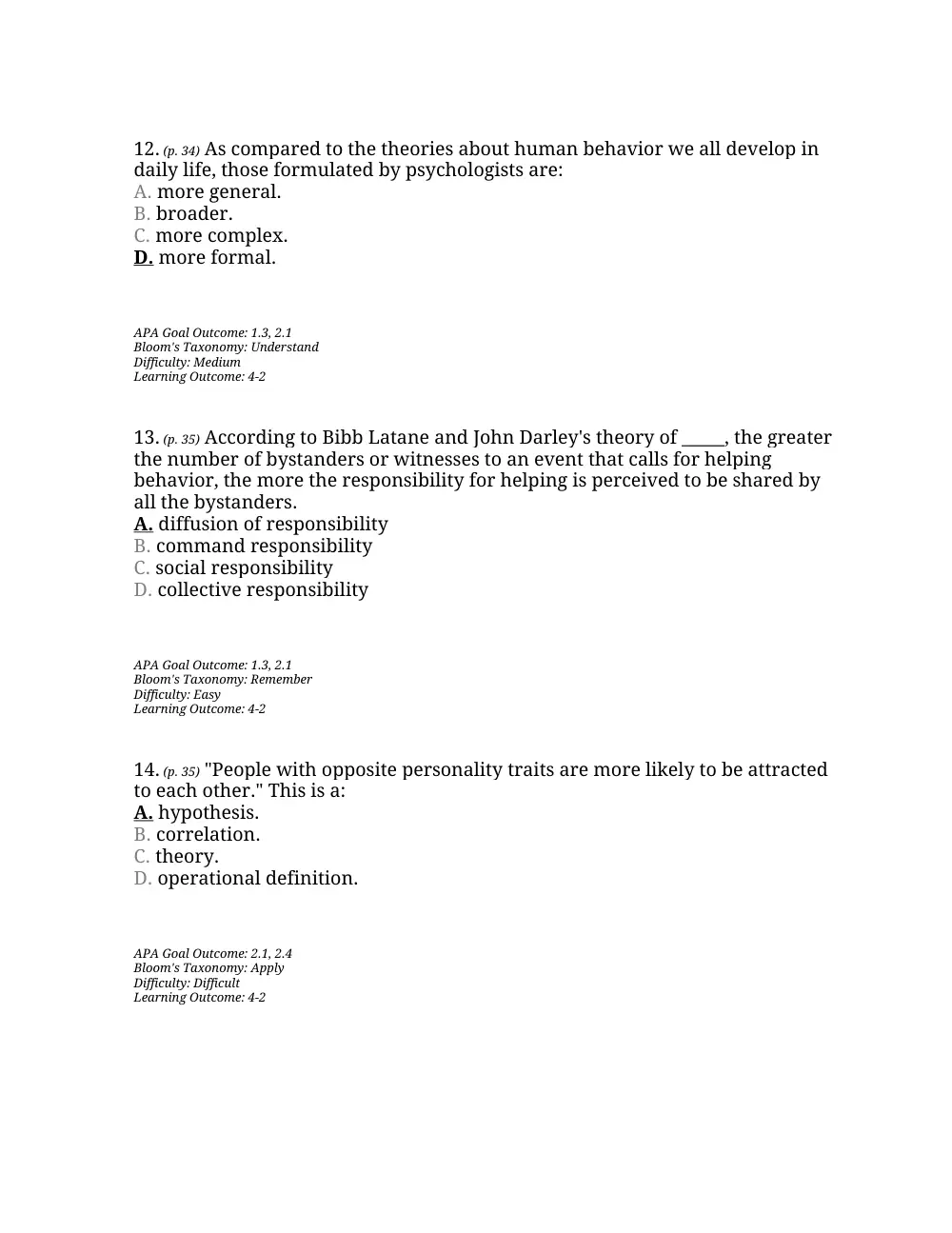
12. (p. 34) As compared to the theories about human behavior we all develop in
daily life, those formulated by psychologists are:
A. more general.
B. broader.
C. more complex.
D. more formal.
APA Goal Outcome: 1.3, 2.1
Bloom's Taxonomy: Understand
Difficulty: Medium
Learning Outcome: 4-2
13. (p. 35) According to Bibb Latane and John Darley's theory of _____, the greater
the number of bystanders or witnesses to an event that calls for helping
behavior, the more the responsibility for helping is perceived to be shared by
all the bystanders.
A. diffusion of responsibility
B. command responsibility
C. social responsibility
D. collective responsibility
APA Goal Outcome: 1.3, 2.1
Bloom's Taxonomy: Remember
Difficulty: Easy
Learning Outcome: 4-2
14. (p. 35) "People with opposite personality traits are more likely to be attracted
to each other." This is a:
A. hypothesis.
B. correlation.
C. theory.
D. operational definition.
APA Goal Outcome: 2.1, 2.4
Bloom's Taxonomy: Apply
Difficulty: Difficult
Learning Outcome: 4-2
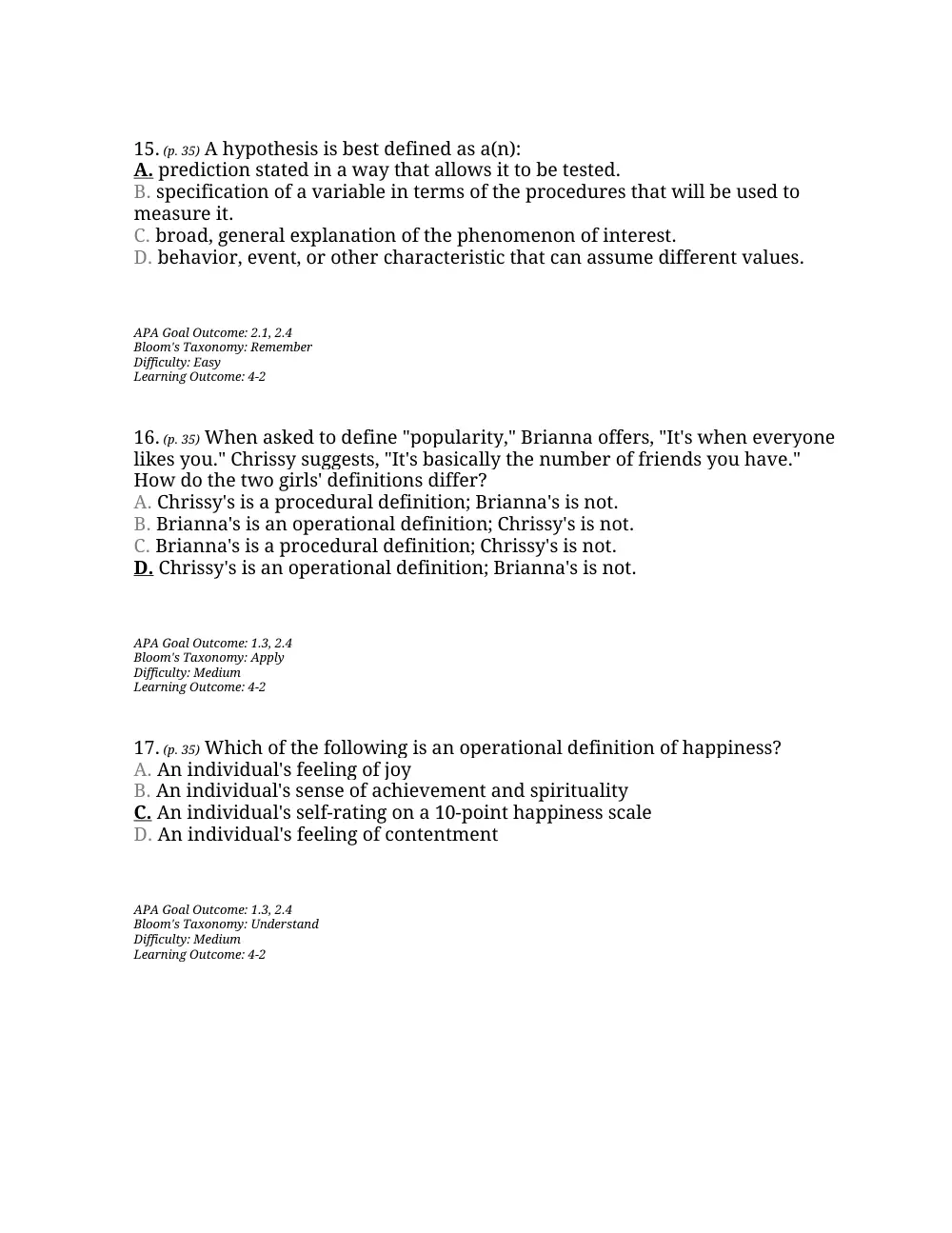
15. (p. 35) A hypothesis is best defined as a(n):
A. prediction stated in a way that allows it to be tested.
B. specification of a variable in terms of the procedures that will be used to
measure it.
C. broad, general explanation of the phenomenon of interest.
D. behavior, event, or other characteristic that can assume different values.
APA Goal Outcome: 2.1, 2.4
Bloom's Taxonomy: Remember
Difficulty: Easy
Learning Outcome: 4-2
16. (p. 35) When asked to define "popularity," Brianna offers, "It's when everyone
likes you." Chrissy suggests, "It's basically the number of friends you have."
How do the two girls' definitions differ?
A. Chrissy's is a procedural definition; Brianna's is not.
B. Brianna's is an operational definition; Chrissy's is not.
C. Brianna's is a procedural definition; Chrissy's is not.
D. Chrissy's is an operational definition; Brianna's is not.
APA Goal Outcome: 1.3, 2.4
Bloom's Taxonomy: Apply
Difficulty: Medium
Learning Outcome: 4-2
17. (p. 35) Which of the following is an operational definition of happiness?
A. An individual's feeling of joy
B. An individual's sense of achievement and spirituality
C. An individual's self-rating on a 10-point happiness scale
D. An individual's feeling of contentment
APA Goal Outcome: 1.3, 2.4
Bloom's Taxonomy: Understand
Difficulty: Medium
Learning Outcome: 4-2
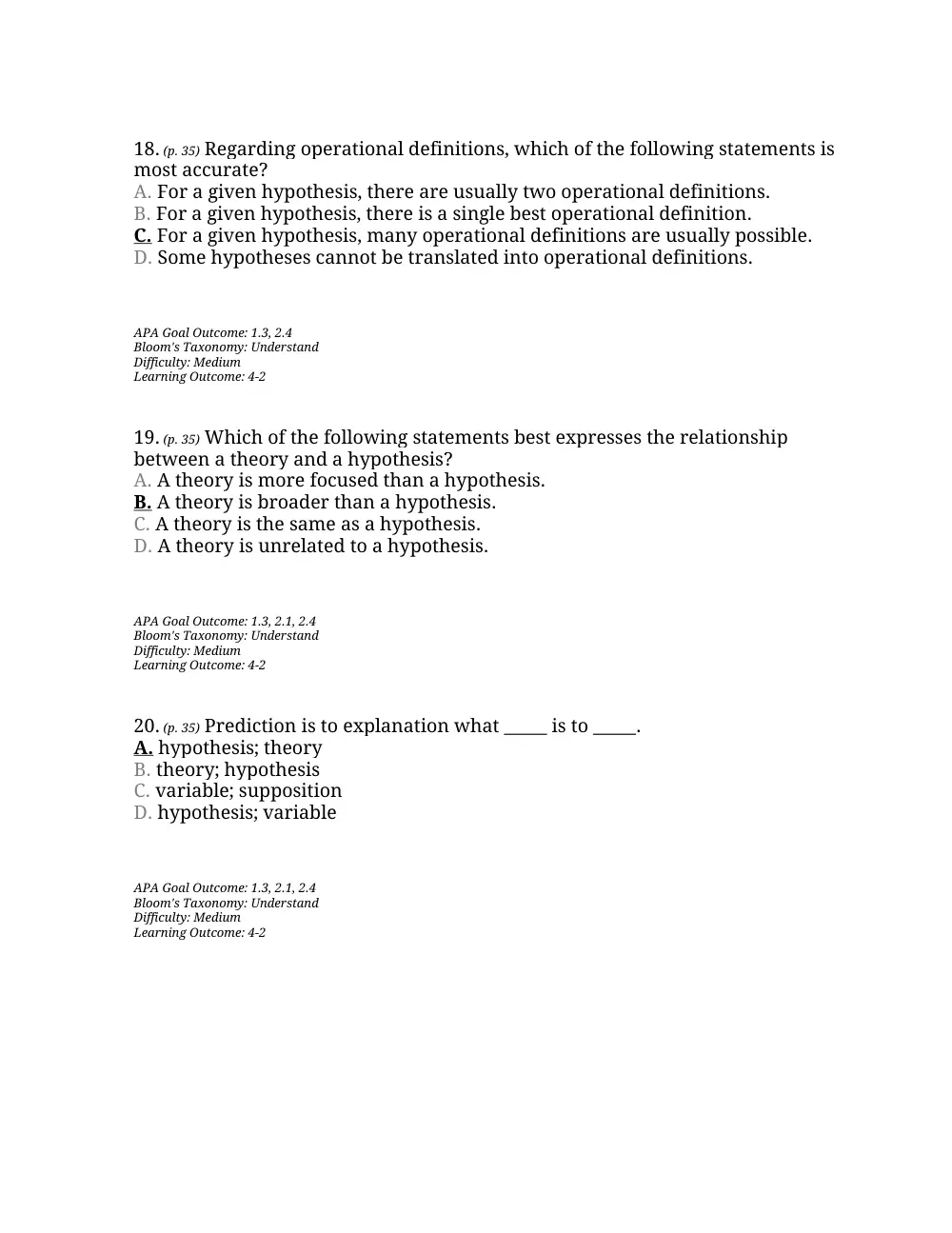
18. (p. 35) Regarding operational definitions, which of the following statements is
most accurate?
A. For a given hypothesis, there are usually two operational definitions.
B. For a given hypothesis, there is a single best operational definition.
C. For a given hypothesis, many operational definitions are usually possible.
D. Some hypotheses cannot be translated into operational definitions.
APA Goal Outcome: 1.3, 2.4
Bloom's Taxonomy: Understand
Difficulty: Medium
Learning Outcome: 4-2
19. (p. 35) Which of the following statements best expresses the relationship
between a theory and a hypothesis?
A. A theory is more focused than a hypothesis.
B. A theory is broader than a hypothesis.
C. A theory is the same as a hypothesis.
D. A theory is unrelated to a hypothesis.
APA Goal Outcome: 1.3, 2.1, 2.4
Bloom's Taxonomy: Understand
Difficulty: Medium
Learning Outcome: 4-2
20. (p. 35) Prediction is to explanation what _____ is to _____.
A. hypothesis; theory
B. theory; hypothesis
C. variable; supposition
D. hypothesis; variable
APA Goal Outcome: 1.3, 2.1, 2.4
Bloom's Taxonomy: Understand
Difficulty: Medium
Learning Outcome: 4-2
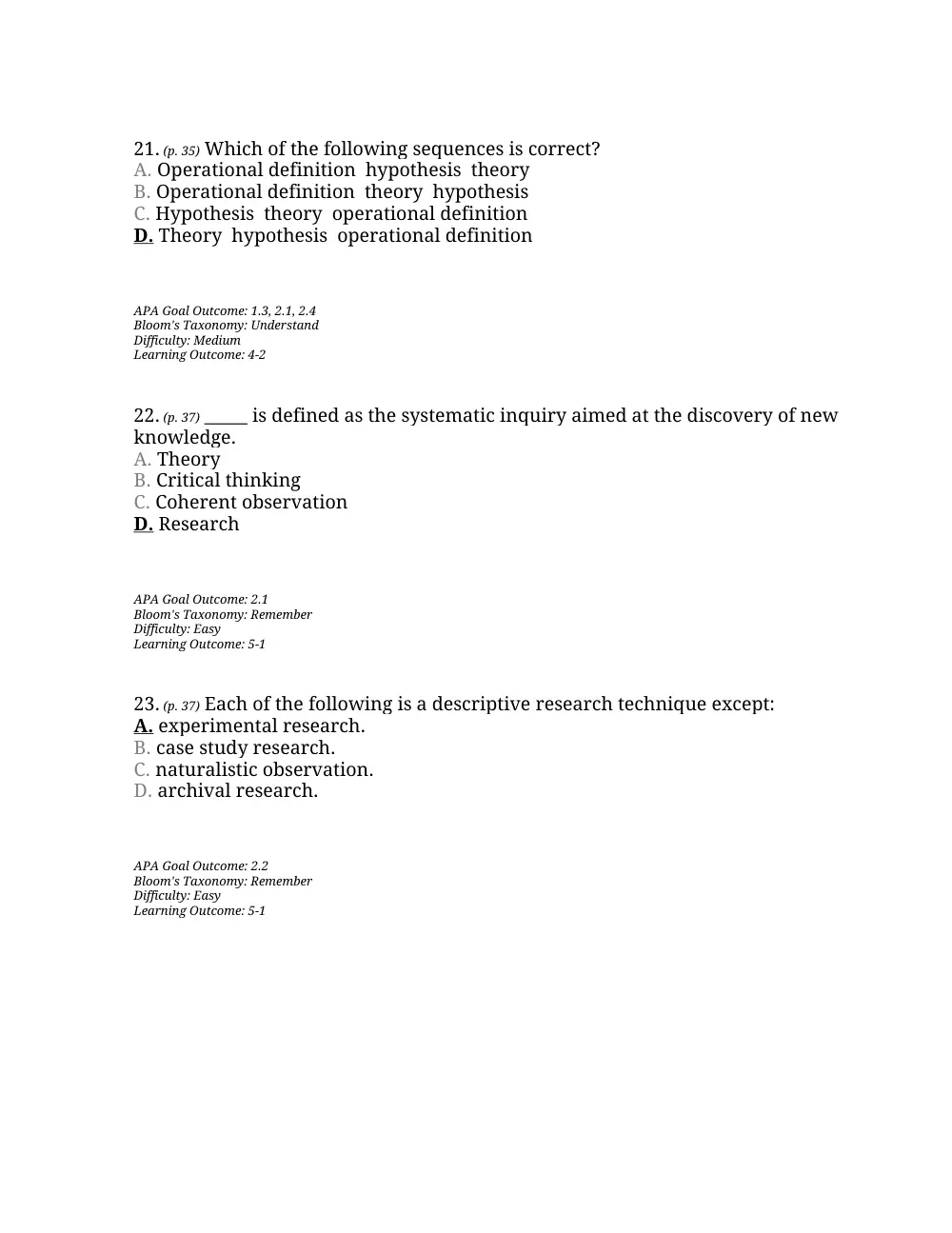
21. (p. 35) Which of the following sequences is correct?
A. Operational definition hypothesis theory
B. Operational definition theory hypothesis
C. Hypothesis theory operational definition
D. Theory hypothesis operational definition
APA Goal Outcome: 1.3, 2.1, 2.4
Bloom's Taxonomy: Understand
Difficulty: Medium
Learning Outcome: 4-2
22. (p. 37) _____ is defined as the systematic inquiry aimed at the discovery of new
knowledge.
A. Theory
B. Critical thinking
C. Coherent observation
D. Research
APA Goal Outcome: 2.1
Bloom's Taxonomy: Remember
Difficulty: Easy
Learning Outcome: 5-1
23. (p. 37) Each of the following is a descriptive research technique except:
A. experimental research.
B. case study research.
C. naturalistic observation.
D. archival research.
APA Goal Outcome: 2.2
Bloom's Taxonomy: Remember
Difficulty: Easy
Learning Outcome: 5-1
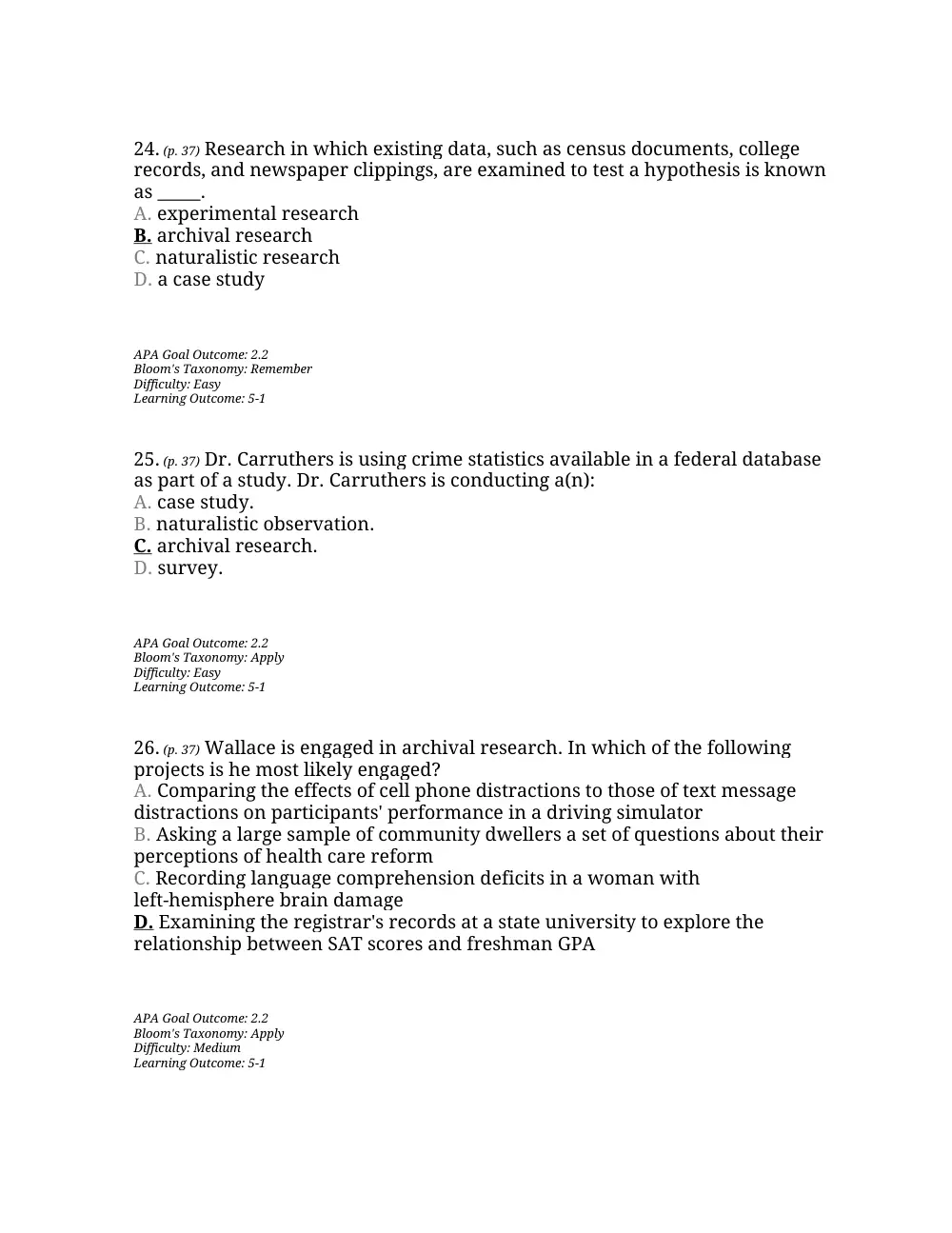
24. (p. 37) Research in which existing data, such as census documents, college
records, and newspaper clippings, are examined to test a hypothesis is known
as _____.
A. experimental research
B. archival research
C. naturalistic research
D. a case study
APA Goal Outcome: 2.2
Bloom's Taxonomy: Remember
Difficulty: Easy
Learning Outcome: 5-1
25. (p. 37) Dr. Carruthers is using crime statistics available in a federal database
as part of a study. Dr. Carruthers is conducting a(n):
A. case study.
B. naturalistic observation.
C. archival research.
D. survey.
APA Goal Outcome: 2.2
Bloom's Taxonomy: Apply
Difficulty: Easy
Learning Outcome: 5-1
26. (p. 37) Wallace is engaged in archival research. In which of the following
projects is he most likely engaged?
A. Comparing the effects of cell phone distractions to those of text message
distractions on participants' performance in a driving simulator
B. Asking a large sample of community dwellers a set of questions about their
perceptions of health care reform
C. Recording language comprehension deficits in a woman with
left-hemisphere brain damage
D. Examining the registrar's records at a state university to explore the
relationship between SAT scores and freshman GPA
APA Goal Outcome: 2.2
Bloom's Taxonomy: Apply
Difficulty: Medium
Learning Outcome: 5-1
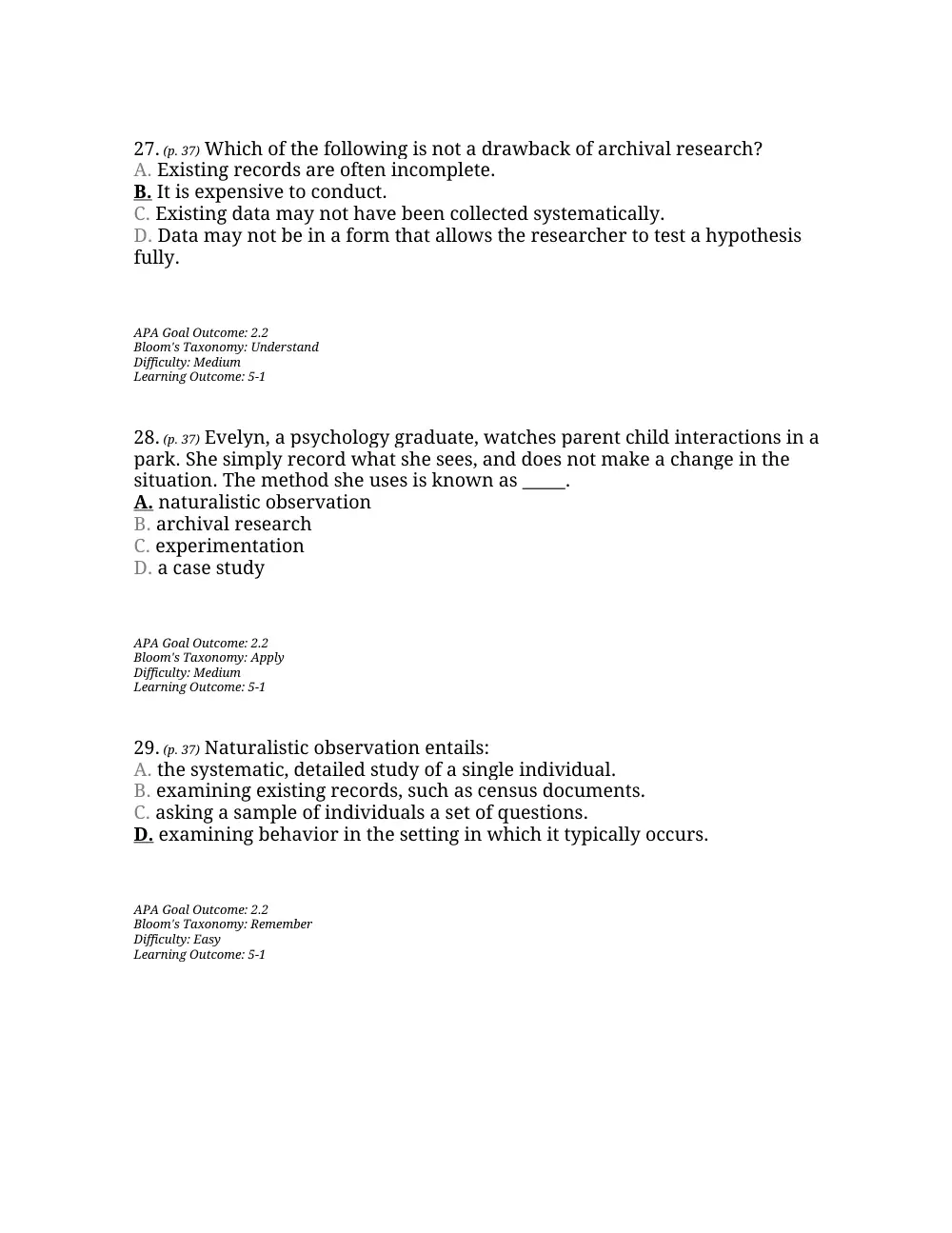
27. (p. 37) Which of the following is not a drawback of archival research?
A. Existing records are often incomplete.
B. It is expensive to conduct.
C. Existing data may not have been collected systematically.
D. Data may not be in a form that allows the researcher to test a hypothesis
fully.
APA Goal Outcome: 2.2
Bloom's Taxonomy: Understand
Difficulty: Medium
Learning Outcome: 5-1
28. (p. 37) Evelyn, a psychology graduate, watches parent child interactions in a
park. She simply record what she sees, and does not make a change in the
situation. The method she uses is known as _____.
A. naturalistic observation
B. archival research
C. experimentation
D. a case study
APA Goal Outcome: 2.2
Bloom's Taxonomy: Apply
Difficulty: Medium
Learning Outcome: 5-1
29. (p. 37) Naturalistic observation entails:
A. the systematic, detailed study of a single individual.
B. examining existing records, such as census documents.
C. asking a sample of individuals a set of questions.
D. examining behavior in the setting in which it typically occurs.
APA Goal Outcome: 2.2
Bloom's Taxonomy: Remember
Difficulty: Easy
Learning Outcome: 5-1
30. (p. 37) DeAndre is recording instances of physical aggression among children
in a schoolyard at recess. DeAndre is undertaking:
A. a naturalistic observation.
B. an archival research.
C. a survey.
D. a case study.
APA Goal Outcome: 2.2
Bloom's Taxonomy: Apply
Difficulty: Medium
Learning Outcome: 5-1
31. (p. 37) Brooke is engaged in naturalistic observation. In which of the
following projects is she most likely engaged?
A. Asking a sample of college students a set of questions about tendency to
become angry in different situations.
B. Watching and recording interactions between subordinates and their
supervisors in a large corporate office.
C. Conducting an in-depth investigation of the history and current behavior of
an autistic boy.
D. Examining crime statistics from the Department of Justice to see if the rate
of property crimes is related to the rate of violent crimes.
APA Goal Outcome: 2.2
Bloom's Taxonomy: Apply
Difficulty: Medium
Learning Outcome: 5-1
32. (p. 37-38) Which of the following descriptive research methods is correctly
matched with a description?
A. Archival research—in-depth investigation of an individual
B. Naturalistic observation—behavior is investigated in the environment in
which it typically occurs, without intervention by the researcher
C. Case study—a sample is asked a series of questions about their thoughts,
attitudes, or behaviors
D. Survey research—existing data is examined to test a hypothesis
APA Goal Outcome: 2.2
Bloom's Taxonomy: Understand
Difficulty: Easy
Learning Outcome: 5-1
33. (p. 37-38) Which of the following descriptive research methods is incorrectly
matched with an advantage?
A. Archival research—inexpensive
B. Naturalistic observation—examines behavior in the "real world"
C. Survey—small sample can give accurate picture of much larger population
D. Case study— it controls any of the factors of interest.
APA Goal Outcome: 2.2
Bloom's Taxonomy: Understand
Difficulty: Easy
Learning Outcome: 5-1
34. (p. 38) Which of the following statements best expresses the relationship
between a sample and a population?
A. A sample includes a population.
B. A population includes a sample.
C. A population is similar to a sample.
D. A sample is completely separate from a population.
APA Goal Outcome: 2.2, 2.3
Bloom's Taxonomy: Understand
Difficulty: Medium
Learning Outcome: 5-1
35. (p. 38) Amy is conducting a survey of dating attitudes and behaviors among
young adults as part of her masters' thesis work. Amy distributes
questionnaires to 200 randomly selected students enrolled in an introductory
psychology course at her university. The 200 students constitute Amy's _____.
The people whom she assumes her results will generalize are termed the _____.
A. control group; population
B. experimental group; population
C. population; sample
D. sample; population
APA Goal Outcome: 2.2, 2.3
Bloom's Taxonomy: Apply
Difficulty: Medium
Learning Outcome: 5-1
36. (p. 38) Wilma is undertaking survey research. Which of the following is she
probably doing?
A. Recording the behaviors of sea lions in their natural habitat
B. Observing the problem-solving strategies of an extremely gifted
middle-school girl
C. Comparing students' performance on abstract and concrete versions of
problems
D. Asking a sample of students a series of questions about their sexual attitudes
and behaviors
APA Goal Outcome: 2.2
Bloom's Taxonomy: Apply
Difficulty: Medium
Learning Outcome: 5-1
37. (p. 38) Dr. Estevez prepares a set of questions to ask college students about
their drinking behavior and their attitudes toward alcohol. Dr. Estevez is
undertaking:
A. a survey research.
B. a case study.
C. a naturalistic observation.
D. an archival research.
APA Goal Outcome: 2.2
Bloom's Taxonomy: Apply
Difficulty: Easy
Learning Outcome: 5-1
38. (p. 38) Dr. Gigliotti is conducting an in-depth, intensive investigation of a
patient with dissociative identity disorder. He uses psychological tests and
interviews to better understand the patient. Dr. Gigliotti is undertaking:
A. a survey research.
B. an archival research.
C. a case study.
D. a naturalistic observation.
APA Goal Outcome: 2.2
Bloom's Taxonomy: Apply
Difficulty: Medium
Learning Outcome: 5-1
39. (p. 38) _____ is an in-depth, intensive investigation of an individual or small
group of people.
A. Archival research
B. Survey research
C. Naturalistic observation
D. Case study
APA Goal Outcome: 2.2
Bloom's Taxonomy: Remember
Difficulty: Easy
Learning Outcome: 5-1
40. (p. 38-39) Which of the following researchers is conducting a case study?
A. Dr. Henriette, who is investigating the effect of word imageability on list
memory by handing out questionnaires
B. Dr. Innis, who is investigating in detail the tactile perception of a blind
woman
C. Dr. Jefferson, who is observing children on a playground
D. Dr. Kulik, who is studying newspaper stories on serial killers
APA Goal Outcome: 2.2
Bloom's Taxonomy: Apply
Difficulty: Medium
Learning Outcome: 5-1
41. (p. 39) Behaviors, events, or other characteristics that can change in some way
are referred to as:
A. variables.
B. constants.
C. operational definitions.
D. hypotheses.
APA Goal Outcome: 2.1
Bloom's Taxonomy: Remember
Difficulty: Easy
Learning Outcome: 5-1
42. (p. 39) Correlation research is:
A. research in which an investigator simply observes some naturally occurring
behavior and does not make a change in the situation.
B. research in which people chosen to represent a larger population are asked
a series of questions about their behavior, thoughts, or attitudes.
C. research in which the relationship between two sets of variables is
examined to determine whether they are associated.
D. research in which existing data, such as census documents, college records,
and newspaper clippings, are examined to test a hypothesis.
APA Goal Outcome: 2.1, 4.4
Bloom's Taxonomy: Understand
Difficulty: Medium
Learning Outcome: 5-1
43. (p. 39) Irving has noticed a pattern: The more alcohol people drink, the more
aggressive they seem to be. Which research method is aimed at verifying a
relationship between two variables?
A. Naturalistic observation
B. Case study
C. Correlational research
D. Archival research
APA Goal Outcome: 2.2
Bloom's Taxonomy: Apply
Difficulty: Easy
Learning Outcome: 5-1
44. (p. 39) Which term is most nearly synonymous with the term correlation?
A. Association
B. Explanation
C. Observation
D. Manipulation
APA Goal Outcome: 2.2
Bloom's Taxonomy: Understand
Difficulty: Easy
Learning Outcome: 5-1
45. (p. 39) The correlation coefficient ranges from _____ to _____.
A. 1 to 10
B. -1.0 to 1.0
C. 0 to 1
D. -10 to 10
APA Goal Outcome: 2.3
Bloom's Taxonomy: Remember
Difficulty: Easy
Learning Outcome: 5-1
46. (p. 39) The strength and direction of the relationship between the two
variables are represented by a mathematical statistic known as a(n) _____.
A. standard deviation
B. affiliation
C. operational definition
D. correlation
APA Goal Outcome: 2.3
Bloom's Taxonomy: Remember
Difficulty: Easy
Learning Outcome: 5-1
47. (p. 39) A positive correlation indicates that:
A. as the value of one variable increases, the value of the other increases.
B. as the value of one variable increases, the value of the other decreases.
C. little or no relationship exists between two variables.
D. one variable causes the other.
APA Goal Outcome: 2.3, 4.4
Bloom's Taxonomy: Understand
Difficulty: Medium
Learning Outcome: 5-1
48. (p. 39-40) Using a sample of young adolescents, Dr. Nguyen finds a correlation
of +.55 between scores on a measure of neglectful or uninvolved parenting and
scores on a measure of delinquent behavior. Which of the following might Dr.
Nguyen legitimately conclude?
A. Uninvolved parenting causes juvenile delinquency.
B. Parenting that is more neglectful is related to a lower degree of delinquent
behavior.
C. Uninvolved parenting is unrelated to delinquency.
D. Parenting that is more neglectful is related to a higher degree of delinquent
behavior.
APA Goal Outcome: 2.3
Bloom's Taxonomy: Apply
Difficulty: Difficult
Learning Outcome: 5-1
49. (p. 39-40) Which of the following correlation coefficients represents the
strongest relationship between two variables?
A. -.75
B. +.60
C. .00
D. +.30
APA Goal Outcome: 2.3
Bloom's Taxonomy: Understand
Difficulty: Medium
Learning Outcome: 5-1
50. (p. 39-40) Which of the following sequences of correlation coefficients correctly
arranges the relationships between three pairs of two variables in order of
increasing strength?
A. -.60, +.10, +.50
B. +.10, +.50, -.60
C. -.60, +.50, +.10
D. .00, -.60, +.50
APA Goal Outcome: 2.3
Bloom's Taxonomy: Understand
Difficulty: Difficult
Learning Outcome: 5-1
51. (p. 40) In a negative correlation:
A. the values of both variables increase simultaneously.
B. as the value of one variable increases, the value of the other decreases.
C. the values of both variables decrease simultaneously.
D. one variable is the cause of the other variable.
APA Goal Outcome: 2.3, 7.3
Bloom's Taxonomy: Understand
Difficulty: Medium
Learning Outcome: 5-1
52. (p. 40) No relationship between two variables is represented by a:
A. negative sign.
B. sigma.
C. zero.
D. positive sign.
APA Goal Outcome: 2.3
Bloom's Taxonomy: Understand
Difficulty: Easy
Learning Outcome: 5-1
53. (p. 41) Experimental research is to correlational research what _____ is to
_____.
A. association; cause
B. description; prediction
C. cause; association
D. description; association
APA Goal Outcome: 2.3
Bloom's Taxonomy: Understand
Difficulty: Medium
Learning Outcome: 5-2
54. (p. 41) The only way psychologists can establish cause-and-effect relationships
through research is by carrying out a(n) _____.
A. correlational research
B. survey research
C. experiment
D. survey
APA Goal Outcome: 2.3
Bloom's Taxonomy: Understand
Difficulty: Medium
Learning Outcome: 5-2
55. (p. 41) Dr. Ingram deliberately varied the imageability of items on a list and
later measured participants' recall of the items. Dr. Ingram conducted a(n)
_____ research.
A. correlational
B. archival
C. observational
D. experimental
APA Goal Outcome: 2.2
Bloom's Taxonomy: Apply
Difficulty: Easy
Learning Outcome: 5-2
56. (p. 41) Experimental research requires that the responses of _____ group(s) be
examined.
A. at least one
B. at least five
C. at least two
D. at least three
APA Goal Outcome: 2.2
Bloom's Taxonomy: Remember
Difficulty: Easy
Learning Outcome: 5-2
57. (p. 42) Experimental group is to control group what _____ is to _____.
A. treatment; no treatment
B. no treatment; treatment
C. independent variable; dependent variable
D. dependent variable; independent variable
APA Goal Outcome: 2.2
Bloom's Taxonomy: Understand
Difficulty: Easy
Learning Outcome: 5-2
58. (p. 42) In the context of psychological research, _____ is any group that
receives a treatment.
A. research group
B. experimental group
C. control group
D. secondary group
APA Goal Outcome: 2.2
Bloom's Taxonomy: Remember
Difficulty: Easy
Learning Outcome: 5-2
59. (p. 42) _____ is a group participating in an experiment that receives no
treatment.
A. Research group
B. Experimental group
C. Control group
D. Secondary group
APA Goal Outcome: 2.2
Bloom's Taxonomy: Remember
Difficulty: Easy
Learning Outcome: 5-2
60. (p. 42) Why are control groups included in experiments?
A. To determine whether two variables are correlated
B. To ascertain cause-and-effect relationships
C. To ensure that participant characteristics are essentially the same in each
group
D. To translate the hypothesis into something testable
APA Goal Outcome: 2.2
Bloom's Taxonomy: Understand
Difficulty: Medium
Learning Outcome: 5-2
61. (p. 42) In an experiment, the _____ variable is deliberately manipulated by the
researcher.
A. control
B. dependent
C. independent
D. experimental
APA Goal Outcome: 2.2
Bloom's Taxonomy: Remember
Difficulty: Easy
Learning Outcome: 5-2
62. (p. 42) In an experiment, the _____ variable is measured and is expected to
change due to the experimenter's manipulation.
A. control
B. dependent
C. independent
D. experimental
APA Goal Outcome: 2.2
Bloom's Taxonomy: Remember
Difficulty: Easy
Learning Outcome: 5-2
63. (p. 42) In an experiment, the dependent variable is:
A. applied to the treatment group.
B. randomized across groups.
C. measured by the researcher and is expected to change.
D. deliberately manipulated by the researcher.
APA Goal Outcome: 2.2
Bloom's Taxonomy: Remember
Difficulty: Easy
Learning Outcome: 5-2
64. (p. 42) In an experiment, the independent variable is:
A. applied to the control group.
B. randomized across groups.
C. measured by the researcher and is expected to change.
D. deliberately manipulated by the researcher.
APA Goal Outcome: 2.2
Bloom's Taxonomy: Remember
Difficulty: Easy
Learning Outcome: 5-2
65. (p. 42) Doctors Chase and Sanborn are conducting an experiment on the
effects of caffeine on memory. Participants are randomly assigned to a caffeine
or a no-caffeine group; their recall of items on a word list is later assessed.
Which pair correctly identifies a variable in this experiment?
A. Caffeine—dependent variable
B. Caffeine—independent variable
C. Word recall—independent variable
D. Word recall—experimental variable
APA Goal Outcome: 2.2
Bloom's Taxonomy: Apply
Difficulty: Medium
Learning Outcome: 5-2
66. (p. 42) Doctors Chase and Sanborn are conducting an experiment on the
effects of caffeine on memory. Participants are randomly assigned to a caffeine
or a no-caffeine group; their recall of items on a word list is later assessed. In
this experiment, word recall is the _____ variable.
A. subject
B. control
C. independent
D. dependent
APA Goal Outcome: 2.2
Bloom's Taxonomy: Apply
Difficulty: Medium
Learning Outcome: 5-2
67. (p. 42) Doctors Chase and Sanborn are conducting an experiment on the
effects of caffeine on memory. Participants are randomly assigned to a caffeine
or a no-caffeine group; their recall of items on a word list is later assessed.
Which pair below correctly names and identifies the variables in this
experiment?
A. Word recall—control variable; caffeine—experimental variable
B. Word recall—independent variable; caffeine—dependent variable
C. Word recall—dependent variable; caffeine—independent variable
D. Word recall—experimental variable; caffeine—control variable
APA Goal Outcome: 2.2
Bloom's Taxonomy: Apply
Difficulty: Medium
Learning Outcome: 5-2
68. (p. 42) In a typical Latane and Darley "bystander" experiment, _____ is the
independent variable and _____ is the dependent variable.
A. the presence of bystanders; whether a false emergency occurs
B. whether a false emergency occurs; the presence of bystanders
C. whether the participant helps; the number of people present
D. number of people present; whether the participant helps
APA Goal Outcome: 1.2, 2.2
Bloom's Taxonomy: Understand
Difficulty: Medium
Learning Outcome: 5-2
69. (p. 42) The people taking part in an experiment are referred to as _____.
A. patients
B. subjects
C. confederates
D. assignees
APA Goal Outcome: 2.2, 7.3
Bloom's Taxonomy: Remember
Difficulty: Easy
Learning Outcome: 5-2
70. (p. 43) The purpose of random assignment is to:
A. combine the results of a number of similar studies.
B. determine how likely it is that the results of a treatment were due to chance.
C. ensure that participant characteristics are equivalent across the various
groups.
D. determine whether two variables are related.
APA Goal Outcome: 2.2
Bloom's Taxonomy: Understand
Difficulty: Easy
Learning Outcome: 5-2
71. (p. 43) In which of the following procedures are participants assigned to
different experimental groups on the basis of chance and chance alone?
A. Operationalization
B. Correlation
C. Random sampling method
D. Random assignment to condition
APA Goal Outcome: 2.3
Bloom's Taxonomy: Remember
Difficulty: Easy
Learning Outcome: 5-2
72. (p. 43) An experimenter flips a coin for each participant and assigns the
participant to one group when "heads" came up and to the other group when
"tails" came up. This process is referred to as:
A. operationalization.
B. random assignment to condition.
C. purposive sampling.
D. correlation.
APA Goal Outcome: 2.3
Bloom's Taxonomy: Remember
Difficulty: Easy
Learning Outcome: 5-2
73. (p. 45) Which of the following is an advantage of archival research?
A. It provides a thorough, in-depth understanding of participants.
B. It provides a sample of people in their natural environment.
C. A small sample can be used to infer attitudes and behavior of a larger
population.
D. Data collection is easy because data already exists.
APA Goal Outcome: 2.2, 2.3, 2.6
Bloom's Taxonomy: Understand
Difficulty: Medium
Learning Outcome: 5-1
74. (p. 45) Which of the following is an advantage of survey research?
A. It provides a thorough, in-depth understanding of participants.
B. It provides a sample of people in their natural environment.
C. A small sample can be used to infer attitudes and behavior of a larger
population.
D. Data collection is easy because data already exists.
APA Goal Outcome: 2.2, 2.3, 2.6
Bloom's Taxonomy: Understand
Difficulty: Medium
Learning Outcome: 5-1
75. (p. 45) Which of the following is a disadvantage of survey research?
A. It is dependent on the availability of existing data.
B. The "typically occurring habitat" being observed cannot be controlled.
C. A small sample cannot be used to infer attitudes and behavior of a larger
population.
D. The sample may not be representative of the larger population.
APA Goal Outcome: 2.2, 2.3, 2.6
Bloom's Taxonomy: Understand
Difficulty: Medium
Learning Outcome: 5-1
76. (p. 45) Which of the following is an advantage of a case study?
A. It provides a thorough, in-depth understanding of participants.
B. It provides a sample of people in their natural environment.
C. A small sample can be used to infer attitudes and behavior of a larger
population.
D. Data collection is easy because data already exists.
APA Goal Outcome: 2.2, 2.3, 2.6
Bloom's Taxonomy: Understand
Difficulty: Medium
Learning Outcome: 5-1
77. (p. 45) Which of the following is a disadvantage of a case study?
A. It is dependent on the availability of existing data.
B. The "typically occurring habitat" being observed cannot be controlled.
C. Results may not be generalizable beyond the sample.
D. It fails to provide a thorough, in-depth understanding of participants.
APA Goal Outcome: 2.2, 2.3, 2.6
Bloom's Taxonomy: Understand
Difficulty: Medium
Learning Outcome: 5-1
78. (p. 45) Meaningful results that make it possible for researchers to feel
confident that they have confirmed their hypotheses is known as a _____.
A. mutually exclusive result
B. subjective outcome
C. significant outcome
D. conditional result
APA Goal Outcome: 2.3
Bloom's Taxonomy: Remember
Difficulty: Easy
Learning Outcome: 5-2
79. (p. 45) Research that is conducted, sometimes using other procedures,
settings, and groups of participants, to increase confidence in prior finding is
referred to as _____.
A. replicated